Submitted to:
Dr. Prema Kumari . K. B.
Assistant Professor,
Department of Pharmaceutics,
COPS, DSU
Banglore.
Presented by:
Arpitha B M
M Pharm (I SEM),
Department of Pharmaceutics,
COPS, DSU
Banglore .
X- RAY
CRYSTALLOGRAPHY
Contents
• Introduction
• Production of x- ray
• Bragg’s law
• Types of crystal
• Reference
COPS DSU Department of Pharmaceutics 2
Introduction
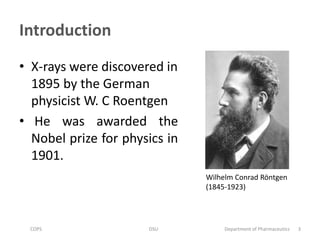
• X-rays were discovered in
1895 by the German
physicist W. C Roentgen
• He was awarded the
Nobel prize for physics in
1901.
COPS DSU Department of Pharmaceutics 3
Wilhelm Conrad Röntgen
(1845-1923)
X-RAY PROPERTIES
• X – ray invisible, highly penetrating ER of much
shorter wavelength (higher frequency) than
visible light.
• The wavelength range for x rays is from about 10-8
m to about 10-11 m, the corresponding frequency
range is from about 3 × 10¹⁶ Hz to about 3 × 10¹⁹
Hz.
COPS DSU Department of Pharmaceutics 4
GENERATION OF X-RAYS
X- rays are generated by following methods :
• By bombarding target element with a beam of
high energy electrons.
• By irradiating metal target with primary beam
of x- rays.
• By using a radioactive source whose decay
causes emission of x rays.
COPS DSU Department of Pharmaceutics 5
Absorption of X-rays
• A larger atom is more likely to absorb an X-ray
photon, because larger atoms have greater energy
differences between orbitals -- the energy level more
closely matches the energy of the photon.
• Smaller atoms, where the electron orbitals are
separated by relatively low jumps in energy, are less
likely to absorb X-ray photons.
• The soft tissue in our body is composed of smaller
atoms, and so does not absorb X-ray photons
particularly well. The calcium atoms that make up
our bones are much larger, so they are better at
absorbing X-ray photons.
COPS DSU Department of Pharmaceutics 6
X-RAY CRYSTALLOGRAPHY
• X-ray crystallography is a technique in crystallography
in which the pattern produced by the diffraction of x-
rays through the closely spaced lattice of atoms in a
crystal is recorded and then analyzed to reveal the
nature of that lattice.
• The wavelength of X-rays is typically 1 A°, comparable
to the interatomic spacing (distance between atoms or
ions) in solids.
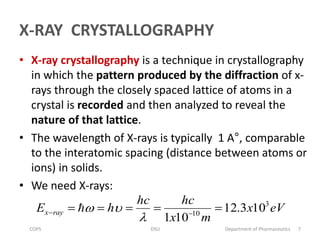
• We need X-rays:
COPS DSU Department of Pharmaceutics 7
eVx
mx
hchc
hE rayx
3
10
103.12
101
 


Crystal Structure Determination
A crystal behaves as a 3-D diffraction grating for x-rays
• The, measurement of the separation of the X-
ray diffraction maxima from a crystal allows us
to determine the size of the unit cell and from
the intensities of diffracted beams one can
obtain information about the arrangement of
atoms within the cell.
COPS DSU Department of Pharmaceutics 8
Bragg’s law
COPS DSU Department of Pharmaceutics 9
•English physicists Sir W.H. Bragg
and his son Sir W.L. Bragg
developed a relationship in 1913.
•To explain why the cleavage faces
of crystals appear to reflect X-ray
beams at certain angles of
incidence (theta,θ).
•This observation is an example of
X-ray wave interference.
9
Sir William Henry Bragg (1862-1942),
William Lawrence Bragg (1890-1971)
• In 1915, the father and son were awarded the Nobel
prize for physics "for their services in the analysis of
crystal structure by means of Xrays".
Bragg’s Law Theory
• When a beam of x- ray is incident upon the crystal, it gets
scattered by the electrons constituiting the crystal atoms.
• If the scattered x rays undergo constructive interference, they
are said to be diffracted by the crystal plane.
• Each crystalline matterial scatters the x- rays in a specific
diffraction pattern and thus produce a fingerprint of its
internal structure.
• The diffracted beams are called reflection. X- rays are
difffracted only if Bragg’s law is satisfied which is given by the
equation.
• Sin θ = n λ /2d
Where n= integer θ=angle of incidence
λ= wavelength d= the interplanar distance of the crystal
COPS DSU Department of Pharmaceutics 10
Bragg’s equation
COPS DSU Department of Pharmaceutics 11
• When an x ray beam strikes a crystal surface at an
angle θ, electrons constituiting the atoms of crystal
surface to oscillate at the same frequency as that of
incident x ray beam and emits fraction of ER.
• Rest of the rays penetrate to the second layer. Again
in second layer some of the rays gets scattered while
rest of them penetrate to the third layer and so on.
• Every crystalline substance scatters the rays in a
unique diffraction pattern thus producing finger
prints which is characteristic to its atomic and
molecular structure.
• The scattered rays may give constructive and
destructive interference.
• Constructive interference are obtained only if the
pathlength or distance between two planes is
equal to a whole number of wavelength.
Basic requirements for the x- ray diffraction are,
• A) path lengths or difference between layers of
atoms should be same as that of wavelength of
radiation.
• B) scattering centers should be spatially
distributed.
COPS DSU Department of Pharmaceutics 12
• Bragg’s law governs the condition for diffraction and the
diffracted beam reffered to as reflection, obeys bragg’s
equation
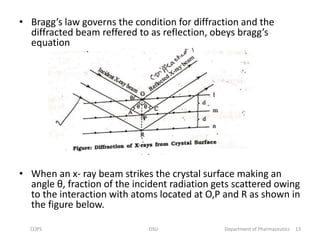
• When an x- ray beam strikes the crystal surface making an
angle θ, fraction of the incident radiation gets scattered owing
to the interaction with atoms located at O,P and R as shown in
the figure below.
COPS DSU Department of Pharmaceutics 13
• As mentioned above,
pathlengths or distance
between the planes l,m,n
is identical and
represented as ‘d’.
• When an x- ray beam
strikes the top crystal
plane at O and the x-ray
strikes the second crystal
plane at P, pathlength
between the parallel x rays
is equal to AP+PC .
COPS DSU Department of Pharmaceutics 14
• But for constructive interference,
AP + PC = n λ --------(1)
When n= integer
λ = wavelength of scattered radiation
COPS DSU Department of Pharmaceutics 15
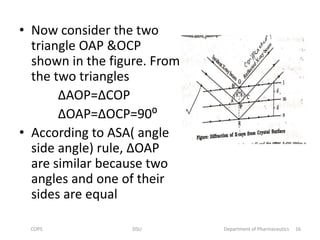
• Now consider the two
triangle OAP &OCP
shown in the figure. From
the two triangles
ΔAOP=ΔCOP
ΔOAP=ΔOCP=90⁰
• According to ASA( angle
side angle) rule, ΔOAP
are similar because two
angles and one of their
sides are equal
COPS DSU Department of Pharmaceutics 16
• Therefore ΔOAP= ΔOCP
• Since side AP=PC substituting AP=PC in eq 1 we
get,
• PC+ PC= n λ
2PC= n λ
PC= n λ /2-------(3)
• Now consider the Δ OPC
In ΔOPC, Sinθ= PC/OP
PC=OP Sinθ
PC= d Sinθ (distance between two
parallel lines l and m is d)
COPS DSU Department of Pharmaceutics 17
Therefore PC=d Sinθ
But from eq 3 PC= n λ /2-----(4)
Therefore by substituting eq 3 in eq 4
n λ /2= dSinθ----Bragg’s equation
By rearranging , we get
Sinθ= n λ /2d (to get constructive interference)
COPS DSU Department of Pharmaceutics 18
COPS DSU
Department of Pharmaceutics
19
Constructive & Destructive Waves
• Constructive interference is the
result of synchronized light
waves that add together to
increase the light intensity.
• Destructive İnterference .
results when two out-of-phase
light waves cancel each other out,
resulting in darkness.
19
COPS DSU Department of Pharmaceutics 20
Reference
• Textbook of pharmacetical analysis vol 2
• Instrumental methods of chemical analsis, Dr.
G. R. Chatwal and Sham Anand
COPS DSU Department of Pharmaceutics 21
COPS DSU Department of Pharmaceutics 22

X- ray crystallography

  • 1.
    Submitted to: Dr. PremaKumari . K. B. Assistant Professor, Department of Pharmaceutics, COPS, DSU Banglore. Presented by: Arpitha B M M Pharm (I SEM), Department of Pharmaceutics, COPS, DSU Banglore . X- RAY CRYSTALLOGRAPHY
  • 2.
    Contents • Introduction • Productionof x- ray • Bragg’s law • Types of crystal • Reference COPS DSU Department of Pharmaceutics 2
  • 3.
    Introduction • X-rays werediscovered in 1895 by the German physicist W. C Roentgen • He was awarded the Nobel prize for physics in 1901. COPS DSU Department of Pharmaceutics 3 Wilhelm Conrad Röntgen (1845-1923)
  • 4.
    X-RAY PROPERTIES • X– ray invisible, highly penetrating ER of much shorter wavelength (higher frequency) than visible light. • The wavelength range for x rays is from about 10-8 m to about 10-11 m, the corresponding frequency range is from about 3 × 10¹⁶ Hz to about 3 × 10¹⁹ Hz. COPS DSU Department of Pharmaceutics 4
  • 5.
    GENERATION OF X-RAYS X-rays are generated by following methods : • By bombarding target element with a beam of high energy electrons. • By irradiating metal target with primary beam of x- rays. • By using a radioactive source whose decay causes emission of x rays. COPS DSU Department of Pharmaceutics 5
  • 6.
    Absorption of X-rays •A larger atom is more likely to absorb an X-ray photon, because larger atoms have greater energy differences between orbitals -- the energy level more closely matches the energy of the photon. • Smaller atoms, where the electron orbitals are separated by relatively low jumps in energy, are less likely to absorb X-ray photons. • The soft tissue in our body is composed of smaller atoms, and so does not absorb X-ray photons particularly well. The calcium atoms that make up our bones are much larger, so they are better at absorbing X-ray photons. COPS DSU Department of Pharmaceutics 6
  • 7.
    X-RAY CRYSTALLOGRAPHY • X-raycrystallography is a technique in crystallography in which the pattern produced by the diffraction of x- rays through the closely spaced lattice of atoms in a crystal is recorded and then analyzed to reveal the nature of that lattice. • The wavelength of X-rays is typically 1 A°, comparable to the interatomic spacing (distance between atoms or ions) in solids. • We need X-rays: COPS DSU Department of Pharmaceutics 7 eVx mx hchc hE rayx 3 10 103.12 101    
  • 8.
    Crystal Structure Determination Acrystal behaves as a 3-D diffraction grating for x-rays • The, measurement of the separation of the X- ray diffraction maxima from a crystal allows us to determine the size of the unit cell and from the intensities of diffracted beams one can obtain information about the arrangement of atoms within the cell. COPS DSU Department of Pharmaceutics 8
  • 9.
    Bragg’s law COPS DSUDepartment of Pharmaceutics 9 •English physicists Sir W.H. Bragg and his son Sir W.L. Bragg developed a relationship in 1913. •To explain why the cleavage faces of crystals appear to reflect X-ray beams at certain angles of incidence (theta,θ). •This observation is an example of X-ray wave interference. 9 Sir William Henry Bragg (1862-1942), William Lawrence Bragg (1890-1971) • In 1915, the father and son were awarded the Nobel prize for physics "for their services in the analysis of crystal structure by means of Xrays".
  • 10.
    Bragg’s Law Theory •When a beam of x- ray is incident upon the crystal, it gets scattered by the electrons constituiting the crystal atoms. • If the scattered x rays undergo constructive interference, they are said to be diffracted by the crystal plane. • Each crystalline matterial scatters the x- rays in a specific diffraction pattern and thus produce a fingerprint of its internal structure. • The diffracted beams are called reflection. X- rays are difffracted only if Bragg’s law is satisfied which is given by the equation. • Sin θ = n λ /2d Where n= integer θ=angle of incidence λ= wavelength d= the interplanar distance of the crystal COPS DSU Department of Pharmaceutics 10
  • 11.
    Bragg’s equation COPS DSUDepartment of Pharmaceutics 11 • When an x ray beam strikes a crystal surface at an angle θ, electrons constituiting the atoms of crystal surface to oscillate at the same frequency as that of incident x ray beam and emits fraction of ER. • Rest of the rays penetrate to the second layer. Again in second layer some of the rays gets scattered while rest of them penetrate to the third layer and so on. • Every crystalline substance scatters the rays in a unique diffraction pattern thus producing finger prints which is characteristic to its atomic and molecular structure.
  • 12.
    • The scatteredrays may give constructive and destructive interference. • Constructive interference are obtained only if the pathlength or distance between two planes is equal to a whole number of wavelength. Basic requirements for the x- ray diffraction are, • A) path lengths or difference between layers of atoms should be same as that of wavelength of radiation. • B) scattering centers should be spatially distributed. COPS DSU Department of Pharmaceutics 12
  • 13.
    • Bragg’s lawgoverns the condition for diffraction and the diffracted beam reffered to as reflection, obeys bragg’s equation • When an x- ray beam strikes the crystal surface making an angle θ, fraction of the incident radiation gets scattered owing to the interaction with atoms located at O,P and R as shown in the figure below. COPS DSU Department of Pharmaceutics 13
  • 14.
    • As mentionedabove, pathlengths or distance between the planes l,m,n is identical and represented as ‘d’. • When an x- ray beam strikes the top crystal plane at O and the x-ray strikes the second crystal plane at P, pathlength between the parallel x rays is equal to AP+PC . COPS DSU Department of Pharmaceutics 14
  • 15.
    • But forconstructive interference, AP + PC = n λ --------(1) When n= integer λ = wavelength of scattered radiation COPS DSU Department of Pharmaceutics 15
  • 16.
    • Now considerthe two triangle OAP &OCP shown in the figure. From the two triangles ΔAOP=ΔCOP ΔOAP=ΔOCP=90⁰ • According to ASA( angle side angle) rule, ΔOAP are similar because two angles and one of their sides are equal COPS DSU Department of Pharmaceutics 16
  • 17.
    • Therefore ΔOAP=ΔOCP • Since side AP=PC substituting AP=PC in eq 1 we get, • PC+ PC= n λ 2PC= n λ PC= n λ /2-------(3) • Now consider the Δ OPC In ΔOPC, Sinθ= PC/OP PC=OP Sinθ PC= d Sinθ (distance between two parallel lines l and m is d) COPS DSU Department of Pharmaceutics 17
  • 18.
    Therefore PC=d Sinθ Butfrom eq 3 PC= n λ /2-----(4) Therefore by substituting eq 3 in eq 4 n λ /2= dSinθ----Bragg’s equation By rearranging , we get Sinθ= n λ /2d (to get constructive interference) COPS DSU Department of Pharmaceutics 18
  • 19.
    COPS DSU Department ofPharmaceutics 19 Constructive & Destructive Waves • Constructive interference is the result of synchronized light waves that add together to increase the light intensity. • Destructive İnterference . results when two out-of-phase light waves cancel each other out, resulting in darkness. 19
  • 20.
    COPS DSU Departmentof Pharmaceutics 20
  • 21.
    Reference • Textbook ofpharmacetical analysis vol 2 • Instrumental methods of chemical analsis, Dr. G. R. Chatwal and Sham Anand COPS DSU Department of Pharmaceutics 21
  • 22.
    COPS DSU Departmentof Pharmaceutics 22