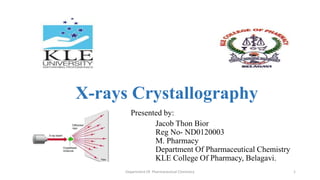
X-rays Crystallography
Presented by:
Jacob Thon Bior
Reg No- ND0120003
M. Pharmacy
Department Of Pharmaceutical Chemistry
KLE College Of Pharmacy, Belagavi.
1
Department Of Pharmaceutical Chemistry
CONTENT:
Introduction to x-ray crystallography
Production of x- rays
Different x-ray methods
Bragg’s law
Rotating crystal technique
X-ray powder technique
Types of Crystals
Application of x-ray diffraction
References
2
Department Of Pharmaceutical Chemistry
Introduction
X ray crystallography is an importance tool to identify the atomic and molecular
structure of crystal.
The crystalline atoms causes a beam of incident x rays to diffract into many
direction.
Crystallography produce three dimensional picture of the density of electron with in
the crystals and from crystal density, the mean position of the atom in crystal can be
determine.
The intensity of each diffracted ray is fed into a computer, which uses a
mathematical equation called a ‘Fourier transform’ to calculate the position of every
atom in the crystallized molecule.
Department Of Pharmaceutical Chemistry 3
Department Of Pharmaceutical Chemistry 4
X-Ray Crystallography is an experimental technique for determining the atomic and
molecular structure of a crystal, in which the crystalline structure causes a beam of
incident X rays to diffract into many specific directions.
The method uses the principle of uniformity of light diffraction of crystals to
determine the structure of a molecule or atom.
X-ray beam to “hit” the crystallized molecule, the electrons surrounding the
molecule diffract as the X-rays hit them. This forms a pattern, this type of pattern is
called the X-ray diffraction pattern
Department Of Pharmaceutical Chemistry 5
X rays
X rays are invisible highly penetrating electromagnetic radiation with short wave
length and high frequency than visible light.
.
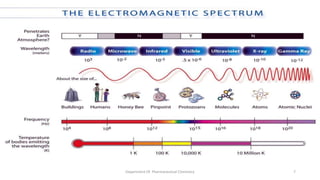
The wavelength range for X rays is from about 10-8 m to about 10-11 m, the
corresponding frequency range is from about 3 × 10¹⁶ Hz to about 3 × 10¹⁹ Hz.
X-ray technology was invented completely by accident. In 1895, a German
physicist “Wilhelm Roentgen” made the discovery while experimenting with
electron beams in a gas discharge tube
He placed various objects between the tube and the screen, and the screen still
glowed. Finally, he put his hand in front of the tube, and saw the outline of his
bones projected onto the fluorescent screen. Immediately after discovering X-rays
themselves
Department Of Pharmaceutical Chemistry 6
Department Of Pharmaceutical Chemistry 7
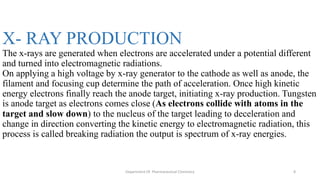
X- RAY PRODUCTION
The x-rays are generated when electrons are accelerated under a potential different
and turned into electromagnetic radiations.
On applying a high voltage by x-ray generator to the cathode as well as anode, the
filament and focusing cup determine the path of acceleration. Once high kinetic
energy electrons finally reach the anode target, initiating x-ray production. Tungsten
is anode target as electrons comes close (As electrons collide with atoms in the
target and slow down) to the nucleus of the target leading to deceleration and
change in direction converting the kinetic energy to electromagnetic radiation, this
process is called breaking radiation the output is spectrum of x-ray energies.
8
Department Of Pharmaceutical Chemistry
X-RAY TUBE
The x-ray are generated from x-ray tube of copper cathode and anode with short
distance between them, enclose in vacuum and high voltage cable attach to cathode
and anode.
A filament is heated in cathode ray tube to produce electrons, accelerating the
electrons toward
the target by applying voltage and
bombarding target with electrons,
if electrons have sufficient energy
to dislodge the inner shell electrons
leading to production of x-rays.
9
Department Of Pharmaceutical Chemistry
DIFFERENT X RAY METHODS
They are classified into 3 types .
X-ray absorption method : In this method ,a beam of x-rays is allowed to pass
and the sample which is having the fraction of x-ray photons absorbed is considered
for a measurement of the concentration of the absorbing substance .These
methods are helpful in elemental analysis .
X-ray diffraction method : These methods are based on the scattering of x-rays by
crystals .This technique is helpful in identification of crystal structure of various
solid compounds.
X-ray fluorescence method : In this methods x-rays are generated in the sample
and by measuring the wave length and intensity of the generated x-rays , helpful
in qualitative and quantitative analysis.
10
Department Of Pharmaceutical Chemistry
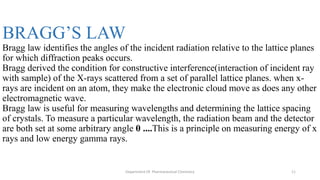
BRAGG’S LAW
Bragg law identifies the angles of the incident radiation relative to the lattice planes
for which diffraction peaks occurs.
Bragg derived the condition for constructive interference(interaction of incident ray
with sample) of the X-rays scattered from a set of parallel lattice planes. when x-
rays are incident on an atom, they make the electronic cloud move as does any other
electromagnetic wave.
Bragg law is useful for measuring wavelengths and determining the lattice spacing
of crystals. To measure a particular wavelength, the radiation beam and the detector
are both set at some arbitrary angle θ ....This is a principle on measuring energy of x
rays and low energy gamma rays.
11
Department Of Pharmaceutical Chemistry
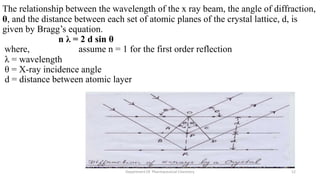
The relationship between the wavelength of the x ray beam, the angle of diffraction,
θ, and the distance between each set of atomic planes of the crystal lattice, d, is
given by Bragg’s equation.
n λ = 2 d sin θ
where, assume n = 1 for the first order reflection
λ = wavelength
θ = X-ray incidence angle
d = distance between atomic layer
Department Of Pharmaceutical Chemistry 12
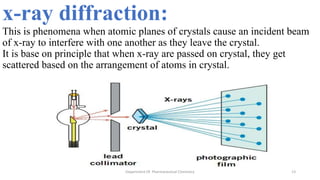
x-ray diffraction:
This is phenomena when atomic planes of crystals cause an incident beam
of x-ray to interfere with one another as they leave the crystal.
It is base on principle that when x-ray are passed on crystal, they get
scattered based on the arrangement of atoms in crystal.
Department Of Pharmaceutical Chemistry 13
Department Of Pharmaceutical Chemistry 14
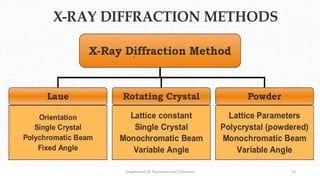
LAUE METHOD
The Laue method is mainly used to determine the orientation of large single crystals
while radiation is reflected from, or transmitted through a fixed crystal.
The Bragg angle is fixed for every set of planes in the crystal. Each set of
planes picks out and diffracts the particular wavelength from the white
radiation that satisfies the Bragg law for the values of d and θ involved.
Department Of Pharmaceutical Chemistry 15
ROTATING CRYSTAL TECHNIQUE
Crystal is rotated about fixed axis, variation in angle θ, the beam is successive
diffracted from a given crystal plane whenever in the course of rotation the value of
θ satisfies the Bragg equation a spot is produce on photographic plate.
16
Department Of Pharmaceutical Chemistry
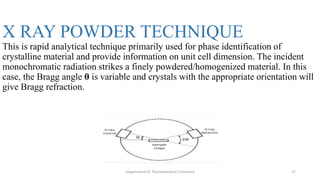
X RAY POWDER TECHNIQUE
This is rapid analytical technique primarily used for phase identification of
crystalline material and provide information on unit cell dimension. The incident
monochromatic radiation strikes a finely powdered/homogenized material. In this
case, the Bragg angle θ is variable and crystals with the appropriate orientation will
give Bragg refraction.
17
Department Of Pharmaceutical Chemistry
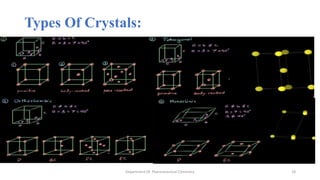
Types Of Crystals:
Department Of Pharmaceutical Chemistry 18
Department Of Pharmaceutical Chemistry 19
APPLICATIONS OF X RAY
DIFFRACTION
1. It is primarily used in fundamental science applications for determining the size
of atoms, the lengths and different types of chemical bonds,
the atomic arrangement of materials, the difference between materials at the atomic
level,
for determining the crystalline integrity, grain orientation, grain size, film thickness
and interface roughness of alloys and minerals.
2. Measurement of sample purity and characterization of organic and inorganic
compounds made for pharmaceutical companies.
.20
Department
Of
Pharmaceutical
Chemistry
3. Determining how a drug might interact with specific proteins and how the drug
can be improved,
analyzing how proteins interact with other proteins, for investigating
microstructures, and
analyzing what amino acids are present in a protein which can help in determining
how catalytically active an enzyme is.
4. Evaluation of physical stability of Amoxicillin trihydrate.
5. X ray Diffraction is used to determination of Cis-Trans isomerism.
Department Of Pharmaceutical Chemistry 21
REFERENCES:
1. Instrumental method of analysis by Willard, Merritt, Dean, Settle,
CBS Publishers and Distributors, 7th Edition, page NO-340-397.
2. Instrumental methods of chemical analysis by Gurdeep R. Chatwal and
Sham K. Anand , Himalaya Publication, 5th revised edition page no. 2.303-
2.339
3. https://ictwiki.iitk.ernt.in/wiki/index.php/unit-2: introduction to x ray
diffraction#ROTATING-CRYSTAL METHOD.
22
Department Of Pharmaceutical Chemistry

X rays crystallography

  • 1.
    X-rays Crystallography Presented by: JacobThon Bior Reg No- ND0120003 M. Pharmacy Department Of Pharmaceutical Chemistry KLE College Of Pharmacy, Belagavi. 1 Department Of Pharmaceutical Chemistry
  • 2.
    CONTENT: Introduction to x-raycrystallography Production of x- rays Different x-ray methods Bragg’s law Rotating crystal technique X-ray powder technique Types of Crystals Application of x-ray diffraction References 2 Department Of Pharmaceutical Chemistry
  • 3.
    Introduction X ray crystallographyis an importance tool to identify the atomic and molecular structure of crystal. The crystalline atoms causes a beam of incident x rays to diffract into many direction. Crystallography produce three dimensional picture of the density of electron with in the crystals and from crystal density, the mean position of the atom in crystal can be determine. The intensity of each diffracted ray is fed into a computer, which uses a mathematical equation called a ‘Fourier transform’ to calculate the position of every atom in the crystallized molecule. Department Of Pharmaceutical Chemistry 3
  • 4.
  • 5.
    X-Ray Crystallography isan experimental technique for determining the atomic and molecular structure of a crystal, in which the crystalline structure causes a beam of incident X rays to diffract into many specific directions. The method uses the principle of uniformity of light diffraction of crystals to determine the structure of a molecule or atom. X-ray beam to “hit” the crystallized molecule, the electrons surrounding the molecule diffract as the X-rays hit them. This forms a pattern, this type of pattern is called the X-ray diffraction pattern Department Of Pharmaceutical Chemistry 5
  • 6.
    X rays X raysare invisible highly penetrating electromagnetic radiation with short wave length and high frequency than visible light. . The wavelength range for X rays is from about 10-8 m to about 10-11 m, the corresponding frequency range is from about 3 × 10¹⁶ Hz to about 3 × 10¹⁹ Hz. X-ray technology was invented completely by accident. In 1895, a German physicist “Wilhelm Roentgen” made the discovery while experimenting with electron beams in a gas discharge tube He placed various objects between the tube and the screen, and the screen still glowed. Finally, he put his hand in front of the tube, and saw the outline of his bones projected onto the fluorescent screen. Immediately after discovering X-rays themselves Department Of Pharmaceutical Chemistry 6
  • 7.
  • 8.
    X- RAY PRODUCTION Thex-rays are generated when electrons are accelerated under a potential different and turned into electromagnetic radiations. On applying a high voltage by x-ray generator to the cathode as well as anode, the filament and focusing cup determine the path of acceleration. Once high kinetic energy electrons finally reach the anode target, initiating x-ray production. Tungsten is anode target as electrons comes close (As electrons collide with atoms in the target and slow down) to the nucleus of the target leading to deceleration and change in direction converting the kinetic energy to electromagnetic radiation, this process is called breaking radiation the output is spectrum of x-ray energies. 8 Department Of Pharmaceutical Chemistry
  • 9.
    X-RAY TUBE The x-rayare generated from x-ray tube of copper cathode and anode with short distance between them, enclose in vacuum and high voltage cable attach to cathode and anode. A filament is heated in cathode ray tube to produce electrons, accelerating the electrons toward the target by applying voltage and bombarding target with electrons, if electrons have sufficient energy to dislodge the inner shell electrons leading to production of x-rays. 9 Department Of Pharmaceutical Chemistry
  • 10.
    DIFFERENT X RAYMETHODS They are classified into 3 types . X-ray absorption method : In this method ,a beam of x-rays is allowed to pass and the sample which is having the fraction of x-ray photons absorbed is considered for a measurement of the concentration of the absorbing substance .These methods are helpful in elemental analysis . X-ray diffraction method : These methods are based on the scattering of x-rays by crystals .This technique is helpful in identification of crystal structure of various solid compounds. X-ray fluorescence method : In this methods x-rays are generated in the sample and by measuring the wave length and intensity of the generated x-rays , helpful in qualitative and quantitative analysis. 10 Department Of Pharmaceutical Chemistry
  • 11.
    BRAGG’S LAW Bragg lawidentifies the angles of the incident radiation relative to the lattice planes for which diffraction peaks occurs. Bragg derived the condition for constructive interference(interaction of incident ray with sample) of the X-rays scattered from a set of parallel lattice planes. when x- rays are incident on an atom, they make the electronic cloud move as does any other electromagnetic wave. Bragg law is useful for measuring wavelengths and determining the lattice spacing of crystals. To measure a particular wavelength, the radiation beam and the detector are both set at some arbitrary angle θ ....This is a principle on measuring energy of x rays and low energy gamma rays. 11 Department Of Pharmaceutical Chemistry
  • 12.
    The relationship betweenthe wavelength of the x ray beam, the angle of diffraction, θ, and the distance between each set of atomic planes of the crystal lattice, d, is given by Bragg’s equation. n λ = 2 d sin θ where, assume n = 1 for the first order reflection λ = wavelength θ = X-ray incidence angle d = distance between atomic layer Department Of Pharmaceutical Chemistry 12
  • 13.
    x-ray diffraction: This isphenomena when atomic planes of crystals cause an incident beam of x-ray to interfere with one another as they leave the crystal. It is base on principle that when x-ray are passed on crystal, they get scattered based on the arrangement of atoms in crystal. Department Of Pharmaceutical Chemistry 13
  • 14.
  • 15.
    LAUE METHOD The Lauemethod is mainly used to determine the orientation of large single crystals while radiation is reflected from, or transmitted through a fixed crystal. The Bragg angle is fixed for every set of planes in the crystal. Each set of planes picks out and diffracts the particular wavelength from the white radiation that satisfies the Bragg law for the values of d and θ involved. Department Of Pharmaceutical Chemistry 15
  • 16.
    ROTATING CRYSTAL TECHNIQUE Crystalis rotated about fixed axis, variation in angle θ, the beam is successive diffracted from a given crystal plane whenever in the course of rotation the value of θ satisfies the Bragg equation a spot is produce on photographic plate. 16 Department Of Pharmaceutical Chemistry
  • 17.
    X RAY POWDERTECHNIQUE This is rapid analytical technique primarily used for phase identification of crystalline material and provide information on unit cell dimension. The incident monochromatic radiation strikes a finely powdered/homogenized material. In this case, the Bragg angle θ is variable and crystals with the appropriate orientation will give Bragg refraction. 17 Department Of Pharmaceutical Chemistry
  • 18.
    Types Of Crystals: DepartmentOf Pharmaceutical Chemistry 18
  • 19.
  • 20.
    APPLICATIONS OF XRAY DIFFRACTION 1. It is primarily used in fundamental science applications for determining the size of atoms, the lengths and different types of chemical bonds, the atomic arrangement of materials, the difference between materials at the atomic level, for determining the crystalline integrity, grain orientation, grain size, film thickness and interface roughness of alloys and minerals. 2. Measurement of sample purity and characterization of organic and inorganic compounds made for pharmaceutical companies. .20 Department Of Pharmaceutical Chemistry
  • 21.
    3. Determining howa drug might interact with specific proteins and how the drug can be improved, analyzing how proteins interact with other proteins, for investigating microstructures, and analyzing what amino acids are present in a protein which can help in determining how catalytically active an enzyme is. 4. Evaluation of physical stability of Amoxicillin trihydrate. 5. X ray Diffraction is used to determination of Cis-Trans isomerism. Department Of Pharmaceutical Chemistry 21
  • 22.
    REFERENCES: 1. Instrumental methodof analysis by Willard, Merritt, Dean, Settle, CBS Publishers and Distributors, 7th Edition, page NO-340-397. 2. Instrumental methods of chemical analysis by Gurdeep R. Chatwal and Sham K. Anand , Himalaya Publication, 5th revised edition page no. 2.303- 2.339 3. https://ictwiki.iitk.ernt.in/wiki/index.php/unit-2: introduction to x ray diffraction#ROTATING-CRYSTAL METHOD. 22 Department Of Pharmaceutical Chemistry