By-
Dr. Prerana B. Jadhav
M. Pharm, Ph.D.
Pharmaceutical Chemistry
Assistant Professor,
Sanjivani College of Pharmaceutical Education and
Research, Kopargaon.
ANTITUBERCULAR
AGENTS
Tuberculosis
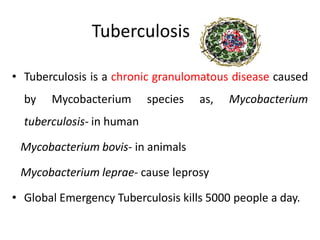
• Tuberculosis is a chronic granulomatous disease caused
by Mycobacterium species as, Mycobacterium
tuberculosis- in human
Mycobacterium bovis- in animals
Mycobacterium leprae- cause leprosy
• Global Emergency Tuberculosis kills 5000 people a day.
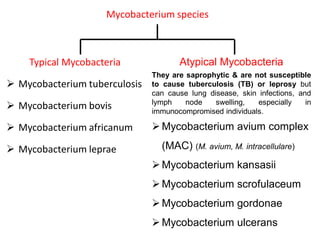
Typical Mycobacteria
 Mycobacterium tuberculosis
 Mycobacterium bovis
 Mycobacterium africanum
 Mycobacterium leprae
Atypical Mycobacteria
They are saprophytic & are not susceptible
to cause tuberculosis (TB) or leprosy but
can cause lung disease, skin infections, and
lymph node swelling, especially in
immunocompromised individuals.
Mycobacterium avium complex
(MAC) (M. avium, M. intracellulare)
Mycobacterium kansasii
Mycobacterium scrofulaceum
Mycobacterium gordonae
Mycobacterium ulcerans
Mycobacterium species
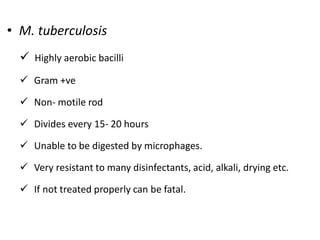
• M. tuberculosis
 Highly aerobic bacilli
 Gram +ve
 Non- motile rod
 Divides every 15- 20 hours
 Unable to be digested by microphages.
 Very resistant to many disinfectants, acid, alkali, drying etc.
 If not treated properly can be fatal.
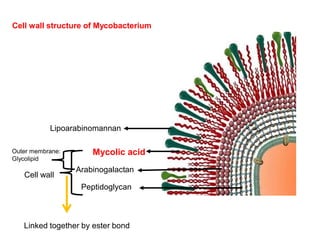
Lipoarabinomannan
Mycolic acid
Arabinogalactan
Peptidoglycan
Outer membrane:
Glycolipid
Cell wall
Linked together by ester bond
Cell wall structure of Mycobacterium
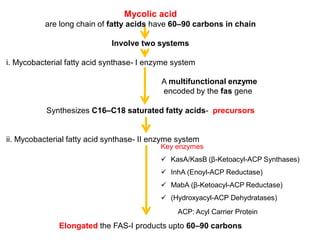
Mycolic acid
are long chain of fatty acids have 60–90 carbons in chain
Involve two systems
i. Mycobacterial fatty acid synthase- I enzyme system
Synthesizes C16–C18 saturated fatty acids- precursors
ii. Mycobacterial fatty acid synthase- II enzyme system
Elongated the FAS-I products upto 60–90 carbons
Key enzymes
 KasA/KasB (β-Ketoacyl-ACP Synthases)
 InhA (Enoyl-ACP Reductase)
 MabA (β-Ketoacyl-ACP Reductase)
 (Hydroxyacyl-ACP Dehydratases)
A multifunctional enzyme
encoded by the fas gene
ACP: Acyl Carrier Protein
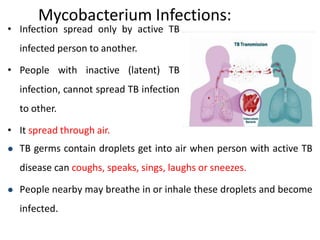
Mycobacterium Infections:
• Infection spread only by active TB
infected person to another.
• People with inactive (latent) TB
infection, cannot spread TB infection
to other.
• It spread through air.
 TB germs contain droplets get into air when person with active TB
disease can coughs, speaks, sings, laughs or sneezes.
 People nearby may breathe in or inhale these droplets and become
infected.
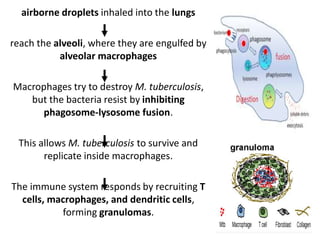
airborne droplets inhaled into the lungs
reach the alveoli, where they are engulfed by
alveolar macrophages
Macrophages try to destroy M. tuberculosis,
but the bacteria resist by inhibiting
phagosome-lysosome fusion.
This allows M. tuberculosis to survive and
replicate inside macrophages.
The immune system responds by recruiting T
cells, macrophages, and dendritic cells,
forming granulomas.
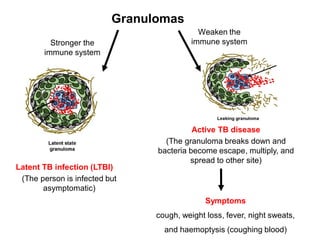
Stronger the
immune system
Latent TB infection (LTBI)
(The person is infected but
asymptomatic)
Granulomas
Weaken the
immune system
Active TB disease
(The granuloma breaks down and
bacteria become escape, multiply, and
spread to other site)
Symptoms
cough, weight loss, fever, night sweats,
and haemoptysis (coughing blood)
Common infection sites
TB germs are most commonly found in the Lungs, but
sometimes they can move to other part of the body
 CNS
 Lymphatic system
 Liver & Spleen
 Bones & joints
 Genitourinary systems
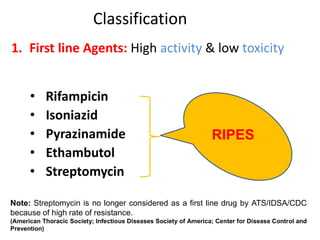
Classification
1. First line Agents: High activity & low toxicity
• Rifampicin
• Isoniazid
• Pyrazinamide
• Ethambutol
• Streptomycin
RIPES
Note: Streptomycin is no longer considered as a first line drug by ATS/IDSA/CDC
because of high rate of resistance.
(American Thoracic Society; Infectious Diseases Society of America; Center for Disease Control and
Prevention)
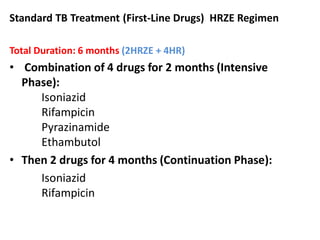
Standard TB Treatment (First-Line Drugs) HRZE Regimen
Total Duration: 6 months (2HRZE + 4HR)
• Combination of 4 drugs for 2 months (Intensive
Phase):
Isoniazid
Rifampicin
Pyrazinamide
Ethambutol
• Then 2 drugs for 4 months (Continuation Phase):
Isoniazid
Rifampicin
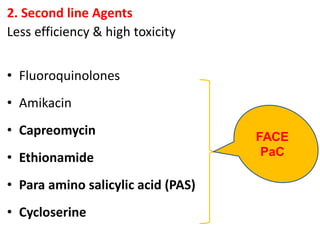
2. Second line Agents
Less efficiency & high toxicity
• Fluoroquinolones
• Amikacin
• Capreomycin
• Ethionamide
• Para amino salicylic acid (PAS)
• Cycloserine
FACE
PaC
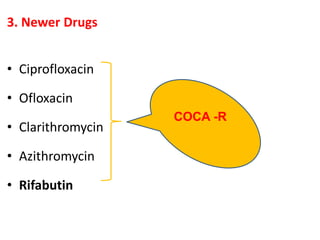
3. Newer Drugs
• Ciprofloxacin
• Ofloxacin
• Clarithromycin
• Azithromycin
• Rifabutin
COCA -R
Classification (Mechanism of
Action)
1. Protein Synthesis inhibitors: (Streptomycin,
Konamycin, Capreomycin, rifampin, rifabutin)
2. Cell wall Synthesis inhibitors: (cycloserine,
ethionamide, isoniazid)
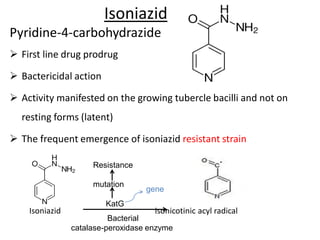
Isoniazid
Pyridine-4-carbohydrazide
 First line drug prodrug
 Bactericidal action
 Activity manifested on the growing tubercle bacilli and not on
resting forms (latent)
 The frequent emergence of isoniazid resistant strain
KatG
Bacterial
catalase-peroxidase enzyme
Isoniazid isonicotinic acyl radical
gene
Resistance
mutation
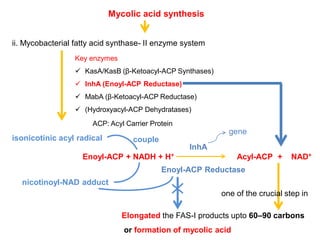
Mycolic acid synthesis
ii. Mycobacterial fatty acid synthase- II enzyme system
Key enzymes
 KasA/KasB (β-Ketoacyl-ACP Synthases)
 InhA (Enoyl-ACP Reductase)
 MabA (β-Ketoacyl-ACP Reductase)
 (Hydroxyacyl-ACP Dehydratases)
ACP: Acyl Carrier Protein
Enoyl-ACP + NADH + H+ Acyl-ACP + NAD+
Enoyl-ACP Reductase
InhA
gene
Elongated the FAS-I products upto 60–90 carbons
or formation of mycolic acid
one of the crucial step in
isonicotinic acyl radical couple
nicotinoyl-NAD adduct
Mechanism of action
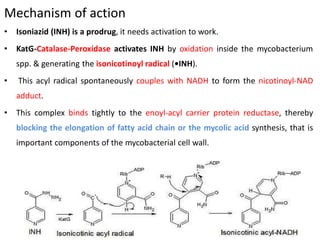
• Isoniazid (INH) is a prodrug, it needs activation to work.
• KatG-Catalase-Peroxidase activates INH by oxidation inside the mycobacterium
spp. & generating the isonicotinoyl radical (•INH).
• This acyl radical spontaneously couples with NADH to form the nicotinoyl-NAD
adduct.
• This complex binds tightly to the enoyl-acyl carrier protein reductase, thereby
blocking the elongation of fatty acid chain or the mycolic acid synthesis, that is
important components of the mycobacterial cell wall.
ADME
• Absorbed: rapidly and completely absorbed in oral
• Distribution: all tissue and fluids in body including CSF.
• Metabolism: inactivation by acetylation of the hydrazine
nitrogen.
• Excretion: through urine within 24 hr.
Adverse effects
 Peripheral neuritis (tis: inflammation)
 Gastrointestinal disturbance: constipation, loss of appetite
 Hepatotoxicity
Drug interaction
• Isoniazid may interact with foods containing
tyramine/histamine (such as cheese, red wine,
certain types of fish).
• This interaction may cause
increased blood pressure
Flushing (sudden redness) of the skin
 headache
dizziness
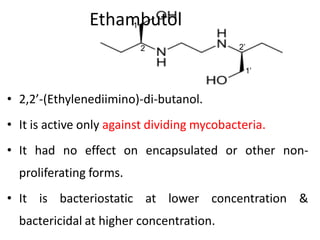
Ethambutol
• 2,2’-(Ethylenediimino)-di-butanol.
• It is active only against dividing mycobacteria.
• It had no effect on encapsulated or other non-
proliferating forms.
• It is bacteriostatic at lower concentration &
bactericidal at higher concentration.
2 2’
1’
1
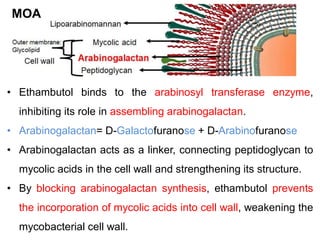
• Ethambutol binds to the arabinosyl transferase enzyme,
inhibiting its role in assembling arabinogalactan.
• Arabinogalactan= D-Galactofuranose + D-Arabinofuranose
• Arabinogalactan acts as a linker, connecting peptidoglycan to
mycolic acids in the cell wall and strengthening its structure.
• By blocking arabinogalactan synthesis, ethambutol prevents
the incorporation of mycolic acids into cell wall, weakening the
mycobacterial cell wall.
MOA
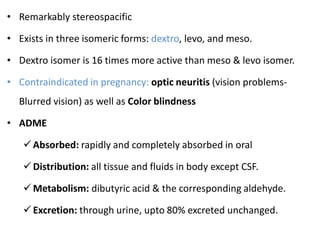
• Remarkably stereospacific
• Exists in three isomeric forms: dextro, levo, and meso.
• Dextro isomer is 16 times more active than meso & levo isomer.
• Contraindicated in pregnancy: optic neuritis (vision problems-
Blurred vision) as well as Color blindness
• ADME
Absorbed: rapidly and completely absorbed in oral
Distribution: all tissue and fluids in body except CSF.
Metabolism: dibutyric acid & the corresponding aldehyde.
Excretion: through urine, upto 80% excreted unchanged.
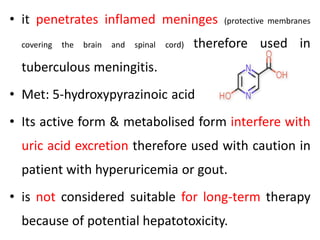
Pyrazinamide (PZA]
• pyrazine-2-carboxamide
• It is active only against dividing mycobacteria.
• It had no effect on encapsulated or other non-
proliferating forms.
• Prodrug
• it penetrates inflamed meninges (protective membranes
covering the brain and spinal cord) therefore used in
tuberculous meningitis.
• Met: 5-hydroxypyrazinoic acid
• Its active form & metabolised form interfere with
uric acid excretion therefore used with caution in
patient with hyperuricemia or gout.
• is not considered suitable for long-term therapy
because of potential hepatotoxicity.
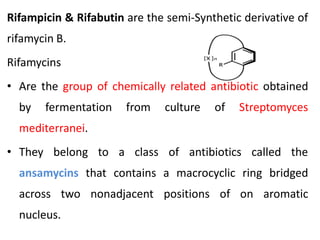
Rifampicin & Rifabutin are the semi-Synthetic derivative of
rifamycin B.
Rifamycins
• Are the group of chemically related antibiotic obtained
by fermentation from culture of Streptomyces
mediterranei.
• They belong to a class of antibiotics called the
ansamycins that contains a macrocyclic ring bridged
across two nonadjacent positions of on aromatic
nucleus.
• Exists in A, B, C, D, and E form.
• All rifamycins are biologically active, but the semi-
synthetic derivatives of Rifamycin B are the most
active.
Rifampicin & Rifabutin: Anti-tuberculosis
activity
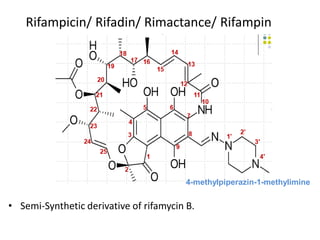
Rifampicin/ Rifadin/ Rimactance/ Rifampin
• Semi-Synthetic derivative of rifamycin B.
4-methylpiperazin-1-methylimine
• MOA: Rifampin inhibit the activity of DNA dependent – RNA
polymerase enzyme by binding with β-subunit of the enzyme,
necessary for RNA Synthesis. This in turn, causes inhibition of bacterial
RNA synthesis.
However mammalian enzymes are not affected by this drug because of
structural and functional differences between the bacterial and
mammalian enzymes.
• Absorption: impaired in the presence of food & 4-amino salicyclic acid.
• Adverse effects: Nausea, vomiting, headache. erythema, nervousness,
hepatotoxicity.
Newer Drug
Rifabutin
• Semi-Synthetic derivative of rifamycin B.
8-isobutyl-1,4,8-triazaspiro[4.5]dec-1-ene
Spiroimidazopiperidyl
derivative
two rings that share a
single atom.
• MOA: as rifampicin
• Active against mycobacterium avium complex (MAC) in AIDS
patients.
• Very lipophilic with high affinity for tissues.
• Absorption: 50% for oral but, Bioavailability 20% because first
pass effect.
• Half-life: 45–50 hr.
• Cause less hepatotoxicity and induction of cyt. P450 enzyme than
rifampicin therefore safer for use in AIDS patients.
Second line Agents
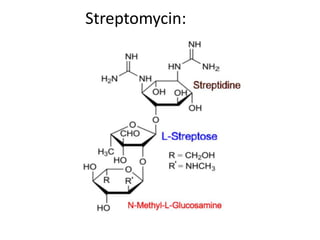
Streptomycin
• Aminoglycosides antibiotic, composed of amino modified
sugars & derived from streptomyces genus.
• They have in vitro bactericidal & in vivo bacteriostatic activity
against Mycobacterium tuberculosis.
• Streptomycin was reported in 1944 as the first clinically
effective anti-tubercular agent.
Streptomycin:
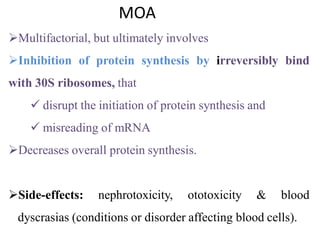
MOA
Multifactorial, but ultimately involves
Inhibition of protein synthesis by irreversibly bind
with 30S ribosomes, that
 disrupt the initiation of protein synthesis and
 misreading of mRNA
Decreases overall protein synthesis.
Side-effects: nephrotoxicity, ototoxicity & blood
dyscrasias (conditions or disorder affecting blood cells).
Capreomycin
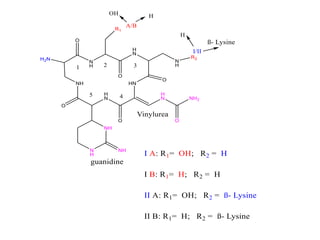
• Polypeptide antibiotic that exists in a cyclic form isolated
from Streptomyces Capreolus.
• Use in combination with other antibiotics for the
treatment of drug resistant tuberculosis.
• It is given by injection into a vein or muscle.
• It is a potentially toxic drug. It damage to the eighth
cranial nerve & renal damage.
• The crude Capreomycin is a mixture of four cyclic
polypeptides, IA, IB, IIA & IIB.
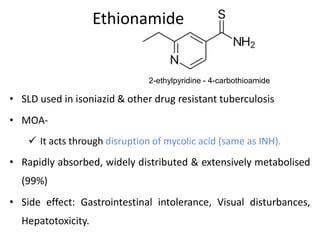
Ethionamide
• SLD used in isoniazid & other drug resistant tuberculosis
• MOA-
 It acts through disruption of mycolic acid (same as INH).
• Rapidly absorbed, widely distributed & extensively metabolised
(99%)
• Side effect: Gastrointestinal intolerance, Visual disturbances,
Hepatotoxicity.
2-ethylpyridine - 4-carbothioamide
P-Amino Salicylic Acid (PAS)
• MOA: It's structural similarity with PABA. Therefore it prevent the
incorporation of PABA into dihydrofolic acid molecule, catalysed by
the enzyme dihydrofolate synthatase, leads to block the synthesis
of folic acid.
• SAR: I] Amino & carboxylic gp. are must be para to each other &
free. II] –OH gp may at ortho or meta, but at ortho position shows
more efficiency.
• Adverse effects: Nausea, diarrhoea, loss of appetite,
agranulocytosis, haemolytic anaemia, and allergic reactions.
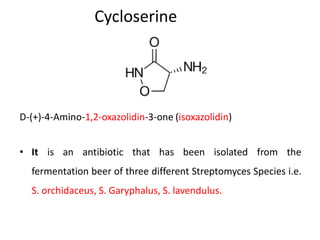
Cycloserine
D-(+)-4-Amino-1,2-oxazolidin-3-one (isoxazolidin)
• It is an antibiotic that has been isolated from the
fermentation beer of three different Streptomyces Species i.e.
S. orchidaceus, S. Garyphalus, S. lavendulus.
MOA
• It prevents the synthesis of cross linking peptide in the formation of
bacterial cell wall by inhibiting the activity of pyridoxal Phosphate-
requiring enzyme alanine racemase.
• It act as a suicide substrate for the pyridoxal Phosphate-requiring
enzyme alanine racemase, that converts L-alanine to D-alanine.
• Irreversible inactivation of the enzyme thereby deprives the cell, of the
D-alanine required for the synthesis of the cross- linking peptides.
• Side Effects: Visual disturbances, nervousness, irritability, depression.

Antitubercular agents medicinal chemistry.pdf

  • 1.
    By- Dr. Prerana B.Jadhav M. Pharm, Ph.D. Pharmaceutical Chemistry Assistant Professor, Sanjivani College of Pharmaceutical Education and Research, Kopargaon. ANTITUBERCULAR AGENTS
  • 2.
    Tuberculosis • Tuberculosis isa chronic granulomatous disease caused by Mycobacterium species as, Mycobacterium tuberculosis- in human Mycobacterium bovis- in animals Mycobacterium leprae- cause leprosy • Global Emergency Tuberculosis kills 5000 people a day.
  • 3.
    Typical Mycobacteria  Mycobacteriumtuberculosis  Mycobacterium bovis  Mycobacterium africanum  Mycobacterium leprae Atypical Mycobacteria They are saprophytic & are not susceptible to cause tuberculosis (TB) or leprosy but can cause lung disease, skin infections, and lymph node swelling, especially in immunocompromised individuals. Mycobacterium avium complex (MAC) (M. avium, M. intracellulare) Mycobacterium kansasii Mycobacterium scrofulaceum Mycobacterium gordonae Mycobacterium ulcerans Mycobacterium species
  • 4.
    • M. tuberculosis Highly aerobic bacilli  Gram +ve  Non- motile rod  Divides every 15- 20 hours  Unable to be digested by microphages.  Very resistant to many disinfectants, acid, alkali, drying etc.  If not treated properly can be fatal.
  • 5.
    Lipoarabinomannan Mycolic acid Arabinogalactan Peptidoglycan Outer membrane: Glycolipid Cellwall Linked together by ester bond Cell wall structure of Mycobacterium
  • 6.
    Mycolic acid are longchain of fatty acids have 60–90 carbons in chain Involve two systems i. Mycobacterial fatty acid synthase- I enzyme system Synthesizes C16–C18 saturated fatty acids- precursors ii. Mycobacterial fatty acid synthase- II enzyme system Elongated the FAS-I products upto 60–90 carbons Key enzymes  KasA/KasB (β-Ketoacyl-ACP Synthases)  InhA (Enoyl-ACP Reductase)  MabA (β-Ketoacyl-ACP Reductase)  (Hydroxyacyl-ACP Dehydratases) A multifunctional enzyme encoded by the fas gene ACP: Acyl Carrier Protein
  • 7.
    Mycobacterium Infections: • Infectionspread only by active TB infected person to another. • People with inactive (latent) TB infection, cannot spread TB infection to other. • It spread through air.  TB germs contain droplets get into air when person with active TB disease can coughs, speaks, sings, laughs or sneezes.  People nearby may breathe in or inhale these droplets and become infected.
  • 8.
    airborne droplets inhaledinto the lungs reach the alveoli, where they are engulfed by alveolar macrophages Macrophages try to destroy M. tuberculosis, but the bacteria resist by inhibiting phagosome-lysosome fusion. This allows M. tuberculosis to survive and replicate inside macrophages. The immune system responds by recruiting T cells, macrophages, and dendritic cells, forming granulomas.
  • 9.
    Stronger the immune system LatentTB infection (LTBI) (The person is infected but asymptomatic) Granulomas Weaken the immune system Active TB disease (The granuloma breaks down and bacteria become escape, multiply, and spread to other site) Symptoms cough, weight loss, fever, night sweats, and haemoptysis (coughing blood)
  • 10.
    Common infection sites TBgerms are most commonly found in the Lungs, but sometimes they can move to other part of the body  CNS  Lymphatic system  Liver & Spleen  Bones & joints  Genitourinary systems
  • 11.
    Classification 1. First lineAgents: High activity & low toxicity • Rifampicin • Isoniazid • Pyrazinamide • Ethambutol • Streptomycin RIPES Note: Streptomycin is no longer considered as a first line drug by ATS/IDSA/CDC because of high rate of resistance. (American Thoracic Society; Infectious Diseases Society of America; Center for Disease Control and Prevention)
  • 12.
    Standard TB Treatment(First-Line Drugs) HRZE Regimen Total Duration: 6 months (2HRZE + 4HR) • Combination of 4 drugs for 2 months (Intensive Phase): Isoniazid Rifampicin Pyrazinamide Ethambutol • Then 2 drugs for 4 months (Continuation Phase): Isoniazid Rifampicin
  • 13.
    2. Second lineAgents Less efficiency & high toxicity • Fluoroquinolones • Amikacin • Capreomycin • Ethionamide • Para amino salicylic acid (PAS) • Cycloserine FACE PaC
  • 14.
    3. Newer Drugs •Ciprofloxacin • Ofloxacin • Clarithromycin • Azithromycin • Rifabutin COCA -R
  • 15.
    Classification (Mechanism of Action) 1.Protein Synthesis inhibitors: (Streptomycin, Konamycin, Capreomycin, rifampin, rifabutin) 2. Cell wall Synthesis inhibitors: (cycloserine, ethionamide, isoniazid)
  • 16.
    Isoniazid Pyridine-4-carbohydrazide  First linedrug prodrug  Bactericidal action  Activity manifested on the growing tubercle bacilli and not on resting forms (latent)  The frequent emergence of isoniazid resistant strain KatG Bacterial catalase-peroxidase enzyme Isoniazid isonicotinic acyl radical gene Resistance mutation
  • 17.
    Mycolic acid synthesis ii.Mycobacterial fatty acid synthase- II enzyme system Key enzymes  KasA/KasB (β-Ketoacyl-ACP Synthases)  InhA (Enoyl-ACP Reductase)  MabA (β-Ketoacyl-ACP Reductase)  (Hydroxyacyl-ACP Dehydratases) ACP: Acyl Carrier Protein Enoyl-ACP + NADH + H+ Acyl-ACP + NAD+ Enoyl-ACP Reductase InhA gene Elongated the FAS-I products upto 60–90 carbons or formation of mycolic acid one of the crucial step in isonicotinic acyl radical couple nicotinoyl-NAD adduct
  • 18.
    Mechanism of action •Isoniazid (INH) is a prodrug, it needs activation to work. • KatG-Catalase-Peroxidase activates INH by oxidation inside the mycobacterium spp. & generating the isonicotinoyl radical (•INH). • This acyl radical spontaneously couples with NADH to form the nicotinoyl-NAD adduct. • This complex binds tightly to the enoyl-acyl carrier protein reductase, thereby blocking the elongation of fatty acid chain or the mycolic acid synthesis, that is important components of the mycobacterial cell wall.
  • 19.
    ADME • Absorbed: rapidlyand completely absorbed in oral • Distribution: all tissue and fluids in body including CSF. • Metabolism: inactivation by acetylation of the hydrazine nitrogen. • Excretion: through urine within 24 hr. Adverse effects  Peripheral neuritis (tis: inflammation)  Gastrointestinal disturbance: constipation, loss of appetite  Hepatotoxicity
  • 20.
    Drug interaction • Isoniazidmay interact with foods containing tyramine/histamine (such as cheese, red wine, certain types of fish). • This interaction may cause increased blood pressure Flushing (sudden redness) of the skin  headache dizziness
  • 21.
    Ethambutol • 2,2’-(Ethylenediimino)-di-butanol. • Itis active only against dividing mycobacteria. • It had no effect on encapsulated or other non- proliferating forms. • It is bacteriostatic at lower concentration & bactericidal at higher concentration. 2 2’ 1’ 1
  • 22.
    • Ethambutol bindsto the arabinosyl transferase enzyme, inhibiting its role in assembling arabinogalactan. • Arabinogalactan= D-Galactofuranose + D-Arabinofuranose • Arabinogalactan acts as a linker, connecting peptidoglycan to mycolic acids in the cell wall and strengthening its structure. • By blocking arabinogalactan synthesis, ethambutol prevents the incorporation of mycolic acids into cell wall, weakening the mycobacterial cell wall. MOA
  • 23.
    • Remarkably stereospacific •Exists in three isomeric forms: dextro, levo, and meso. • Dextro isomer is 16 times more active than meso & levo isomer. • Contraindicated in pregnancy: optic neuritis (vision problems- Blurred vision) as well as Color blindness • ADME Absorbed: rapidly and completely absorbed in oral Distribution: all tissue and fluids in body except CSF. Metabolism: dibutyric acid & the corresponding aldehyde. Excretion: through urine, upto 80% excreted unchanged.
  • 24.
    Pyrazinamide (PZA] • pyrazine-2-carboxamide •It is active only against dividing mycobacteria. • It had no effect on encapsulated or other non- proliferating forms. • Prodrug
  • 25.
    • it penetratesinflamed meninges (protective membranes covering the brain and spinal cord) therefore used in tuberculous meningitis. • Met: 5-hydroxypyrazinoic acid • Its active form & metabolised form interfere with uric acid excretion therefore used with caution in patient with hyperuricemia or gout. • is not considered suitable for long-term therapy because of potential hepatotoxicity.
  • 26.
    Rifampicin & Rifabutinare the semi-Synthetic derivative of rifamycin B. Rifamycins • Are the group of chemically related antibiotic obtained by fermentation from culture of Streptomyces mediterranei. • They belong to a class of antibiotics called the ansamycins that contains a macrocyclic ring bridged across two nonadjacent positions of on aromatic nucleus.
  • 27.
    • Exists inA, B, C, D, and E form. • All rifamycins are biologically active, but the semi- synthetic derivatives of Rifamycin B are the most active. Rifampicin & Rifabutin: Anti-tuberculosis activity
  • 28.
    Rifampicin/ Rifadin/ Rimactance/Rifampin • Semi-Synthetic derivative of rifamycin B. 4-methylpiperazin-1-methylimine
  • 29.
    • MOA: Rifampininhibit the activity of DNA dependent – RNA polymerase enzyme by binding with β-subunit of the enzyme, necessary for RNA Synthesis. This in turn, causes inhibition of bacterial RNA synthesis. However mammalian enzymes are not affected by this drug because of structural and functional differences between the bacterial and mammalian enzymes. • Absorption: impaired in the presence of food & 4-amino salicyclic acid. • Adverse effects: Nausea, vomiting, headache. erythema, nervousness, hepatotoxicity.
  • 30.
    Newer Drug Rifabutin • Semi-Syntheticderivative of rifamycin B. 8-isobutyl-1,4,8-triazaspiro[4.5]dec-1-ene Spiroimidazopiperidyl derivative two rings that share a single atom.
  • 31.
    • MOA: asrifampicin • Active against mycobacterium avium complex (MAC) in AIDS patients. • Very lipophilic with high affinity for tissues. • Absorption: 50% for oral but, Bioavailability 20% because first pass effect. • Half-life: 45–50 hr. • Cause less hepatotoxicity and induction of cyt. P450 enzyme than rifampicin therefore safer for use in AIDS patients.
  • 32.
    Second line Agents Streptomycin •Aminoglycosides antibiotic, composed of amino modified sugars & derived from streptomyces genus. • They have in vitro bactericidal & in vivo bacteriostatic activity against Mycobacterium tuberculosis. • Streptomycin was reported in 1944 as the first clinically effective anti-tubercular agent.
  • 33.
  • 34.
    MOA Multifactorial, but ultimatelyinvolves Inhibition of protein synthesis by irreversibly bind with 30S ribosomes, that  disrupt the initiation of protein synthesis and  misreading of mRNA Decreases overall protein synthesis. Side-effects: nephrotoxicity, ototoxicity & blood dyscrasias (conditions or disorder affecting blood cells).
  • 35.
    Capreomycin • Polypeptide antibioticthat exists in a cyclic form isolated from Streptomyces Capreolus. • Use in combination with other antibiotics for the treatment of drug resistant tuberculosis. • It is given by injection into a vein or muscle. • It is a potentially toxic drug. It damage to the eighth cranial nerve & renal damage. • The crude Capreomycin is a mixture of four cyclic polypeptides, IA, IB, IIA & IIB.
  • 37.
    Ethionamide • SLD usedin isoniazid & other drug resistant tuberculosis • MOA-  It acts through disruption of mycolic acid (same as INH). • Rapidly absorbed, widely distributed & extensively metabolised (99%) • Side effect: Gastrointestinal intolerance, Visual disturbances, Hepatotoxicity. 2-ethylpyridine - 4-carbothioamide
  • 38.
    P-Amino Salicylic Acid(PAS) • MOA: It's structural similarity with PABA. Therefore it prevent the incorporation of PABA into dihydrofolic acid molecule, catalysed by the enzyme dihydrofolate synthatase, leads to block the synthesis of folic acid. • SAR: I] Amino & carboxylic gp. are must be para to each other & free. II] –OH gp may at ortho or meta, but at ortho position shows more efficiency. • Adverse effects: Nausea, diarrhoea, loss of appetite, agranulocytosis, haemolytic anaemia, and allergic reactions.
  • 39.
    Cycloserine D-(+)-4-Amino-1,2-oxazolidin-3-one (isoxazolidin) • Itis an antibiotic that has been isolated from the fermentation beer of three different Streptomyces Species i.e. S. orchidaceus, S. Garyphalus, S. lavendulus.
  • 40.
    MOA • It preventsthe synthesis of cross linking peptide in the formation of bacterial cell wall by inhibiting the activity of pyridoxal Phosphate- requiring enzyme alanine racemase. • It act as a suicide substrate for the pyridoxal Phosphate-requiring enzyme alanine racemase, that converts L-alanine to D-alanine. • Irreversible inactivation of the enzyme thereby deprives the cell, of the D-alanine required for the synthesis of the cross- linking peptides. • Side Effects: Visual disturbances, nervousness, irritability, depression.