WELCOME
FOURIER-TRANSFORM
NUCLEAR MAGNETIC RESONANCE (FT-NMR)

RAHUL B S
M PHARM PART 1
PHARMCEUTICAL CHEMISTRY
CONTENTS
Introduction
Fourier transformation
Components of FT NMR
Advantages
Reference
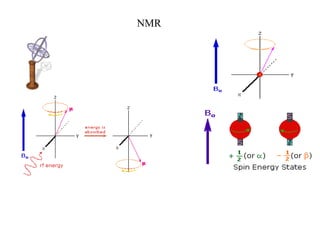
NMR
FOURIER-TRANSFORM
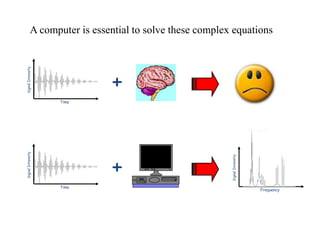
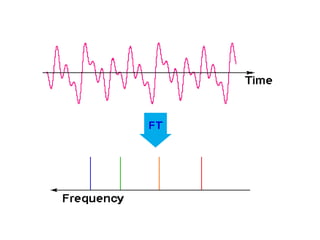
It is the mathematical operation in which the complex
waveform can be broken-down into simple mathematical
operations.

It is the mathematical operation required to convert a time
domain spectrum to frequency domain spectrum (or vice versa).

Following an adequate S/N ratio, digital data must be
transformed into the frequency data.
A computer is essential to solve these complex equations

Signal Intensity

+

Signal Intensity

+
Time

Signal Intensity

Time

Frequency
CONTINUOUS WAVE NMR (CW-NMR

In continuous wave NMR (CW-NMR), the sample is continuously
irradiated with a frequency while the magnetic field is varied and the
spectrum is a recording of which magnetic fields caused the sample to
absorb RF (happens when the Larmor frequency)
DEMERITS OF CW NMR

 Conventional NMR is not sensitive.
 Development of good spectra in microgram quantities is
difficult

Time consuming takes- 100-1000 times longer to record a
scan relative to FT-NMR
 Some times it is impossible
FT-NMR
FTNMR or pulse NMR, the sample is irradiated periodically
with brief, highly intense pulses of radio- frequency radiation,
following which the free induction decay signal - a characteristic
radio- frequency emission signal stimulated by the irradiation – is
recorded as a function of time.

The frequency- domain spectrum can be obtained by a
Fourier transform employing a digital computer
The spectral range is not scanned
continuously

Stimulate all transitions simultaneously

Each of N increments is exposed to a field
for a very short time(10μsec
Sample irradiated by a pulse of RF radiation containing all
the frequencies over the 1H range (fixed field).

Relaxation by emitting radiation: signal- Free Induction
Decay (FID)

FID signals contains the vector-sum of the responses from
all the spins
A time domain spectrum is obtained

Fourier transformed into a frequency domain
spectrum
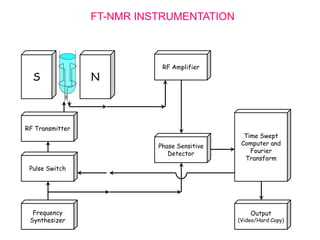
FT-NMR INSTRUMENTATION

S

N

RF Amplifier

RF Transmitter
Phase Sensitive
Detector

Time Swept
Computer and
Fourier
Transform

Pulse Switch

Frequency
Synthesizer

Output

(Video/Hard Copy)
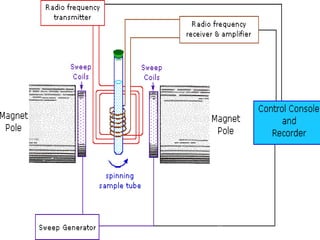
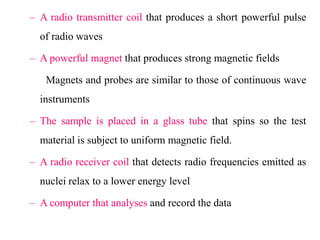
– A radio transmitter coil that produces a short powerful pulse
of radio waves
– A powerful magnet that produces strong magnetic fields
Magnets and probes are similar to those of continuous wave
instruments
– The sample is placed in a glass tube that spins so the test
material is subject to uniform magnetic field.
– A radio receiver coil that detects radio frequencies emitted as

nuclei relax to a lower energy level
– A computer that analyses and record the data
1.

SAMPLE STIMULATION

i.

Power of the RF pulse
The intensity of the signal detected in pulsed NMR is a function
of the power of RF pulse used for excitation
Suitable RF power and pulse width cause magnetization to rotate
by 90⁰ pulse.

Relaxation process occurs
The magnitude of the magnetization decreases with time.

The resulting signal is known as Free Induction Decay(FID)
ii) Pulse duration and recycling time
All precessional frequencies within the effective band width of
the pulse are excited.
The extent is inversely proportional to the duration of pulse in
the time domain.
The broader the pulse spectral region, the shorter is the pulse

2)DETECTOR
Detects the decay of magnetization with respect to time.
The FID corresponding to absorption of a single frequency
spectrum is a simple exponentially decaying sine wave.
The FID, modulated by all the frequencies, consists of a set of
interfering wave forms along with noise.
FID related with time is called time domain spectrum.
Other factors



Homogeneity of the sample



Stability of the magnetic field



Presence of paramagnetic substances in the sample



Chemical exchange of nuclei
3) DIGITIZATION
Digitized by employing an analogue to digital converter

(ADC)
It is collected as an array of integers in a computer
The interval between points at which the FID is sampled

as Δt.
It shows the max. frequency that can be measured in the
FID.
Spectral width (Sw) =1/2 x Δt
4) Signal to Noise ratio (S/N)

 Measures the efficiency of an instrument to distinguish between the
signals and electronic noise

S/N = mean / standard deviation
 It is a function of variables such as instrumental and nature of the
sample.
S/N ratio depends on

The strength of the applied magnetic field
S/N α [ H0 ]3/2

The more intense the magnetic field, the better will be S/N
S/N = average signal amplitude/ root mean square (RMS) noise
RMS noise = average peak to peak noise 2.5

5Signal

to noise ratio (S/N) enhancement

For PMR spectra, S/N enhancement is required in case of
micro amounts sample. In NMR of other nuclei, enhancement is
commonly employed since the sensitivity of NMR experiments
may drastically reduced.
1. Appropriate instrument design
2. Signal averaging to isolate the signal from noise.
3. By FT using filtering techniques.
ADVANTAGES

Advantages of FT instruments
Jaquinot advantage (few optical elements)
Resolving power (reproducibility)

Data obtain in one sec
ADVANTAGES OF FT NMR

Dramatic increase in the sensitivity of NMR measurements
Has widespread applications esp. for 13C NMR, 31P NMR and 19F
NMR giving high signal to noise ratio facilitating rapid scanning

Can be obtained with less than 5 mg of the compound
The signals stand out clearly with almost no electronic
background noise

Used in engineering, industrial quality control and medicine
MRI is most prominent FT NMR applications
REFERENCES:
1.

Instrumental methods of Chemical Analysis by H. Kaur, 4th
Edition, page no: 421-446

2.

Instrumental Analysis by skoog.

3.

Instrumental analysis by willard
FT NMR

FT NMR

  • 1.
  • 2.
    FOURIER-TRANSFORM NUCLEAR MAGNETIC RESONANCE(FT-NMR) RAHUL B S M PHARM PART 1 PHARMCEUTICAL CHEMISTRY
  • 3.
  • 4.
  • 5.
    FOURIER-TRANSFORM It is themathematical operation in which the complex waveform can be broken-down into simple mathematical operations. It is the mathematical operation required to convert a time domain spectrum to frequency domain spectrum (or vice versa). Following an adequate S/N ratio, digital data must be transformed into the frequency data.
  • 6.
    A computer isessential to solve these complex equations Signal Intensity + Signal Intensity + Time Signal Intensity Time Frequency
  • 7.
    CONTINUOUS WAVE NMR(CW-NMR In continuous wave NMR (CW-NMR), the sample is continuously irradiated with a frequency while the magnetic field is varied and the spectrum is a recording of which magnetic fields caused the sample to absorb RF (happens when the Larmor frequency)
  • 8.
    DEMERITS OF CWNMR  Conventional NMR is not sensitive.  Development of good spectra in microgram quantities is difficult Time consuming takes- 100-1000 times longer to record a scan relative to FT-NMR  Some times it is impossible
  • 9.
    FT-NMR FTNMR or pulseNMR, the sample is irradiated periodically with brief, highly intense pulses of radio- frequency radiation, following which the free induction decay signal - a characteristic radio- frequency emission signal stimulated by the irradiation – is recorded as a function of time. The frequency- domain spectrum can be obtained by a Fourier transform employing a digital computer
  • 10.
    The spectral rangeis not scanned continuously Stimulate all transitions simultaneously Each of N increments is exposed to a field for a very short time(10μsec
  • 11.
    Sample irradiated bya pulse of RF radiation containing all the frequencies over the 1H range (fixed field). Relaxation by emitting radiation: signal- Free Induction Decay (FID) FID signals contains the vector-sum of the responses from all the spins
  • 12.
    A time domainspectrum is obtained Fourier transformed into a frequency domain spectrum
  • 15.
    FT-NMR INSTRUMENTATION S N RF Amplifier RFTransmitter Phase Sensitive Detector Time Swept Computer and Fourier Transform Pulse Switch Frequency Synthesizer Output (Video/Hard Copy)
  • 16.
    – A radiotransmitter coil that produces a short powerful pulse of radio waves – A powerful magnet that produces strong magnetic fields Magnets and probes are similar to those of continuous wave instruments – The sample is placed in a glass tube that spins so the test material is subject to uniform magnetic field. – A radio receiver coil that detects radio frequencies emitted as nuclei relax to a lower energy level – A computer that analyses and record the data
  • 17.
    1. SAMPLE STIMULATION i. Power ofthe RF pulse The intensity of the signal detected in pulsed NMR is a function of the power of RF pulse used for excitation Suitable RF power and pulse width cause magnetization to rotate by 90⁰ pulse. Relaxation process occurs The magnitude of the magnetization decreases with time. The resulting signal is known as Free Induction Decay(FID)
  • 18.
    ii) Pulse durationand recycling time All precessional frequencies within the effective band width of the pulse are excited. The extent is inversely proportional to the duration of pulse in the time domain. The broader the pulse spectral region, the shorter is the pulse 2)DETECTOR Detects the decay of magnetization with respect to time. The FID corresponding to absorption of a single frequency spectrum is a simple exponentially decaying sine wave. The FID, modulated by all the frequencies, consists of a set of interfering wave forms along with noise. FID related with time is called time domain spectrum.
  • 19.
    Other factors  Homogeneity ofthe sample  Stability of the magnetic field  Presence of paramagnetic substances in the sample  Chemical exchange of nuclei
  • 20.
    3) DIGITIZATION Digitized byemploying an analogue to digital converter (ADC) It is collected as an array of integers in a computer The interval between points at which the FID is sampled as Δt. It shows the max. frequency that can be measured in the FID. Spectral width (Sw) =1/2 x Δt
  • 21.
    4) Signal toNoise ratio (S/N)  Measures the efficiency of an instrument to distinguish between the signals and electronic noise S/N = mean / standard deviation  It is a function of variables such as instrumental and nature of the sample. S/N ratio depends on The strength of the applied magnetic field S/N α [ H0 ]3/2 The more intense the magnetic field, the better will be S/N
  • 22.
    S/N = averagesignal amplitude/ root mean square (RMS) noise RMS noise = average peak to peak noise 2.5 5Signal to noise ratio (S/N) enhancement For PMR spectra, S/N enhancement is required in case of micro amounts sample. In NMR of other nuclei, enhancement is commonly employed since the sensitivity of NMR experiments may drastically reduced. 1. Appropriate instrument design 2. Signal averaging to isolate the signal from noise. 3. By FT using filtering techniques.
  • 23.
    ADVANTAGES Advantages of FTinstruments Jaquinot advantage (few optical elements) Resolving power (reproducibility) Data obtain in one sec
  • 24.
    ADVANTAGES OF FTNMR Dramatic increase in the sensitivity of NMR measurements Has widespread applications esp. for 13C NMR, 31P NMR and 19F NMR giving high signal to noise ratio facilitating rapid scanning Can be obtained with less than 5 mg of the compound The signals stand out clearly with almost no electronic background noise Used in engineering, industrial quality control and medicine MRI is most prominent FT NMR applications
  • 25.
    REFERENCES: 1. Instrumental methods ofChemical Analysis by H. Kaur, 4th Edition, page no: 421-446 2. Instrumental Analysis by skoog. 3. Instrumental analysis by willard