X-RAY DIFFRACTION
By-
Manish Sahu
M.Sc. Chemistry (Final)
Sp.- Physical Chemistry
CONTENTS
• Introduction
• History
• Bragg’s law
• X-Ray Diffraction
• Basis of crystallography
• Seven crystal system
• Method of X-Ray diffraction
• Basis features of typical x-ray
• Application
• Uses
• Error
• Conclusion
• References
Introduction:-
• It is a non-destructive analytical techniques used to
study the structure, composition and physical properties
of materials.
• Bragg’s law is used to explain the interference pattern of
X-rays.
• It is commonly known as X-ray diffraction or X-ray wave
interference.
History:-
• In 1895 discovery of X-ray production by Willem
Roentgen.
• In 1914 discovery of X-ray diffraction pattern by
knipping and Von Laue.
• In 1915 theory of X-ray diffraction pattern by
Bragg.
Bragg’s law
λ = 2dsinθ
……………
 Crystalline material consist of parallel rows of atoms
separated by unique distances.
 Diffraction occurs when a beam enter a crystalline
substance and is scattered.
 Direction and intensity of diffraction depends on
orientation of the crystal lattice with radiation.
DERIVATION
Since we know that
λ = AB + BC --------(1)
But, AB = BC
λ = 2AB --------(2)
But, AB = dsinθ --------(3)
From equation (2) we get,
λ = 2 ( dsinθ )
λ = 2dsinθ (by equation (3))
λ = 2dsinθ
This equation is known as Bragg’s equation.
X-RAY DIFFRACTION:-
 Non distractive analytical technique for identification
and quantitative determination of various crystalline
from known as phases.
 Identification is achieved by comparing the X-ray
diffraction pattern.
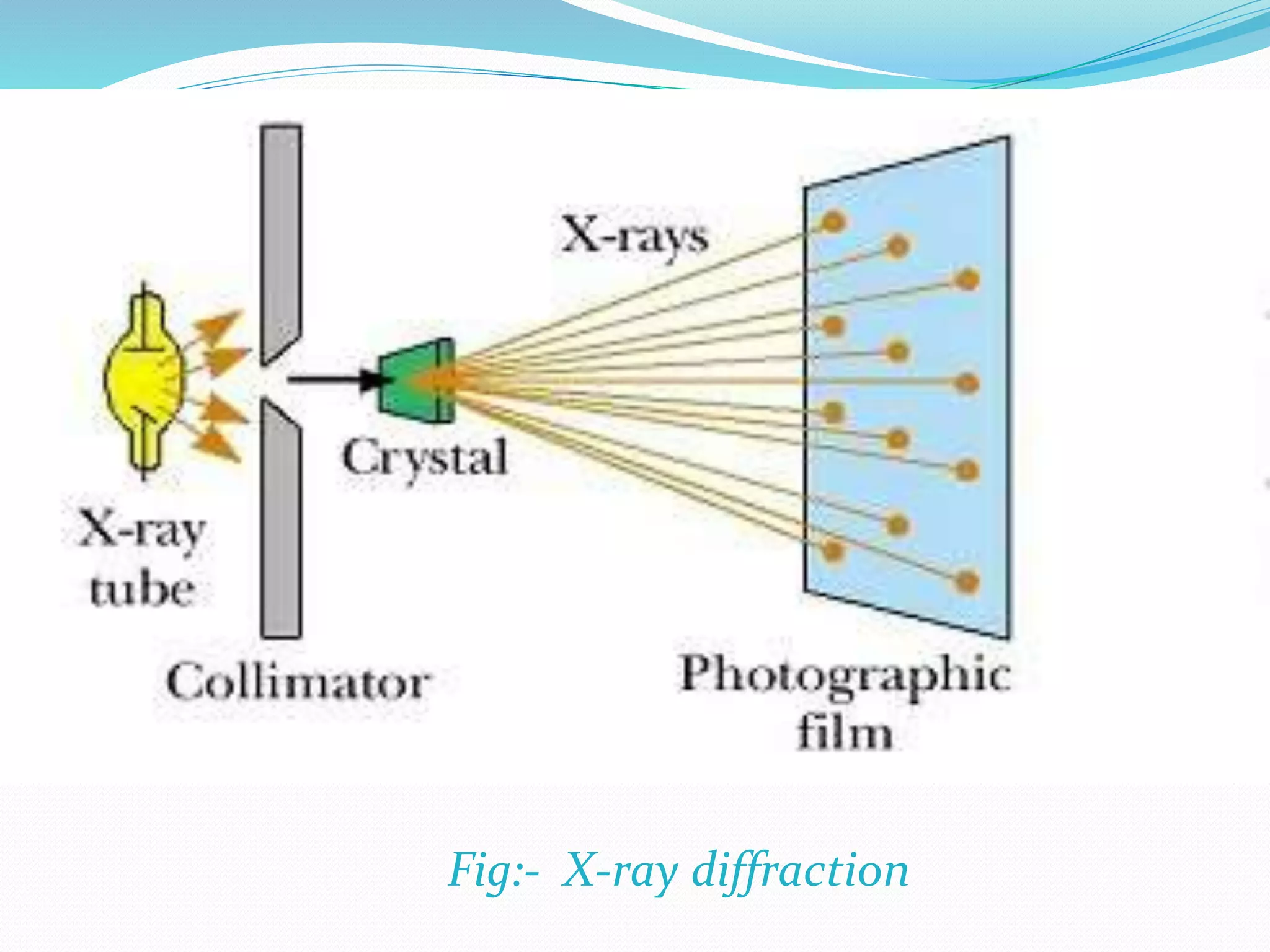
 The atomic planes of a crystal cause an incident beam
of X-ray to interference with one another as they leave
the crystal. This phenomenon is called X-ray
diffraction.
Fig:- X-ray diffraction
BASIC OF CRYSTALLOGRAPHY:-
 A crystal consist of periodic arrangement of the unit
cell into a lattice.
 A unit cell can contain a single atom or atom in a fixed
rearrangement.
 A crystal lattice is a regular 3D distribution of atom in
space.
SEVEN CRYSTAL SYSTEM:-
(1) Laue’s photographic method:-
Fig:- Laue’s method Fig:- Laue pattern
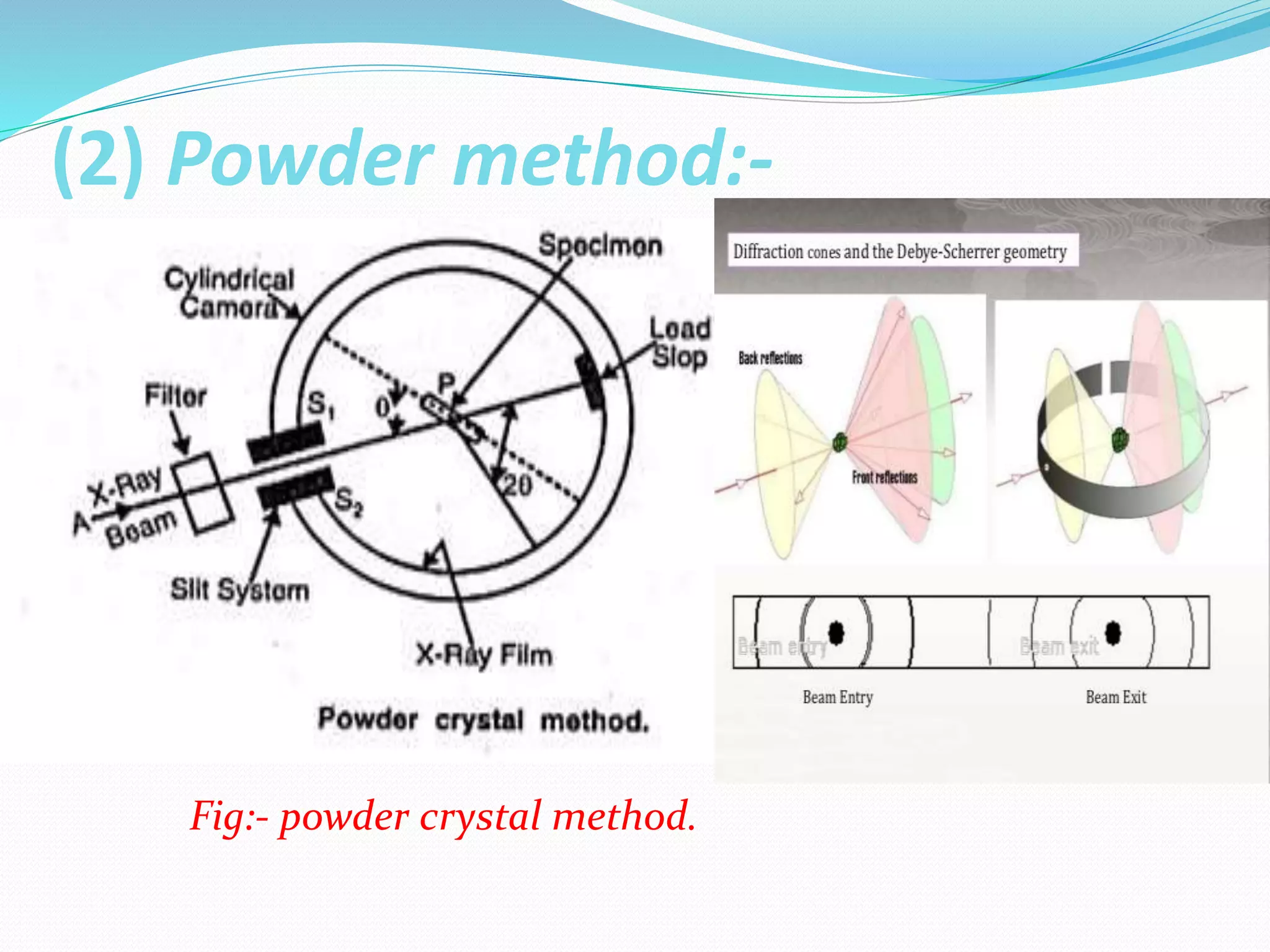
(2) Powder method:-
Fig:- powder crystal method.
APPLICATION:-
 It is a non distractive technique.
 To determine crystalline phases and orientation.
 To determine the structural properties such as
Grain
Size
Strain
Shape
Lattice parameters.
 To determine atomic arrangement.
USES:-
 Obtain X-ray diffraction pattern.
 Measure d-spacing.
 Obtain integrated intensities.
ERRORS:-
 Speciment displacement.
 Errors in zero position.
 Instrument misalingnment.
CONCLUSION:-
 Non- destructive, fast, easy sample preparation.
 High-accuracy for d-spacing calculation.
 Standard are available for thousand of material
systems.
References:-
 Chatwal G.R., Instrumental method of chemical analysis,
1st edition, Himalaya Publishing house; 2004, page No.
2.303 – 2.332
 Sharma B.K., Instrumental method of chemical analysis,
24th edition, Goel Publishing house; 2006, page No. 329-
359
 Gurtu-Gurtu , Biophysical chemistry , 5th edition, 2010
page No. 195-202
X-Ray Diffraction

X-Ray Diffraction

  • 1.
    X-RAY DIFFRACTION By- Manish Sahu M.Sc.Chemistry (Final) Sp.- Physical Chemistry
  • 2.
    CONTENTS • Introduction • History •Bragg’s law • X-Ray Diffraction • Basis of crystallography • Seven crystal system • Method of X-Ray diffraction • Basis features of typical x-ray • Application • Uses • Error • Conclusion • References
  • 3.
    Introduction:- • It isa non-destructive analytical techniques used to study the structure, composition and physical properties of materials. • Bragg’s law is used to explain the interference pattern of X-rays. • It is commonly known as X-ray diffraction or X-ray wave interference.
  • 4.
    History:- • In 1895discovery of X-ray production by Willem Roentgen. • In 1914 discovery of X-ray diffraction pattern by knipping and Von Laue. • In 1915 theory of X-ray diffraction pattern by Bragg.
  • 5.
  • 6.
    ……………  Crystalline materialconsist of parallel rows of atoms separated by unique distances.  Diffraction occurs when a beam enter a crystalline substance and is scattered.  Direction and intensity of diffraction depends on orientation of the crystal lattice with radiation.
  • 7.
    DERIVATION Since we knowthat λ = AB + BC --------(1) But, AB = BC λ = 2AB --------(2) But, AB = dsinθ --------(3) From equation (2) we get, λ = 2 ( dsinθ ) λ = 2dsinθ (by equation (3)) λ = 2dsinθ This equation is known as Bragg’s equation.
  • 8.
    X-RAY DIFFRACTION:-  Nondistractive analytical technique for identification and quantitative determination of various crystalline from known as phases.  Identification is achieved by comparing the X-ray diffraction pattern.  The atomic planes of a crystal cause an incident beam of X-ray to interference with one another as they leave the crystal. This phenomenon is called X-ray diffraction.
  • 9.
  • 10.
    BASIC OF CRYSTALLOGRAPHY:- A crystal consist of periodic arrangement of the unit cell into a lattice.  A unit cell can contain a single atom or atom in a fixed rearrangement.  A crystal lattice is a regular 3D distribution of atom in space.
  • 11.
  • 13.
    (1) Laue’s photographicmethod:- Fig:- Laue’s method Fig:- Laue pattern
  • 15.
    (2) Powder method:- Fig:-powder crystal method.
  • 16.
    APPLICATION:-  It isa non distractive technique.  To determine crystalline phases and orientation.  To determine the structural properties such as Grain Size Strain Shape Lattice parameters.  To determine atomic arrangement.
  • 17.
    USES:-  Obtain X-raydiffraction pattern.  Measure d-spacing.  Obtain integrated intensities.
  • 18.
    ERRORS:-  Speciment displacement. Errors in zero position.  Instrument misalingnment.
  • 19.
    CONCLUSION:-  Non- destructive,fast, easy sample preparation.  High-accuracy for d-spacing calculation.  Standard are available for thousand of material systems.
  • 20.
    References:-  Chatwal G.R.,Instrumental method of chemical analysis, 1st edition, Himalaya Publishing house; 2004, page No. 2.303 – 2.332  Sharma B.K., Instrumental method of chemical analysis, 24th edition, Goel Publishing house; 2006, page No. 329- 359  Gurtu-Gurtu , Biophysical chemistry , 5th edition, 2010 page No. 195-202