Beneficiation and Mineral Processing
of Clay Minerals
Hassan Z. Harraz
hharraz2006@yahoo.com
2015- 2016
© Hassan Harraz 2016
OUTLİNE OF LECTURE 6:
Examples Mineral processing:
7.1) Structure of Clay
7.2) Types of Clay Minerals
7.3) Different Silicate Clay Minerals
7.4) Clay Grades
7.4.1) China Clay Processing
7.5) PROPERTY CHARACTERIZATION OF CLAY MINERALS
A) CLAY-WATER INTERACTION
A-1) Introduction
i) Hydrogen bond
ii) Ion hydration
iii) Osmotic pressure
A-2) “Charged” Clay Particles
A-2.1 ) Origins of Charge Deficiencies
Isomorphous Substitution
i) Imperfections in the crystal lattice -Isomorphous substitution.
ii) Imperfections in the crystal lattice - The broken edge:
iii) Proton equilibria (pH-dependent charges):
iv) Adsorbed ion charge (inner sphere complex charge and outer sphere complex charge:
A-.3) Cation Replaceability
A-4) Cation Exchange Capacity
B) INTERACTION OF CLAY PARTICLES
B-1) Introduction
i) Diffuse Double Layer
ii) Interaction Forces
iii) Terminology
iv) Particle Associations
B-2) Interaction of Clay Particles
C) SWELLING CLAYS
C-1) Swelling Potential
C-.2) Engineering Applications for Swelling Clay
i) Lime treatment for the swelling clay
ii) Dispersion agents (drilling mud; hydrometer analysis)
© Hassan Harraz 2016
 Clay is a naturally occurring material composed
primarily of fine grained minerals, which shows
plasticity through a variable range of water content
and which can be hardened when dried or fired.
 Clay deposits are mostly composed of clay minerals
(phyllosilicate minerals) and variable amount of water
trapped in the mineral.
 Clay materials have been investigated because of
their importance in agriculture, in ceramics, in
construction and other uses.
CLAY
 Adsorption mechanism of clay
colloids:
Clay minerals have weekly
bound hydrated interlayers
Interlayer cations can be
displaced by other cations from
aqueous solution to give an ion-
exchange reaction
 Mineral Suspension Technology:
Eliminates non-essential
elements
Optimizes Absorption and
Adsorption processes
Enhances the Ionic exchange
process
Creating a multitude of
Natural Product Applications
© Hassan Harraz 2016
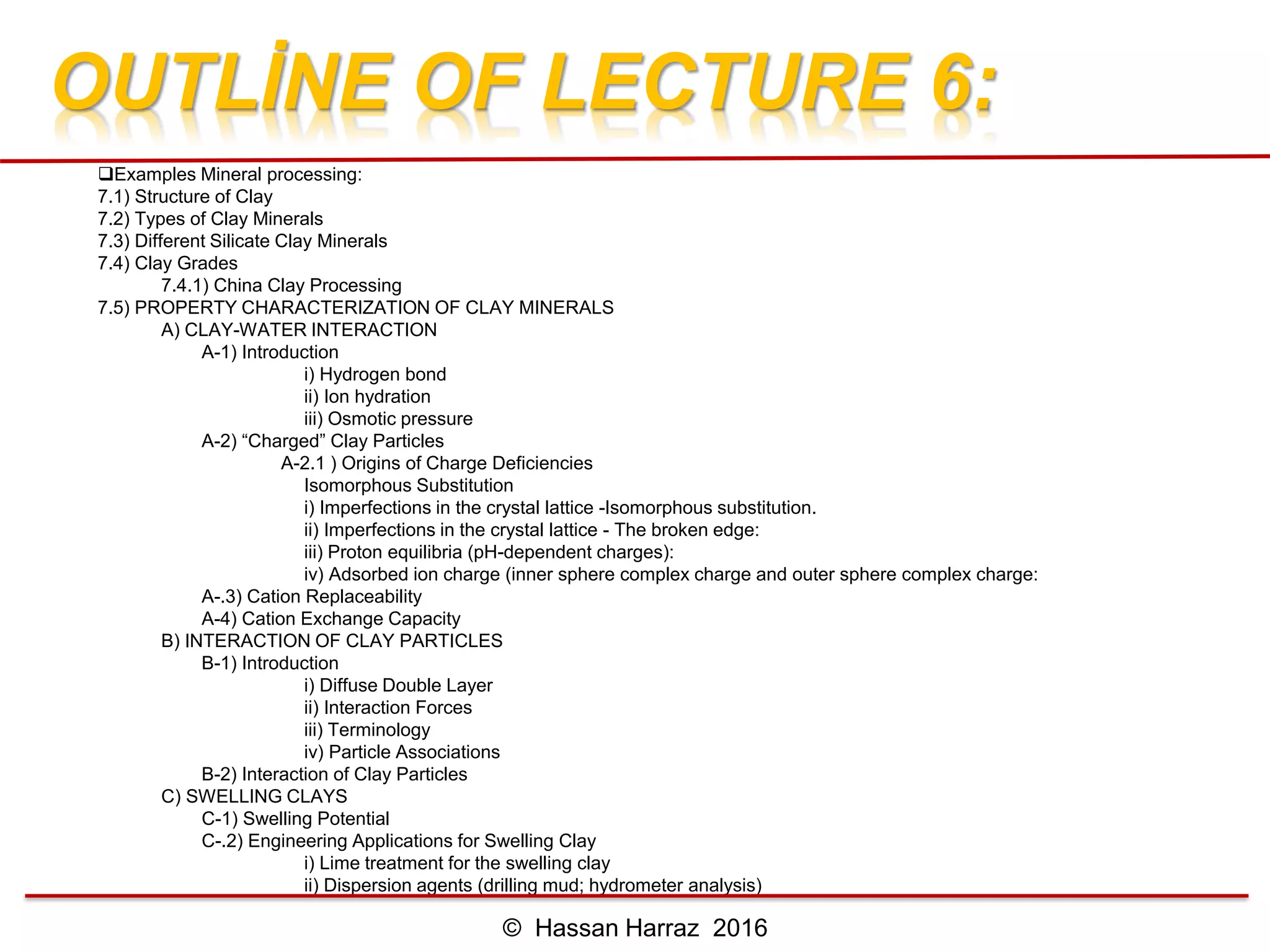
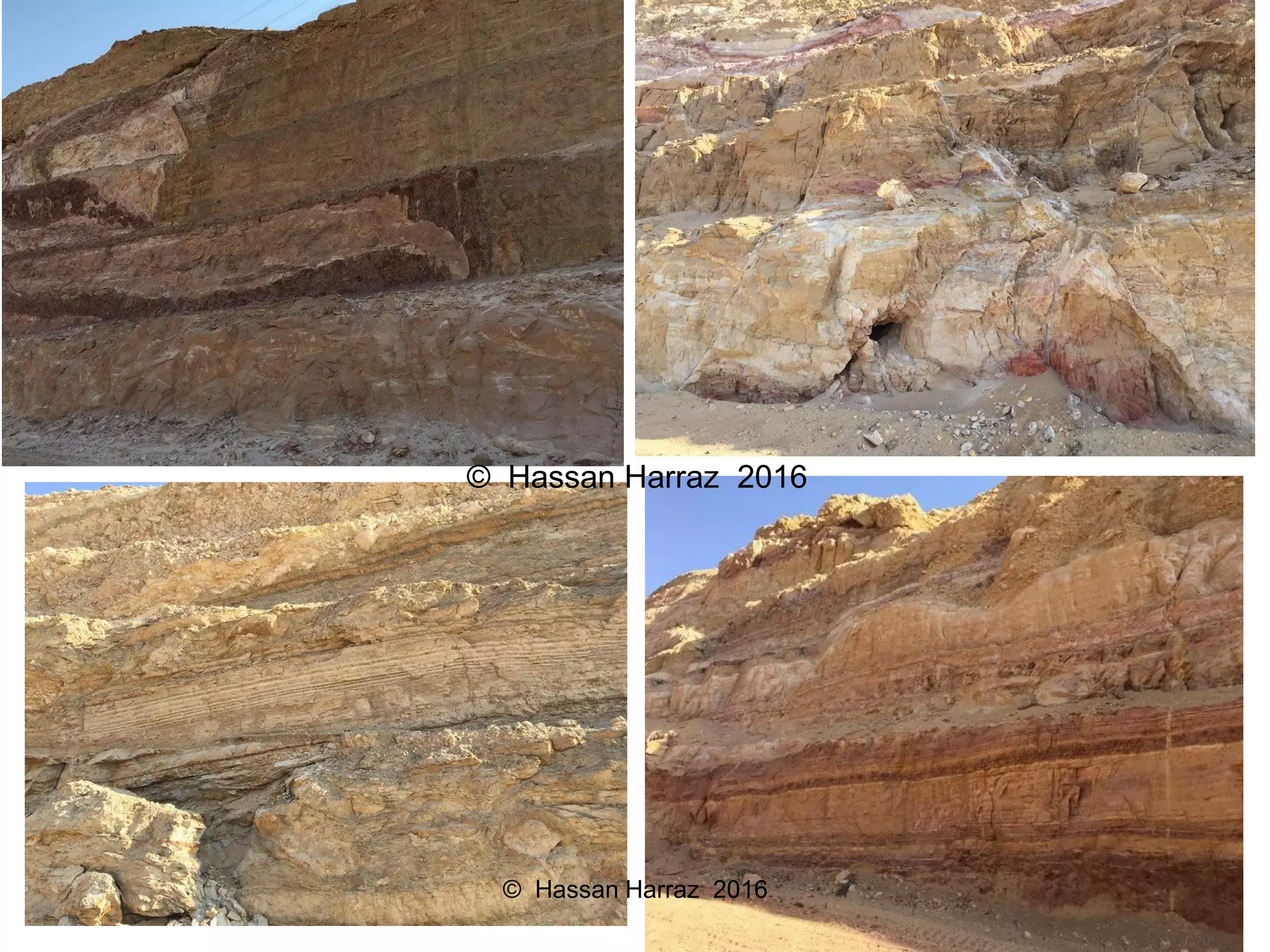
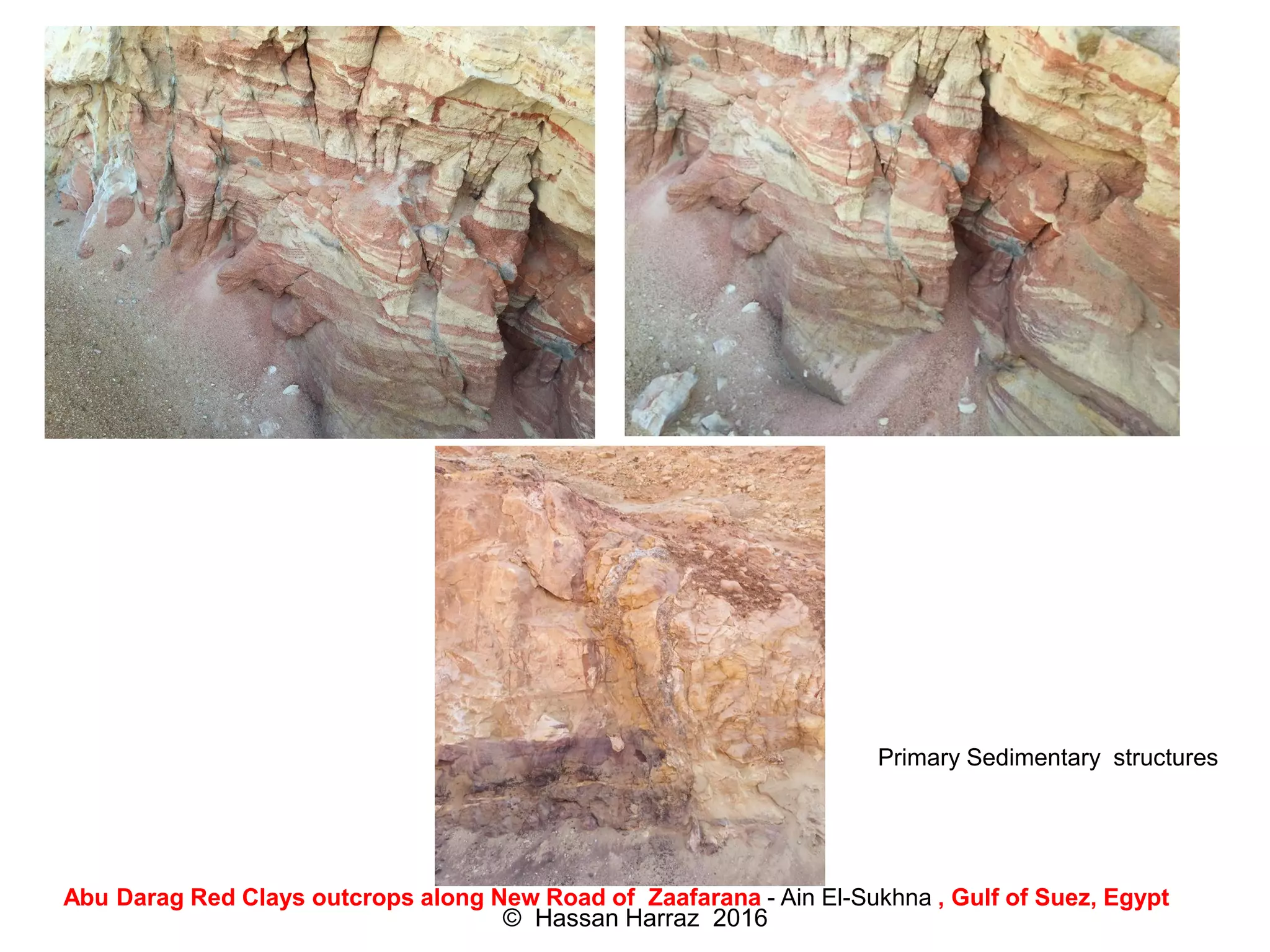
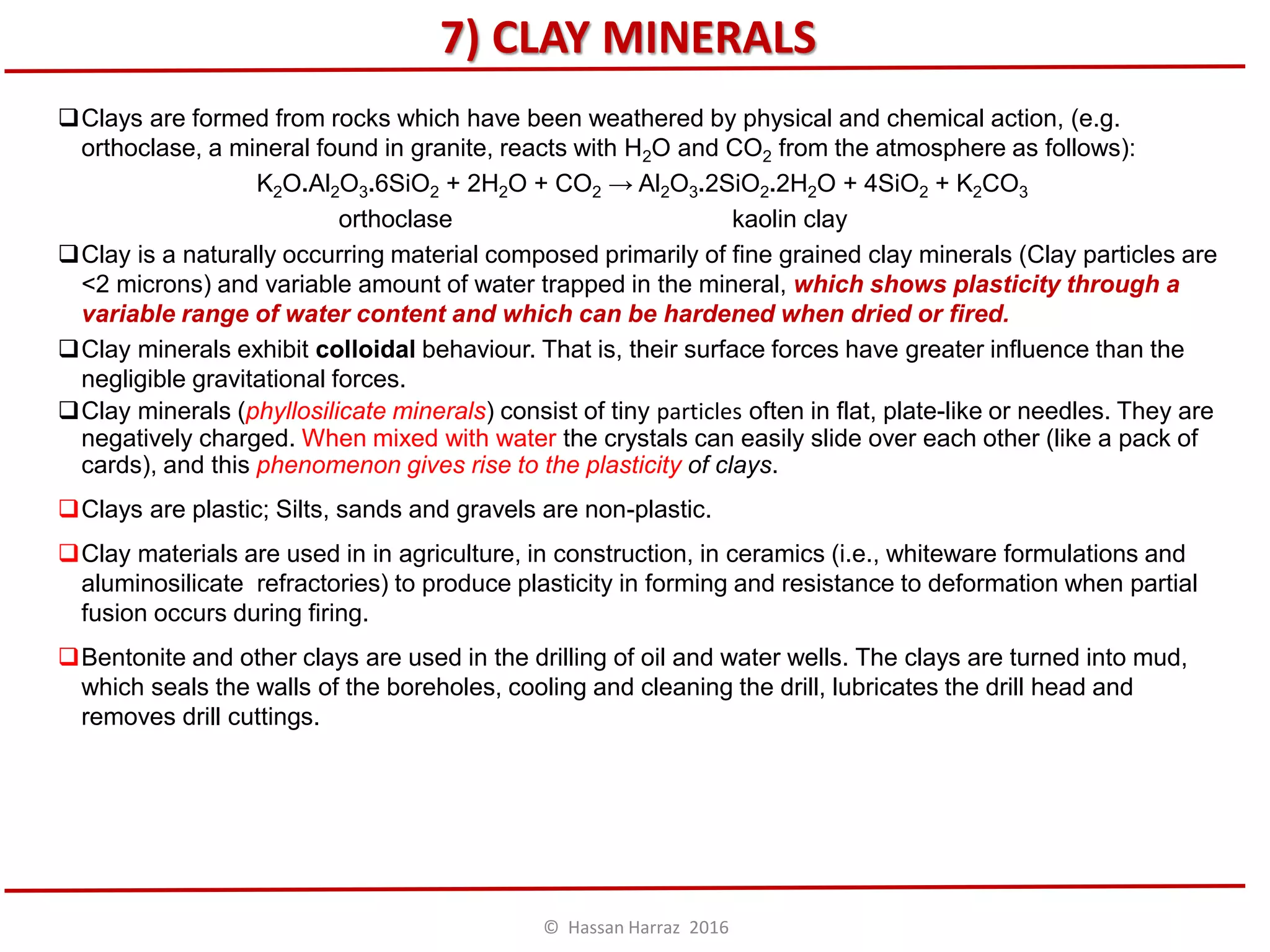
Abu Darag Red Clays outcrops along New Road of Zaafarana - Ain El-Sukhna , Gulf of Suez, Egypt
Primary Sedimentary structures
© Hassan Harraz 2016
7) CLAY MINERALS
Clays are formed from rocks which have been weathered by physical and chemical action, (e.g.
orthoclase, a mineral found in granite, reacts with H2O and CO2 from the atmosphere as follows):
K2O.Al2O3.6SiO2 + 2H2O + CO2 → Al2O3.2SiO2.2H2O + 4SiO2 + K2CO3
orthoclase kaolin clay
Clay is a naturally occurring material composed primarily of fine grained clay minerals (Clay particles are
<2 microns) and variable amount of water trapped in the mineral, which shows plasticity through a
variable range of water content and which can be hardened when dried or fired.
Clay minerals exhibit colloidal behaviour. That is, their surface forces have greater influence than the
negligible gravitational forces.
Clay minerals (phyllosilicate minerals) consist of tiny particles often in flat, plate-like or needles. They are
negatively charged. When mixed with water the crystals can easily slide over each other (like a pack of
cards), and this phenomenon gives rise to the plasticity of clays.
Clays are plastic; Silts, sands and gravels are non-plastic.
Clay materials are used in in agriculture, in construction, in ceramics (i.e., whiteware formulations and
aluminosilicate refractories) to produce plasticity in forming and resistance to deformation when partial
fusion occurs during firing.
Bentonite and other clays are used in the drilling of oil and water wells. The clays are turned into mud,
which seals the walls of the boreholes, cooling and cleaning the drill, lubricates the drill head and
removes drill cuttings.
© Hassan Harraz 2016
Structure of Clay
All have layers of Si tetrahedra and
layers of Al, Fe, Mg octahedra,
similar to gibbsite or brucite
SEM view of clay
Connected tetrahedra,
sharing oxygensTetrahedron and Tetrahedral sheets
Connected octahedra,
sharing oxygens or hydroxylsOctahedron and Octahedral Sheets
Silicon tetrahedron
silicon
oxygen
hydroxyl or oxygen
aluminium or
magnesium
Aluminium Octahedron
Clay minerals are made
of two distinct structural
units
All clay mineral are made of different
combinations of the above two sheets:
tetrahedral sheet and octahedral sheet.
© Hassan Harraz 2016
7.1) GENERAL STRUCTURE OF CLAY
(a) Silica tetrahedron
(b) Alumina octahedral
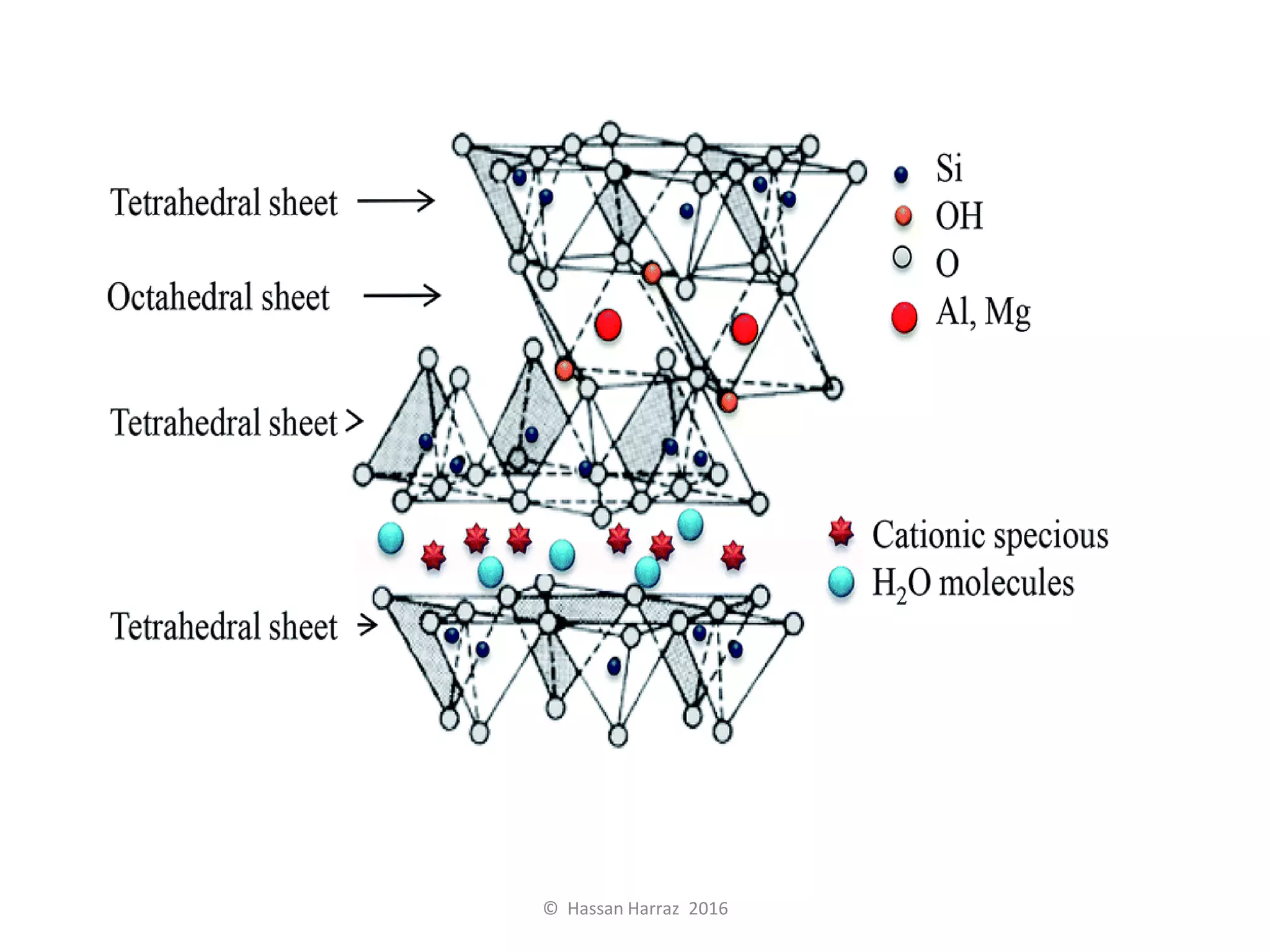
 Composed of tetrahedral and octahedral “Sandwiches”
 Tetrahedron: central cation (Si+4, Al+3) surrounded by 4 oxygens
 Octahedron: central cation (Al+3,Fe+2, Mg+2) surrounded by 6 oxygens (or hydroxyls)
 The silicon ions are in fourfold coordination with oxygen, and the vertices of all the SiO4 tetrahedra point in one direction.
These apical oxygens link the tetrahedral layer to another sub-layer, called the octahedral layer, which is formed by Al ions in
six-fold coordination with O and OH. The oxygens form a hexagonal ring of approximately the same size as the SiO rings. A
kaolinite crystal consists of a stack of many layer with adjacent units linked by hydrogen bonds. This structure is broken
down when the clay body is fired.
 Sheets combine to form layers. Layers are separated by interlayer space
 Water, adsorbed cations
Water plays a critical role in many clay minerals. Contains elements that act as bonding agents:
 keeps the crystalline structure together.
 Most notable are the H+ and the OH- cations and anions.
In many circumstances the water can be driven off or can facilitate ion substitution, especially in 2:1
© Hassan Harraz 2016
7.2) Types of Clay Minerals
1) Silicate Clays (crystalline)
2) Sesquioxide/oxidic clays
3) Amorphous clays (non-crystalline, Mixed layer)
© Hassan Harraz 2016
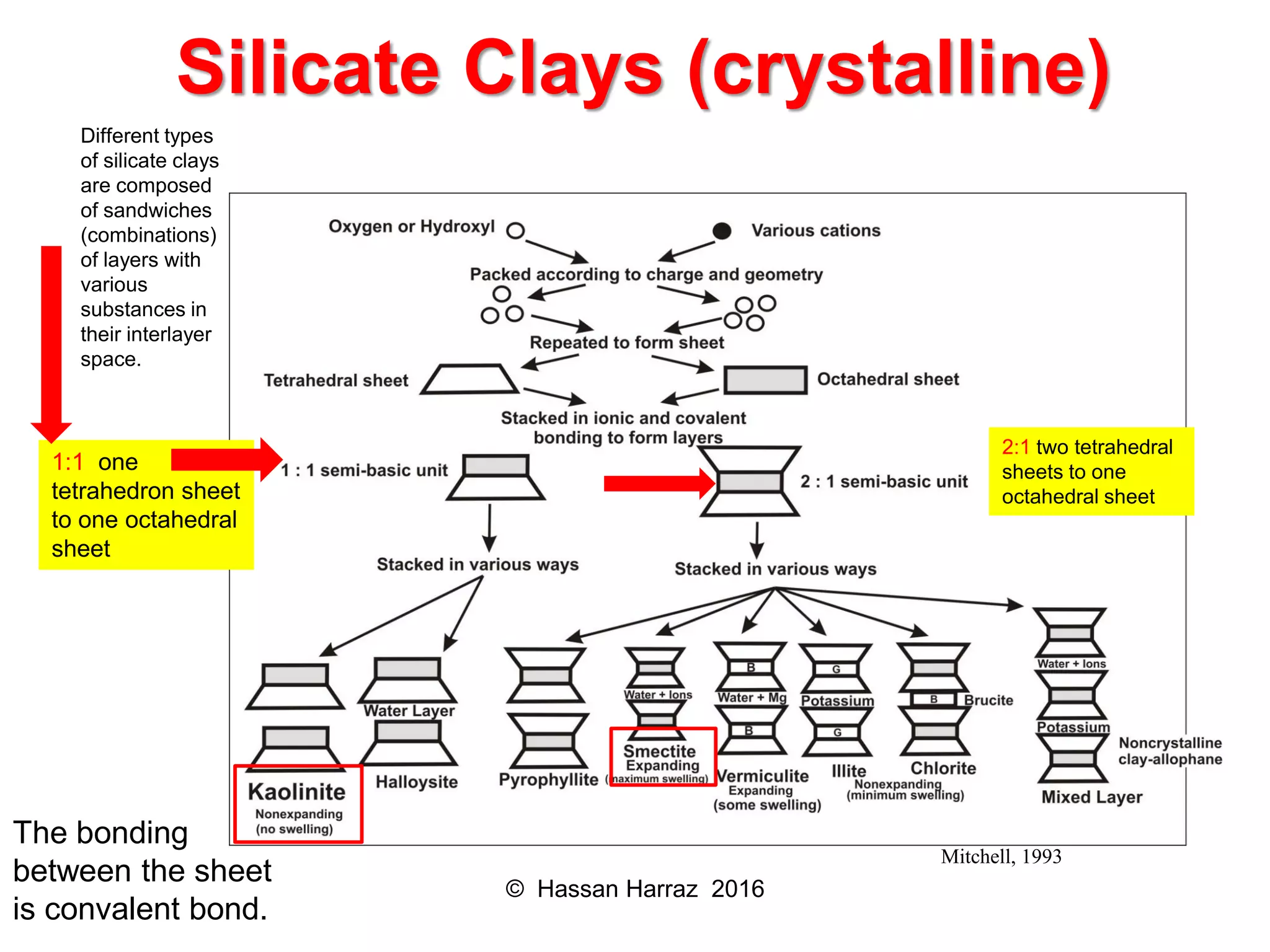
Silicate Clays (crystalline)
Mitchell, 1993
© Hassan Harraz 2016
1:1 one
tetrahedron sheet
to one octahedral
sheet
Different types
of silicate clays
are composed
of sandwiches
(combinations)
of layers with
various
substances in
their interlayer
space.
2:1 two tetrahedral
sheets to one
octahedral sheet
The bonding
between the sheet
is convalent bond.
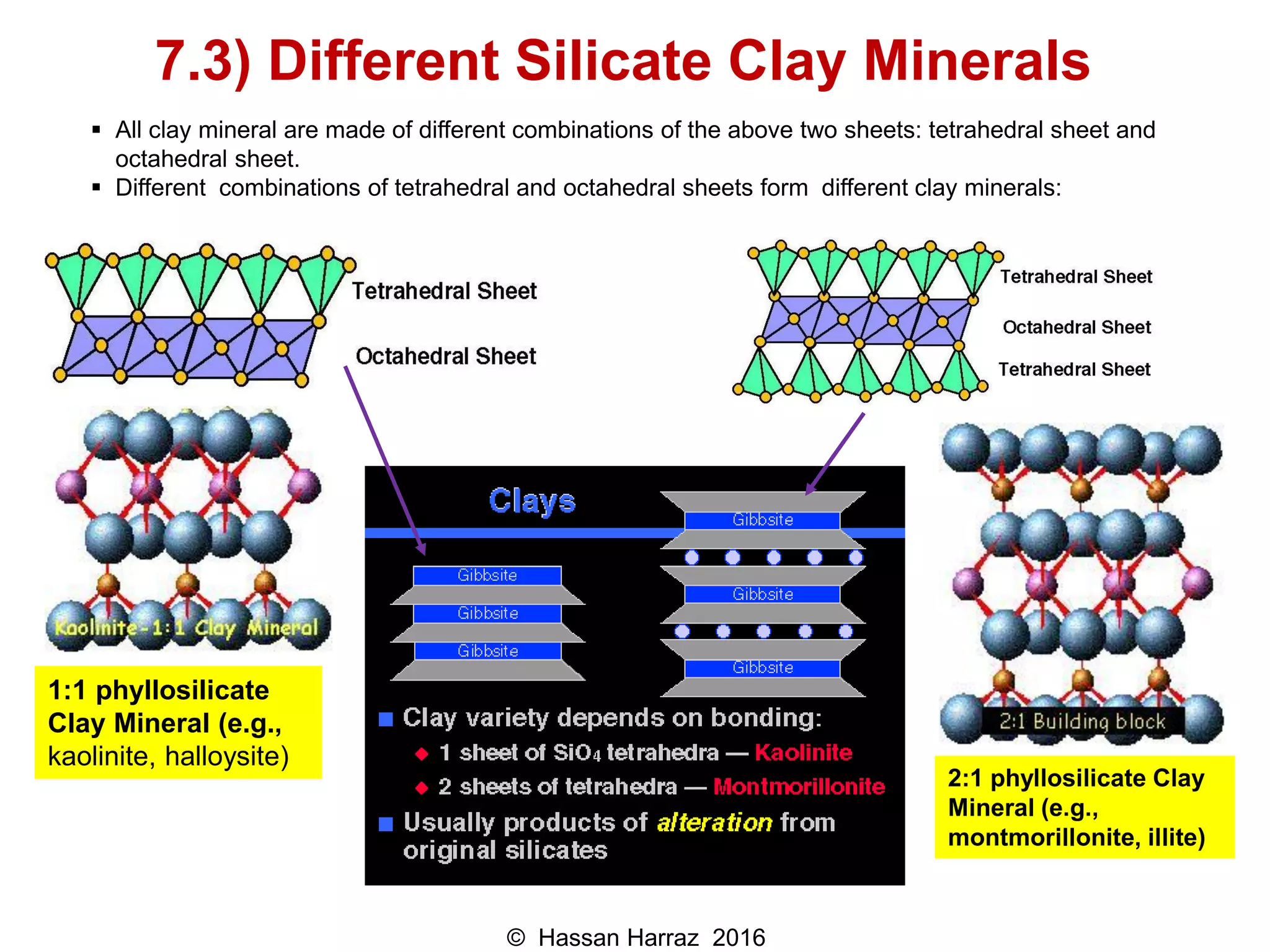
1:1 phyllosilicate
Clay Mineral (e.g.,
kaolinite, halloysite)
2:1 phyllosilicate Clay
Mineral (e.g.,
montmorillonite, illite)
7.3) Different Silicate Clay Minerals
 All clay mineral are made of different combinations of the above two sheets: tetrahedral sheet and
octahedral sheet.
 Different combinations of tetrahedral and octahedral sheets form different clay minerals:
© Hassan Harraz 2016
CLASSIFICATION OF CLAY
(b) 2:1 clay structure(a) 1:1 clay structure
nH2O and exchangeable cations
Alumina Sheet
Silica Sheet
Alumina Sheet
Silica Sheet
Hydrogen Bonding
Alumina Sheet
Silica Sheet
Silica Sheet
Alumina Sheet
Silica Sheet
Silica Sheet
© Hassan Harraz 2016
Interlayer surface
Montmorillonite
Illite
Kaolinite
50-120 m2/gm (external surface)
700-840 m2/gm (including the interlayer surface)
65-100 m2/gm
10-20 m2/gm
Interlayer surface
© Hassan Harraz 2016
Expanding and non-expanding cationic-CMs: the arrangement
of tetrahedral sheets with octahedral sheets gives rise to
various classes of clay minerals
ExpandingNon-Expanding
© Hassan Harraz 2016
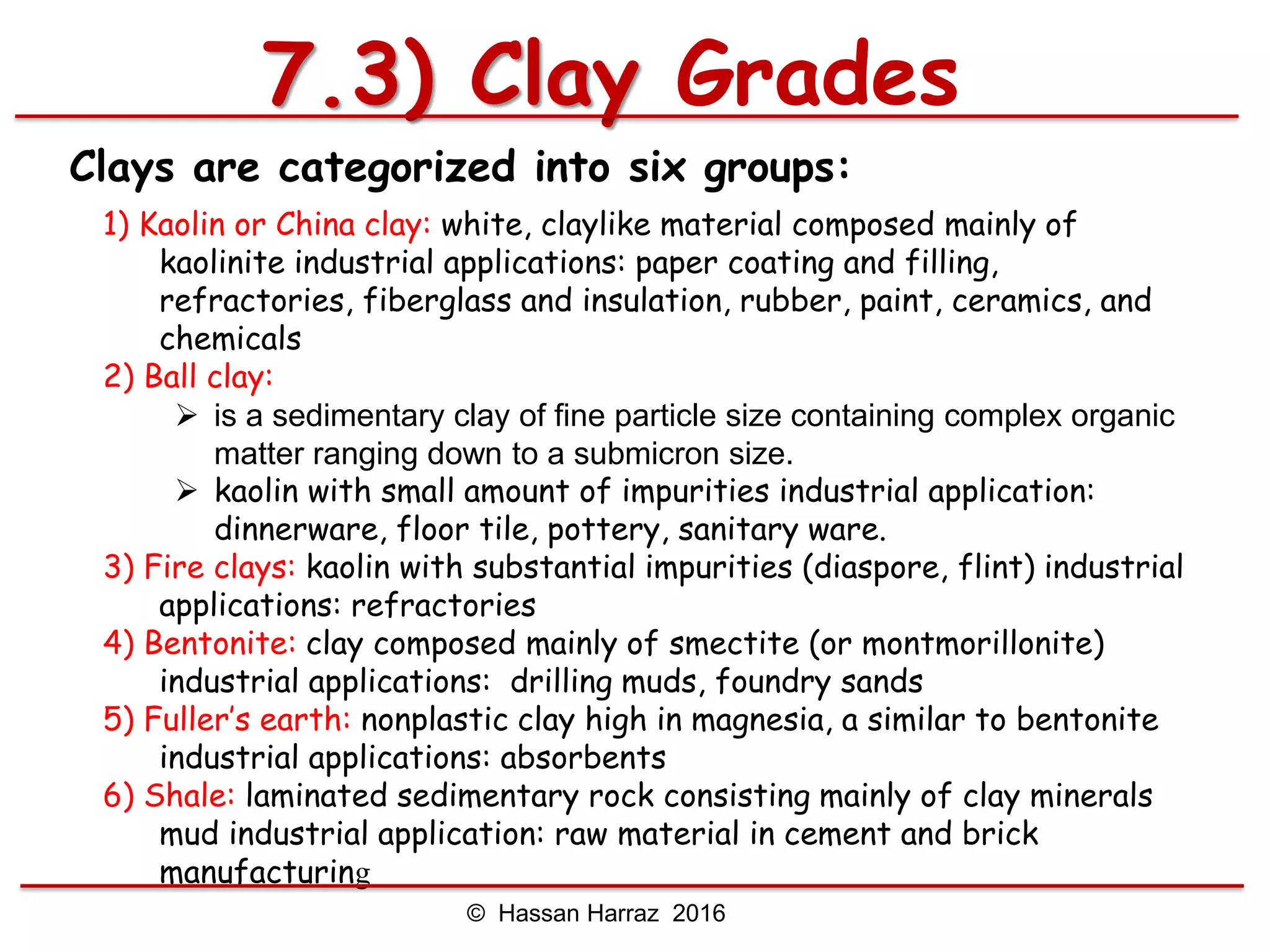
Clays are categorized into six groups:
1) Kaolin or China clay: white, claylike material composed mainly of
kaolinite industrial applications: paper coating and filling,
refractories, fiberglass and insulation, rubber, paint, ceramics, and
chemicals
2) Ball clay:
 is a sedimentary clay of fine particle size containing complex organic
matter ranging down to a submicron size.
 kaolin with small amount of impurities industrial application:
dinnerware, floor tile, pottery, sanitary ware.
3) Fire clays: kaolin with substantial impurities (diaspore, flint) industrial
applications: refractories
4) Bentonite: clay composed mainly of smectite (or montmorillonite)
industrial applications: drilling muds, foundry sands
5) Fuller’s earth: nonplastic clay high in magnesia, a similar to bentonite
industrial applications: absorbents
6) Shale: laminated sedimentary rock consisting mainly of clay minerals
mud industrial application: raw material in cement and brick
manufacturing
7.3) Clay Grades
© Hassan Harraz 2016
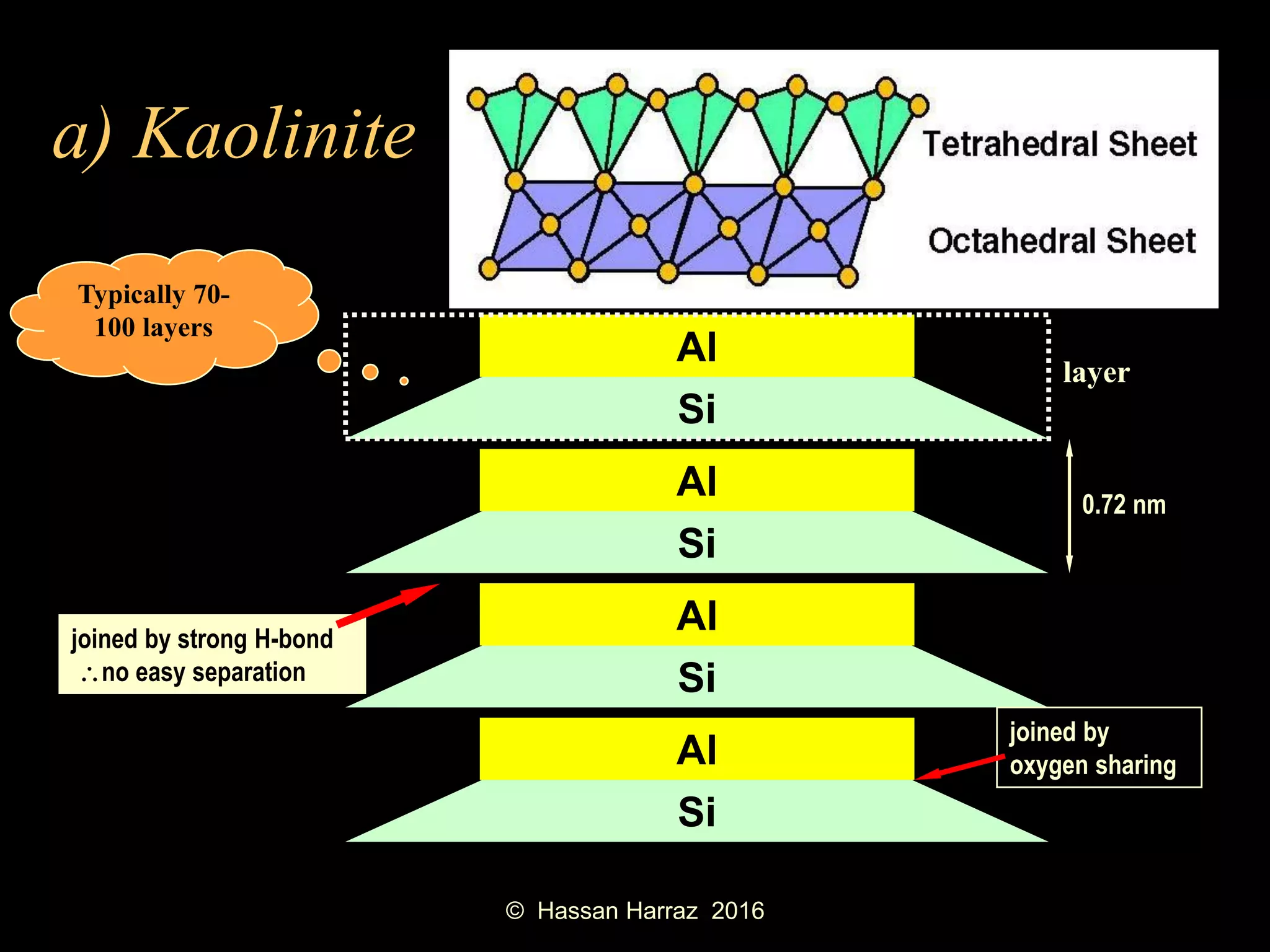
Si
Al
Si
Al
Si
Al
Si
Al
joined by strong H-bond
no easy separation
0.72 nm
Typically 70-
100 layers
joined by
oxygen sharing
a) Kaolinite
layer
© Hassan Harraz 2016
Kaolin mine south west Aswan
Abu Darag Red Clays outcrops
along New Road of Zaafarana - Ain
El-Sukhna , Gulf of Suez, Egypt
a) Kaolinite
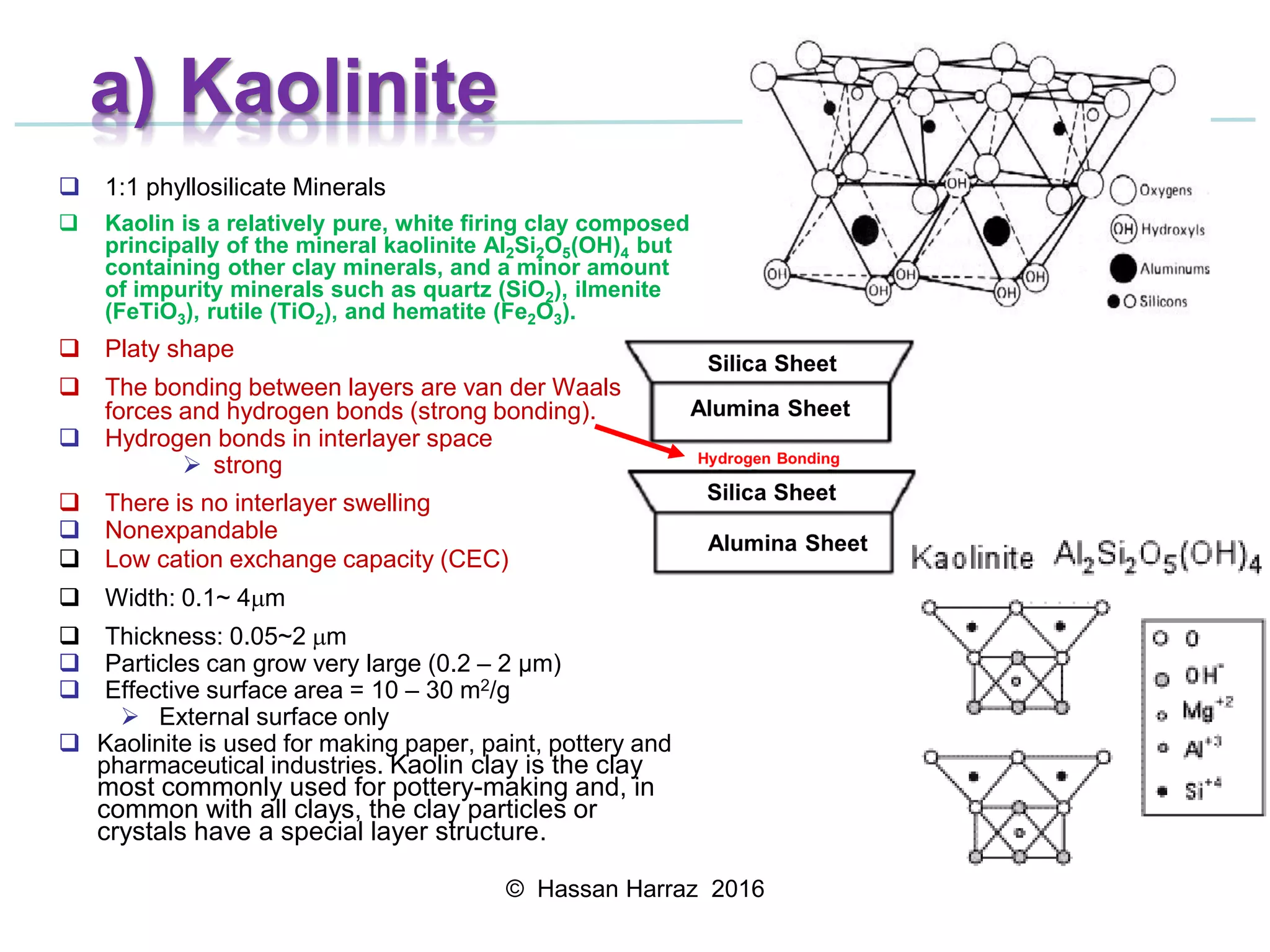
 1:1 phyllosilicate Minerals
 Kaolin is a relatively pure, white firing clay composed
principally of the mineral kaolinite Al2Si2O5(OH)4 but
containing other clay minerals, and a minor amount
of impurity minerals such as quartz (SiO2), ilmenite
(FeTiO3), rutile (TiO2), and hematite (Fe2O3).
 Platy shape
 The bonding between layers are van der Waals
forces and hydrogen bonds (strong bonding).
 Hydrogen bonds in interlayer space
 strong
 There is no interlayer swelling
 Nonexpandable
 Low cation exchange capacity (CEC)
 Width: 0.1~ 4m
 Thickness: 0.05~2 m
 Particles can grow very large (0.2 – 2 µm)
 Effective surface area = 10 – 30 m2/g
 External surface only
 Kaolinite is used for making paper, paint, pottery and
pharmaceutical industries. Kaolin clay is the clay
most commonly used for pottery-making and, in
common with all clays, the clay particles or
crystals have a special layer structure.
© Hassan Harraz 2016
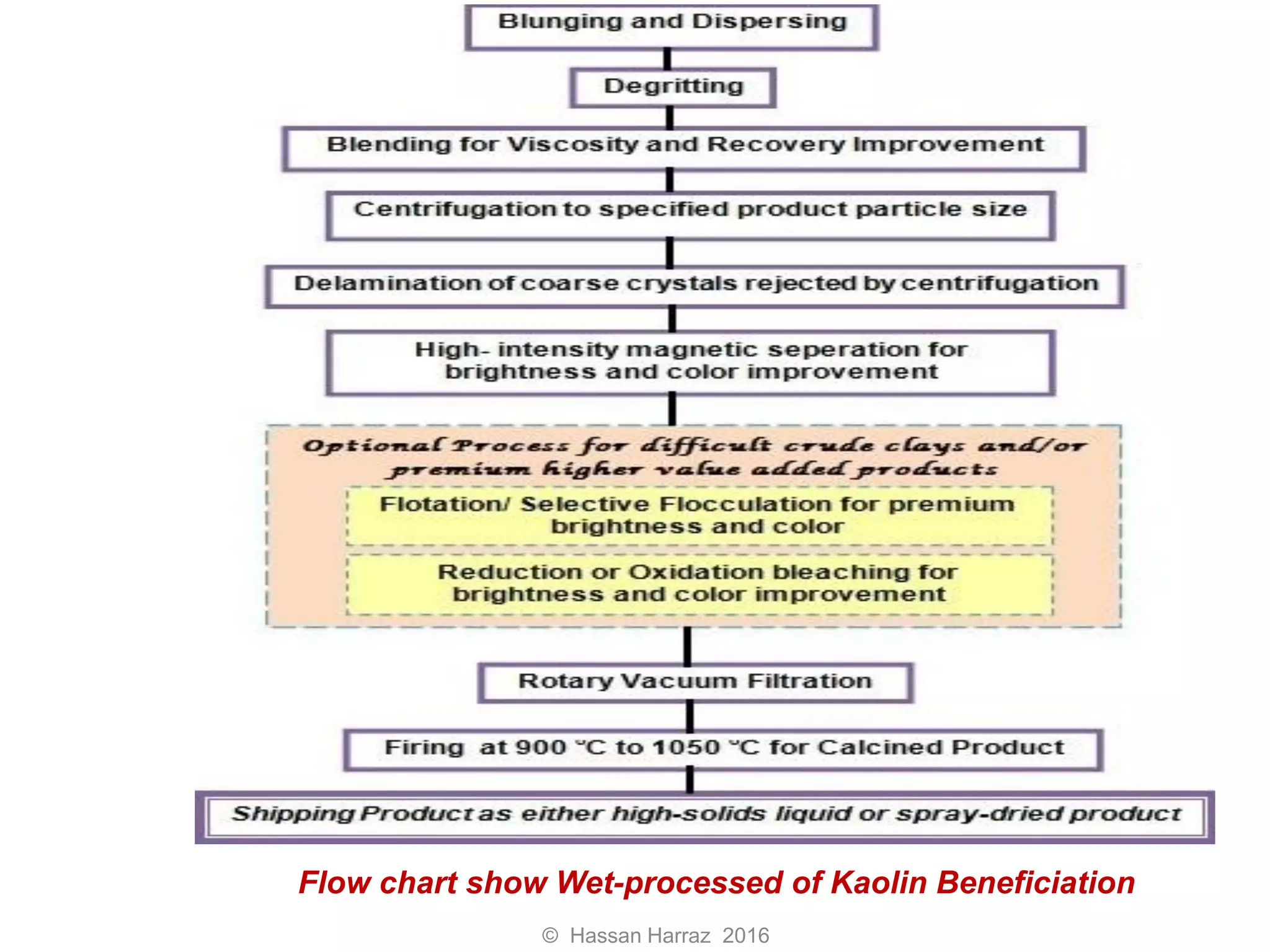
Blunging :(high-energy mixing with water) to a
dispersed 30-40% solids liquid slurry. The kaolin
is mixed with water and chemical dispersants,
which puts the clay particles in suspension
(slurry).
De-gritting: Degritting to – 220 mesh (- 75 µm) to
remove coarse sand and mica. The slurried
kaolin is usually transported through pipelines
to degritting facilities (rakes), where sand,
mica and other impurities are extracted with
the help of gravity.
Blending to achieve optimum mix of particle size, and
to equalize variation of other quality parameters.
Centrifuging: Centrifugation to product particle size
(50% - 100% < 2 µm).The centrifuge
separates the fine kaolin particles from
coarse particles. Fine particles, still in the
form of a slurry, move on for further
processing.
7.3.1) China Clay processing
De-gritting (rake) tables
© Hassan Harraz 2016
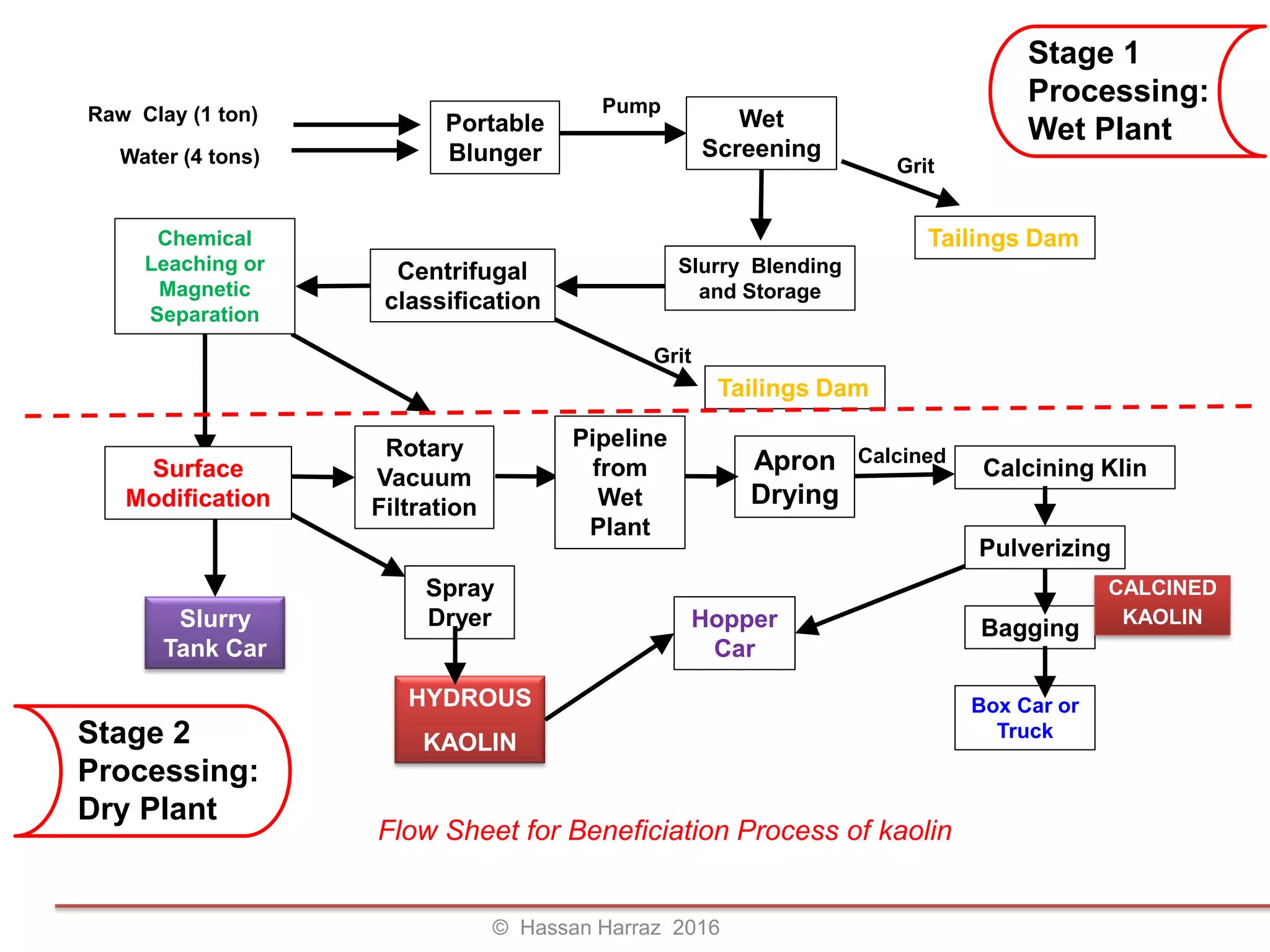
A typical wet-processed kaolin shown above
undergoes many of the following steps:
Flow Sheet for Beneficiation Process of kaolin
Wet
Screening
Apron
Drying
Rotary
Vacuum
Filtration
Raw Clay (1 ton)
Slurry
Tank Car
Hopper
Car
Box Car or
Truck
Bagging
Calcining Klin
Water (4 tons)
Portable
Blunger Grit
Grit
Pump
Calcined
Chemical
Leaching or
Magnetic
Separation
Surface
Modification
Spray
Dryer
Centrifugal
classification
Slurry Blending
and Storage
© Hassan Harraz 2016
HYDROUS
KAOLIN
Pipeline
from
Wet
Plant
Pulverizing
Tailings Dam
Tailings Dam
CALCINED
KAOLIN
Stage 1
Processing:
Wet Plant
Stage 2
Processing:
Dry Plant
© Hassan Harraz 2016
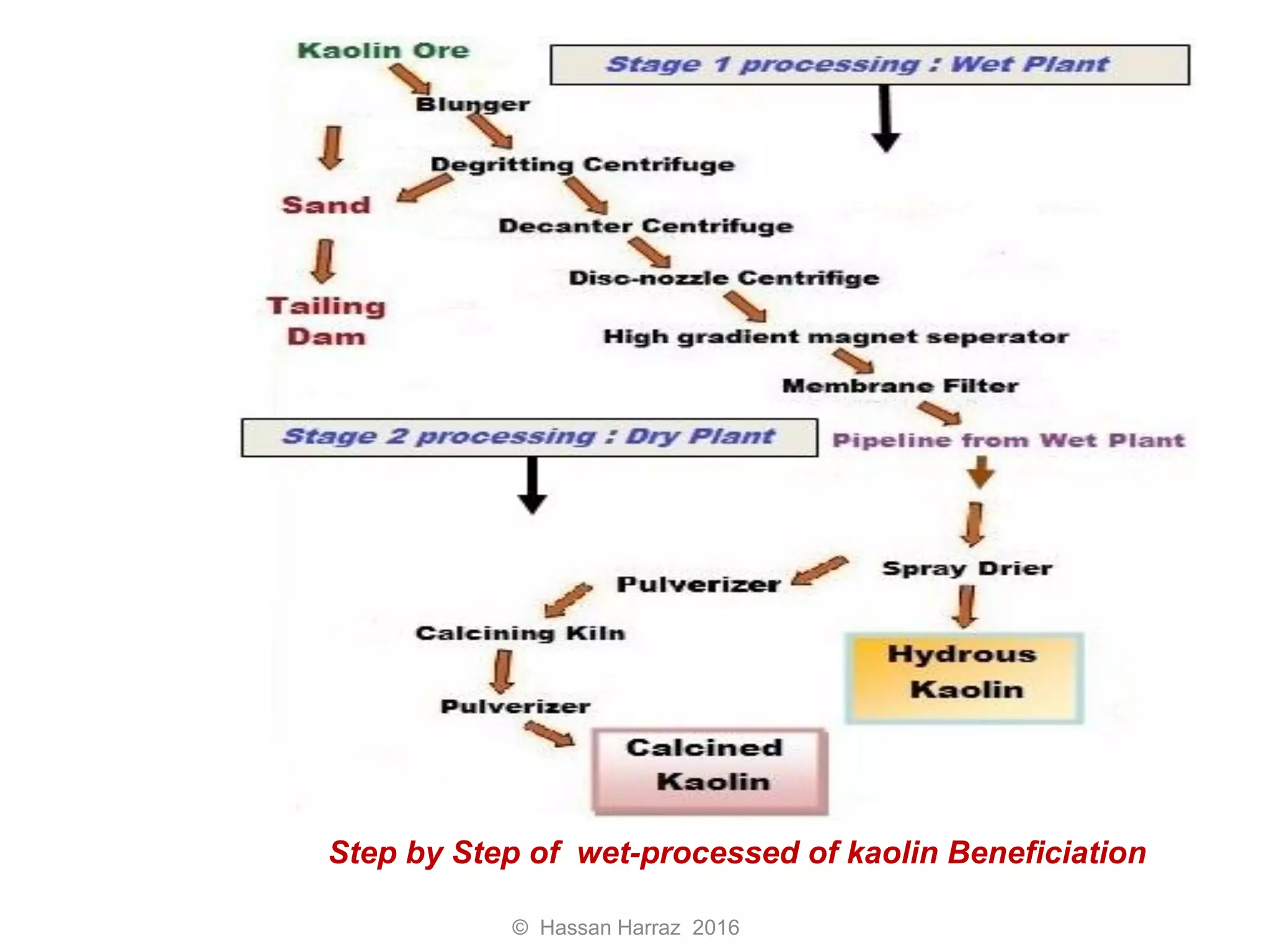
Step by Step of wet-processed of kaolin Beneficiation
© Hassan Harraz 2016
Flow chart show Wet-processed of Kaolin Beneficiation
Delamination: Delimination to reduce particle size, increase aspect ratio (ratio of diameter to thickness),
and improve brightness.For customers who want a delaminated clay product suited for
lightweight coating applications, coarse kaolinite particles are used as starting material.
Delamination occurs as the coarse particles of kaolin which when magnified appear as
"booklets" are broken into thin platelets by mechanical milling.
Brightness enhancement: Undesirable colors are removed through one or more processes including
reductive leaching, flocculation, ozonation (i.e., ozone oxidation), magnetic separation, froth
flotation, and oxidation, which will remove iron oxides, titanium oxides, organic, and other
undesirable materials.
Filtering and drying: Filtration to ~55% solids, spray drying or evaporation, repulping to 70% solids slurry
or selling as dry-pigment product. Large rotary vacuum filters remove water from the
slurried kaolin. Large gas-fired spray dryers remove and evaporate the remaining moisture.
Optional calcination to a higher brightness and more opaque pigment product.
7.3.1) China Clay processing (cont.)
© Hassan Harraz 2016
Some materials are calcined, and a hard aggregate is formed Dried cake or
calcined materials may be pulverized or ground and then sized or air
elutriated before bagging or loading in hopper cars.
Many fine materials are loaded and unloaded using pneumatic fluidization
and are stored at the plant site m large silos.
b) Montmorillonite (or Mg-Smectite clays)
Si
Al
Si
Si
Al
Si
Si
Al
Si
0.96
nm
joined by weak
van der Waal’s bond
easily separated
by water
 also called Smectite; expands on contact with water
A highly reactive (expansive)
clay
swells on contact
with water
(OH)4Al4Si8O20.nH2O
high affinity to water
© Hassan Harraz 2016
b) Montmorillonite (or Mg-Smectite clays)
 Montmorilonite (nanoclay raw material).
 Film-like shape.
 Width: 1 or 2 m
 Thickness: 10 Å (~1/100) width
 Montmorillonite: is Mg form of smectite, with a general chemical formula :
(Na, Ca)(Al,Mg, Fe)6(Si4O10)3(OH)6-nH2O
 Montmorillonite or smectite is family of expansible 2:1 phyllosilicate clays having permanent layer charge
because of the isomorphous substitution in either the octahedral sheet (typically from the substitution of low
charge species such as Mg2+ , Fe2+, or Mn2+ for Al3+)
 There is extensive isomorphous substitution for silicon and aluminum by other cations, which results in
charge deficiencies of clay particles. Always negative due to isomorphous substitution
 Cations adsorbed in interlayer space. n·H2O and cations exist between unit layers, and the basal spacing is
from 9.6 Å to  (after swelling).
 Maximum Swelling. There exists interlayer swelling, which is very important to engineering practice
(expansive clay).
 Layers weakly held together by weak O-O bonds or cation-O bonds. The interlayer bonding is by van der
Waals forces and by cations which balance charge deficiencies (weak bonding).
Expandable: Most expandable of all clays
 Montmorillonites have very high specific surface (650 – 800 m2/g) {i.e., Internal surface area >> external
surface area}, high cation exchange capacity (CEC), and high affinity to water. They form reactive clays.
 Montmorillonites have very high liquid limit (100+), plasticity index and activity (1-7).
© Hassan Harraz 2016
 Montmorillinite can expand by several times its original volume when it comes in contact with
water. This makes it useful as a drilling mud (to keep drill holes open), in slurry trench walls, stopping
leakage in soil, rocks, and dams. Most important is as drilling mud in which the montmorillonite is
used to give the fluid viscosity several times that of water.
 Montmorillinite, however, is a dangerous type of clay to encounter if it is found in tunnels or road cuts.
Because of its expandable nature, it can lead to serious slope or wall failures.
 Bentonite:
 Montmorillinite is the main constituent of bentonite, derived by weathering of volcanic ash.
 montmorillonite family
 the essential nanoclay raw material
 used as drilling mud, in slurry trench walls, stopping leakages; lubricant
b) Montmorillonite
Bentonite-bearing shales, such as in the Painted
Desert, are derived from weathering of volcanic ash.
© Hassan Harraz 2016
Uses of Clay - Drilling Mud
Bentonite and other clays are used in the drilling of oil and water
wells. The clays are turned into mud, which seals the walls of the
boreholes, lubricates the drill head and removes drill cuttings.
Drilling mud slurry
Cooling and
cleaning the drill “Gushers” used to be
common until the use
of drilling mud was
implemented
deep oil is at high pressure
© Hassan Harraz 2016
Uses of Clay - Contaminant
Removal
Clay slurrys have effectively been used to remove a range of
comtaminants, including P and heavy metals, and overall
water clarification.
Schematic of montmorillonite
absorbing Zn
© Hassan Harraz 2016
7.5) PROPERTY CHARACTERIZATION OF CLAY MINERALS
© Hassan Harraz 2016
Polar Water Molecules
Structure
Polar molecule
H(+) H(+)
O(-)
Salts in aqueous solution
Hydration
Hydrogen bond
Dipolar character of water
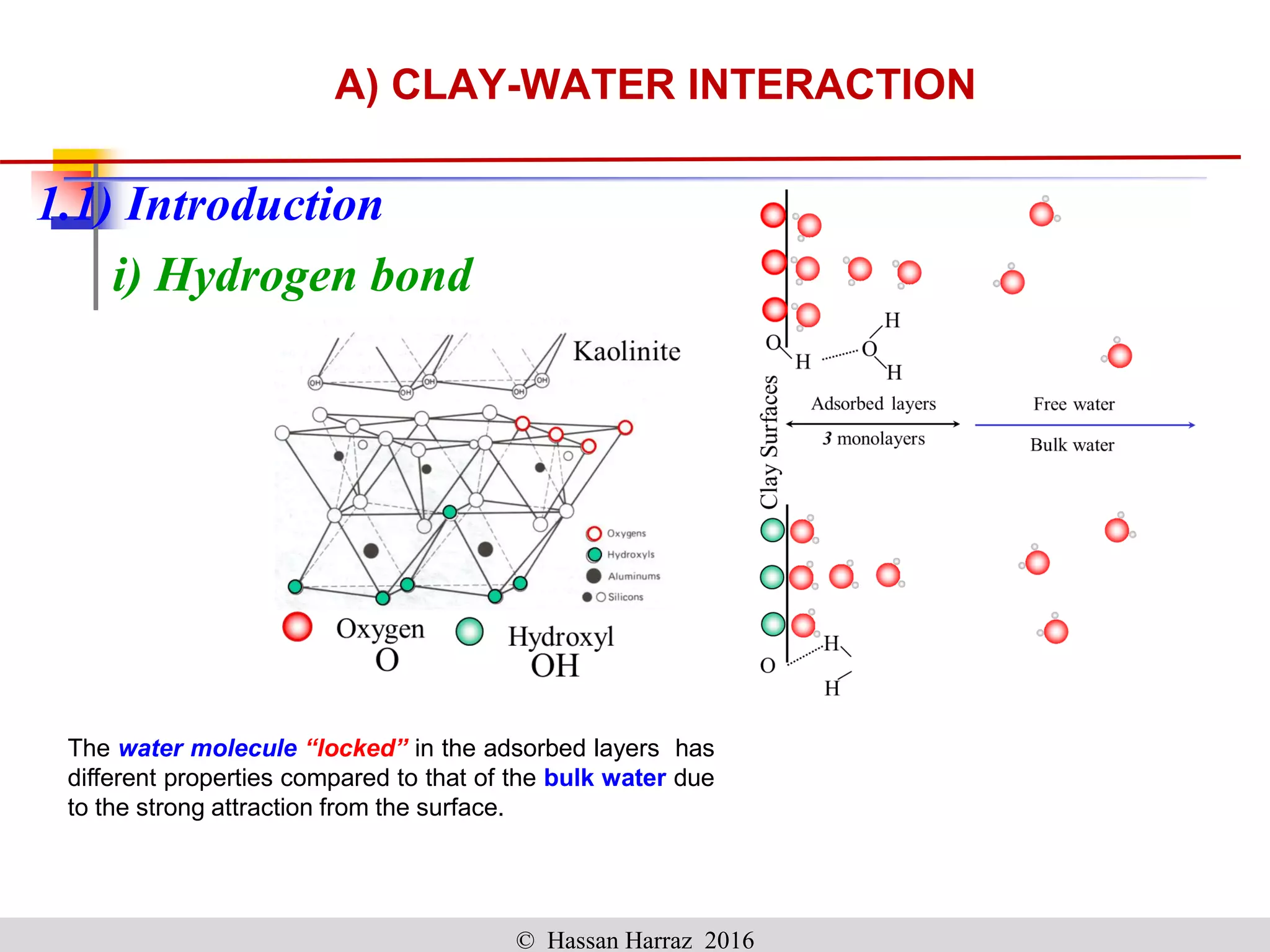
i) Hydrogen bond
The water molecule “locked” in the adsorbed layers has
different properties compared to that of the bulk water due
to the strong attraction from the surface.
© Hassan Harraz 2016
A) CLAY-WATER INTERACTION
1.1) Introduction
© Hassan Harraz 2016
ii) Ion hydration
The concentration of cations is higher in the interlayers (A) compared with that in the solution
(B) due to negatively charged surfaces. Because of this concentration difference, water
molecules tend to diffuse toward the interlayer in an attempt to equalize concentration.
iii) Osmotic pressure
From Oxtoby et al., 1994
© Hassan Harraz 2016
• External or interlayer surfaces are negatively charged in general.
• The edges can be positively or negatively charged.
• Different cations balance charge deficiencies.
Dry condition
(c)2001Brooks/Cole,adivisionofThomsonLearning,Inc.
ThomsonLearning™isatrademarkusedhereinunderlicense.
Figure 2.12 Attraction of dipolar molecules in diffuse double layer
1.2) “Charged” Clay Particles
1.2.1 ) Origins of Charge Deficiencies
© Hassan Harraz 2016
i) Imperfections in the crystal lattice -Isomorphous substitution.
 The cations in the octahedral or tetrahedral sheet can be replaced by different kinds of cations
without change in crystal structure (similar physical size of cations).
For example,
 Al3+ in place of Si4+ (Tetrahedral sheet)
 Mg2+ instead of Al3+(Octahedral sheet)
 Fe2+ instead of Mg2+(Octahedral sheet)
unbalanced charges (charge deficiencies)
 This is the main source of charge deficiencies for montmorillonite.
 Only minor isomorphous substitution takes place in kaolinite.
Isomorphous Substitution
The clay particle derives its net negative charge from the isomorphous
substitution and broken bonds at the boundaries.
 Substitution of Si4+ and Al3+ by other lower valence (e.g., Mg2+) cations,
i.e. Lower charge cations replace higher charge cations as central
cation (e.g., Mg+2 replaces Al+3).
 Leaves net negative charge {i.e., Results in charge imbalance ..→net
negative}.
 This presence in an octahedral or tetrahedral position of a cation other
than that normally found, without change in crystal structure, is
isomorphous substitution.
1.2 .1) Origins of Charge Deficiencies (Cont.)
© Hassan Harraz 2016
ii) Imperfections in the crystal lattice - The
broken edge
The broken edge can be positively or
negatively charged.
iii) Adsorbed ion charge (inner sphere
complex charge and outer sphere
complex charge)
Ions of outer sphere complexes do not lose
their hydration spheres. The inner
complexes have direct electrostatic
bonding between the central atoms.
1.2.1) Origins of Charge Deficiencies (Cont.)
© Hassan Harraz 2016
iv) Proton equilibria (pH-dependent charges)
)ionDeprotonat(OHOMOHOHM
)otonation(PrOHMHOHM
2
2




Kaolinite particles are positively charged on
their edges when in a low pH environment,
but negatively charged in a high pH (basic)
environment.
M
M
M
O
O-
O
H+
H
HM: metal
1.3) Cation Replaceability
© Hassan Harraz 2016
 Different types and quantities of cations are adsorbed to balance charge deficiencies in clay
particles.
 The types of adsorbed cations depend on the depositional environment. For example, sodium and
magnesium are dominant cations in marine clays since they are common in sea water. In general,
calcium and magnesium are the predominant cations.
 The adsorbed cations are exchangeable (replaceable). For example,
(Lambe and Whitman, 1979)
 The ease of cation replacement depends on the
i) Valence (primarily):
Higher valence cations can replace cations of lower valence.
ii) Ion size:
Cations with larger non-hydrated radii or smaller hydrated radii
have greater replacement power.
According to rules (i) and (ii), the general order of replacement is
Li+<Na+<K+<Rb+<Cs+<Mg2+<Ca2+<Ba2+<Cu2+<Al3+<Fe3+<Th4+
iii) Relative amount:
High concentration of Na+ can displace Al3+.
1.4) Cation Exchange Capacity (C.E.C)
 Capacity to attract cations (known as exchangeable cations) from the
water (i.e., measure of the net negative charge of the clay particle) .
 Clearly, it is related to surface charge density and specific surface.
 The amount of exchangeable cations in a soil or in mineral is capable of retaining
on surface.
 Charge balance of overall mineral is require:
CEC – Cations +  Anions = 0
CEC= Cations -  Anions
 The quantity of exchangeable cations is termed the cation exchangeable capacity
(CEC) and is usually expressed as milliequivalents (meq) per 100 gram of dry clay {i.e.,
meq/100g (net negative charge per 100 g of clay):
 The replacement power is greater for higher valence and larger
cations.
Al3+ > Ca2+ > Mg2+ >> NH4
+ > K+ > H+ > Na+ > Li+
 The negatively charged clay particles can attract cations from the water. These
cations can be freely exchanged with other cations present in the water.
 For example Al3+ can replace Ca2+ , and Ca2+ can replace Mg2+.
© Hassan Harraz 2016
 In units of Coulombs per gram (C/g) or in terms of milliequivalents per gram (meq/g)
 One equivalent = 6.021023 electron charges or 96500 Coulombs, which is 1 Faraday.
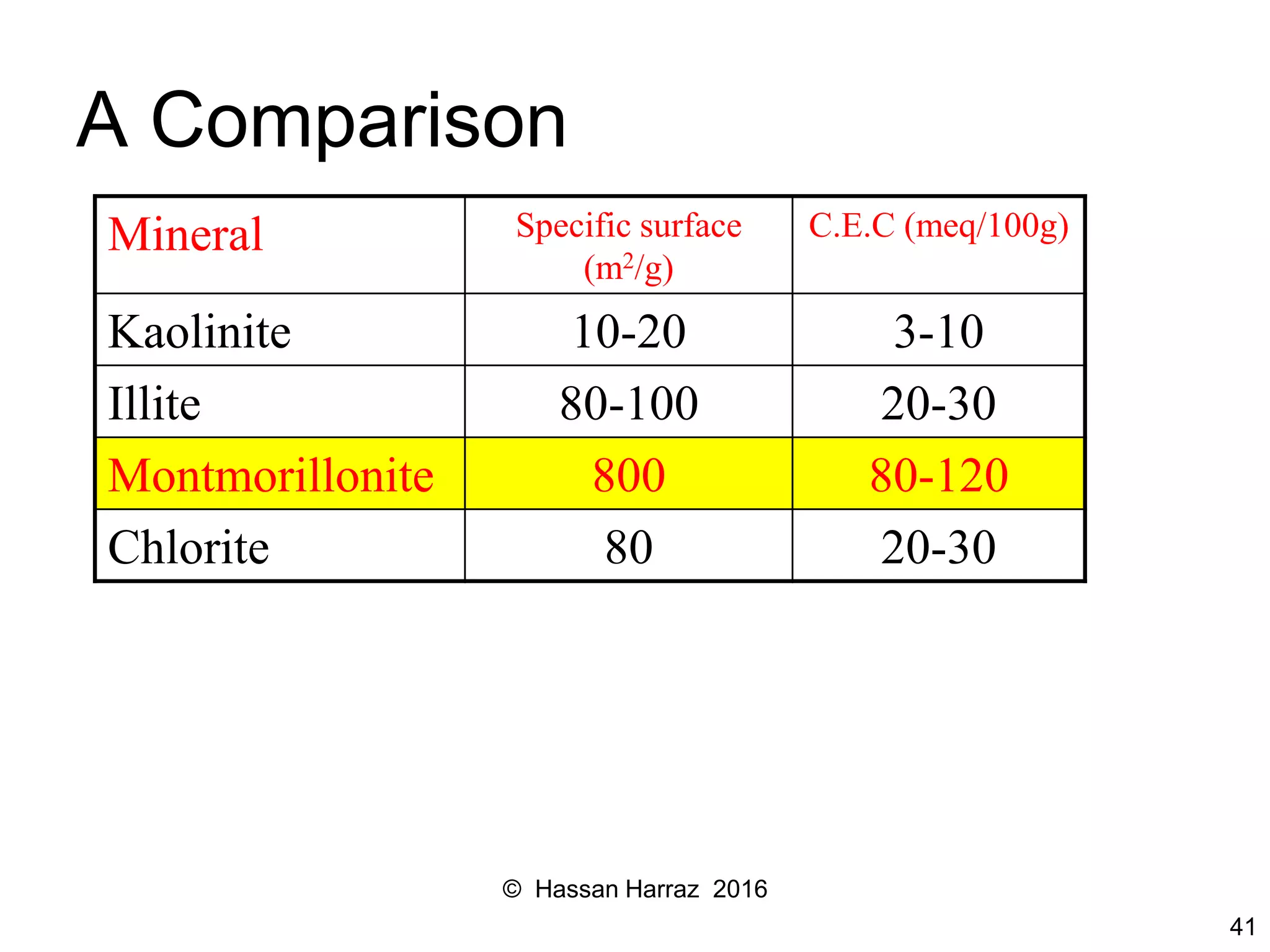
A Comparison
Mineral Specific surface
(m2/g)
C.E.C (meq/100g)
Kaolinite 10-20 3-10
Illite 80-100 20-30
Montmorillonite 800 80-120
Chlorite 80 20-30
41
© Hassan Harraz 2016
B) INTERACTION OF CLAY PARTICLES
(or LAYER, or INTERLAYERS)
© Hassan Harraz 2016
Clay particle with negatively charged surface
Plummer et al., Physical Geology 9th edition, McGraw Hill Inc, Fig. 2.19b
Main difference- ions that make up the middle of the Sandwich
© Hassan Harraz 2016
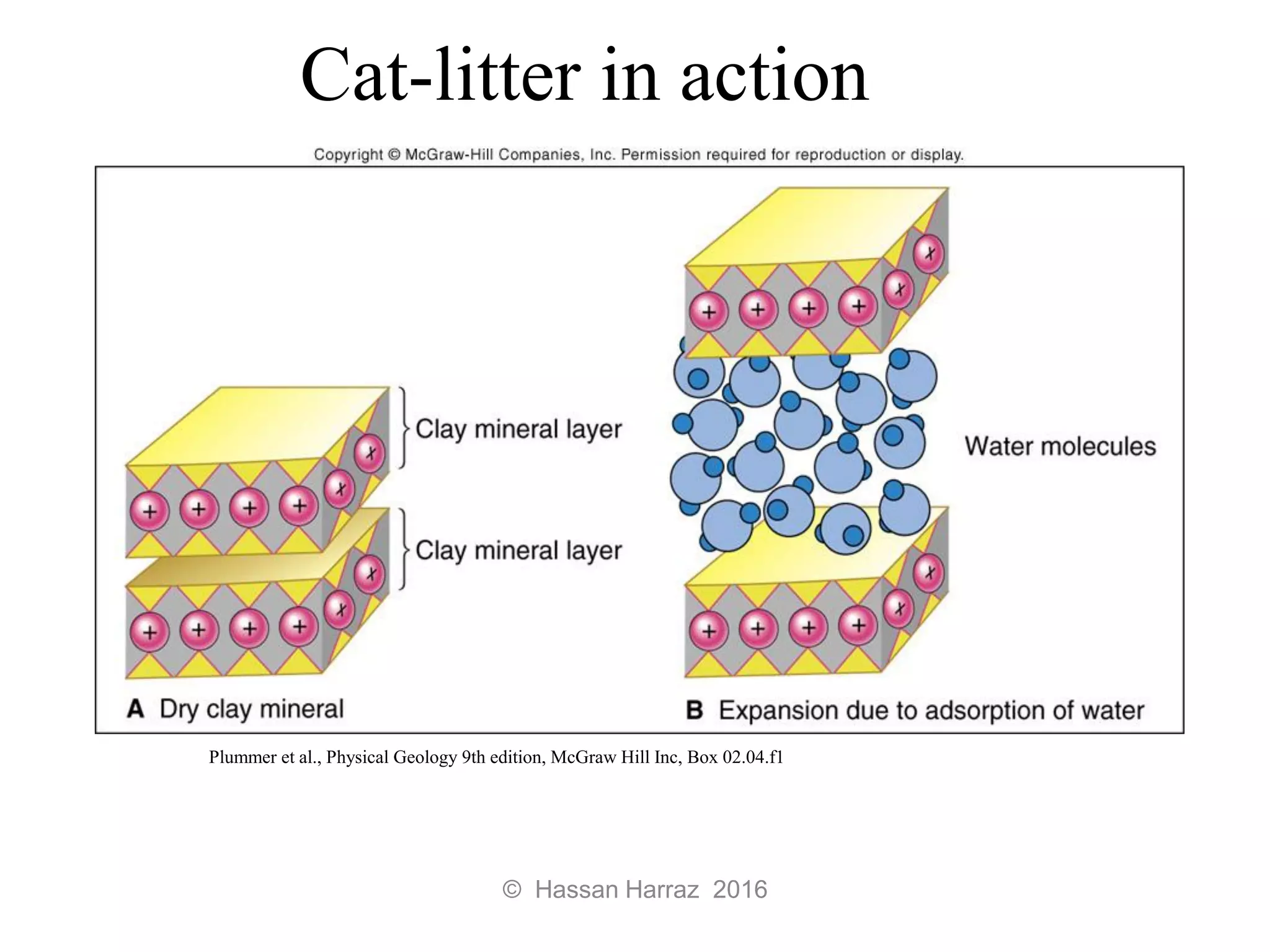
Plummer et al., Physical Geology 9th edition, McGraw Hill Inc, Box 02.04.f1
Cat-litter in action
© Hassan Harraz 2016
i) Diffuse Double Layer
© Hassan Harraz 2016
ii) Interaction Forces
© Hassan Harraz 2016
Net force between clay particles (or interlayers)
= van der Waals attraction +
Double layer repulsion (overlapping of the double layer)+
Coulombian attraction (between the positive edge and negative face)
DLVO
forces
iii) Flocculated and Aggregation of Particles
DLVO Theory
(Two Particles)
a) Van der Waals, Long-range (Attractive)
b) Electrostatic, Long-range (Attractive or Repulsive)
c) Steric, Short-range (Repulsive)
d) Solvation, Short-range (Attractive or Repulsive)
e) Born, Atomic-range (Repulsive)
Inter Particle Forces
S
iv) Terminology
 Dispersed: No face-to-face association of clay particles
 Aggregated: Face-to-face association (FF) of several clay
particles.
 Flocculated: Edge-to-Edge (EE) or edge-to-face (EF) association
 Deflocculated: No association between aggregates
Face (F)
Edge (E)
Clay Particle
van Olphen, 1991 (from Mitchell, 1993)
© Hassan Harraz 2016
v) Particle Associations
© Hassan Harraz 2016
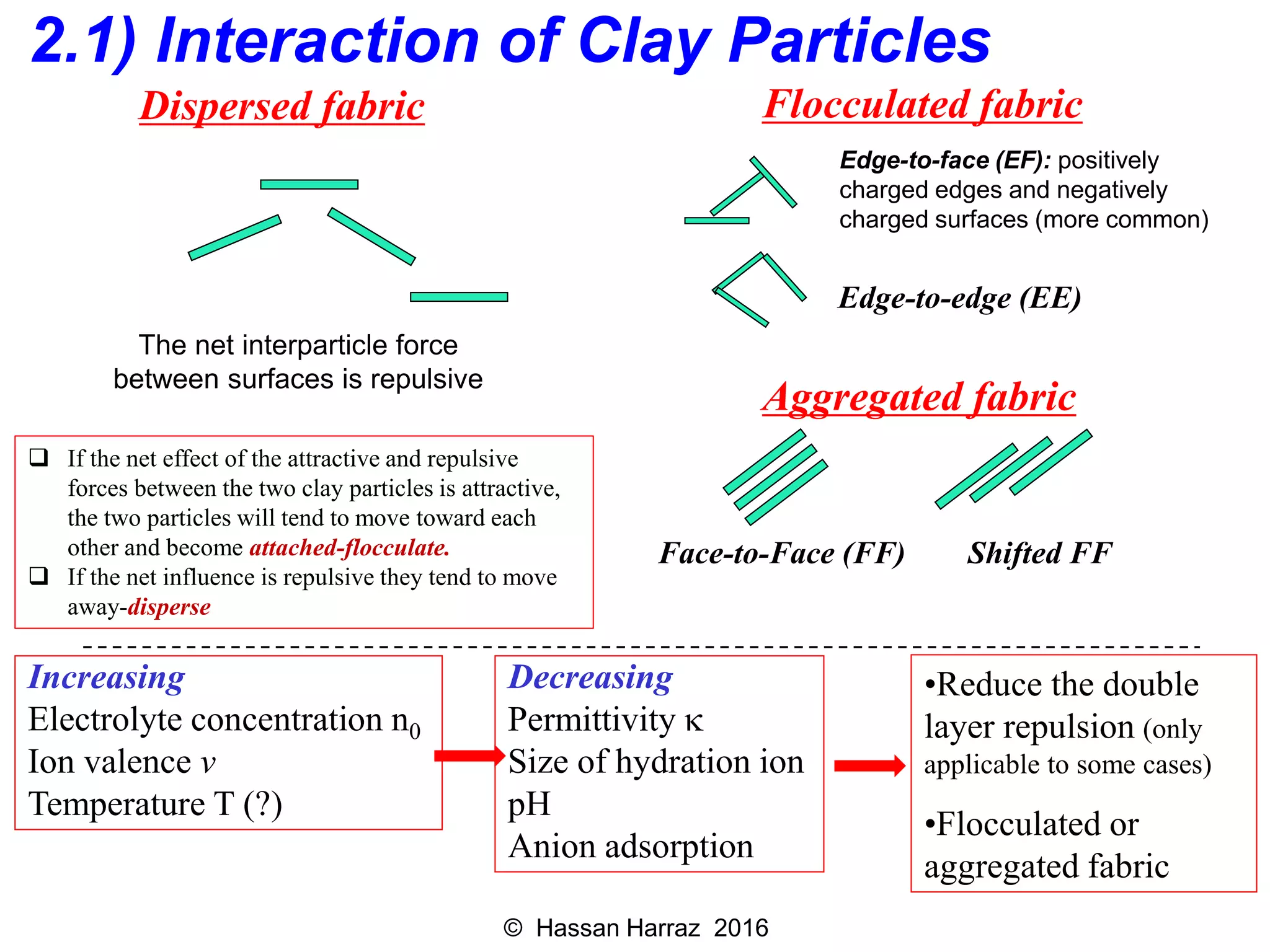
2.1) Interaction of Clay Particles
© Hassan Harraz 2016
Dispersed fabric
The net interparticle force
between surfaces is repulsive
Increasing
Electrolyte concentration n0
Ion valence v
Temperature T (?)
Decreasing
Permittivity 
Size of hydration ion
pH
Anion adsorption
•Reduce the double
layer repulsion (only
applicable to some cases)
•Flocculated or
aggregated fabric
Flocculated fabric
Edge-to-face (EF): positively
charged edges and negatively
charged surfaces (more common)
Edge-to-edge (EE)
Aggregated fabric
Face-to-Face (FF) Shifted FF
 If the net effect of the attractive and repulsive
forces between the two clay particles is attractive,
the two particles will tend to move toward each
other and become attached-flocculate.
 If the net influence is repulsive they tend to move
away-disperse
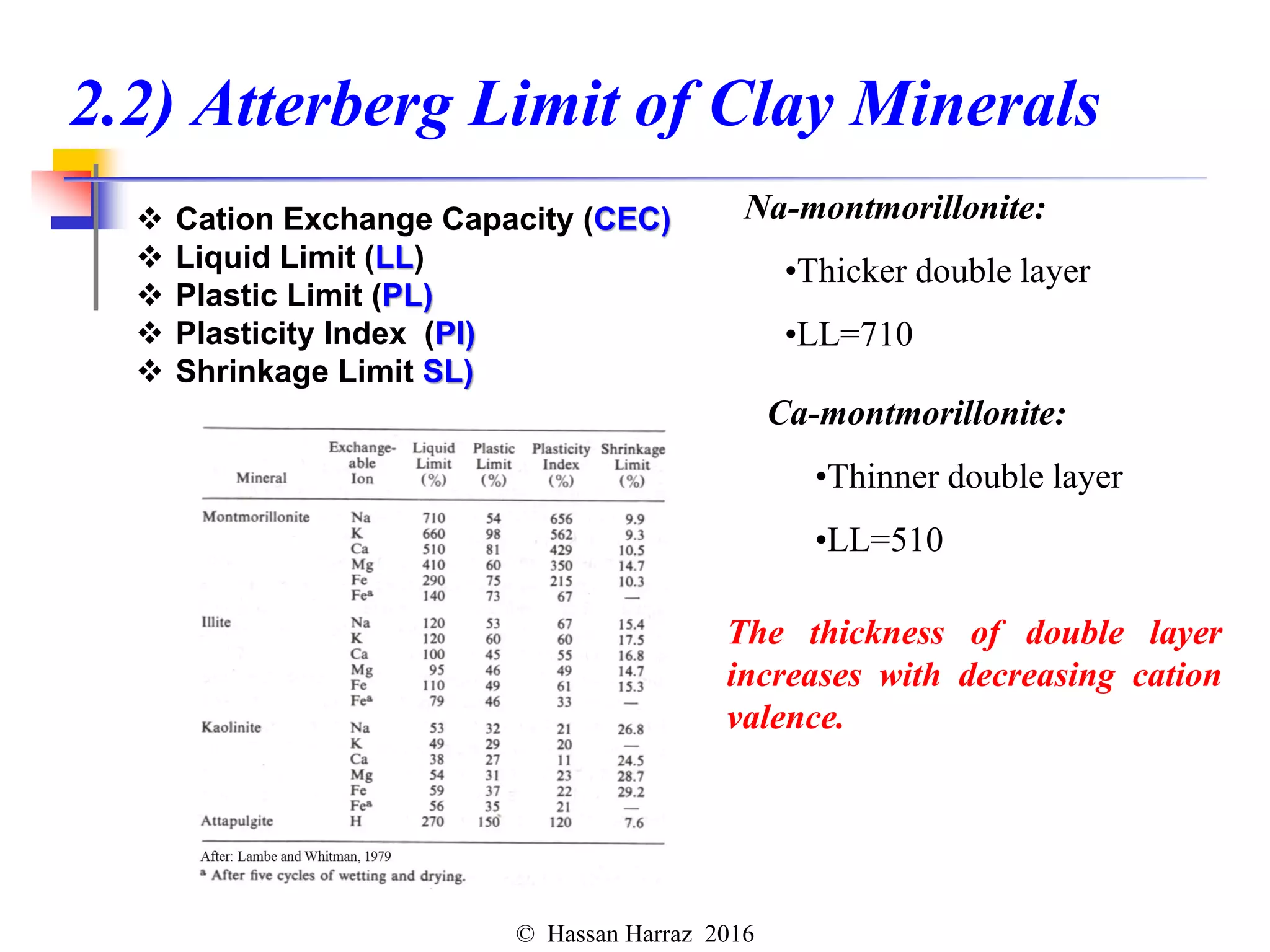
2.2) Atterberg Limit of Clay Minerals
Na-montmorillonite:
•Thicker double layer
•LL=710
Ca-montmorillonite:
•Thinner double layer
•LL=510
The thickness of double layer
increases with decreasing cation
valence.
© Hassan Harraz 2016
 Cation Exchange Capacity (CEC)
 Liquid Limit (LL)
 Plastic Limit (PL)
 Plasticity Index (PI)
 Shrinkage Limit SL)
C) SWELLING CLAYS
© Hassan Harraz 2016
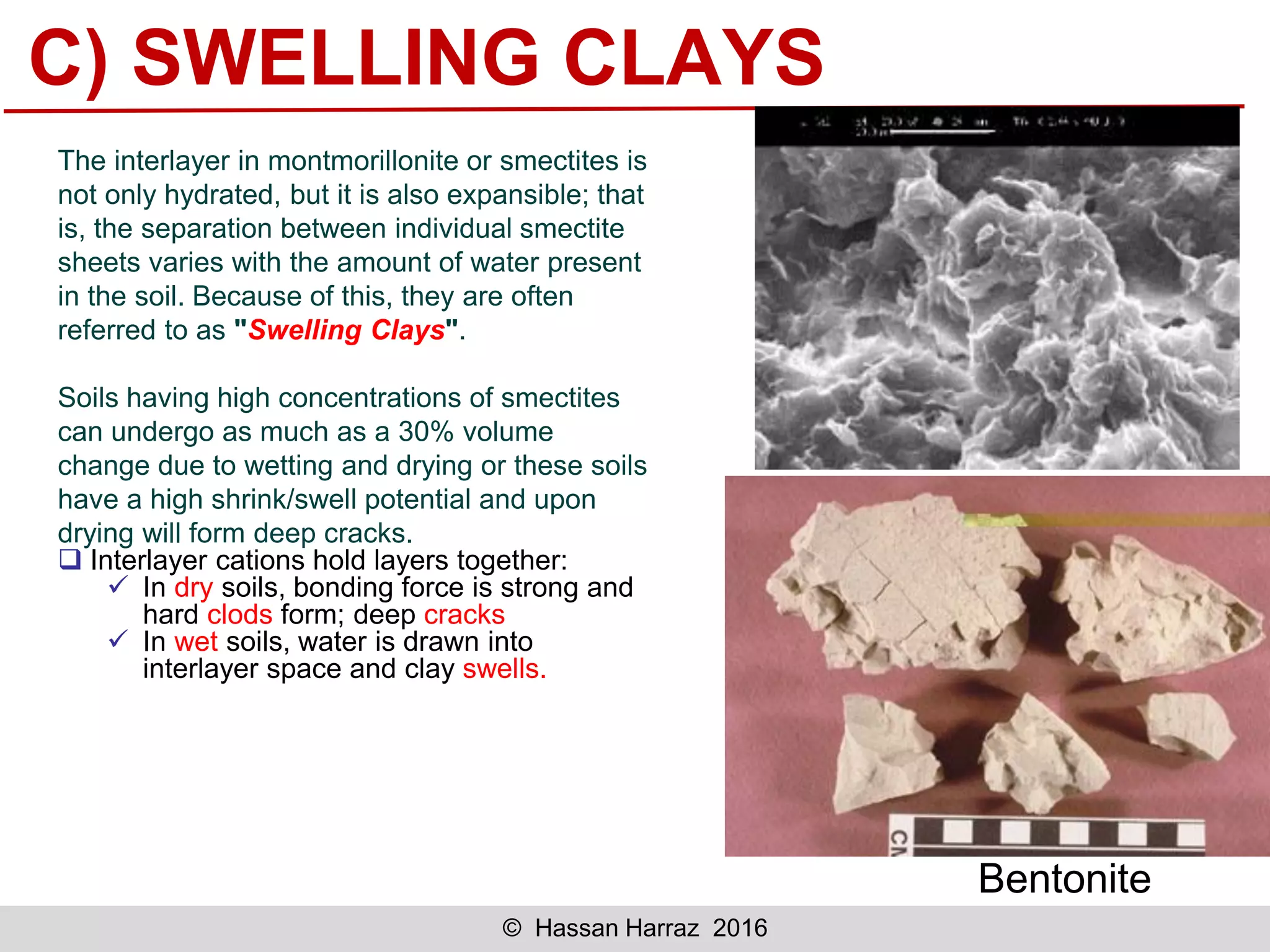
The interlayer in montmorillonite or smectites is
not only hydrated, but it is also expansible; that
is, the separation between individual smectite
sheets varies with the amount of water present
in the soil. Because of this, they are often
referred to as "Swelling Clays".
Soils having high concentrations of smectites
can undergo as much as a 30% volume
change due to wetting and drying or these soils
have a high shrink/swell potential and upon
drying will form deep cracks.
 Interlayer cations hold layers together:
 In dry soils, bonding force is strong and
hard clods form; deep cracks
 In wet soils, water is drawn into
interlayer space and clay swells.
Bentonite
3.1) Swelling Potential
© Hassan Harraz 2016
Practically speaking, the three ingredients generally necessary for potentially damaging
swelling to occur are:
i) presence of montmorillonite in the soil,
ii) the natural water content must be around the Plastic Limit (PL), and
iii) there must be a source of water for the potentially swelling clay (Gromko, 1974, from Holtz
and Kovacs, 1981)
3.2) Engineering Applications for Swelling Clay
i) Lime treatment for the swelling clay
 The swelling clay such as Na-montmorillonite beneath the foundation is
potentially harmful to the light structure.
 Adding lime (CaO) into such soil can effectively reduce the swelling
potential due to Ca2+ displacing Na+, and can increase the strength by
dehydration of soils and cementation.
© Hassan Harraz 2016
The swelling clays can form a
so-called “filter cake” and
enable soil layers to become
relatively impermeable.
Earth pressure and
ground water
pressure
Pressure profile
of slurry
TrenchMontmorillonite is the dominant clay mineral in bentonite Xanthakos, 1991
3.2) Engineering Applications for Swelling Clay (cont.)
ii) Dispersion agents (drilling mud; hydrometer analysis)
• Sodium hexa-metaphosphate (NaPO3) and sodium silicate (Na2SiO3) are used as the
dispersion agent in the hydrometer analysis.
• How does this dispersion agent work?
 Three hypotheses:
a) Edge-charge reversal:
The anions adsorption onto the edge of the clay particle may neutralize the positive
edge-charge or further reverse the edge-charge from positive to negative. The edge-
charge reversal can form a negative double layer on the edge surfaces to break down
flocculated structure, and assist in forming a dispersed structure.
b) Ion exchange:
The sodium cations can replace the divalent cations existing in the clay particles such
as Ca2+ and Mg2+. The decrease of cation valence can increase the thickness of the
double layer and interparticle repulsion, which can assist in forming a dispersed
structure.
c) pH:
The higher pH may make the edge-charge tend to be negative, which can break down
the flocculated structure and assist in forming a dispersed structure. The adding of
dispersing agent such as sodium carbonate may slightly increase the pH.
© Hassan Harraz 2016
Biomedical Applications of Cationic Clay Minerals
Clay minerals have been a subject of interest owing to
their ready availability in nature, a wide range of
applications in various industries, and particularly their
current and potential biomedical applications. They have
been widely used for curative and protective purposes by
humans since ancient times.
Cationic clay minerals possess specific physicochemical
characteristics such as high surface reactivity (high
adsorption, cation exchange, colloidal or swelling
capacity), good rheological behavior, high acid-absorbing
capacity, and high dispersibility in water, which renders
them suitable for various biomedical applications.
There is no updated review focusing on cationic clay
minerals and their applications in pharmaceuticals,
cosmetics, and regenerative medicine.
A brief introduction on natural, synthetic, and hybrid
cationic clay minerals followed by a detailed discussion
about their applications in biological systems.
© Hassan Harraz 2016
Applications of Modified and Unmodified Cationic Clay Minerals in
Various Biological Systems
© Hassan Harraz 2016
Different Biomolecule and Drug Adsorption Sites on a
Cationic Clay Mineral:
1) Surface site,
2) Edge site,
3) Inter-lamellar site
© Hassan Harraz 2016
Representation of a Clay-Based Material in Biosensors
© Hassan Harraz 2016

Beneficiation and mineral processing of clay minerals

  • 1.
    Beneficiation and MineralProcessing of Clay Minerals Hassan Z. Harraz hharraz2006@yahoo.com 2015- 2016 © Hassan Harraz 2016
  • 2.
    OUTLİNE OF LECTURE6: Examples Mineral processing: 7.1) Structure of Clay 7.2) Types of Clay Minerals 7.3) Different Silicate Clay Minerals 7.4) Clay Grades 7.4.1) China Clay Processing 7.5) PROPERTY CHARACTERIZATION OF CLAY MINERALS A) CLAY-WATER INTERACTION A-1) Introduction i) Hydrogen bond ii) Ion hydration iii) Osmotic pressure A-2) “Charged” Clay Particles A-2.1 ) Origins of Charge Deficiencies Isomorphous Substitution i) Imperfections in the crystal lattice -Isomorphous substitution. ii) Imperfections in the crystal lattice - The broken edge: iii) Proton equilibria (pH-dependent charges): iv) Adsorbed ion charge (inner sphere complex charge and outer sphere complex charge: A-.3) Cation Replaceability A-4) Cation Exchange Capacity B) INTERACTION OF CLAY PARTICLES B-1) Introduction i) Diffuse Double Layer ii) Interaction Forces iii) Terminology iv) Particle Associations B-2) Interaction of Clay Particles C) SWELLING CLAYS C-1) Swelling Potential C-.2) Engineering Applications for Swelling Clay i) Lime treatment for the swelling clay ii) Dispersion agents (drilling mud; hydrometer analysis) © Hassan Harraz 2016
  • 3.
     Clay isa naturally occurring material composed primarily of fine grained minerals, which shows plasticity through a variable range of water content and which can be hardened when dried or fired.  Clay deposits are mostly composed of clay minerals (phyllosilicate minerals) and variable amount of water trapped in the mineral.  Clay materials have been investigated because of their importance in agriculture, in ceramics, in construction and other uses. CLAY
  • 4.
     Adsorption mechanismof clay colloids: Clay minerals have weekly bound hydrated interlayers Interlayer cations can be displaced by other cations from aqueous solution to give an ion- exchange reaction  Mineral Suspension Technology: Eliminates non-essential elements Optimizes Absorption and Adsorption processes Enhances the Ionic exchange process Creating a multitude of Natural Product Applications
  • 5.
    © Hassan Harraz2016 © Hassan Harraz 2016
  • 6.
    Abu Darag RedClays outcrops along New Road of Zaafarana - Ain El-Sukhna , Gulf of Suez, Egypt Primary Sedimentary structures © Hassan Harraz 2016
  • 7.
    7) CLAY MINERALS Claysare formed from rocks which have been weathered by physical and chemical action, (e.g. orthoclase, a mineral found in granite, reacts with H2O and CO2 from the atmosphere as follows): K2O.Al2O3.6SiO2 + 2H2O + CO2 → Al2O3.2SiO2.2H2O + 4SiO2 + K2CO3 orthoclase kaolin clay Clay is a naturally occurring material composed primarily of fine grained clay minerals (Clay particles are <2 microns) and variable amount of water trapped in the mineral, which shows plasticity through a variable range of water content and which can be hardened when dried or fired. Clay minerals exhibit colloidal behaviour. That is, their surface forces have greater influence than the negligible gravitational forces. Clay minerals (phyllosilicate minerals) consist of tiny particles often in flat, plate-like or needles. They are negatively charged. When mixed with water the crystals can easily slide over each other (like a pack of cards), and this phenomenon gives rise to the plasticity of clays. Clays are plastic; Silts, sands and gravels are non-plastic. Clay materials are used in in agriculture, in construction, in ceramics (i.e., whiteware formulations and aluminosilicate refractories) to produce plasticity in forming and resistance to deformation when partial fusion occurs during firing. Bentonite and other clays are used in the drilling of oil and water wells. The clays are turned into mud, which seals the walls of the boreholes, cooling and cleaning the drill, lubricates the drill head and removes drill cuttings. © Hassan Harraz 2016
  • 8.
    Structure of Clay Allhave layers of Si tetrahedra and layers of Al, Fe, Mg octahedra, similar to gibbsite or brucite SEM view of clay Connected tetrahedra, sharing oxygensTetrahedron and Tetrahedral sheets Connected octahedra, sharing oxygens or hydroxylsOctahedron and Octahedral Sheets Silicon tetrahedron silicon oxygen hydroxyl or oxygen aluminium or magnesium Aluminium Octahedron Clay minerals are made of two distinct structural units All clay mineral are made of different combinations of the above two sheets: tetrahedral sheet and octahedral sheet. © Hassan Harraz 2016
  • 9.
    7.1) GENERAL STRUCTUREOF CLAY (a) Silica tetrahedron (b) Alumina octahedral  Composed of tetrahedral and octahedral “Sandwiches”  Tetrahedron: central cation (Si+4, Al+3) surrounded by 4 oxygens  Octahedron: central cation (Al+3,Fe+2, Mg+2) surrounded by 6 oxygens (or hydroxyls)  The silicon ions are in fourfold coordination with oxygen, and the vertices of all the SiO4 tetrahedra point in one direction. These apical oxygens link the tetrahedral layer to another sub-layer, called the octahedral layer, which is formed by Al ions in six-fold coordination with O and OH. The oxygens form a hexagonal ring of approximately the same size as the SiO rings. A kaolinite crystal consists of a stack of many layer with adjacent units linked by hydrogen bonds. This structure is broken down when the clay body is fired.  Sheets combine to form layers. Layers are separated by interlayer space  Water, adsorbed cations Water plays a critical role in many clay minerals. Contains elements that act as bonding agents:  keeps the crystalline structure together.  Most notable are the H+ and the OH- cations and anions. In many circumstances the water can be driven off or can facilitate ion substitution, especially in 2:1 © Hassan Harraz 2016
  • 10.
  • 11.
    7.2) Types ofClay Minerals 1) Silicate Clays (crystalline) 2) Sesquioxide/oxidic clays 3) Amorphous clays (non-crystalline, Mixed layer) © Hassan Harraz 2016
  • 12.
    Silicate Clays (crystalline) Mitchell,1993 © Hassan Harraz 2016 1:1 one tetrahedron sheet to one octahedral sheet Different types of silicate clays are composed of sandwiches (combinations) of layers with various substances in their interlayer space. 2:1 two tetrahedral sheets to one octahedral sheet The bonding between the sheet is convalent bond.
  • 13.
    1:1 phyllosilicate Clay Mineral(e.g., kaolinite, halloysite) 2:1 phyllosilicate Clay Mineral (e.g., montmorillonite, illite) 7.3) Different Silicate Clay Minerals  All clay mineral are made of different combinations of the above two sheets: tetrahedral sheet and octahedral sheet.  Different combinations of tetrahedral and octahedral sheets form different clay minerals: © Hassan Harraz 2016
  • 14.
    CLASSIFICATION OF CLAY (b)2:1 clay structure(a) 1:1 clay structure nH2O and exchangeable cations Alumina Sheet Silica Sheet Alumina Sheet Silica Sheet Hydrogen Bonding Alumina Sheet Silica Sheet Silica Sheet Alumina Sheet Silica Sheet Silica Sheet © Hassan Harraz 2016
  • 15.
    Interlayer surface Montmorillonite Illite Kaolinite 50-120 m2/gm(external surface) 700-840 m2/gm (including the interlayer surface) 65-100 m2/gm 10-20 m2/gm Interlayer surface © Hassan Harraz 2016
  • 16.
    Expanding and non-expandingcationic-CMs: the arrangement of tetrahedral sheets with octahedral sheets gives rise to various classes of clay minerals ExpandingNon-Expanding © Hassan Harraz 2016
  • 17.
    Clays are categorizedinto six groups: 1) Kaolin or China clay: white, claylike material composed mainly of kaolinite industrial applications: paper coating and filling, refractories, fiberglass and insulation, rubber, paint, ceramics, and chemicals 2) Ball clay:  is a sedimentary clay of fine particle size containing complex organic matter ranging down to a submicron size.  kaolin with small amount of impurities industrial application: dinnerware, floor tile, pottery, sanitary ware. 3) Fire clays: kaolin with substantial impurities (diaspore, flint) industrial applications: refractories 4) Bentonite: clay composed mainly of smectite (or montmorillonite) industrial applications: drilling muds, foundry sands 5) Fuller’s earth: nonplastic clay high in magnesia, a similar to bentonite industrial applications: absorbents 6) Shale: laminated sedimentary rock consisting mainly of clay minerals mud industrial application: raw material in cement and brick manufacturing 7.3) Clay Grades © Hassan Harraz 2016
  • 18.
    Si Al Si Al Si Al Si Al joined by strongH-bond no easy separation 0.72 nm Typically 70- 100 layers joined by oxygen sharing a) Kaolinite layer © Hassan Harraz 2016
  • 19.
    © Hassan Harraz2016 Kaolin mine south west Aswan Abu Darag Red Clays outcrops along New Road of Zaafarana - Ain El-Sukhna , Gulf of Suez, Egypt
  • 20.
    a) Kaolinite  1:1phyllosilicate Minerals  Kaolin is a relatively pure, white firing clay composed principally of the mineral kaolinite Al2Si2O5(OH)4 but containing other clay minerals, and a minor amount of impurity minerals such as quartz (SiO2), ilmenite (FeTiO3), rutile (TiO2), and hematite (Fe2O3).  Platy shape  The bonding between layers are van der Waals forces and hydrogen bonds (strong bonding).  Hydrogen bonds in interlayer space  strong  There is no interlayer swelling  Nonexpandable  Low cation exchange capacity (CEC)  Width: 0.1~ 4m  Thickness: 0.05~2 m  Particles can grow very large (0.2 – 2 µm)  Effective surface area = 10 – 30 m2/g  External surface only  Kaolinite is used for making paper, paint, pottery and pharmaceutical industries. Kaolin clay is the clay most commonly used for pottery-making and, in common with all clays, the clay particles or crystals have a special layer structure. © Hassan Harraz 2016
  • 21.
    Blunging :(high-energy mixingwith water) to a dispersed 30-40% solids liquid slurry. The kaolin is mixed with water and chemical dispersants, which puts the clay particles in suspension (slurry). De-gritting: Degritting to – 220 mesh (- 75 µm) to remove coarse sand and mica. The slurried kaolin is usually transported through pipelines to degritting facilities (rakes), where sand, mica and other impurities are extracted with the help of gravity. Blending to achieve optimum mix of particle size, and to equalize variation of other quality parameters. Centrifuging: Centrifugation to product particle size (50% - 100% < 2 µm).The centrifuge separates the fine kaolin particles from coarse particles. Fine particles, still in the form of a slurry, move on for further processing. 7.3.1) China Clay processing De-gritting (rake) tables © Hassan Harraz 2016 A typical wet-processed kaolin shown above undergoes many of the following steps:
  • 22.
    Flow Sheet forBeneficiation Process of kaolin Wet Screening Apron Drying Rotary Vacuum Filtration Raw Clay (1 ton) Slurry Tank Car Hopper Car Box Car or Truck Bagging Calcining Klin Water (4 tons) Portable Blunger Grit Grit Pump Calcined Chemical Leaching or Magnetic Separation Surface Modification Spray Dryer Centrifugal classification Slurry Blending and Storage © Hassan Harraz 2016 HYDROUS KAOLIN Pipeline from Wet Plant Pulverizing Tailings Dam Tailings Dam CALCINED KAOLIN Stage 1 Processing: Wet Plant Stage 2 Processing: Dry Plant
  • 23.
    © Hassan Harraz2016 Step by Step of wet-processed of kaolin Beneficiation
  • 24.
    © Hassan Harraz2016 Flow chart show Wet-processed of Kaolin Beneficiation
  • 25.
    Delamination: Delimination toreduce particle size, increase aspect ratio (ratio of diameter to thickness), and improve brightness.For customers who want a delaminated clay product suited for lightweight coating applications, coarse kaolinite particles are used as starting material. Delamination occurs as the coarse particles of kaolin which when magnified appear as "booklets" are broken into thin platelets by mechanical milling. Brightness enhancement: Undesirable colors are removed through one or more processes including reductive leaching, flocculation, ozonation (i.e., ozone oxidation), magnetic separation, froth flotation, and oxidation, which will remove iron oxides, titanium oxides, organic, and other undesirable materials. Filtering and drying: Filtration to ~55% solids, spray drying or evaporation, repulping to 70% solids slurry or selling as dry-pigment product. Large rotary vacuum filters remove water from the slurried kaolin. Large gas-fired spray dryers remove and evaporate the remaining moisture. Optional calcination to a higher brightness and more opaque pigment product. 7.3.1) China Clay processing (cont.) © Hassan Harraz 2016 Some materials are calcined, and a hard aggregate is formed Dried cake or calcined materials may be pulverized or ground and then sized or air elutriated before bagging or loading in hopper cars. Many fine materials are loaded and unloaded using pneumatic fluidization and are stored at the plant site m large silos.
  • 26.
    b) Montmorillonite (orMg-Smectite clays) Si Al Si Si Al Si Si Al Si 0.96 nm joined by weak van der Waal’s bond easily separated by water  also called Smectite; expands on contact with water A highly reactive (expansive) clay swells on contact with water (OH)4Al4Si8O20.nH2O high affinity to water © Hassan Harraz 2016
  • 27.
    b) Montmorillonite (orMg-Smectite clays)  Montmorilonite (nanoclay raw material).  Film-like shape.  Width: 1 or 2 m  Thickness: 10 Å (~1/100) width  Montmorillonite: is Mg form of smectite, with a general chemical formula : (Na, Ca)(Al,Mg, Fe)6(Si4O10)3(OH)6-nH2O  Montmorillonite or smectite is family of expansible 2:1 phyllosilicate clays having permanent layer charge because of the isomorphous substitution in either the octahedral sheet (typically from the substitution of low charge species such as Mg2+ , Fe2+, or Mn2+ for Al3+)  There is extensive isomorphous substitution for silicon and aluminum by other cations, which results in charge deficiencies of clay particles. Always negative due to isomorphous substitution  Cations adsorbed in interlayer space. n·H2O and cations exist between unit layers, and the basal spacing is from 9.6 Å to  (after swelling).  Maximum Swelling. There exists interlayer swelling, which is very important to engineering practice (expansive clay).  Layers weakly held together by weak O-O bonds or cation-O bonds. The interlayer bonding is by van der Waals forces and by cations which balance charge deficiencies (weak bonding). Expandable: Most expandable of all clays  Montmorillonites have very high specific surface (650 – 800 m2/g) {i.e., Internal surface area >> external surface area}, high cation exchange capacity (CEC), and high affinity to water. They form reactive clays.  Montmorillonites have very high liquid limit (100+), plasticity index and activity (1-7). © Hassan Harraz 2016
  • 28.
     Montmorillinite canexpand by several times its original volume when it comes in contact with water. This makes it useful as a drilling mud (to keep drill holes open), in slurry trench walls, stopping leakage in soil, rocks, and dams. Most important is as drilling mud in which the montmorillonite is used to give the fluid viscosity several times that of water.  Montmorillinite, however, is a dangerous type of clay to encounter if it is found in tunnels or road cuts. Because of its expandable nature, it can lead to serious slope or wall failures.  Bentonite:  Montmorillinite is the main constituent of bentonite, derived by weathering of volcanic ash.  montmorillonite family  the essential nanoclay raw material  used as drilling mud, in slurry trench walls, stopping leakages; lubricant b) Montmorillonite Bentonite-bearing shales, such as in the Painted Desert, are derived from weathering of volcanic ash. © Hassan Harraz 2016
  • 29.
    Uses of Clay- Drilling Mud Bentonite and other clays are used in the drilling of oil and water wells. The clays are turned into mud, which seals the walls of the boreholes, lubricates the drill head and removes drill cuttings. Drilling mud slurry Cooling and cleaning the drill “Gushers” used to be common until the use of drilling mud was implemented deep oil is at high pressure © Hassan Harraz 2016
  • 30.
    Uses of Clay- Contaminant Removal Clay slurrys have effectively been used to remove a range of comtaminants, including P and heavy metals, and overall water clarification. Schematic of montmorillonite absorbing Zn © Hassan Harraz 2016
  • 31.
    7.5) PROPERTY CHARACTERIZATIONOF CLAY MINERALS © Hassan Harraz 2016
  • 32.
    © Hassan Harraz2016 Polar Water Molecules Structure Polar molecule H(+) H(+) O(-) Salts in aqueous solution Hydration Hydrogen bond Dipolar character of water
  • 33.
    i) Hydrogen bond Thewater molecule “locked” in the adsorbed layers has different properties compared to that of the bulk water due to the strong attraction from the surface. © Hassan Harraz 2016 A) CLAY-WATER INTERACTION 1.1) Introduction
  • 34.
    © Hassan Harraz2016 ii) Ion hydration The concentration of cations is higher in the interlayers (A) compared with that in the solution (B) due to negatively charged surfaces. Because of this concentration difference, water molecules tend to diffuse toward the interlayer in an attempt to equalize concentration. iii) Osmotic pressure From Oxtoby et al., 1994
  • 35.
    © Hassan Harraz2016 • External or interlayer surfaces are negatively charged in general. • The edges can be positively or negatively charged. • Different cations balance charge deficiencies. Dry condition (c)2001Brooks/Cole,adivisionofThomsonLearning,Inc. ThomsonLearning™isatrademarkusedhereinunderlicense. Figure 2.12 Attraction of dipolar molecules in diffuse double layer 1.2) “Charged” Clay Particles
  • 36.
    1.2.1 ) Originsof Charge Deficiencies © Hassan Harraz 2016 i) Imperfections in the crystal lattice -Isomorphous substitution.  The cations in the octahedral or tetrahedral sheet can be replaced by different kinds of cations without change in crystal structure (similar physical size of cations). For example,  Al3+ in place of Si4+ (Tetrahedral sheet)  Mg2+ instead of Al3+(Octahedral sheet)  Fe2+ instead of Mg2+(Octahedral sheet) unbalanced charges (charge deficiencies)  This is the main source of charge deficiencies for montmorillonite.  Only minor isomorphous substitution takes place in kaolinite. Isomorphous Substitution The clay particle derives its net negative charge from the isomorphous substitution and broken bonds at the boundaries.  Substitution of Si4+ and Al3+ by other lower valence (e.g., Mg2+) cations, i.e. Lower charge cations replace higher charge cations as central cation (e.g., Mg+2 replaces Al+3).  Leaves net negative charge {i.e., Results in charge imbalance ..→net negative}.  This presence in an octahedral or tetrahedral position of a cation other than that normally found, without change in crystal structure, is isomorphous substitution.
  • 37.
    1.2 .1) Originsof Charge Deficiencies (Cont.) © Hassan Harraz 2016 ii) Imperfections in the crystal lattice - The broken edge The broken edge can be positively or negatively charged. iii) Adsorbed ion charge (inner sphere complex charge and outer sphere complex charge) Ions of outer sphere complexes do not lose their hydration spheres. The inner complexes have direct electrostatic bonding between the central atoms.
  • 38.
    1.2.1) Origins ofCharge Deficiencies (Cont.) © Hassan Harraz 2016 iv) Proton equilibria (pH-dependent charges) )ionDeprotonat(OHOMOHOHM )otonation(PrOHMHOHM 2 2     Kaolinite particles are positively charged on their edges when in a low pH environment, but negatively charged in a high pH (basic) environment. M M M O O- O H+ H HM: metal
  • 39.
    1.3) Cation Replaceability ©Hassan Harraz 2016  Different types and quantities of cations are adsorbed to balance charge deficiencies in clay particles.  The types of adsorbed cations depend on the depositional environment. For example, sodium and magnesium are dominant cations in marine clays since they are common in sea water. In general, calcium and magnesium are the predominant cations.  The adsorbed cations are exchangeable (replaceable). For example, (Lambe and Whitman, 1979)  The ease of cation replacement depends on the i) Valence (primarily): Higher valence cations can replace cations of lower valence. ii) Ion size: Cations with larger non-hydrated radii or smaller hydrated radii have greater replacement power. According to rules (i) and (ii), the general order of replacement is Li+<Na+<K+<Rb+<Cs+<Mg2+<Ca2+<Ba2+<Cu2+<Al3+<Fe3+<Th4+ iii) Relative amount: High concentration of Na+ can displace Al3+.
  • 40.
    1.4) Cation ExchangeCapacity (C.E.C)  Capacity to attract cations (known as exchangeable cations) from the water (i.e., measure of the net negative charge of the clay particle) .  Clearly, it is related to surface charge density and specific surface.  The amount of exchangeable cations in a soil or in mineral is capable of retaining on surface.  Charge balance of overall mineral is require: CEC – Cations +  Anions = 0 CEC= Cations -  Anions  The quantity of exchangeable cations is termed the cation exchangeable capacity (CEC) and is usually expressed as milliequivalents (meq) per 100 gram of dry clay {i.e., meq/100g (net negative charge per 100 g of clay):  The replacement power is greater for higher valence and larger cations. Al3+ > Ca2+ > Mg2+ >> NH4 + > K+ > H+ > Na+ > Li+  The negatively charged clay particles can attract cations from the water. These cations can be freely exchanged with other cations present in the water.  For example Al3+ can replace Ca2+ , and Ca2+ can replace Mg2+. © Hassan Harraz 2016  In units of Coulombs per gram (C/g) or in terms of milliequivalents per gram (meq/g)  One equivalent = 6.021023 electron charges or 96500 Coulombs, which is 1 Faraday.
  • 41.
    A Comparison Mineral Specificsurface (m2/g) C.E.C (meq/100g) Kaolinite 10-20 3-10 Illite 80-100 20-30 Montmorillonite 800 80-120 Chlorite 80 20-30 41 © Hassan Harraz 2016
  • 42.
    B) INTERACTION OFCLAY PARTICLES (or LAYER, or INTERLAYERS) © Hassan Harraz 2016 Clay particle with negatively charged surface
  • 43.
    Plummer et al.,Physical Geology 9th edition, McGraw Hill Inc, Fig. 2.19b Main difference- ions that make up the middle of the Sandwich © Hassan Harraz 2016
  • 44.
    Plummer et al.,Physical Geology 9th edition, McGraw Hill Inc, Box 02.04.f1 Cat-litter in action © Hassan Harraz 2016
  • 45.
    i) Diffuse DoubleLayer © Hassan Harraz 2016
  • 46.
    ii) Interaction Forces ©Hassan Harraz 2016 Net force between clay particles (or interlayers) = van der Waals attraction + Double layer repulsion (overlapping of the double layer)+ Coulombian attraction (between the positive edge and negative face) DLVO forces iii) Flocculated and Aggregation of Particles DLVO Theory (Two Particles) a) Van der Waals, Long-range (Attractive) b) Electrostatic, Long-range (Attractive or Repulsive) c) Steric, Short-range (Repulsive) d) Solvation, Short-range (Attractive or Repulsive) e) Born, Atomic-range (Repulsive) Inter Particle Forces S
  • 47.
    iv) Terminology  Dispersed:No face-to-face association of clay particles  Aggregated: Face-to-face association (FF) of several clay particles.  Flocculated: Edge-to-Edge (EE) or edge-to-face (EF) association  Deflocculated: No association between aggregates Face (F) Edge (E) Clay Particle van Olphen, 1991 (from Mitchell, 1993) © Hassan Harraz 2016
  • 48.
    v) Particle Associations ©Hassan Harraz 2016
  • 49.
    2.1) Interaction ofClay Particles © Hassan Harraz 2016 Dispersed fabric The net interparticle force between surfaces is repulsive Increasing Electrolyte concentration n0 Ion valence v Temperature T (?) Decreasing Permittivity  Size of hydration ion pH Anion adsorption •Reduce the double layer repulsion (only applicable to some cases) •Flocculated or aggregated fabric Flocculated fabric Edge-to-face (EF): positively charged edges and negatively charged surfaces (more common) Edge-to-edge (EE) Aggregated fabric Face-to-Face (FF) Shifted FF  If the net effect of the attractive and repulsive forces between the two clay particles is attractive, the two particles will tend to move toward each other and become attached-flocculate.  If the net influence is repulsive they tend to move away-disperse
  • 50.
    2.2) Atterberg Limitof Clay Minerals Na-montmorillonite: •Thicker double layer •LL=710 Ca-montmorillonite: •Thinner double layer •LL=510 The thickness of double layer increases with decreasing cation valence. © Hassan Harraz 2016  Cation Exchange Capacity (CEC)  Liquid Limit (LL)  Plastic Limit (PL)  Plasticity Index (PI)  Shrinkage Limit SL)
  • 51.
    C) SWELLING CLAYS ©Hassan Harraz 2016 The interlayer in montmorillonite or smectites is not only hydrated, but it is also expansible; that is, the separation between individual smectite sheets varies with the amount of water present in the soil. Because of this, they are often referred to as "Swelling Clays". Soils having high concentrations of smectites can undergo as much as a 30% volume change due to wetting and drying or these soils have a high shrink/swell potential and upon drying will form deep cracks.  Interlayer cations hold layers together:  In dry soils, bonding force is strong and hard clods form; deep cracks  In wet soils, water is drawn into interlayer space and clay swells. Bentonite
  • 52.
    3.1) Swelling Potential ©Hassan Harraz 2016 Practically speaking, the three ingredients generally necessary for potentially damaging swelling to occur are: i) presence of montmorillonite in the soil, ii) the natural water content must be around the Plastic Limit (PL), and iii) there must be a source of water for the potentially swelling clay (Gromko, 1974, from Holtz and Kovacs, 1981)
  • 53.
    3.2) Engineering Applicationsfor Swelling Clay i) Lime treatment for the swelling clay  The swelling clay such as Na-montmorillonite beneath the foundation is potentially harmful to the light structure.  Adding lime (CaO) into such soil can effectively reduce the swelling potential due to Ca2+ displacing Na+, and can increase the strength by dehydration of soils and cementation. © Hassan Harraz 2016 The swelling clays can form a so-called “filter cake” and enable soil layers to become relatively impermeable. Earth pressure and ground water pressure Pressure profile of slurry TrenchMontmorillonite is the dominant clay mineral in bentonite Xanthakos, 1991
  • 54.
    3.2) Engineering Applicationsfor Swelling Clay (cont.) ii) Dispersion agents (drilling mud; hydrometer analysis) • Sodium hexa-metaphosphate (NaPO3) and sodium silicate (Na2SiO3) are used as the dispersion agent in the hydrometer analysis. • How does this dispersion agent work?  Three hypotheses: a) Edge-charge reversal: The anions adsorption onto the edge of the clay particle may neutralize the positive edge-charge or further reverse the edge-charge from positive to negative. The edge- charge reversal can form a negative double layer on the edge surfaces to break down flocculated structure, and assist in forming a dispersed structure. b) Ion exchange: The sodium cations can replace the divalent cations existing in the clay particles such as Ca2+ and Mg2+. The decrease of cation valence can increase the thickness of the double layer and interparticle repulsion, which can assist in forming a dispersed structure. c) pH: The higher pH may make the edge-charge tend to be negative, which can break down the flocculated structure and assist in forming a dispersed structure. The adding of dispersing agent such as sodium carbonate may slightly increase the pH. © Hassan Harraz 2016
  • 55.
    Biomedical Applications ofCationic Clay Minerals Clay minerals have been a subject of interest owing to their ready availability in nature, a wide range of applications in various industries, and particularly their current and potential biomedical applications. They have been widely used for curative and protective purposes by humans since ancient times. Cationic clay minerals possess specific physicochemical characteristics such as high surface reactivity (high adsorption, cation exchange, colloidal or swelling capacity), good rheological behavior, high acid-absorbing capacity, and high dispersibility in water, which renders them suitable for various biomedical applications. There is no updated review focusing on cationic clay minerals and their applications in pharmaceuticals, cosmetics, and regenerative medicine. A brief introduction on natural, synthetic, and hybrid cationic clay minerals followed by a detailed discussion about their applications in biological systems. © Hassan Harraz 2016
  • 56.
    Applications of Modifiedand Unmodified Cationic Clay Minerals in Various Biological Systems © Hassan Harraz 2016
  • 57.
    Different Biomolecule andDrug Adsorption Sites on a Cationic Clay Mineral: 1) Surface site, 2) Edge site, 3) Inter-lamellar site © Hassan Harraz 2016
  • 58.
    Representation of aClay-Based Material in Biosensors © Hassan Harraz 2016