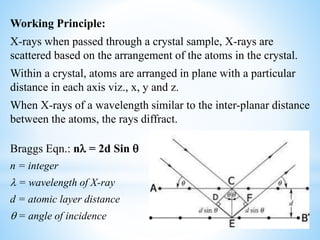
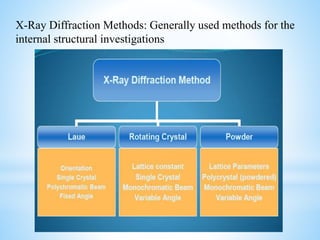
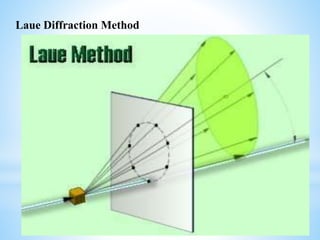
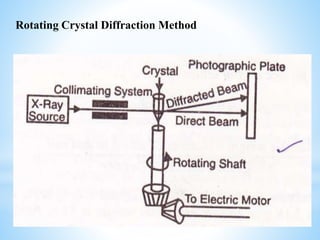
X-ray diffraction was discovered by Max von Laue and works by detecting the scattering pattern of X-rays passing through a crystal. The document discusses how X-rays are scattered based on the arrangement of atoms in the crystal according to Bragg's law, which states that constructive interference occurs when the path difference of X-rays reflected from crystal planes is equal to an integer multiple of the wavelength. Common XRD methods include Laue diffraction, rotating crystal diffraction, and powder crystal diffraction. XRD is useful for determining crystal structures, identifying materials, and analyzing properties like purity and crystallinity.