ARRYTHMIA
PRESENTED BY,
Anjali.c
First year m.pharm
Department of pharmacy practice
Grace college of pharmacy
DEFINITION
• Arrhythmias are deviations from normal
heartbeat pattern. They include abnormalities
of impulse formation,such as heart
rate,rhythm,or site of impulse origin and
conduction disturbances,which disrupt the
normal sequence of atrial and ventricular
activation.
NORMAL ELECTRICAL ACTIVITY IN THE
HEART
CLASSIFICATION
 1. TACHYARRYTHMIA
a) Atrial:
o Atrial fibrillation
o Atrial flutter
o PSVT
o Automatic atrialTachycardia Atrial
extrasystols
b) Ventricle
oVentricular fibrillation
oVentricular flutter
oVentricular tachycardia
oProarrythmia
oTorsades depoint
oVentricular extrasystole
c) AV node
o AV nodal extra systolic paroxysmal
AV nodal tachycardia
2) BRADY ARRHYTHMIA
o Sick-sinus syndrome(SSS)
o Tachy-brady syndrome
o Heart block
EPIDEMIOLOGY
• It is estimated that 3.9nmillion people in
USA have a cardiac rhythm disturbance
and that is result in 730000 hospital
admissions each year.
• Atrial arrhythmias are more common than
ventricular arrhythmias and atrial fibrillation
(AF) is the commonest chronic arrhythmia.
• Incidence of AF increases with age from
less than 0.1% in the 30-39 year age group
to above 1% in 70-79 year old men.
• Women have a lower risk of AF than male.
ETIOLOGICAL FACTORS
• Heart disease
• Myocardial infarction(MI)
• Systemic hypertension
• Hyperkalemia/hypokalemia
• Chronic obstructive pulmonary disease(COPD)
• Thyroid disorders
• Drug therapy
• Toxic doses of cardioactive drugs
• Increased sympathetic tone
• Vagal stimulation
• Metabolic disturbances
• Cor pulmonale
ETIOPATHOGENESIS
1) Abnormal impulse formation may stem from
• Decreased automaticity, as in escape beats and bradycardia
• Increased automaticity, as in premature beats, tachycardia, and
extrasystole
• Depolarization and triggered activity, leading to sustained
ectopic firing
2)Abnormal impulse conduction results from
• A conduction block or delay
• Reentry occurs when an impulse is rerouted through certain
regions in which it has already travelled. Thus the impulse
depolarizes the same tissue more than once, producing an
additional impulse. Reentry sites include the SA and AV nodes
as well as various accessory conditions must exist:
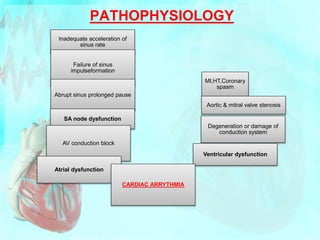
PATHOPHYSIOLOGY
Inadequate acceleration of
sinus rate
MI,HT,Coronary
spasm
Failure of sinus
impulseformation
Aortic & mitral valve stenosis
Abrupt sinus prolonged pause
Degeneration or damage of
conduction system
SA node dysfunction
AV conduction block
Atrial dysfunction
Ventricular dysfunction
CARDIAC ARRYTHMIA
CLINICAL MANIFESTATION
• Palpitations
• Chest pain
• Anxiety and confusion(reduced blood
perfusion)
• Dyspnea
• Skin pallor or cyanosis
• Abnormal pulse rate, rhythm or amplitude
• Reduced blood pressure
• Syncope
• Weakness
• Convulsions
• Hypotesion
• Decreased urinary output
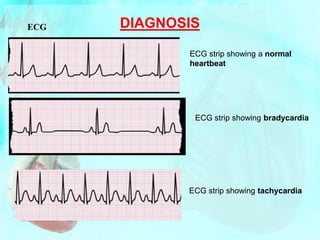
DIAGNOSIS
ECG strip showing a normal
heartbeat
ECG strip showing bradycardia
ECG strip showing tachycardia
ECG
• Electrophysiological (EP) testing: These intra
cardiac procedures determine the location of
ectopic foci.
• Laboratory findings
• Serum potassium level˃5mEq/L reflects
Hyperkalemia
• serum calcium level˂4.5mEq/L signifies
hypocalcemia
• serum magnesium level˂2.5mEq/L signify
hypomagnesemia
• His bundle study :can locate the origin of a heart
block or reentry pattern
MANAGEMENT
NON-PHARMACOLOGICAL
• Lifestyle changes
• Devices: Implantable cardioverter defibrillator (ICD)
• Cardioversion: This treatment can be chemical or
electric
• Cardiac Ablation: A nonsurgical technique that
neutralizes parts of the abnormal electrical pathway
(tissue) that is causing the arrhythmia
• Cardiac Surgery
Cardiac surgery is an invasive procedure where
surgeons will remove abnormal sites
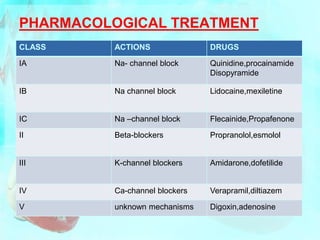
PHARMACOLOGICAL TREATMENT
CLASS ACTIONS DRUGS
IA Na- channel block Quinidine,procainamide
Disopyramide
IB Na channel block Lidocaine,mexiletine
IC Na –channel block Flecainide,Propafenone
II Beta-blockers Propranolol,esmolol
III K-channel blockers Amidarone,dofetilide
IV Ca-channel blockers Verapramil,diltiazem
V unknown mechanisms Digoxin,adenosine
Arrythmia
Arrythmia
Arrythmia

Arrythmia

  • 1.
    ARRYTHMIA PRESENTED BY, Anjali.c First yearm.pharm Department of pharmacy practice Grace college of pharmacy
  • 2.
    DEFINITION • Arrhythmias aredeviations from normal heartbeat pattern. They include abnormalities of impulse formation,such as heart rate,rhythm,or site of impulse origin and conduction disturbances,which disrupt the normal sequence of atrial and ventricular activation.
  • 3.
  • 4.
    CLASSIFICATION  1. TACHYARRYTHMIA a)Atrial: o Atrial fibrillation o Atrial flutter o PSVT o Automatic atrialTachycardia Atrial extrasystols
  • 5.
    b) Ventricle oVentricular fibrillation oVentricularflutter oVentricular tachycardia oProarrythmia oTorsades depoint oVentricular extrasystole c) AV node o AV nodal extra systolic paroxysmal AV nodal tachycardia
  • 6.
    2) BRADY ARRHYTHMIA oSick-sinus syndrome(SSS) o Tachy-brady syndrome o Heart block
  • 7.
    EPIDEMIOLOGY • It isestimated that 3.9nmillion people in USA have a cardiac rhythm disturbance and that is result in 730000 hospital admissions each year. • Atrial arrhythmias are more common than ventricular arrhythmias and atrial fibrillation (AF) is the commonest chronic arrhythmia. • Incidence of AF increases with age from less than 0.1% in the 30-39 year age group to above 1% in 70-79 year old men. • Women have a lower risk of AF than male.
  • 8.
    ETIOLOGICAL FACTORS • Heartdisease • Myocardial infarction(MI) • Systemic hypertension • Hyperkalemia/hypokalemia • Chronic obstructive pulmonary disease(COPD) • Thyroid disorders • Drug therapy • Toxic doses of cardioactive drugs • Increased sympathetic tone • Vagal stimulation • Metabolic disturbances • Cor pulmonale
  • 9.
    ETIOPATHOGENESIS 1) Abnormal impulseformation may stem from • Decreased automaticity, as in escape beats and bradycardia • Increased automaticity, as in premature beats, tachycardia, and extrasystole • Depolarization and triggered activity, leading to sustained ectopic firing 2)Abnormal impulse conduction results from • A conduction block or delay • Reentry occurs when an impulse is rerouted through certain regions in which it has already travelled. Thus the impulse depolarizes the same tissue more than once, producing an additional impulse. Reentry sites include the SA and AV nodes as well as various accessory conditions must exist:
  • 10.
    PATHOPHYSIOLOGY Inadequate acceleration of sinusrate MI,HT,Coronary spasm Failure of sinus impulseformation Aortic & mitral valve stenosis Abrupt sinus prolonged pause Degeneration or damage of conduction system SA node dysfunction AV conduction block Atrial dysfunction Ventricular dysfunction CARDIAC ARRYTHMIA
  • 11.
    CLINICAL MANIFESTATION • Palpitations •Chest pain • Anxiety and confusion(reduced blood perfusion) • Dyspnea • Skin pallor or cyanosis • Abnormal pulse rate, rhythm or amplitude • Reduced blood pressure • Syncope • Weakness • Convulsions • Hypotesion • Decreased urinary output
  • 12.
    DIAGNOSIS ECG strip showinga normal heartbeat ECG strip showing bradycardia ECG strip showing tachycardia ECG
  • 13.
    • Electrophysiological (EP)testing: These intra cardiac procedures determine the location of ectopic foci. • Laboratory findings • Serum potassium level˃5mEq/L reflects Hyperkalemia • serum calcium level˂4.5mEq/L signifies hypocalcemia • serum magnesium level˂2.5mEq/L signify hypomagnesemia • His bundle study :can locate the origin of a heart block or reentry pattern
  • 14.
    MANAGEMENT NON-PHARMACOLOGICAL • Lifestyle changes •Devices: Implantable cardioverter defibrillator (ICD) • Cardioversion: This treatment can be chemical or electric • Cardiac Ablation: A nonsurgical technique that neutralizes parts of the abnormal electrical pathway (tissue) that is causing the arrhythmia • Cardiac Surgery Cardiac surgery is an invasive procedure where surgeons will remove abnormal sites
  • 15.
    PHARMACOLOGICAL TREATMENT CLASS ACTIONSDRUGS IA Na- channel block Quinidine,procainamide Disopyramide IB Na channel block Lidocaine,mexiletine IC Na –channel block Flecainide,Propafenone II Beta-blockers Propranolol,esmolol III K-channel blockers Amidarone,dofetilide IV Ca-channel blockers Verapramil,diltiazem V unknown mechanisms Digoxin,adenosine