
ESSENTIAL DRUGS
Presented by;
Aiswarya.A.T
First year M.Pharm
Dept. of Pharmacy Practice
Grace College of Pharmacy
Essential drugs
HISTORY
In 1975, the 28th World Health Assembly reviewed the main drug problems
facing the developing countries & outlined possible new drug policies
The Director General of WHO, referred to the experience gained by some
countries, where schemes of basic or essential drugs had been implemented with
tremendous success
Such schemes were intended to extend the accessibility & rational use of most
necessary drugs to their respective populations, whose basic health needs could
not be met by the existing supply systems
The concept of essential drugs was born, & the first model list of essential drugs
was published in 1977
Current versions
18th WHO Essential Medicines List in
April 2013
4th WHO Essential Medicines List for
Children updated in April 2013
19th WHO Model List of Essential
Medicines in April 2015
WHO Definition
Essential drugs are those that satisfy the health
care needs of the majority of the population which is
available at all times in adequate amounts & in
appropriate dosage forms.
The model list of essential drugs is important in developing
countries because of the reasons:
Development of treatment guidelines
Development of national formularies
Measures to improve drug use information for patients & general
public
Guidelines For Establishing A National
Programme For Essential Drugs
A national drug authority should be established
A National Drugs & Therapeutics Committee (NDTC) should be
established
Generic names should be used for all drugs
A concise, accurate & comprehensive drug information booklet
should be prepared
The quality of all products, including stability & bioavailability
should be assured throughout product registration process
Competent health authorities should decide on the level of
expertise needed to prescribe drugs
Efficient administration of supply, storage & distribution of drugs
in the essential drug list, is indeed required for the success of ED
programme
There should be a well-documented procurement policy, based on
records of turnover of drugs
Research, both clinical & pharmaceutical, is sometimes needed to
settle a choice of a particular drug under local conditions
Guidelines … contd…
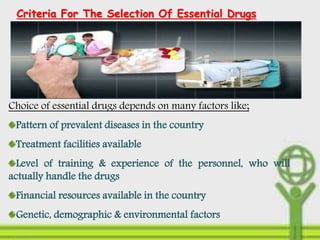
Criteria For The Selection Of Essential Drugs
Choice of essential drugs depends on many factors like;
Pattern of prevalent diseases in the country
Treatment facilities available
Level of training & experience of the personnel, who will
actually handle the drugs
Financial resources available in the country
Genetic, demographic & environmental factors
Selection of essential drugs must
always be;
Evidence-based; not situation based
Selected drugs should have sound & adequate data on their
efficacy & safety, based on clinical studies
Performance of a drug in general use has been proved in variety
of medical settings
Each selected drug must be available in adequate quantities & in
the dosage form that is recommended by NDTC
It must have assured quality, including bioavailability & stability,
under various conditions prevailing in the country
When 2 or more drugs appear to be similar in quality,
bioavailability, stability, choice should be made on the basis of
careful evaluation of their relative efficacy, safety, quality, price &
availability
When cost becomes an issue in the selection of drugs, only the unit
cost of the drug alone should not be considered
Comparative pharmacokinetic properties of drugs in the same
therapeutic category, proves helpful for the choice
Local facilities to manufacture drugs or their storage should also
be considered
ED’s should contain only one single basic drug or active ingredient
Contd…
Tasks After The Formation Of
Essential Drug List
1. Updating the ED list
Guiding principles have been laid down by WHO:
The extend to which the countries implement schemes, or
establish EDL is a national policy decision of each country
EDL must accommodate a variety of social situations to meet the
real health needs of the majority of the population
The model EDL is a tentative identification of ‘common core’ or
‘common thread’ which runs across health care needs of many a
developing country
Exclusion from model EDL doesn’t mean rejection
The formation of EDL & its updating is a continuing process
2. EDL for primary health care centres
Existing system of medicines
National Health Infrastructure
The pattern of endemic diseases
Supplies
3. Specialist control of drug use
Egs of situations where specialist control of drug use is necessary
are;
The use of reserve antimicrobials (antibiotics) for multiresistant
bacteria
Establishing adequate regimens for treatment of TB & leprosy
The use of antineoplastic & immunosuppressive drugs
The use of antiretroviral (AIDS) drugs
The use of antimicrobial, antifungal, antiviral agents for TB
treatment, respiratory infections of HIV positive & AIDS patients,
who are highly susceptible to such infections.
4. Research & Development
a) Pharmaceutical aspects
Development of local or regional capacities in quality assurance, inorder to
ensure that quality is maintained.
Development of procurement procedures, especially for large quantities, to
get best price.
Development of processing & packaging of dosage forms, to ensure quality of
products.
Development of efficient distribution systems with suitably trained personnel
b) Clinical & Epidemiological aspects
To assess efficacy & safety of new candidate drugs
To assess benefits & safety of traditional medicines & medicinal plants in the
region
To assess effects of genetic & ethnic differences among local population on the
pharmacokinetics & other therapeutic parameters
c) Educational aspects
Development of training programmes in policy formation, quality
control, information system, drug procurement, storage &
distribution aspects.
Development of educational & training programmes for
prescribers & other healthcare workers.
Development of appropriate public education programmes,
information programmes on diagnosis, early recognition of
symptoms & use of correct self medication.
Development of information booklets & leaflets for consumer
education.
5. Drug information & educational activities
For safe, effective & prudent use of ED, relevant & reliable drug
information is a must.
Make effective use of several WHO publications on “model
prescribing information”. Already five titles on drugs in
anaesthesia, parasitic diseases, mycobacterial diseases, STD’s& in
skin diseases, exist.
Develop model formulary to complement model list of ED’s.
Develop drug information sheets on all drugs in EDL, to guide
the prescribers to safe & effective use of drugs.
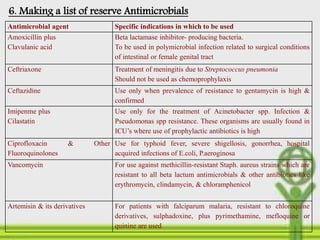
6. Making a list of reserve Antimicrobials
Antimicrobial agent Specific indications in which to be used
Amoxicillin plus
Clavulanic acid
Beta lactamase inhibitor- producing bacteria.
To be used in polymicrobial infection related to surgical conditions
of intestinal or female genital tract
Ceftriaxone Treatment of meningitis due to Streptococcus pneumonia
Should not be used as chemoprophylaxis
Ceftazidine Use only when prevalence of resistance to gentamycin is high &
confirmed
Imipenme plus
Cilastatin
Use only for the treatment of Acinetobacter spp. Infection &
Pseudomonas spp resistance. These organisms are usually found in
ICU’s where use of prophylactic antibiotics is high
Ciprofloxacin & Other
Fluoroquinolones
Use for typhoid fever, severe shigellosis, gonorrhea, hospital
acquired infections of E.coli, P.aeroginosa
Vancomycin For use against methicillin-resistant Staph. aureus strains which are
resistant to all beta lactum antimicrobials & other antibiotics like
erythromycin, clindamycin, & chloramphenicol
Artemisin & its derivatives For patients with falciparum malaria, resistant to chloroquine
derivatives, sulphadoxine, plus pyrimethamine, mefloquine or
quinine are used
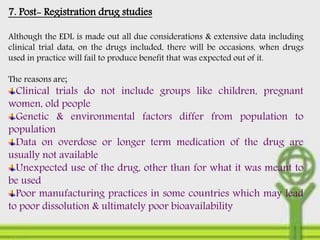
7. Post- Registration drug studies
Although the EDL is made out all due considerations & extensive data including
clinical trial data, on the drugs included, there will be occasions, when drugs
used in practice will fail to produce benefit that was expected out of it.
The reasons are;
Clinical trials do not include groups like children, pregnant
women, old people
Genetic & environmental factors differ from population to
population
Data on overdose or longer term medication of the drug are
usually not available
Unexpected use of the drug, other than for what it was meant to
be used
Poor manufacturing practices in some countries which may lead
to poor dissolution & ultimately poor bioavailability
Thank you!

Edl ppt

  • 1.
    ESSENTIAL DRUGS Presented by; Aiswarya.A.T Firstyear M.Pharm Dept. of Pharmacy Practice Grace College of Pharmacy
  • 2.
    Essential drugs HISTORY In 1975,the 28th World Health Assembly reviewed the main drug problems facing the developing countries & outlined possible new drug policies The Director General of WHO, referred to the experience gained by some countries, where schemes of basic or essential drugs had been implemented with tremendous success Such schemes were intended to extend the accessibility & rational use of most necessary drugs to their respective populations, whose basic health needs could not be met by the existing supply systems The concept of essential drugs was born, & the first model list of essential drugs was published in 1977
  • 3.
    Current versions 18th WHOEssential Medicines List in April 2013 4th WHO Essential Medicines List for Children updated in April 2013 19th WHO Model List of Essential Medicines in April 2015
  • 4.
    WHO Definition Essential drugsare those that satisfy the health care needs of the majority of the population which is available at all times in adequate amounts & in appropriate dosage forms. The model list of essential drugs is important in developing countries because of the reasons: Development of treatment guidelines Development of national formularies Measures to improve drug use information for patients & general public
  • 5.
    Guidelines For EstablishingA National Programme For Essential Drugs A national drug authority should be established A National Drugs & Therapeutics Committee (NDTC) should be established Generic names should be used for all drugs A concise, accurate & comprehensive drug information booklet should be prepared The quality of all products, including stability & bioavailability should be assured throughout product registration process
  • 6.
    Competent health authoritiesshould decide on the level of expertise needed to prescribe drugs Efficient administration of supply, storage & distribution of drugs in the essential drug list, is indeed required for the success of ED programme There should be a well-documented procurement policy, based on records of turnover of drugs Research, both clinical & pharmaceutical, is sometimes needed to settle a choice of a particular drug under local conditions Guidelines … contd…
  • 7.
    Criteria For TheSelection Of Essential Drugs Choice of essential drugs depends on many factors like; Pattern of prevalent diseases in the country Treatment facilities available Level of training & experience of the personnel, who will actually handle the drugs Financial resources available in the country Genetic, demographic & environmental factors
  • 8.
    Selection of essentialdrugs must always be; Evidence-based; not situation based Selected drugs should have sound & adequate data on their efficacy & safety, based on clinical studies Performance of a drug in general use has been proved in variety of medical settings Each selected drug must be available in adequate quantities & in the dosage form that is recommended by NDTC It must have assured quality, including bioavailability & stability, under various conditions prevailing in the country
  • 9.
    When 2 ormore drugs appear to be similar in quality, bioavailability, stability, choice should be made on the basis of careful evaluation of their relative efficacy, safety, quality, price & availability When cost becomes an issue in the selection of drugs, only the unit cost of the drug alone should not be considered Comparative pharmacokinetic properties of drugs in the same therapeutic category, proves helpful for the choice Local facilities to manufacture drugs or their storage should also be considered ED’s should contain only one single basic drug or active ingredient Contd…
  • 10.
    Tasks After TheFormation Of Essential Drug List 1. Updating the ED list Guiding principles have been laid down by WHO: The extend to which the countries implement schemes, or establish EDL is a national policy decision of each country EDL must accommodate a variety of social situations to meet the real health needs of the majority of the population The model EDL is a tentative identification of ‘common core’ or ‘common thread’ which runs across health care needs of many a developing country Exclusion from model EDL doesn’t mean rejection The formation of EDL & its updating is a continuing process
  • 11.
    2. EDL forprimary health care centres Existing system of medicines National Health Infrastructure The pattern of endemic diseases Supplies
  • 12.
    3. Specialist controlof drug use Egs of situations where specialist control of drug use is necessary are; The use of reserve antimicrobials (antibiotics) for multiresistant bacteria Establishing adequate regimens for treatment of TB & leprosy The use of antineoplastic & immunosuppressive drugs The use of antiretroviral (AIDS) drugs The use of antimicrobial, antifungal, antiviral agents for TB treatment, respiratory infections of HIV positive & AIDS patients, who are highly susceptible to such infections.
  • 13.
    4. Research &Development a) Pharmaceutical aspects Development of local or regional capacities in quality assurance, inorder to ensure that quality is maintained. Development of procurement procedures, especially for large quantities, to get best price. Development of processing & packaging of dosage forms, to ensure quality of products. Development of efficient distribution systems with suitably trained personnel b) Clinical & Epidemiological aspects To assess efficacy & safety of new candidate drugs To assess benefits & safety of traditional medicines & medicinal plants in the region To assess effects of genetic & ethnic differences among local population on the pharmacokinetics & other therapeutic parameters
  • 14.
    c) Educational aspects Developmentof training programmes in policy formation, quality control, information system, drug procurement, storage & distribution aspects. Development of educational & training programmes for prescribers & other healthcare workers. Development of appropriate public education programmes, information programmes on diagnosis, early recognition of symptoms & use of correct self medication. Development of information booklets & leaflets for consumer education.
  • 15.
    5. Drug information& educational activities For safe, effective & prudent use of ED, relevant & reliable drug information is a must. Make effective use of several WHO publications on “model prescribing information”. Already five titles on drugs in anaesthesia, parasitic diseases, mycobacterial diseases, STD’s& in skin diseases, exist. Develop model formulary to complement model list of ED’s. Develop drug information sheets on all drugs in EDL, to guide the prescribers to safe & effective use of drugs.
  • 16.
    6. Making alist of reserve Antimicrobials Antimicrobial agent Specific indications in which to be used Amoxicillin plus Clavulanic acid Beta lactamase inhibitor- producing bacteria. To be used in polymicrobial infection related to surgical conditions of intestinal or female genital tract Ceftriaxone Treatment of meningitis due to Streptococcus pneumonia Should not be used as chemoprophylaxis Ceftazidine Use only when prevalence of resistance to gentamycin is high & confirmed Imipenme plus Cilastatin Use only for the treatment of Acinetobacter spp. Infection & Pseudomonas spp resistance. These organisms are usually found in ICU’s where use of prophylactic antibiotics is high Ciprofloxacin & Other Fluoroquinolones Use for typhoid fever, severe shigellosis, gonorrhea, hospital acquired infections of E.coli, P.aeroginosa Vancomycin For use against methicillin-resistant Staph. aureus strains which are resistant to all beta lactum antimicrobials & other antibiotics like erythromycin, clindamycin, & chloramphenicol Artemisin & its derivatives For patients with falciparum malaria, resistant to chloroquine derivatives, sulphadoxine, plus pyrimethamine, mefloquine or quinine are used
  • 17.
    7. Post- Registrationdrug studies Although the EDL is made out all due considerations & extensive data including clinical trial data, on the drugs included, there will be occasions, when drugs used in practice will fail to produce benefit that was expected out of it. The reasons are; Clinical trials do not include groups like children, pregnant women, old people Genetic & environmental factors differ from population to population Data on overdose or longer term medication of the drug are usually not available Unexpected use of the drug, other than for what it was meant to be used Poor manufacturing practices in some countries which may lead to poor dissolution & ultimately poor bioavailability
  • 18.