BRAGG’S LAW M FACTS
SUMMER TOPIC
Follow us on
Facebook : www.facebook.com/metallurgical.f
Instagram: metallurgical facts
For any query mail us:
metallurgicalfacts@gmail.com
NOTE: This topic is totally based on GATE syllabus to help the gate
Aspirants..
Incase of doubt you can message us on our facebook page.
#STAY_CONNECTED
BRAGG’S LAW M FACTS
INTRODUCTION
 Bragg’s Law was introduced by Sir W. H. Bragg and his son Sir W. L. Bragg.
 In physics, it is a special case of Laue Diffraction and gives the angle of coherent
and incoherent scattering from a crystal lattice.
 The law correlates the X – ray wavelength λ , interplaner spacing d , and
reflection angle θ.
 According to the law, when the x-ray is incident on to a crystal surface, its angle
of incidence will reflect back with a same angle of scattering.
BRAGG’S LAW
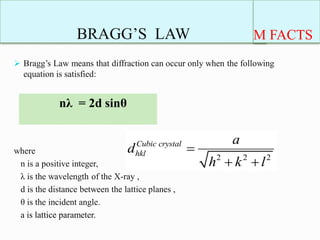
 Bragg’s Law means that diffraction can occur only when the following
equation is satisfied:
where
n is a positive integer,
λ is the wavelength of the X-ray ,
d is the distance between the lattice planes ,
θ is the incident angle.
a is lattice parameter.
M FACTS
nλ = 2d sinθ
2 2 2
Cubic crystal
hkl
a
d
h k l

 
BRAGG’S LAW M FACTS
The most significant point of the Bragg’s Law can be explained by the
constructive interference, which occurs when the path difference of travelling
waves matches with the integral multiplication of the wavelength.
BRAGG’S CONDITION:
The Bragg’s Law does not only mean the constructive interference of Bragg’s
equation, but it has much more strict meaning.
Diffraction will never occur , if Bragg’s equation is not satisfied, in case of
infinitely large number of lattice planes.
In other words , diffraction may be observed , even if the situation is slightly
deviated from the condition, in case of finite number of lattice planes.
BRAGG’S LAW M FACTS
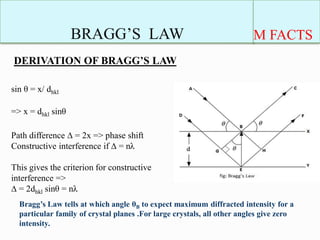
sin θ = x/ dhkl
=> x = dhkl sinθ
Path difference ∆ = 2x => phase shift
Constructive interference if ∆ = nλ
This gives the criterion for constructive
interference =>
∆ = 2dhkl sinθ = nλ
Bragg’s Law tells at which angle θB to expect maximum diffracted intensity for a
particular family of crystal planes .For large crystals, all other angles give zero
intensity.
DERIVATION OF BRAGG’S LAW
BRAGG’S LAW
Three geometrical facts are worth remembering:
1)The incident beam, the normal to the diffraction plane, and the diffracted beam are
always coplanar.
2) The angle between the diffracted beam and the transmitted beam is always 2θ .This
is known as the diffraction angle.
3) θ is angle of incidence known as Bragg’s angle.
Bragg’s equation is a negative law
 If Bragg’s eq. is NOT satisfied  NO reflection can occur
 If Bragg’s eq. is satisfied  reflection MAY occur
M FACTS
Stay connected
Thank you
M FACTS

Bragg's law

  • 1.
    BRAGG’S LAW MFACTS SUMMER TOPIC Follow us on Facebook : www.facebook.com/metallurgical.f Instagram: metallurgical facts For any query mail us: metallurgicalfacts@gmail.com NOTE: This topic is totally based on GATE syllabus to help the gate Aspirants.. Incase of doubt you can message us on our facebook page. #STAY_CONNECTED
  • 2.
    BRAGG’S LAW MFACTS INTRODUCTION  Bragg’s Law was introduced by Sir W. H. Bragg and his son Sir W. L. Bragg.  In physics, it is a special case of Laue Diffraction and gives the angle of coherent and incoherent scattering from a crystal lattice.  The law correlates the X – ray wavelength λ , interplaner spacing d , and reflection angle θ.  According to the law, when the x-ray is incident on to a crystal surface, its angle of incidence will reflect back with a same angle of scattering.
  • 3.
    BRAGG’S LAW  Bragg’sLaw means that diffraction can occur only when the following equation is satisfied: where n is a positive integer, λ is the wavelength of the X-ray , d is the distance between the lattice planes , θ is the incident angle. a is lattice parameter. M FACTS nλ = 2d sinθ 2 2 2 Cubic crystal hkl a d h k l   
  • 4.
    BRAGG’S LAW MFACTS The most significant point of the Bragg’s Law can be explained by the constructive interference, which occurs when the path difference of travelling waves matches with the integral multiplication of the wavelength. BRAGG’S CONDITION: The Bragg’s Law does not only mean the constructive interference of Bragg’s equation, but it has much more strict meaning. Diffraction will never occur , if Bragg’s equation is not satisfied, in case of infinitely large number of lattice planes. In other words , diffraction may be observed , even if the situation is slightly deviated from the condition, in case of finite number of lattice planes.
  • 5.
    BRAGG’S LAW MFACTS sin θ = x/ dhkl => x = dhkl sinθ Path difference ∆ = 2x => phase shift Constructive interference if ∆ = nλ This gives the criterion for constructive interference => ∆ = 2dhkl sinθ = nλ Bragg’s Law tells at which angle θB to expect maximum diffracted intensity for a particular family of crystal planes .For large crystals, all other angles give zero intensity. DERIVATION OF BRAGG’S LAW
  • 6.
    BRAGG’S LAW Three geometricalfacts are worth remembering: 1)The incident beam, the normal to the diffraction plane, and the diffracted beam are always coplanar. 2) The angle between the diffracted beam and the transmitted beam is always 2θ .This is known as the diffraction angle. 3) θ is angle of incidence known as Bragg’s angle. Bragg’s equation is a negative law  If Bragg’s eq. is NOT satisfied  NO reflection can occur  If Bragg’s eq. is satisfied  reflection MAY occur M FACTS
  • 7.