Presented by;
AISWARYA.A.T,
First year M.Pharm,
Dept. of Pharmacy Practice,
Grace college of Pharmacy.
PROCUREMENT
OF DRUGS
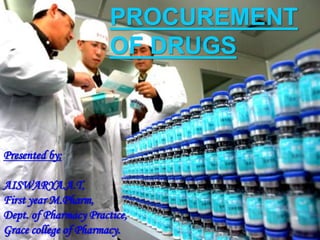
PROCUREMENT
Procurement is defined as a process of
acquiring supplies through purchases from the
manufacturers, their agents like distributors or from
private or public suppliers.
Purchasing of medicines starts with the framing of
buying policies and ends with receiving, stocking, and
payment.
It involves the application of special skills and
knowledge from both the professional and legal
viewpoints
WHO SHOULD
PURCHASE
DRUGS?????
Purchasing
agent?????
Pharmacist
OR
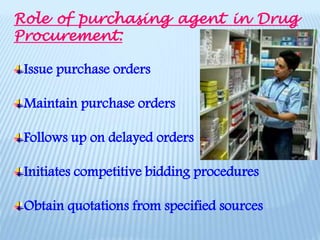
Role of purchasing agent in Drug
Procurement:
Issue purchase orders
Maintain purchase orders
Follows up on delayed orders
Initiates competitive bidding procedures
Obtain quotations from specified sources
By direct purchase from
manufacturer and/or wholesaler
By bid from either manufacturers
or wholesalers
By purchase from a local retail
pharmacy
By a contract purchase arrangement
with manufacturer
By a contract purchase through a
hospital purchase burean
/corportation
Role of pharmacist in Drug Procurement:
Hospital pharmacist in collaboration with
purchasing agent assume following duties:
Maintain a list of names, address & telephone numbers of
drug manufacturers, wholesalers & their representatives
Prepare detailed specifications of drugs, chemicals &
biological
Prepare request for purchase forms
Prepare receiving memo if drugs are received directly by
the pharmacy
Prepare return memo, whenever applicable
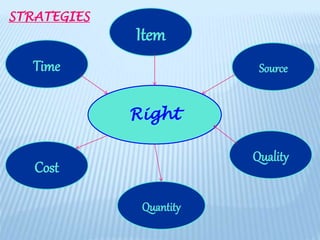
Right
Time
Item
Source
Quality
Quantity
Cost
STRATEGIES
1. Procurement of cost effective medicines in the right quantities
2. Indenting of items and quantity
Annual indents
Supplementary indents
Emergent indents
3. Selection of reliable suppliers of quality items
4. Ensuring timely delivery of the ordered items
5. Fixing lowest possible total cost
Unit cost
Visible cost
Hidden costs
Inventory holding costs
Operating costs
Capital loss
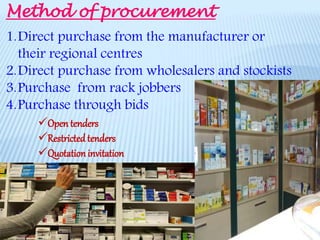
Method of procurement
1.Direct purchase from the manufacturer or
their regional centres
2.Direct purchase from wholesalers and stockists
3.Purchase from rack jobbers
4.Purchase through bids
Open tenders
Restricted tenders
Quotation invitation
5. Purchase through competitive
negotiation
6. Purchase through a contract
Fixed quantity contract
Running contract
Rate contract
7. Local purchase
8. In house manufacture of
medicines in the hospitals.
Procurement in community
pharmacies
Selection of medicines & fixing order
quantity
Identifying the financial position
Identification of procurement method
Identification of dependable sources of
supply
Negotiating & finalising suitable
purchase terms
Transferring the title of the
items(merchandise) from the supplier to
the pharmacy
Monitoring order status &
consumption trend
Thank you…

PROCUREMENT

  • 1.
    Presented by; AISWARYA.A.T, First yearM.Pharm, Dept. of Pharmacy Practice, Grace college of Pharmacy. PROCUREMENT OF DRUGS
  • 2.
    PROCUREMENT Procurement is definedas a process of acquiring supplies through purchases from the manufacturers, their agents like distributors or from private or public suppliers. Purchasing of medicines starts with the framing of buying policies and ends with receiving, stocking, and payment. It involves the application of special skills and knowledge from both the professional and legal viewpoints
  • 4.
  • 5.
    Role of purchasingagent in Drug Procurement: Issue purchase orders Maintain purchase orders Follows up on delayed orders Initiates competitive bidding procedures Obtain quotations from specified sources
  • 6.
    By direct purchasefrom manufacturer and/or wholesaler By bid from either manufacturers or wholesalers By purchase from a local retail pharmacy By a contract purchase arrangement with manufacturer By a contract purchase through a hospital purchase burean /corportation Role of pharmacist in Drug Procurement:
  • 7.
    Hospital pharmacist incollaboration with purchasing agent assume following duties: Maintain a list of names, address & telephone numbers of drug manufacturers, wholesalers & their representatives Prepare detailed specifications of drugs, chemicals & biological Prepare request for purchase forms Prepare receiving memo if drugs are received directly by the pharmacy Prepare return memo, whenever applicable
  • 8.
  • 9.
    1. Procurement ofcost effective medicines in the right quantities 2. Indenting of items and quantity Annual indents Supplementary indents Emergent indents 3. Selection of reliable suppliers of quality items 4. Ensuring timely delivery of the ordered items 5. Fixing lowest possible total cost Unit cost Visible cost Hidden costs Inventory holding costs Operating costs Capital loss
  • 10.
    Method of procurement 1.Directpurchase from the manufacturer or their regional centres 2.Direct purchase from wholesalers and stockists 3.Purchase from rack jobbers 4.Purchase through bids Open tenders Restricted tenders Quotation invitation
  • 11.
    5. Purchase throughcompetitive negotiation 6. Purchase through a contract Fixed quantity contract Running contract Rate contract 7. Local purchase 8. In house manufacture of medicines in the hospitals.
  • 15.
    Procurement in community pharmacies Selectionof medicines & fixing order quantity Identifying the financial position Identification of procurement method Identification of dependable sources of supply Negotiating & finalising suitable purchase terms Transferring the title of the items(merchandise) from the supplier to the pharmacy Monitoring order status & consumption trend
  • 16.