 Introduction
 How Diffraction Works
 Demonstration
 Analyzing Diffraction Patterns
 Summary and Conclusions
Introduction
Motivation:
• X-ray diffraction is used to obtain structural
information about crystalline solids.
• Useful in biochemistry to solve the structures of
complex biomolecules.
• Bridge the gaps between physics, chemistry, and
biology.
X-ray diffraction is important for:
• Solid-state physics
• Biophysics
• Medical physics
• Chemistry and Biochemistry
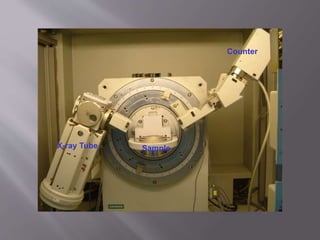
X-ray Diffractometer
 Wave Interacting with a Single Particle
 Incident beams scatter uniformly in all directions
 Wave Interacting with a Solid
 Scattered beams interfere constructively in some
directions, producing diffracted beams
 Random arrangements cause beams to randomly
interfere and no distinctive pattern is produced
 Crystalline Material
 Regular pattern of crystalline atoms produces
regular diffraction pattern.
 Diffraction pattern gives information on crystal
structure
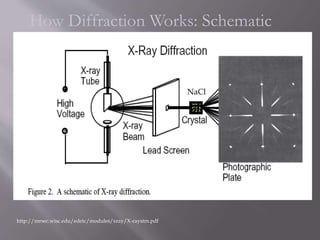
How Diffraction Works: Schematic
http://mrsec.wisc.edu/edetc/modules/xray/X-raystm.pdf
NaCl
X-ray Tube
Counter
Sample
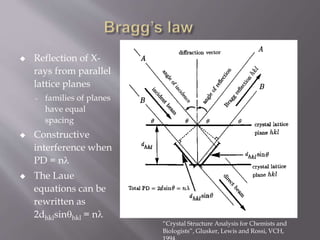
 Reflection of X-
rays from parallel
lattice planes
- families of planes
have equal
spacing
 Constructive
interference when
PD = n
 The Laue
equations can be
rewritten as
2dhklsinhkl = n
“Crystal Structure Analysis for Chemists and
Biologists”, Glusker, Lewis and Rossi, VCH,
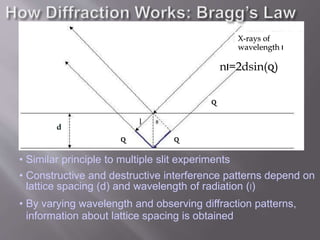
nl=2dsin(Q)
• Similar principle to multiple slit experiments
• Constructive and destructive interference patterns depend on
lattice spacing (d) and wavelength of radiation (l)
• By varying wavelength and observing diffraction patterns,
information about lattice spacing is obtained
d
Q Q
Q
X-rays of
wavelength l
l
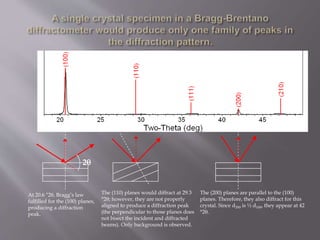
2
At 20.6 °2, Bragg’s law
fulfilled for the (100) planes,
producing a diffraction
peak.
The (110) planes would diffract at 29.3
°2; however, they are not properly
aligned to produce a diffraction peak
(the perpendicular to those planes does
not bisect the incident and diffracted
beams). Only background is observed.
The (200) planes are parallel to the (100)
planes. Therefore, they also diffract for this
crystal. Since d200 is ½ d100, they appear at 42
°2.
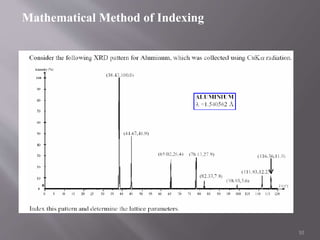
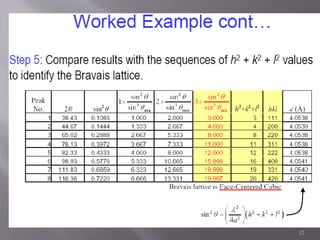
Mathematical Method of Indexing
Example
10
11
12
 X-ray diffraction is a technique for analyzing
structures.
 X-ray beam hits a crystal, scattering the beam in a
manner characterized by the atomic structure
 Even complex structures can be analyzed by x-ray
diffraction, such as DNA and proteins in biology
 This will provide useful in the future for
combining knowledge from physics, chemistry,
and biology

X-ray diffactrometery

  • 2.
     Introduction  HowDiffraction Works  Demonstration  Analyzing Diffraction Patterns  Summary and Conclusions
  • 3.
    Introduction Motivation: • X-ray diffractionis used to obtain structural information about crystalline solids. • Useful in biochemistry to solve the structures of complex biomolecules. • Bridge the gaps between physics, chemistry, and biology. X-ray diffraction is important for: • Solid-state physics • Biophysics • Medical physics • Chemistry and Biochemistry X-ray Diffractometer
  • 4.
     Wave Interactingwith a Single Particle  Incident beams scatter uniformly in all directions  Wave Interacting with a Solid  Scattered beams interfere constructively in some directions, producing diffracted beams  Random arrangements cause beams to randomly interfere and no distinctive pattern is produced  Crystalline Material  Regular pattern of crystalline atoms produces regular diffraction pattern.  Diffraction pattern gives information on crystal structure
  • 5.
    How Diffraction Works:Schematic http://mrsec.wisc.edu/edetc/modules/xray/X-raystm.pdf NaCl
  • 6.
  • 7.
     Reflection ofX- rays from parallel lattice planes - families of planes have equal spacing  Constructive interference when PD = n  The Laue equations can be rewritten as 2dhklsinhkl = n “Crystal Structure Analysis for Chemists and Biologists”, Glusker, Lewis and Rossi, VCH,
  • 8.
    nl=2dsin(Q) • Similar principleto multiple slit experiments • Constructive and destructive interference patterns depend on lattice spacing (d) and wavelength of radiation (l) • By varying wavelength and observing diffraction patterns, information about lattice spacing is obtained d Q Q Q X-rays of wavelength l l
  • 9.
    2 At 20.6 °2,Bragg’s law fulfilled for the (100) planes, producing a diffraction peak. The (110) planes would diffract at 29.3 °2; however, they are not properly aligned to produce a diffraction peak (the perpendicular to those planes does not bisect the incident and diffracted beams). Only background is observed. The (200) planes are parallel to the (100) planes. Therefore, they also diffract for this crystal. Since d200 is ½ d100, they appear at 42 °2.
  • 10.
    Mathematical Method ofIndexing Example 10
  • 11.
  • 12.
  • 13.
     X-ray diffractionis a technique for analyzing structures.  X-ray beam hits a crystal, scattering the beam in a manner characterized by the atomic structure  Even complex structures can be analyzed by x-ray diffraction, such as DNA and proteins in biology  This will provide useful in the future for combining knowledge from physics, chemistry, and biology

Editor's Notes

  • #8 Derive/point out where it comes from!