M.Prasad Naidu
MSc Medical Biochemistry, Ph.D,.
 Total blood volume is 4.5-5 litres.
 If blood containing anticoagulants (e.g.heparin
, potassium oxalate) is centrifuged , the plasma
separates out as a supernatant while the cells
remain at the bottom.
 About 55-60% of blood is plasma
 The packed cell volume or hematocrit is about
40-45%
 Plasma is the clear straw coloured fluid
portion of the blood minus its cellular elements.
 It constitutes about 55% of the blood volume.
 Serum is plasma minus clotting factors
(fibrinogen & prothrombin ).
 The defribrinated plasma is called serum
 PLASMA contains the following composition:
WATER:
Is the main constituent of Plasma – 91%
SOLIDS: 9% of the plasma (1% inorganic molecules
& 8% organic molecules)
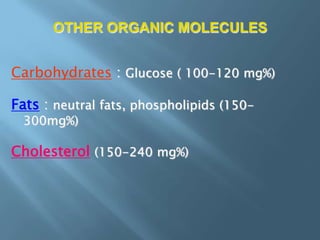
OTHER ORGANIC MOLECULES
Carbohydrates : Glucose ( 100-120 mg%)
Fats : neutral fats, phospholipids (150-
300mg%)
Cholesterol (150-240 mg%)
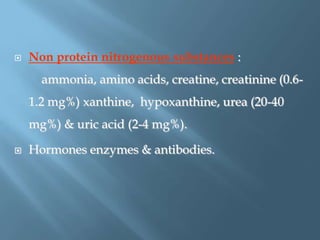
 Non protein nitrogenous substances :
ammonia, amino acids, creatine, creatinine (0.6-
1.2 mg%) xanthine, hypoxanthine, urea (20-40
mg%) & uric acid (2-4 mg%).
 Hormones enzymes & antibodies.
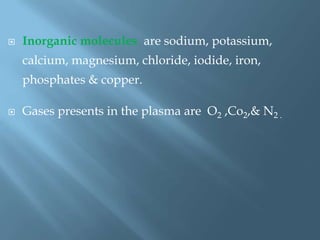
 Inorganic molecules are sodium, potassium,
calcium, magnesium, chloride, iodide, iron,
phosphates & copper.
 Gases presents in the plasma are O2 ,Co2,& N2 .
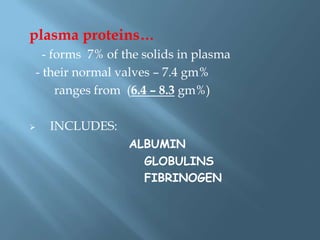
plasma proteins…
- forms 7% of the solids in plasma
- their normal valves – 7.4 gm%
ranges from (6.4 – 8.3 gm%)
 INCLUDES:
ALBUMIN
GLOBULINS
FIBRINOGEN
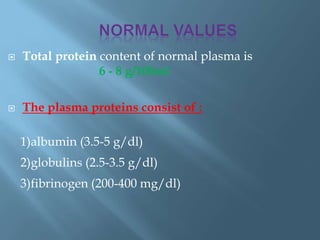
 Total protein content of normal plasma is
6 - 8 g/100ml
 The plasma proteins consist of :
1)albumin (3.5-5 g/dl)
2)globulins (2.5-3.5 g/dl)
3)fibrinogen (200-400 mg/dl)
 The albumin : globulin ratio is usually between 1.2
:; 1 to 1.5 :1
 Almost all plasma proteins , except
immunoglobulins are synthesized in liver
 In clinical laboratory, separation is usually done by
salts.
 Thus , fibrinogen is precipitated by 10% and
globulins by 22% concentration of sodium sulphate
 Ammonium sulphate will precipitate :
albumin by full-saturation
globulin by half-saturation
 In clinical laboratory , total proteins of patients are
estimated by Biuret method.
 Albumin is quantitated by Bromo cresol green
(BCG) method , in which the dye is preferentially
bound with albumin , and the colour intensity is
measured colourimetrically.
 OTHER METHODS:
 Lowry’s method
 Kjeldahl’s method
 Dye-binding method
 UV-absorption method
 The most common method of analyzing plasma
proteins is by electrophoresis.
 The term electrophoresis refers to the movement of
chargeD particles through an electrolyte when
subjected to an electric field
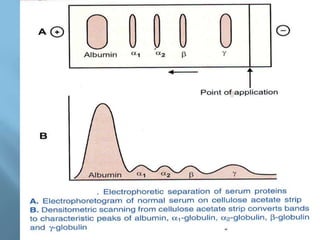
 In clinical laboratory , cellulose acetate is widely
used as a supporting medium.
 Its use permits resolution , after staining , of plasma
proteins into five bands , designated albumin , α1 , α2
, β and γ fractions, respectively
 The stained strip of cellulose acetate is called
electrophoretogram.
 The amounts of these five bands can be
conveniently quantified by use of Densitometric
scanning machines.
 Characteristic changes in the amounts of one or
more of these five bands are found in many
diseases.
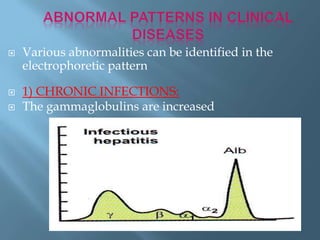
 Various abnormalities can be identified in the
electrophoretic pattern
 1) CHRONIC INFECTIONS:
 The gammaglobulins are increased
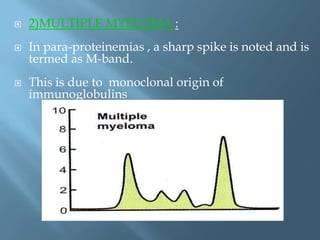
 2)MULTIPLE MYELOMA :
 In para-proteinemias , a sharp spike is noted and is
termed as M-band.
 This is due to monoclonal origin of
immunoglobulins
 PRIMARY IMMUNE DEFICIENCY :
 The gamma globulin fraction is reduced
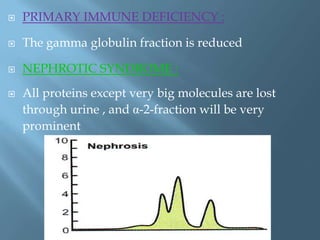
 NEPHROTIC SYNDROME :
 All proteins except very big molecules are lost
through urine , and α-2-fraction will be very
prominent
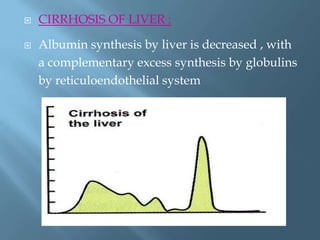
 CIRRHOSIS OF LIVER :
 Albumin synthesis by liver is decreased , with
a complementary excess synthesis by globulins
by reticuloendothelial system
 CHRONIC LYMPHATIC LEUKEMIA:
 Gamma globulin fraction is reduced
 ALPHA-1-ANTITRYPSIN DEFICIENCY:
 The alpha-1 band is thin or even missing
 Albumin (69 kDa) is the major protein in
human plasma(3.4-4.7 g/dl)
 It makes up approximately 60% of the total
plasma protein.
 About 40% of albumin is present in the plasma,
and the other 60% is present in the extracellular
space.
 The liver produces about 12g of albumin per day ,
representing about 25% of total hepatic protein
synthesis
 Albumin can come out of vascular compartment. So
albumin is present in CSF and interstitial fluid.
 1)COLLOID OSMOTIC PRESSURE OF PLASMA:
 The total osmolality of serum is 278-305 mosmol/kg.
 This is exerted mainly by salts, which can pass easily
from intravascular to extravascular space.
 Therefore, the osmotic pressure exerted by
electrolytes inside and outside the vascular
compartments will cancel each other.
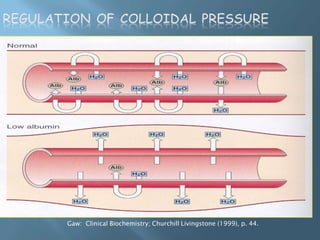
 But proteins cannot easily escape out of blood
vessels, and therefore , proteins exert the
„effective osmotic pressure‟.
 It is about 25mm Hg, and 80% of it is
contributed by albumin.
 The maintenance of blood volume is dependent
on this effective osmotic pressure
Gaw: Clinical Biochemistry; Churchill Livingstone (1999), p. 44.
 TRANSPORT FUNCTION:
 Albumin is the carrier of various hydrophobic
substances in the blood such as:
 i)bilirubin & non-esterified fatty acids
 ii)drugs (sulpha,aspirin,salicylate,)
 iii)hormones(steroid hormones,thyroxine)
 iv)metals (calcium,copper,heavy metals)
3)BUFFERING ACTION :
 Albumin has maximum buffering capacity
amongst all proteins
 It has a total of 16 histidine residues which
contribute to this buffering action.
4)NUTRITIONAL FUNCTION:
 All tissue cells can take up albumin by
pinocytosis.
 It is then broken down to amino acid level.
 So albumin may be considered as the transport
form of essential amino acids from liver to
extrahepatic cells.
1)BLOOD-BRAIN BARRIER:
 Albumin-fatty acid complex cannot cross blood-
brain barrier and hence fatty acids cannot be taken
up by brain.
2)PROTEIN-BOUND CALCIUM:
 Calcium level in blood is lowered in hypo-
albuminemia
 Thus , even though total calcium level in blood is
lowered, ionised calcium level may be normal, so
tetany may not occur.
 3) THERAPEUTIC USE:
 Human albumin is therapeutically useful to treat
burns,hemorrhage and shock.
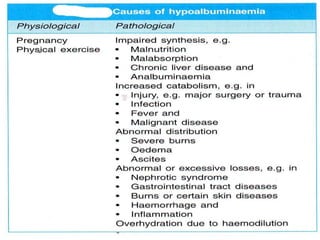
 4)EDEMA:
 Hypo-albuminemia will result in tissue edema
 Eg: a)malnutrition
b)nephrotic syndrome
c)cirrhosis of liver
d)chronic congestive cardiac failure.
 CIRRHOSIS OF LIVER:
 Synthesis is decreased.
 MALNUTRITION:
 Availability of amino acids is reduce and so
albumin synthesis is affected.
 NEPHROTIC SYNDROME:
 Permeability of kidney glomerular membrane is
defective , so that albumin is excreted in large
quantities.
 PROTEIN LOSING ENTEROPATHY:
 Large quantities of albumin is lost from
intestinal tract.
 ALBUMINURIA:
 Presence of albumin in urine is called
albuminuria.
 It is always pathological.
 Seen in:
a)Nephrotic syndrome(large quantities)
b)Acute nephritis
c)Inflammatory conditions of urinary tract.
 Detection of albumin in urine is done by heat and
acetic acid test.
 MICRO-ALBUMINURIA:
 In micro-albuminuria or minimal albuminuria
or plauci-albuminuria , small quantity of
albumin (30-300 mg/dl) is seen in urine
 It is estimated by RIA
 Increased levels of microalbuminuria is an
indication of early involvement of renal tissue
in diabetic patients
 Albumin-globulin ratio :
 In hypo-albuminemia, there will be a
compensatory increase in globulins which are
synthesized by the reticulo-endothelial
system(plasma cells).
 Albumin-globulin ratio (A/G ratio) is thus
altered or even reversed.
 Hypoproteinemia :
 Since albumin is the major protein present in
the blood, any condition causing lowering of
albumin will lead to reduce total proteins in
blood
 HYPERALBUMINEMIA :
 Increased levels of plasma albumin are present
only in acute dehydration and have no clinical
significance
 ANALBUMINAEMIA :
 Analbuminemia is a rare hereditary abnormality
in which plasma albumin concentration is usually
less than 1.0gm/L
 Globulins are bigger in size than albumin .
Globulins constitute several fractions. These are:
 α1- globulin
 α2- globulin
 β- globulin
 γ- globulin
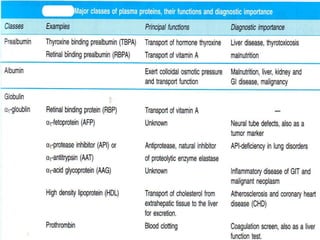
 Retinol binding protein(RBP)
 α1 – fetoprotein(AFP)
 α1 – protease inhibitor (API)
 α1 - acid glycoprotein (AAG)
 High density lipopprotein (HDL)
 Prothrombin
 RETINOL BINDING PROTEIN (RBP)
 Retinol (vitamin A) is transported in plasma
bound to RBP.
 Most retinol RBP in the plasma is reversibely
complexed with transthyretin (thyroxine binding
protein)
 α1- FETOPROTEIN (AFP)
 This is present in the tissues and plasma of the
fetus
 It may play an immunoregulatory role during
pregnancy.
 α1- PROTEASE INHIBITOR (API) / α1-
ANTITRYPSIN (AAT) :
 API is one of the plasma proteins, that inhibits activity of
proteases particularly elastase, which degrades elastin, a
protein that gives elasticity to the lungs
 α1-ACID GLYCOPROTEIN (AAG)
 AAG also known as orosomucoid, contains a high
percentage of carbohydrate with a large number of sialic
acid residues
 It is synthesized by liver parenchymal cells.
 PROTHROMBIN
 It is synthesized by liver with the help of
vitamin K and involved in blood clotting
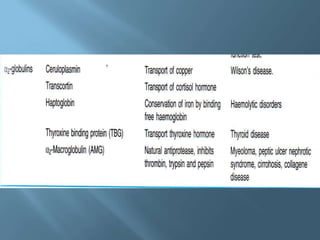
 Ceruloplasmin(ferro-oxidase)
 Transcortin / corticosteroid binding globulin
 Haptoglobin
 Thyroxine binding globulin(TBG)
 α2 - macroglobulin (AMG)
 CERULOPLASMIN (FERRO-OXIDASE)
 This is a copper containing protein.
 It has oxidase activity
 Ceruloplasmin is the major transport protein for
copper, an essential trace element.
 It is also essential for the regulation of oxiation-
reduction , transport and utilization of iron
 Plasma ceruloplasmin level is reduced in Wilson‟s
disease in patients with malnutrition and in the
nephrotic syndrome.
 TRANSCORTIN /CORTICOSTEROID BINDING
GLOBULIN:
 This binds cortisol
 It is synthesized in liver and synthesis is increased by
oestrogen
 HAPTOGLOBIN:
 It plays an important role in the conservation of iron by
preventing its loss in the urine
 Haptoglobin binds free Hb to form a complex which is too
large to be filtered by the kidney and thus prevents the
loss of iron in the urine.
 THYROXINE-BINDING GLOBULIN (TBG)
 TBG is synthesized in liver
 TBG has a electrophoretic mobility between α1 &
α2 globulins
 It transports thyroxine hormone(T3 & T4)
 α2 - MACROGLOBULIN(AMG)
 This is major α2 - globulin , which is a natural
inhibitor of endopeptidases such as trypsin,
chymotrypsin, plasmin, thrombin .etc.
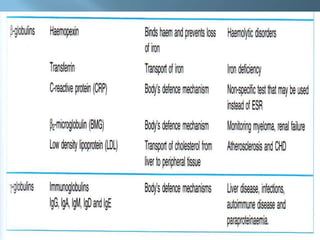
 Haemopexin
 Transferrin
 β2 -microglobulin(BMG)
 C-reactive protein(CRP)
 Low density lipoprotein
 HAEMOPEXIN
 Like haptoglobulin, haemopexin also plays an
important role in the conservation of iron by
preventing its loss in urine
 TRANSFERRIN
 Is synthesized in liver
 It transports iron(2 molecules of Fe3+ per molecule
of transferrin) through blood to the sites where
iron is required
 C-REACTIVE PROTEIN(CRP)
 CRP is involved in the body’s response to
inflammations .mainly bacterial..
 It is useful in differentiating bacterial from viral
infections because the level of CRP is increased
in bacterial infections only.

MICROGLOBULIN
 This protein forms part of the human leucocyte
antigen(HLA) system
 Plasma levels are increased whenever, there is
malignant lymphoid or myeloid proliferation and
renal failure
 The acute phase response is a non-specific response
to the stimulus of tissue following trauma, infection
,inflammation, burn, etc
 Following trauma etc , the body responds by
initiating a series of mechanisms that lead to rapid
decrease in the concentration of many proteins,eg
 Albumin
 Prealbumin
 Transferrin
 These are termed “negative acute phase reactants”
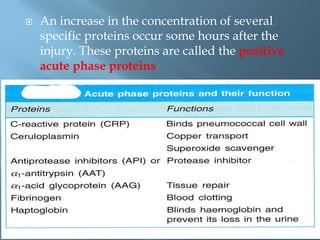
 An increase in the concentration of several
specific proteins occur some hours after the
injury. These proteins are called the positive
acute phase proteins
Definition:
 The Igs constitute a heterogenous family of serum
proteins, which either function as antibodies or are
chemically related to antibodies
 The immunoglobulins are γ- globulins , called
antibodies. All antibodies are immunoglobulin but
all immunoglobulins may not be antibodies
 They constitute about 20% of all the plasma
proteins
 Igs are produced by plasma cells & to some extent
by lymphocytes
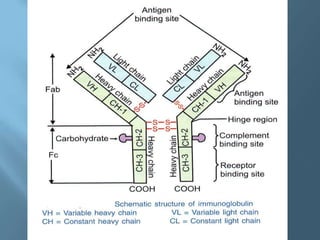
 Immunoglobulins are glycoproteins made up of
light(L) and heavy(H) polypeptide chains.
 All Igs have the same basic structure.
The basic Ig is a “Y” shaped molecule and consist of 4
polypeptide chains:
 2 H chains
 2 L chains
 The 4 chains are linked by disulfide bonds
 An individual antibody molecule always consists of
identical H chains & identical L chains
 L chain may be either of 2 types, kappa(κ) or
lambda(λ) but not both
 The heavy chains may be of 5 types and are
designated by greek letter:
 Alpha(α)
 Gamma(γ)
 Delta(δ)
 Mu(μ)
 Epsilon(ε)
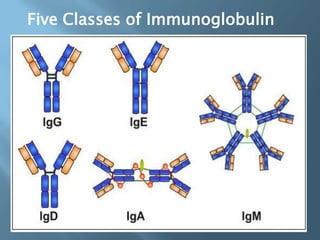
Five Classes of Immunoglobulin
 Igs are named as per their heavy chain type as IgA ,
IgG , IgD , IgM & IgE
 The L and H chains are subdivided into variable and
constant regions
 L chain consists of one variable(VL) and one
constant (CL) domain or region
 Most H-chains consist of one variable(VH) and 3
constant(CH-1,CH-2 & CH-3) domains
 IgG & IgA have 3 CH domains whereas IgM & IgE
have 4
 Each Ig molecule has hinge region between CH-
1 & CH-2, which allows better fit with the
antigen surface.
 The variable regions of both L & H chains have 3
extremely variable amino acid sequences at the
amino terminal end called hypervariable region
 Enzyme(papain) digestion splits the Ig molecule
into 2 fragments named as Fab (Fragment for
antigen binding) and Fc (crystallizable
fragment)
 The primary function of antibodies is to protect
against infectious agents or their products.
 Igs provide resistance because they can :
 Neutralize toxins & viruses
 Opsonize microbes so they are more easily
phagocytosed
 Activate complement & prevent the attachment
of microbes to mucosal surfaces
 In addition to these functions, antibodies can
act as an enzyme to catalyze the synthesis of
ozone (O3) that has microbicidal activity.
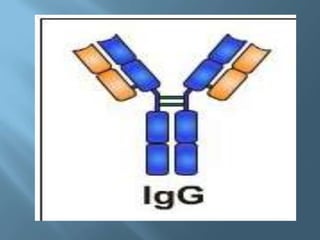
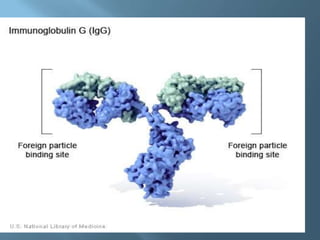
 IgG (HEAVY CHAIN γ ) :
 Is a monomeric molecule with 2 antigen binding
sites
 There are 4 subclasses, IgG1 to IGg4 based on
antigenic differences in the H-chains and on the
number and location of disulfide bonds
 It is produced mainly in the secondary response
and constitutes an important defence against
bacteria & viruses
 IgG is the major class of immunoglobulin found in
the serum which accounts for 70% of the total
 IgG is the only antibody that crosses the placenta
& therefore is the class of maternal antibody that
protects the fetus
 Functions:
 Neutralizes bacterial toxins and viruses
 Opsonises bacteria, making them easier to
phagocytize
 Activates complements which enhances bacterial
killing
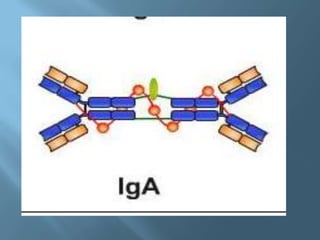
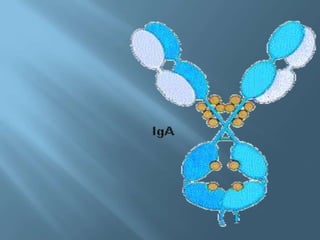
 IgA is the 2nd most abundant class constituting
about 20% of serum immunoglobulins
 IgA occurs in 2 forms:
 Secretory IgA
 Serum IgA
 Secretory IgA is a dimeric molecule formed by 2
monomer units, joined together at their carboxy
terminals by a protein termed J-chains
 Additionally secretory IgA has a secretory
component attached to dimer
 Secretory IgA is found in external secretions
such as colostrum,saliva,tears and respiratory ,
intestinal & genital tract secretions
 Serum IgA exists as monomeric form( found in
internal secretions such as
synovial,amniotic,pleural & CSF )
 Functions:
 Secretory IgA prevents attachment of bacteria
and viruses to mucous membranes and helps
protect mucous surface from antigenic attack
 Prevents access of foreign substances to
circulation
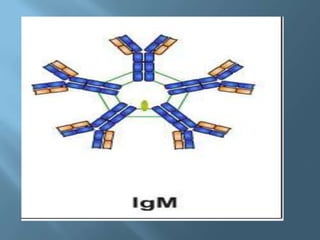
 It is a pentamer consisting of 5 identical Ig
molecules, joined together by disulfide bridges.
 IgM accounts for some 10% of normal Ig
 IgM is the main Ig produced early in the primary
response
 As it is pentamer, it has 10 antigen binding sites &
is the most efficient Ig in agglutination,
complement activation & other antibody
reactions & is important in defence against
bacteria & viruses
 The natural blood group antibodies, anti-A &
anti-B are IgM
 IgM present on the surface of B lymphocytes is
monomer, where it functions as an antigen
binding receptor for antigen recognition
 IgM can be produced by fetus in certain
infections.
 Functions:
 Activate complement, promotes phagocytosis &
causes lysis of antigenic cells(bacteria)
 Waldenstorm’s macroglobulinaemia :
 It is a malignant disease of lymphoid elements,
characterized by high serum concentrarion of
IgM
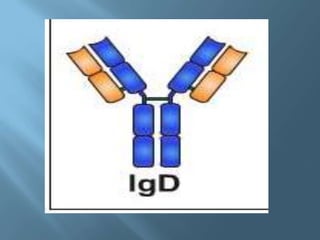
 It is a monomer and resembles IgG structurally
 IgD has no known antibody function but may
function as an antigen receptor
 Like, IgM, it is present on the surface of many B
lymphocytes
 The circulating concentration of IgD in blood is
very low
 IgD is labile
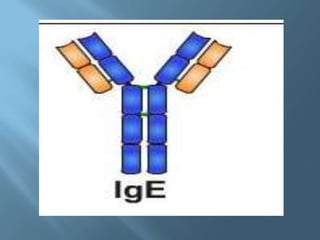
 IgE is a monomeric molecule similar to IgG. It is
sometimes called reagin
 Although IgE is present in trace amounts, in
normal persons with allergic activity have greatly
increased amounts
 Functions:
 Antiallergic & antiparasitic
 IgE is responsible for anaphylactic(immediate)
type of hypersensitivity & allergy. Its main
activity is mediated by mast cells or basophils
 Defends against worm infections by causing
release of enzymes from eosinophils
 Main host defence against parasites like
helminthus, provides protection in the disease
schistomiasis
 A malignant proliferation of plasma cells
 Results in an abnormally high concentration of
serum immunoglobulins, usually IgG or IgA
 In multiple myeloma, more light chains are
produced than heavy chains and enter the
bloodstream
 Because they are of relatively low m.wt, they
pass through glomerular membrane and
appear in the urine, these protein chains of low
m.wt are known as Bence Jones Proteins
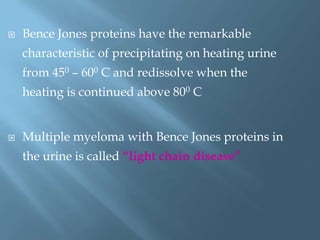
 Bence Jones proteins have the remarkable
characteristic of precipitating on heating urine
from 450 – 600 C and redissolve when the
heating is continued above 800 C
 Multiple myeloma with Bence Jones proteins in
the urine is called “light chain disease”
Plasma proteins.
Plasma proteins.
Plasma proteins.

Plasma proteins.

  • 1.
    M.Prasad Naidu MSc MedicalBiochemistry, Ph.D,.
  • 2.
     Total bloodvolume is 4.5-5 litres.  If blood containing anticoagulants (e.g.heparin , potassium oxalate) is centrifuged , the plasma separates out as a supernatant while the cells remain at the bottom.  About 55-60% of blood is plasma  The packed cell volume or hematocrit is about 40-45%
  • 3.
     Plasma isthe clear straw coloured fluid portion of the blood minus its cellular elements.  It constitutes about 55% of the blood volume.  Serum is plasma minus clotting factors (fibrinogen & prothrombin ).  The defribrinated plasma is called serum
  • 4.
     PLASMA containsthe following composition: WATER: Is the main constituent of Plasma – 91% SOLIDS: 9% of the plasma (1% inorganic molecules & 8% organic molecules)
  • 5.
    OTHER ORGANIC MOLECULES Carbohydrates: Glucose ( 100-120 mg%) Fats : neutral fats, phospholipids (150- 300mg%) Cholesterol (150-240 mg%)
  • 6.
     Non proteinnitrogenous substances : ammonia, amino acids, creatine, creatinine (0.6- 1.2 mg%) xanthine, hypoxanthine, urea (20-40 mg%) & uric acid (2-4 mg%).  Hormones enzymes & antibodies.
  • 7.
     Inorganic moleculesare sodium, potassium, calcium, magnesium, chloride, iodide, iron, phosphates & copper.  Gases presents in the plasma are O2 ,Co2,& N2 .
  • 8.
    plasma proteins… - forms7% of the solids in plasma - their normal valves – 7.4 gm% ranges from (6.4 – 8.3 gm%)  INCLUDES: ALBUMIN GLOBULINS FIBRINOGEN
  • 9.
     Total proteincontent of normal plasma is 6 - 8 g/100ml  The plasma proteins consist of : 1)albumin (3.5-5 g/dl) 2)globulins (2.5-3.5 g/dl) 3)fibrinogen (200-400 mg/dl)
  • 10.
     The albumin: globulin ratio is usually between 1.2 :; 1 to 1.5 :1  Almost all plasma proteins , except immunoglobulins are synthesized in liver
  • 11.
     In clinicallaboratory, separation is usually done by salts.  Thus , fibrinogen is precipitated by 10% and globulins by 22% concentration of sodium sulphate  Ammonium sulphate will precipitate : albumin by full-saturation globulin by half-saturation
  • 12.
     In clinicallaboratory , total proteins of patients are estimated by Biuret method.  Albumin is quantitated by Bromo cresol green (BCG) method , in which the dye is preferentially bound with albumin , and the colour intensity is measured colourimetrically.
  • 13.
     OTHER METHODS: Lowry’s method  Kjeldahl’s method  Dye-binding method  UV-absorption method
  • 14.
     The mostcommon method of analyzing plasma proteins is by electrophoresis.  The term electrophoresis refers to the movement of chargeD particles through an electrolyte when subjected to an electric field
  • 15.
     In clinicallaboratory , cellulose acetate is widely used as a supporting medium.  Its use permits resolution , after staining , of plasma proteins into five bands , designated albumin , α1 , α2 , β and γ fractions, respectively
  • 16.
     The stainedstrip of cellulose acetate is called electrophoretogram.  The amounts of these five bands can be conveniently quantified by use of Densitometric scanning machines.  Characteristic changes in the amounts of one or more of these five bands are found in many diseases.
  • 18.
     Various abnormalitiescan be identified in the electrophoretic pattern  1) CHRONIC INFECTIONS:  The gammaglobulins are increased
  • 19.
     2)MULTIPLE MYELOMA:  In para-proteinemias , a sharp spike is noted and is termed as M-band.  This is due to monoclonal origin of immunoglobulins
  • 20.
     PRIMARY IMMUNEDEFICIENCY :  The gamma globulin fraction is reduced  NEPHROTIC SYNDROME :  All proteins except very big molecules are lost through urine , and α-2-fraction will be very prominent
  • 21.
     CIRRHOSIS OFLIVER :  Albumin synthesis by liver is decreased , with a complementary excess synthesis by globulins by reticuloendothelial system
  • 22.
     CHRONIC LYMPHATICLEUKEMIA:  Gamma globulin fraction is reduced  ALPHA-1-ANTITRYPSIN DEFICIENCY:  The alpha-1 band is thin or even missing
  • 23.
     Albumin (69kDa) is the major protein in human plasma(3.4-4.7 g/dl)  It makes up approximately 60% of the total plasma protein.  About 40% of albumin is present in the plasma, and the other 60% is present in the extracellular space.
  • 24.
     The liverproduces about 12g of albumin per day , representing about 25% of total hepatic protein synthesis  Albumin can come out of vascular compartment. So albumin is present in CSF and interstitial fluid.
  • 25.
     1)COLLOID OSMOTICPRESSURE OF PLASMA:  The total osmolality of serum is 278-305 mosmol/kg.  This is exerted mainly by salts, which can pass easily from intravascular to extravascular space.  Therefore, the osmotic pressure exerted by electrolytes inside and outside the vascular compartments will cancel each other.
  • 26.
     But proteinscannot easily escape out of blood vessels, and therefore , proteins exert the „effective osmotic pressure‟.  It is about 25mm Hg, and 80% of it is contributed by albumin.  The maintenance of blood volume is dependent on this effective osmotic pressure
  • 27.
    Gaw: Clinical Biochemistry;Churchill Livingstone (1999), p. 44.
  • 28.
     TRANSPORT FUNCTION: Albumin is the carrier of various hydrophobic substances in the blood such as:  i)bilirubin & non-esterified fatty acids  ii)drugs (sulpha,aspirin,salicylate,)  iii)hormones(steroid hormones,thyroxine)  iv)metals (calcium,copper,heavy metals)
  • 29.
    3)BUFFERING ACTION : Albumin has maximum buffering capacity amongst all proteins  It has a total of 16 histidine residues which contribute to this buffering action.
  • 30.
    4)NUTRITIONAL FUNCTION:  Alltissue cells can take up albumin by pinocytosis.  It is then broken down to amino acid level.  So albumin may be considered as the transport form of essential amino acids from liver to extrahepatic cells.
  • 31.
    1)BLOOD-BRAIN BARRIER:  Albumin-fattyacid complex cannot cross blood- brain barrier and hence fatty acids cannot be taken up by brain.
  • 32.
    2)PROTEIN-BOUND CALCIUM:  Calciumlevel in blood is lowered in hypo- albuminemia  Thus , even though total calcium level in blood is lowered, ionised calcium level may be normal, so tetany may not occur.
  • 33.
     3) THERAPEUTICUSE:  Human albumin is therapeutically useful to treat burns,hemorrhage and shock.  4)EDEMA:  Hypo-albuminemia will result in tissue edema  Eg: a)malnutrition b)nephrotic syndrome c)cirrhosis of liver d)chronic congestive cardiac failure.
  • 34.
     CIRRHOSIS OFLIVER:  Synthesis is decreased.  MALNUTRITION:  Availability of amino acids is reduce and so albumin synthesis is affected.  NEPHROTIC SYNDROME:  Permeability of kidney glomerular membrane is defective , so that albumin is excreted in large quantities.
  • 35.
     PROTEIN LOSINGENTEROPATHY:  Large quantities of albumin is lost from intestinal tract.
  • 37.
     ALBUMINURIA:  Presenceof albumin in urine is called albuminuria.  It is always pathological.  Seen in: a)Nephrotic syndrome(large quantities) b)Acute nephritis c)Inflammatory conditions of urinary tract.  Detection of albumin in urine is done by heat and acetic acid test.
  • 38.
     MICRO-ALBUMINURIA:  Inmicro-albuminuria or minimal albuminuria or plauci-albuminuria , small quantity of albumin (30-300 mg/dl) is seen in urine  It is estimated by RIA  Increased levels of microalbuminuria is an indication of early involvement of renal tissue in diabetic patients
  • 39.
     Albumin-globulin ratio:  In hypo-albuminemia, there will be a compensatory increase in globulins which are synthesized by the reticulo-endothelial system(plasma cells).  Albumin-globulin ratio (A/G ratio) is thus altered or even reversed.
  • 40.
     Hypoproteinemia : Since albumin is the major protein present in the blood, any condition causing lowering of albumin will lead to reduce total proteins in blood
  • 41.
     HYPERALBUMINEMIA : Increased levels of plasma albumin are present only in acute dehydration and have no clinical significance  ANALBUMINAEMIA :  Analbuminemia is a rare hereditary abnormality in which plasma albumin concentration is usually less than 1.0gm/L
  • 42.
     Globulins arebigger in size than albumin . Globulins constitute several fractions. These are:  α1- globulin  α2- globulin  β- globulin  γ- globulin
  • 43.
     Retinol bindingprotein(RBP)  α1 – fetoprotein(AFP)  α1 – protease inhibitor (API)  α1 - acid glycoprotein (AAG)  High density lipopprotein (HDL)  Prothrombin
  • 44.
     RETINOL BINDINGPROTEIN (RBP)  Retinol (vitamin A) is transported in plasma bound to RBP.  Most retinol RBP in the plasma is reversibely complexed with transthyretin (thyroxine binding protein)  α1- FETOPROTEIN (AFP)  This is present in the tissues and plasma of the fetus  It may play an immunoregulatory role during pregnancy.
  • 45.
     α1- PROTEASEINHIBITOR (API) / α1- ANTITRYPSIN (AAT) :  API is one of the plasma proteins, that inhibits activity of proteases particularly elastase, which degrades elastin, a protein that gives elasticity to the lungs  α1-ACID GLYCOPROTEIN (AAG)  AAG also known as orosomucoid, contains a high percentage of carbohydrate with a large number of sialic acid residues  It is synthesized by liver parenchymal cells.
  • 46.
     PROTHROMBIN  Itis synthesized by liver with the help of vitamin K and involved in blood clotting
  • 47.
     Ceruloplasmin(ferro-oxidase)  Transcortin/ corticosteroid binding globulin  Haptoglobin  Thyroxine binding globulin(TBG)  α2 - macroglobulin (AMG)
  • 48.
     CERULOPLASMIN (FERRO-OXIDASE) This is a copper containing protein.  It has oxidase activity  Ceruloplasmin is the major transport protein for copper, an essential trace element.  It is also essential for the regulation of oxiation- reduction , transport and utilization of iron  Plasma ceruloplasmin level is reduced in Wilson‟s disease in patients with malnutrition and in the nephrotic syndrome.
  • 49.
     TRANSCORTIN /CORTICOSTEROIDBINDING GLOBULIN:  This binds cortisol  It is synthesized in liver and synthesis is increased by oestrogen  HAPTOGLOBIN:  It plays an important role in the conservation of iron by preventing its loss in the urine  Haptoglobin binds free Hb to form a complex which is too large to be filtered by the kidney and thus prevents the loss of iron in the urine.
  • 50.
     THYROXINE-BINDING GLOBULIN(TBG)  TBG is synthesized in liver  TBG has a electrophoretic mobility between α1 & α2 globulins  It transports thyroxine hormone(T3 & T4)  α2 - MACROGLOBULIN(AMG)  This is major α2 - globulin , which is a natural inhibitor of endopeptidases such as trypsin, chymotrypsin, plasmin, thrombin .etc.
  • 51.
     Haemopexin  Transferrin β2 -microglobulin(BMG)  C-reactive protein(CRP)  Low density lipoprotein
  • 52.
     HAEMOPEXIN  Likehaptoglobulin, haemopexin also plays an important role in the conservation of iron by preventing its loss in urine  TRANSFERRIN  Is synthesized in liver  It transports iron(2 molecules of Fe3+ per molecule of transferrin) through blood to the sites where iron is required
  • 53.
     C-REACTIVE PROTEIN(CRP) CRP is involved in the body’s response to inflammations .mainly bacterial..  It is useful in differentiating bacterial from viral infections because the level of CRP is increased in bacterial infections only. 
  • 54.
    MICROGLOBULIN  This proteinforms part of the human leucocyte antigen(HLA) system  Plasma levels are increased whenever, there is malignant lymphoid or myeloid proliferation and renal failure
  • 55.
     The acutephase response is a non-specific response to the stimulus of tissue following trauma, infection ,inflammation, burn, etc  Following trauma etc , the body responds by initiating a series of mechanisms that lead to rapid decrease in the concentration of many proteins,eg  Albumin  Prealbumin  Transferrin  These are termed “negative acute phase reactants”
  • 56.
     An increasein the concentration of several specific proteins occur some hours after the injury. These proteins are called the positive acute phase proteins
  • 57.
    Definition:  The Igsconstitute a heterogenous family of serum proteins, which either function as antibodies or are chemically related to antibodies  The immunoglobulins are γ- globulins , called antibodies. All antibodies are immunoglobulin but all immunoglobulins may not be antibodies
  • 58.
     They constituteabout 20% of all the plasma proteins  Igs are produced by plasma cells & to some extent by lymphocytes
  • 59.
     Immunoglobulins areglycoproteins made up of light(L) and heavy(H) polypeptide chains.  All Igs have the same basic structure. The basic Ig is a “Y” shaped molecule and consist of 4 polypeptide chains:  2 H chains  2 L chains  The 4 chains are linked by disulfide bonds
  • 60.
     An individualantibody molecule always consists of identical H chains & identical L chains  L chain may be either of 2 types, kappa(κ) or lambda(λ) but not both  The heavy chains may be of 5 types and are designated by greek letter:  Alpha(α)  Gamma(γ)  Delta(δ)  Mu(μ)  Epsilon(ε)
  • 61.
    Five Classes ofImmunoglobulin
  • 63.
     Igs arenamed as per their heavy chain type as IgA , IgG , IgD , IgM & IgE  The L and H chains are subdivided into variable and constant regions  L chain consists of one variable(VL) and one constant (CL) domain or region  Most H-chains consist of one variable(VH) and 3 constant(CH-1,CH-2 & CH-3) domains  IgG & IgA have 3 CH domains whereas IgM & IgE have 4
  • 64.
     Each Igmolecule has hinge region between CH- 1 & CH-2, which allows better fit with the antigen surface.  The variable regions of both L & H chains have 3 extremely variable amino acid sequences at the amino terminal end called hypervariable region  Enzyme(papain) digestion splits the Ig molecule into 2 fragments named as Fab (Fragment for antigen binding) and Fc (crystallizable fragment)
  • 66.
     The primaryfunction of antibodies is to protect against infectious agents or their products.  Igs provide resistance because they can :  Neutralize toxins & viruses  Opsonize microbes so they are more easily phagocytosed  Activate complement & prevent the attachment of microbes to mucosal surfaces
  • 67.
     In additionto these functions, antibodies can act as an enzyme to catalyze the synthesis of ozone (O3) that has microbicidal activity.
  • 68.
     IgG (HEAVYCHAIN γ ) :  Is a monomeric molecule with 2 antigen binding sites  There are 4 subclasses, IgG1 to IGg4 based on antigenic differences in the H-chains and on the number and location of disulfide bonds  It is produced mainly in the secondary response and constitutes an important defence against bacteria & viruses
  • 69.
     IgG isthe major class of immunoglobulin found in the serum which accounts for 70% of the total  IgG is the only antibody that crosses the placenta & therefore is the class of maternal antibody that protects the fetus  Functions:  Neutralizes bacterial toxins and viruses  Opsonises bacteria, making them easier to phagocytize  Activates complements which enhances bacterial killing
  • 72.
     IgA isthe 2nd most abundant class constituting about 20% of serum immunoglobulins  IgA occurs in 2 forms:  Secretory IgA  Serum IgA  Secretory IgA is a dimeric molecule formed by 2 monomer units, joined together at their carboxy terminals by a protein termed J-chains
  • 73.
     Additionally secretoryIgA has a secretory component attached to dimer  Secretory IgA is found in external secretions such as colostrum,saliva,tears and respiratory , intestinal & genital tract secretions  Serum IgA exists as monomeric form( found in internal secretions such as synovial,amniotic,pleural & CSF )
  • 74.
     Functions:  SecretoryIgA prevents attachment of bacteria and viruses to mucous membranes and helps protect mucous surface from antigenic attack  Prevents access of foreign substances to circulation
  • 77.
     It isa pentamer consisting of 5 identical Ig molecules, joined together by disulfide bridges.  IgM accounts for some 10% of normal Ig  IgM is the main Ig produced early in the primary response  As it is pentamer, it has 10 antigen binding sites & is the most efficient Ig in agglutination, complement activation & other antibody reactions & is important in defence against bacteria & viruses
  • 78.
     The naturalblood group antibodies, anti-A & anti-B are IgM  IgM present on the surface of B lymphocytes is monomer, where it functions as an antigen binding receptor for antigen recognition  IgM can be produced by fetus in certain infections.  Functions:  Activate complement, promotes phagocytosis & causes lysis of antigenic cells(bacteria)
  • 79.
     Waldenstorm’s macroglobulinaemia:  It is a malignant disease of lymphoid elements, characterized by high serum concentrarion of IgM
  • 81.
     It isa monomer and resembles IgG structurally  IgD has no known antibody function but may function as an antigen receptor  Like, IgM, it is present on the surface of many B lymphocytes  The circulating concentration of IgD in blood is very low  IgD is labile
  • 83.
     IgE isa monomeric molecule similar to IgG. It is sometimes called reagin  Although IgE is present in trace amounts, in normal persons with allergic activity have greatly increased amounts  Functions:  Antiallergic & antiparasitic
  • 84.
     IgE isresponsible for anaphylactic(immediate) type of hypersensitivity & allergy. Its main activity is mediated by mast cells or basophils  Defends against worm infections by causing release of enzymes from eosinophils  Main host defence against parasites like helminthus, provides protection in the disease schistomiasis
  • 85.
     A malignantproliferation of plasma cells  Results in an abnormally high concentration of serum immunoglobulins, usually IgG or IgA
  • 86.
     In multiplemyeloma, more light chains are produced than heavy chains and enter the bloodstream  Because they are of relatively low m.wt, they pass through glomerular membrane and appear in the urine, these protein chains of low m.wt are known as Bence Jones Proteins
  • 87.
     Bence Jonesproteins have the remarkable characteristic of precipitating on heating urine from 450 – 600 C and redissolve when the heating is continued above 800 C  Multiple myeloma with Bence Jones proteins in the urine is called “light chain disease”