PLASMA PROTEINS
Department of Biochemistry, KMC, DuwakotSaturday, April
04, 2015
Rajesh Chaudhary 1
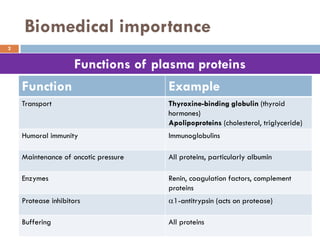
Biomedical importance
Function Example
Transport Thyroxine-binding globulin (thyroid
hormones)
Apolipoproteins (cholesterol, triglyceride)
Humoral immunity Immunoglobulins
Maintenance of oncotic pressure All proteins, particularly albumin
Enzymes Renin, coagulation factors, complement
proteins
Protease inhibitors a1-antitrypsin (acts on protease)
Buffering All proteins
Functions of plasma proteins
2
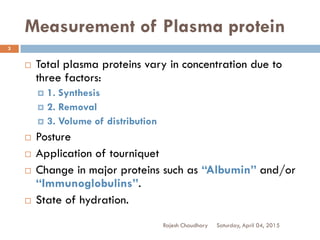
Measurement of Plasma protein
 Total plasma proteins vary in concentration due to
three factors:
 1. Synthesis
 2. Removal
 3. Volume of distribution
 Posture
 Application of tourniquet
 Change in major proteins such as “Albumin” and/or
“Immunoglobulins”.
 State of hydration.
Saturday, April 04, 2015Rajesh Chaudhary
3
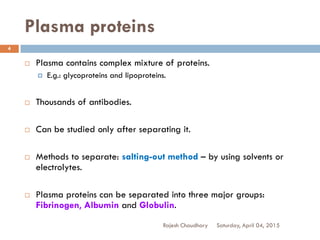
Plasma proteins
 Plasma contains complex mixture of proteins.
 E.g.: glycoproteins and lipoproteins.
 Thousands of antibodies.
 Can be studied only after separating it.
 Methods to separate: salting-out method – by using solvents or
electrolytes.
 Plasma proteins can be separated into three major groups:
Fibrinogen, Albumin and Globulin.
Saturday, April 04, 2015Rajesh Chaudhary
4
Plasma proteins
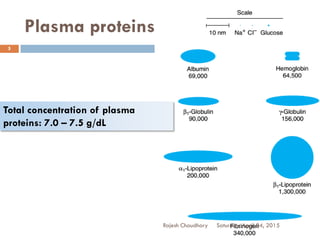
Total concentration of plasma
proteins: 7.0 – 7.5 g/dL
Saturday, April 04, 2015Rajesh Chaudhary
5
Plasma protein or Serum protein ?
Saturday, April 04, 2015Rajesh Chaudhary
6
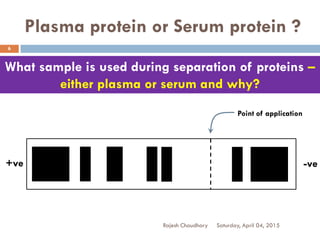
What sample is used during separation of proteins –
either plasma or serum and why?
+ve -ve
Point of application
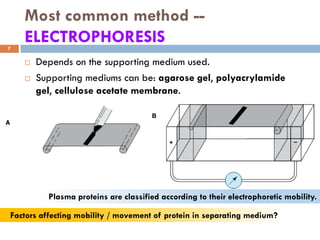
Most common method --
ELECTROPHORESIS
 Depends on the supporting medium used.
 Supporting mediums can be: agarose gel, polyacrylamide
gel, cellulose acetate membrane.
7
Plasma proteins are classified according to their electrophoretic mobility.
Factors affecting mobility / movement of protein in separating medium?
Electrophoresis
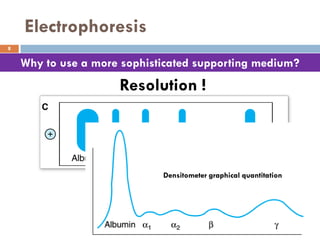
Why to use a more sophisticated supporting medium?
Resolution !
8
Densitometer graphical quantitation
Concentration of plasma protein
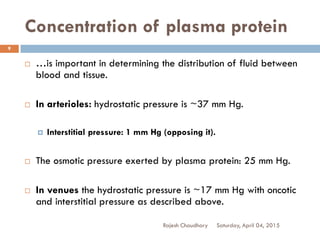
 …is important in determining the distribution of fluid between
blood and tissue.
 In arterioles: hydrostatic pressure is ~37 mm Hg.
 Interstitial pressure: 1 mm Hg (opposing it).
 The osmotic pressure exerted by plasma protein: 25 mm Hg.
 In venues the hydrostatic pressure is ~17 mm Hg with oncotic
and interstitial pressure as described above.
Saturday, April 04, 2015Rajesh Chaudhary
9
Plasma proteins
(Plasma proteins have been studied extensively)
Saturday, April 04, 2015Rajesh Chaudhary
10
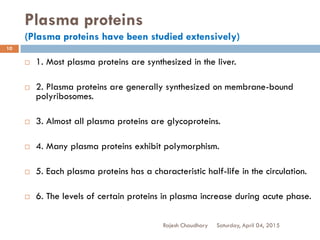
 1. Most plasma proteins are synthesized in the liver.
 2. Plasma proteins are generally synthesized on membrane-bound
polyribosomes.
 3. Almost all plasma proteins are glycoproteins.
 4. Many plasma proteins exhibit polymorphism.
 5. Each plasma proteins has a characteristic half-life in the circulation.
 6. The levels of certain proteins in plasma increase during acute phase.
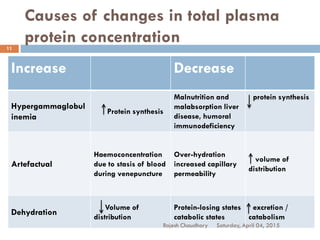
Causes of changes in total plasma
protein concentration
Increase Decrease
Hypergammaglobul
inemia
Protein synthesis
Malnutrition and
malabsorption liver
disease, humoral
immunodeficiency
protein synthesis
Artefactual
Haemoconcentration
due to stasis of blood
during venepuncture
Over-hydration
increased capillary
permeability
volume of
distribution
Dehydration
Volume of
distribution
Protein-losing states
catabolic states
excretion /
catabolism
Saturday, April 04, 2015Rajesh Chaudhary
11
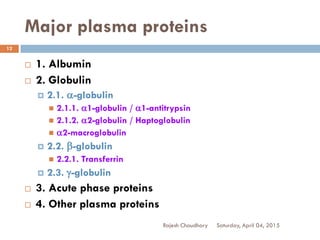
Major plasma proteins
 1. Albumin
 2. Globulin
 2.1. a-globulin
 2.1.1. a1-globulin / a1-antitrypsin
 2.1.2. a2-globulin / Haptoglobulin
 a2-macroglobulin
 2.2. b-globulin
 2.2.1. Transferrin
 2.3. g-globulin
 3. Acute phase proteins
 4. Other plasma proteins
Saturday, April 04, 2015Rajesh Chaudhary
12
Albumin
 69 kDa in size and is a major protein in human plasma (3.4 –
4.7 g/dL).
 ~60% of total plasma protein is Albumin.
 40% is present in plasma and remaining 60% in extracellular
space.
 12 g/day of albumin is produced.
 Albumin production is reduced in live disease.
 Mature human albumin: 585 AA, single polypeptide chain, 17
disulfide bonds.
 Shape: ellipsoidal shape, thus doesn’t increase viscosity
plasma.
Saturday, April 04, 2015Rajesh Chaudhary
13
Analbuminemia
 Condition in which human lacks albumin.
 Reason: because of mutation in gene splicing.
 Patient shows moderate edema.
 Binds with several forms of ligands.
 E.g. Calcium, steroid hormones, FFA, bilirubin etc.
 Plays an important role in copper transport in body.
 Used in treatment of hemorrhagic shock but it’s controversial.
Saturday, April 04, 2015Rajesh Chaudhary
14
Haptoglobulin (Hp)
Saturday, April 04, 2015Rajesh Chaudhary
15
 Binds extracorpuscular hemoglobin (Hb) in tight
noncovalent complex (Hb-Hp).
 Amount: 40-180 mg of hemoglobin-binding capacity per
deciliter.
 Molecular weight of Hb: 65 kDa.
 Molecular weight of Hp: 90 kDa.
 Total = 155 kDa.
 Haptoglobulin exists in three polymorphic forms: Hp 1-1,
Hp 2-1, and Hp 2-2.
 The level of haptoglobulin falls in hemoglytic anemia.
How does Hp level falls in hemolytic anemia?
Transferrin / b1-globulin
Saturday, April 04, 2015Rajesh Chaudhary
16
 Glycoprotein with 76 kDa of size, having 20 polymorphic
forms is synthesized in liver.
 Have 20 polymorphic forms.
 Transfers 2 moles of Fe3+ per mole of transferrin.
 Approximately 200 billion red blood cells (about 20 mL) are
catabolized per day, releasing about 25 mg of iron into the
body.
 Iron consumed through diet is absorbed as Fe2+.
 Free iron is toxic but diminishes potential toxicity and also
directs where it is required.
 Total concentration of transferring in plasma 300 mg/dL.
Ceruloplasmin / a2-globulin
Saturday, April 04, 2015Rajesh Chaudhary
17
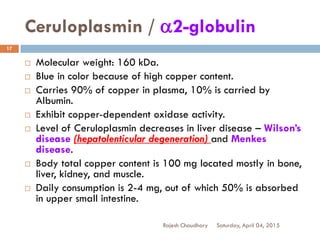
 Molecular weight: 160 kDa.
 Blue in color because of high copper content.
 Carries 90% of copper in plasma, 10% is carried by
Albumin.
 Exhibit copper-dependent oxidase activity.
 Level of Ceruloplasmin decreases in liver disease – Wilson’s
disease (hepatolenticular degeneration) and Menkes
disease.
 Body total copper content is 100 mg located mostly in bone,
liver, kidney, and muscle.
 Daily consumption is 2-4 mg, out of which 50% is absorbed
in upper small intestine.
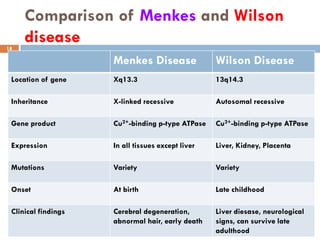
Comparison of Menkes and Wilson
disease
Sunday, April 05, 2015Rajesh Chaudhary
18
Menkes Disease Wilson Disease
Location of gene Xq13.3 13q14.3
Inheritance X-linked recessive Autosomal recessive
Gene product Cu2+-binding p-type ATPase Cu2+-binding p-type ATPase
Expression In all tissues except liver Liver, Kidney, Placenta
Mutations Variety Variety
Onset At birth Late childhood
Clinical findings Cerebral degeneration,
abnormal hair, early death
Liver diesase, neurological
signs, can survive late
adulthood
a1-antitrypsin / a1-antiproteinase
Saturday, April 04, 2015Rajesh Chaudhary
19
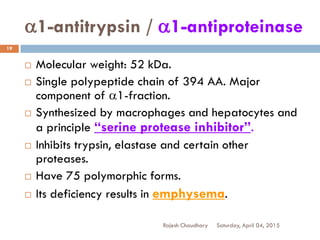
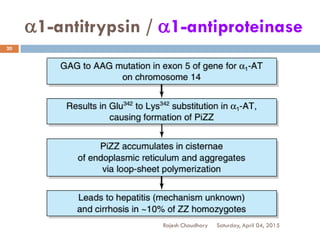
 Molecular weight: 52 kDa.
 Single polypeptide chain of 394 AA. Major
component of a1-fraction.
 Synthesized by macrophages and hepatocytes and
a principle “serine protease inhibitor”.
 Inhibits trypsin, elastase and certain other
proteases.
 Have 75 polymorphic forms.
 Its deficiency results in emphysema.
a1-antitrypsin / a1-antiproteinase
Saturday, April 04, 2015Rajesh Chaudhary
20
a2-macroglobulin
Saturday, April 04, 2015Rajesh Chaudhary
21
 Large glycoprotein with molecular weight 720 kDa.
 Consists of 4 subunits each subunits with 180kDa.
 Comprise of 8-10% of total plasma proteins.
 Approximately 10% of total copper in plasma is
transported by a2-macroglobulin, remainder is
transported by albumin.
 Major panprotease inhibitor.
 Cleared from plasma after binding to receptor located in
many cell types.
1. Harper’s Biochemistry, 25th. Edition
2. Mark’s Basic Medical Biochemistry, 8th.
Edition
3. Clinical Chemistry, William J Marshal, 6th.
Edition
References
Saturday, April 04, 2015
22
Rajesh Chaudhary

Plasma proteins

  • 1.
    PLASMA PROTEINS Department ofBiochemistry, KMC, DuwakotSaturday, April 04, 2015 Rajesh Chaudhary 1
  • 2.
    Biomedical importance Function Example TransportThyroxine-binding globulin (thyroid hormones) Apolipoproteins (cholesterol, triglyceride) Humoral immunity Immunoglobulins Maintenance of oncotic pressure All proteins, particularly albumin Enzymes Renin, coagulation factors, complement proteins Protease inhibitors a1-antitrypsin (acts on protease) Buffering All proteins Functions of plasma proteins 2
  • 3.
    Measurement of Plasmaprotein  Total plasma proteins vary in concentration due to three factors:  1. Synthesis  2. Removal  3. Volume of distribution  Posture  Application of tourniquet  Change in major proteins such as “Albumin” and/or “Immunoglobulins”.  State of hydration. Saturday, April 04, 2015Rajesh Chaudhary 3
  • 4.
    Plasma proteins  Plasmacontains complex mixture of proteins.  E.g.: glycoproteins and lipoproteins.  Thousands of antibodies.  Can be studied only after separating it.  Methods to separate: salting-out method – by using solvents or electrolytes.  Plasma proteins can be separated into three major groups: Fibrinogen, Albumin and Globulin. Saturday, April 04, 2015Rajesh Chaudhary 4
  • 5.
    Plasma proteins Total concentrationof plasma proteins: 7.0 – 7.5 g/dL Saturday, April 04, 2015Rajesh Chaudhary 5
  • 6.
    Plasma protein orSerum protein ? Saturday, April 04, 2015Rajesh Chaudhary 6 What sample is used during separation of proteins – either plasma or serum and why? +ve -ve Point of application
  • 7.
    Most common method-- ELECTROPHORESIS  Depends on the supporting medium used.  Supporting mediums can be: agarose gel, polyacrylamide gel, cellulose acetate membrane. 7 Plasma proteins are classified according to their electrophoretic mobility. Factors affecting mobility / movement of protein in separating medium?
  • 8.
    Electrophoresis Why to usea more sophisticated supporting medium? Resolution ! 8 Densitometer graphical quantitation
  • 9.
    Concentration of plasmaprotein  …is important in determining the distribution of fluid between blood and tissue.  In arterioles: hydrostatic pressure is ~37 mm Hg.  Interstitial pressure: 1 mm Hg (opposing it).  The osmotic pressure exerted by plasma protein: 25 mm Hg.  In venues the hydrostatic pressure is ~17 mm Hg with oncotic and interstitial pressure as described above. Saturday, April 04, 2015Rajesh Chaudhary 9
  • 10.
    Plasma proteins (Plasma proteinshave been studied extensively) Saturday, April 04, 2015Rajesh Chaudhary 10  1. Most plasma proteins are synthesized in the liver.  2. Plasma proteins are generally synthesized on membrane-bound polyribosomes.  3. Almost all plasma proteins are glycoproteins.  4. Many plasma proteins exhibit polymorphism.  5. Each plasma proteins has a characteristic half-life in the circulation.  6. The levels of certain proteins in plasma increase during acute phase.
  • 11.
    Causes of changesin total plasma protein concentration Increase Decrease Hypergammaglobul inemia Protein synthesis Malnutrition and malabsorption liver disease, humoral immunodeficiency protein synthesis Artefactual Haemoconcentration due to stasis of blood during venepuncture Over-hydration increased capillary permeability volume of distribution Dehydration Volume of distribution Protein-losing states catabolic states excretion / catabolism Saturday, April 04, 2015Rajesh Chaudhary 11
  • 12.
    Major plasma proteins 1. Albumin  2. Globulin  2.1. a-globulin  2.1.1. a1-globulin / a1-antitrypsin  2.1.2. a2-globulin / Haptoglobulin  a2-macroglobulin  2.2. b-globulin  2.2.1. Transferrin  2.3. g-globulin  3. Acute phase proteins  4. Other plasma proteins Saturday, April 04, 2015Rajesh Chaudhary 12
  • 13.
    Albumin  69 kDain size and is a major protein in human plasma (3.4 – 4.7 g/dL).  ~60% of total plasma protein is Albumin.  40% is present in plasma and remaining 60% in extracellular space.  12 g/day of albumin is produced.  Albumin production is reduced in live disease.  Mature human albumin: 585 AA, single polypeptide chain, 17 disulfide bonds.  Shape: ellipsoidal shape, thus doesn’t increase viscosity plasma. Saturday, April 04, 2015Rajesh Chaudhary 13
  • 14.
    Analbuminemia  Condition inwhich human lacks albumin.  Reason: because of mutation in gene splicing.  Patient shows moderate edema.  Binds with several forms of ligands.  E.g. Calcium, steroid hormones, FFA, bilirubin etc.  Plays an important role in copper transport in body.  Used in treatment of hemorrhagic shock but it’s controversial. Saturday, April 04, 2015Rajesh Chaudhary 14
  • 15.
    Haptoglobulin (Hp) Saturday, April04, 2015Rajesh Chaudhary 15  Binds extracorpuscular hemoglobin (Hb) in tight noncovalent complex (Hb-Hp).  Amount: 40-180 mg of hemoglobin-binding capacity per deciliter.  Molecular weight of Hb: 65 kDa.  Molecular weight of Hp: 90 kDa.  Total = 155 kDa.  Haptoglobulin exists in three polymorphic forms: Hp 1-1, Hp 2-1, and Hp 2-2.  The level of haptoglobulin falls in hemoglytic anemia. How does Hp level falls in hemolytic anemia?
  • 16.
    Transferrin / b1-globulin Saturday,April 04, 2015Rajesh Chaudhary 16  Glycoprotein with 76 kDa of size, having 20 polymorphic forms is synthesized in liver.  Have 20 polymorphic forms.  Transfers 2 moles of Fe3+ per mole of transferrin.  Approximately 200 billion red blood cells (about 20 mL) are catabolized per day, releasing about 25 mg of iron into the body.  Iron consumed through diet is absorbed as Fe2+.  Free iron is toxic but diminishes potential toxicity and also directs where it is required.  Total concentration of transferring in plasma 300 mg/dL.
  • 17.
    Ceruloplasmin / a2-globulin Saturday,April 04, 2015Rajesh Chaudhary 17  Molecular weight: 160 kDa.  Blue in color because of high copper content.  Carries 90% of copper in plasma, 10% is carried by Albumin.  Exhibit copper-dependent oxidase activity.  Level of Ceruloplasmin decreases in liver disease – Wilson’s disease (hepatolenticular degeneration) and Menkes disease.  Body total copper content is 100 mg located mostly in bone, liver, kidney, and muscle.  Daily consumption is 2-4 mg, out of which 50% is absorbed in upper small intestine.
  • 18.
    Comparison of Menkesand Wilson disease Sunday, April 05, 2015Rajesh Chaudhary 18 Menkes Disease Wilson Disease Location of gene Xq13.3 13q14.3 Inheritance X-linked recessive Autosomal recessive Gene product Cu2+-binding p-type ATPase Cu2+-binding p-type ATPase Expression In all tissues except liver Liver, Kidney, Placenta Mutations Variety Variety Onset At birth Late childhood Clinical findings Cerebral degeneration, abnormal hair, early death Liver diesase, neurological signs, can survive late adulthood
  • 19.
    a1-antitrypsin / a1-antiproteinase Saturday,April 04, 2015Rajesh Chaudhary 19  Molecular weight: 52 kDa.  Single polypeptide chain of 394 AA. Major component of a1-fraction.  Synthesized by macrophages and hepatocytes and a principle “serine protease inhibitor”.  Inhibits trypsin, elastase and certain other proteases.  Have 75 polymorphic forms.  Its deficiency results in emphysema.
  • 20.
    a1-antitrypsin / a1-antiproteinase Saturday,April 04, 2015Rajesh Chaudhary 20
  • 21.
    a2-macroglobulin Saturday, April 04,2015Rajesh Chaudhary 21  Large glycoprotein with molecular weight 720 kDa.  Consists of 4 subunits each subunits with 180kDa.  Comprise of 8-10% of total plasma proteins.  Approximately 10% of total copper in plasma is transported by a2-macroglobulin, remainder is transported by albumin.  Major panprotease inhibitor.  Cleared from plasma after binding to receptor located in many cell types.
  • 22.
    1. Harper’s Biochemistry,25th. Edition 2. Mark’s Basic Medical Biochemistry, 8th. Edition 3. Clinical Chemistry, William J Marshal, 6th. Edition References Saturday, April 04, 2015 22 Rajesh Chaudhary