Glycogen Metabolism-
Part-1
Glycogenesis
Namrata Chhabra, M.D. Biochemistry
Learning Objectives
 At the end of this discussions,
 the learners will be in a position to understand :
 Structure of Glycogen
 Steps of synthesis and degradation of glycogen
 Regulation of these processes
 Clinical significance of Glycogen metabolism
Introduction
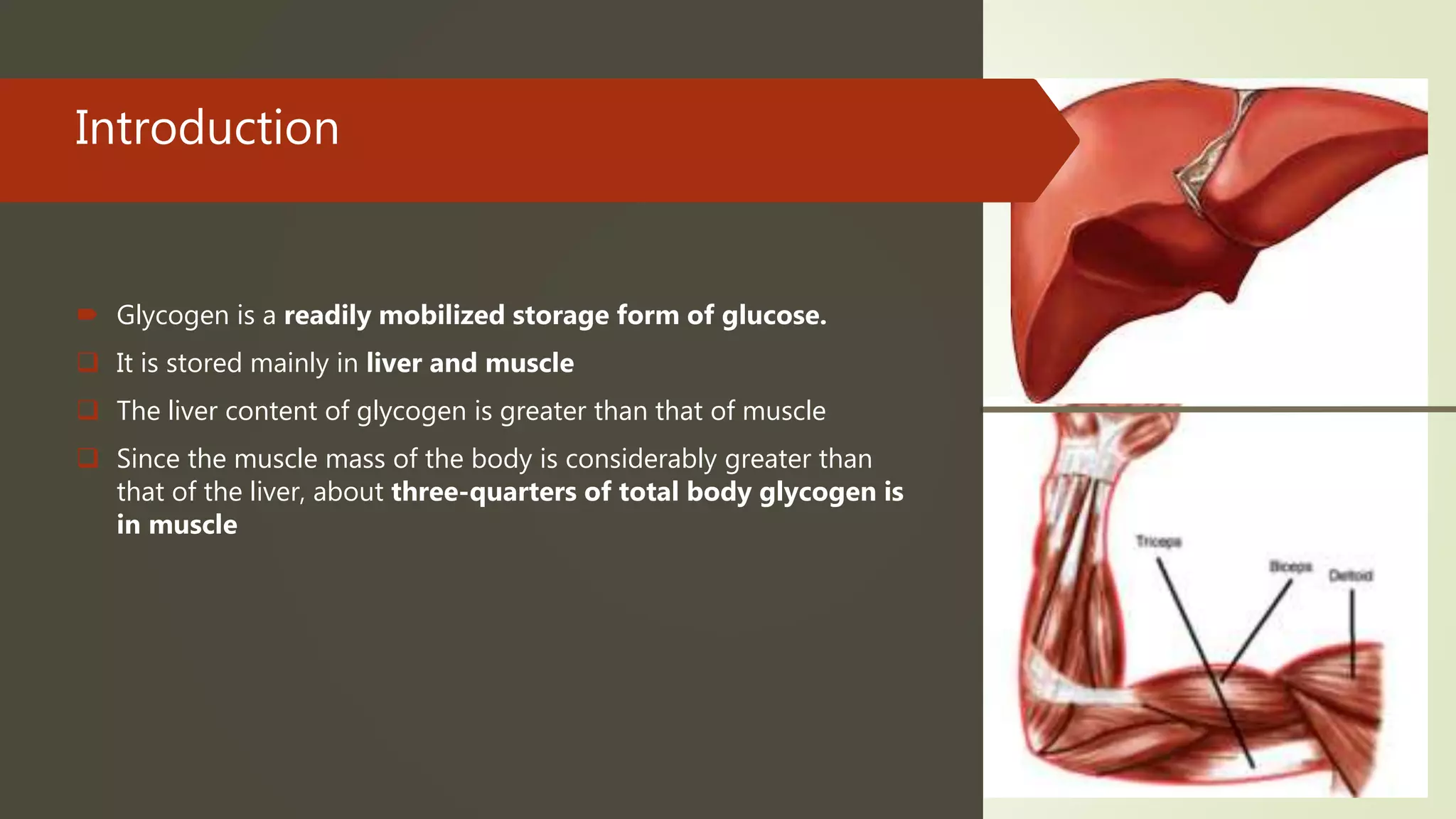
 Glycogen is a readily mobilized storage form of glucose.
 It is stored mainly in liver and muscle
 The liver content of glycogen is greater than that of muscle
 Since the muscle mass of the body is considerably greater than
that of the liver, about three-quarters of total body glycogen is
in muscle
Glycogen-
Chemistry
4
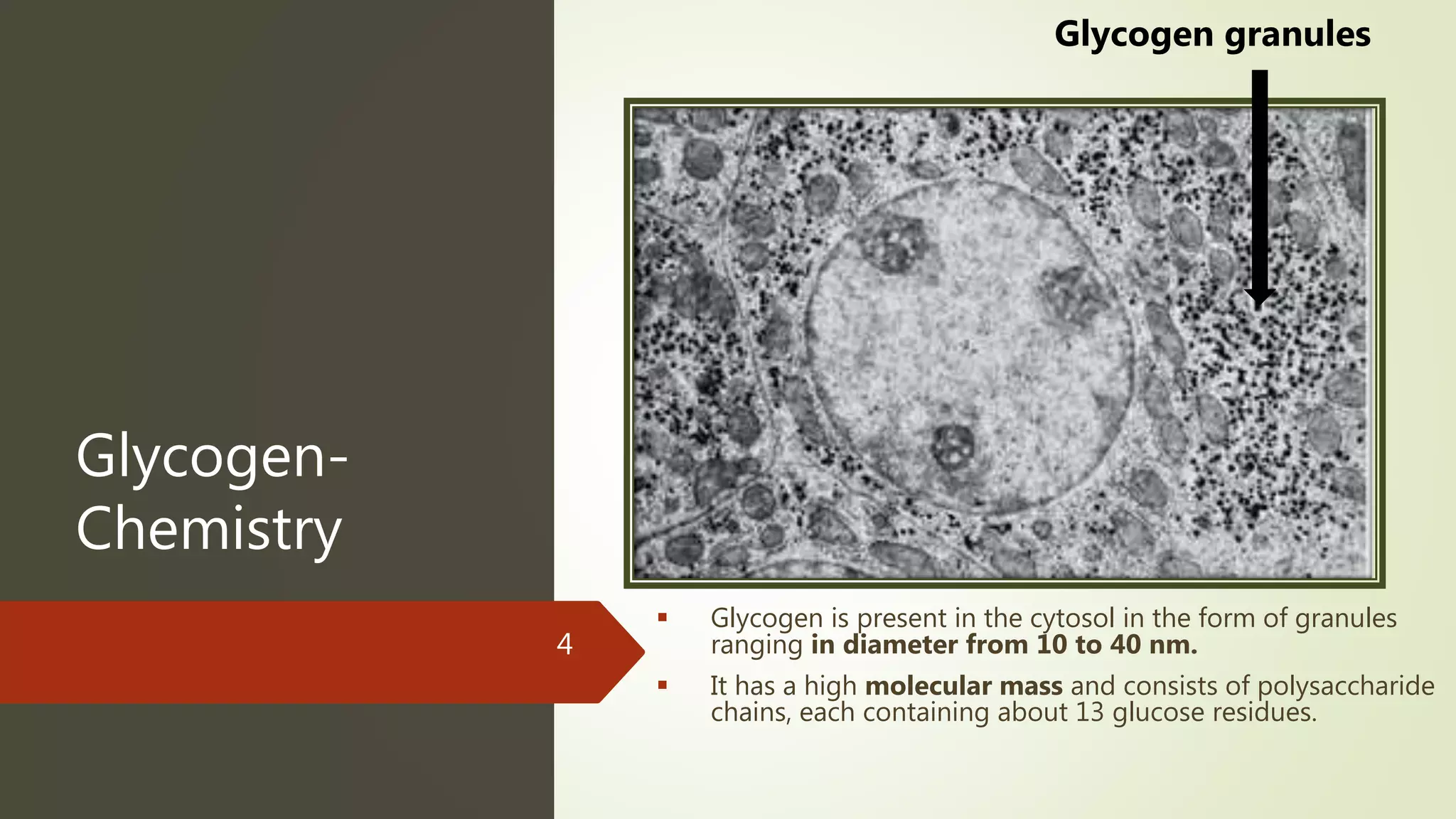
 Glycogen is present in the cytosol in the form of granules
ranging in diameter from 10 to 40 nm.
 It has a high molecular mass and consists of polysaccharide
chains, each containing about 13 glucose residues.
Glycogen granules
Glycogen- Chemistry
Glycogenin
5
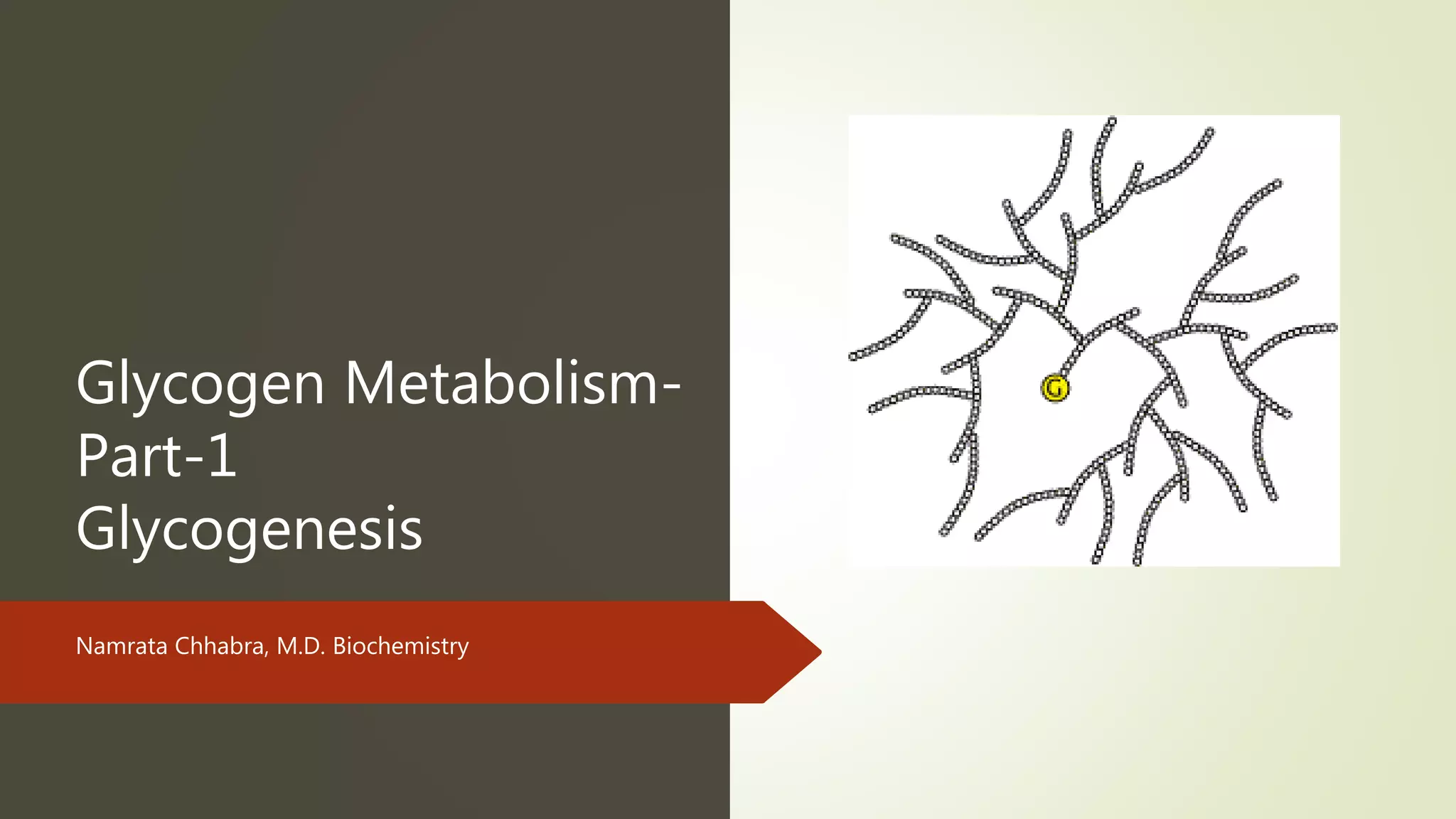
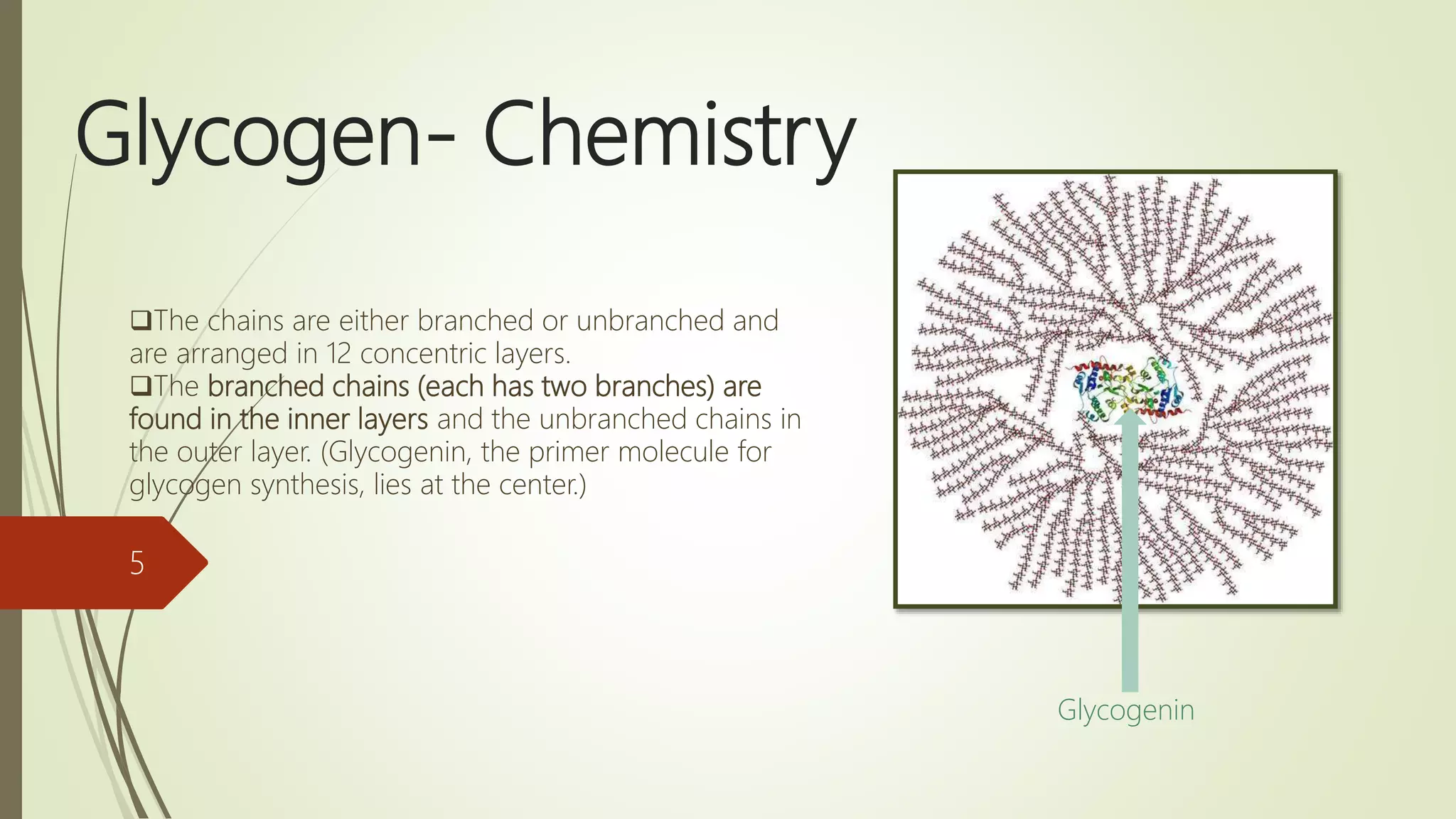
The chains are either branched or unbranched and
are arranged in 12 concentric layers.
The branched chains (each has two branches) are
found in the inner layers and the unbranched chains in
the outer layer. (Glycogenin, the primer molecule for
glycogen synthesis, lies at the center.)
6
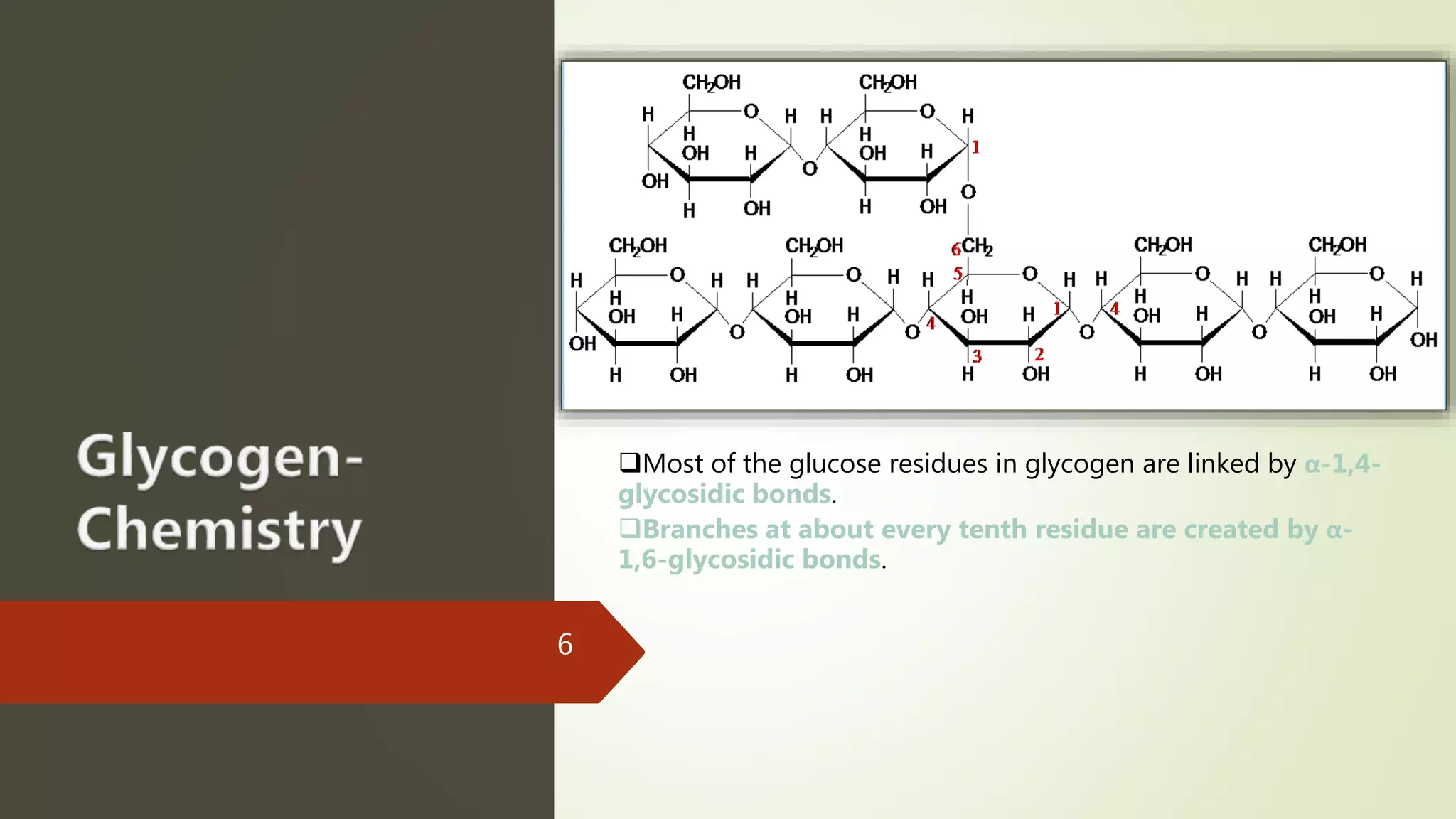
Most of the glucose residues in glycogen are linked by α-1,4-
glycosidic bonds.
Branches at about every tenth residue are created by α-
1,6-glycosidic bonds.
Why branching ?
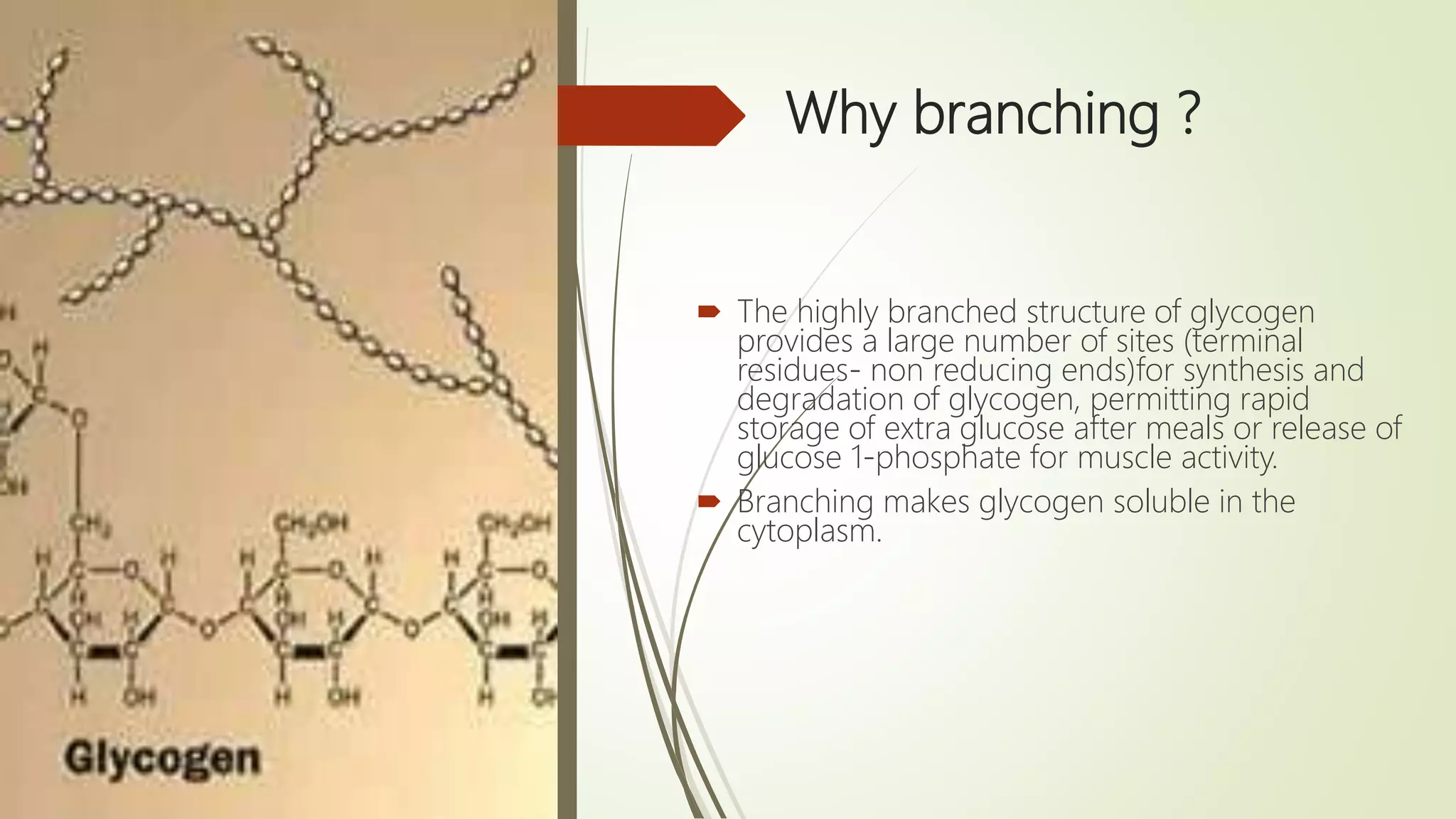
 The highly branched structure of glycogen
provides a large number of sites (terminal
residues- non reducing ends)for synthesis and
degradation of glycogen, permitting rapid
storage of extra glucose after meals or release of
glucose 1-phosphate for muscle activity.
 Branching makes glycogen soluble in the
cytoplasm.
Reasons for storing
Glycogen as a fuel :
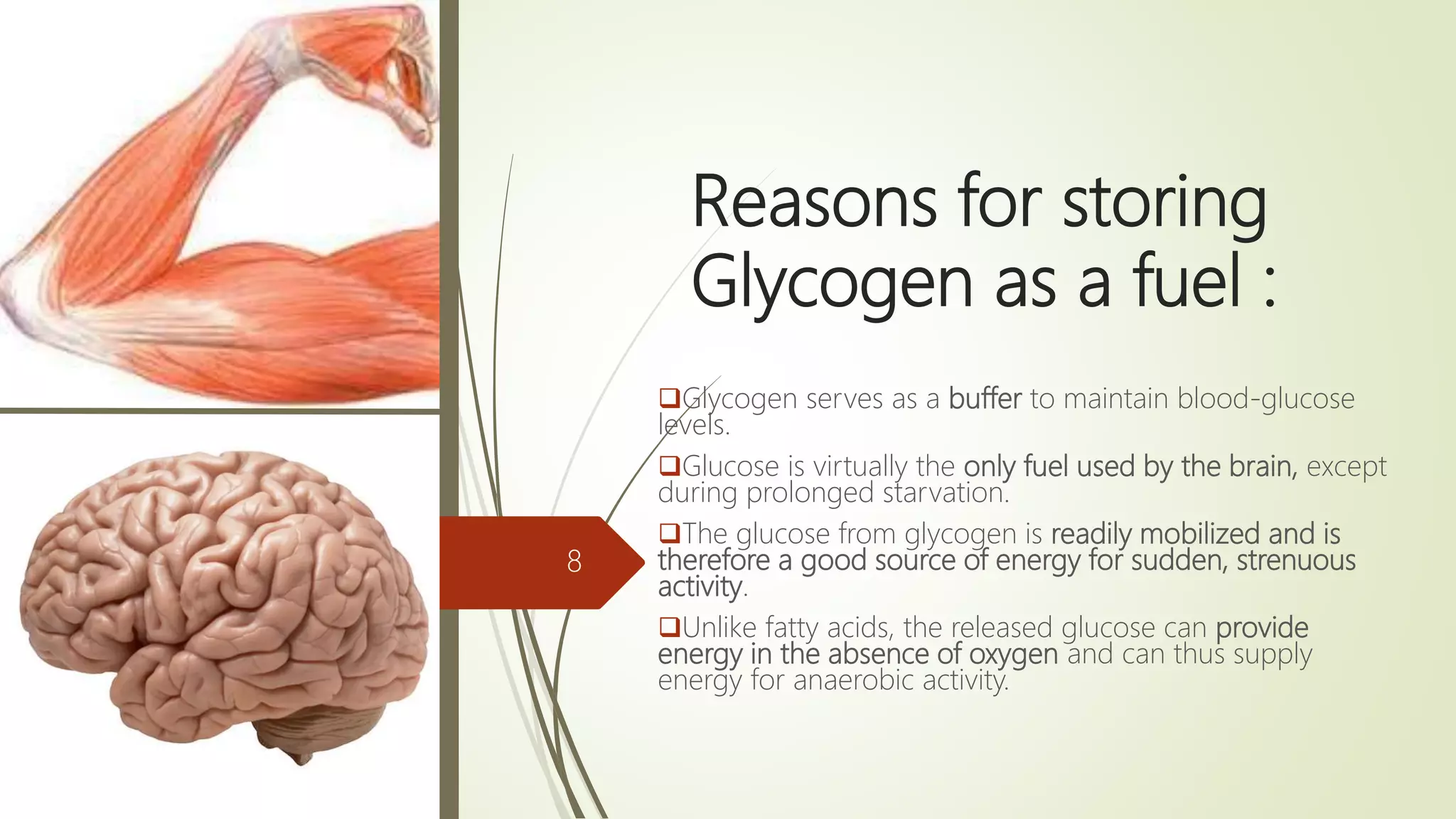
Glycogen serves as a buffer to maintain blood-glucose
levels.
Glucose is virtually the only fuel used by the brain, except
during prolonged starvation.
The glucose from glycogen is readily mobilized and is
therefore a good source of energy for sudden, strenuous
activity.
Unlike fatty acids, the released glucose can provide
energy in the absence of oxygen and can thus supply
energy for anaerobic activity.
8
Glycogenesis
9
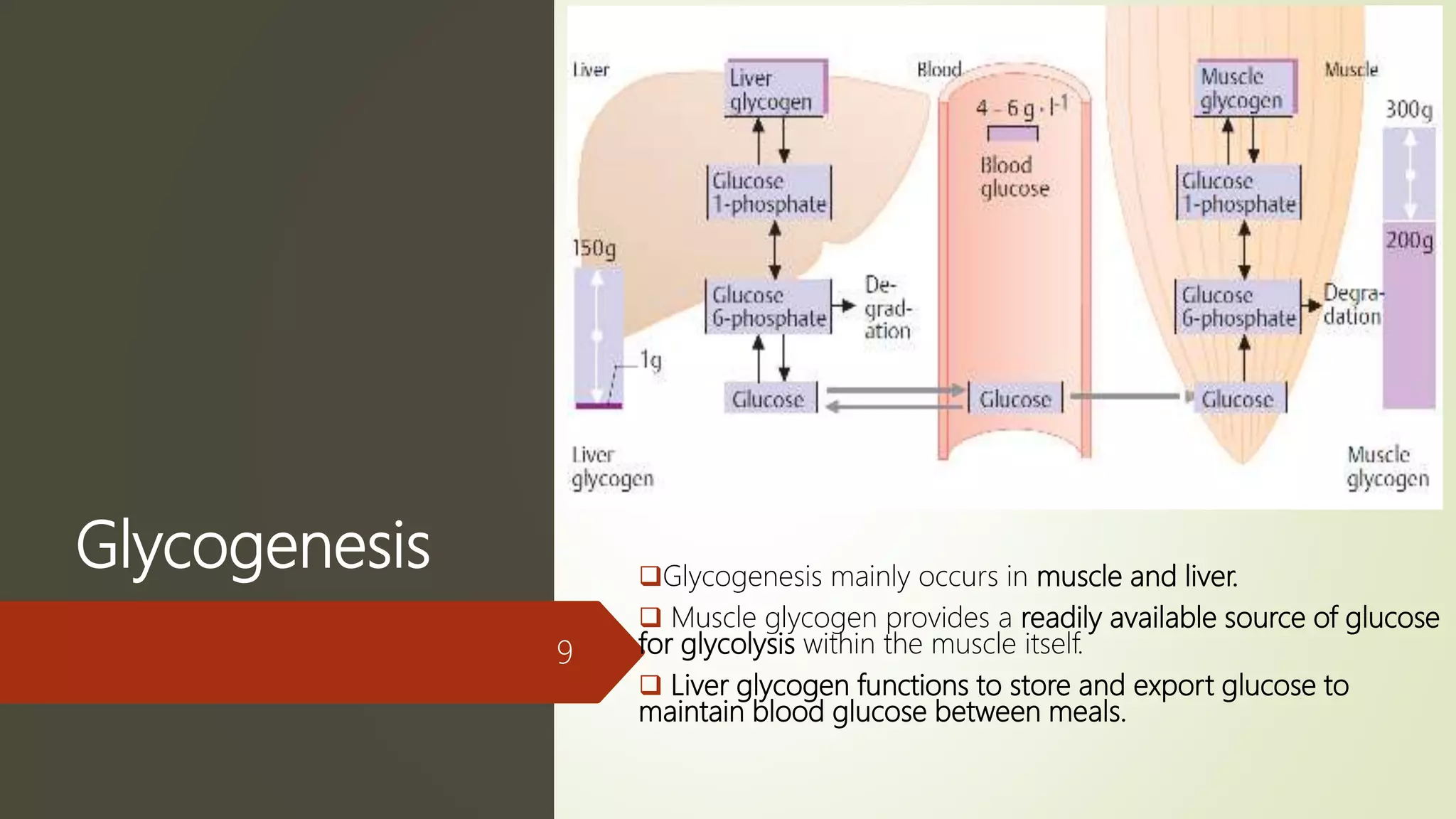
Glycogenesis mainly occurs in muscle and liver.
 Muscle glycogen provides a readily available source of glucose
for glycolysis within the muscle itself.
 Liver glycogen functions to store and export glucose to
maintain blood glucose between meals.
Contribution of
muscle to maintain
blood glucose levels
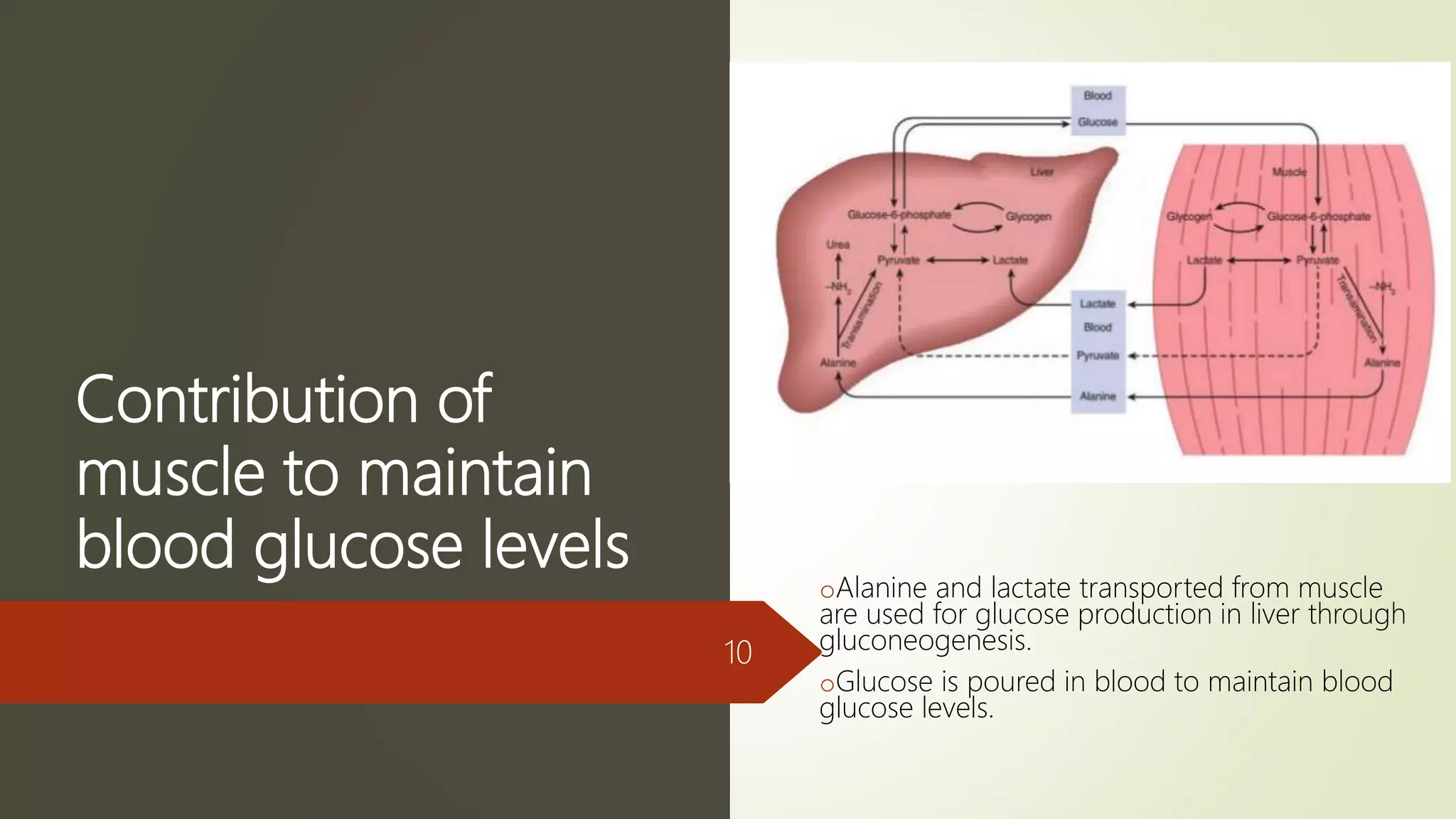
oAlanine and lactate transported from muscle
are used for glucose production in liver through
gluconeogenesis.
oGlucose is poured in blood to maintain blood
glucose levels.
10
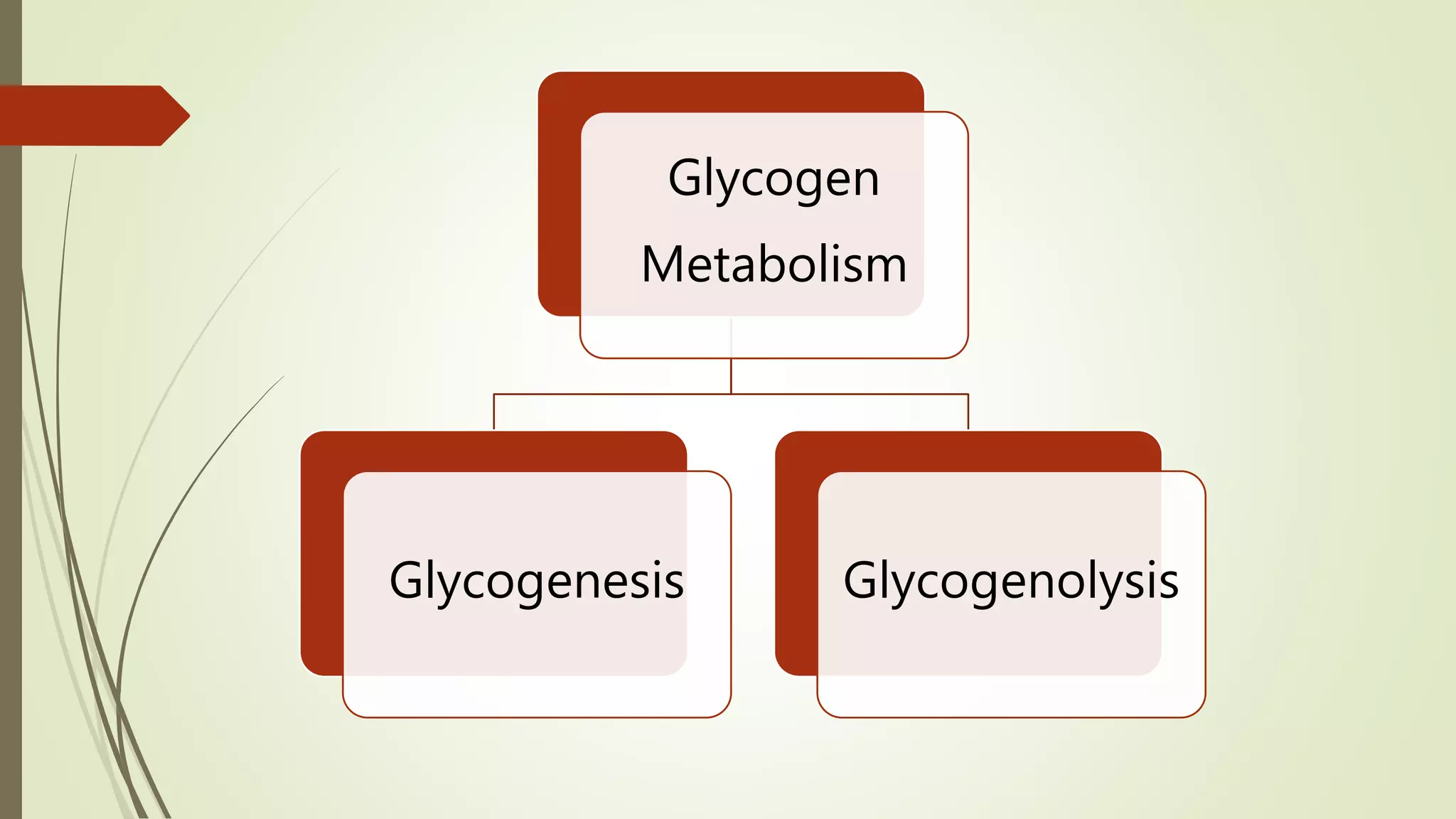
Glycogen
Metabolism
Glycogenesis Glycogenolysis
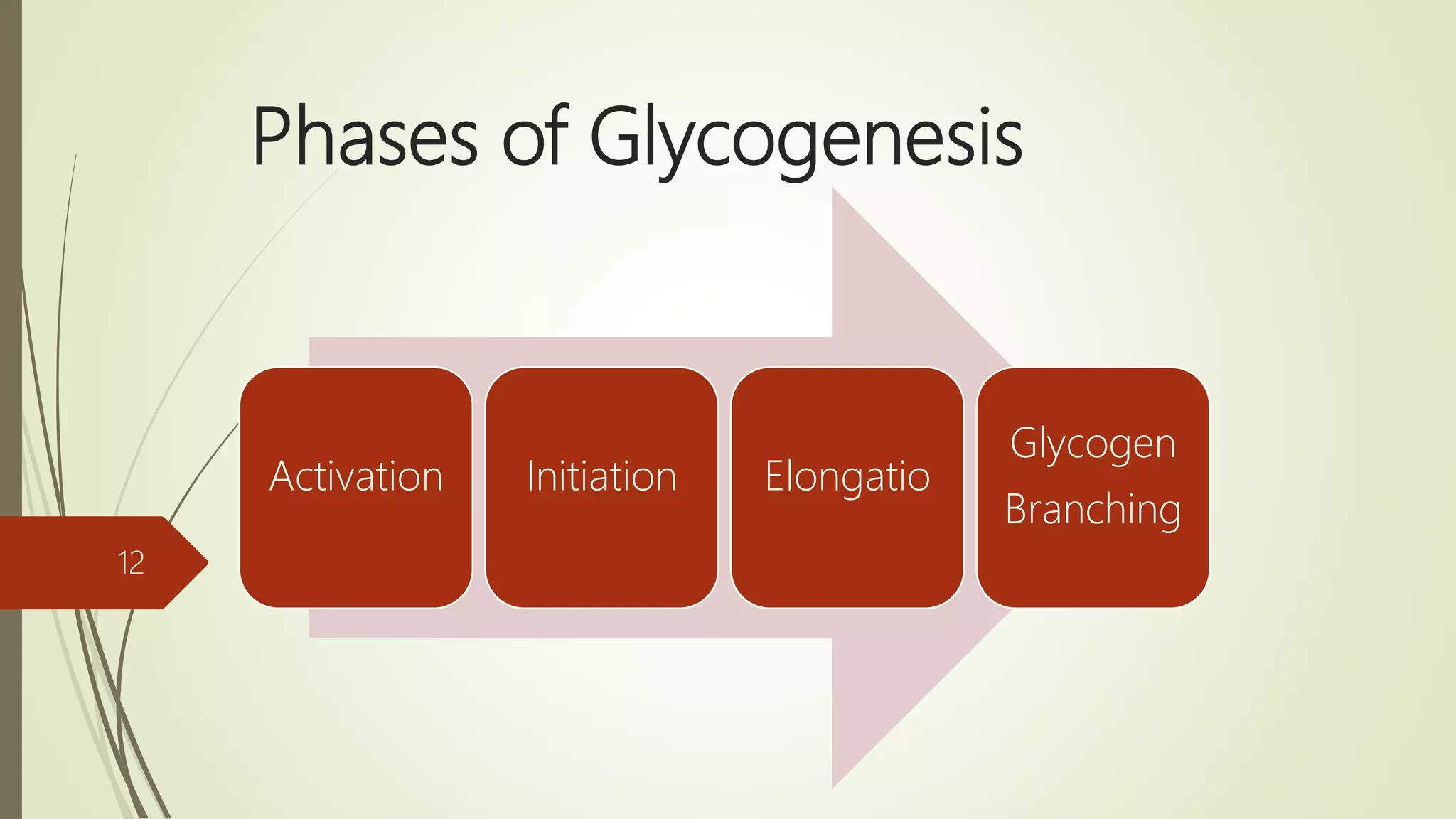
Phases of Glycogenesis
12
Activation Initiation Elongatio
Glycogen
Branching
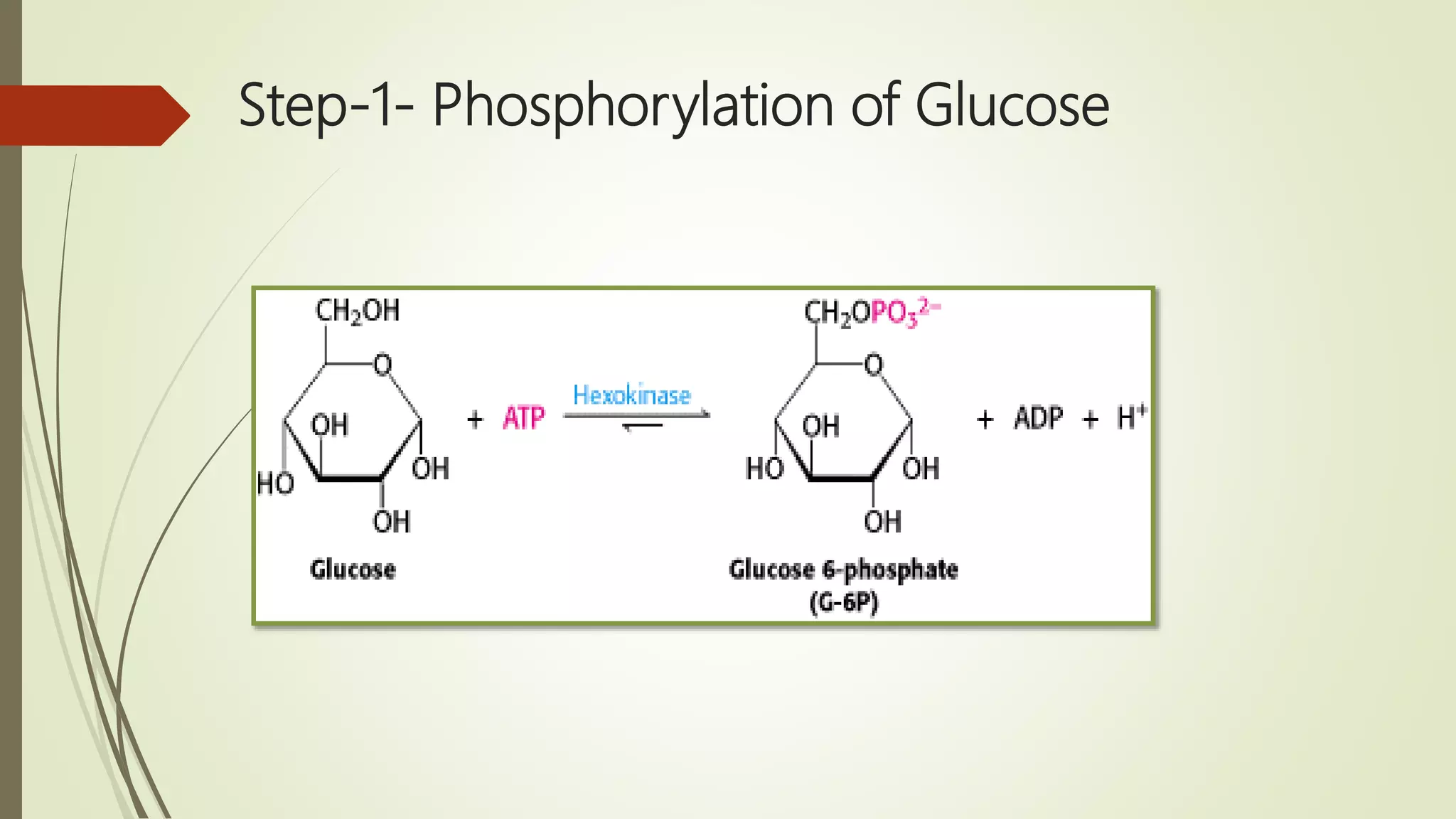
Step-1- Phosphorylation of Glucose
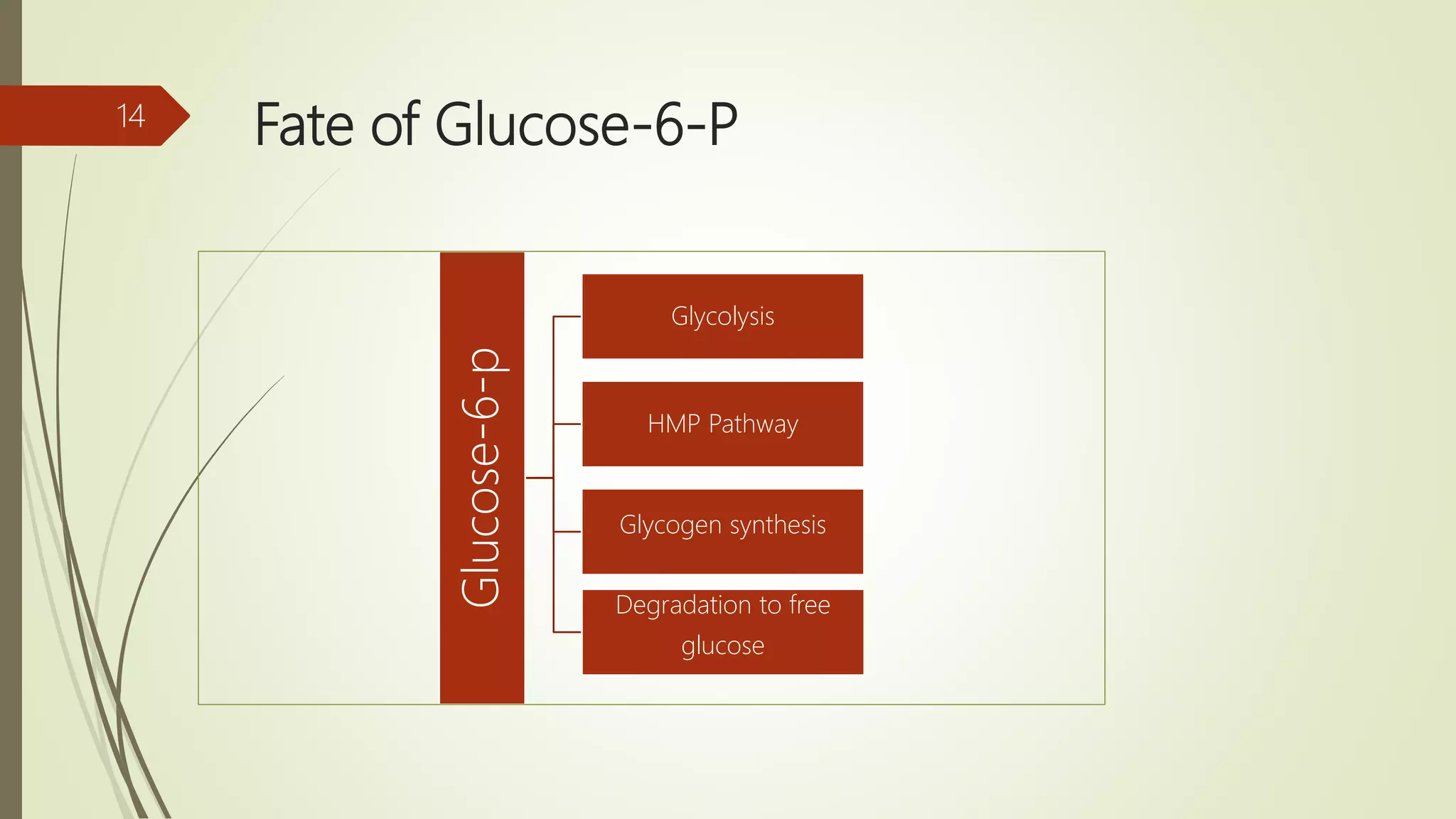
Fate of Glucose-6-P14
Glucose-6-p
Glycolysis
HMP Pathway
Glycogen synthesis
Degradation to free
glucose
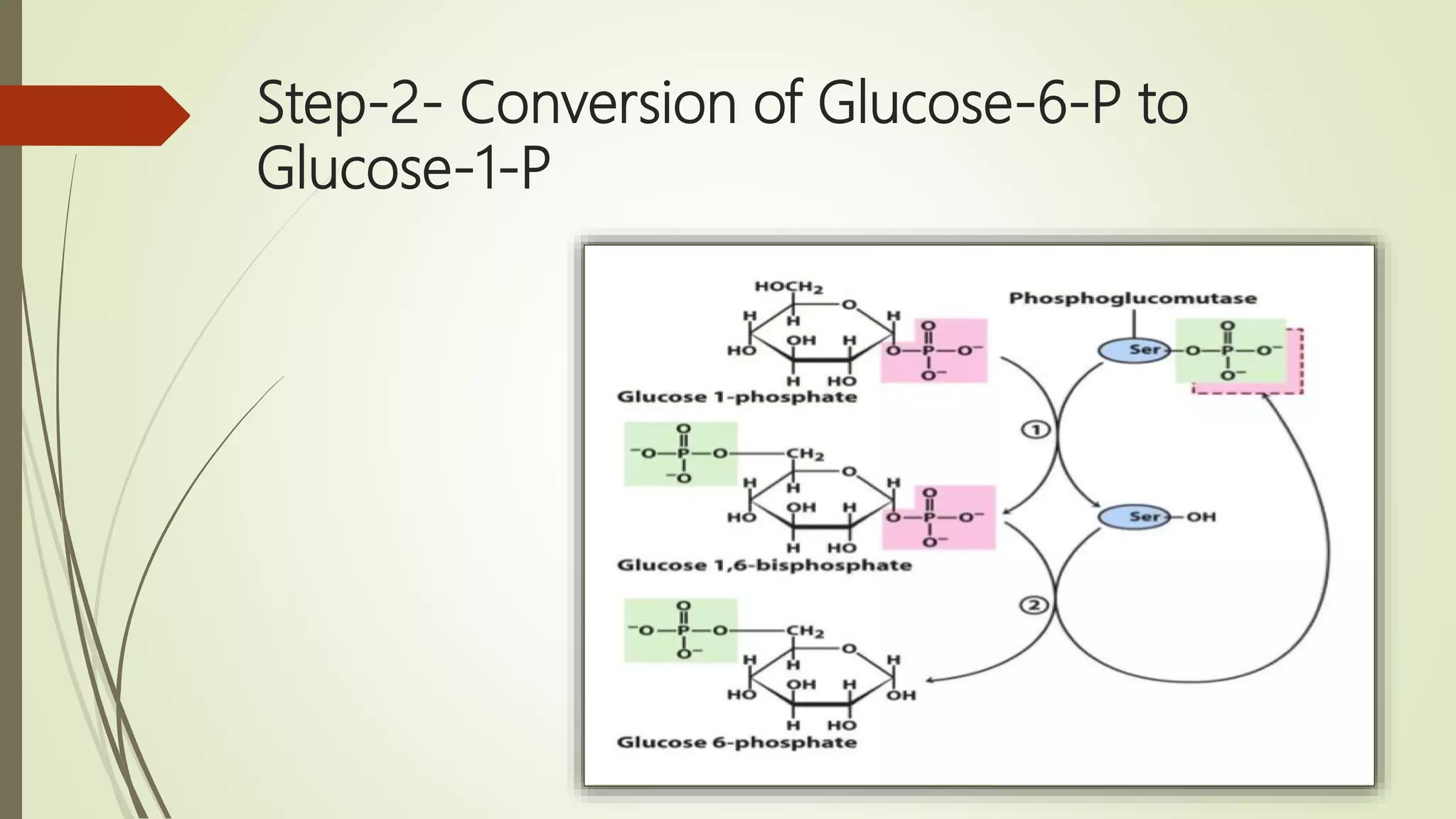
Step-2- Conversion of Glucose-6-P to
Glucose-1-P
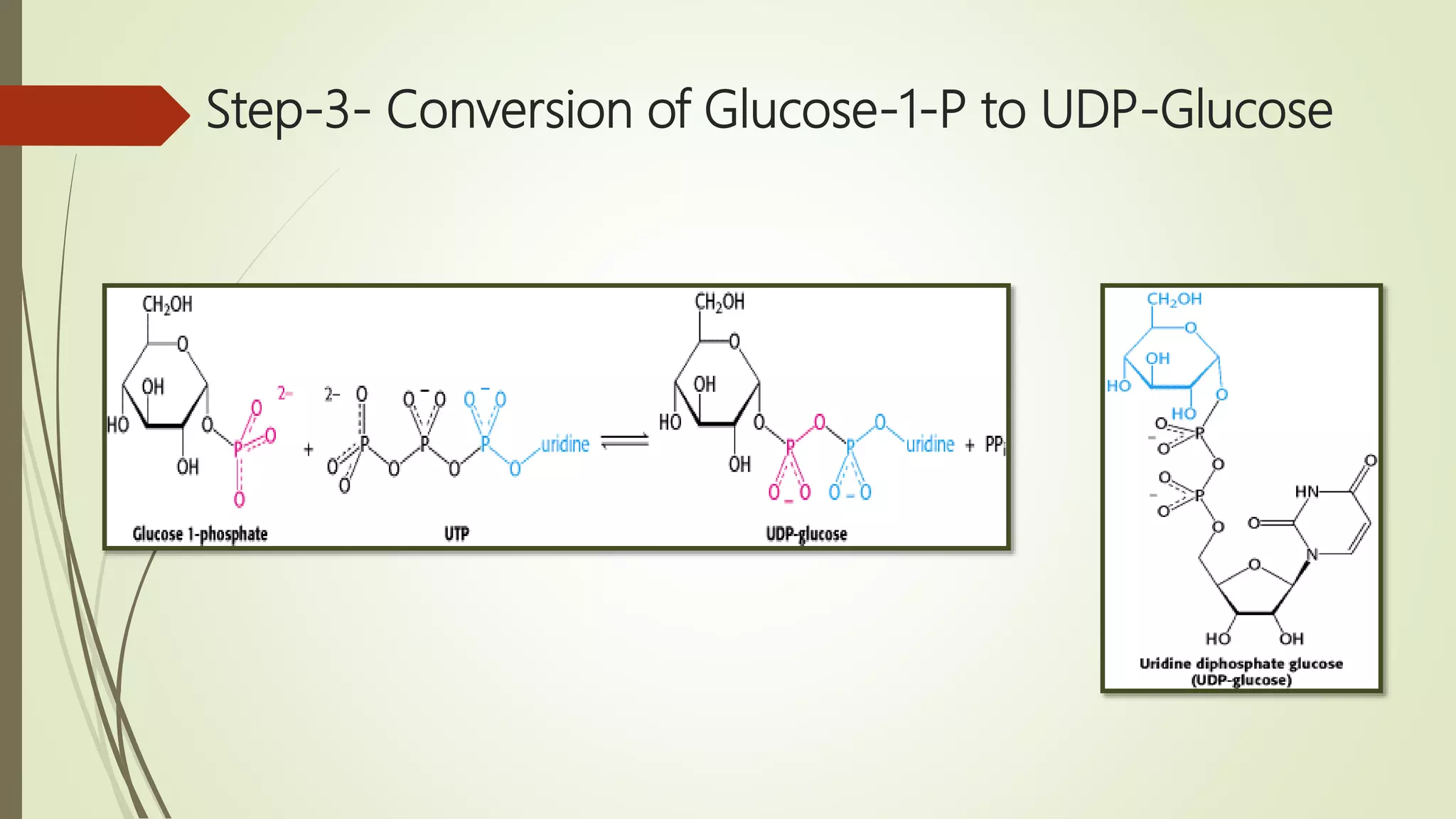
Step-3- Conversion of Glucose-1-P to UDP-Glucose
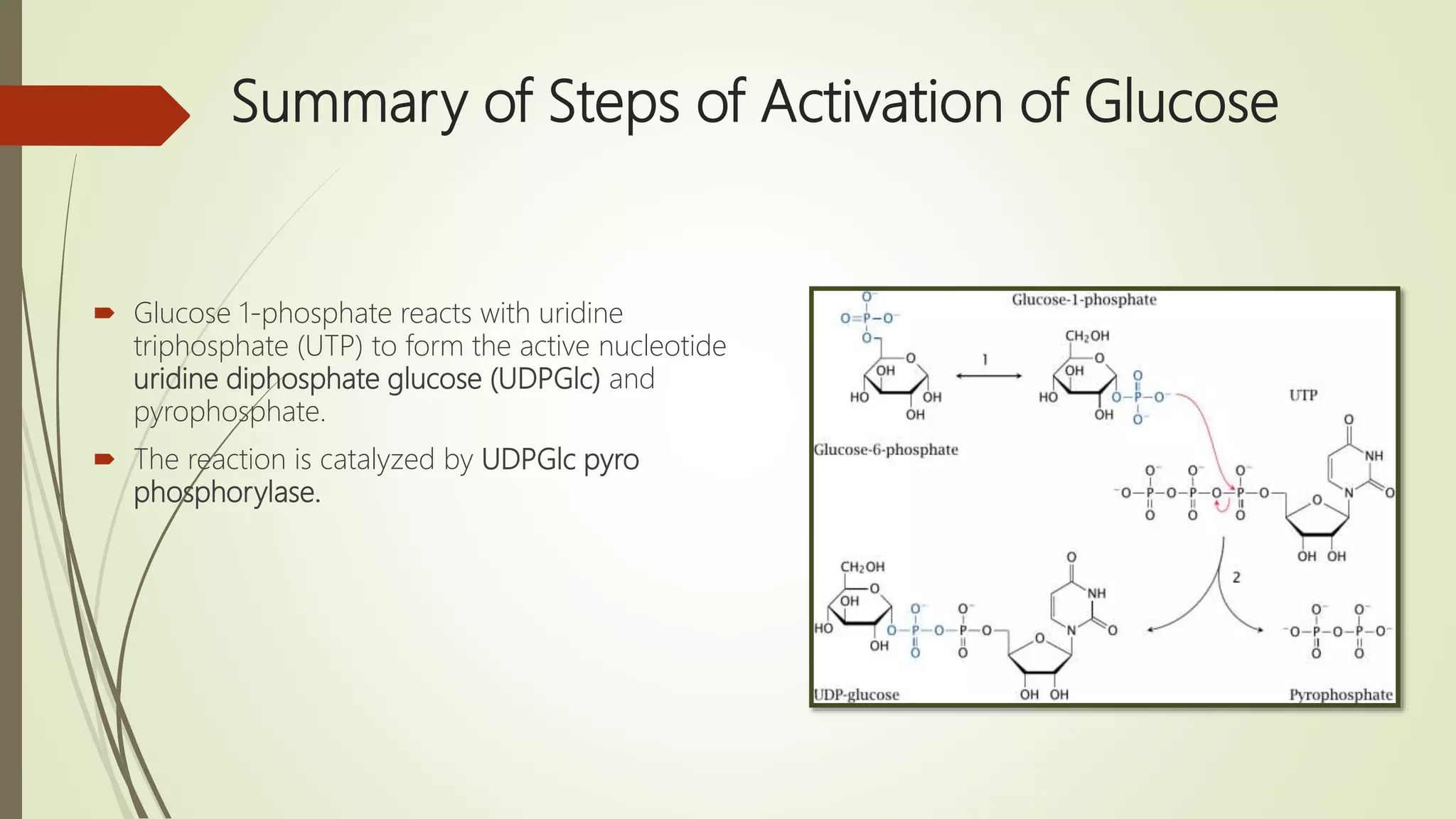
Summary of Steps of Activation of Glucose
 Glucose 1-phosphate reacts with uridine
triphosphate (UTP) to form the active nucleotide
uridine diphosphate glucose (UDPGlc) and
pyrophosphate.
 The reaction is catalyzed by UDPGlc pyro
phosphorylase.
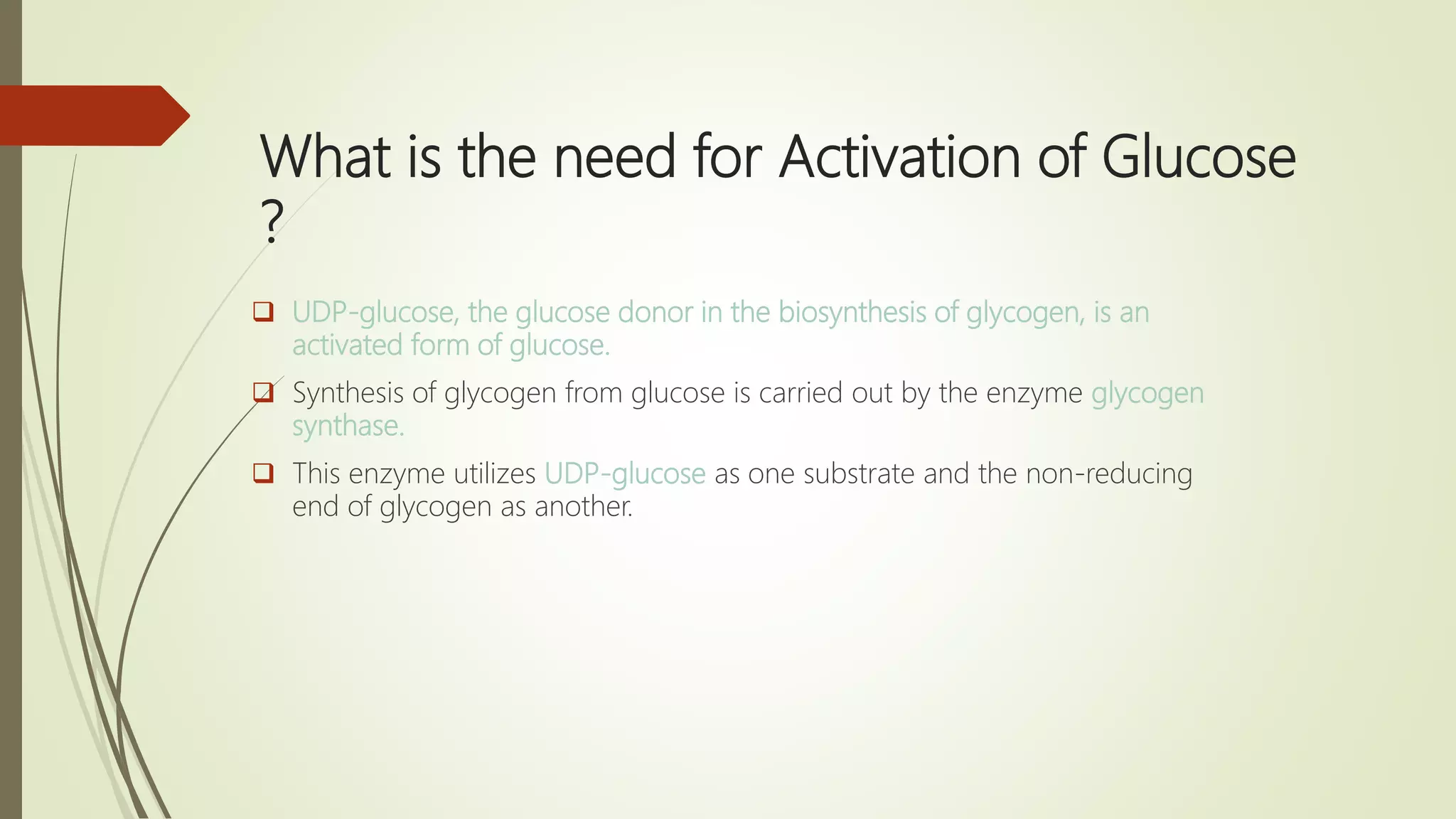
What is the need for Activation of Glucose
?
 UDP-glucose, the glucose donor in the biosynthesis of glycogen, is an
activated form of glucose.
 Synthesis of glycogen from glucose is carried out by the enzyme glycogen
synthase.
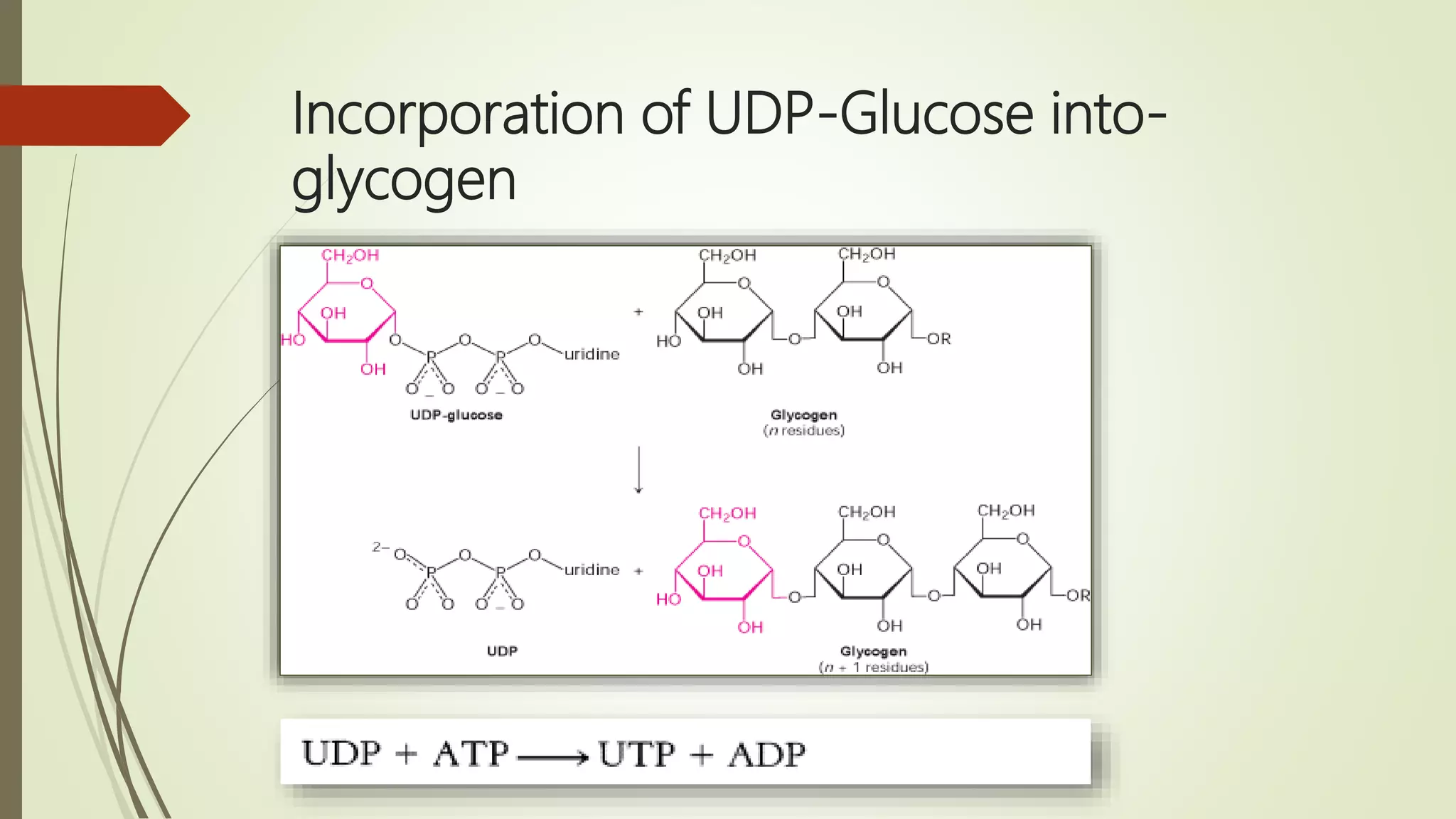
 This enzyme utilizes UDP-glucose as one substrate and the non-reducing
end of glycogen as another.
Incorporation of UDP-Glucose into-
glycogen
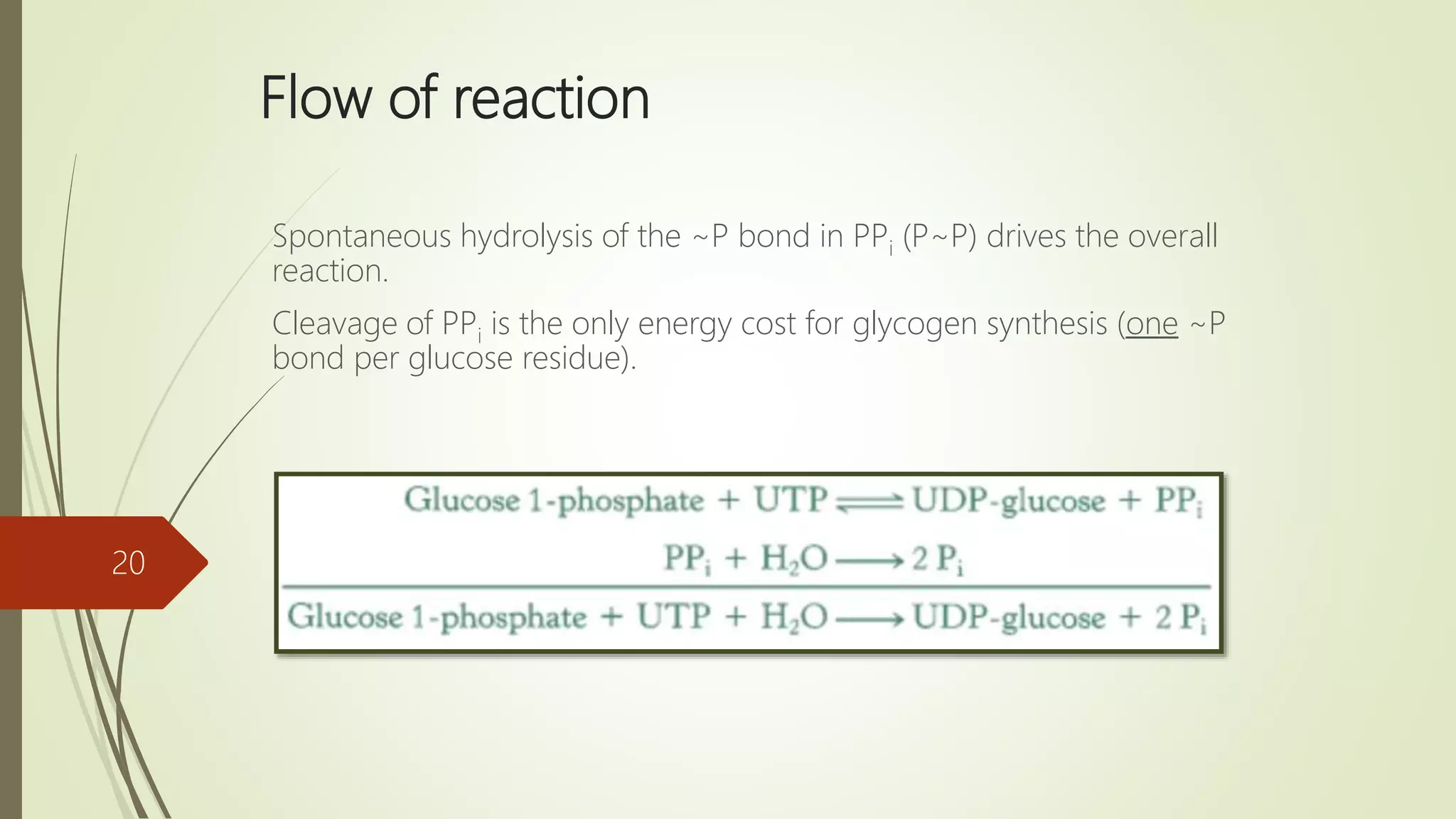
Flow of reaction
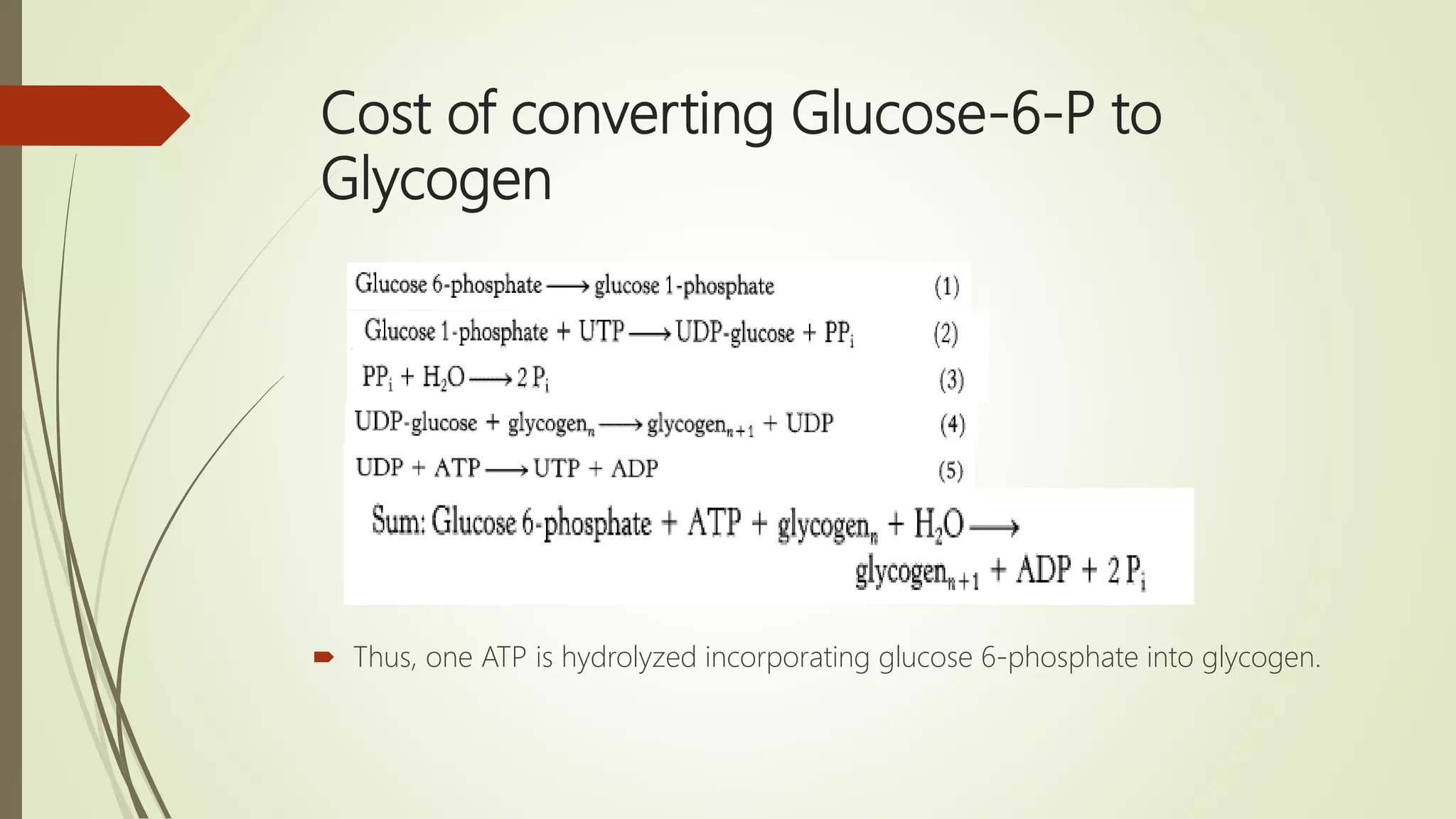
Spontaneous hydrolysis of the ~P bond in PPi (P~P) drives the overall
reaction.
Cleavage of PPi is the only energy cost for glycogen synthesis (one ~P
bond per glucose residue).
20
Cost of converting Glucose-6-P to
Glycogen
 Thus, one ATP is hydrolyzed incorporating glucose 6-phosphate into glycogen.
2) Initiation of Glycogenesis
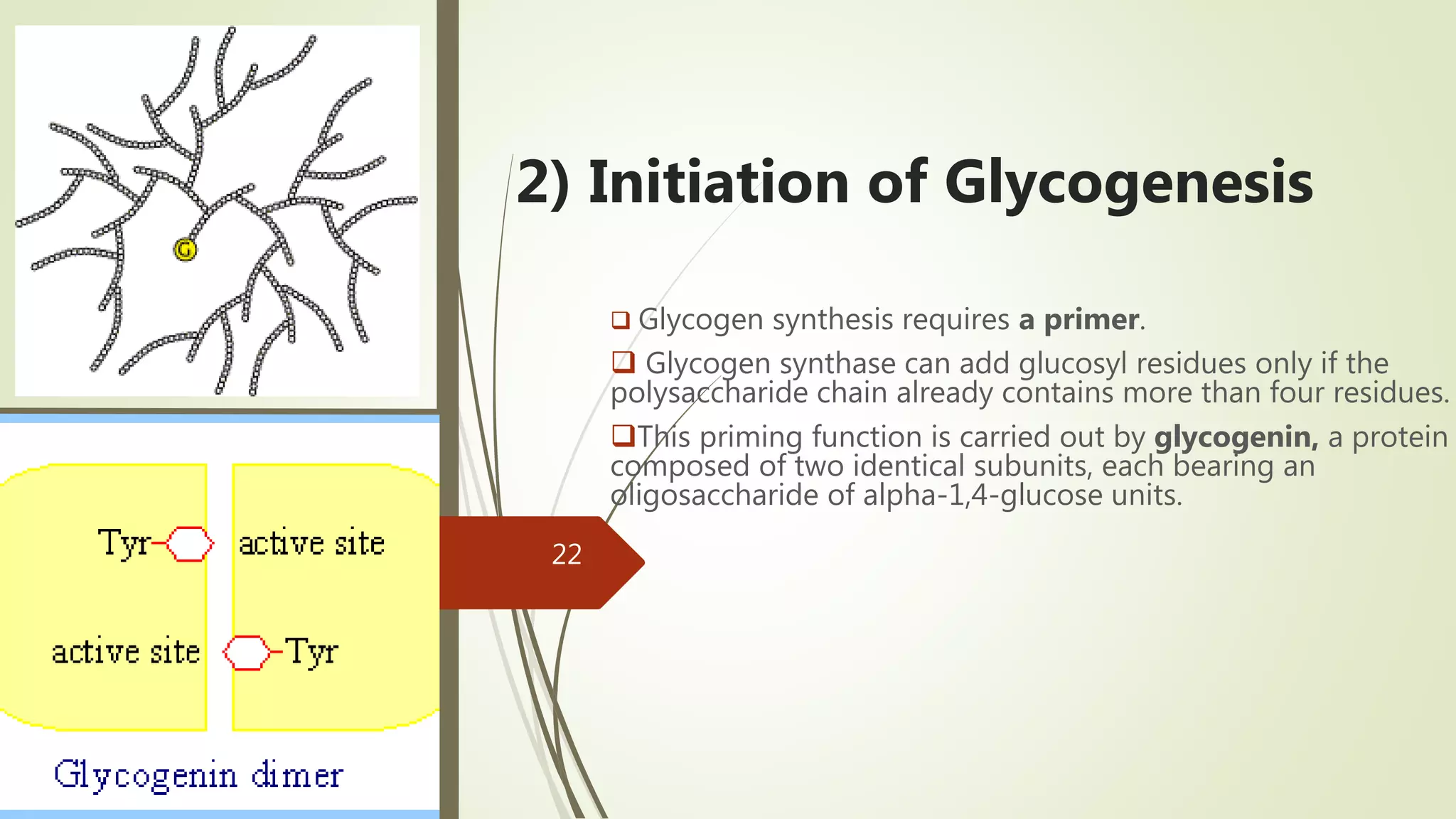
 Glycogen synthesis requires a primer.
 Glycogen synthase can add glucosyl residues only if the
polysaccharide chain already contains more than four residues.
This priming function is carried out by glycogenin, a protein
composed of two identical subunits, each bearing an
oligosaccharide of alpha-1,4-glucose units.
22
Initiation
OH
UDP UDP UDP UDP
UDP-GlcUDP-Glc UDP-GlcUDP-Glc
Glycogenin
Tyrosine
UDP +ATP
UTP+ADP
Initiation
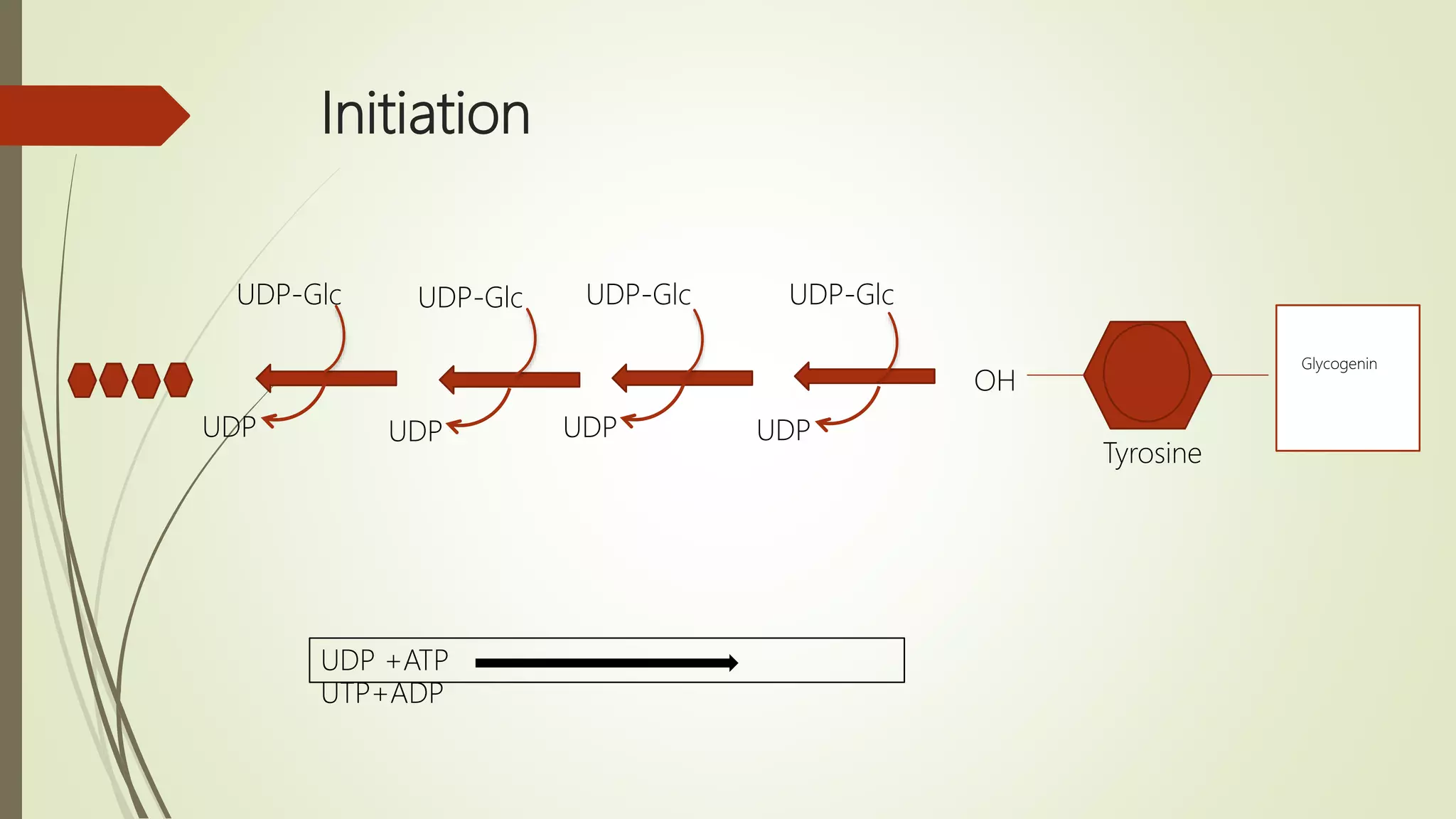
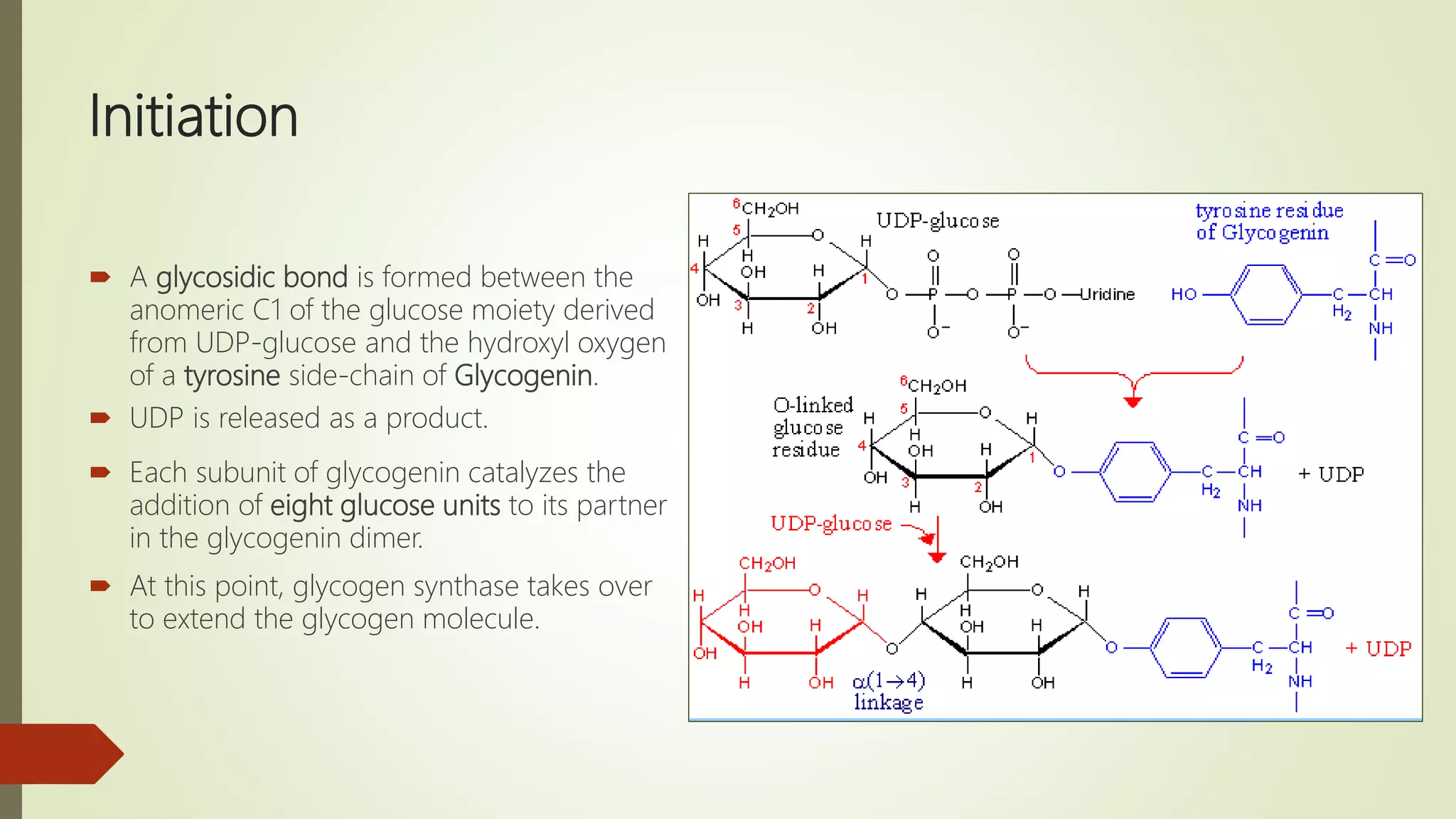
 A glycosidic bond is formed between the
anomeric C1 of the glucose moiety derived
from UDP-glucose and the hydroxyl oxygen
of a tyrosine side-chain of Glycogenin.
 UDP is released as a product.
 Each subunit of glycogenin catalyzes the
addition of eight glucose units to its partner
in the glycogenin dimer.
 At this point, glycogen synthase takes over
to extend the glycogen molecule.
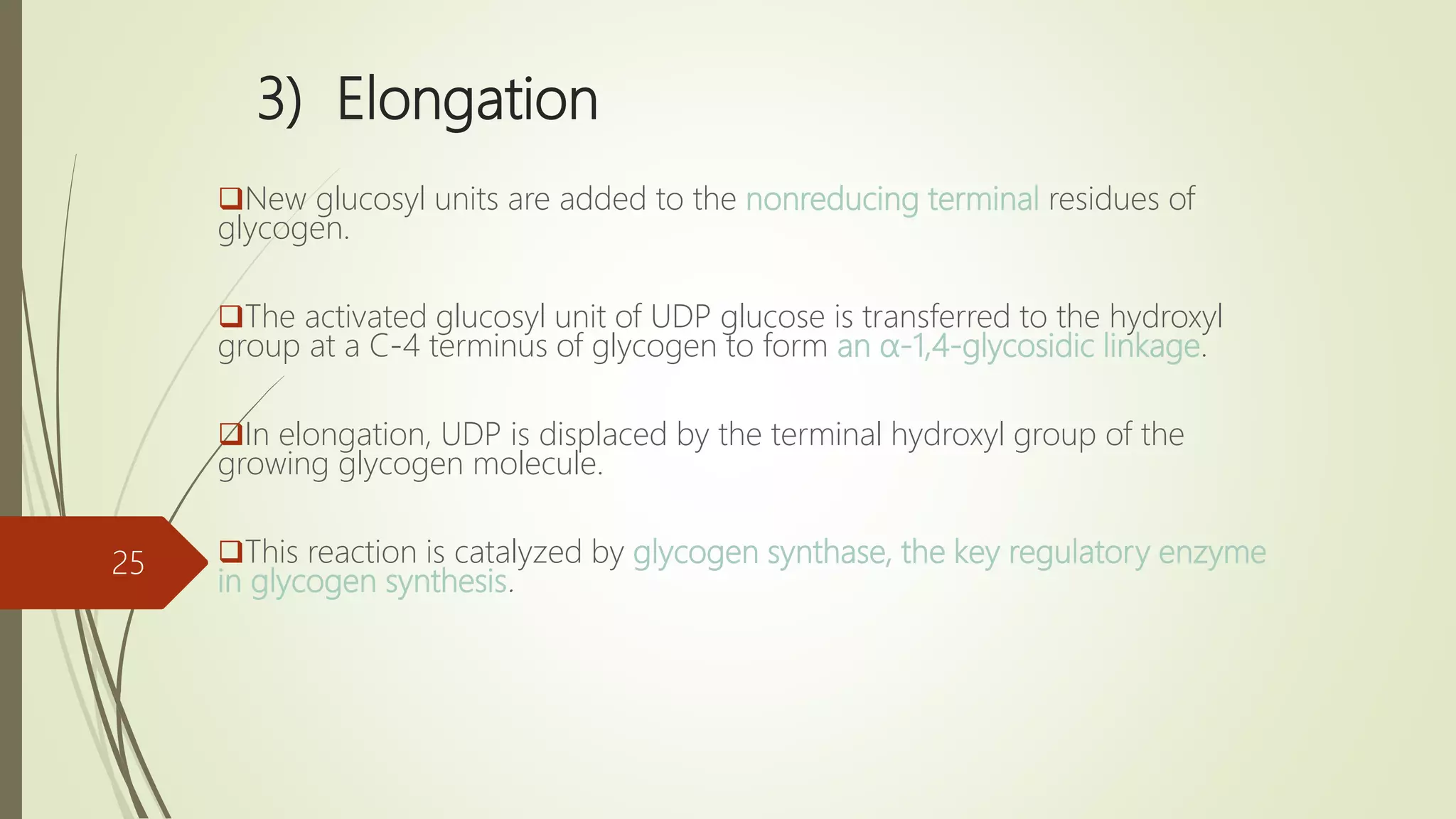
3) Elongation
New glucosyl units are added to the nonreducing terminal residues of
glycogen.
The activated glucosyl unit of UDP glucose is transferred to the hydroxyl
group at a C-4 terminus of glycogen to form an α-1,4-glycosidic linkage.
In elongation, UDP is displaced by the terminal hydroxyl group of the
growing glycogen molecule.
This reaction is catalyzed by glycogen synthase, the key regulatory enzyme
in glycogen synthesis.
25
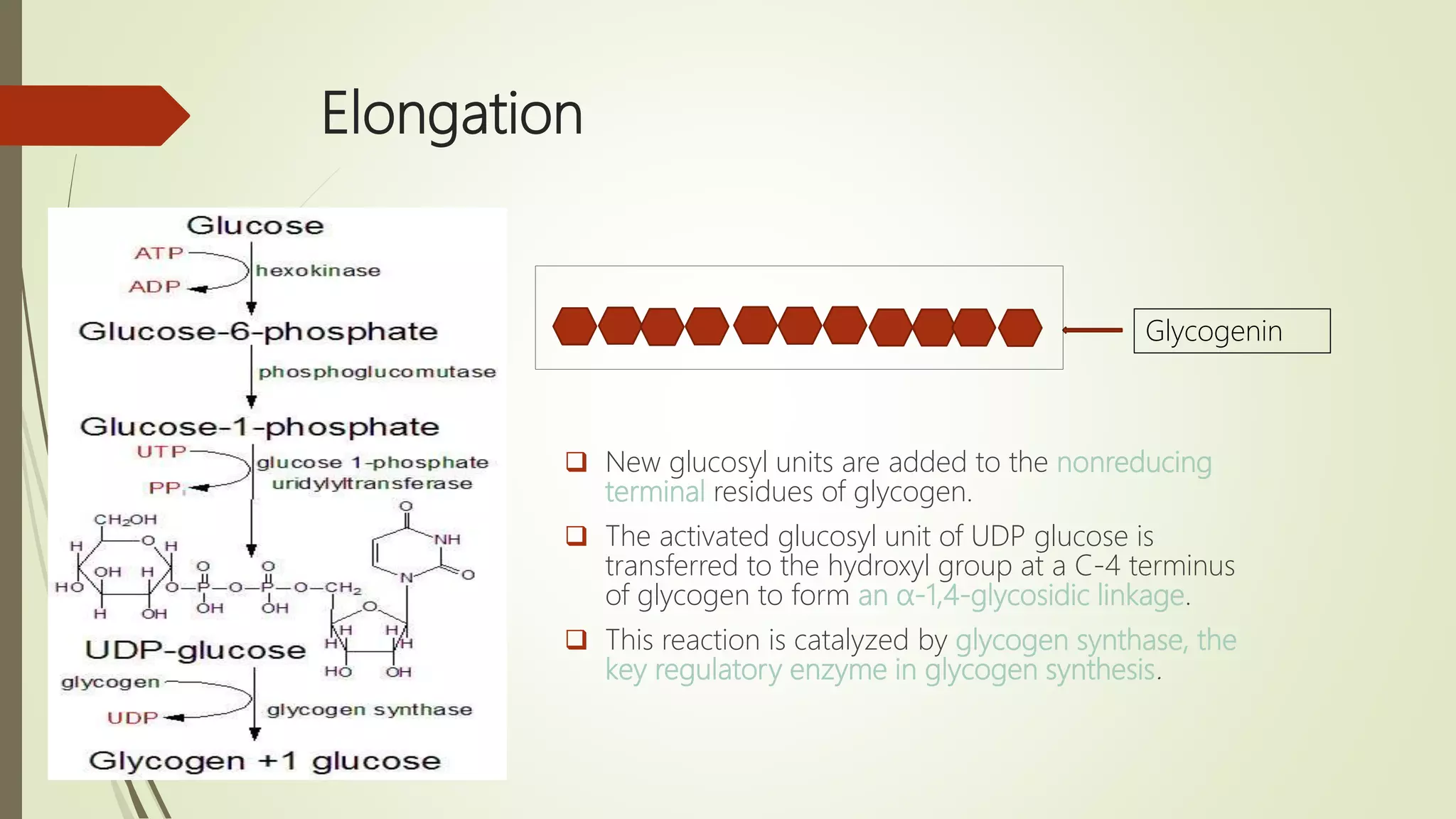
Elongation
Glycogenin
 New glucosyl units are added to the nonreducing
terminal residues of glycogen.
 The activated glucosyl unit of UDP glucose is
transferred to the hydroxyl group at a C-4 terminus
of glycogen to form an α-1,4-glycosidic linkage.
 This reaction is catalyzed by glycogen synthase, the
key regulatory enzyme in glycogen synthesis.
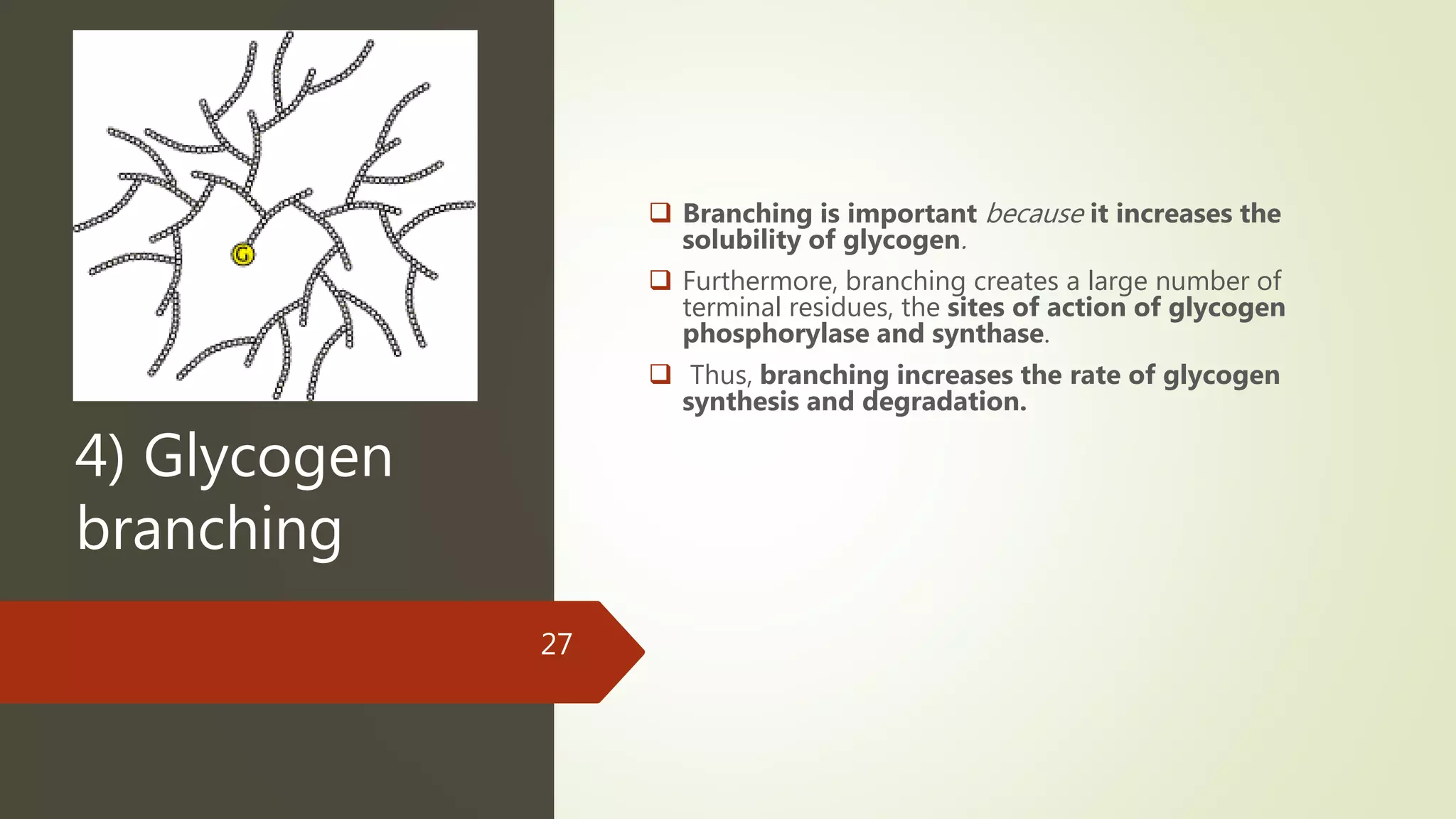
4) Glycogen
branching
 Branching is important because it increases the
solubility of glycogen.
 Furthermore, branching creates a large number of
terminal residues, the sites of action of glycogen
phosphorylase and synthase.
 Thus, branching increases the rate of glycogen
synthesis and degradation.
27
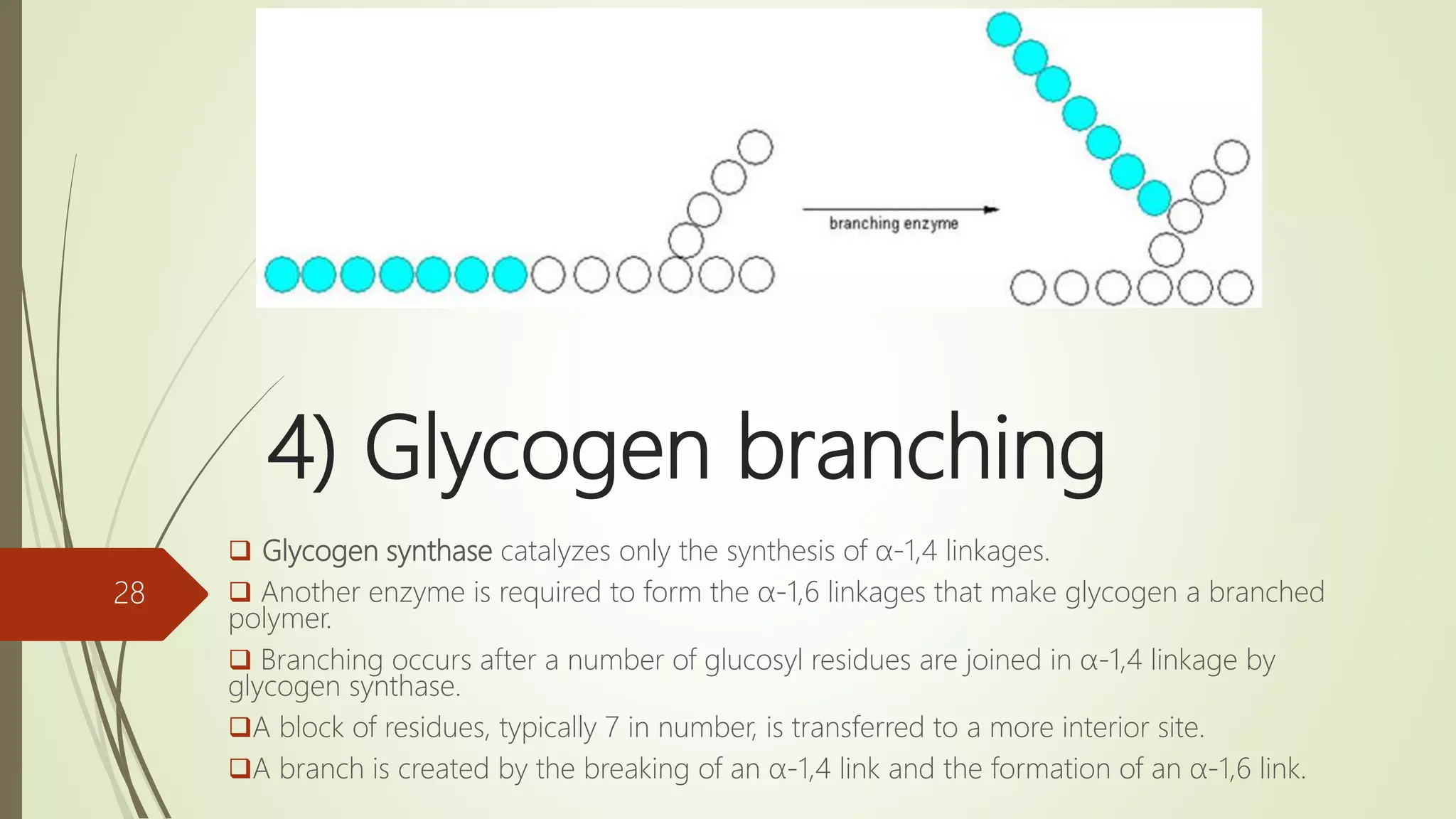
4) Glycogen branching
 Glycogen synthase catalyzes only the synthesis of α-1,4 linkages.
 Another enzyme is required to form the α-1,6 linkages that make glycogen a branched
polymer.
 Branching occurs after a number of glucosyl residues are joined in α-1,4 linkage by
glycogen synthase.
A block of residues, typically 7 in number, is transferred to a more interior site.
A branch is created by the breaking of an α-1,4 link and the formation of an α-1,6 link.
28
Chain elongation and repetition of steps
 Chain elongation is carried out by Glycogen synthase
 Branching is carried out by branching enzyme.
 The steps are repeated till sufficient amount of glycogen has been synthesized, or
in other words the process continues, till the time glucose is available.
Important facts
 2 enzymes are important for glycogen synthesis- Glycogen synthesis
 Glycogen synthase- Which becomes active in the presence of high glucose
concentration, therefore glycogenesis occurs after meals when plenty of glucose
is available.
 Second enzyme- Branching enzyme- Deficiency of this enzyme causes a
glycogen storage disease- Amylopectonosis- Andersen's disease, In which
abnormal form of glycogen with few branch points is stored, therefore death
occurs from heart or liver failure.
Regulation of Glycogenesis- In the next
section….
Thank you

Glycogen metabolism- revision

  • 1.
  • 2.
    Learning Objectives  Atthe end of this discussions,  the learners will be in a position to understand :  Structure of Glycogen  Steps of synthesis and degradation of glycogen  Regulation of these processes  Clinical significance of Glycogen metabolism
  • 3.
    Introduction  Glycogen isa readily mobilized storage form of glucose.  It is stored mainly in liver and muscle  The liver content of glycogen is greater than that of muscle  Since the muscle mass of the body is considerably greater than that of the liver, about three-quarters of total body glycogen is in muscle
  • 4.
    Glycogen- Chemistry 4  Glycogen ispresent in the cytosol in the form of granules ranging in diameter from 10 to 40 nm.  It has a high molecular mass and consists of polysaccharide chains, each containing about 13 glucose residues. Glycogen granules
  • 5.
    Glycogen- Chemistry Glycogenin 5 The chainsare either branched or unbranched and are arranged in 12 concentric layers. The branched chains (each has two branches) are found in the inner layers and the unbranched chains in the outer layer. (Glycogenin, the primer molecule for glycogen synthesis, lies at the center.)
  • 6.
    6 Most of theglucose residues in glycogen are linked by α-1,4- glycosidic bonds. Branches at about every tenth residue are created by α- 1,6-glycosidic bonds.
  • 7.
    Why branching ? The highly branched structure of glycogen provides a large number of sites (terminal residues- non reducing ends)for synthesis and degradation of glycogen, permitting rapid storage of extra glucose after meals or release of glucose 1-phosphate for muscle activity.  Branching makes glycogen soluble in the cytoplasm.
  • 8.
    Reasons for storing Glycogenas a fuel : Glycogen serves as a buffer to maintain blood-glucose levels. Glucose is virtually the only fuel used by the brain, except during prolonged starvation. The glucose from glycogen is readily mobilized and is therefore a good source of energy for sudden, strenuous activity. Unlike fatty acids, the released glucose can provide energy in the absence of oxygen and can thus supply energy for anaerobic activity. 8
  • 9.
    Glycogenesis 9 Glycogenesis mainly occursin muscle and liver.  Muscle glycogen provides a readily available source of glucose for glycolysis within the muscle itself.  Liver glycogen functions to store and export glucose to maintain blood glucose between meals.
  • 10.
    Contribution of muscle tomaintain blood glucose levels oAlanine and lactate transported from muscle are used for glucose production in liver through gluconeogenesis. oGlucose is poured in blood to maintain blood glucose levels. 10
  • 11.
  • 12.
    Phases of Glycogenesis 12 ActivationInitiation Elongatio Glycogen Branching
  • 13.
  • 14.
    Fate of Glucose-6-P14 Glucose-6-p Glycolysis HMPPathway Glycogen synthesis Degradation to free glucose
  • 15.
    Step-2- Conversion ofGlucose-6-P to Glucose-1-P
  • 16.
    Step-3- Conversion ofGlucose-1-P to UDP-Glucose
  • 17.
    Summary of Stepsof Activation of Glucose  Glucose 1-phosphate reacts with uridine triphosphate (UTP) to form the active nucleotide uridine diphosphate glucose (UDPGlc) and pyrophosphate.  The reaction is catalyzed by UDPGlc pyro phosphorylase.
  • 18.
    What is theneed for Activation of Glucose ?  UDP-glucose, the glucose donor in the biosynthesis of glycogen, is an activated form of glucose.  Synthesis of glycogen from glucose is carried out by the enzyme glycogen synthase.  This enzyme utilizes UDP-glucose as one substrate and the non-reducing end of glycogen as another.
  • 19.
  • 20.
    Flow of reaction Spontaneoushydrolysis of the ~P bond in PPi (P~P) drives the overall reaction. Cleavage of PPi is the only energy cost for glycogen synthesis (one ~P bond per glucose residue). 20
  • 21.
    Cost of convertingGlucose-6-P to Glycogen  Thus, one ATP is hydrolyzed incorporating glucose 6-phosphate into glycogen.
  • 22.
    2) Initiation ofGlycogenesis  Glycogen synthesis requires a primer.  Glycogen synthase can add glucosyl residues only if the polysaccharide chain already contains more than four residues. This priming function is carried out by glycogenin, a protein composed of two identical subunits, each bearing an oligosaccharide of alpha-1,4-glucose units. 22
  • 23.
    Initiation OH UDP UDP UDPUDP UDP-GlcUDP-Glc UDP-GlcUDP-Glc Glycogenin Tyrosine UDP +ATP UTP+ADP
  • 24.
    Initiation  A glycosidicbond is formed between the anomeric C1 of the glucose moiety derived from UDP-glucose and the hydroxyl oxygen of a tyrosine side-chain of Glycogenin.  UDP is released as a product.  Each subunit of glycogenin catalyzes the addition of eight glucose units to its partner in the glycogenin dimer.  At this point, glycogen synthase takes over to extend the glycogen molecule.
  • 25.
    3) Elongation New glucosylunits are added to the nonreducing terminal residues of glycogen. The activated glucosyl unit of UDP glucose is transferred to the hydroxyl group at a C-4 terminus of glycogen to form an α-1,4-glycosidic linkage. In elongation, UDP is displaced by the terminal hydroxyl group of the growing glycogen molecule. This reaction is catalyzed by glycogen synthase, the key regulatory enzyme in glycogen synthesis. 25
  • 26.
    Elongation Glycogenin  New glucosylunits are added to the nonreducing terminal residues of glycogen.  The activated glucosyl unit of UDP glucose is transferred to the hydroxyl group at a C-4 terminus of glycogen to form an α-1,4-glycosidic linkage.  This reaction is catalyzed by glycogen synthase, the key regulatory enzyme in glycogen synthesis.
  • 27.
    4) Glycogen branching  Branchingis important because it increases the solubility of glycogen.  Furthermore, branching creates a large number of terminal residues, the sites of action of glycogen phosphorylase and synthase.  Thus, branching increases the rate of glycogen synthesis and degradation. 27
  • 28.
    4) Glycogen branching Glycogen synthase catalyzes only the synthesis of α-1,4 linkages.  Another enzyme is required to form the α-1,6 linkages that make glycogen a branched polymer.  Branching occurs after a number of glucosyl residues are joined in α-1,4 linkage by glycogen synthase. A block of residues, typically 7 in number, is transferred to a more interior site. A branch is created by the breaking of an α-1,4 link and the formation of an α-1,6 link. 28
  • 29.
    Chain elongation andrepetition of steps  Chain elongation is carried out by Glycogen synthase  Branching is carried out by branching enzyme.  The steps are repeated till sufficient amount of glycogen has been synthesized, or in other words the process continues, till the time glucose is available.
  • 30.
    Important facts  2enzymes are important for glycogen synthesis- Glycogen synthesis  Glycogen synthase- Which becomes active in the presence of high glucose concentration, therefore glycogenesis occurs after meals when plenty of glucose is available.  Second enzyme- Branching enzyme- Deficiency of this enzyme causes a glycogen storage disease- Amylopectonosis- Andersen's disease, In which abnormal form of glycogen with few branch points is stored, therefore death occurs from heart or liver failure.
  • 31.
    Regulation of Glycogenesis-In the next section…. Thank you