PLASMA PROTEINS
Dr. Sanjeev Shrivastava
Plasma Proteins
• The normal serum protein level is 6.3-8.3 g/dL.
• • The type of proteins in serum include:
• a. Albumin- 4.8 g/dL
• b. Globulins- 2.3 g/dL
α− globulin: α1 & α2−globulins
β− globulin: β1 & β2 globulins
γ− globulins
• c. Fibrinogen - 0.3 g/dL
• d. Prothombin -
Synthesis of plasma proteins
 IN EMBRYO-
- Plasma proteins are synthesized by mesenchymal
cells.
 IN ADULT-
-albumin and fibrinogen – Reticuloendothelial cells of
liver.
-alpha and beta globulins- liver , spleen, bone marrow
-Gamma globulins – B Lymphocyte
MEASUREMENT OF PROTEIN
FRACTIONS
• The protein fraction in plasma can be
separated and estimated using the following
methods:
– Electrophoresis
_ Precipitation
– Immuno-electrophoretic method
– Salting out method
– Ultracentrifugation
Plasma proteins
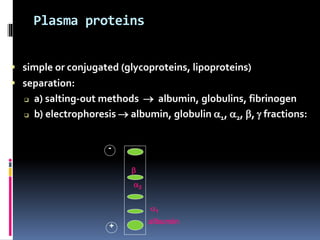
 simple or conjugated (glycoproteins, lipoproteins)
 separation:
 a) salting-out methods  albumin, globulins, fibrinogen
 b) electrophoresis  albumin, globulin 1, 2, ,  fractions:
-
+


2
1
albumin
ALBUMIN
• A low molecular weight protein (M.Wt= 65,000).
• Functions include:
– Transport
– Osmotic pressure regulation
• Synthesized in the liver.
• Deficiency: in liver disease and kidney disease.
HYPOALBUMINAEMIA
• Normal albumin level = 3.2-5.2 g/dL.
• Hypoalbuminaemia: the level of albumin <3.2
g/dL.
• Frequently encountered.
• Consequence:
– Oedema
– Hypocalcaemia
– Alteration in the levels of protein-bound
substance due to loss of carrier protein.
GLOBULINS
• Heterogenous group
• Can be separated into different fractions on the
basis of their electrophoretic mobility and
sedimentation coefficient:
- α1-Globulin - α1- Fetoprotein
α1- Antitrypsin
- α2- Globulin - α2- Fetoprotein
Haptoglobin
- β- Globulin - Transferrin
Ceruloplasmin
- γ- Globulin - Antibodies
(immunoglobulins)
FIBRINOGEN
• A globulin of very high mol. wt.
• Can be precipitated easily.
• Can be converted to fibrin which causes the
blood clot formation.
• Synthesized exclusively in the liver.
A/G Ratio
 Normal albumin: globulin ratio- 1.7:1 (2:1)
 It is reversed when albumin synthesis
decreased as occurs in liver diseases,
and when globulin increased as occurs in
hyperproteinaemia.
SERUM PROTEIN DEFECTS
• Normal serum protein levels:
Total serum protein level: 6.3-8.3 g/dL.
• Hyperproteinaemia:
Total serum protein level: > 9.0 g/dL.
• Hypoproteinaemia:
Total serum protein level: < 6.3 g/dL.
Functions of Plasma proteins
• Osmotic regulation:
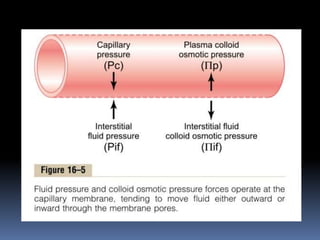
- Plasma proteins are colloidal and non-diffusable
and exert a colloidal osmotic pressure which helps
to maintain a normal blood volume and a normal
water content in the interstitial fluid and the
tissues.
- Albumin content is most important in regulation of
colloidal osmotic or oncotic pressure.
- Decrease in albumin level results in loss of water
from blood and its entry into interstitial fluids
causing edema.
Functions of Plasma proteins
 Contribution to blood viscosity-
- Fibrinogen and albumin are significant contributor to
blood viscosity.
- It is 4-5 times that of water.
- It play important role to maintenance of the blood
pressure.
 Role as reserve proteins-
Plasma proteins serve as reserve proteins and utilized
by tissues during condition like- starvation, inadequate
protein intake, excessive catabolism.
Functions of Plasma proteins
• Protective function:
- Immunoglobulins combine with foreign antigens
and remove them.
 Provide stability to blood- Globulin and fibrinogen
help in the suspension stability to blood. RBCs
remain suspended uniformly in blood during
circulation.
Functions of Plasma proteins
• Transport: e.g.
-Transferrin transports iron.
- Ceruloplasmin transports copper.
- Albumin transports fatty acids, bilirubin
calcium, many drugs etc.
-Transcortin transports cortisol and corticosterone
- Retinol binding protein transports retinol.
- Lipoproteins transport lipids.
- Haptoglobin transports free haemoglobin.
-Thyroxin binding globulin transports thyroxin.
Functions of Plasma proteins
• Blood clotting:
- Many factors are involved in clotting mechanism
and prevent loss of excessive amount of blood.
e.g. clotting factors IX,VIII, thrombin, fibrinogen
etc.
- An excess of deficiency leads to a disease. e.g
hemophilia, thrombus formation.
• Anticoagulant activity (thrombolysis):
- Plasmin breaks down thrombin and dissolves the
clot
Functions of Plasma proteins
• Catalytic function (enzymes):
- e.g.- lipases for removal of lipids from the
blood.
• Buffering capacity:
- Proteins in plasma help to maintain acid-base
balance.
Plasmapheresis/Whipple’s
experiment
 To demonstrates the importance of plasma protein
 Dogs – blood is removed completely washed in saline
and re-infused into the body with a solution.
 Due to lack of proteins the animal undergoes the state
of shock. If animal fed with diet containing proteins the
normal level of PP is restored.These synthasized by
liver of dog.
 After removal of liver , the shock persist and animal
lead to death.
 Importance- PP are essential for survival.
- pp mainly synthesized by liver.

Plasma proteins

  • 1.
  • 2.
    Plasma Proteins • Thenormal serum protein level is 6.3-8.3 g/dL. • • The type of proteins in serum include: • a. Albumin- 4.8 g/dL • b. Globulins- 2.3 g/dL α− globulin: α1 & α2−globulins β− globulin: β1 & β2 globulins γ− globulins • c. Fibrinogen - 0.3 g/dL • d. Prothombin -
  • 3.
    Synthesis of plasmaproteins  IN EMBRYO- - Plasma proteins are synthesized by mesenchymal cells.  IN ADULT- -albumin and fibrinogen – Reticuloendothelial cells of liver. -alpha and beta globulins- liver , spleen, bone marrow -Gamma globulins – B Lymphocyte
  • 4.
    MEASUREMENT OF PROTEIN FRACTIONS •The protein fraction in plasma can be separated and estimated using the following methods: – Electrophoresis _ Precipitation – Immuno-electrophoretic method – Salting out method – Ultracentrifugation
  • 5.
    Plasma proteins  simpleor conjugated (glycoproteins, lipoproteins)  separation:  a) salting-out methods  albumin, globulins, fibrinogen  b) electrophoresis  albumin, globulin 1, 2, ,  fractions: - +   2 1 albumin
  • 6.
    ALBUMIN • A lowmolecular weight protein (M.Wt= 65,000). • Functions include: – Transport – Osmotic pressure regulation • Synthesized in the liver. • Deficiency: in liver disease and kidney disease.
  • 7.
    HYPOALBUMINAEMIA • Normal albuminlevel = 3.2-5.2 g/dL. • Hypoalbuminaemia: the level of albumin <3.2 g/dL. • Frequently encountered. • Consequence: – Oedema – Hypocalcaemia – Alteration in the levels of protein-bound substance due to loss of carrier protein.
  • 8.
    GLOBULINS • Heterogenous group •Can be separated into different fractions on the basis of their electrophoretic mobility and sedimentation coefficient: - α1-Globulin - α1- Fetoprotein α1- Antitrypsin - α2- Globulin - α2- Fetoprotein Haptoglobin - β- Globulin - Transferrin Ceruloplasmin - γ- Globulin - Antibodies (immunoglobulins)
  • 9.
    FIBRINOGEN • A globulinof very high mol. wt. • Can be precipitated easily. • Can be converted to fibrin which causes the blood clot formation. • Synthesized exclusively in the liver.
  • 10.
    A/G Ratio  Normalalbumin: globulin ratio- 1.7:1 (2:1)  It is reversed when albumin synthesis decreased as occurs in liver diseases, and when globulin increased as occurs in hyperproteinaemia.
  • 11.
    SERUM PROTEIN DEFECTS •Normal serum protein levels: Total serum protein level: 6.3-8.3 g/dL. • Hyperproteinaemia: Total serum protein level: > 9.0 g/dL. • Hypoproteinaemia: Total serum protein level: < 6.3 g/dL.
  • 12.
    Functions of Plasmaproteins • Osmotic regulation: - Plasma proteins are colloidal and non-diffusable and exert a colloidal osmotic pressure which helps to maintain a normal blood volume and a normal water content in the interstitial fluid and the tissues. - Albumin content is most important in regulation of colloidal osmotic or oncotic pressure. - Decrease in albumin level results in loss of water from blood and its entry into interstitial fluids causing edema.
  • 14.
    Functions of Plasmaproteins  Contribution to blood viscosity- - Fibrinogen and albumin are significant contributor to blood viscosity. - It is 4-5 times that of water. - It play important role to maintenance of the blood pressure.  Role as reserve proteins- Plasma proteins serve as reserve proteins and utilized by tissues during condition like- starvation, inadequate protein intake, excessive catabolism.
  • 15.
    Functions of Plasmaproteins • Protective function: - Immunoglobulins combine with foreign antigens and remove them.  Provide stability to blood- Globulin and fibrinogen help in the suspension stability to blood. RBCs remain suspended uniformly in blood during circulation.
  • 16.
    Functions of Plasmaproteins • Transport: e.g. -Transferrin transports iron. - Ceruloplasmin transports copper. - Albumin transports fatty acids, bilirubin calcium, many drugs etc. -Transcortin transports cortisol and corticosterone - Retinol binding protein transports retinol. - Lipoproteins transport lipids. - Haptoglobin transports free haemoglobin. -Thyroxin binding globulin transports thyroxin.
  • 17.
    Functions of Plasmaproteins • Blood clotting: - Many factors are involved in clotting mechanism and prevent loss of excessive amount of blood. e.g. clotting factors IX,VIII, thrombin, fibrinogen etc. - An excess of deficiency leads to a disease. e.g hemophilia, thrombus formation. • Anticoagulant activity (thrombolysis): - Plasmin breaks down thrombin and dissolves the clot
  • 18.
    Functions of Plasmaproteins • Catalytic function (enzymes): - e.g.- lipases for removal of lipids from the blood. • Buffering capacity: - Proteins in plasma help to maintain acid-base balance.
  • 19.
    Plasmapheresis/Whipple’s experiment  To demonstratesthe importance of plasma protein  Dogs – blood is removed completely washed in saline and re-infused into the body with a solution.  Due to lack of proteins the animal undergoes the state of shock. If animal fed with diet containing proteins the normal level of PP is restored.These synthasized by liver of dog.  After removal of liver , the shock persist and animal lead to death.  Importance- PP are essential for survival. - pp mainly synthesized by liver.