Glycogen metabolism- Part-2
(Glycogen degradation)
Namrata Chhabra, M.D., Biochemistry
1/6/2017Namrata Chhabra, M.D., Biochemistry 1
Learning objectives
 To understand:
 The Purpose
 Role of Enzymes and coenzymes, and
 The steps involved in the pathway of Glycogenolysis
1/6/2017Namrata Chhabra, M.D., Biochemistry 2
Introduction
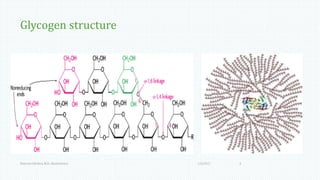
 Glycogen is a storage form of glucose.
 It is a very large, branched polymer of glucose residues that
can be broken down to yield glucose molecules when energy
is needed.
 Most of the glucose residues in glycogen are linked by α-1,4-
glycosidic bonds.
 Branches at about every tenth residue are created by α-1,6-
glycosidic bonds.
1/6/2017Namrata Chhabra, M.D., Biochemistry 3
Glycogen structure
1/6/2017Namrata Chhabra, M.D., Biochemistry 4
Purpose of Glycogenolysis
 The controlled breakdown of glycogen and release of
glucose increase the amount of glucose that is
available between meals. Hence, glycogen serves as a
buffer to maintain blood-glucose levels.
 Glycogen's role in maintaining blood glucose levels is
especially important because glucose is virtually
the only fuel used by the brain, except during
prolonged starvation.
1/6/2017Namrata Chhabra, M.D., Biochemistry 5
Purpose of Glycogenolysis
 The glucose from glycogen is readily mobilized and
is therefore a good source of energy for sudden,
strenuous activity.
 Unlike fatty acids, the released glucose can provide
energy in the absence of oxygen and can thus
supply energy for anaerobic activity.
1/6/2017Namrata Chhabra, M.D., Biochemistry 6
Enzymes involved in Glycogenolysis
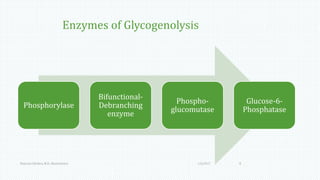
 The efficient breakdown of glycogen requires four
enzyme activities:
 one to degrade glycogen,
 two to remodel glycogen so that it remains a
substrate for degradation, and
 one to convert the product of glycogen breakdown
into a form suitable for further metabolism.
1/6/2017Namrata Chhabra, M.D., Biochemistry 7
Enzymes of Glycogenolysis
Phosphorylase
Bifunctional-
Debranching
enzyme
Phospho-
glucomutase
Glucose-6-
Phosphatase
1/6/2017Namrata Chhabra, M.D., Biochemistry 8
Major coenzyme of Glycogenolysis
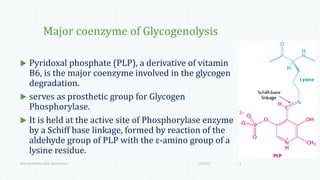
 Pyridoxal phosphate (PLP), a derivative of vitamin
B6, is the major coenzyme involved in the glycogen
degradation.
 serves as prosthetic group for Glycogen
Phosphorylase.
 It is held at the active site of Phosphorylase enzyme
by a Schiff base linkage, formed by reaction of the
aldehyde group of PLP with the ε-amino group of a
lysine residue.
1/6/2017Namrata Chhabra, M.D., Biochemistry 9
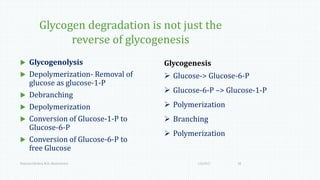
Glycogen degradation is not just the
reverse of glycogenesis
Glycogenesis
 Glucose-> Glucose-6-P
 Glucose-6-P –> Glucose-1-P
 Polymerization
 Branching
 Polymerization
 Glycogenolysis
 Depolymerization- Removal of
glucose as glucose-1-P
 Debranching
 Depolymerization
 Conversion of Glucose-1-P to
Glucose-6-P
 Conversion of Glucose-6-P to
free Glucose
1/6/2017Namrata Chhabra, M.D., Biochemistry 10
Specific steps of Glycogenolysis
 Step-1- Depolymerization (Release of Glucose-1-P from
Glycogen)
 Enzyme- Phosphorylase
 Coenzyme– Pyridoxal phosphate
 Reaction involved :
1/6/2017Namrata Chhabra, M.D., Biochemistry 11
Step-1- Reaction catalyzed by
Phosphorylase
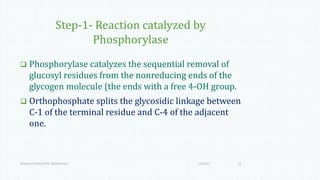
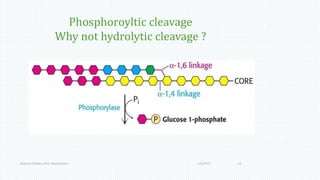
 Phosphorylase catalyzes the sequential removal of
glucosyl residues from the nonreducing ends of the
glycogen molecule (the ends with a free 4-OH group.
 Orthophosphate splits the glycosidic linkage between
C-1 of the terminal residue and C-4 of the adjacent
one.
1/6/2017Namrata Chhabra, M.D., Biochemistry 12
Phosphoroyltic cleavage
Why not hydrolytic cleavage ?
1/6/2017Namrata Chhabra, M.D., Biochemistry 13
Advantages of Phosphoroyltic cleavage
 The phosphoroylytic cleavage of glycogen is energetically
advantageous because the released sugar is already
phosphorylated.
 In contrast, a hydrolytic cleavage would yield glucose, which
would then have to be phosphorylated at the expense of the
hydrolysis of a molecule of ATP to enter the glycolytic pathway.
 An additional advantage of phosphoroylytic cleavage for muscle
cells is that glucose 1-phosphate, negatively charged under
physiological conditions, cannot diffuse out of the cell.
1/6/2017Namrata Chhabra, M.D., Biochemistry 14
Problem with Phosphorylase
 The α-1,6-glycosidic bonds at the branch points are
not susceptible to cleavage by phosphorylase.
 Glycogen phosphorylase stops cleaving α -1,4
linkages when it reaches a terminal residue four
residues away from a branch point.
 Because about 1 in 10 residues is branched, glycogen
degradation by the phosphorylase alone would come
to a halt after the release of six glucose molecules per
branch.
1/6/2017Namrata Chhabra, M.D., Biochemistry 15
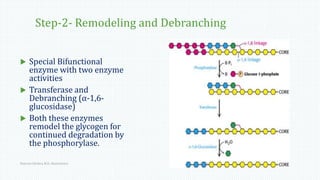
Step-2- Remodeling and Debranching
 Special Bifunctional
enzyme with two enzyme
activities
 Transferase and
Debranching (α-1,6-
glucosidase)
 Both these enzymes
remodel the glycogen for
continued degradation by
the phosphorylase.
1/6/2017Namrata Chhabra, M.D., Biochemistry 16
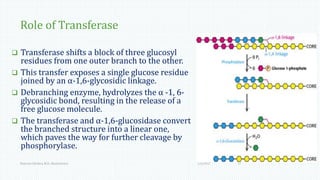
Role of Transferase
 Transferase shifts a block of three glucosyl
residues from one outer branch to the other.
 This transfer exposes a single glucose residue
joined by an α-1,6-glycosidic linkage.
 Debranching enzyme, hydrolyzes the α -1, 6-
glycosidic bond, resulting in the release of a
free glucose molecule.
 The transferase and α-1,6-glucosidase convert
the branched structure into a linear one,
which paves the way for further cleavage by
phosphorylase.
1/6/2017Namrata Chhabra, M.D., Biochemistry 17
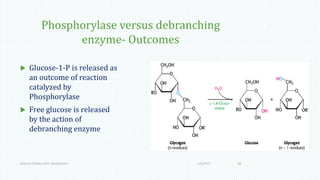
Phosphorylase versus debranching
enzyme- Outcomes
 Glucose-1-P is released as
an outcome of reaction
catalyzed by
Phosphorylase
 Free glucose is released
by the action of
debranching enzyme
1/6/2017Namrata Chhabra, M.D., Biochemistry 18
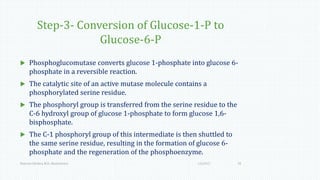
Step-3- Conversion of Glucose-1-P to
Glucose-6-P
 Phosphoglucomutase converts glucose 1-phosphate into glucose 6-
phosphate in a reversible reaction.
 The catalytic site of an active mutase molecule contains a
phosphorylated serine residue.
 The phosphoryl group is transferred from the serine residue to the
C-6 hydroxyl group of glucose 1-phosphate to form glucose 1,6-
bisphosphate.
 The C-1 phosphoryl group of this intermediate is then shuttled to
the same serine residue, resulting in the formation of glucose 6-
phosphate and the regeneration of the phosphoenzyme.
1/6/2017Namrata Chhabra, M.D., Biochemistry 19
Reaction catalyzed by Phosphoglucomutase
1/6/2017Namrata Chhabra, M.D., Biochemistry 20
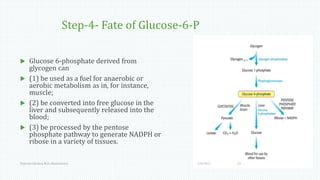
Step-4- Fate of Glucose-6-P
 Glucose 6-phosphate derived from
glycogen can
 (1) be used as a fuel for anaerobic or
aerobic metabolism as in, for instance,
muscle;
 (2) be converted into free glucose in the
liver and subsequently released into the
blood;
 (3) be processed by the pentose
phosphate pathway to generate NADPH or
ribose in a variety of tissues.
1/6/2017Namrata Chhabra, M.D., Biochemistry 21
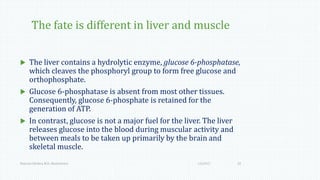
The fate is different in liver and muscle
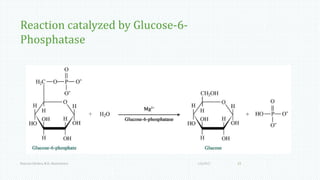
 The liver contains a hydrolytic enzyme, glucose 6-phosphatase,
which cleaves the phosphoryl group to form free glucose and
orthophosphate.
 Glucose 6-phosphatase is absent from most other tissues.
Consequently, glucose 6-phosphate is retained for the
generation of ATP.
 In contrast, glucose is not a major fuel for the liver. The liver
releases glucose into the blood during muscular activity and
between meals to be taken up primarily by the brain and
skeletal muscle.
1/6/2017Namrata Chhabra, M.D., Biochemistry 22
Reaction catalyzed by Glucose-6-
Phosphatase
1/6/2017Namrata Chhabra, M.D., Biochemistry 23
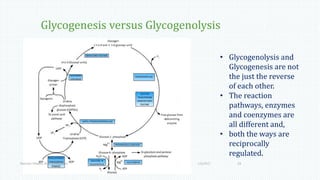
Glycogenesis versus Glycogenolysis
• Glycogenolysis and
Glycogenesis are not
the just the reverse
of each other.
• The reaction
pathways, enzymes
and coenzymes are
all different and,
• both the ways are
reciprocally
regulated.
1/6/2017Namrata Chhabra, M.D., Biochemistry 24
Regulation of glycogen metabolism
 To be continued in the next section…
1/6/2017Namrata Chhabra, M.D., Biochemistry 25
Thank you
1/6/2017Namrata Chhabra, M.D., Biochemistry 26

Glycogen metabolism part-2

  • 1.
    Glycogen metabolism- Part-2 (Glycogendegradation) Namrata Chhabra, M.D., Biochemistry 1/6/2017Namrata Chhabra, M.D., Biochemistry 1
  • 2.
    Learning objectives  Tounderstand:  The Purpose  Role of Enzymes and coenzymes, and  The steps involved in the pathway of Glycogenolysis 1/6/2017Namrata Chhabra, M.D., Biochemistry 2
  • 3.
    Introduction  Glycogen isa storage form of glucose.  It is a very large, branched polymer of glucose residues that can be broken down to yield glucose molecules when energy is needed.  Most of the glucose residues in glycogen are linked by α-1,4- glycosidic bonds.  Branches at about every tenth residue are created by α-1,6- glycosidic bonds. 1/6/2017Namrata Chhabra, M.D., Biochemistry 3
  • 4.
  • 5.
    Purpose of Glycogenolysis The controlled breakdown of glycogen and release of glucose increase the amount of glucose that is available between meals. Hence, glycogen serves as a buffer to maintain blood-glucose levels.  Glycogen's role in maintaining blood glucose levels is especially important because glucose is virtually the only fuel used by the brain, except during prolonged starvation. 1/6/2017Namrata Chhabra, M.D., Biochemistry 5
  • 6.
    Purpose of Glycogenolysis The glucose from glycogen is readily mobilized and is therefore a good source of energy for sudden, strenuous activity.  Unlike fatty acids, the released glucose can provide energy in the absence of oxygen and can thus supply energy for anaerobic activity. 1/6/2017Namrata Chhabra, M.D., Biochemistry 6
  • 7.
    Enzymes involved inGlycogenolysis  The efficient breakdown of glycogen requires four enzyme activities:  one to degrade glycogen,  two to remodel glycogen so that it remains a substrate for degradation, and  one to convert the product of glycogen breakdown into a form suitable for further metabolism. 1/6/2017Namrata Chhabra, M.D., Biochemistry 7
  • 8.
  • 9.
    Major coenzyme ofGlycogenolysis  Pyridoxal phosphate (PLP), a derivative of vitamin B6, is the major coenzyme involved in the glycogen degradation.  serves as prosthetic group for Glycogen Phosphorylase.  It is held at the active site of Phosphorylase enzyme by a Schiff base linkage, formed by reaction of the aldehyde group of PLP with the ε-amino group of a lysine residue. 1/6/2017Namrata Chhabra, M.D., Biochemistry 9
  • 10.
    Glycogen degradation isnot just the reverse of glycogenesis Glycogenesis  Glucose-> Glucose-6-P  Glucose-6-P –> Glucose-1-P  Polymerization  Branching  Polymerization  Glycogenolysis  Depolymerization- Removal of glucose as glucose-1-P  Debranching  Depolymerization  Conversion of Glucose-1-P to Glucose-6-P  Conversion of Glucose-6-P to free Glucose 1/6/2017Namrata Chhabra, M.D., Biochemistry 10
  • 11.
    Specific steps ofGlycogenolysis  Step-1- Depolymerization (Release of Glucose-1-P from Glycogen)  Enzyme- Phosphorylase  Coenzyme– Pyridoxal phosphate  Reaction involved : 1/6/2017Namrata Chhabra, M.D., Biochemistry 11
  • 12.
    Step-1- Reaction catalyzedby Phosphorylase  Phosphorylase catalyzes the sequential removal of glucosyl residues from the nonreducing ends of the glycogen molecule (the ends with a free 4-OH group.  Orthophosphate splits the glycosidic linkage between C-1 of the terminal residue and C-4 of the adjacent one. 1/6/2017Namrata Chhabra, M.D., Biochemistry 12
  • 13.
    Phosphoroyltic cleavage Why nothydrolytic cleavage ? 1/6/2017Namrata Chhabra, M.D., Biochemistry 13
  • 14.
    Advantages of Phosphoroylticcleavage  The phosphoroylytic cleavage of glycogen is energetically advantageous because the released sugar is already phosphorylated.  In contrast, a hydrolytic cleavage would yield glucose, which would then have to be phosphorylated at the expense of the hydrolysis of a molecule of ATP to enter the glycolytic pathway.  An additional advantage of phosphoroylytic cleavage for muscle cells is that glucose 1-phosphate, negatively charged under physiological conditions, cannot diffuse out of the cell. 1/6/2017Namrata Chhabra, M.D., Biochemistry 14
  • 15.
    Problem with Phosphorylase The α-1,6-glycosidic bonds at the branch points are not susceptible to cleavage by phosphorylase.  Glycogen phosphorylase stops cleaving α -1,4 linkages when it reaches a terminal residue four residues away from a branch point.  Because about 1 in 10 residues is branched, glycogen degradation by the phosphorylase alone would come to a halt after the release of six glucose molecules per branch. 1/6/2017Namrata Chhabra, M.D., Biochemistry 15
  • 16.
    Step-2- Remodeling andDebranching  Special Bifunctional enzyme with two enzyme activities  Transferase and Debranching (α-1,6- glucosidase)  Both these enzymes remodel the glycogen for continued degradation by the phosphorylase. 1/6/2017Namrata Chhabra, M.D., Biochemistry 16
  • 17.
    Role of Transferase Transferase shifts a block of three glucosyl residues from one outer branch to the other.  This transfer exposes a single glucose residue joined by an α-1,6-glycosidic linkage.  Debranching enzyme, hydrolyzes the α -1, 6- glycosidic bond, resulting in the release of a free glucose molecule.  The transferase and α-1,6-glucosidase convert the branched structure into a linear one, which paves the way for further cleavage by phosphorylase. 1/6/2017Namrata Chhabra, M.D., Biochemistry 17
  • 18.
    Phosphorylase versus debranching enzyme-Outcomes  Glucose-1-P is released as an outcome of reaction catalyzed by Phosphorylase  Free glucose is released by the action of debranching enzyme 1/6/2017Namrata Chhabra, M.D., Biochemistry 18
  • 19.
    Step-3- Conversion ofGlucose-1-P to Glucose-6-P  Phosphoglucomutase converts glucose 1-phosphate into glucose 6- phosphate in a reversible reaction.  The catalytic site of an active mutase molecule contains a phosphorylated serine residue.  The phosphoryl group is transferred from the serine residue to the C-6 hydroxyl group of glucose 1-phosphate to form glucose 1,6- bisphosphate.  The C-1 phosphoryl group of this intermediate is then shuttled to the same serine residue, resulting in the formation of glucose 6- phosphate and the regeneration of the phosphoenzyme. 1/6/2017Namrata Chhabra, M.D., Biochemistry 19
  • 20.
    Reaction catalyzed byPhosphoglucomutase 1/6/2017Namrata Chhabra, M.D., Biochemistry 20
  • 21.
    Step-4- Fate ofGlucose-6-P  Glucose 6-phosphate derived from glycogen can  (1) be used as a fuel for anaerobic or aerobic metabolism as in, for instance, muscle;  (2) be converted into free glucose in the liver and subsequently released into the blood;  (3) be processed by the pentose phosphate pathway to generate NADPH or ribose in a variety of tissues. 1/6/2017Namrata Chhabra, M.D., Biochemistry 21
  • 22.
    The fate isdifferent in liver and muscle  The liver contains a hydrolytic enzyme, glucose 6-phosphatase, which cleaves the phosphoryl group to form free glucose and orthophosphate.  Glucose 6-phosphatase is absent from most other tissues. Consequently, glucose 6-phosphate is retained for the generation of ATP.  In contrast, glucose is not a major fuel for the liver. The liver releases glucose into the blood during muscular activity and between meals to be taken up primarily by the brain and skeletal muscle. 1/6/2017Namrata Chhabra, M.D., Biochemistry 22
  • 23.
    Reaction catalyzed byGlucose-6- Phosphatase 1/6/2017Namrata Chhabra, M.D., Biochemistry 23
  • 24.
    Glycogenesis versus Glycogenolysis •Glycogenolysis and Glycogenesis are not the just the reverse of each other. • The reaction pathways, enzymes and coenzymes are all different and, • both the ways are reciprocally regulated. 1/6/2017Namrata Chhabra, M.D., Biochemistry 24
  • 25.
    Regulation of glycogenmetabolism  To be continued in the next section… 1/6/2017Namrata Chhabra, M.D., Biochemistry 25
  • 26.