Dr.Jasmin.A.S
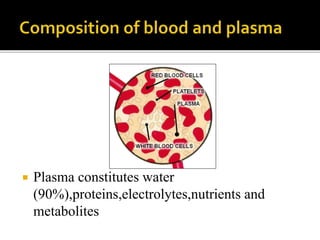
 Plasma constitutes water
(90%),proteins,electrolytes,nutrients and
metabolites
AlbuminGlobulin
Fibrinogen Others
Albumin 60%
Globulin 35%
Fibrinogen 4%
Others 1%
 Total protein content - 6-8 g/dl
 Almost all plasma proteins except
immunoglobulins are synthesised in liver
 Mainly glycoproteins
 Albumin ,globulin and fibrinogen are the
major plasma proteins
 Predominant plasma protein,water soluble
 Synthesised in liver
 The name is derived from the white
precipitate formed when egg is boiled[albus
means white in Latin]
 Normal blood level is 3.5-5 g/dl
 Migrates fastest in electrophoresis at alkaline
pH and precipitates last in salting out
methods
 Structure and synthesis
 Has one polypeptide chain consisting of 585
AAs with 17 disulfide bonds
 Mol wt :69 KD,relatively low mol.wt
 Daily production:12g/day
 Estimation of albumin is a component of
liver function test [LFT]
 Has a PI of 4.7
 Its signal peptide is removed as it passes into
the cisternae of the rough endoplasmic
reticulum, and a hexapeptide at the resulting
amino terminal is subsequently cleaved off
farther along the secretory pathway Albumin
can come out of vascular compartment,so it is
present in CSF and interstitial fluid
 Albumin is initially synthesized as a
preproprotein
1. Maintenance of blood volume by maintaining
the colloid osmotic pressure
 Total osmolality of serum is 278-305 milliosmol/kg
 Albumin is responsible for 75-80% of the osmotic
pressure of human plasma due to its large
concentration and relatively small mol.wt
 Maintenance of blood volume and body fluid
distribution is dependent on EOP
 According to Starling hypothesis,at the capillary
end,the BP expels water out and EOP takes water
into the vascular compartment at the venous end
 At arterial end BP is 35 mm Hg,EOP is 25 mm
Hg;thus water is expelled by a pressure of 10 mm
Hg
 At the venous end,BP is 15 mm Hg and EOP is 25
mm Hg;thus water is imbibed with a pressure of
10 mm Hg
 Thus no of water molecules escaping out at the
arterial side will be exactly equal to those
returned at the venous end and thus blood
volume remains the same
 In hypo albuminemia,[decreased blood levels
of albumin] the EOP is correspondingly
decreased return of water to blood vessels
decreased accumulation/retention of water
in tissues  EDEMA
 Edema usually occurs when blood albumin
level is < 2g/dl
2. Transport function
 Carrier of various hydrophobic substances
i. Bilirubin and non esterified fatty acids
ii. Drugs like
sulpha,aspirin,salicylate,dicoumarol,
phenytoin
iii. Hormones like steroid hormones,thyroxine
iv. Metals like copper,calcium and heavy metals
3. Buffering action
 Albumin has maximum buffering capacity as it
has the highest concentration in blood
 Albumin has 16 histidine residues which
contributes to this buffering action
4. Nutritional function
 Albumin is a complete protein
 Albumin is taken up by pinocytosis
 It may be considered as the transport form of
essential AAs from liver to extra hepatic cells
 Albumin thus serves as a source of AAs especially
in cases of nutritional deprivation
1. Blood brain barrier
 Alb-FA complex cannot cross the BBB,so FAs
cannot be taken up by brain
 Unconjugated bilirubin can cross the BBB : so in
cases of unconjugated hyperbilirubinemia in
infants,as occurs in Rh incompatibility,the free
bilirubin can get deposited in the brain leading to
kernicterus and mental retardation
2. Drug interactions
 Drugs having high affinity to albumin will
compete each other for the available sites with
consequent displacement of one drug leading to
significant drug interactions
 Eg : phenytoin – dicoumarol interaction
3. Blood calcium levels
 In hypo albuminemia,blood levels of calcium
decreases
 Serum total calcium may be decreased
 Ionic calcium remains same
 Tetany does not occur
 For a fall of 1g/dl of albumin,Ca is lowered by
0.8mg/dl
4. Therapeutic use
 Human albumin is therapeutically useful to treat
burns,hemorrhage and shock
5. Hypo albuminemia and edema
a. Malnutrition - albumin synthesis is depressed
[generalised edema]
b. Nephrotic syndrome - albumin is lost through
urine facial edema]
c. Cirrhosis of liver – decreased albumin synthesis
[ascites]
d. c/c congestive heart failure – pitting edema of
feet
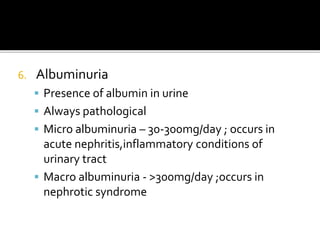
6. Albuminuria
 Presence of albumin in urine
 Always pathological
 Micro albuminuria – 30-300mg/day ; occurs in
acute nephritis,inflammatory conditions of
urinary tract
 Macro albuminuria - >300mg/day ;occurs in
nephrotic syndrome
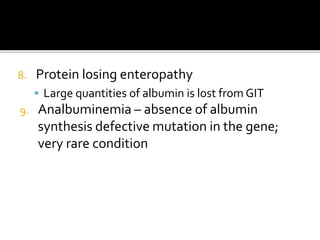
8. Protein losing enteropathy
 Large quantities of albumin is lost from GIT
9. Analbuminemia – absence of albumin
synthesis defective mutation in the gene;
very rare condition
 ALBUMIN-GLOBULIN RATIO or
A/G ratio
 Normal is 1.2:1 – 1.5:1
 In hypo albuminemia,there will be compensatory
increase in globulin synthesis
 A/G ratio is either altered or even reversed leading
to edema
 Common causes include cirrhosis,nephrotic
syndrome,multiple myeloma
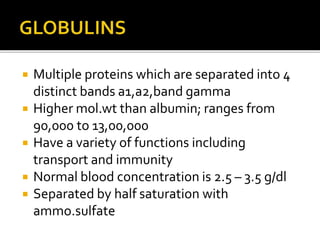
 Multiple proteins which are separated into 4
distinct bands a1,a2,band gamma
 Higher mol.wt than albumin; ranges from
90,000 to 13,00,000
 Have a variety of functions including
transport and immunity
 Normal blood concentration is 2.5 – 3.5 g/dl
 Separated by half saturation with
ammo.sulfate
Α1-globulins
A1 antitrypsin Inhibitor of trypsin and other
serine proteases
Oroso mucoid Transports progesterone
A1 lipoproteins Transports cholesterol from
tissues to liver
AFP Principal fetal protein
Retinol binding protein [RBP] Transports retinol
Thyroxine binding globulin
[TBG]
Transports thyroxine
Cortisol binding globulin
[CBG]or transcortin
Transports cortisol and
corticosterol
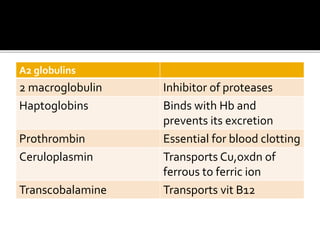
A2 globulins
2 macroglobulin Inhibitor of proteases
Haptoglobins Binds with Hb and
prevents its excretion
Prothrombin Essential for blood clotting
Ceruloplasmin Transports Cu,oxdn of
ferrous to ferric ion
Transcobalamine Transports vit B12
B globulins
B lipoproteins [LDL] Transports cholesterol and
triglycerides to tissues
B2 microglobulin Used to test renal tubular
function
Transferrin Transports iron
Hemopexins Transports heme
Plasminogen Involved in fibrinolysis
 Gamma globulins
 Eg: CRP [C reactive protein]
 Non specific defence against infectious agents
 Synthesised by liver
 Mol.wt 3,40,000 D
 Acute phase protein
 Has important role in blood clotting process
 Also called clotting factor1
 Constitutes 4-6% of total protein (200-400
mgdl)
 Imparts maximum viscosity to blood
 Precipitated with 1/5 th saturation with
ammonium sulphate
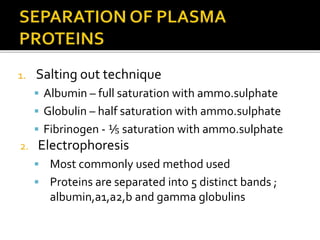
1. Salting out technique
 Albumin – full saturation with ammo.sulphate
 Globulin – half saturation with ammo.sulphate
 Fibrinogen - ⅕ saturation with ammo.sulphate
2. Electrophoresis
 Most commonly used method used
 Proteins are separated into 5 distinct bands ;
albumin,a1,a2,b and gamma globulins
Normal electrophoretic pattern
Reference ranges:
Total protein 6.0 – 8.0 g/dL
Albumin 3.5 – 5.0 g/dL
α1-globulins 0.1 – 0.4 g/dL
α2-globulins 0.4 – 1.3 g/dL
β-globulins 0.6 – 1.3 g/dL
γ-globulins 0.6 – 1.5 g/dL
 Acute infections
• Immediate response occurs with
stress or inflammation caused by
infection, injury or surgical
trauma
• normal or ↓ albumin
• ↑ α1 and α2 globulins
 Chronic infections
•Late response is correlated with
chronic infection
(autoimmune diseases, chronic
liver disease, chronic infection,
cancer)
• normal or ↓ albumin
•↑α1 or α2 globulins
•↑↑ γ globulins
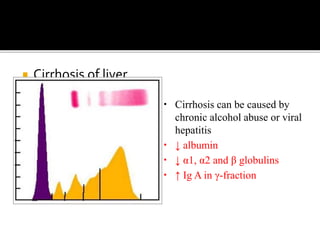
 Cirrhosis of liver
• Cirrhosis can be caused by
chronic alcohol abuse or viral
hepatitis
• ↓ albumin
• ↓ α1, α2 and β globulins
• ↑ Ig A in γ-fraction
 Nephrotic syndrome
• the kidney damage illustrates the
long term loss of lower
molecular weight proteins
(↓ albumin and IgG – they are
filtered in kidney)
• retention of higher molecular
weight proteins (↑↑ α2-
macroglobulin and ↑β-globulin)
 Multiple myeloma
3. Ultra centrifugation technique
 Based on the difference in densities of various
proteins
4. Cohn’s fractionation
5. Gel filtration
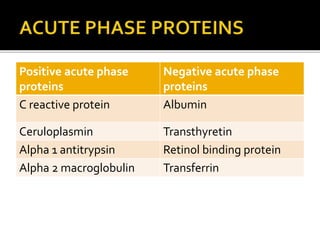
 A class of proteins whose plasma
concentrations increase (positive acute phase
proteins) or decrease (negative acute phase
proteins) in response to various inflammatory
and neoplastic conditions
Positive acute phase
proteins
Negative acute phase
proteins
C reactive protein Albumin
Ceruloplasmin Transthyretin
Alpha 1 antitrypsin Retinol binding protein
Alpha 2 macroglobulin Transferrin
 C reactive protein (CRP)
Named so because it reacts with C polysaccharide
of capsule of Pneumococci
Beta globulin with mol.wt of 115-140 KD
Synthesised by liver
It can stimulate complement activity and
macrophage phagocytosis
Clinically important marker in predicting the risk
of coronary artery diseases
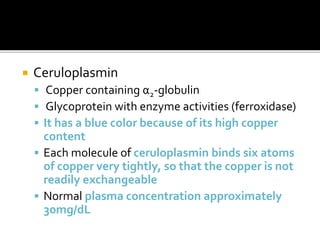
 Ceruloplasmin
 Copper containing α2-globulin
 Glycoprotein with enzyme activities (ferroxidase)
 It has a blue color because of its high copper
content
 Each molecule of ceruloplasmin binds six atoms
of copper very tightly, so that the copper is not
readily exchangeable
 Normal plasma concentration approximately
30mg/dL
 Synthesized in liver in the form of apo
ceruloplasmin, when copper atoms get
attached it becomes Ceruloplasmin.
 It carries 90% of the Cu present in plasma &binds
so tightly that the Cu is not readily
exchangeable.
 Albumin carries the other 10% of the plasma Cu
but binds less tightly
 Albumin thus donates its Cu to tissues more
readily than ceruloplasmin and appears to be
more important in Cu transport
 Normal level- 25-50 mg/dl
 Low levels of ceruloplasmin are found in Wilson
disease (hepatolenticular degeneration), a
disease due to abnormal metabolism of copper.
 The amount of ceruloplasmin in plasma is also
decreased in liver diseases, mal nutrition and
nephrotic syndrome.
 Increased in active hepatitis,biliary
cirrhosis,hemochromatosis,obstructive biliary
disease,pregnancy,estrogen
therapy,inflammatory conditions,collagen
disorders and in malignancies
 A1 antitrypsin
 Also called α1-antiprotease
 It is a single-chain protein of 394 amino acids,
contains three oligosaccharide chains
 It is the major component (> 90%) of the α 1
fraction of human plasma.
 It is synthesized by hepatocytes and
macrophages and is the principal serine
protease inhibitor of human plasma.
 It inhibits trypsin, elastase, and certain other
proteases by forming complexes with them.
A deficiency of this protein has a role in certain
cases (approximately 5%) of emphysema.
 Transport proteins
1. Albumin
2. Retinol binding protein
3. Thyroxine binding globulin
4. Cortisol binding globulin
5. Haptoglobin
6. Transferrin
7. Hemopexin
8. HDL and LDL

Plasma proteins

  • 1.
  • 2.
     Plasma constituteswater (90%),proteins,electrolytes,nutrients and metabolites
  • 3.
  • 4.
     Total proteincontent - 6-8 g/dl  Almost all plasma proteins except immunoglobulins are synthesised in liver  Mainly glycoproteins  Albumin ,globulin and fibrinogen are the major plasma proteins
  • 5.
     Predominant plasmaprotein,water soluble  Synthesised in liver  The name is derived from the white precipitate formed when egg is boiled[albus means white in Latin]  Normal blood level is 3.5-5 g/dl  Migrates fastest in electrophoresis at alkaline pH and precipitates last in salting out methods
  • 6.
     Structure andsynthesis  Has one polypeptide chain consisting of 585 AAs with 17 disulfide bonds  Mol wt :69 KD,relatively low mol.wt  Daily production:12g/day  Estimation of albumin is a component of liver function test [LFT]  Has a PI of 4.7
  • 7.
     Its signalpeptide is removed as it passes into the cisternae of the rough endoplasmic reticulum, and a hexapeptide at the resulting amino terminal is subsequently cleaved off farther along the secretory pathway Albumin can come out of vascular compartment,so it is present in CSF and interstitial fluid  Albumin is initially synthesized as a preproprotein
  • 8.
    1. Maintenance ofblood volume by maintaining the colloid osmotic pressure  Total osmolality of serum is 278-305 milliosmol/kg  Albumin is responsible for 75-80% of the osmotic pressure of human plasma due to its large concentration and relatively small mol.wt  Maintenance of blood volume and body fluid distribution is dependent on EOP  According to Starling hypothesis,at the capillary end,the BP expels water out and EOP takes water into the vascular compartment at the venous end
  • 9.
     At arterialend BP is 35 mm Hg,EOP is 25 mm Hg;thus water is expelled by a pressure of 10 mm Hg  At the venous end,BP is 15 mm Hg and EOP is 25 mm Hg;thus water is imbibed with a pressure of 10 mm Hg  Thus no of water molecules escaping out at the arterial side will be exactly equal to those returned at the venous end and thus blood volume remains the same
  • 10.
     In hypoalbuminemia,[decreased blood levels of albumin] the EOP is correspondingly decreased return of water to blood vessels decreased accumulation/retention of water in tissues  EDEMA  Edema usually occurs when blood albumin level is < 2g/dl
  • 11.
    2. Transport function Carrier of various hydrophobic substances i. Bilirubin and non esterified fatty acids ii. Drugs like sulpha,aspirin,salicylate,dicoumarol, phenytoin iii. Hormones like steroid hormones,thyroxine iv. Metals like copper,calcium and heavy metals
  • 12.
    3. Buffering action Albumin has maximum buffering capacity as it has the highest concentration in blood  Albumin has 16 histidine residues which contributes to this buffering action
  • 13.
    4. Nutritional function Albumin is a complete protein  Albumin is taken up by pinocytosis  It may be considered as the transport form of essential AAs from liver to extra hepatic cells  Albumin thus serves as a source of AAs especially in cases of nutritional deprivation
  • 14.
    1. Blood brainbarrier  Alb-FA complex cannot cross the BBB,so FAs cannot be taken up by brain  Unconjugated bilirubin can cross the BBB : so in cases of unconjugated hyperbilirubinemia in infants,as occurs in Rh incompatibility,the free bilirubin can get deposited in the brain leading to kernicterus and mental retardation
  • 15.
    2. Drug interactions Drugs having high affinity to albumin will compete each other for the available sites with consequent displacement of one drug leading to significant drug interactions  Eg : phenytoin – dicoumarol interaction
  • 16.
    3. Blood calciumlevels  In hypo albuminemia,blood levels of calcium decreases  Serum total calcium may be decreased  Ionic calcium remains same  Tetany does not occur  For a fall of 1g/dl of albumin,Ca is lowered by 0.8mg/dl
  • 17.
    4. Therapeutic use Human albumin is therapeutically useful to treat burns,hemorrhage and shock
  • 18.
    5. Hypo albuminemiaand edema a. Malnutrition - albumin synthesis is depressed [generalised edema] b. Nephrotic syndrome - albumin is lost through urine facial edema] c. Cirrhosis of liver – decreased albumin synthesis [ascites] d. c/c congestive heart failure – pitting edema of feet
  • 19.
    6. Albuminuria  Presenceof albumin in urine  Always pathological  Micro albuminuria – 30-300mg/day ; occurs in acute nephritis,inflammatory conditions of urinary tract  Macro albuminuria - >300mg/day ;occurs in nephrotic syndrome
  • 20.
    8. Protein losingenteropathy  Large quantities of albumin is lost from GIT 9. Analbuminemia – absence of albumin synthesis defective mutation in the gene; very rare condition
  • 21.
     ALBUMIN-GLOBULIN RATIOor A/G ratio  Normal is 1.2:1 – 1.5:1  In hypo albuminemia,there will be compensatory increase in globulin synthesis  A/G ratio is either altered or even reversed leading to edema  Common causes include cirrhosis,nephrotic syndrome,multiple myeloma
  • 22.
     Multiple proteinswhich are separated into 4 distinct bands a1,a2,band gamma  Higher mol.wt than albumin; ranges from 90,000 to 13,00,000  Have a variety of functions including transport and immunity  Normal blood concentration is 2.5 – 3.5 g/dl  Separated by half saturation with ammo.sulfate
  • 23.
    Α1-globulins A1 antitrypsin Inhibitorof trypsin and other serine proteases Oroso mucoid Transports progesterone A1 lipoproteins Transports cholesterol from tissues to liver AFP Principal fetal protein Retinol binding protein [RBP] Transports retinol Thyroxine binding globulin [TBG] Transports thyroxine Cortisol binding globulin [CBG]or transcortin Transports cortisol and corticosterol
  • 24.
    A2 globulins 2 macroglobulinInhibitor of proteases Haptoglobins Binds with Hb and prevents its excretion Prothrombin Essential for blood clotting Ceruloplasmin Transports Cu,oxdn of ferrous to ferric ion Transcobalamine Transports vit B12
  • 25.
    B globulins B lipoproteins[LDL] Transports cholesterol and triglycerides to tissues B2 microglobulin Used to test renal tubular function Transferrin Transports iron Hemopexins Transports heme Plasminogen Involved in fibrinolysis
  • 26.
     Gamma globulins Eg: CRP [C reactive protein]  Non specific defence against infectious agents
  • 27.
     Synthesised byliver  Mol.wt 3,40,000 D  Acute phase protein  Has important role in blood clotting process  Also called clotting factor1  Constitutes 4-6% of total protein (200-400 mgdl)  Imparts maximum viscosity to blood  Precipitated with 1/5 th saturation with ammonium sulphate
  • 28.
    1. Salting outtechnique  Albumin – full saturation with ammo.sulphate  Globulin – half saturation with ammo.sulphate  Fibrinogen - ⅕ saturation with ammo.sulphate 2. Electrophoresis  Most commonly used method used  Proteins are separated into 5 distinct bands ; albumin,a1,a2,b and gamma globulins
  • 29.
    Normal electrophoretic pattern Referenceranges: Total protein 6.0 – 8.0 g/dL Albumin 3.5 – 5.0 g/dL α1-globulins 0.1 – 0.4 g/dL α2-globulins 0.4 – 1.3 g/dL β-globulins 0.6 – 1.3 g/dL γ-globulins 0.6 – 1.5 g/dL
  • 30.
     Acute infections •Immediate response occurs with stress or inflammation caused by infection, injury or surgical trauma • normal or ↓ albumin • ↑ α1 and α2 globulins
  • 31.
     Chronic infections •Lateresponse is correlated with chronic infection (autoimmune diseases, chronic liver disease, chronic infection, cancer) • normal or ↓ albumin •↑α1 or α2 globulins •↑↑ γ globulins
  • 32.
     Cirrhosis ofliver • Cirrhosis can be caused by chronic alcohol abuse or viral hepatitis • ↓ albumin • ↓ α1, α2 and β globulins • ↑ Ig A in γ-fraction
  • 33.
     Nephrotic syndrome •the kidney damage illustrates the long term loss of lower molecular weight proteins (↓ albumin and IgG – they are filtered in kidney) • retention of higher molecular weight proteins (↑↑ α2- macroglobulin and ↑β-globulin)
  • 34.
  • 35.
    3. Ultra centrifugationtechnique  Based on the difference in densities of various proteins 4. Cohn’s fractionation 5. Gel filtration
  • 36.
     A classof proteins whose plasma concentrations increase (positive acute phase proteins) or decrease (negative acute phase proteins) in response to various inflammatory and neoplastic conditions
  • 37.
    Positive acute phase proteins Negativeacute phase proteins C reactive protein Albumin Ceruloplasmin Transthyretin Alpha 1 antitrypsin Retinol binding protein Alpha 2 macroglobulin Transferrin
  • 38.
     C reactiveprotein (CRP) Named so because it reacts with C polysaccharide of capsule of Pneumococci Beta globulin with mol.wt of 115-140 KD Synthesised by liver It can stimulate complement activity and macrophage phagocytosis Clinically important marker in predicting the risk of coronary artery diseases
  • 39.
     Ceruloplasmin  Coppercontaining α2-globulin  Glycoprotein with enzyme activities (ferroxidase)  It has a blue color because of its high copper content  Each molecule of ceruloplasmin binds six atoms of copper very tightly, so that the copper is not readily exchangeable  Normal plasma concentration approximately 30mg/dL
  • 40.
     Synthesized inliver in the form of apo ceruloplasmin, when copper atoms get attached it becomes Ceruloplasmin.  It carries 90% of the Cu present in plasma &binds so tightly that the Cu is not readily exchangeable.  Albumin carries the other 10% of the plasma Cu but binds less tightly  Albumin thus donates its Cu to tissues more readily than ceruloplasmin and appears to be more important in Cu transport
  • 41.
     Normal level-25-50 mg/dl  Low levels of ceruloplasmin are found in Wilson disease (hepatolenticular degeneration), a disease due to abnormal metabolism of copper.  The amount of ceruloplasmin in plasma is also decreased in liver diseases, mal nutrition and nephrotic syndrome.  Increased in active hepatitis,biliary cirrhosis,hemochromatosis,obstructive biliary disease,pregnancy,estrogen therapy,inflammatory conditions,collagen disorders and in malignancies
  • 42.
     A1 antitrypsin Also called α1-antiprotease  It is a single-chain protein of 394 amino acids, contains three oligosaccharide chains  It is the major component (> 90%) of the α 1 fraction of human plasma.  It is synthesized by hepatocytes and macrophages and is the principal serine protease inhibitor of human plasma.
  • 43.
     It inhibitstrypsin, elastase, and certain other proteases by forming complexes with them. A deficiency of this protein has a role in certain cases (approximately 5%) of emphysema.
  • 44.
     Transport proteins 1.Albumin 2. Retinol binding protein 3. Thyroxine binding globulin 4. Cortisol binding globulin 5. Haptoglobin 6. Transferrin 7. Hemopexin 8. HDL and LDL