DR NILESH KATE
MBBS,MD
ASSOCIATE PROF
DEPT. OF PHYSIOLOGY
PLATELETS
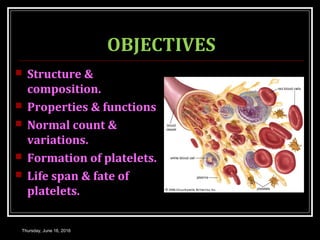
OBJECTIVES
 Structure &
composition.
 Properties & functions
 Normal count &
variations.
 Formation of platelets.
 Life span & fate of
platelets.
Thursday, June 16, 2016
STRUCTURE & COMPOSITION.
 Platelets – small plate like.
 Thrombocytes. – thrombo –
clot; cytes—cells.
 Size – smallest blood cells ;
2-4 μm.
 Shape – spherical or oval
discoid
 Volume 5.8 μm3.
 Colour – colourless
Thursday, June 16, 2016
STRUCTURE & COMPOSITION
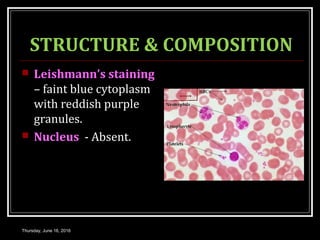
 Leishmann’s staining
– faint blue cytoplasm
with reddish purple
granules.
 Nucleus - Absent.
Thursday, June 16, 2016
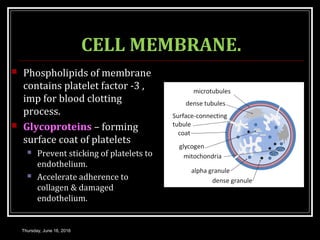
ELECTRON MICROSCOPIC
PICTURE.
 Cell membrane.
 Microtubules.
 Cytoplasm.
Thursday, June 16, 2016
CELL MEMBRANE.
 6 nm thick trilaminar
membrane.
 Consists of
 Lipids – phospholipids,
cholesterol &
glycolipids.
 Carbohydrates.
 Proteins –
glycoproteins.
Thursday, June 16, 2016
CELL MEMBRANE.
 Phospholipids of membrane
contains platelet factor -3 ,
imp for blood clotting
process.
 Glycoproteins – forming
surface coat of platelets
 Prevent sticking of platelets to
endothelium.
 Accelerate adherence to
collagen & damaged
endothelium.
Thursday, June 16, 2016
CELL MEMBRANE.
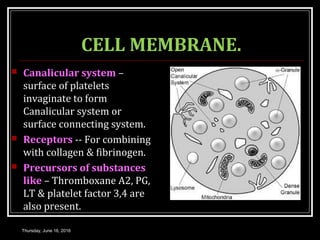
 Canalicular system –
surface of platelets
invaginate to form
Canalicular system or
surface connecting system.
 Receptors -- For combining
with collagen & fibrinogen.
 Precursors of substances
like – Thromboxane A2, PG,
LT & platelet factor 3,4 are
also present.
Thursday, June 16, 2016
MICROTUBULES.
 Made up of
Polymerised proteins
called Tubulins.
 Forms compact
bundle below
membrane & encircle
whole cytoplasm.
 Responsible for
discoid shape.
Thursday, June 16, 2016
CYTOPLASM.
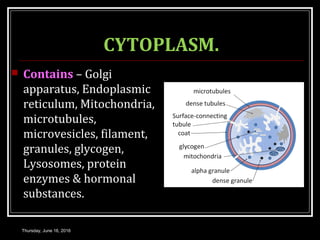
 Contains – Golgi
apparatus, Endoplasmic
reticulum, Mitochondria,
microtubules,
microvesicles, filament,
granules, glycogen,
Lysosomes, protein
enzymes & hormonal
substances.
Thursday, June 16, 2016
GOLGI APPARATUS,
ENDOPLASMIC RETICULUM
 Synthesizes various
Enzymes.
 Endoplasmic
Reticulum – stores
large amount of
calcium.
Thursday, June 16, 2016
MITOCHONDRIA
 Power house of cell.
 Produce ATP & ADP.
Thursday, June 16, 2016
CONTRACTILE PROTEINS.
 Actin & Myosin – same as those of contractile
proteins of muscle.
 Responsible for platelet contraction & clot retraction.
 Thrombosthenin
Thursday, June 16, 2016
OTHER PROTEINS
 Fibrin stabilizing Factor – Imp in blood coagulation.
 Platelet derived growth factor – for growth of vascular
endothelial cells, vascular smooth cells & fibroblast
 Involved in repair of damaged blood vessel.
 Von-Willebrand factor – for platelet adherence
Thursday, June 16, 2016
GRANULES
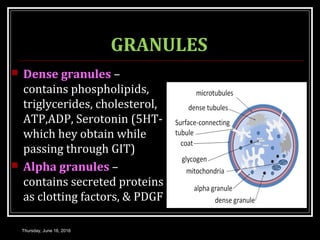
 Dense granules –
contains phospholipids,
triglycerides, cholesterol,
ATP,ADP, Serotonin (5HT-
which hey obtain while
passing through GIT)
 Alpha granules –
contains secreted proteins
as clotting factors, & PDGF
Thursday, June 16, 2016
ENZYMES
 Adenosine triphosphatase & enzyme for synthesis
of prostaglandins.
 Prostaglandins – acts as a local hormone & have
local vascular & tissue reaction.
Thursday, June 16, 2016
PROPERTIES
 Adhesiveness –
whenever comes in
contact with any wet or
rough surface gets
activated & stick to
surface.
 Factors responsible are –
collagen, thrombin, ADP,
thromboxane A2, Ca ion
& Von-Willebrand Factor
Thursday, June 16, 2016
PROPERTIES
 Aggregation – property
to stick to each other
 Factors responsible are
ADP & Thromboxane A2
 Agglutination –
property of clumping
together of platelet
 Its due to platelet
Agglutinins.
Thursday, June 16, 2016
FUNCTIONS
 Role in haemostasis.
 Role in clot formation.
 Role in clot retraction.
 Role in repair of injured blood vessels.
 Role in Defense mechanism.
 Transport & storage function.
Thursday, June 16, 2016
ROLE IN HAEMOSTASIS.
 Haemostasis – spontaneous arrest of bleeding from injured
blood vessel.
 Vasoconstriction – by 5HT & other vasoconstrictors
 Temporary haemostatic plug – by platelets due to its
property of adhesiveness & aggregation.
 Definite haemostatic plug – also initiated by platelets.
Thursday, June 16, 2016
ROLE IN CLOT FORMATION.
 Play imp role in formation of intrinsic prothrombin
activator
 It is responsible for onset of blood clotting.
Thursday, June 16, 2016
ROLE IN CLOT RETRACTION.
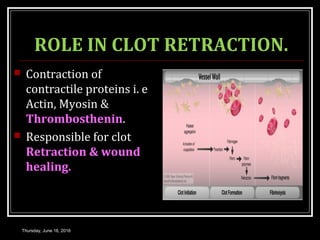
 Contraction of
contractile proteins i. e
Actin, Myosin &
Thrombosthenin.
 Responsible for clot
Retraction & wound
healing.
Thursday, June 16, 2016
ROLE IN REPAIR OF INJURED
BLOOD VESSELS.
 Platelet derived growth
factor (PDGF) in
cytoplasm of platelet
imp for Repair of
Endothelium.
Thursday, June 16, 2016
ROLE IN DEFENCE MECHANISM.
 Due to the property of
agglutination , platelets
are capable of
Phagocytosis.
 Mainly in Phagocytosis
of carbon particles,
viruses & immune
complexes.
Thursday, June 16, 2016
TRANSPORT & STORAGE
FUNCTION.
 Platelet when passes
through GIT takes 5-
HT against
concentration gradient,
stored & transported to
the site of injury.
Thursday, June 16, 2016
NORMAL COUNT &
VARIATIONS.
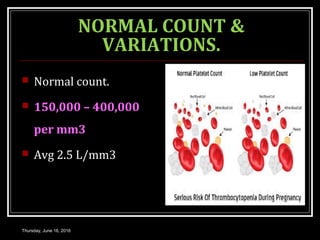
 Normal count.
 150,000 – 400,000
per mm3
 Avg 2.5 L/mm3
Thursday, June 16, 2016
PHYSIOLOGICAL VARIATIONS.
 Age – Less in infant, reach adult level by 3 months of age.
 Sex – No difference but during mensturation reduced in
females.
 Meal – Increases after meal
 Muscular exercise – Increases.
 High Altitude – Increases.
Thursday, June 16, 2016
PATHOLOGICAL VARIATIONS.
 Thrombocytosis.
 Increase in count more than 450,000/mm3
 After Splenectomy
 After hemorrhage, severe injury, major operation &
parturition.
 Myloproliferative Disorders – CML, Polycythemia vera,
Myelofibrosis.
Thursday, June 16, 2016
PATHOLOGICAL VARIATIONS.
 Thrombocytopenia
 Decrease in count less than
150,000/mm3
 ITP
 Bone marrow depression
 Acute leukemia
 Infections
 Toxaemia, septicemia &
uremia.
Thursday, June 16, 2016
FORMATION OF PLATELETS.
 Stages in platelets
production.(10 days)
 Megakaryoblast.
 Promegakaryocyte.
 Megakaryocyte.
 Sites – Bone Marrow
 Stem cells – PHSC
 CFU- Meg
Thursday, June 16, 2016
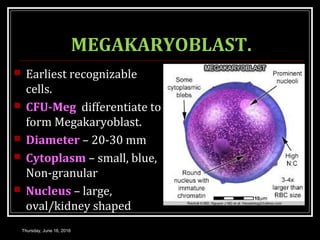
MEGAKARYOBLAST.
 Earliest recognizable
cells.
 CFU-Meg differentiate to
form Megakaryoblast.
 Diameter – 20-30 mm
 Cytoplasm – small, blue,
Non-granular
 Nucleus – large,
oval/kidney shaped
Thursday, June 16, 2016
PROMEGAKARYOCYTE
 Megakaryoblast –
Endoreduplication of
nuclear chromatin.
 Nuclear chromatin
replicates in multiple of 2
without division of cell.
 Large cell with 32 times
diploid content of nuclear
DNA formed.
 Cytoplasm – Granular.
Thursday, June 16, 2016
MEGAKARYOCYTE.
 Diameter – large cell with
30-90mm in diameter.
 Nucleus- single multiloaded.
 Cytoplasm – abundant with
red purple granules.
 Cell margin – irregular with
many Pseudopodia which
gets detached into blood &
forms platelets.
 One Megakaryocyte – 4000
platelets
Thursday, June 16, 2016
CONTROL OF TROMBOPOIESIS.
 Thrombopoietin –
 Megakaryocyte –
colony stimulating
activity (Meg-CSA)
Thursday, June 16, 2016
LIFE SPAN & FATE OF
PLATELETS.
 Life span – 8-12 days
 Avg – 10 days.
 Fate – Destroyed by tissue macrophage system in
spleen.
 Splenomegaly – reduces platelet count.
 Splenectomy – increases platelet count.
Thursday, June 16, 2016
Thank
You

PLATELETS

  • 1.
    DR NILESH KATE MBBS,MD ASSOCIATEPROF DEPT. OF PHYSIOLOGY PLATELETS
  • 2.
    OBJECTIVES  Structure & composition. Properties & functions  Normal count & variations.  Formation of platelets.  Life span & fate of platelets. Thursday, June 16, 2016
  • 3.
    STRUCTURE & COMPOSITION. Platelets – small plate like.  Thrombocytes. – thrombo – clot; cytes—cells.  Size – smallest blood cells ; 2-4 μm.  Shape – spherical or oval discoid  Volume 5.8 μm3.  Colour – colourless Thursday, June 16, 2016
  • 4.
    STRUCTURE & COMPOSITION Leishmann’s staining – faint blue cytoplasm with reddish purple granules.  Nucleus - Absent. Thursday, June 16, 2016
  • 5.
    ELECTRON MICROSCOPIC PICTURE.  Cellmembrane.  Microtubules.  Cytoplasm. Thursday, June 16, 2016
  • 6.
    CELL MEMBRANE.  6nm thick trilaminar membrane.  Consists of  Lipids – phospholipids, cholesterol & glycolipids.  Carbohydrates.  Proteins – glycoproteins. Thursday, June 16, 2016
  • 7.
    CELL MEMBRANE.  Phospholipidsof membrane contains platelet factor -3 , imp for blood clotting process.  Glycoproteins – forming surface coat of platelets  Prevent sticking of platelets to endothelium.  Accelerate adherence to collagen & damaged endothelium. Thursday, June 16, 2016
  • 8.
    CELL MEMBRANE.  Canalicularsystem – surface of platelets invaginate to form Canalicular system or surface connecting system.  Receptors -- For combining with collagen & fibrinogen.  Precursors of substances like – Thromboxane A2, PG, LT & platelet factor 3,4 are also present. Thursday, June 16, 2016
  • 9.
    MICROTUBULES.  Made upof Polymerised proteins called Tubulins.  Forms compact bundle below membrane & encircle whole cytoplasm.  Responsible for discoid shape. Thursday, June 16, 2016
  • 10.
    CYTOPLASM.  Contains –Golgi apparatus, Endoplasmic reticulum, Mitochondria, microtubules, microvesicles, filament, granules, glycogen, Lysosomes, protein enzymes & hormonal substances. Thursday, June 16, 2016
  • 11.
    GOLGI APPARATUS, ENDOPLASMIC RETICULUM Synthesizes various Enzymes.  Endoplasmic Reticulum – stores large amount of calcium. Thursday, June 16, 2016
  • 12.
    MITOCHONDRIA  Power houseof cell.  Produce ATP & ADP. Thursday, June 16, 2016
  • 13.
    CONTRACTILE PROTEINS.  Actin& Myosin – same as those of contractile proteins of muscle.  Responsible for platelet contraction & clot retraction.  Thrombosthenin Thursday, June 16, 2016
  • 14.
    OTHER PROTEINS  Fibrinstabilizing Factor – Imp in blood coagulation.  Platelet derived growth factor – for growth of vascular endothelial cells, vascular smooth cells & fibroblast  Involved in repair of damaged blood vessel.  Von-Willebrand factor – for platelet adherence Thursday, June 16, 2016
  • 15.
    GRANULES  Dense granules– contains phospholipids, triglycerides, cholesterol, ATP,ADP, Serotonin (5HT- which hey obtain while passing through GIT)  Alpha granules – contains secreted proteins as clotting factors, & PDGF Thursday, June 16, 2016
  • 16.
    ENZYMES  Adenosine triphosphatase& enzyme for synthesis of prostaglandins.  Prostaglandins – acts as a local hormone & have local vascular & tissue reaction. Thursday, June 16, 2016
  • 17.
    PROPERTIES  Adhesiveness – whenevercomes in contact with any wet or rough surface gets activated & stick to surface.  Factors responsible are – collagen, thrombin, ADP, thromboxane A2, Ca ion & Von-Willebrand Factor Thursday, June 16, 2016
  • 18.
    PROPERTIES  Aggregation –property to stick to each other  Factors responsible are ADP & Thromboxane A2  Agglutination – property of clumping together of platelet  Its due to platelet Agglutinins. Thursday, June 16, 2016
  • 19.
    FUNCTIONS  Role inhaemostasis.  Role in clot formation.  Role in clot retraction.  Role in repair of injured blood vessels.  Role in Defense mechanism.  Transport & storage function. Thursday, June 16, 2016
  • 20.
    ROLE IN HAEMOSTASIS. Haemostasis – spontaneous arrest of bleeding from injured blood vessel.  Vasoconstriction – by 5HT & other vasoconstrictors  Temporary haemostatic plug – by platelets due to its property of adhesiveness & aggregation.  Definite haemostatic plug – also initiated by platelets. Thursday, June 16, 2016
  • 21.
    ROLE IN CLOTFORMATION.  Play imp role in formation of intrinsic prothrombin activator  It is responsible for onset of blood clotting. Thursday, June 16, 2016
  • 22.
    ROLE IN CLOTRETRACTION.  Contraction of contractile proteins i. e Actin, Myosin & Thrombosthenin.  Responsible for clot Retraction & wound healing. Thursday, June 16, 2016
  • 23.
    ROLE IN REPAIROF INJURED BLOOD VESSELS.  Platelet derived growth factor (PDGF) in cytoplasm of platelet imp for Repair of Endothelium. Thursday, June 16, 2016
  • 24.
    ROLE IN DEFENCEMECHANISM.  Due to the property of agglutination , platelets are capable of Phagocytosis.  Mainly in Phagocytosis of carbon particles, viruses & immune complexes. Thursday, June 16, 2016
  • 25.
    TRANSPORT & STORAGE FUNCTION. Platelet when passes through GIT takes 5- HT against concentration gradient, stored & transported to the site of injury. Thursday, June 16, 2016
  • 26.
    NORMAL COUNT & VARIATIONS. Normal count.  150,000 – 400,000 per mm3  Avg 2.5 L/mm3 Thursday, June 16, 2016
  • 27.
    PHYSIOLOGICAL VARIATIONS.  Age– Less in infant, reach adult level by 3 months of age.  Sex – No difference but during mensturation reduced in females.  Meal – Increases after meal  Muscular exercise – Increases.  High Altitude – Increases. Thursday, June 16, 2016
  • 28.
    PATHOLOGICAL VARIATIONS.  Thrombocytosis. Increase in count more than 450,000/mm3  After Splenectomy  After hemorrhage, severe injury, major operation & parturition.  Myloproliferative Disorders – CML, Polycythemia vera, Myelofibrosis. Thursday, June 16, 2016
  • 29.
    PATHOLOGICAL VARIATIONS.  Thrombocytopenia Decrease in count less than 150,000/mm3  ITP  Bone marrow depression  Acute leukemia  Infections  Toxaemia, septicemia & uremia. Thursday, June 16, 2016
  • 30.
    FORMATION OF PLATELETS. Stages in platelets production.(10 days)  Megakaryoblast.  Promegakaryocyte.  Megakaryocyte.  Sites – Bone Marrow  Stem cells – PHSC  CFU- Meg Thursday, June 16, 2016
  • 31.
    MEGAKARYOBLAST.  Earliest recognizable cells. CFU-Meg differentiate to form Megakaryoblast.  Diameter – 20-30 mm  Cytoplasm – small, blue, Non-granular  Nucleus – large, oval/kidney shaped Thursday, June 16, 2016
  • 32.
    PROMEGAKARYOCYTE  Megakaryoblast – Endoreduplicationof nuclear chromatin.  Nuclear chromatin replicates in multiple of 2 without division of cell.  Large cell with 32 times diploid content of nuclear DNA formed.  Cytoplasm – Granular. Thursday, June 16, 2016
  • 33.
    MEGAKARYOCYTE.  Diameter –large cell with 30-90mm in diameter.  Nucleus- single multiloaded.  Cytoplasm – abundant with red purple granules.  Cell margin – irregular with many Pseudopodia which gets detached into blood & forms platelets.  One Megakaryocyte – 4000 platelets Thursday, June 16, 2016
  • 34.
    CONTROL OF TROMBOPOIESIS. Thrombopoietin –  Megakaryocyte – colony stimulating activity (Meg-CSA) Thursday, June 16, 2016
  • 35.
    LIFE SPAN &FATE OF PLATELETS.  Life span – 8-12 days  Avg – 10 days.  Fate – Destroyed by tissue macrophage system in spleen.  Splenomegaly – reduces platelet count.  Splenectomy – increases platelet count. Thursday, June 16, 2016
  • 36.