DR NILESH KATE
MBBS,MD
ASSOCIATE PROF
DEPT. OF PHYSIOLOGY
PLASMA
PROTEINS.
OBJECTIVES
 Plasma
 Composition
 serum
 Plasma proteins.
 Classification
 Methods of separation.
 Properties.
 Features.
 Functions.
 Synthesis
 Changes in health and
diseases.
Tuesday, February 2, 2016
Plasma.
 Composition.
 Water (91%)
 Solids. (9%)
 Plasma proteins.
 Organic molecules.
 Inorganic molecules.
 Gases.
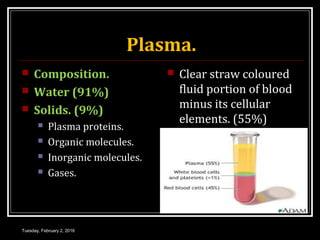
 Clear straw coloured
fluid portion of blood
minus its cellular
elements. (55%)
Tuesday, February 2, 2016
Solids. (9%)
 Plasma proteins – 7%
 Normal range – 6.4-8.3gm%
 Albumin, globulin, fibrinogen
& others.
 Organic molecules
 Carbohydrates
 Fats
 Non-protein nitrogenous
substances
 Hormones.
 Inorganic
substances – 1%
 Na, K, Ca, Mg, Cl, I, Fe,
P & Cu.
 Gases.
 Oxygen, Co2 & N.
Tuesday, February 2, 2016
Serum.
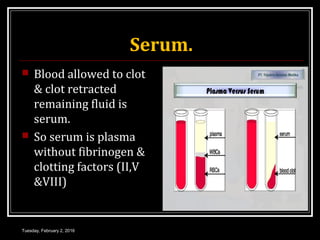
 Blood allowed to clot
& clot retracted
remaining fluid is
serum.
 So serum is plasma
without fibrinogen &
clotting factors (II,V
&VIII)
Tuesday, February 2, 2016
Classification of plasma
proteins.
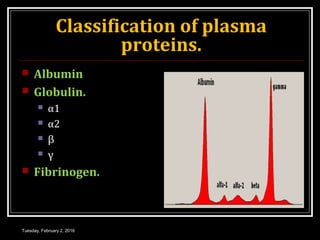
 Albumin
 Globulin.
 α1
 α2
 β
 γ
 Fibrinogen.
Tuesday, February 2, 2016
Methods of separation.
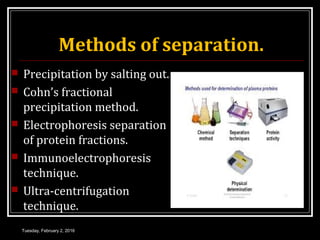
 Precipitation by salting out.
 Cohn’s fractional
precipitation method.
 Electrophoresis separation
of protein fractions.
 Immunoelectrophoresis
technique.
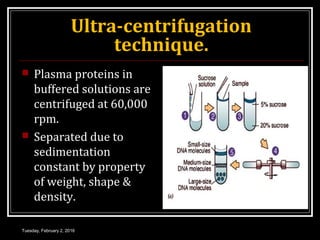
 Ultra-centrifugation
technique.
Tuesday, February 2, 2016
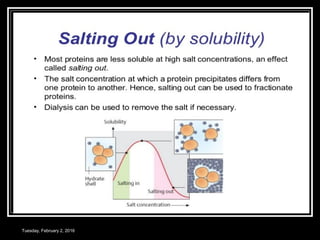
Precipitation by salting out.
 By sodium sulphate
solution.
 By Howe (1922).
 3 major fractions
 Fibrinogen – removed with
clot converting plasma into
serum.
 Globulins – by 22% Na2so4
 Albumin –m remains in
serum.
 By ammonium
sulphate solution.
 Albumin precipitated
by full saturation.
 Globulin – by half
saturation.
 Fibrinogen by one-
fifth saturation.
Tuesday, February 2, 2016
Cohn’s fractional precipitation
method.
 Ethanol solution with
different conc. at
lower temp is used to
fractionalize plasma
proteins
 Fraction I – rich in fibrinogen.
 Fraction II- gamma globulins.
 Fraction III – alpha & beta
globulin with isoagglutinin &
prothrombin.
 Fraction IV - alpha & beta
globulin.
 Fraction V – rich in albumin.
Tuesday, February 2, 2016
Electrophoresis separation of
protein fractions.
 It separate plasma proteins
into different fractions due to
electric charges of each
fractions.
 Clinical use –
 To know presence of abnormal
proteins
 Absence of normal proteins
 Change in relative conc. of
different proteins
 Techniques – (FPAC)
 Free boundary
electrophoresis.
 Paper electrophoresis.
 Agar gel
electrophoresis.
 Cellulose strip
electrophoresis.
Tuesday, February 2, 2016
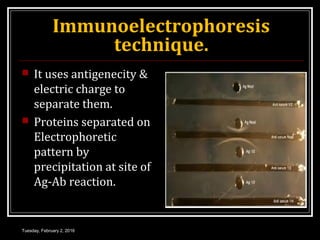
Immunoelectrophoresis
technique.
 It uses antigenecity &
electric charge to
separate them.
 Proteins separated on
Electrophoretic
pattern by
precipitation at site of
Ag-Ab reaction.
Tuesday, February 2, 2016
Ultra-centrifugation
technique.
 Plasma proteins in
buffered solutions are
centrifuged at 60,000
rpm.
 Separated due to
sedimentation
constant by property
of weight, shape &
density.
Tuesday, February 2, 2016
Properties of plasma proteins.
 Molecular weight.
 Osmotic pressure.
 Specific gravity.
 Isoelectric point.
 Electrophoretic
mobility.
 Precipitation by salts.
 Water solubility.
 Amphoteric nature.
Tuesday, February 2, 2016
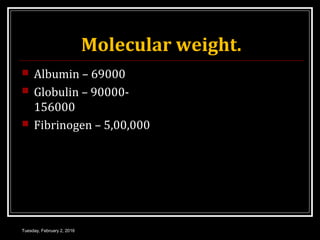
Molecular weight.
 Albumin – 69000
 Globulin – 90000-
156000
 Fibrinogen – 5,00,000
Tuesday, February 2, 2016
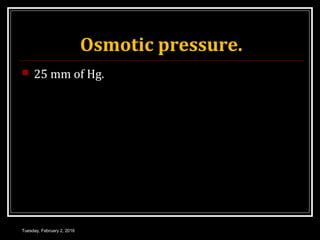
Osmotic pressure.
 25 mm of Hg.
Tuesday, February 2, 2016
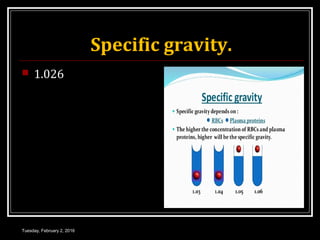
Specific gravity.
 1.026
Tuesday, February 2, 2016
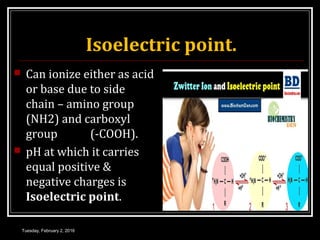
Isoelectric point.
 Can ionize either as acid
or base due to side
chain – amino group
(NH2) and carboxyl
group (-COOH).
 pH at which it carries
equal positive &
negative charges is
Isoelectric point.
Tuesday, February 2, 2016
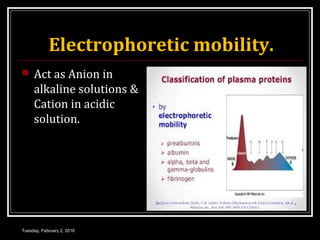
Electrophoretic mobility.
 Act as Anion in
alkaline solutions &
Cation in acidic
solution.
Tuesday, February 2, 2016
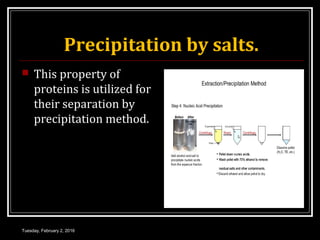
Precipitation by salts.
 This property of
proteins is utilized for
their separation by
precipitation method.
Tuesday, February 2, 2016
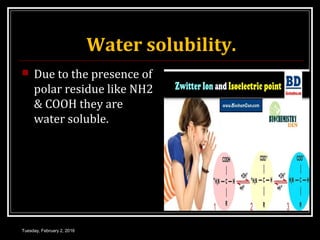
Water solubility.
 Due to the presence of
polar residue like NH2
& COOH they are
water soluble.
Tuesday, February 2, 2016
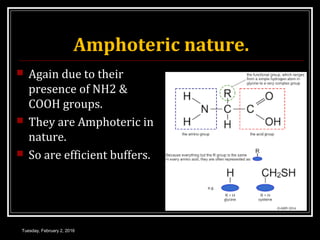
Amphoteric nature.
 Again due to their
presence of NH2 &
COOH groups.
 They are Amphoteric in
nature.
 So are efficient buffers.
Tuesday, February 2, 2016
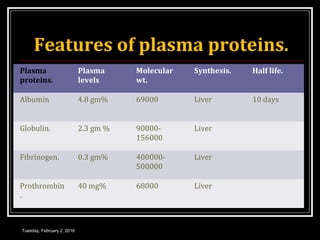
Features of plasma proteins.
Plasma
proteins.
Plasma
levels
Molecular
wt.
Synthesis. Half life.
Albumin 4.8 gm% 69000 Liver 10 days
Globulin. 2.3 gm % 90000-
156000
Liver
Fibrinogen. 0.3 gm% 400000-
500000
Liver
Prothrombin
.
40 mg% 68000 Liver
Tuesday, February 2, 2016
Different forms of Globulins.
 Ceruloplasmin.
 Fetunin.
 Glycoprotein.
 Haptoglobulin.
 Angiotensinogen.
 Transferrine.
 Immunoglobulin.
 Lipoproteins.
 Haemagglutinins.
Tuesday, February 2, 2016
Functions of Plasma Proteins.
 Suspension stability of
blood.
 Fibrinolytic function.
 Osmotic pressure.
 Blood viscosity.
 Coagulation of blood.
 Defense mechanism of
body.
 Transport function.
 Reserve proteins.
 Acid base balance of
the body.
 Nourishment of tissue
cells.
 Genetic information
Tuesday, February 2, 2016
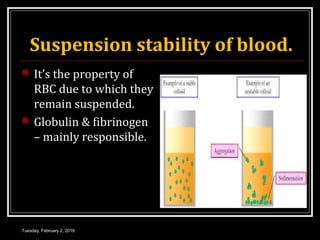
Suspension stability of blood.
 It’s the property of
RBC due to which they
remain suspended.
 Globulin & fibrinogen
– mainly responsible.
Tuesday, February 2, 2016
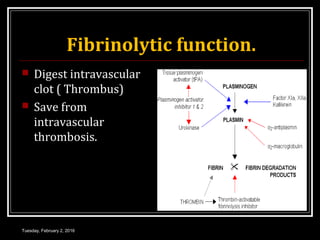
Fibrinolytic function.
 Digest intravascular
clot ( Thrombus)
 Save from
intravascular
thrombosis.
Tuesday, February 2, 2016
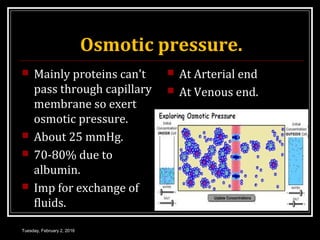
Osmotic pressure.
 Mainly proteins can't
pass through capillary
membrane so exert
osmotic pressure.
 About 25 mmHg.
 70-80% due to
albumin.
 Imp for exchange of
fluids.
 At Arterial end
 At Venous end.
Tuesday, February 2, 2016
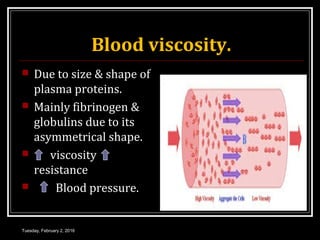
Blood viscosity.
 Due to size & shape of
plasma proteins.
 Mainly fibrinogen &
globulins due to its
asymmetrical shape.
 viscosity
resistance
 Blood pressure.
Tuesday, February 2, 2016
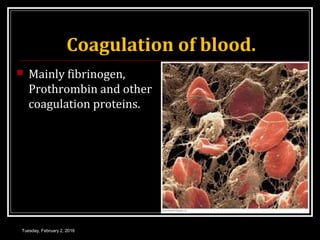
Coagulation of blood.
 Mainly fibrinogen,
Prothrombin and other
coagulation proteins.
Tuesday, February 2, 2016
Defense mechanism of body.
 Mainly gamma
globulins against
microorganisms.
Tuesday, February 2, 2016
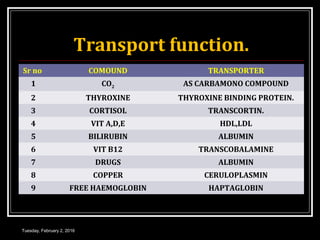
Transport function.
Sr no COMOUND TRANSPORTER
1 CO2 AS CARBAMONO COMPOUND
2 THYROXINE THYROXINE BINDING PROTEIN.
3 CORTISOL TRANSCORTIN.
4 VIT A,D,E HDL,LDL
5 BILIRUBIN ALBUMIN
6 VIT B12 TRANSCOBALAMINE
7 DRUGS ALBUMIN
8 COPPER CERULOPLASMIN
9 FREE HAEMOGLOBIN HAPTAGLOBIN
Tuesday, February 2, 2016
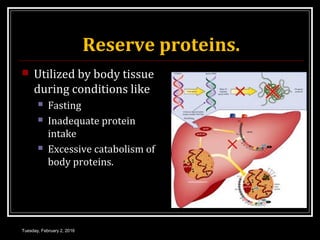
Reserve proteins.
 Utilized by body tissue
during conditions like
 Fasting
 Inadequate protein
intake
 Excessive catabolism of
body proteins.
Tuesday, February 2, 2016
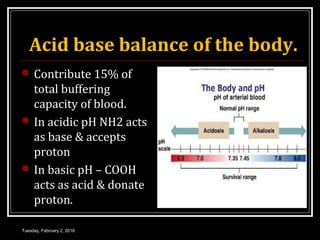
Acid base balance of the body.
 Contribute 15% of
total buffering
capacity of blood.
 In acidic pH NH2 acts
as base & accepts
proton
 In basic pH – COOH
acts as acid & donate
proton.
Tuesday, February 2, 2016
Nourishment of tissue cells.
 Plasma proteins used
by WBC to produce
substances known as
Trephones or Carrel.
 Essential for
nourishment of tissue
cells.
Tuesday, February 2, 2016
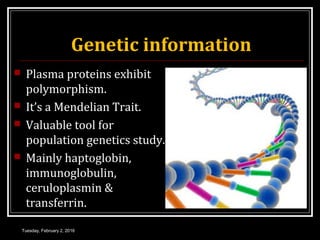
Genetic information
 Plasma proteins exhibit
polymorphism.
 It’s a Mendelian Trait.
 Valuable tool for
population genetics study.
 Mainly haptoglobin,
immunoglobulin,
ceruloplasmin &
transferrin.
Tuesday, February 2, 2016
Synthesis of plasma proteins.
 Site.
 In embryo – Mesenchymal cells.
 In Adult –
 Albumin & Fibrinogen by retculoendothelia cells of liver.
 Alpha & beta globulins by liver, spleen & bone marrow.
 Gamma by B Lymphocytes.
Tuesday, February 2, 2016
Factors affecting Synthesis of
plasma proteins.
 Dietary proteins.
 Relationship between dietary proteins & plasma
proteins is studied by “Whipple” by experiment
called “Plasmapheresis”.
Tuesday, February 2, 2016
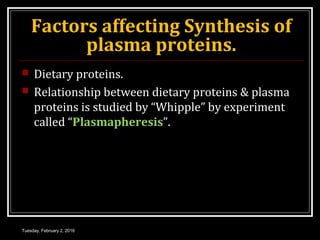
Plasmapheresis.
 Dog made
hypoproteinemic by
repeatedly withdrawing
blood & reinjecting
cellular elements.(in
Ringer Locke RL) till
protein 4gm/100ml.
 Then different standard
diets are given
Tuesday, February 2, 2016
Conclusions.
 Dietary proteins – essential.
 Chemical resemblance – determine efficacy.
 Essential amino acids – must for synthesis.
 Dietary proteins of animal origin – favors
albumin synthesis.
Tuesday, February 2, 2016
Conclusions.(cont….)
 Dietary proteins of plant origin - Globulin
synthesis.
 Regeneration period – 14 days.
 Rate of regeneration – very fast within first 24
hrs.
Tuesday, February 2, 2016
Other factors.
 Presence of infection. –
reduces plasma protein
synthesis.
 Exposure to antigen –
stimulate formation of
antibodies.
 Inflammatory
conditions – promotes.
 Colloid oncotic pressure
affects albumin synthesis.
 Interleukin I by
activated
macrophages
stimulate synthesis.
 Prostaglandins –
increases acute phase
proteins.
Tuesday, February 2, 2016
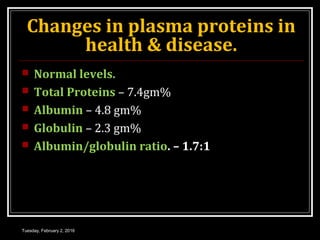
Changes in plasma proteins in
health & disease.
 Normal levels.
 Total Proteins – 7.4gm%
 Albumin – 4.8 gm%
 Globulin – 2.3 gm%
 Albumin/globulin ratio. – 1.7:1
Tuesday, February 2, 2016
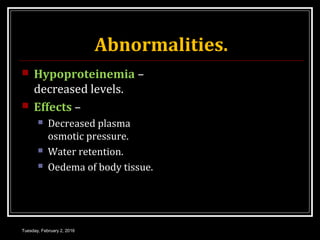
Abnormalities.
 Hypoproteinemia –
decreased levels.
 Effects –
 Decreased plasma
osmotic pressure.
 Water retention.
 Oedema of body tissue.
Tuesday, February 2, 2016
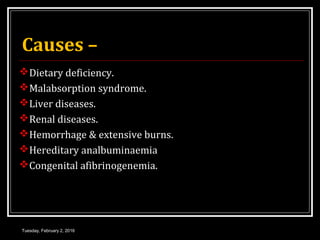
Causes –
Dietary deficiency.
Malabsorption syndrome.
Liver diseases.
Renal diseases.
Hemorrhage & extensive burns.
Hereditary analbuminaemia
Congenital afibrinogenemia.
Tuesday, February 2, 2016
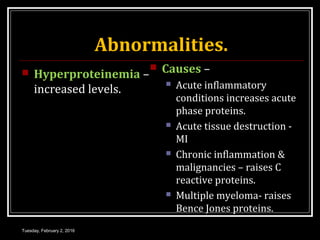
Abnormalities.
 Hyperproteinemia –
increased levels.
 Causes –
 Acute inflammatory
conditions increases acute
phase proteins.
 Acute tissue destruction -
MI
 Chronic inflammation &
malignancies – raises C
reactive proteins.
 Multiple myeloma- raises
Bence Jones proteins.
Tuesday, February 2, 2016
Reversal of normal A:G ratio.
 Normal ratio 1.7:1
 Reversed in
 Liver diseases as albumin synthesis decreases.
 Hypoproteinemia as globulin levels increases.
Tuesday, February 2, 2016
Thank
You

Plasma proteins

  • 1.
    DR NILESH KATE MBBS,MD ASSOCIATEPROF DEPT. OF PHYSIOLOGY PLASMA PROTEINS.
  • 2.
    OBJECTIVES  Plasma  Composition serum  Plasma proteins.  Classification  Methods of separation.  Properties.  Features.  Functions.  Synthesis  Changes in health and diseases. Tuesday, February 2, 2016
  • 3.
    Plasma.  Composition.  Water(91%)  Solids. (9%)  Plasma proteins.  Organic molecules.  Inorganic molecules.  Gases.  Clear straw coloured fluid portion of blood minus its cellular elements. (55%) Tuesday, February 2, 2016
  • 4.
    Solids. (9%)  Plasmaproteins – 7%  Normal range – 6.4-8.3gm%  Albumin, globulin, fibrinogen & others.  Organic molecules  Carbohydrates  Fats  Non-protein nitrogenous substances  Hormones.  Inorganic substances – 1%  Na, K, Ca, Mg, Cl, I, Fe, P & Cu.  Gases.  Oxygen, Co2 & N. Tuesday, February 2, 2016
  • 5.
    Serum.  Blood allowedto clot & clot retracted remaining fluid is serum.  So serum is plasma without fibrinogen & clotting factors (II,V &VIII) Tuesday, February 2, 2016
  • 6.
    Classification of plasma proteins. Albumin  Globulin.  α1  α2  β  γ  Fibrinogen. Tuesday, February 2, 2016
  • 7.
    Methods of separation. Precipitation by salting out.  Cohn’s fractional precipitation method.  Electrophoresis separation of protein fractions.  Immunoelectrophoresis technique.  Ultra-centrifugation technique. Tuesday, February 2, 2016
  • 8.
    Precipitation by saltingout.  By sodium sulphate solution.  By Howe (1922).  3 major fractions  Fibrinogen – removed with clot converting plasma into serum.  Globulins – by 22% Na2so4  Albumin –m remains in serum.  By ammonium sulphate solution.  Albumin precipitated by full saturation.  Globulin – by half saturation.  Fibrinogen by one- fifth saturation. Tuesday, February 2, 2016
  • 9.
  • 10.
    Cohn’s fractional precipitation method. Ethanol solution with different conc. at lower temp is used to fractionalize plasma proteins  Fraction I – rich in fibrinogen.  Fraction II- gamma globulins.  Fraction III – alpha & beta globulin with isoagglutinin & prothrombin.  Fraction IV - alpha & beta globulin.  Fraction V – rich in albumin. Tuesday, February 2, 2016
  • 11.
    Electrophoresis separation of proteinfractions.  It separate plasma proteins into different fractions due to electric charges of each fractions.  Clinical use –  To know presence of abnormal proteins  Absence of normal proteins  Change in relative conc. of different proteins  Techniques – (FPAC)  Free boundary electrophoresis.  Paper electrophoresis.  Agar gel electrophoresis.  Cellulose strip electrophoresis. Tuesday, February 2, 2016
  • 12.
    Immunoelectrophoresis technique.  It usesantigenecity & electric charge to separate them.  Proteins separated on Electrophoretic pattern by precipitation at site of Ag-Ab reaction. Tuesday, February 2, 2016
  • 13.
    Ultra-centrifugation technique.  Plasma proteinsin buffered solutions are centrifuged at 60,000 rpm.  Separated due to sedimentation constant by property of weight, shape & density. Tuesday, February 2, 2016
  • 14.
    Properties of plasmaproteins.  Molecular weight.  Osmotic pressure.  Specific gravity.  Isoelectric point.  Electrophoretic mobility.  Precipitation by salts.  Water solubility.  Amphoteric nature. Tuesday, February 2, 2016
  • 15.
    Molecular weight.  Albumin– 69000  Globulin – 90000- 156000  Fibrinogen – 5,00,000 Tuesday, February 2, 2016
  • 16.
    Osmotic pressure.  25mm of Hg. Tuesday, February 2, 2016
  • 17.
  • 18.
    Isoelectric point.  Canionize either as acid or base due to side chain – amino group (NH2) and carboxyl group (-COOH).  pH at which it carries equal positive & negative charges is Isoelectric point. Tuesday, February 2, 2016
  • 19.
    Electrophoretic mobility.  Actas Anion in alkaline solutions & Cation in acidic solution. Tuesday, February 2, 2016
  • 20.
    Precipitation by salts. This property of proteins is utilized for their separation by precipitation method. Tuesday, February 2, 2016
  • 21.
    Water solubility.  Dueto the presence of polar residue like NH2 & COOH they are water soluble. Tuesday, February 2, 2016
  • 22.
    Amphoteric nature.  Againdue to their presence of NH2 & COOH groups.  They are Amphoteric in nature.  So are efficient buffers. Tuesday, February 2, 2016
  • 23.
    Features of plasmaproteins. Plasma proteins. Plasma levels Molecular wt. Synthesis. Half life. Albumin 4.8 gm% 69000 Liver 10 days Globulin. 2.3 gm % 90000- 156000 Liver Fibrinogen. 0.3 gm% 400000- 500000 Liver Prothrombin . 40 mg% 68000 Liver Tuesday, February 2, 2016
  • 24.
    Different forms ofGlobulins.  Ceruloplasmin.  Fetunin.  Glycoprotein.  Haptoglobulin.  Angiotensinogen.  Transferrine.  Immunoglobulin.  Lipoproteins.  Haemagglutinins. Tuesday, February 2, 2016
  • 25.
    Functions of PlasmaProteins.  Suspension stability of blood.  Fibrinolytic function.  Osmotic pressure.  Blood viscosity.  Coagulation of blood.  Defense mechanism of body.  Transport function.  Reserve proteins.  Acid base balance of the body.  Nourishment of tissue cells.  Genetic information Tuesday, February 2, 2016
  • 26.
    Suspension stability ofblood.  It’s the property of RBC due to which they remain suspended.  Globulin & fibrinogen – mainly responsible. Tuesday, February 2, 2016
  • 27.
    Fibrinolytic function.  Digestintravascular clot ( Thrombus)  Save from intravascular thrombosis. Tuesday, February 2, 2016
  • 28.
    Osmotic pressure.  Mainlyproteins can't pass through capillary membrane so exert osmotic pressure.  About 25 mmHg.  70-80% due to albumin.  Imp for exchange of fluids.  At Arterial end  At Venous end. Tuesday, February 2, 2016
  • 29.
    Blood viscosity.  Dueto size & shape of plasma proteins.  Mainly fibrinogen & globulins due to its asymmetrical shape.  viscosity resistance  Blood pressure. Tuesday, February 2, 2016
  • 30.
    Coagulation of blood. Mainly fibrinogen, Prothrombin and other coagulation proteins. Tuesday, February 2, 2016
  • 31.
    Defense mechanism ofbody.  Mainly gamma globulins against microorganisms. Tuesday, February 2, 2016
  • 32.
    Transport function. Sr noCOMOUND TRANSPORTER 1 CO2 AS CARBAMONO COMPOUND 2 THYROXINE THYROXINE BINDING PROTEIN. 3 CORTISOL TRANSCORTIN. 4 VIT A,D,E HDL,LDL 5 BILIRUBIN ALBUMIN 6 VIT B12 TRANSCOBALAMINE 7 DRUGS ALBUMIN 8 COPPER CERULOPLASMIN 9 FREE HAEMOGLOBIN HAPTAGLOBIN Tuesday, February 2, 2016
  • 33.
    Reserve proteins.  Utilizedby body tissue during conditions like  Fasting  Inadequate protein intake  Excessive catabolism of body proteins. Tuesday, February 2, 2016
  • 34.
    Acid base balanceof the body.  Contribute 15% of total buffering capacity of blood.  In acidic pH NH2 acts as base & accepts proton  In basic pH – COOH acts as acid & donate proton. Tuesday, February 2, 2016
  • 35.
    Nourishment of tissuecells.  Plasma proteins used by WBC to produce substances known as Trephones or Carrel.  Essential for nourishment of tissue cells. Tuesday, February 2, 2016
  • 36.
    Genetic information  Plasmaproteins exhibit polymorphism.  It’s a Mendelian Trait.  Valuable tool for population genetics study.  Mainly haptoglobin, immunoglobulin, ceruloplasmin & transferrin. Tuesday, February 2, 2016
  • 37.
    Synthesis of plasmaproteins.  Site.  In embryo – Mesenchymal cells.  In Adult –  Albumin & Fibrinogen by retculoendothelia cells of liver.  Alpha & beta globulins by liver, spleen & bone marrow.  Gamma by B Lymphocytes. Tuesday, February 2, 2016
  • 38.
    Factors affecting Synthesisof plasma proteins.  Dietary proteins.  Relationship between dietary proteins & plasma proteins is studied by “Whipple” by experiment called “Plasmapheresis”. Tuesday, February 2, 2016
  • 39.
    Plasmapheresis.  Dog made hypoproteinemicby repeatedly withdrawing blood & reinjecting cellular elements.(in Ringer Locke RL) till protein 4gm/100ml.  Then different standard diets are given Tuesday, February 2, 2016
  • 40.
    Conclusions.  Dietary proteins– essential.  Chemical resemblance – determine efficacy.  Essential amino acids – must for synthesis.  Dietary proteins of animal origin – favors albumin synthesis. Tuesday, February 2, 2016
  • 41.
    Conclusions.(cont….)  Dietary proteinsof plant origin - Globulin synthesis.  Regeneration period – 14 days.  Rate of regeneration – very fast within first 24 hrs. Tuesday, February 2, 2016
  • 42.
    Other factors.  Presenceof infection. – reduces plasma protein synthesis.  Exposure to antigen – stimulate formation of antibodies.  Inflammatory conditions – promotes.  Colloid oncotic pressure affects albumin synthesis.  Interleukin I by activated macrophages stimulate synthesis.  Prostaglandins – increases acute phase proteins. Tuesday, February 2, 2016
  • 43.
    Changes in plasmaproteins in health & disease.  Normal levels.  Total Proteins – 7.4gm%  Albumin – 4.8 gm%  Globulin – 2.3 gm%  Albumin/globulin ratio. – 1.7:1 Tuesday, February 2, 2016
  • 44.
    Abnormalities.  Hypoproteinemia – decreasedlevels.  Effects –  Decreased plasma osmotic pressure.  Water retention.  Oedema of body tissue. Tuesday, February 2, 2016
  • 45.
    Causes – Dietary deficiency. Malabsorptionsyndrome. Liver diseases. Renal diseases. Hemorrhage & extensive burns. Hereditary analbuminaemia Congenital afibrinogenemia. Tuesday, February 2, 2016
  • 46.
    Abnormalities.  Hyperproteinemia – increasedlevels.  Causes –  Acute inflammatory conditions increases acute phase proteins.  Acute tissue destruction - MI  Chronic inflammation & malignancies – raises C reactive proteins.  Multiple myeloma- raises Bence Jones proteins. Tuesday, February 2, 2016
  • 47.
    Reversal of normalA:G ratio.  Normal ratio 1.7:1  Reversed in  Liver diseases as albumin synthesis decreases.  Hypoproteinemia as globulin levels increases. Tuesday, February 2, 2016
  • 48.