Biochemistry for medics
www.namrata.co
3/25/2017 1Namrata Chhabra
NAMRATA CHHABRA,M.D.
Provide the monomer units from which the long
polypeptide chains of proteins are synthesized
3/25/2017 2Namrata Chhabra
 L-amino acids and their derivatives participate in cellular
functions as diverse as:
 Nerve transmission and the
 Biosynthesis of porphyrins,
 Purines, pyrimidines, and urea.
3/25/2017Namrata Chhabra 3
 Short polymers of amino acids called peptides perform
prominent roles in the neuroendocrine system as :
 hormones,
 hormone-releasing factors,
 neuromodulators, or
 neurotransmitters.
3/25/2017Namrata Chhabra 4
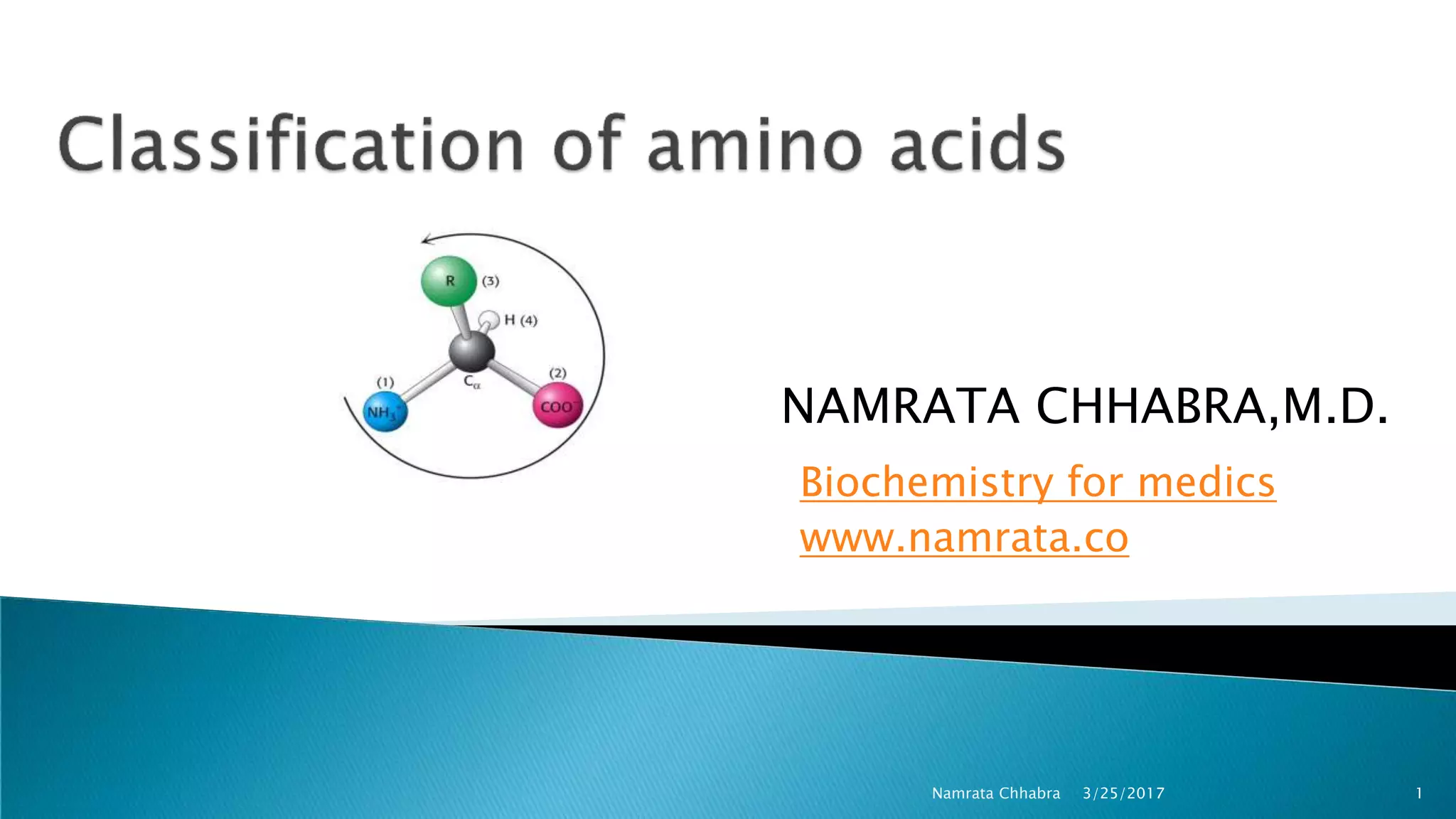
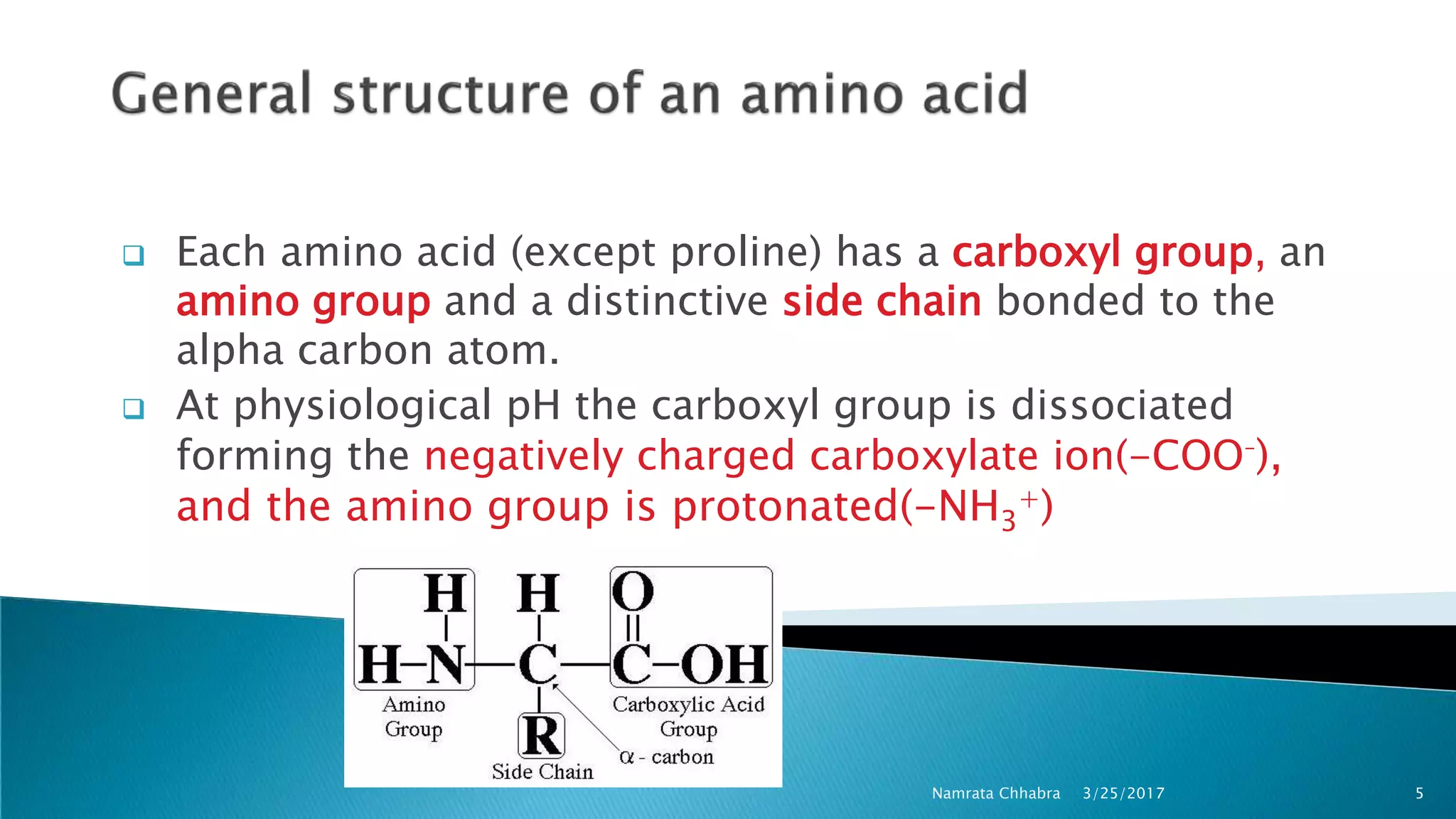
 Each amino acid (except proline) has a carboxyl group, an
amino group and a distinctive side chain bonded to the
alpha carbon atom.
 At physiological pH the carboxyl group is dissociated
forming the negatively charged carboxylate ion(-COO-
),
and the amino group is protonated(-NH3
+)
3/25/2017 5Namrata Chhabra
Amino acids can be classified in 4 ways:
1.Based on structure
2.Based on the side chain characters
3.Based on nutritional requirements
4.Based on metabolic fate
3/25/2017 6Namrata Chhabra
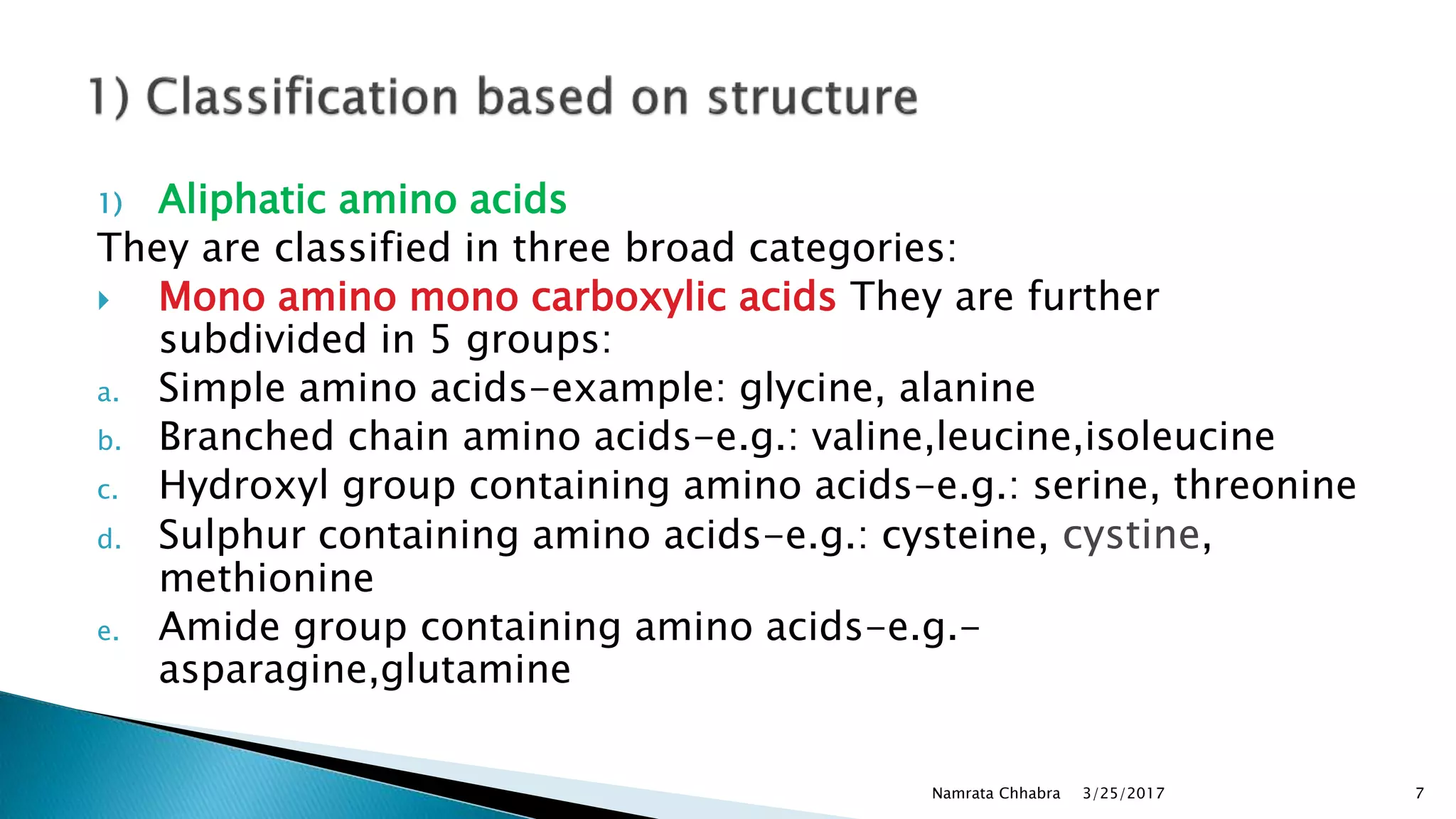
1) Aliphatic amino acids
They are classified in three broad categories:
 Mono amino mono carboxylic acids They are further
subdivided in 5 groups:
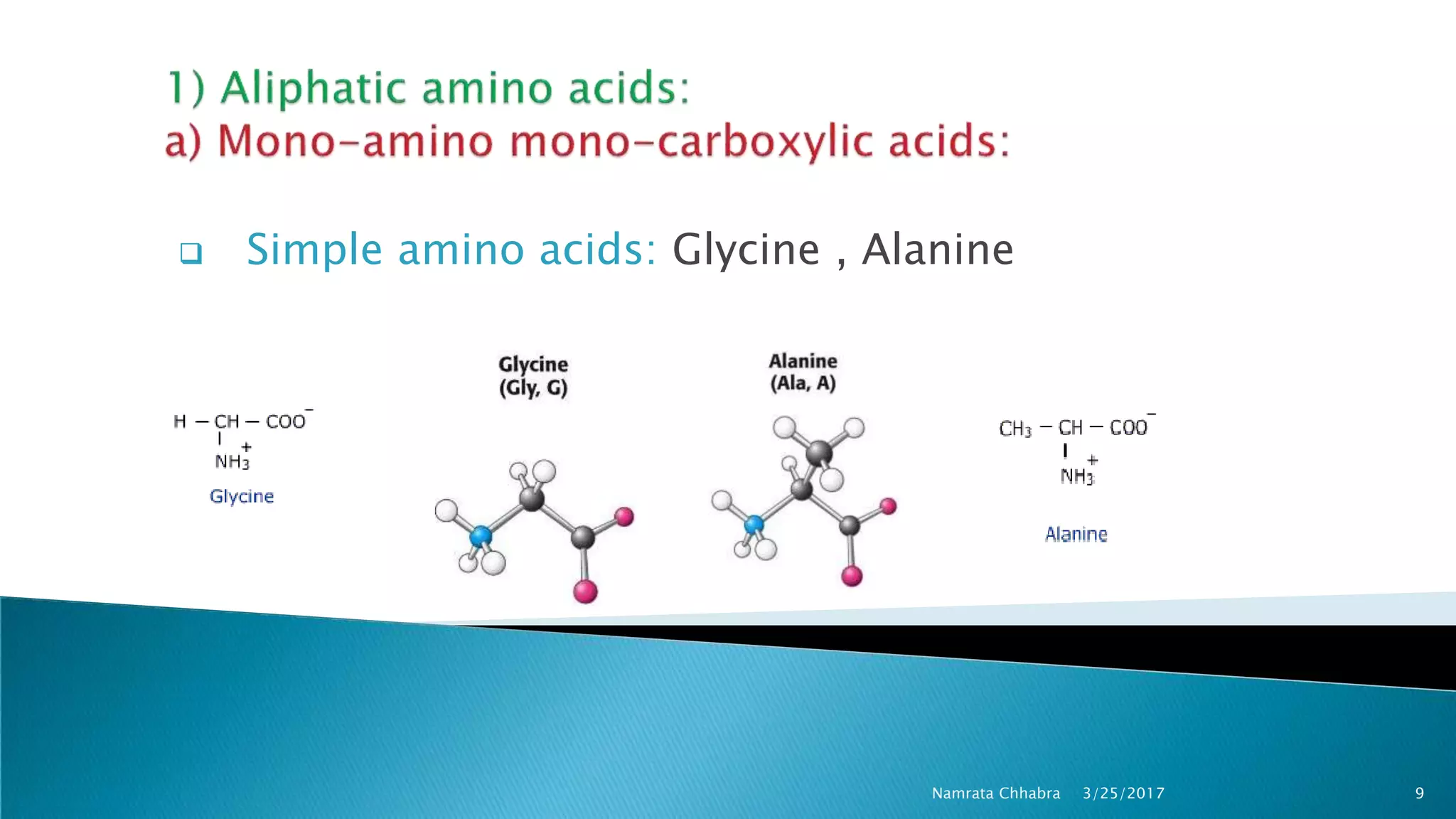
a. Simple amino acids-example: glycine, alanine
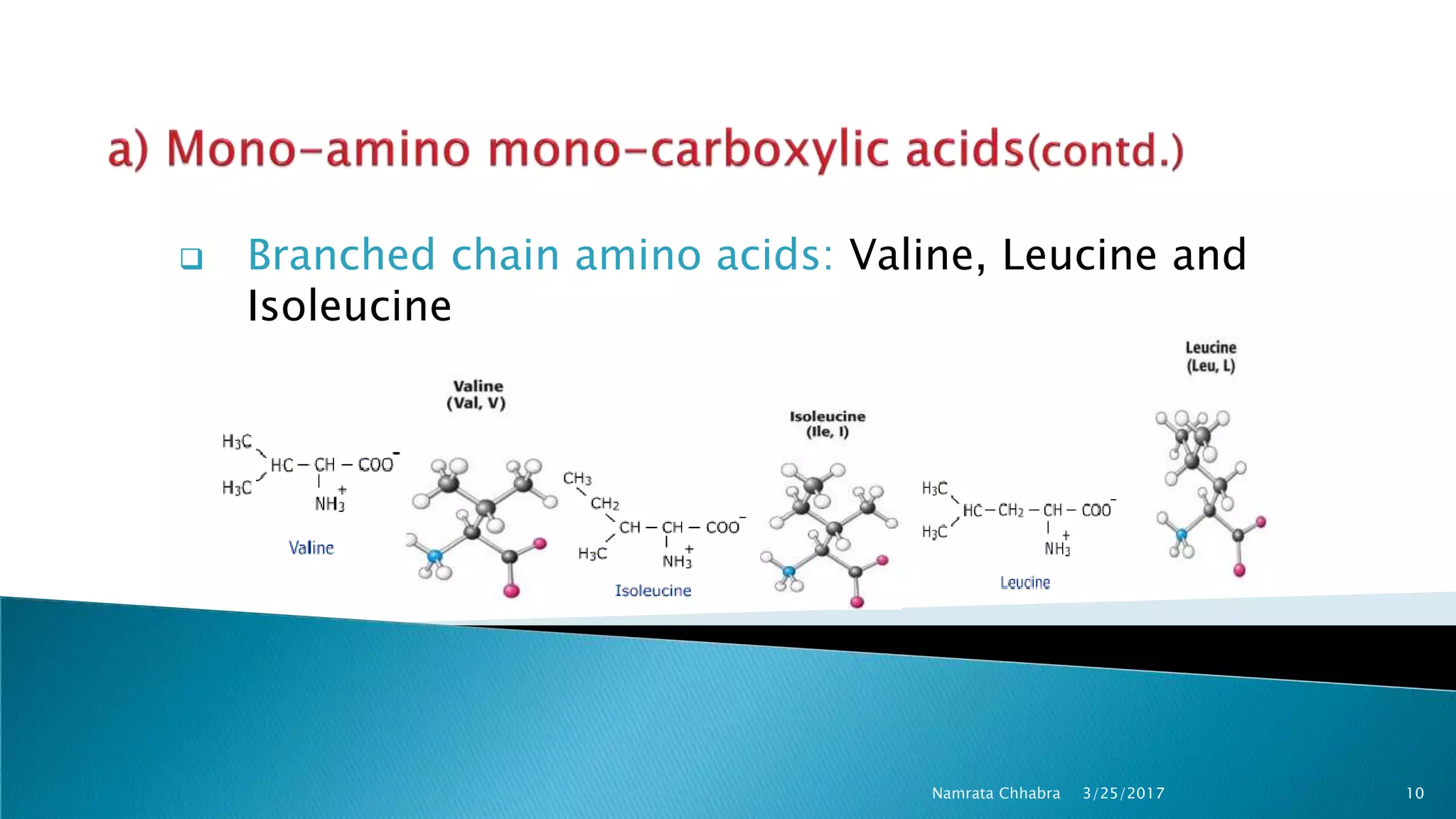
b. Branched chain amino acids-e.g.: valine,leucine,isoleucine
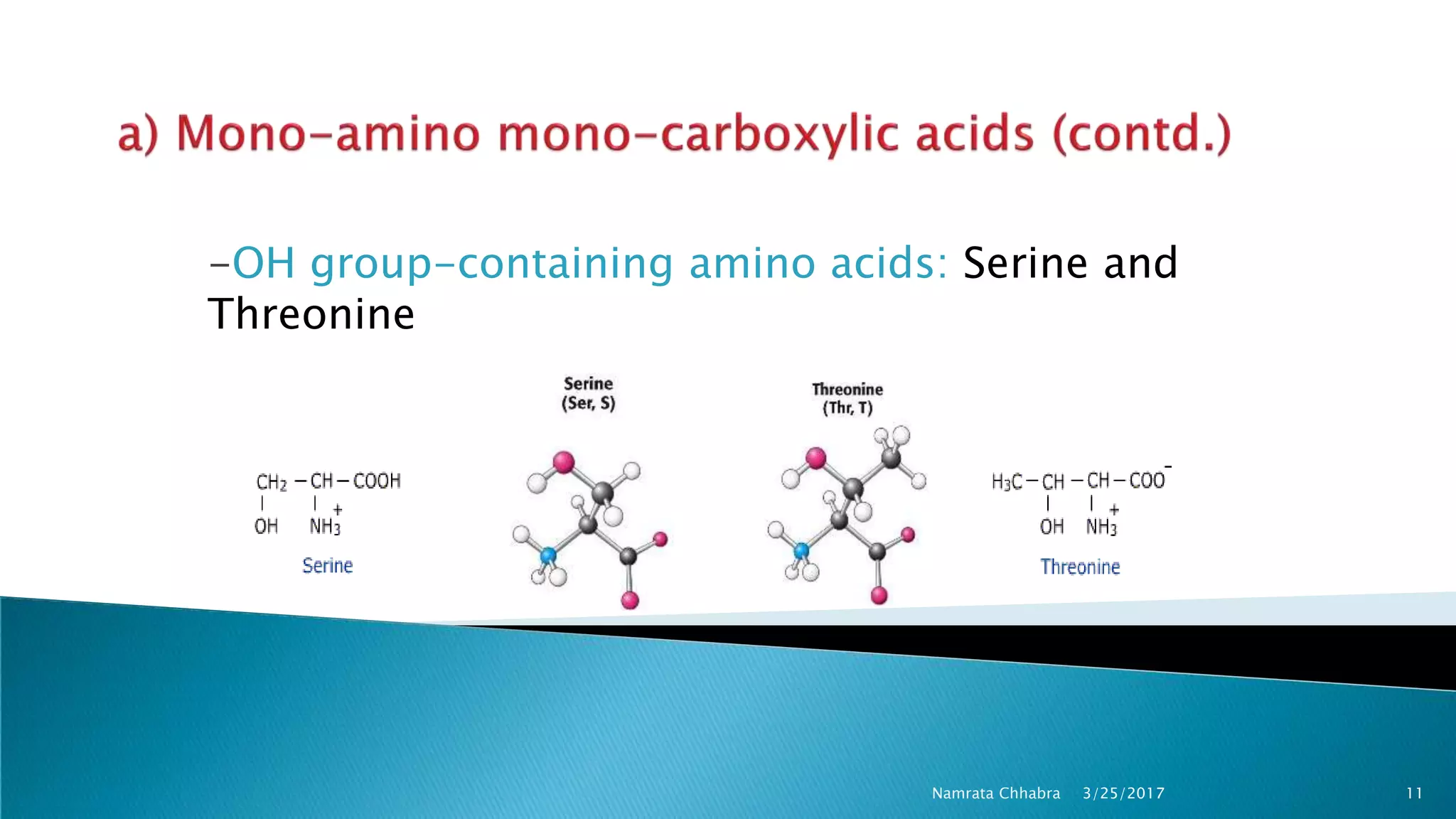
c. Hydroxyl group containing amino acids-e.g.: serine, threonine
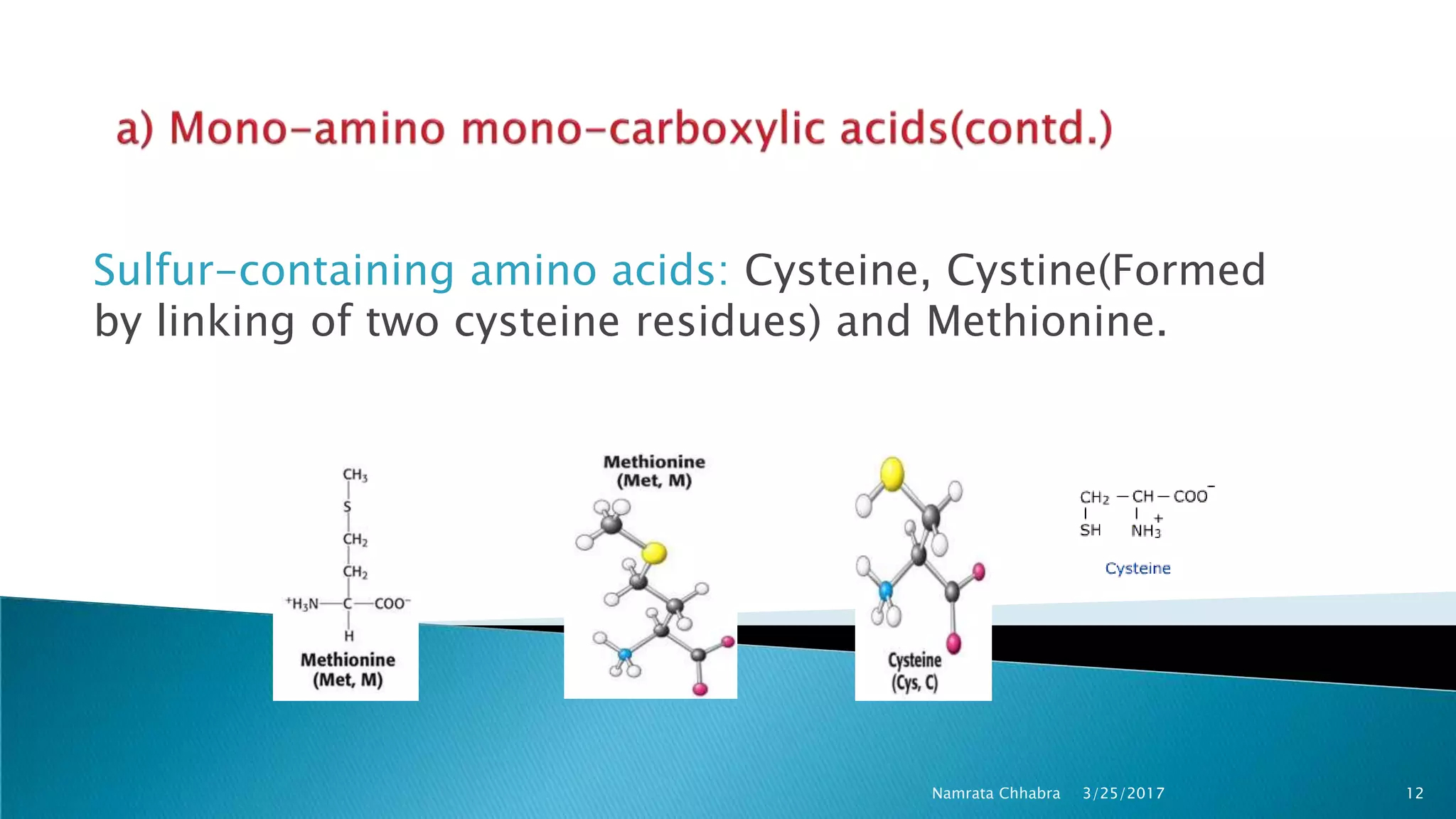
d. Sulphur containing amino acids-e.g.: cysteine, cystine,
methionine
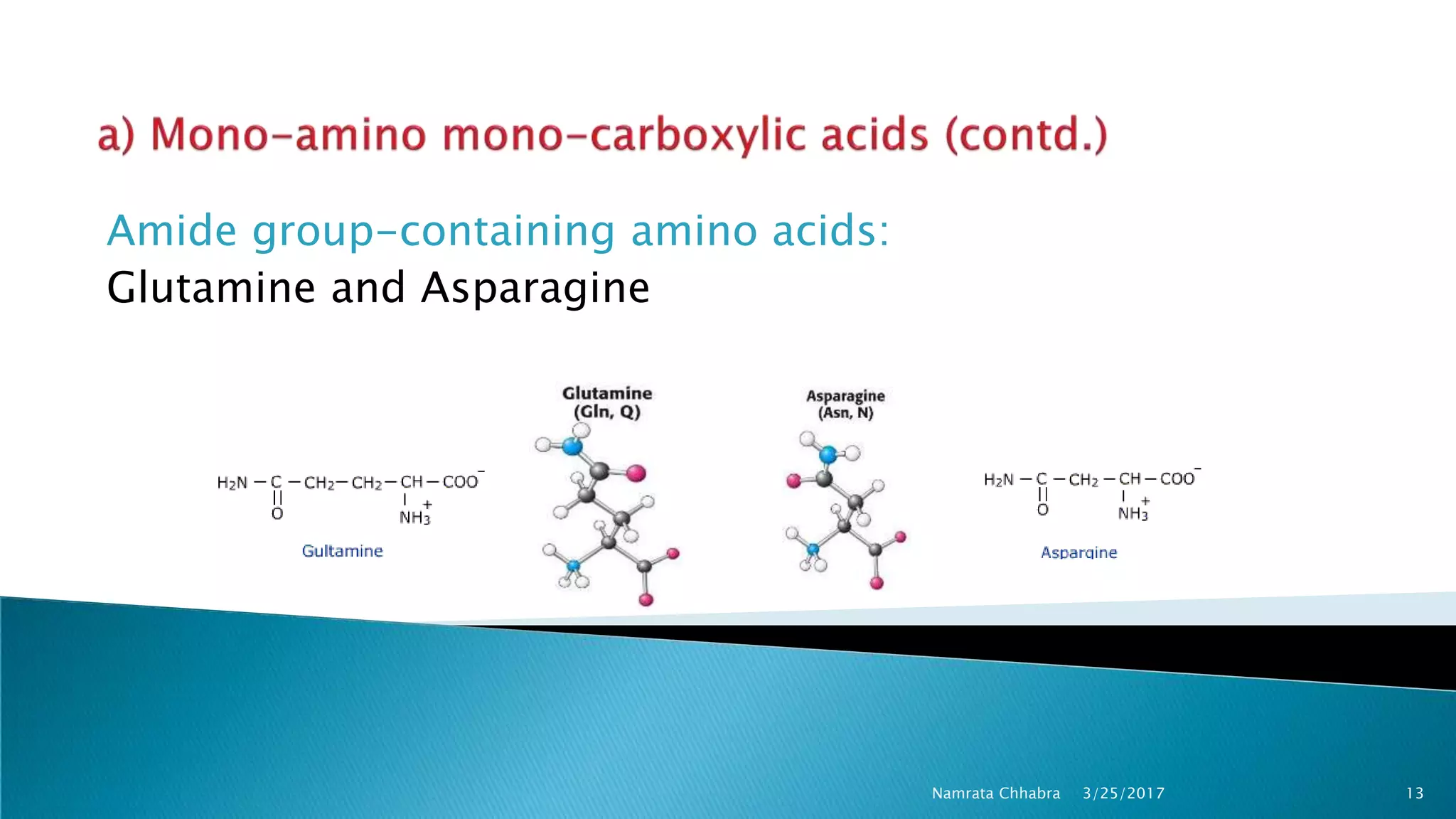
e. Amide group containing amino acids-e.g.-
asparagine,glutamine
3/25/2017Namrata Chhabra 7
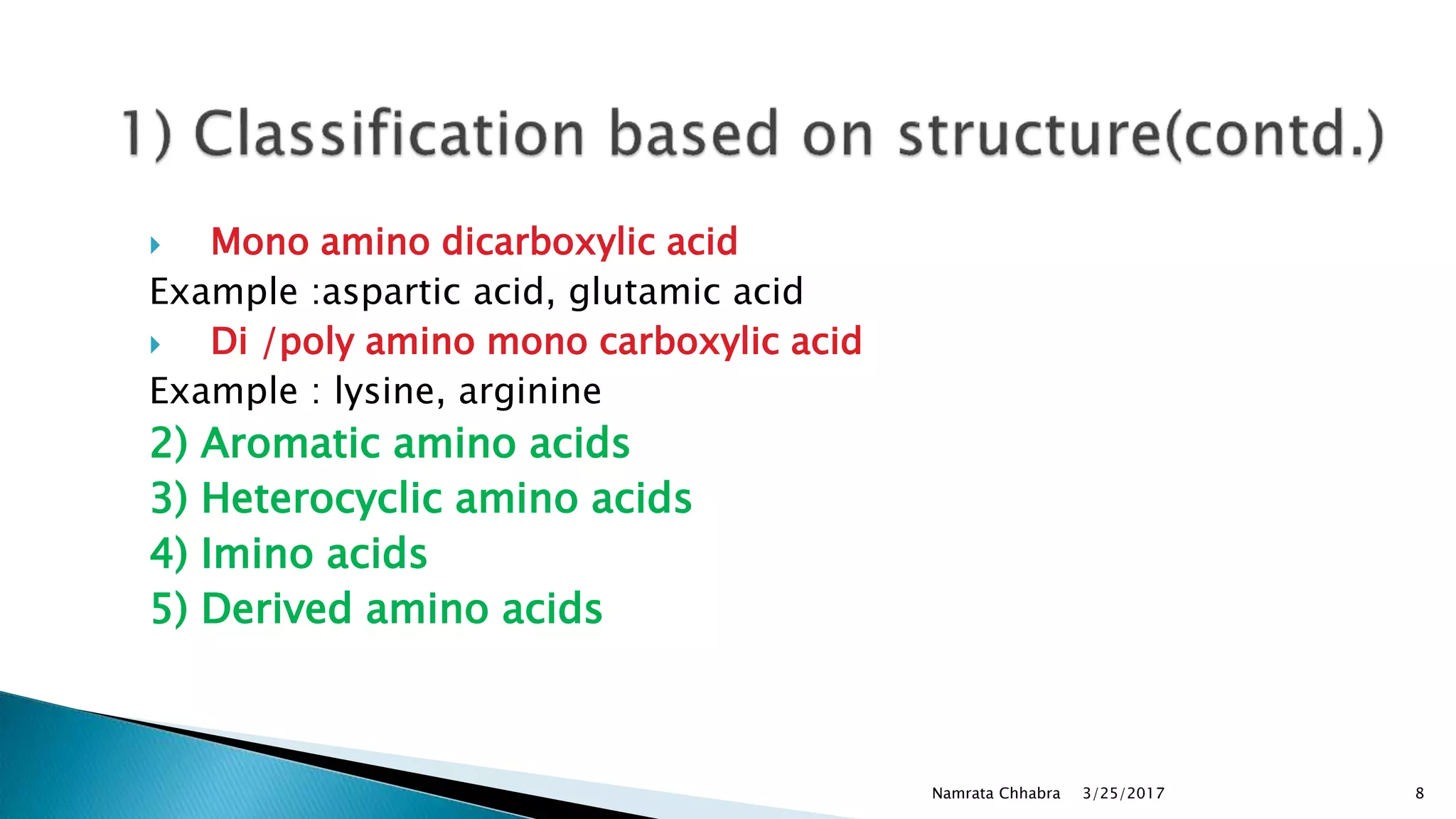
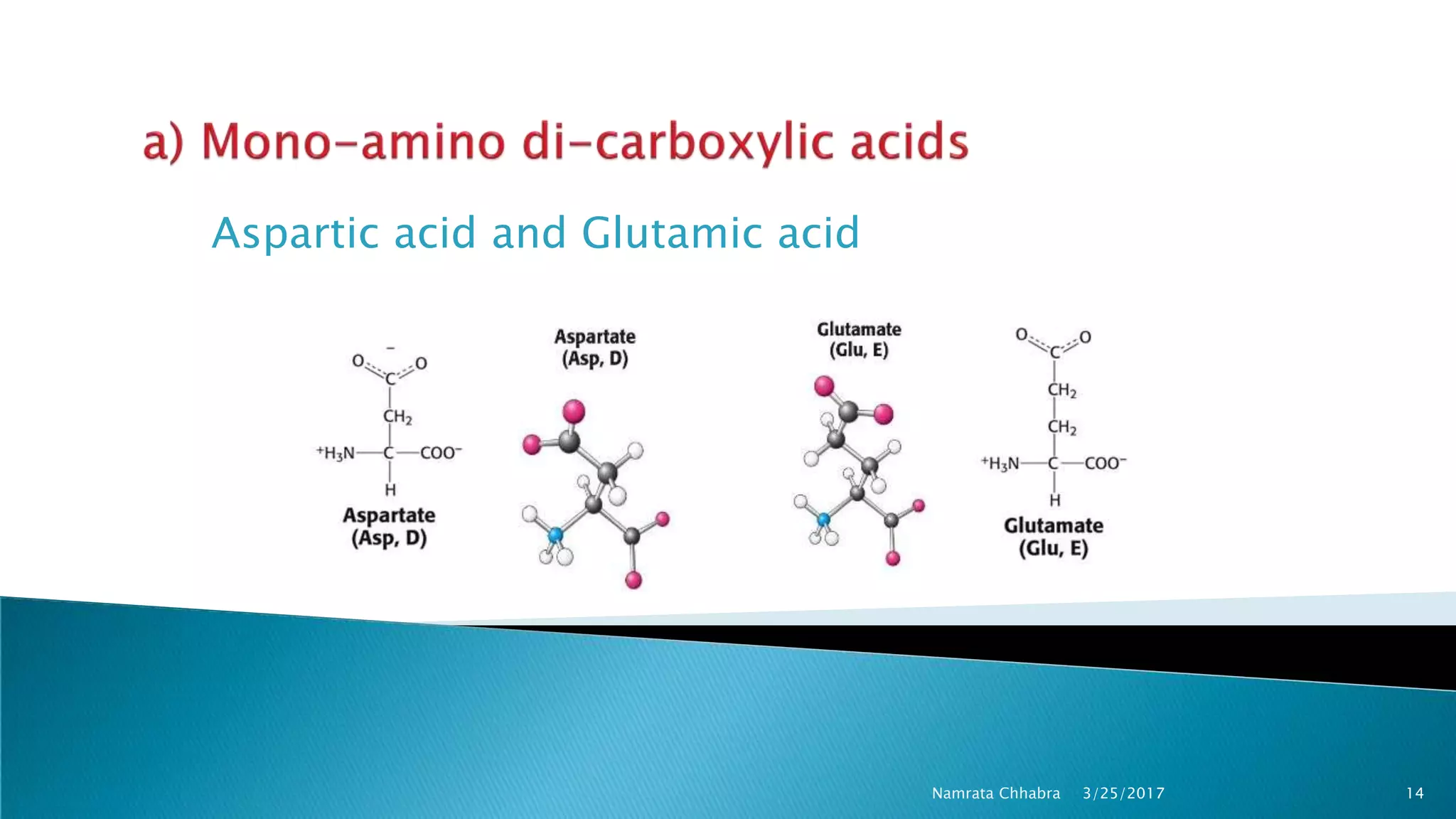
 Mono amino dicarboxylic acid
Example :aspartic acid, glutamic acid
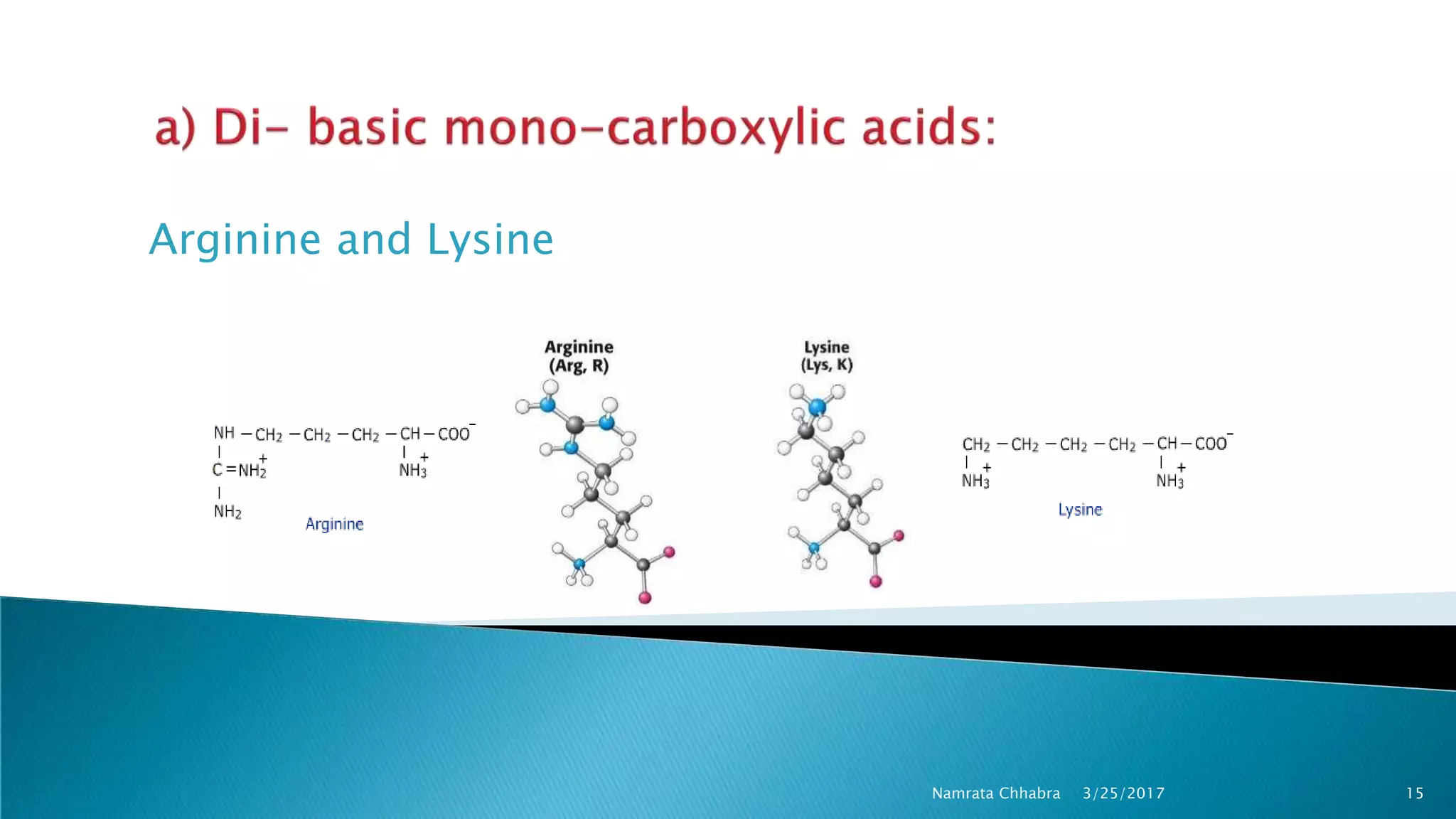
 Di /poly amino mono carboxylic acid
Example : lysine, arginine
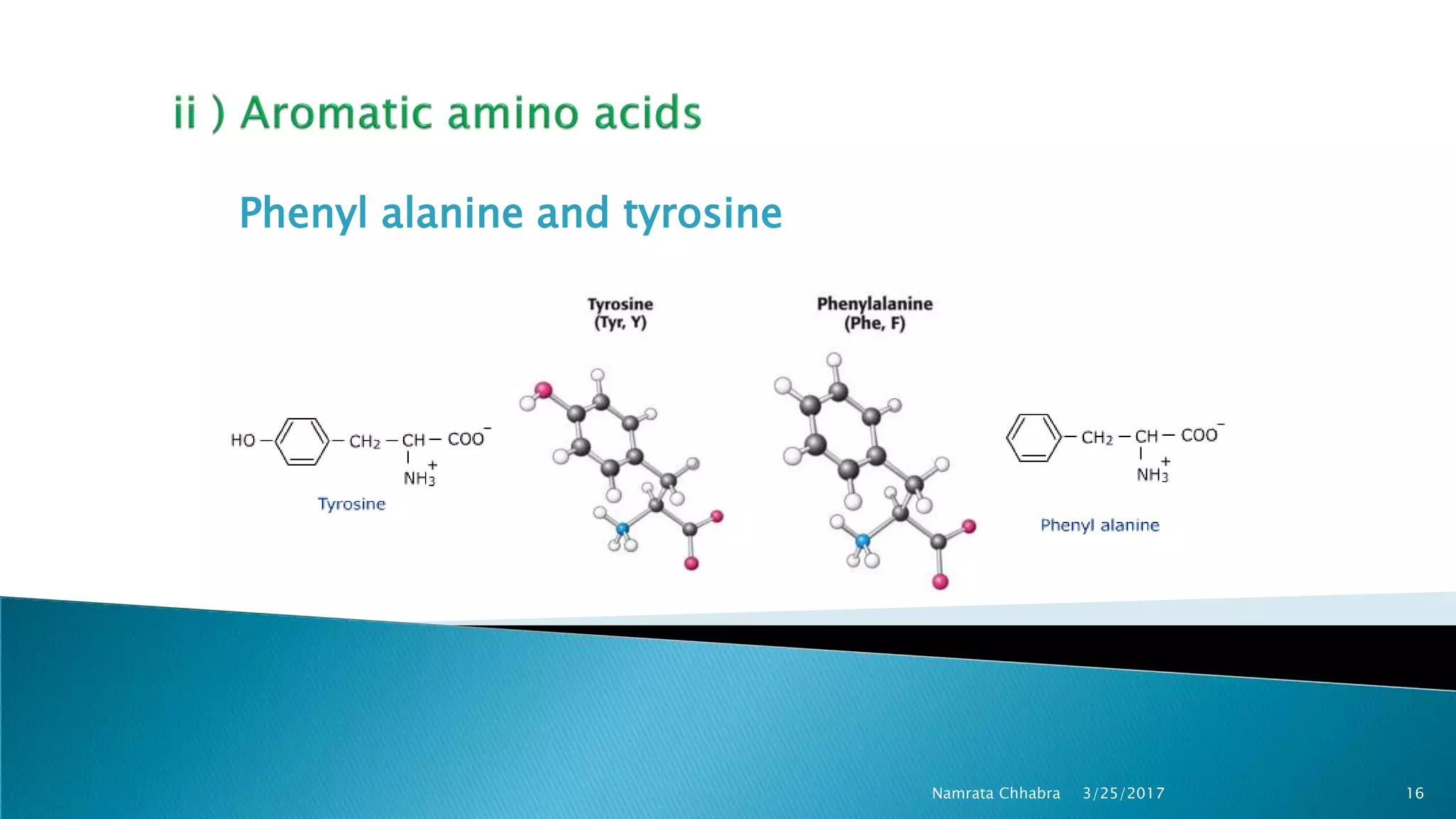
2) Aromatic amino acids
3) Heterocyclic amino acids
4) Imino acids
5) Derived amino acids
3/25/2017Namrata Chhabra 8
 Simple amino acids: Glycine , Alanine
3/25/2017 9Namrata Chhabra
 Branched chain amino acids: Valine, Leucine and
Isoleucine
3/25/2017 10Namrata Chhabra
-OH group-containing amino acids: Serine and
Threonine
3/25/2017 11Namrata Chhabra
Sulfur-containing amino acids: Cysteine, Cystine(Formed
by linking of two cysteine residues) and Methionine.
3/25/2017 12Namrata Chhabra
Amide group-containing amino acids:
Glutamine and Asparagine
3/25/2017 13Namrata Chhabra
Aspartic acid and Glutamic acid
3/25/2017 14Namrata Chhabra
Arginine and Lysine
3/25/2017 15Namrata Chhabra
Phenyl alanine and tyrosine
3/25/2017 16Namrata Chhabra
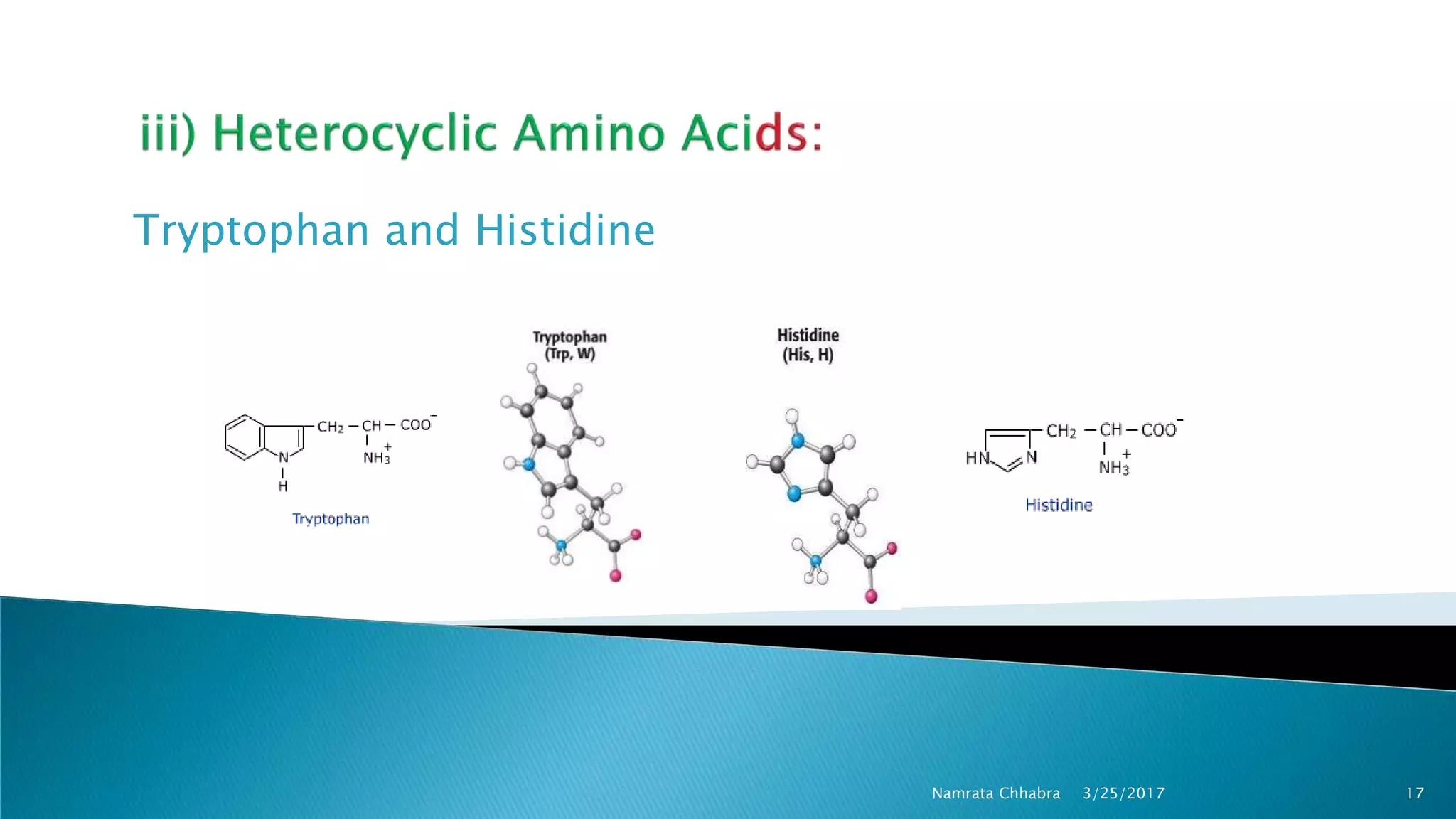
Tryptophan and Histidine
3/25/2017 17Namrata Chhabra
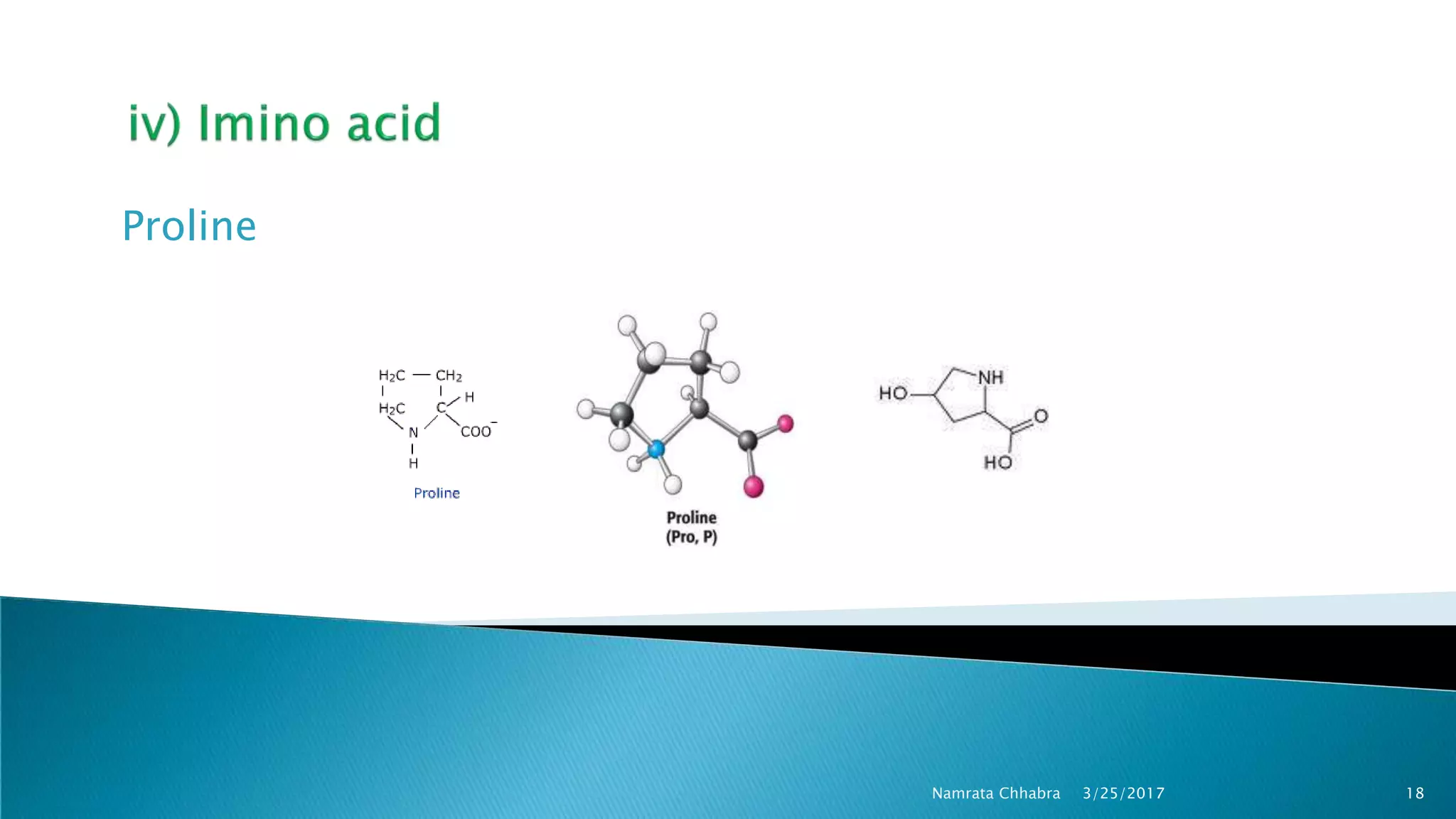
Proline
3/25/2017 18Namrata Chhabra
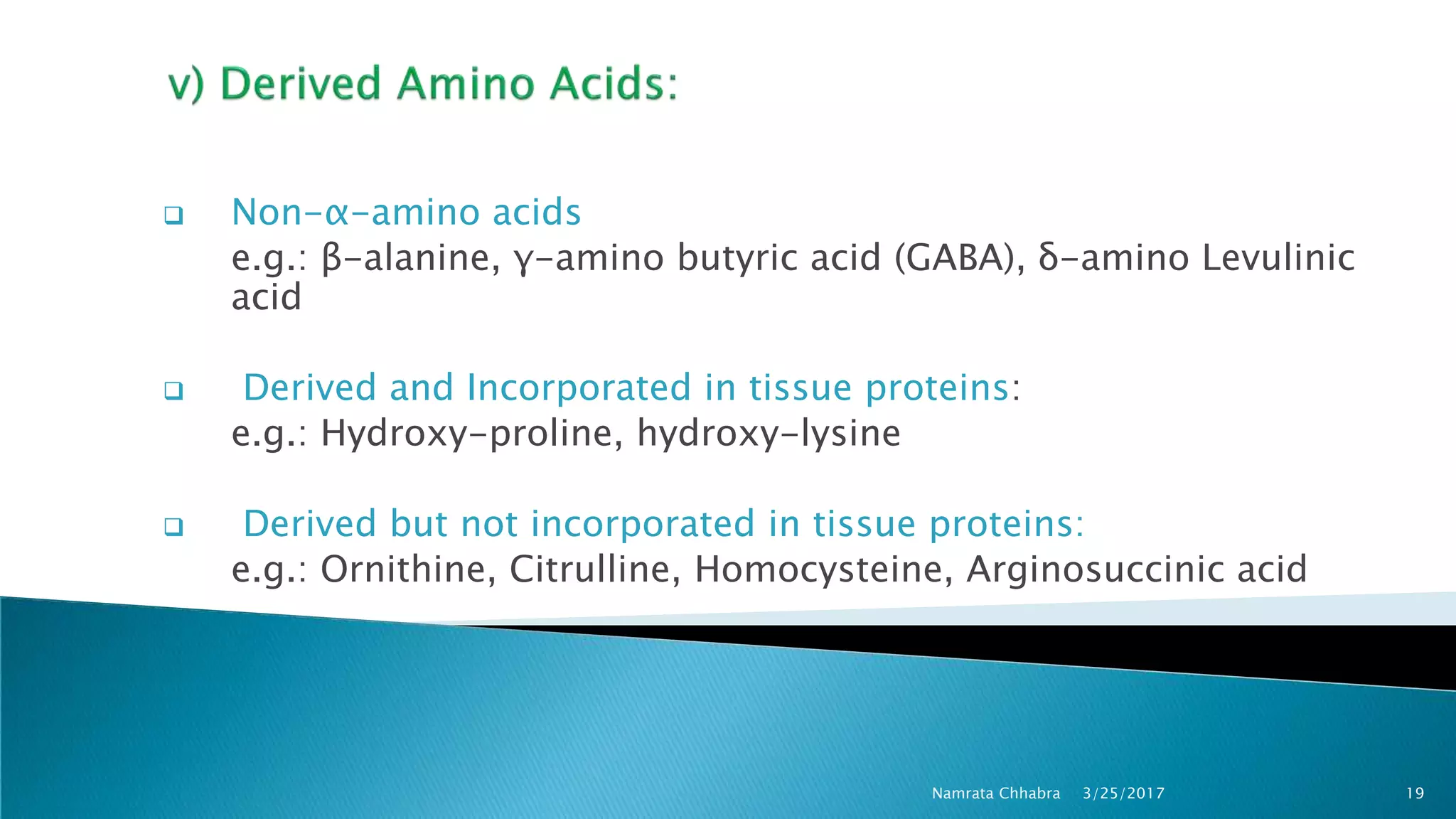
 Non-α-amino acids
e.g.: β-alanine, γ-amino butyric acid (GABA), δ-amino Levulinic
acid
 Derived and Incorporated in tissue proteins:
e.g.: Hydroxy-proline, hydroxy-lysine
 Derived but not incorporated in tissue proteins:
e.g.: Ornithine, Citrulline, Homocysteine, Arginosuccinic acid
3/25/2017 19Namrata Chhabra
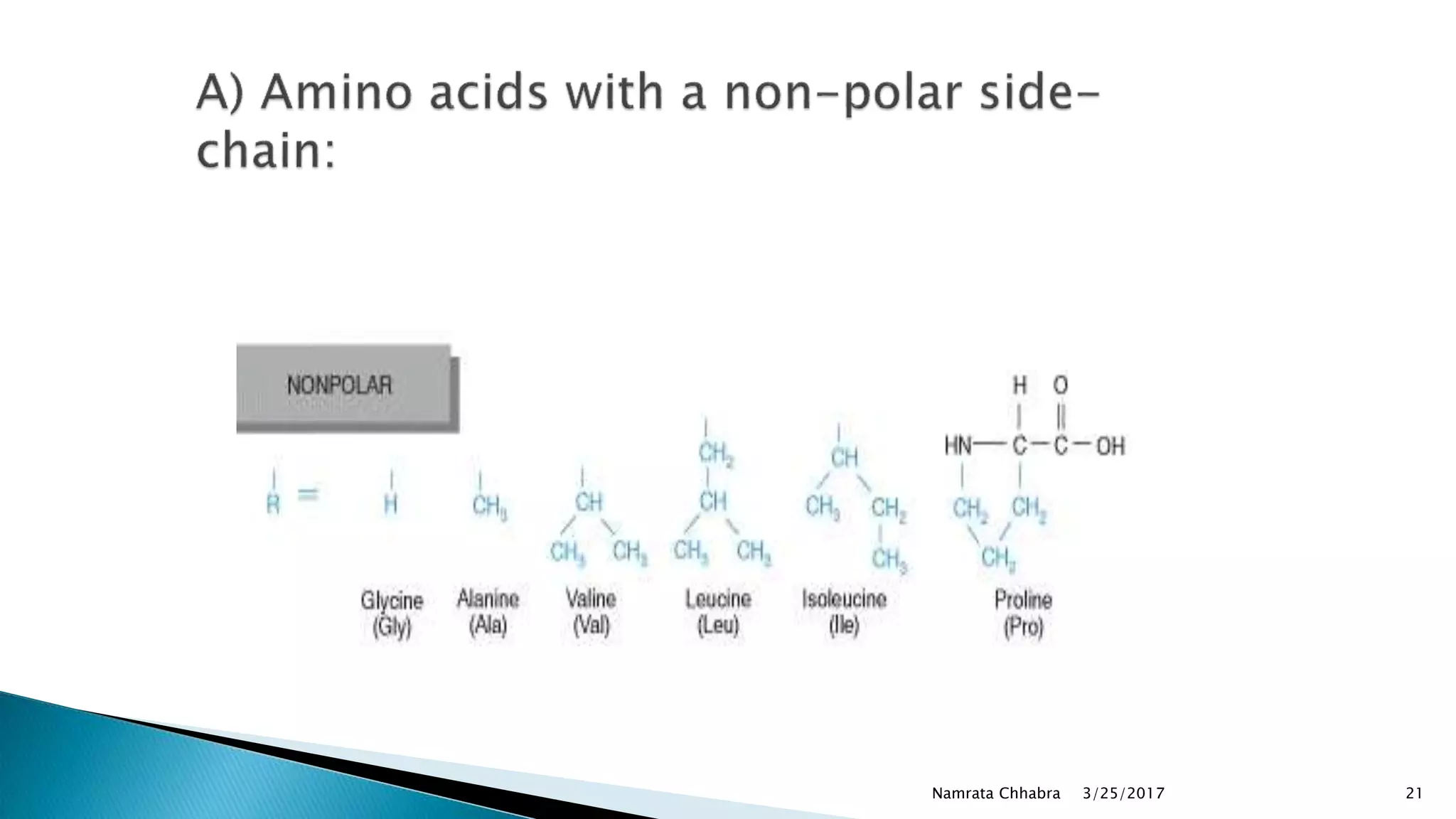
A. Amino acids with a non-polar side-chain:
e.g.: Alanine, Valine, Leucine, Isoleucine, Phenylalanine,
Tryptophan, Proline
 Each of these amino acids has a side chain that does
not bind or give off protons or participates in
hydrogen or ionic bonds.
 Side chains of these amino acids can be thought of as
“Oily” or lipid like, a property that promotes
hydrophobic interactions.
3/25/2017 20Namrata Chhabra
3/25/2017Namrata Chhabra 21
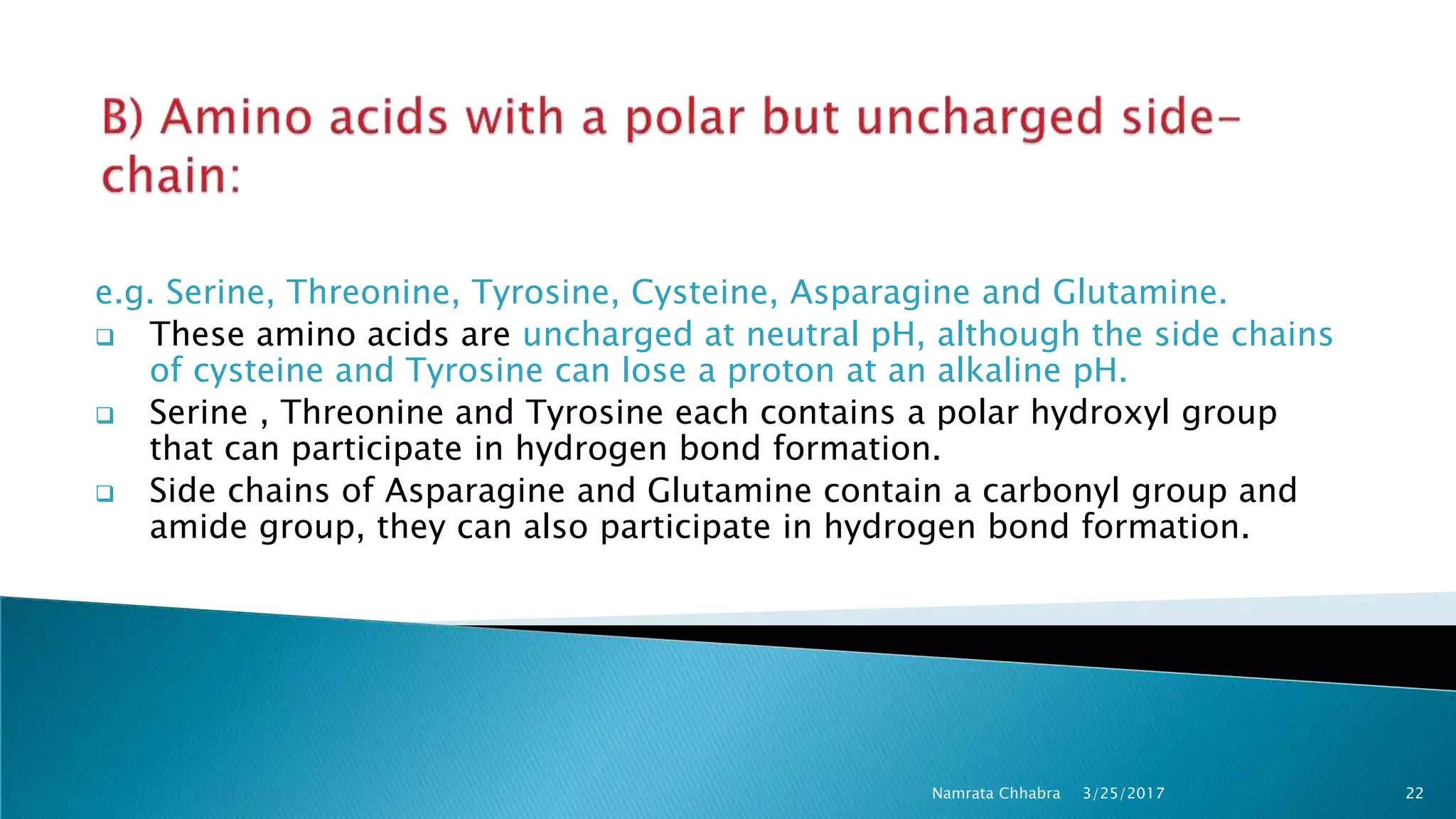
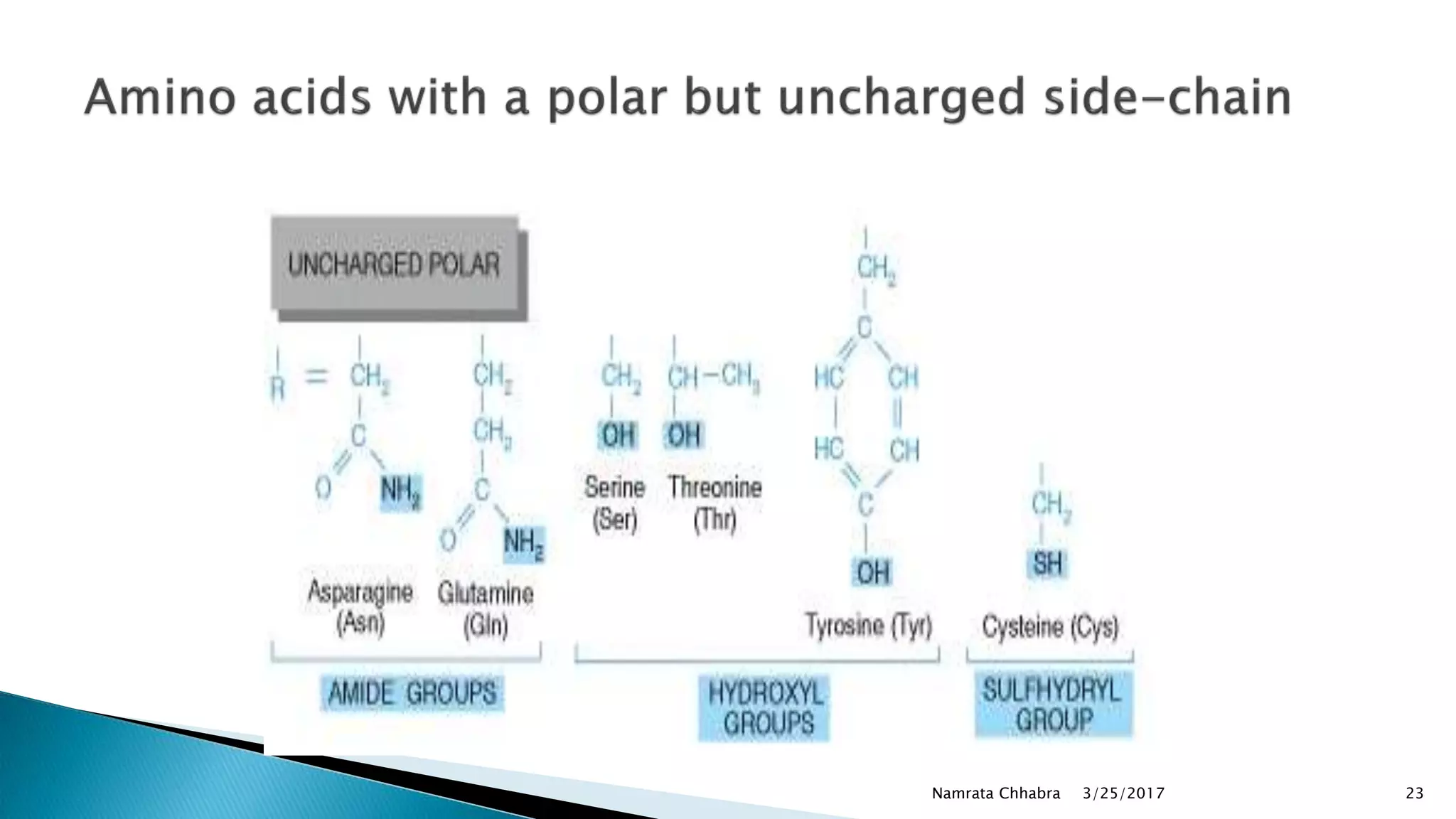
e.g. Serine, Threonine, Tyrosine, Cysteine, Asparagine and Glutamine.
 These amino acids are uncharged at neutral pH, although the side chains
of cysteine and Tyrosine can lose a proton at an alkaline pH.
 Serine , Threonine and Tyrosine each contains a polar hydroxyl group
that can participate in hydrogen bond formation.
 Side chains of Asparagine and Glutamine contain a carbonyl group and
amide group, they can also participate in hydrogen bond formation.
3/25/2017 22Namrata Chhabra
3/25/2017Namrata Chhabra 23
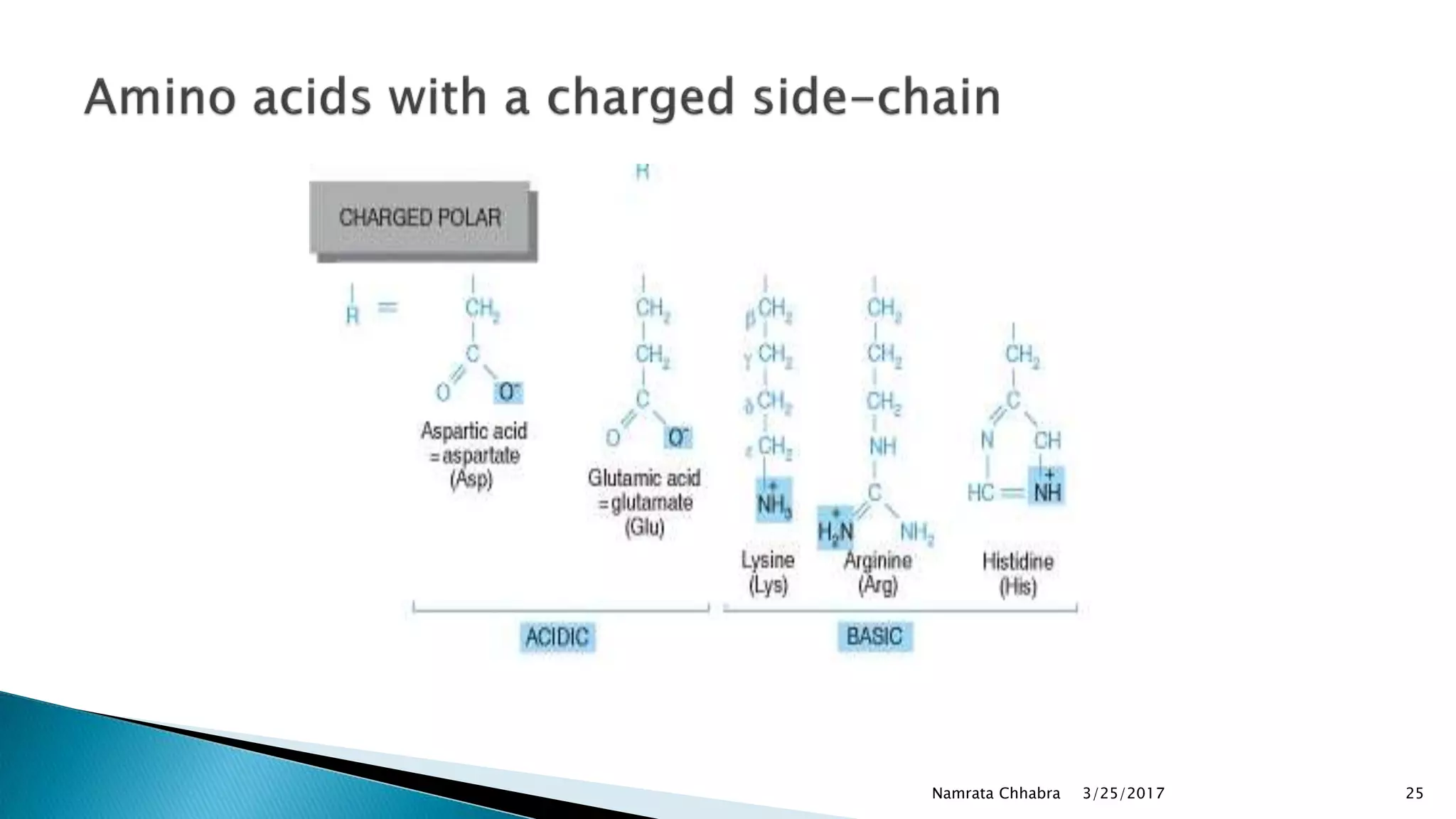
a) Amino acids with a positively charged side-chain:
The basic amino acids- Lysine, Arginine and Histidine
b) Amino acids with a negatively charged side-chain:
The acidic amino acids- Glutamic acid and Aspartic acid
They are hydrophilic in nature.
3/25/2017 24Namrata Chhabra
3/25/2017Namrata Chhabra 25
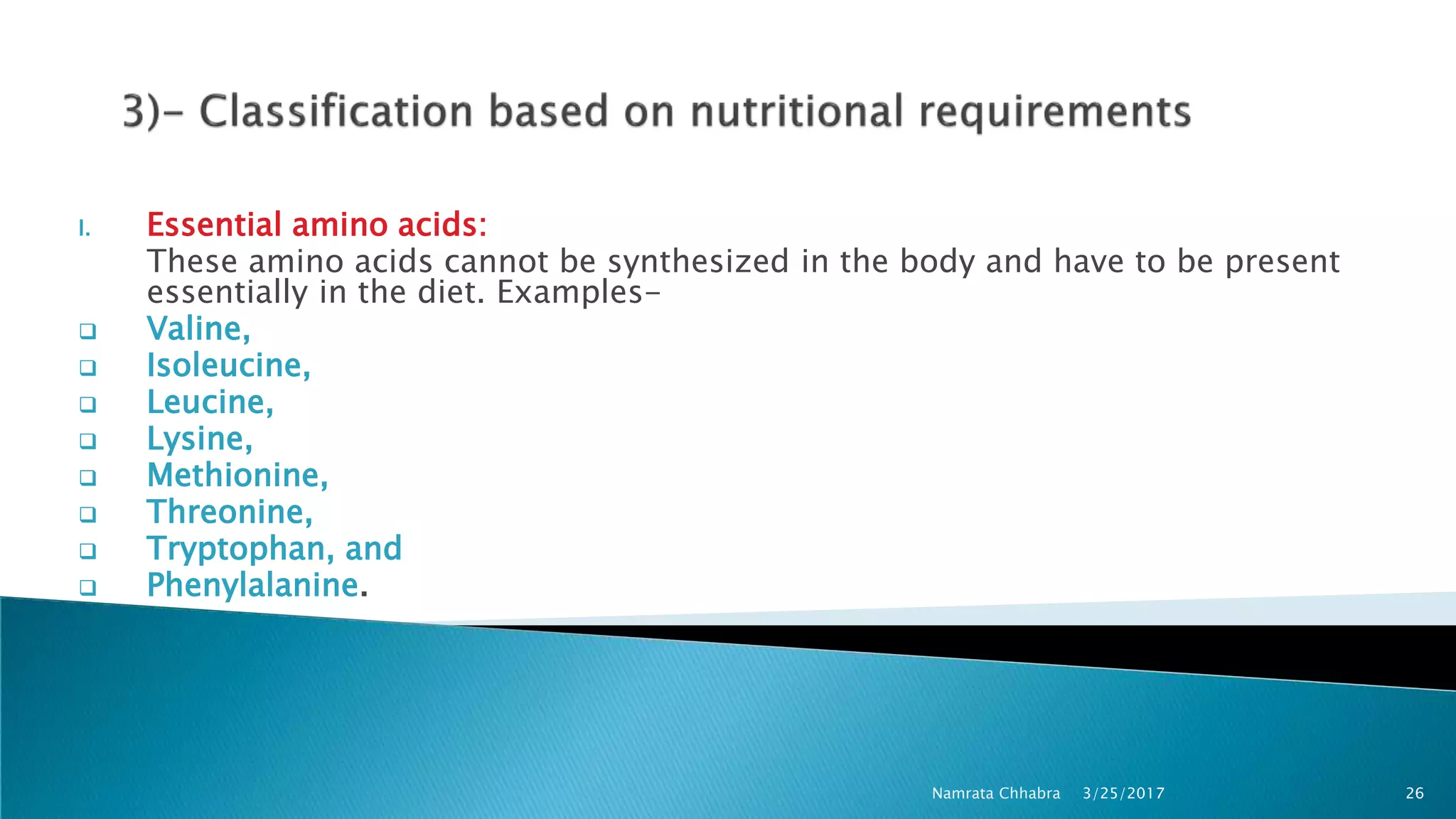
I. Essential amino acids:
These amino acids cannot be synthesized in the body and have to be present
essentially in the diet. Examples-
 Valine,
 Isoleucine,
 Leucine,
 Lysine,
 Methionine,
 Threonine,
 Tryptophan, and
 Phenylalanine.
3/25/2017 26Namrata Chhabra
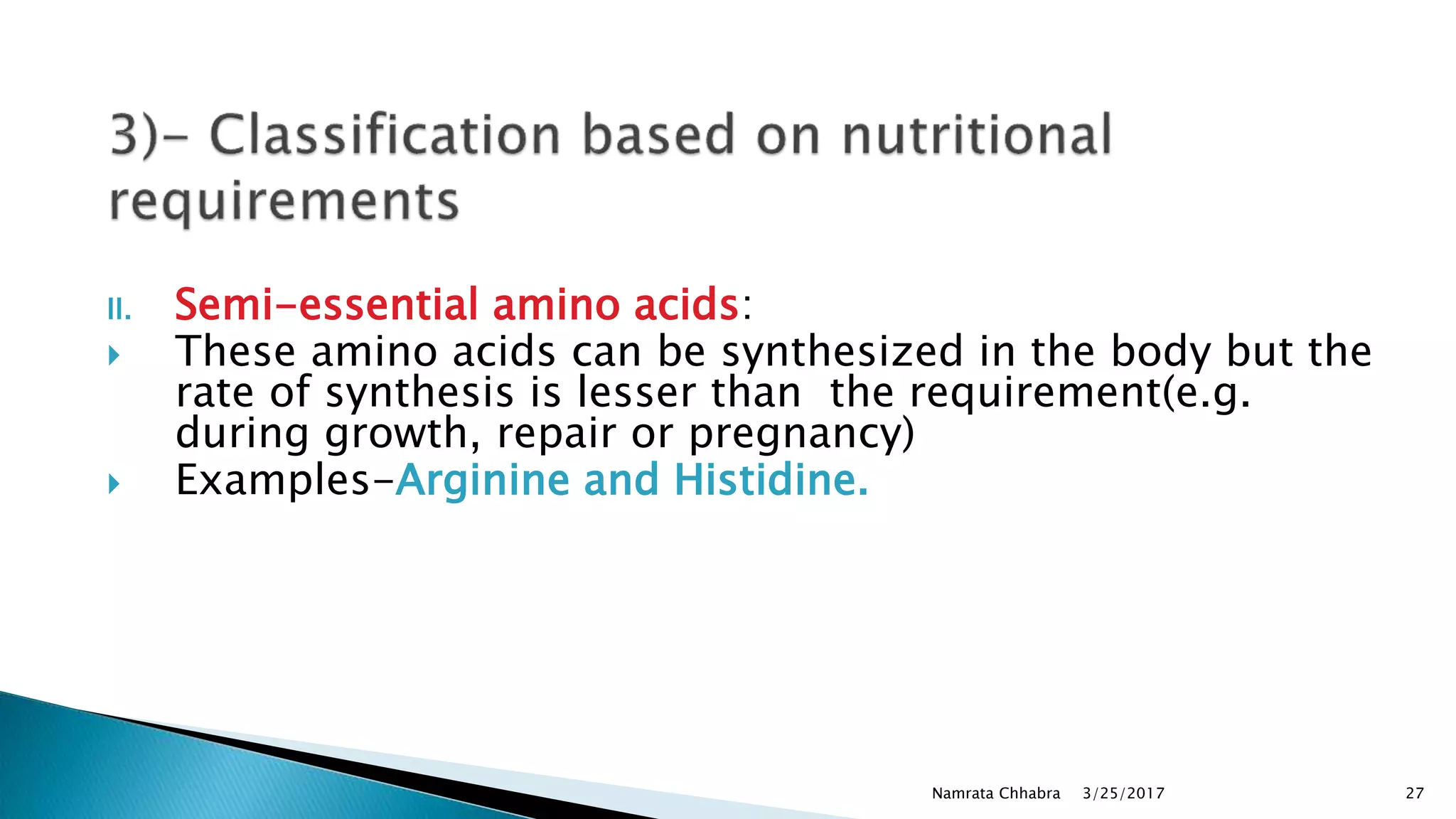
II. Semi-essential amino acids:
 These amino acids can be synthesized in the body but the
rate of synthesis is lesser than the requirement(e.g.
during growth, repair or pregnancy)
 Examples-Arginine and Histidine.
3/25/2017Namrata Chhabra 27
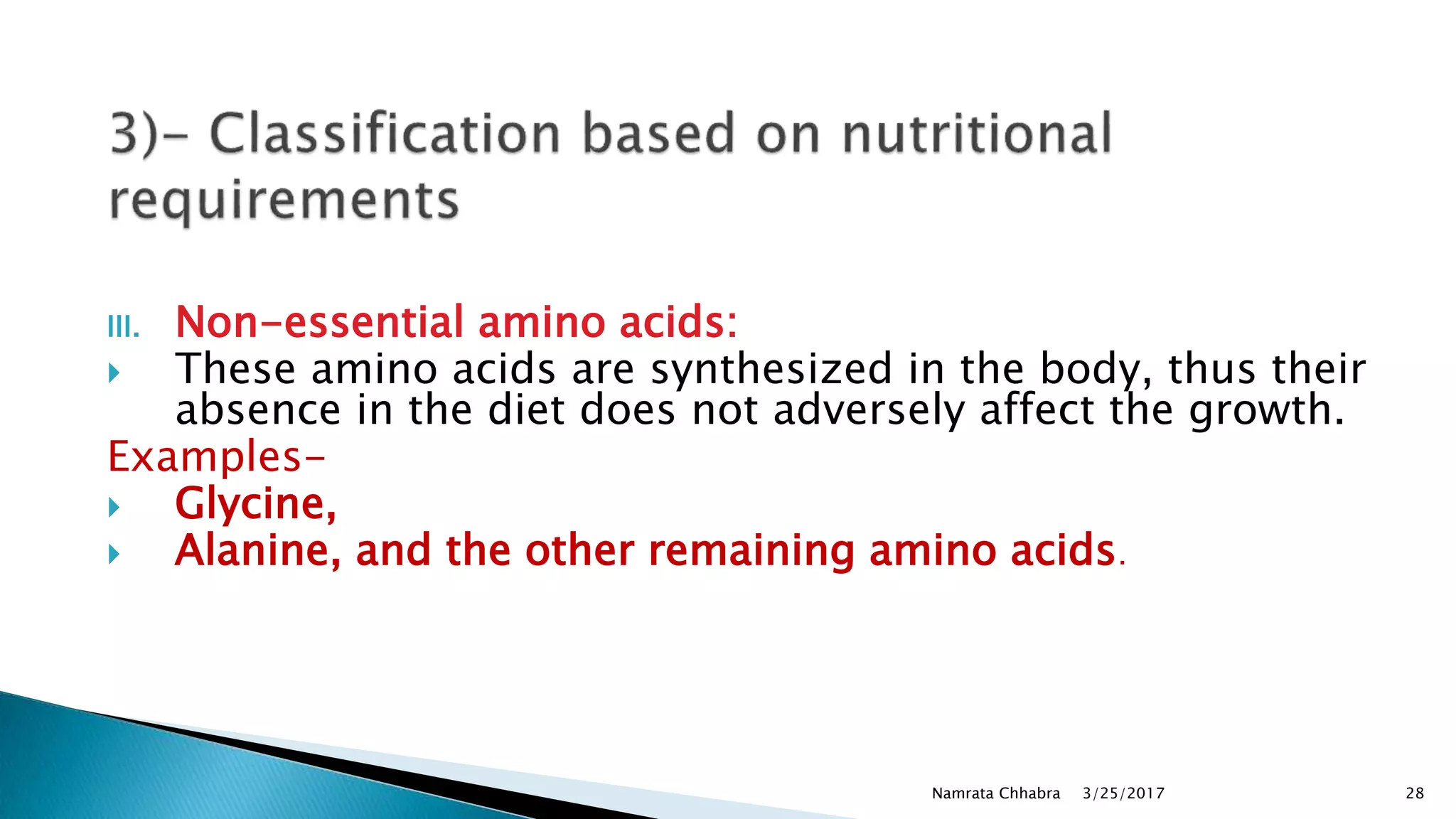
III. Non-essential amino acids:
 These amino acids are synthesized in the body, thus their
absence in the diet does not adversely affect the growth.
Examples-
 Glycine,
 Alanine, and the other remaining amino acids.
3/25/2017Namrata Chhabra 28
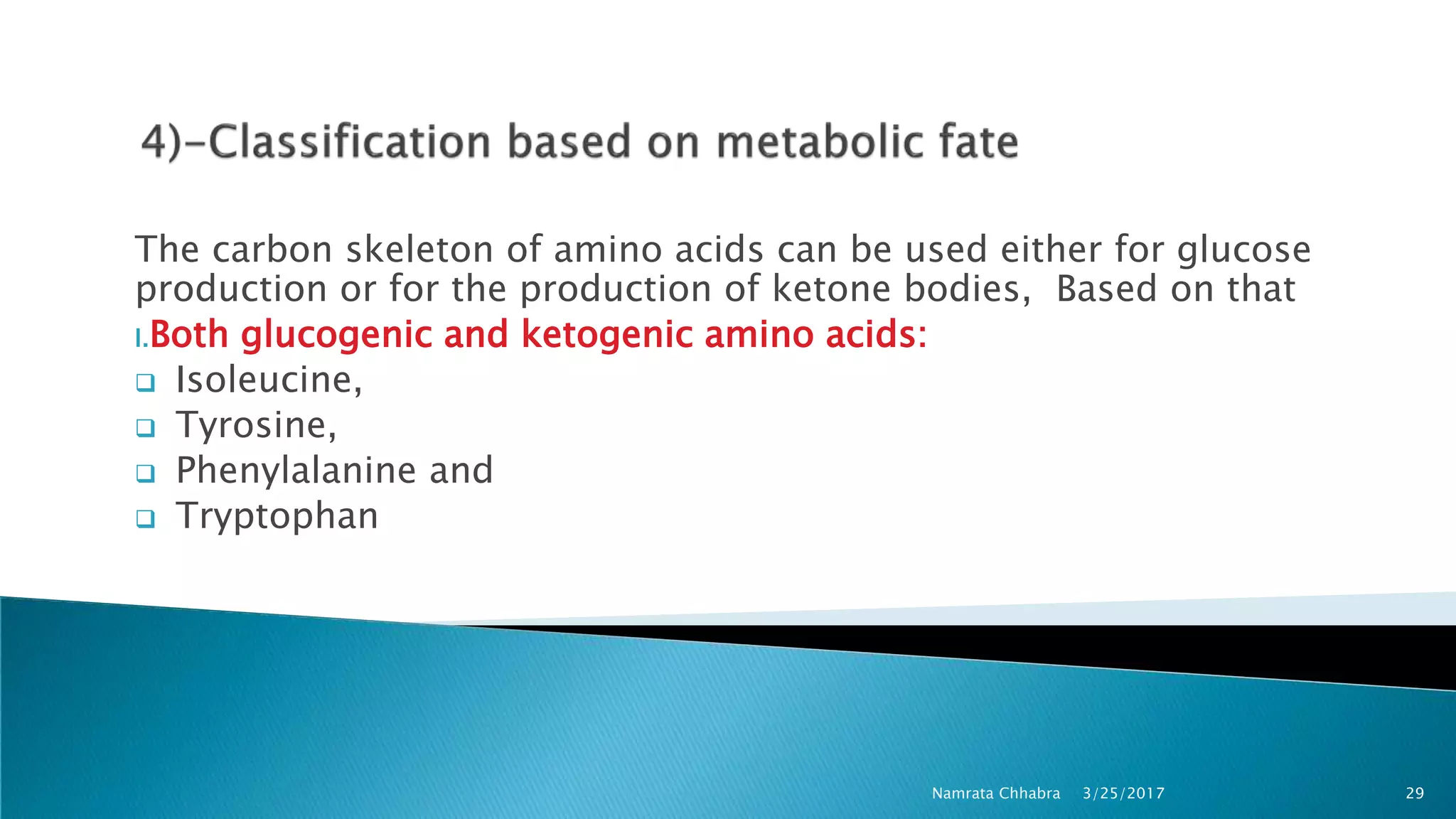
The carbon skeleton of amino acids can be used either for glucose
production or for the production of ketone bodies, Based on that
I.Both glucogenic and ketogenic amino acids:
 Isoleucine,
 Tyrosine,
 Phenylalanine and
 Tryptophan
3/25/2017 29Namrata Chhabra
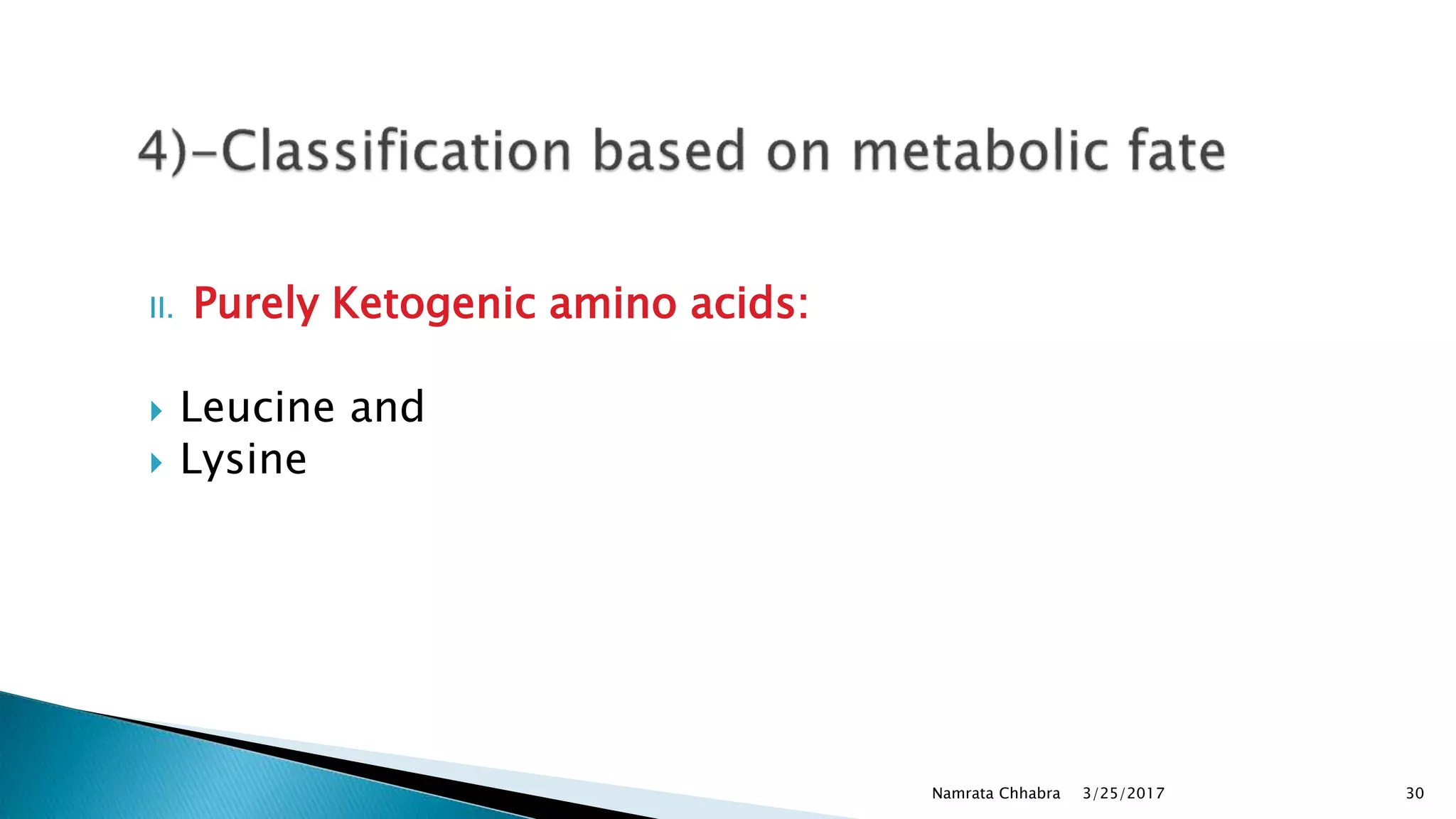
II. Purely Ketogenic amino acids:
 Leucine and
 Lysine
3/25/2017Namrata Chhabra 30
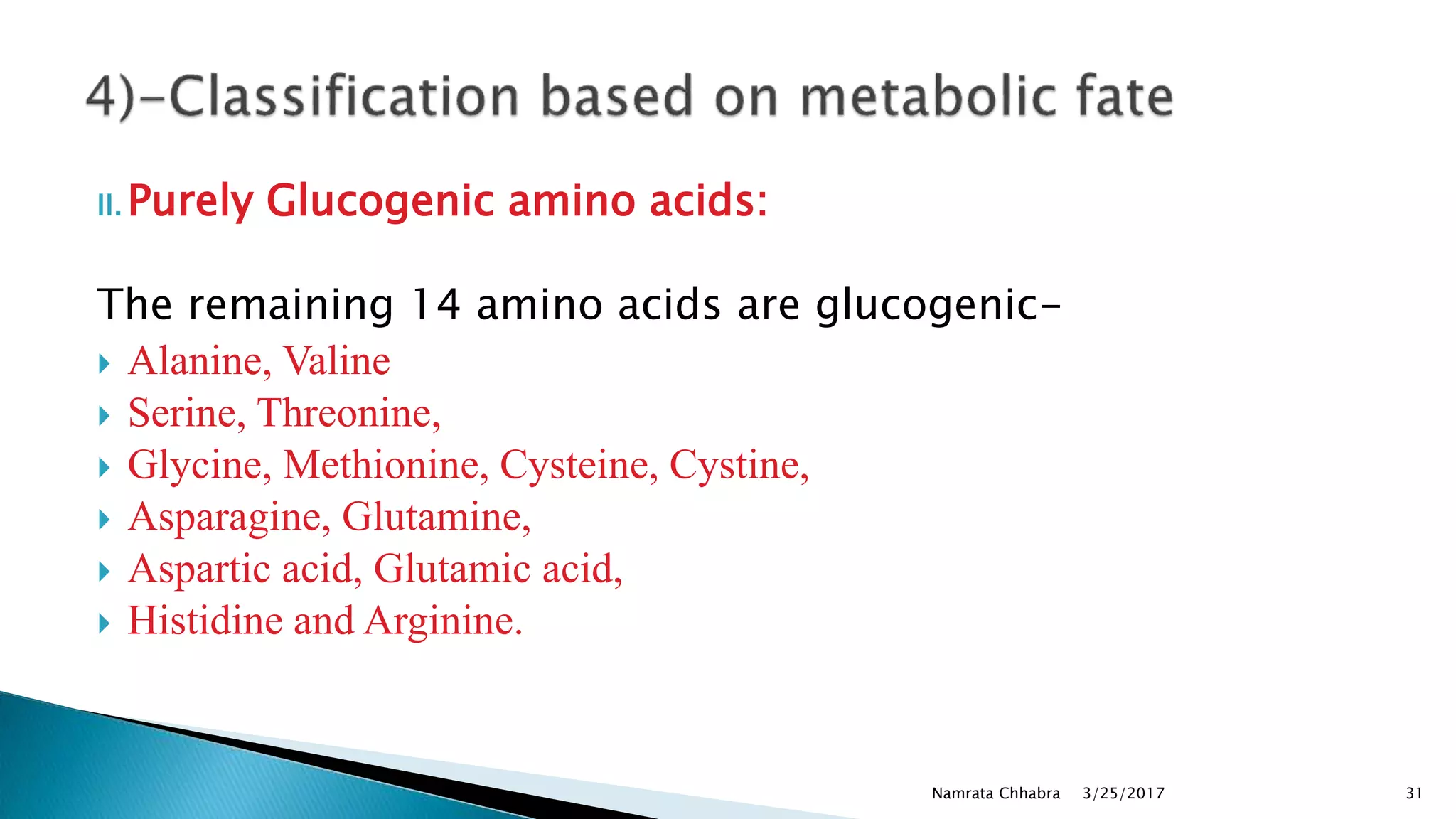
II. Purely Glucogenic amino acids:
The remaining 14 amino acids are glucogenic-
 Alanine, Valine
 Serine, Threonine,
 Glycine, Methionine, Cysteine, Cystine,
 Asparagine, Glutamine,
 Aspartic acid, Glutamic acid,
 Histidine and Arginine.
3/25/2017Namrata Chhabra 31
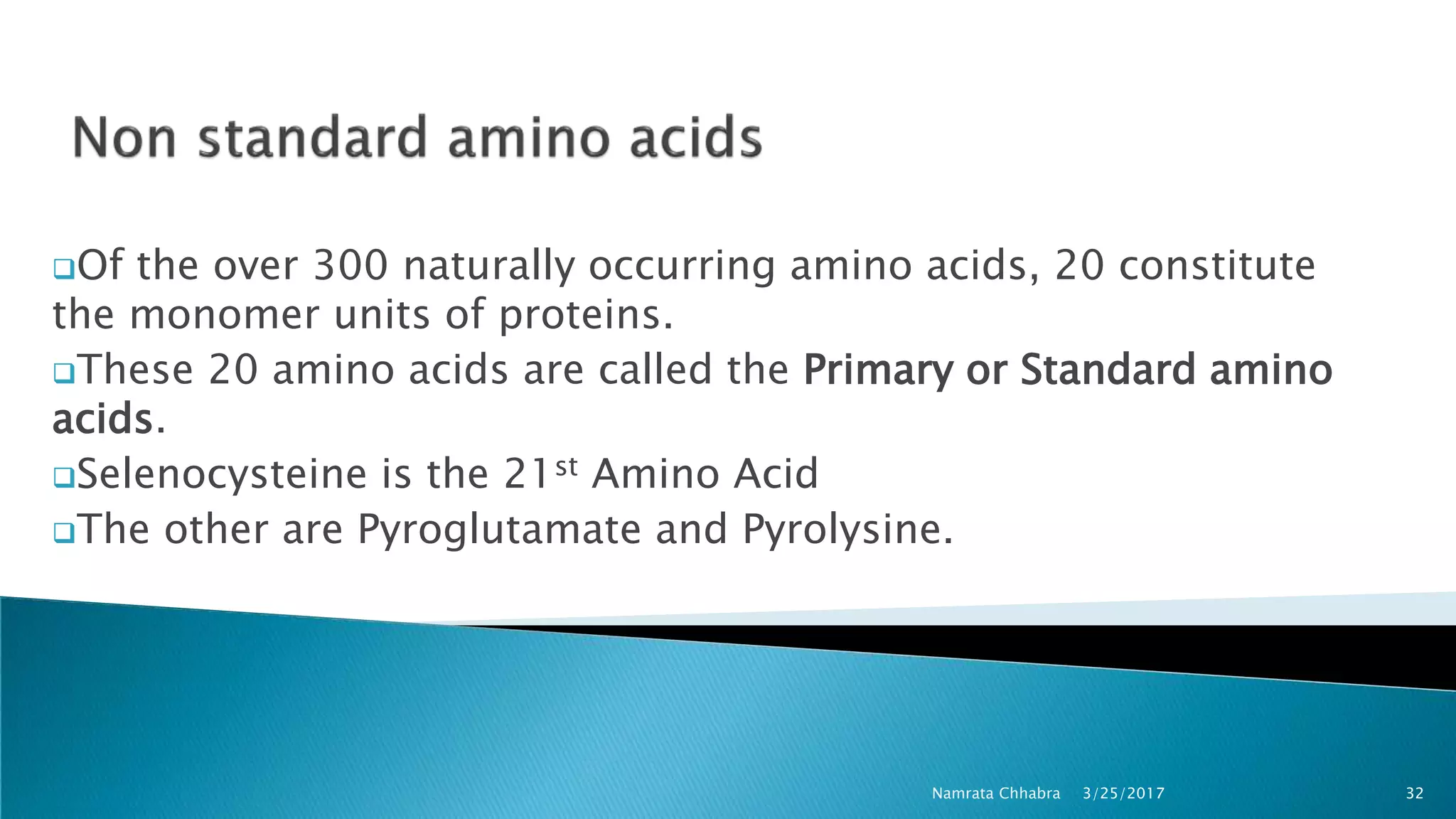
Of the over 300 naturally occurring amino acids, 20 constitute
the monomer units of proteins.
These 20 amino acids are called the Primary or Standard amino
acids.
Selenocysteine is the 21st Amino Acid
The other are Pyroglutamate and Pyrolysine.
3/25/2017 32Namrata Chhabra
3/25/2017Namrata Chhabra 33

Classification of amino acids

  • 1.
    Biochemistry for medics www.namrata.co 3/25/20171Namrata Chhabra NAMRATA CHHABRA,M.D.
  • 2.
    Provide the monomerunits from which the long polypeptide chains of proteins are synthesized 3/25/2017 2Namrata Chhabra
  • 3.
     L-amino acidsand their derivatives participate in cellular functions as diverse as:  Nerve transmission and the  Biosynthesis of porphyrins,  Purines, pyrimidines, and urea. 3/25/2017Namrata Chhabra 3
  • 4.
     Short polymersof amino acids called peptides perform prominent roles in the neuroendocrine system as :  hormones,  hormone-releasing factors,  neuromodulators, or  neurotransmitters. 3/25/2017Namrata Chhabra 4
  • 5.
     Each aminoacid (except proline) has a carboxyl group, an amino group and a distinctive side chain bonded to the alpha carbon atom.  At physiological pH the carboxyl group is dissociated forming the negatively charged carboxylate ion(-COO- ), and the amino group is protonated(-NH3 +) 3/25/2017 5Namrata Chhabra
  • 6.
    Amino acids canbe classified in 4 ways: 1.Based on structure 2.Based on the side chain characters 3.Based on nutritional requirements 4.Based on metabolic fate 3/25/2017 6Namrata Chhabra
  • 7.
    1) Aliphatic aminoacids They are classified in three broad categories:  Mono amino mono carboxylic acids They are further subdivided in 5 groups: a. Simple amino acids-example: glycine, alanine b. Branched chain amino acids-e.g.: valine,leucine,isoleucine c. Hydroxyl group containing amino acids-e.g.: serine, threonine d. Sulphur containing amino acids-e.g.: cysteine, cystine, methionine e. Amide group containing amino acids-e.g.- asparagine,glutamine 3/25/2017Namrata Chhabra 7
  • 8.
     Mono aminodicarboxylic acid Example :aspartic acid, glutamic acid  Di /poly amino mono carboxylic acid Example : lysine, arginine 2) Aromatic amino acids 3) Heterocyclic amino acids 4) Imino acids 5) Derived amino acids 3/25/2017Namrata Chhabra 8
  • 9.
     Simple aminoacids: Glycine , Alanine 3/25/2017 9Namrata Chhabra
  • 10.
     Branched chainamino acids: Valine, Leucine and Isoleucine 3/25/2017 10Namrata Chhabra
  • 11.
    -OH group-containing aminoacids: Serine and Threonine 3/25/2017 11Namrata Chhabra
  • 12.
    Sulfur-containing amino acids:Cysteine, Cystine(Formed by linking of two cysteine residues) and Methionine. 3/25/2017 12Namrata Chhabra
  • 13.
    Amide group-containing aminoacids: Glutamine and Asparagine 3/25/2017 13Namrata Chhabra
  • 14.
    Aspartic acid andGlutamic acid 3/25/2017 14Namrata Chhabra
  • 15.
  • 16.
    Phenyl alanine andtyrosine 3/25/2017 16Namrata Chhabra
  • 17.
  • 18.
  • 19.
     Non-α-amino acids e.g.:β-alanine, γ-amino butyric acid (GABA), δ-amino Levulinic acid  Derived and Incorporated in tissue proteins: e.g.: Hydroxy-proline, hydroxy-lysine  Derived but not incorporated in tissue proteins: e.g.: Ornithine, Citrulline, Homocysteine, Arginosuccinic acid 3/25/2017 19Namrata Chhabra
  • 20.
    A. Amino acidswith a non-polar side-chain: e.g.: Alanine, Valine, Leucine, Isoleucine, Phenylalanine, Tryptophan, Proline  Each of these amino acids has a side chain that does not bind or give off protons or participates in hydrogen or ionic bonds.  Side chains of these amino acids can be thought of as “Oily” or lipid like, a property that promotes hydrophobic interactions. 3/25/2017 20Namrata Chhabra
  • 21.
  • 22.
    e.g. Serine, Threonine,Tyrosine, Cysteine, Asparagine and Glutamine.  These amino acids are uncharged at neutral pH, although the side chains of cysteine and Tyrosine can lose a proton at an alkaline pH.  Serine , Threonine and Tyrosine each contains a polar hydroxyl group that can participate in hydrogen bond formation.  Side chains of Asparagine and Glutamine contain a carbonyl group and amide group, they can also participate in hydrogen bond formation. 3/25/2017 22Namrata Chhabra
  • 23.
  • 24.
    a) Amino acidswith a positively charged side-chain: The basic amino acids- Lysine, Arginine and Histidine b) Amino acids with a negatively charged side-chain: The acidic amino acids- Glutamic acid and Aspartic acid They are hydrophilic in nature. 3/25/2017 24Namrata Chhabra
  • 25.
  • 26.
    I. Essential aminoacids: These amino acids cannot be synthesized in the body and have to be present essentially in the diet. Examples-  Valine,  Isoleucine,  Leucine,  Lysine,  Methionine,  Threonine,  Tryptophan, and  Phenylalanine. 3/25/2017 26Namrata Chhabra
  • 27.
    II. Semi-essential aminoacids:  These amino acids can be synthesized in the body but the rate of synthesis is lesser than the requirement(e.g. during growth, repair or pregnancy)  Examples-Arginine and Histidine. 3/25/2017Namrata Chhabra 27
  • 28.
    III. Non-essential aminoacids:  These amino acids are synthesized in the body, thus their absence in the diet does not adversely affect the growth. Examples-  Glycine,  Alanine, and the other remaining amino acids. 3/25/2017Namrata Chhabra 28
  • 29.
    The carbon skeletonof amino acids can be used either for glucose production or for the production of ketone bodies, Based on that I.Both glucogenic and ketogenic amino acids:  Isoleucine,  Tyrosine,  Phenylalanine and  Tryptophan 3/25/2017 29Namrata Chhabra
  • 30.
    II. Purely Ketogenicamino acids:  Leucine and  Lysine 3/25/2017Namrata Chhabra 30
  • 31.
    II. Purely Glucogenicamino acids: The remaining 14 amino acids are glucogenic-  Alanine, Valine  Serine, Threonine,  Glycine, Methionine, Cysteine, Cystine,  Asparagine, Glutamine,  Aspartic acid, Glutamic acid,  Histidine and Arginine. 3/25/2017Namrata Chhabra 31
  • 32.
    Of the over300 naturally occurring amino acids, 20 constitute the monomer units of proteins. These 20 amino acids are called the Primary or Standard amino acids. Selenocysteine is the 21st Amino Acid The other are Pyroglutamate and Pyrolysine. 3/25/2017 32Namrata Chhabra
  • 33.