The Inner Planets Mercury, Venus, Earth, and Mars
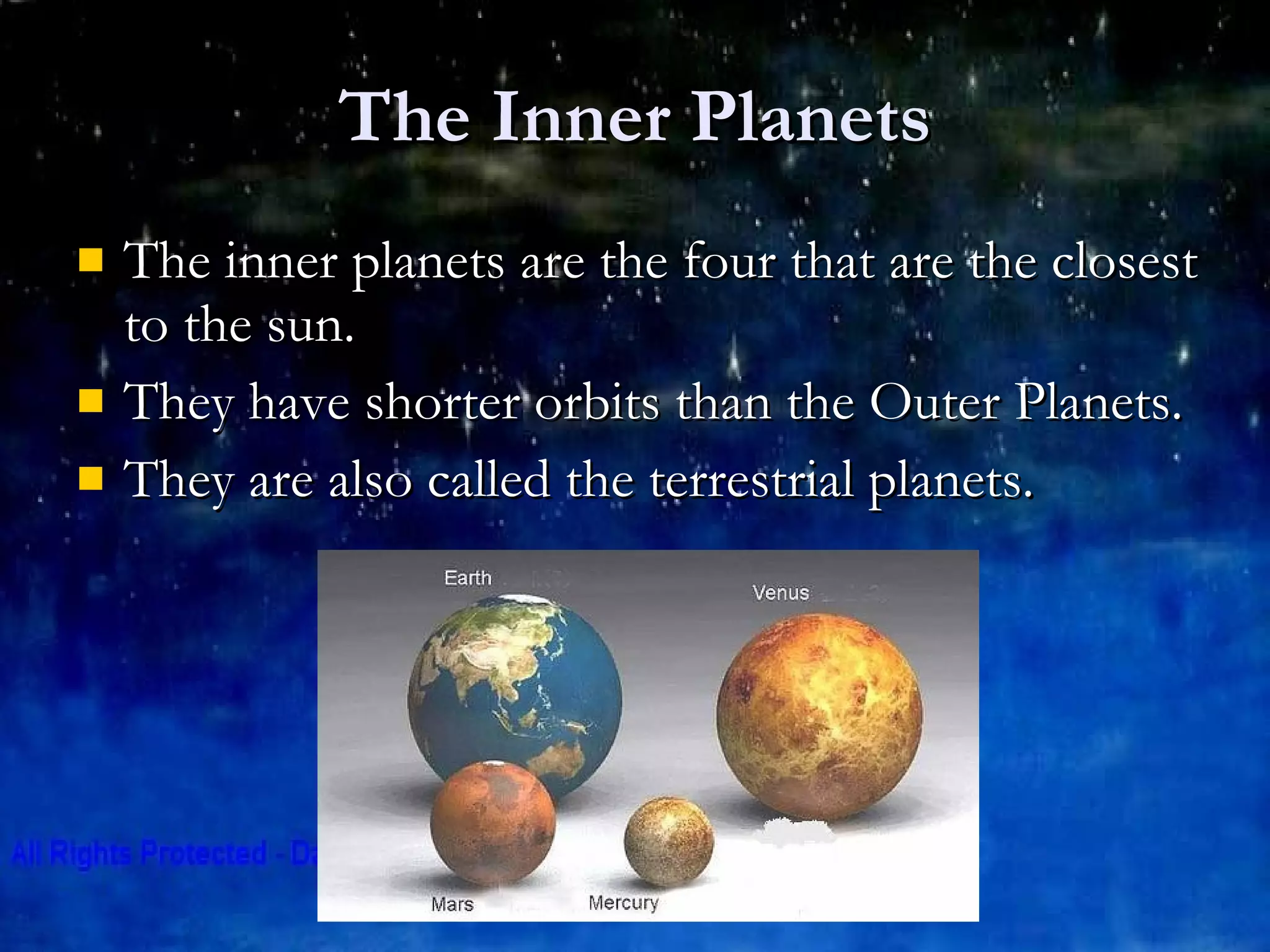
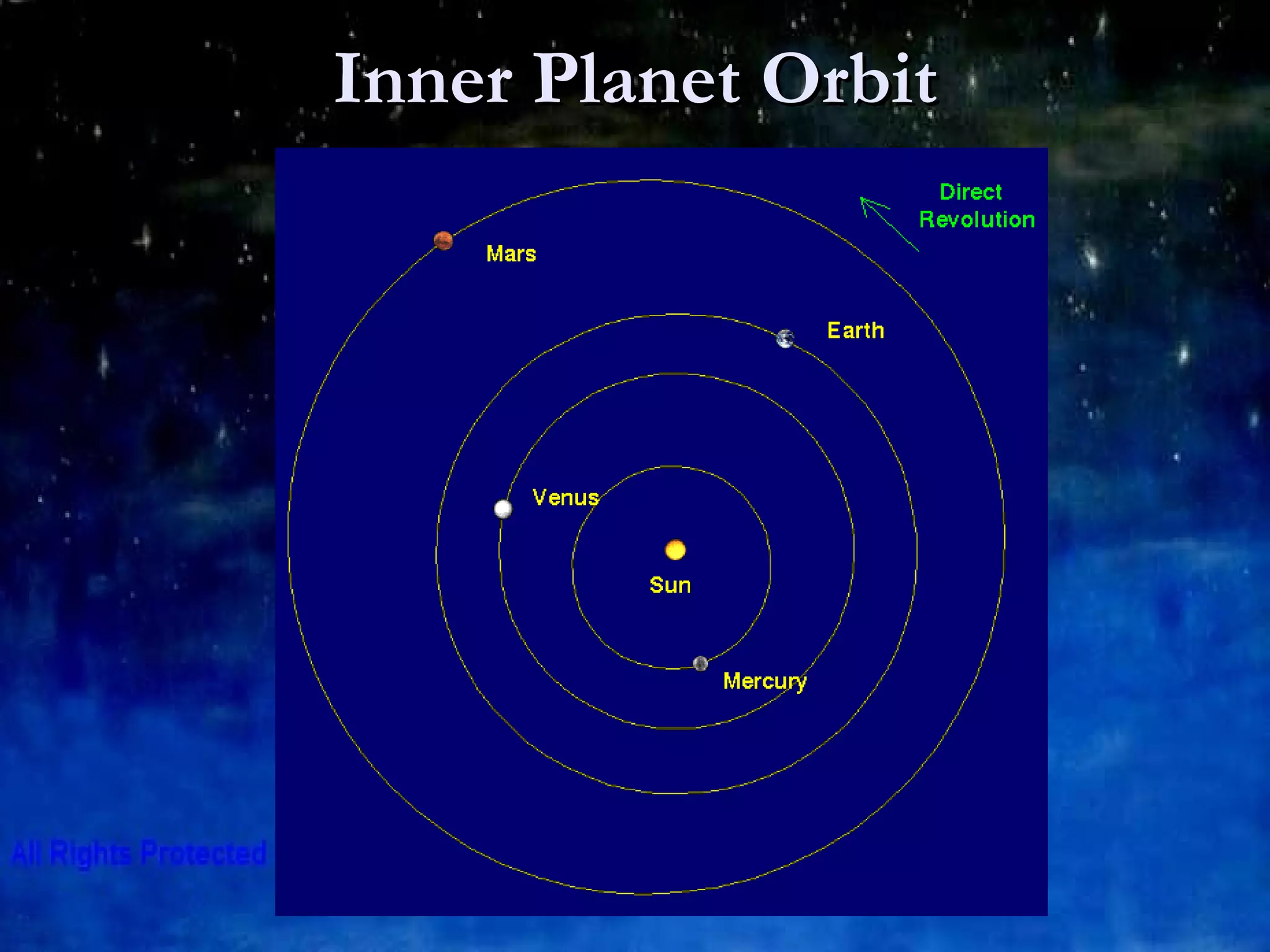
The Inner Planets The inner planets are the four that are the closest to the sun.  They have shorter orbits than the Outer Planets. They are also called the terrestrial planets.
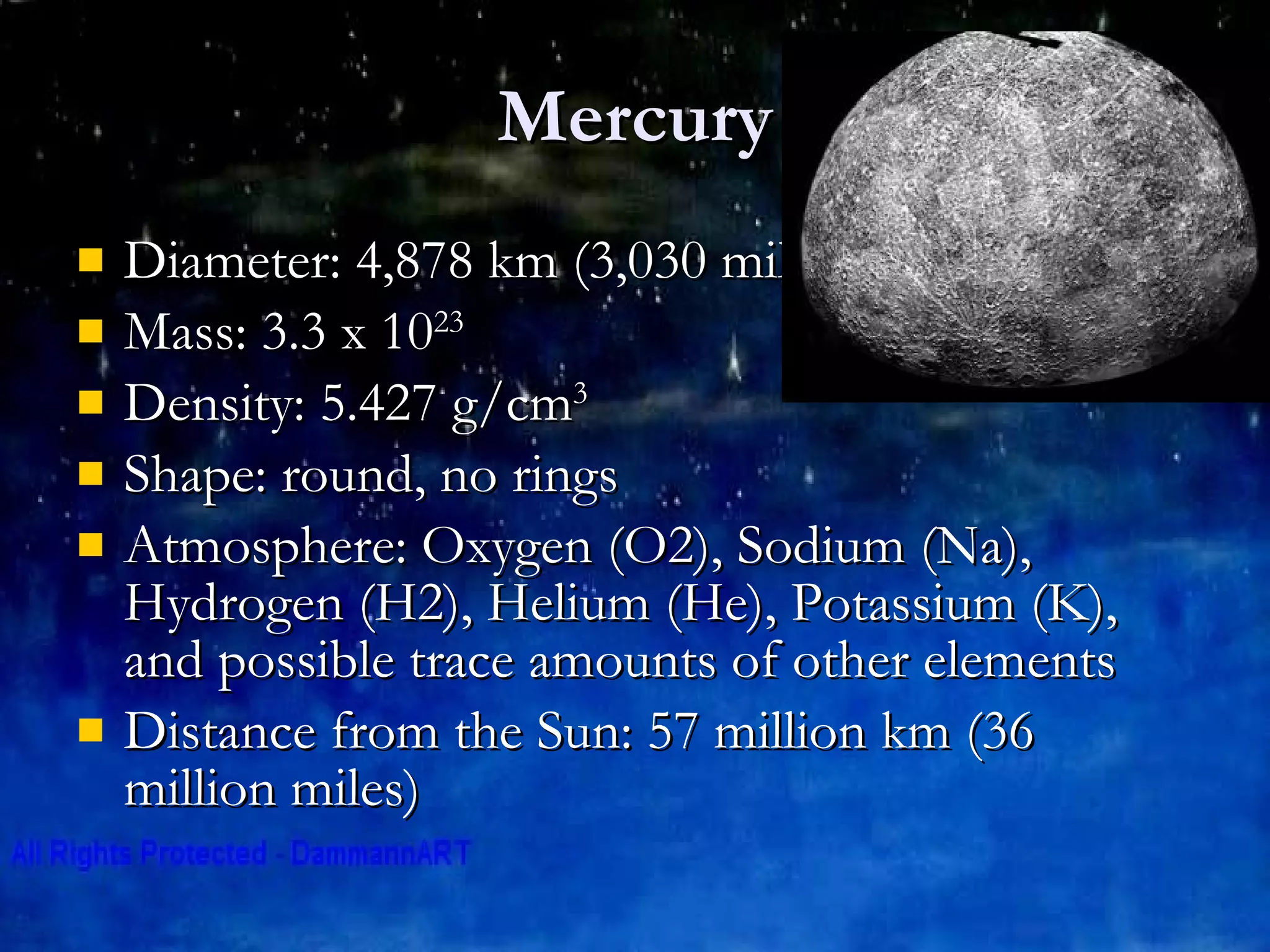
Mercury Diameter: 4,878 km (3,030 miles)  Mass: 3.3 x 10 23   Density: 5.427 g/cm 3   Shape: round, no rings Atmosphere: Oxygen (O2), Sodium (Na), Hydrogen (H2), Helium (He), Potassium (K), and possible trace amounts of other elements Distance from the Sun: 57 million km (36 million miles)
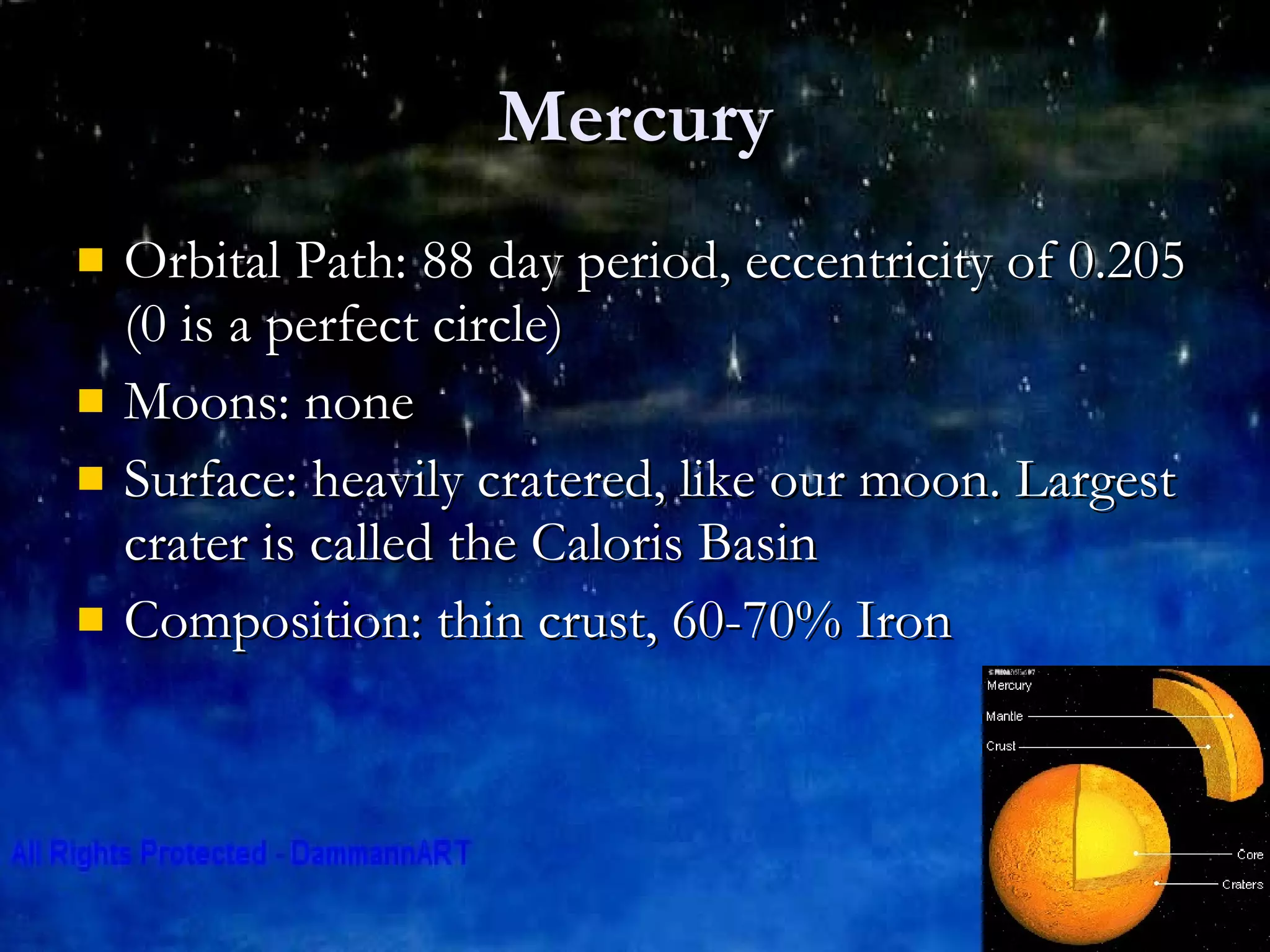
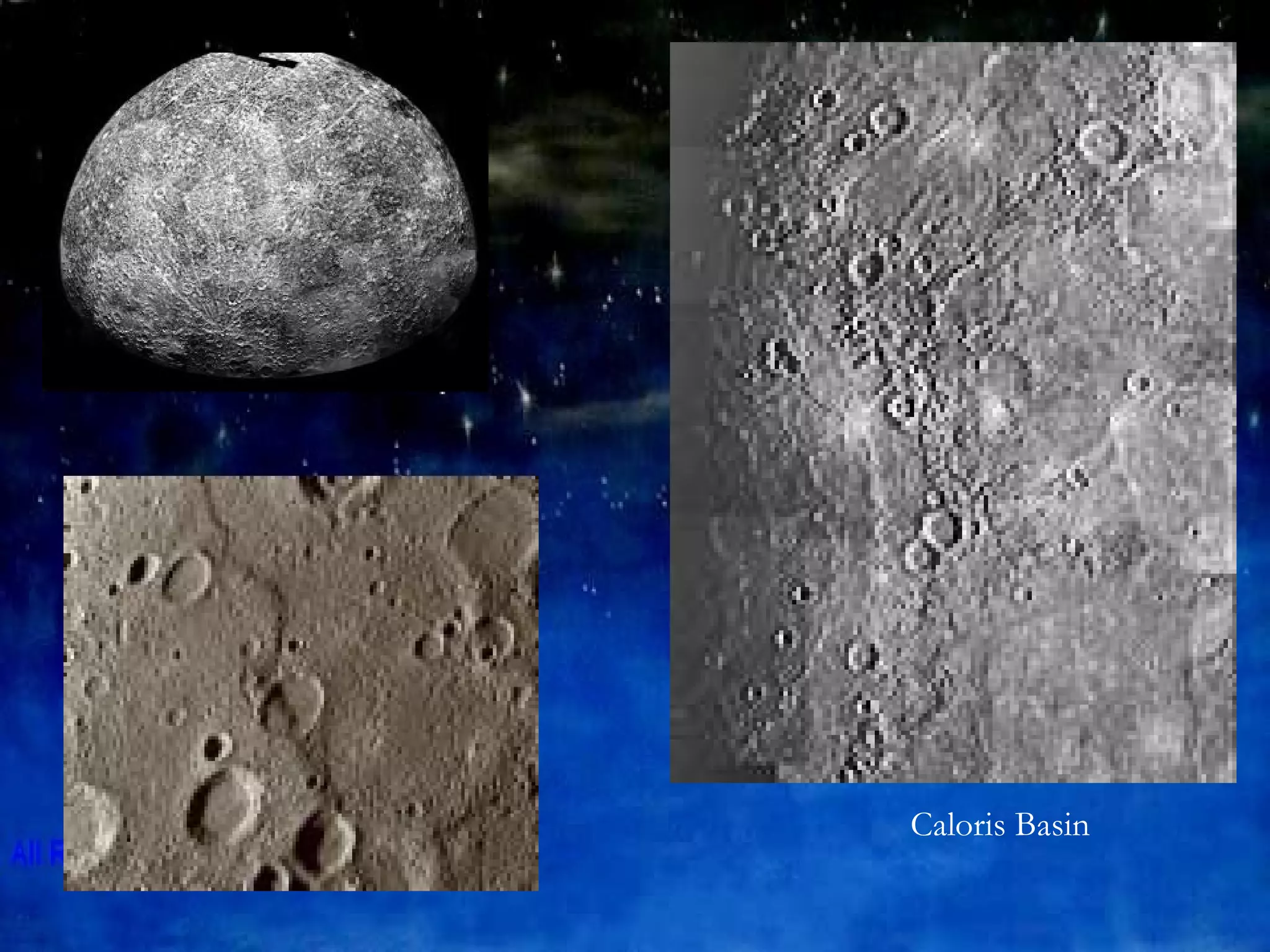
Mercury Orbital Path: 88 day period, eccentricity of 0.205 (0 is a perfect circle) Moons: none Surface: heavily cratered, like our moon. Largest crater is called the Caloris Basin Composition: thin crust, 60-70% Iron
Caloris Basin
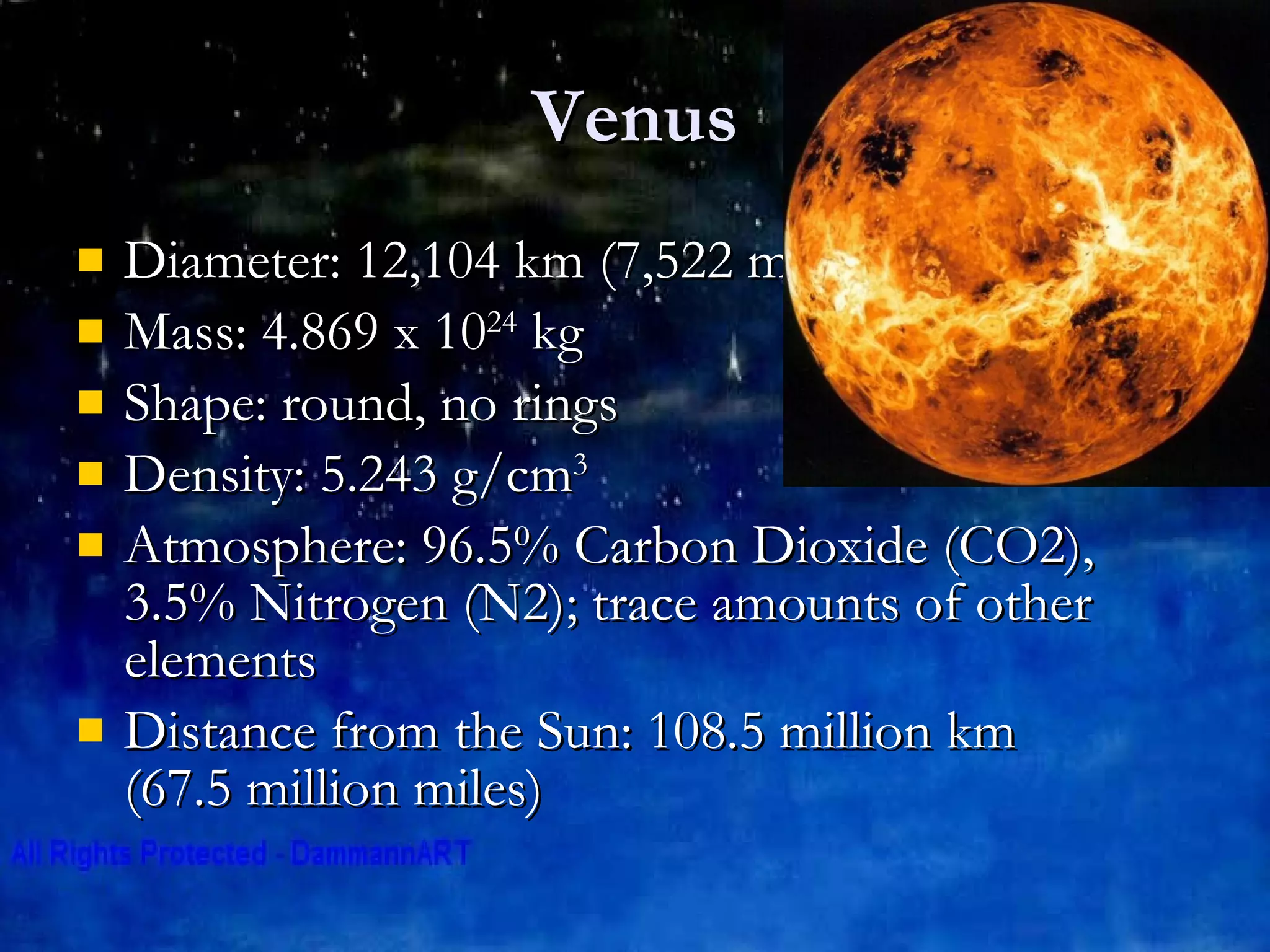
Venus Diameter: 12,104 km (7,522 miles)  Mass: 4.869 x 10 24  kg  Shape: round, no rings Density: 5.243 g/cm 3 Atmosphere: 96.5% Carbon Dioxide (CO2), 3.5% Nitrogen (N2); trace amounts of other elements Distance from the Sun: 108.5 million km  (67.5 million miles)
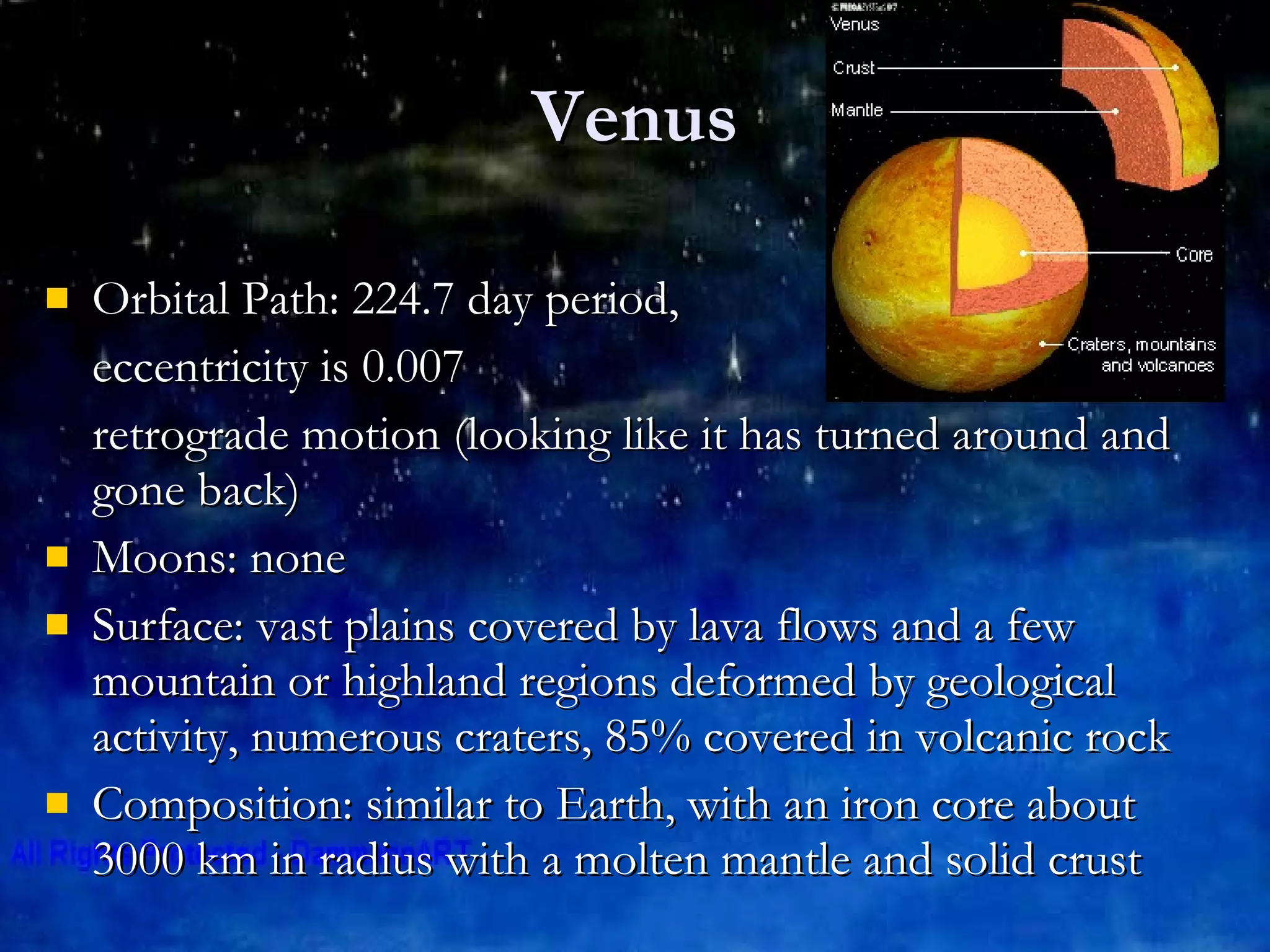
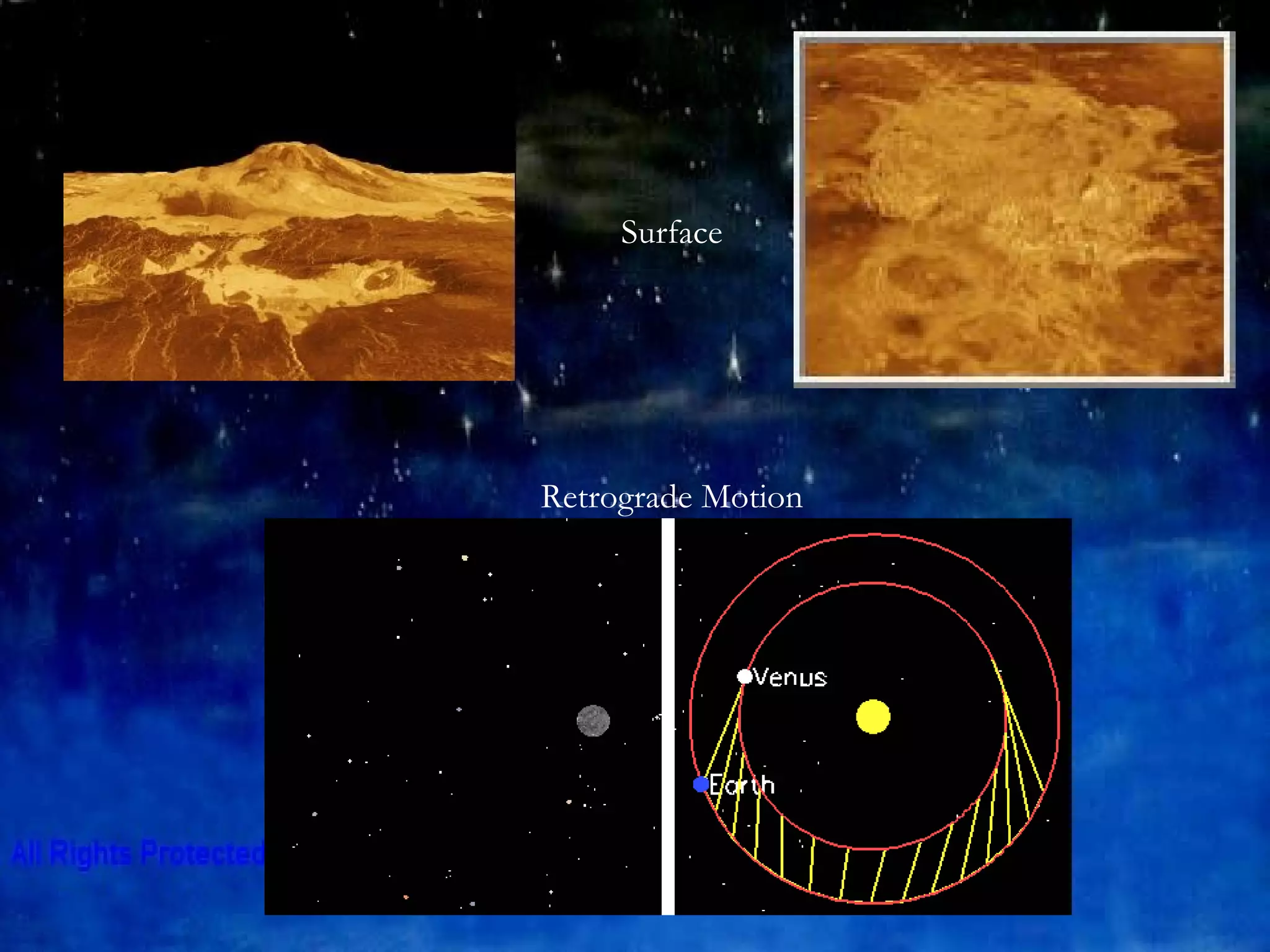
Venus Orbital Path: 224.7 day period,  eccentricity is 0.007 retrograde motion (looking like it has turned around and gone back) Moons: none Surface: vast plains covered by lava flows and a few mountain or highland regions deformed by geological activity, numerous craters, 85% covered in volcanic rock Composition: similar to Earth, with an iron core about 3000 km in radius with a molten mantle and solid crust
Surface Retrograde Motion
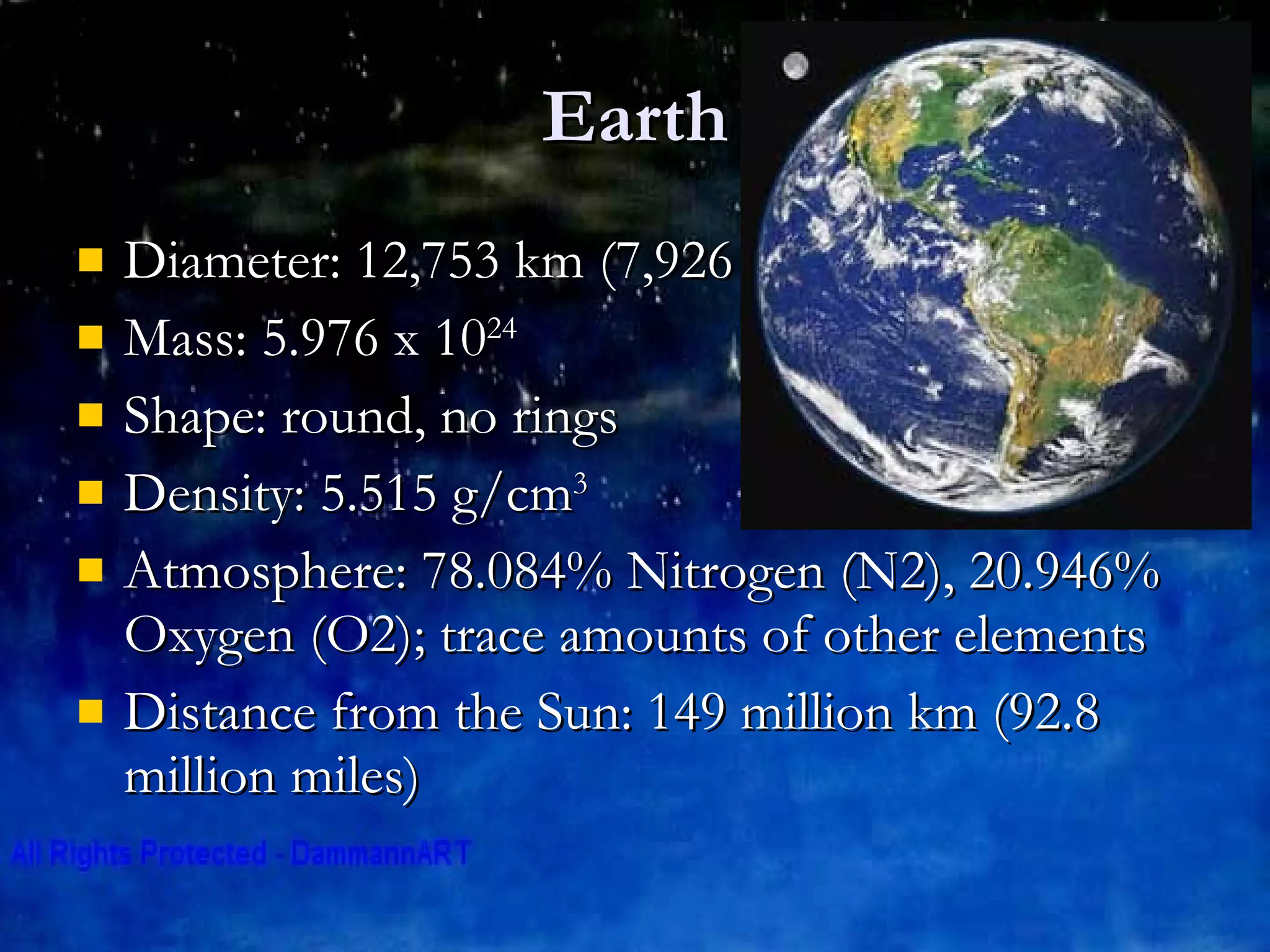
Earth Diameter: 12,753 km (7,926 miles)  Mass: 5.976 x 10 24   Shape: round, no rings Density: 5.515 g/cm 3 Atmosphere: 78.084% Nitrogen (N2), 20.946% Oxygen (O2); trace amounts of other elements Distance from the Sun: 149 million km (92.8 million miles)
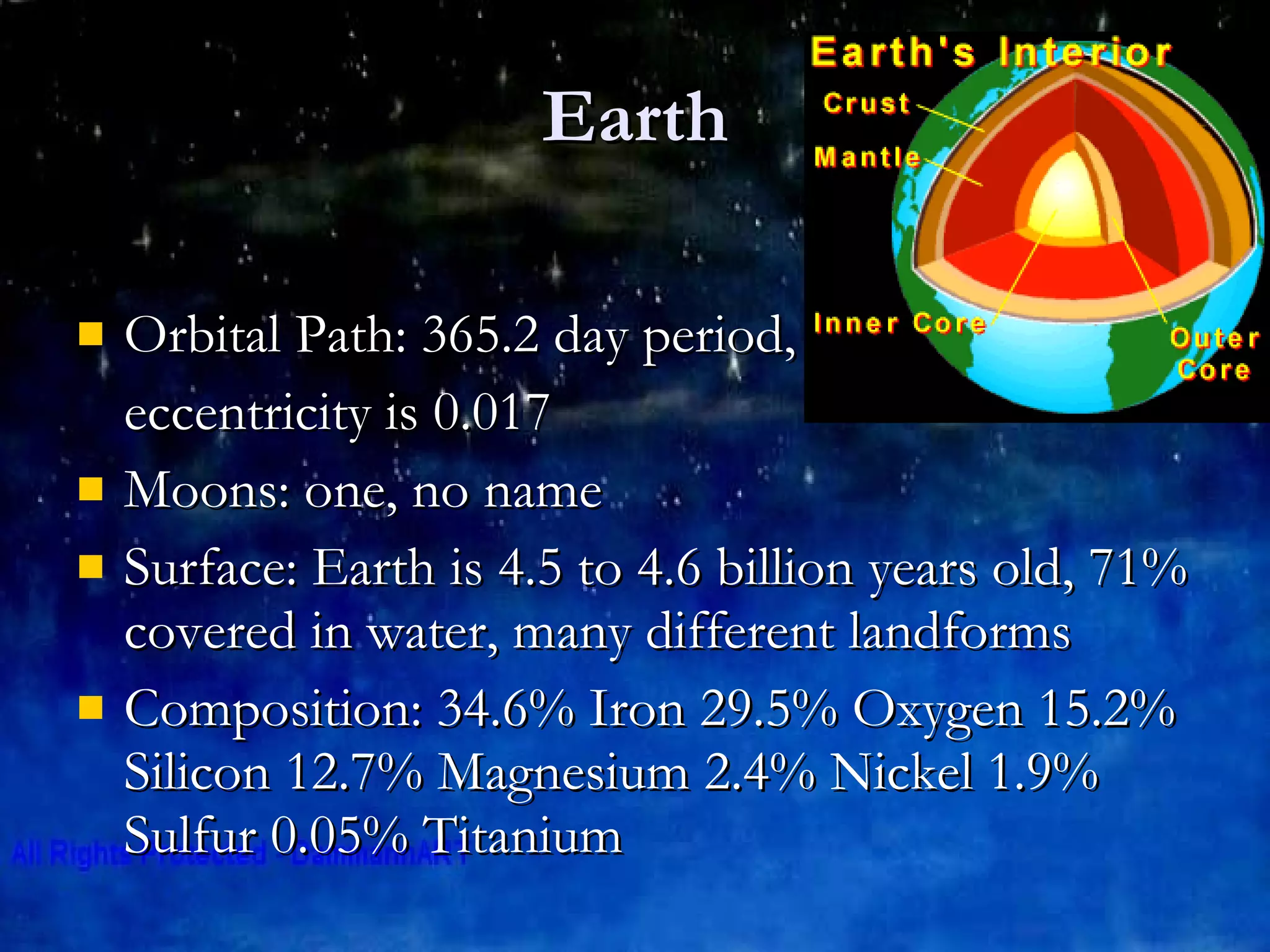
Earth Orbital Path: 365.2 day period,  eccentricity is 0.017 Moons: one, no name Surface: Earth is 4.5 to 4.6 billion years old, 71% covered in water, many different landforms Composition: 34.6% Iron 29.5% Oxygen 15.2% Silicon 12.7% Magnesium 2.4% Nickel 1.9% Sulfur 0.05% Titanium
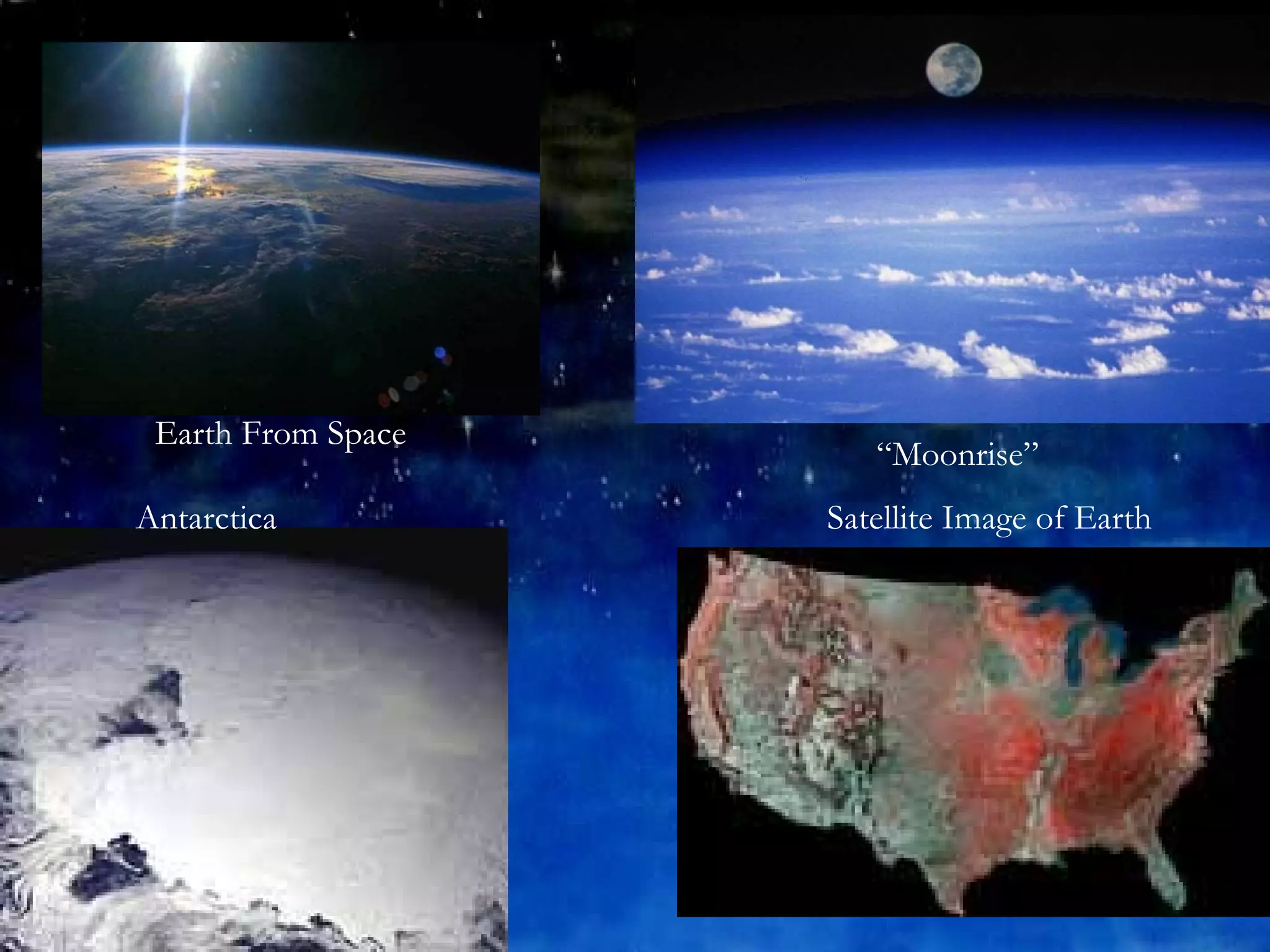
“ Moonrise” Antarctica Earth From Space Satellite Image of Earth
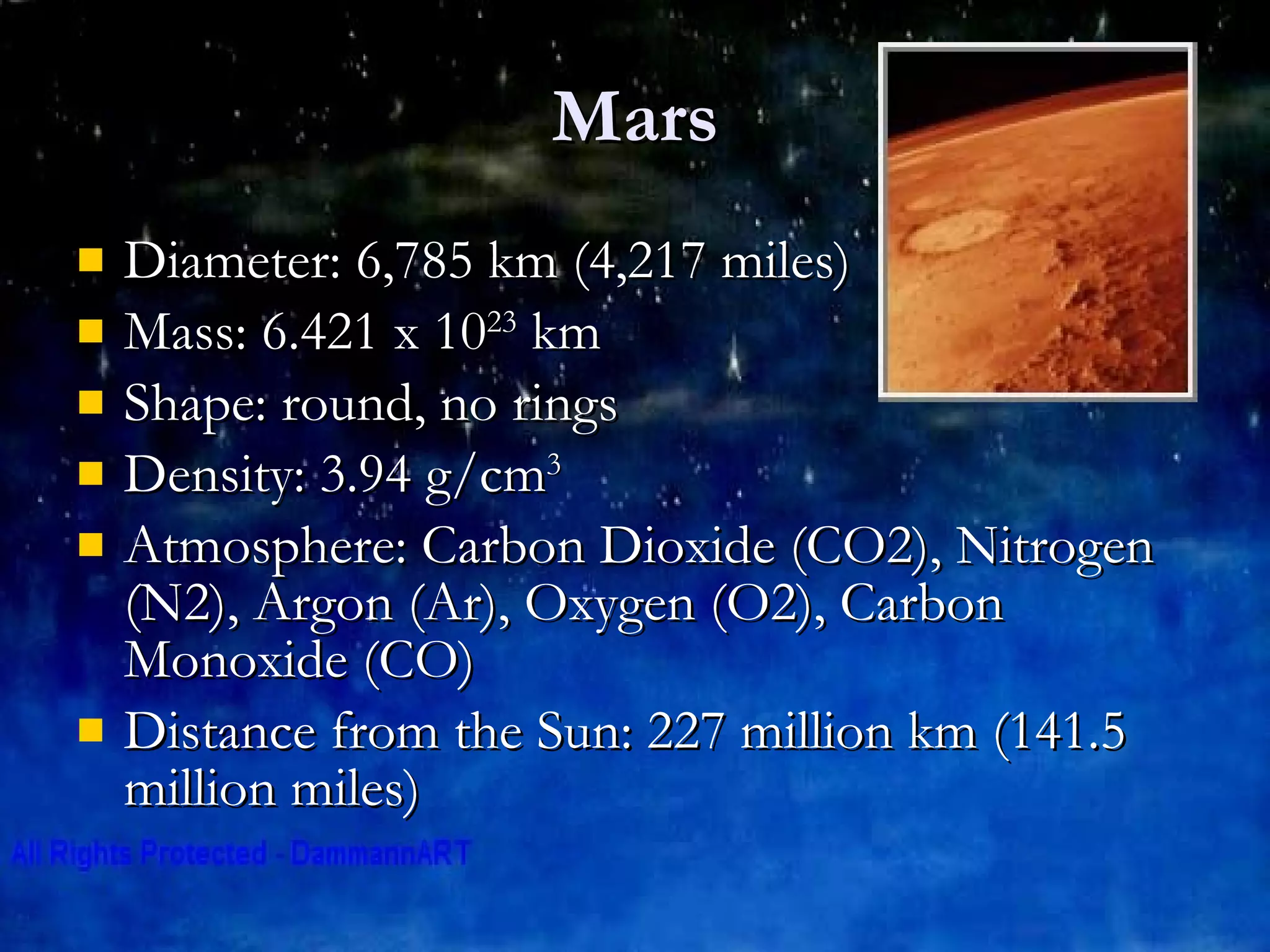
Mars Diameter: 6,785 km (4,217 miles)  Mass: 6.421 x 10 23  km Shape: round, no rings Density: 3.94 g/cm 3 Atmosphere: Carbon Dioxide (CO2), Nitrogen (N2), Argon (Ar), Oxygen (O2), Carbon Monoxide (CO) Distance from the Sun: 227 million km (141.5 million miles)
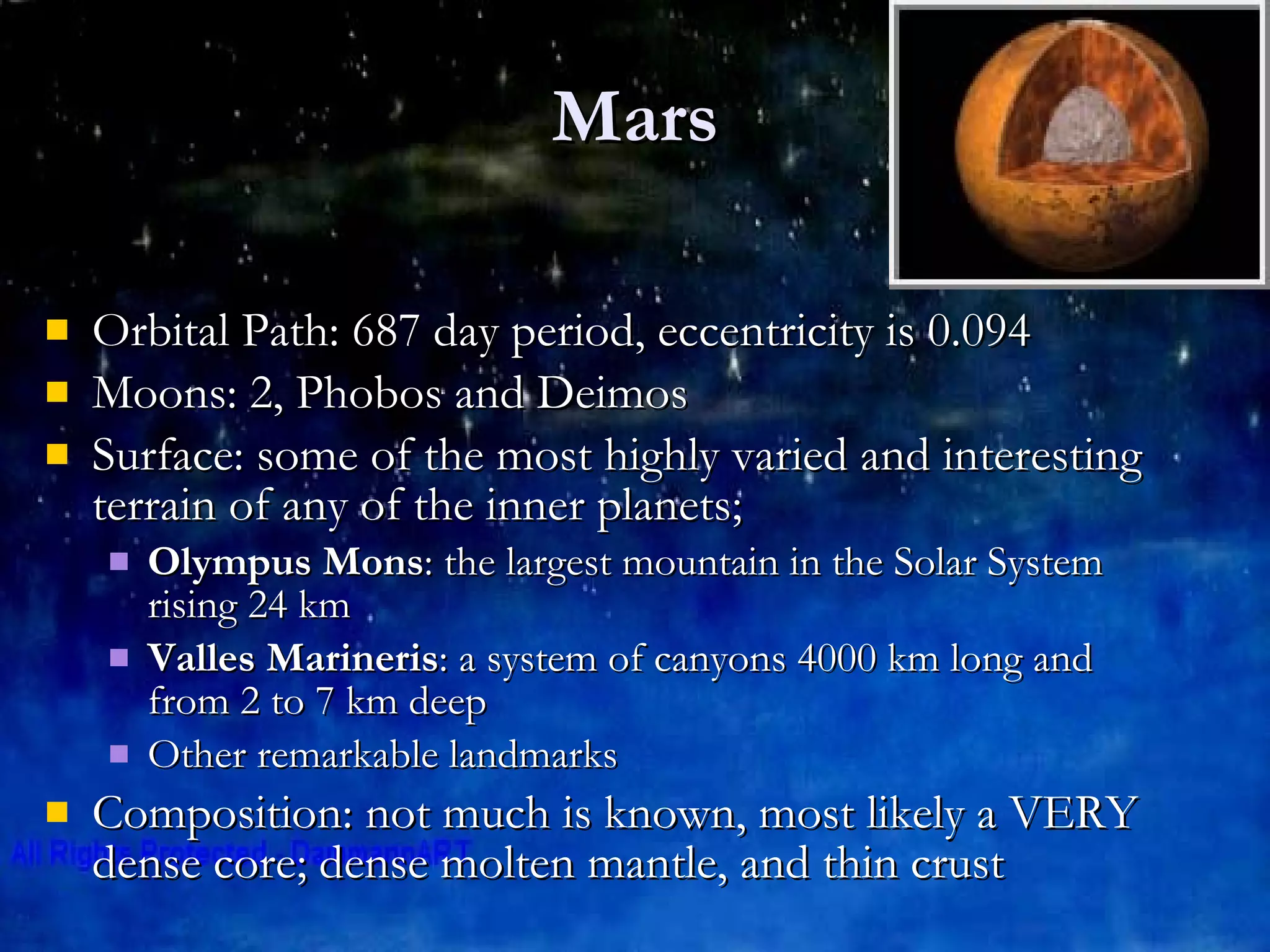
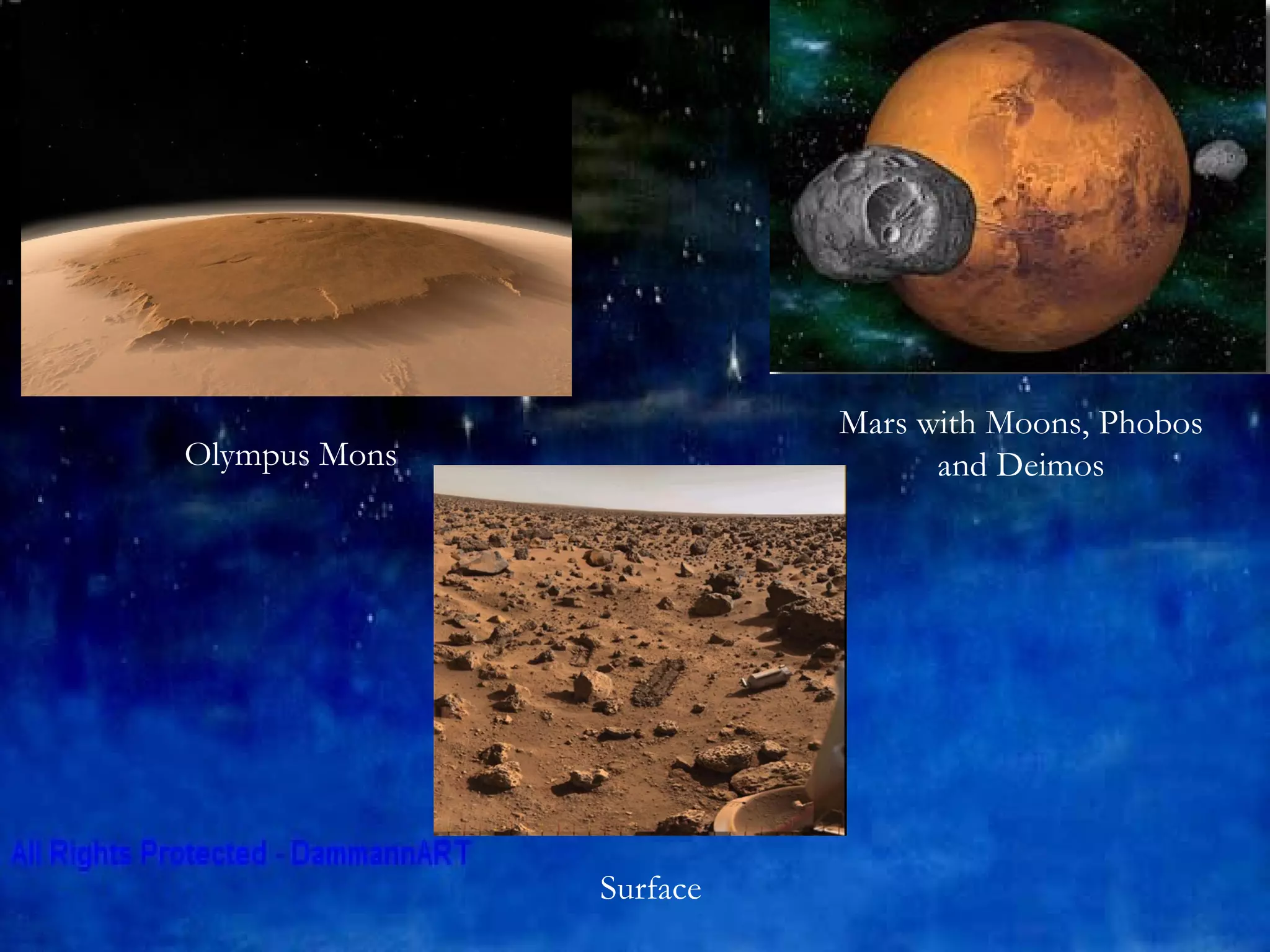
Mars Orbital Path: 687 day period, eccentricity is 0.094 Moons: 2, Phobos and Deimos Surface: some of the most highly varied and interesting terrain of any of the inner planets;  Olympus Mons : the largest mountain in the Solar System rising 24 km  Valles Marineris : a system of canyons 4000 km long and from 2 to 7 km deep  Other remarkable landmarks Composition: not much is known, most likely a VERY dense core; dense molten mantle, and thin crust
Olympus Mons Mars with Moons, Phobos and Deimos Surface
Inner Planet Orbit
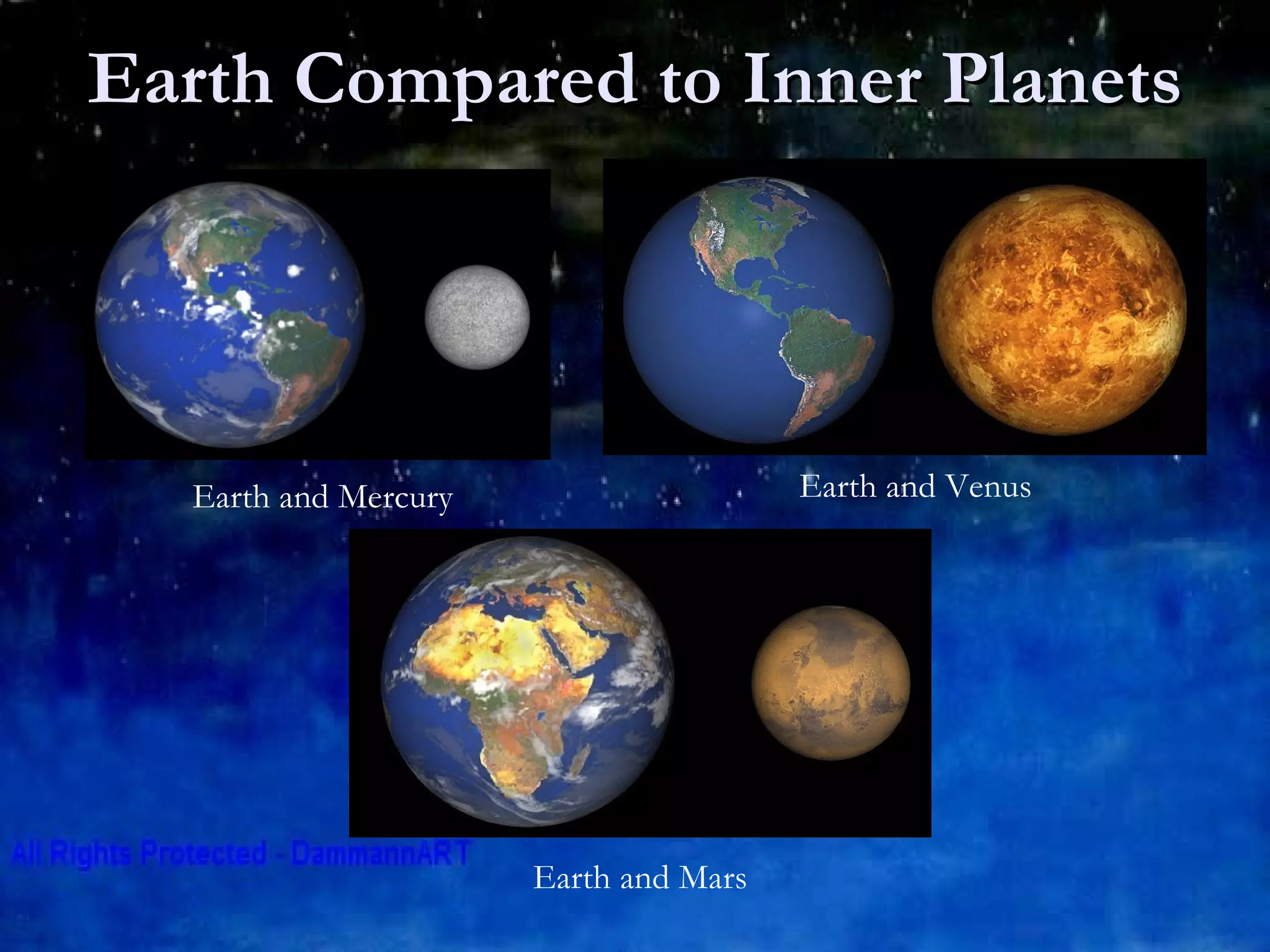
Earth Compared to Inner Planets Earth and Venus Earth and Mercury Earth and Mars
Copyright Information All facts were retrieved via Yahoo Search for Planetary Facts All pictures were retrieved via Yahoo Search for pictures Pictures of Earth with planets retrieved © Walter Myers from www.arcadiastreet.com

The Inner Planets

  • 1.
    The Inner PlanetsMercury, Venus, Earth, and Mars
  • 2.
    The Inner PlanetsThe inner planets are the four that are the closest to the sun. They have shorter orbits than the Outer Planets. They are also called the terrestrial planets.
  • 3.
    Mercury Diameter: 4,878km (3,030 miles) Mass: 3.3 x 10 23 Density: 5.427 g/cm 3 Shape: round, no rings Atmosphere: Oxygen (O2), Sodium (Na), Hydrogen (H2), Helium (He), Potassium (K), and possible trace amounts of other elements Distance from the Sun: 57 million km (36 million miles)
  • 4.
    Mercury Orbital Path:88 day period, eccentricity of 0.205 (0 is a perfect circle) Moons: none Surface: heavily cratered, like our moon. Largest crater is called the Caloris Basin Composition: thin crust, 60-70% Iron
  • 5.
  • 6.
    Venus Diameter: 12,104km (7,522 miles) Mass: 4.869 x 10 24 kg Shape: round, no rings Density: 5.243 g/cm 3 Atmosphere: 96.5% Carbon Dioxide (CO2), 3.5% Nitrogen (N2); trace amounts of other elements Distance from the Sun: 108.5 million km (67.5 million miles)
  • 7.
    Venus Orbital Path:224.7 day period, eccentricity is 0.007 retrograde motion (looking like it has turned around and gone back) Moons: none Surface: vast plains covered by lava flows and a few mountain or highland regions deformed by geological activity, numerous craters, 85% covered in volcanic rock Composition: similar to Earth, with an iron core about 3000 km in radius with a molten mantle and solid crust
  • 8.
  • 9.
    Earth Diameter: 12,753km (7,926 miles) Mass: 5.976 x 10 24 Shape: round, no rings Density: 5.515 g/cm 3 Atmosphere: 78.084% Nitrogen (N2), 20.946% Oxygen (O2); trace amounts of other elements Distance from the Sun: 149 million km (92.8 million miles)
  • 10.
    Earth Orbital Path:365.2 day period, eccentricity is 0.017 Moons: one, no name Surface: Earth is 4.5 to 4.6 billion years old, 71% covered in water, many different landforms Composition: 34.6% Iron 29.5% Oxygen 15.2% Silicon 12.7% Magnesium 2.4% Nickel 1.9% Sulfur 0.05% Titanium
  • 11.
    “ Moonrise” AntarcticaEarth From Space Satellite Image of Earth
  • 12.
    Mars Diameter: 6,785km (4,217 miles) Mass: 6.421 x 10 23 km Shape: round, no rings Density: 3.94 g/cm 3 Atmosphere: Carbon Dioxide (CO2), Nitrogen (N2), Argon (Ar), Oxygen (O2), Carbon Monoxide (CO) Distance from the Sun: 227 million km (141.5 million miles)
  • 13.
    Mars Orbital Path:687 day period, eccentricity is 0.094 Moons: 2, Phobos and Deimos Surface: some of the most highly varied and interesting terrain of any of the inner planets; Olympus Mons : the largest mountain in the Solar System rising 24 km Valles Marineris : a system of canyons 4000 km long and from 2 to 7 km deep Other remarkable landmarks Composition: not much is known, most likely a VERY dense core; dense molten mantle, and thin crust
  • 14.
    Olympus Mons Marswith Moons, Phobos and Deimos Surface
  • 15.
  • 16.
    Earth Compared toInner Planets Earth and Venus Earth and Mercury Earth and Mars
  • 17.
    Copyright Information Allfacts were retrieved via Yahoo Search for Planetary Facts All pictures were retrieved via Yahoo Search for pictures Pictures of Earth with planets retrieved © Walter Myers from www.arcadiastreet.com