
EVOLUTION
OF UNIVERSE
INDEX
 INTRODUCTION
 MAIN THEORIES
 BIG BANG THEORY
 STEADY STATE THEORY
 PULSATING THEORY
INTRODUCTION
The study of the evolution of the universe from its first
moments to the present is called Cosmology.
“If being educated means having an informed sense
of time and place, then it is essential for a person to
be familiar with the scientific aspects of the
universe and know something of its origin and
structure.”
MAIN THEORIES
The three main theories put forward to explain
the origin and evolution of the universe are:
I. The Big Bang Theory
II. The Steady State Theory
III. The Pulsating Theory
However, Big Bang Theory is the generally
accepted Theory explaining evolution of
universe.
THE BIG BANG THEORY
Le Maitre and Gammow proposed this theory in 1927.
According to this theory, at the beginning of the
universe, the whole matter of the universe was
once concentrated in an extremely dense and hot
(~10 12K) fireball. Then about 20 billion years ago a
vast explosion (big bang) occurred. The matter was
broken into pieces, which were thrown out with high
speed in all directions forming stars and galaxies;
which are still moving way from one another.
According to Hubble's law, the light rays from stars
and galaxies, which are situated at a distance of 20
billion light years or more, can never reach us. Thus
this distance becomes the boundary of observable
universe. On account of continuous recession,
more and more galaxies will go beyond this
boundary and the will be lost. As a result of this, the
number of galaxies per unit volume will go on
decreasing and ultimately a time may come when
we may have empty universe.
Hubble found experimental evidence (1929) –
galaxies are moving away from us with speeds
proportional to their distance.
Big Bang – what is it?
• Collapsing cloud of interstellar dust
• Cloud dense and cold so collapses under its own
self-gravity (cold gas has less internal pressure to
counteract gravity)
• Once collapsed, it immediately warms up because
of release of gravitational energy during collapse
• All mass and energy concentrated at a geometric
point
BIG BANG
 ~ 14 or 15 billion year ago
 Beginning of space and time
 Expansion/cooling of universe began
 Protons and neutrons formed
 Cooling initiated the formation of atoms – first
mostly H (the most abundant form of matter in
the universe) and He (two lightest elements).
Formation of galaxy and stars
• Galaxy – rotating aggregation of stars, dust, gas
and debris held together by gravity
• Stars are massive spheres of incandescent gases
• 100’s of billions of galaxies in the universe and
100’s of billions of stars in the galaxies
 Sun is a star
 Sun plus its family of planets is our solar
system
 Our solar system formed about 5 BY ago
 Our solar system orbits the Galaxy’s core
(230 million year orbit at 280 km/s)
Stars
• Stars form in nebulae, large diffuse clouds of dust
and gas.
• Condensation theory – spinning nebula starts to
shrink and heat under its own gravity
• At temperature of ~10 million degrees C, nuclear
fusion begins (H’s fuse to form He) which releases
energy and stops shrinkage
• Star is stable once fusion reactions begin (form
atoms as heavy as C and O)
Our Solar System
 Our solar nebula was struck by a supernova
 Caused our condensing nebula to spin
 Introduced heavy atoms to seed the formation of
planets
 5 BY ago, the solar nebula was 75% H, 23% He
and 2% other material
 Center became protosun
 Outer material became planets – smaller bodies
that orbit a star but do not shine by their own light
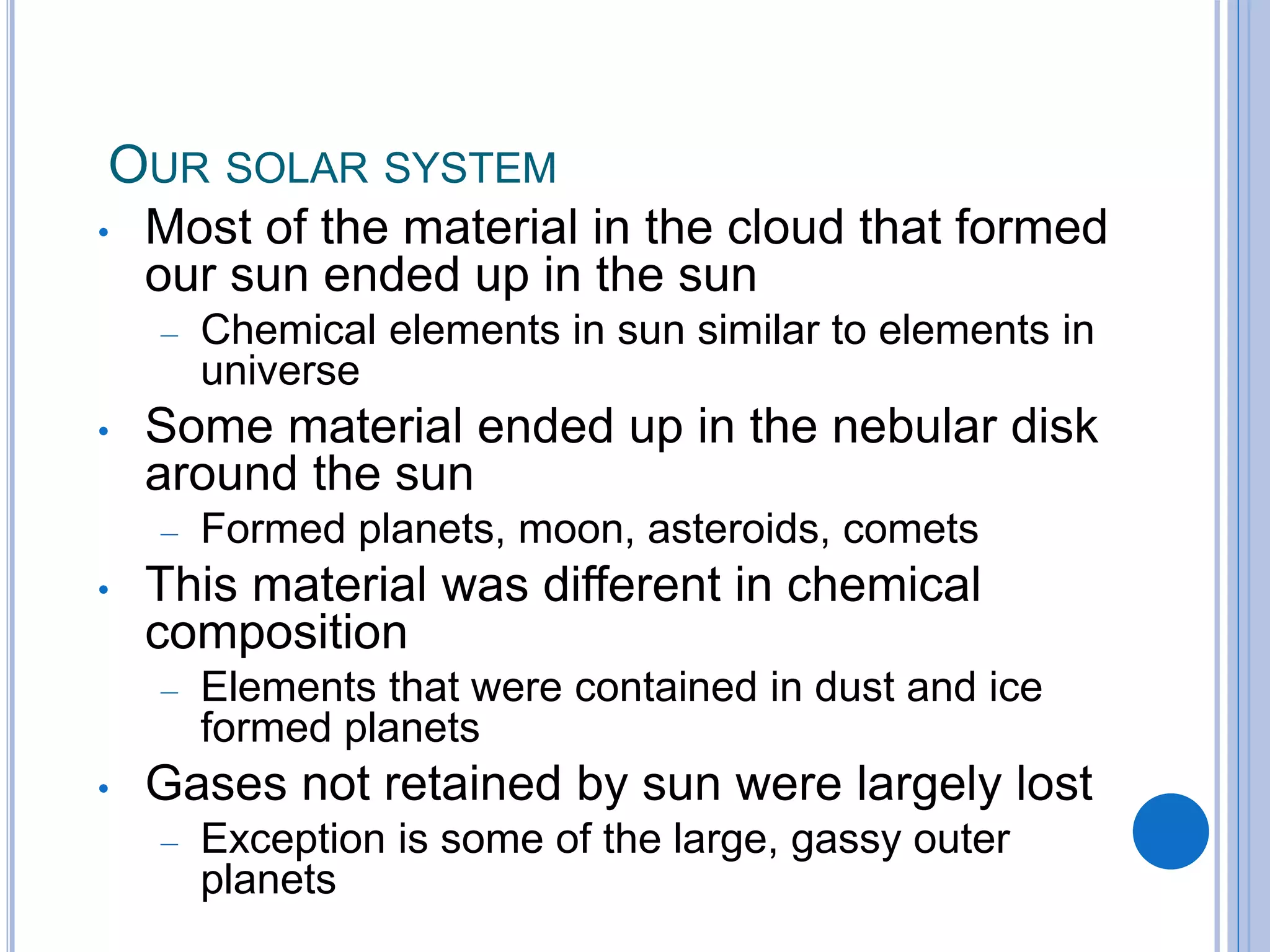
OUR SOLAR SYSTEM
• Most of the material in the cloud that formed
our sun ended up in the sun
– Chemical elements in sun similar to elements in
universe
• Some material ended up in the nebular disk
around the sun
– Formed planets, moon, asteroids, comets
• This material was different in chemical
composition
– Elements that were contained in dust and ice
formed planets
• Gases not retained by sun were largely lost
– Exception is some of the large, gassy outer
planets
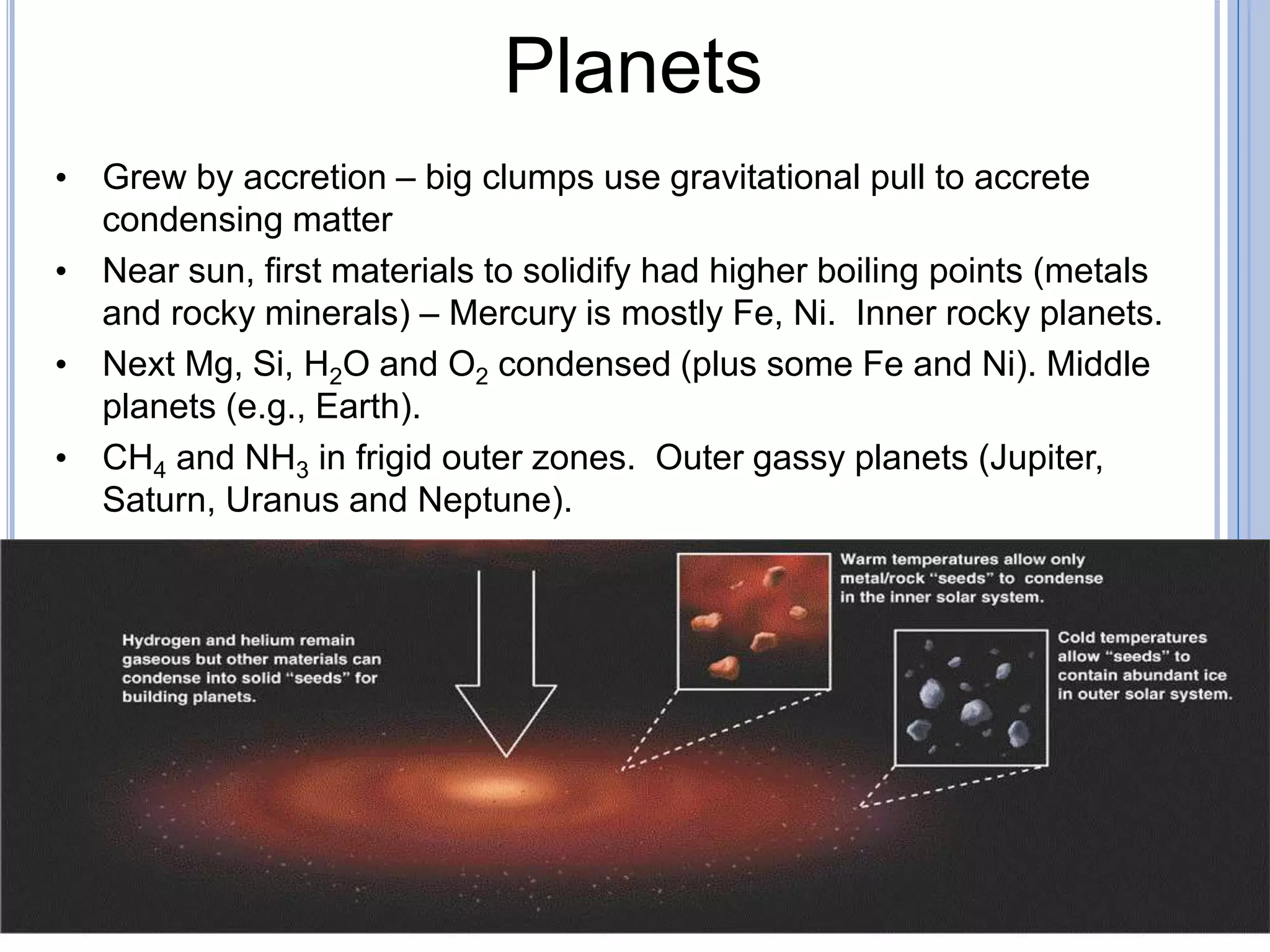
Planets
• Grew by accretion – big clumps use gravitational pull to accrete
condensing matter
• Near sun, first materials to solidify had higher boiling points (metals
and rocky minerals) – Mercury is mostly Fe, Ni. Inner rocky planets.
• Next Mg, Si, H2O and O2 condensed (plus some Fe and Ni). Middle
planets (e.g., Earth).
• CH4 and NH3 in frigid outer zones. Outer gassy planets (Jupiter,
Saturn, Uranus and Neptune).
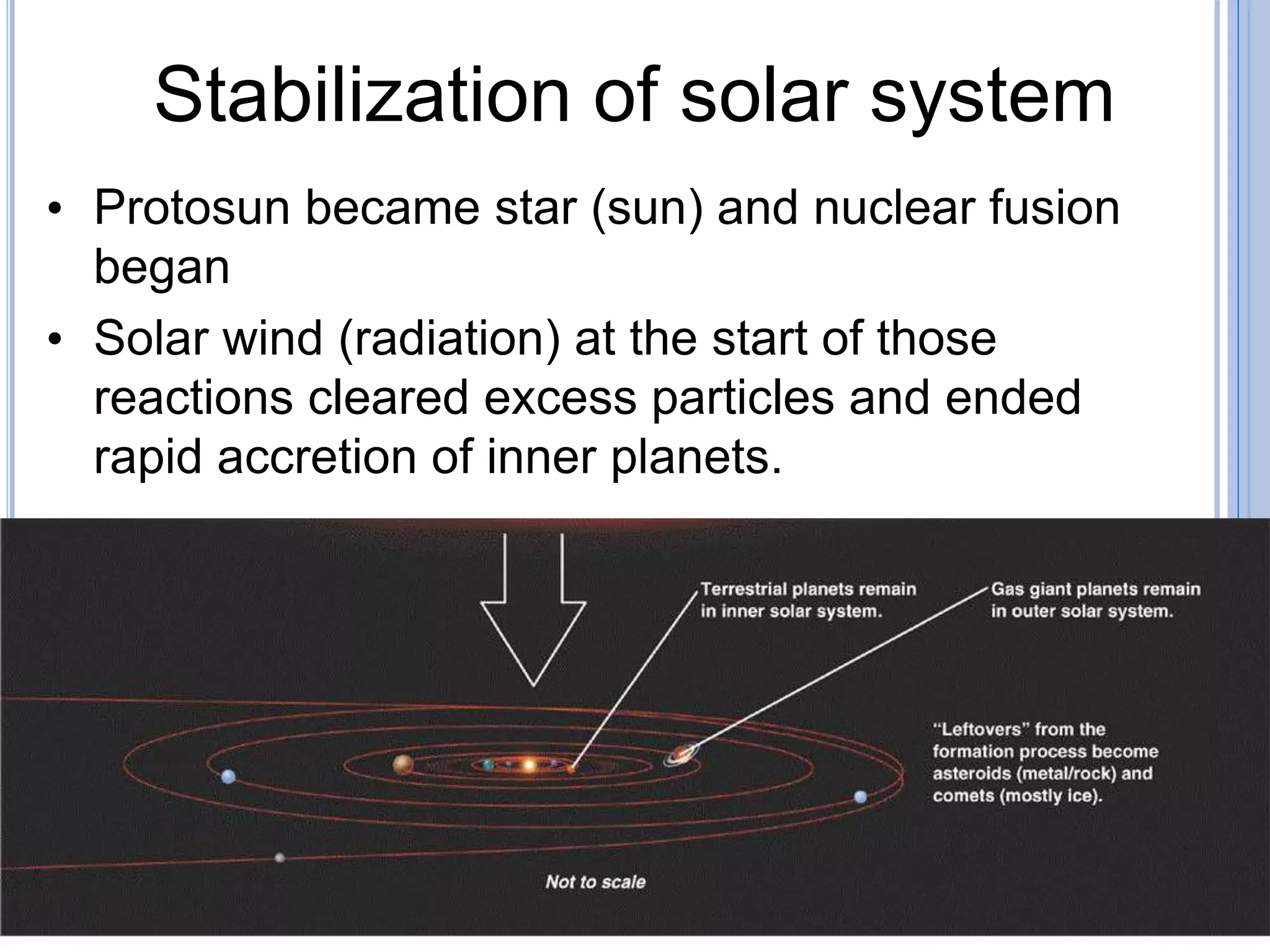
Stabilization of solar system
• Protosun became star (sun) and nuclear fusion
began
• Solar wind (radiation) at the start of those
reactions cleared excess particles and ended
rapid accretion of inner planets.
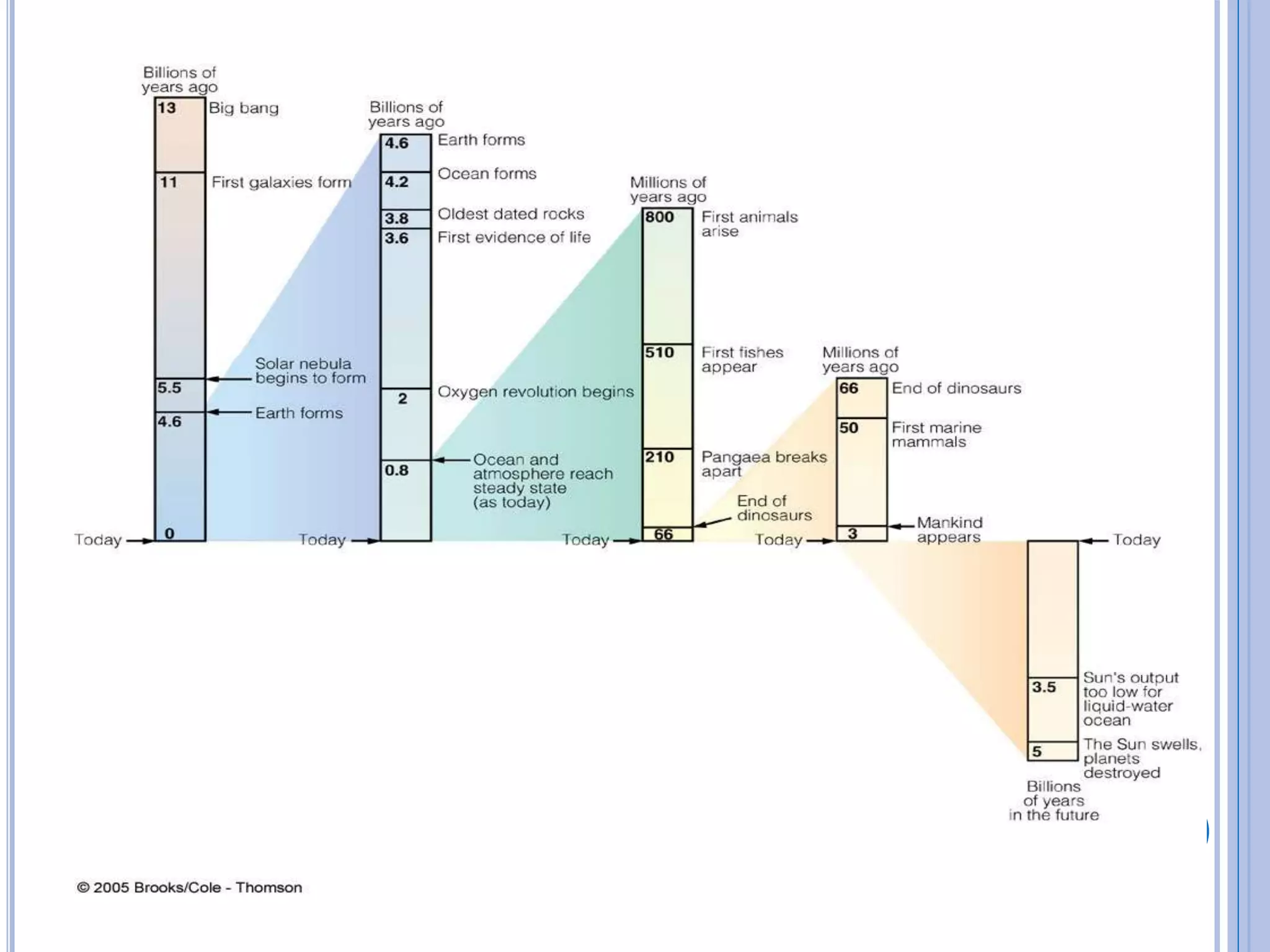
Timeline (since big bang)
• 10-35 sec ABB (The Big Bang)
• The universe is an infinitely dense, hot fireball.
• 10-6 sec ABB (1 millionth of a second)
• Universe forms: Expansion slows down; universe cools and becomes
less dense
• The most basic forces in nature become distinct: first gravity, then the
strong force, which holds nuclei of atoms together, followed by the
weak and electromagnetic forces. By the first second, the universe is
made up of fundamental particles and energy: quarks, electrons,
photons, neutrinos and less familiar types. These particles smash
together to form protons and neutrons.
• 3 sec ABB
• Formation of basic elements
• Protons and neutrons come together to form the nuclei of simple
elements: hydrogen (1 proton), helium (2 protons) and lithium (3
protons) (1, 2 and 3 in periodic table).
• 300,000 yr ABB
• Matter dominates
• As universe expands, waves of light are stretched to lower and lower
energy, while the matter travels onward largely unaffected. Neutral
atoms are formed as electrons link up with hydrogen and helium
nuclei. Microwave background radiation gives us a direct picture of
how matter was distributed at this early time.
• 300 MY ABB
• Birth of stars and galaxies.
• Gravity amplifies slight irregularities in the density of the
primordial gas. Even as the universe continues to expand
rapidly, pockets of gas become more and more dense. Stars
ignite within these pockets, and groups of stars become the
earliest galaxies. (Still perhaps 12 to 15 billion years before the
present).
• 5 BY ago: Birth of the Sun
•The sun forms within a cloud of gas in a spiral arm of the Milky
Way Galaxy. A vast disk of gas and debris that swirls around this
new star gives birth to planets, moons, and asteroids.
• 3.8 BY ago: Earliest Life
• The Earth has cooled and an atmosphere develops. Microscopic
living cells, neither plants nor animals, begin to evolve and flourish
in earth's many volcanic environments.
• 700 MY ago: Primitive Animals appear
• These are mostly flatworms, jellyfish and algae. By 570 million
years before the present, large numbers of creatures with hard
shells suddenly appear.
• 200 MY ago: Mammals appear
• The first mammals evolved from a class of reptiles that evolved
mammalian traits, such as a segmented jaw and a series of bones
that make up the inner ear.
• 65 MY ago: Dinosaurs become extinct
• An asteroid or comet slams into the northern part of the
Yucatan Peninsula in Mexico. This world-wide cataclysm
brings to an end the long age of the dinosaurs, and allows
mammals to diversify and expand their ranges.
• 600,000 yr ago: Homo sapiens evolve
• Our earliest ancestors evolve in Africa from a line of
creatures that descended from apes.
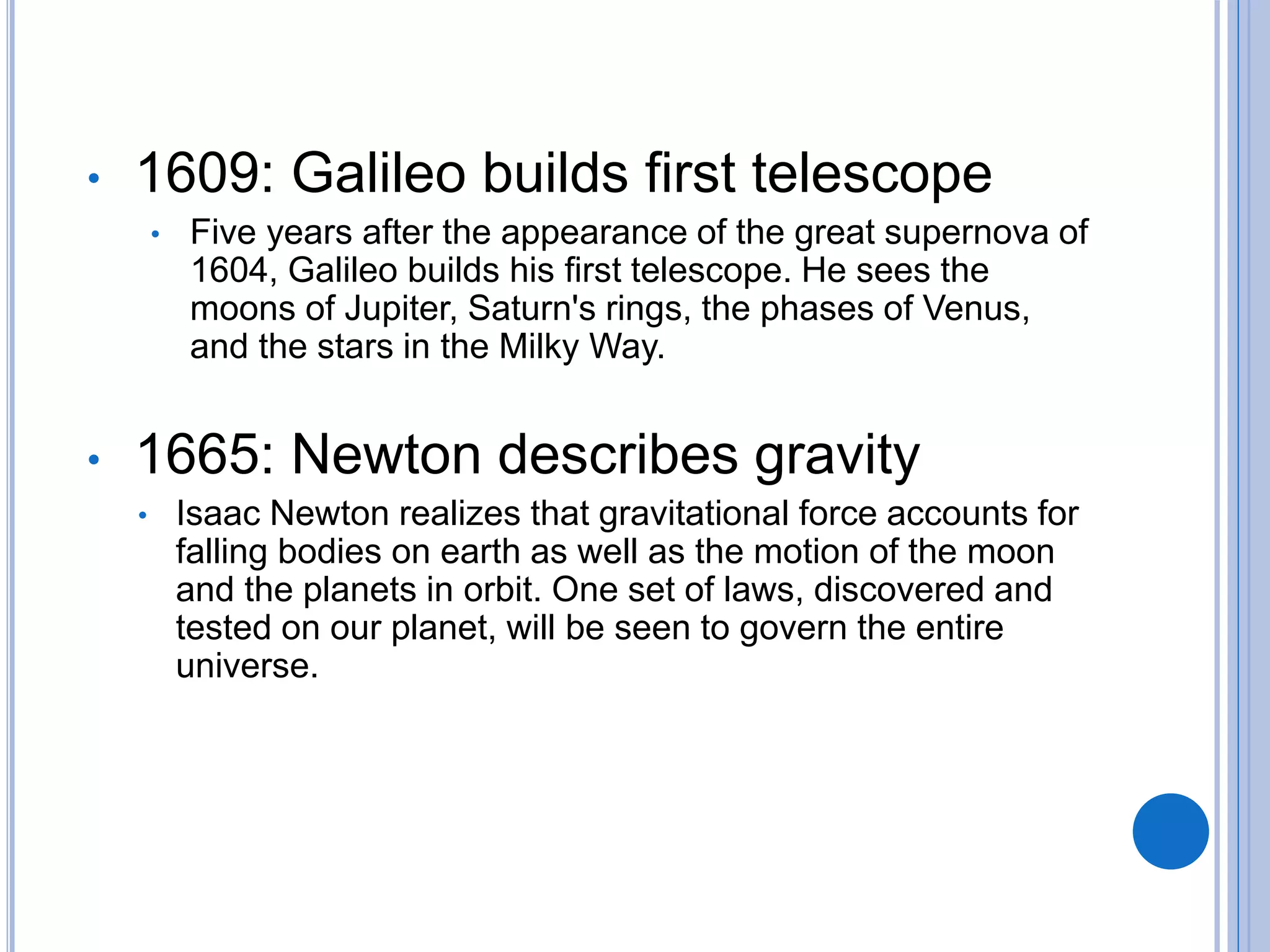
• 1609: Galileo builds first telescope
• Five years after the appearance of the great supernova of
1604, Galileo builds his first telescope. He sees the
moons of Jupiter, Saturn's rings, the phases of Venus,
and the stars in the Milky Way.
• 1665: Newton describes gravity
• Isaac Newton realizes that gravitational force accounts for
falling bodies on earth as well as the motion of the moon
and the planets in orbit. One set of laws, discovered and
tested on our planet, will be seen to govern the entire
universe.
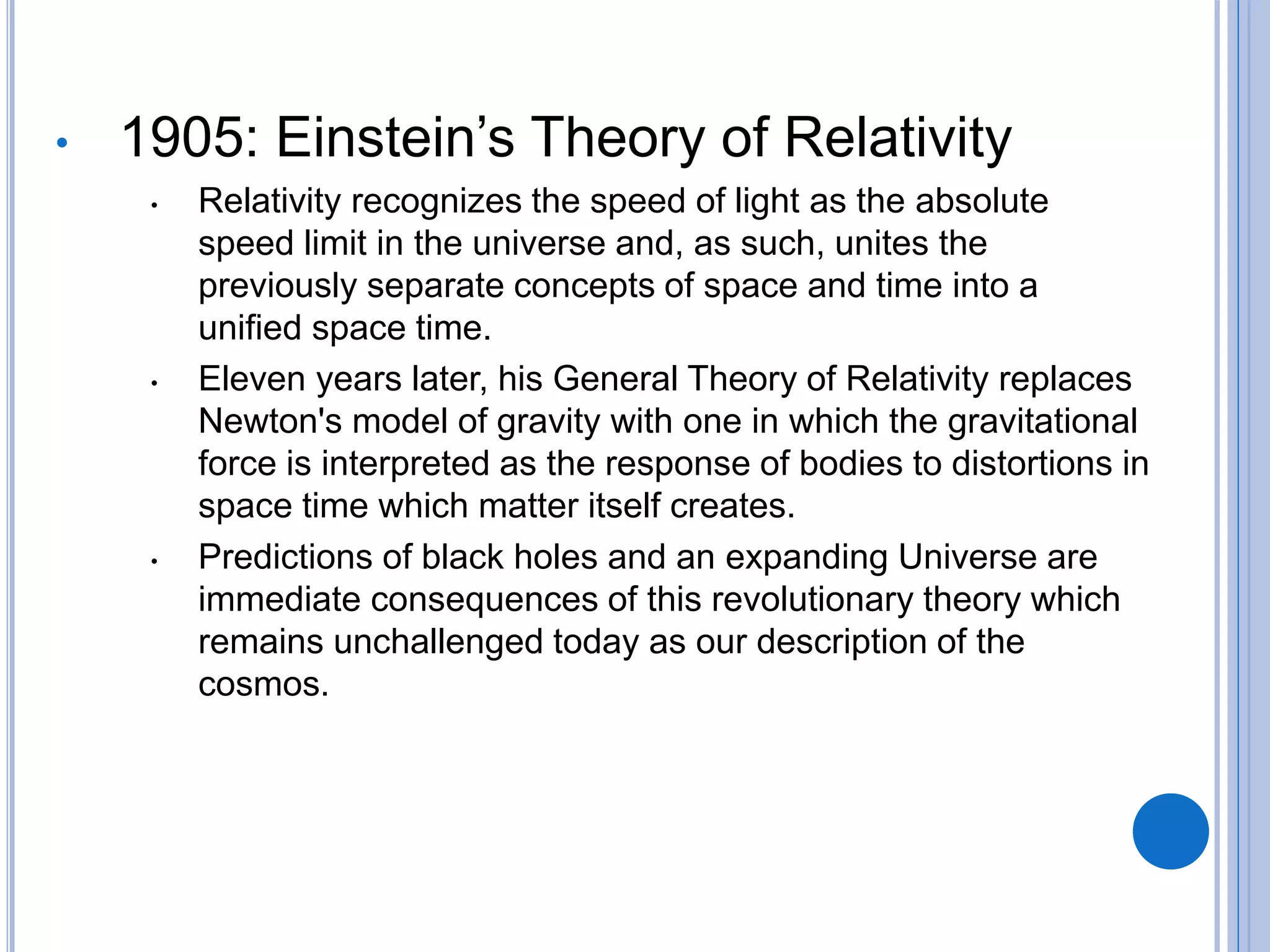
• 1905: Einstein’s Theory of Relativity
• Relativity recognizes the speed of light as the absolute
speed limit in the universe and, as such, unites the
previously separate concepts of space and time into a
unified space time.
• Eleven years later, his General Theory of Relativity replaces
Newton's model of gravity with one in which the gravitational
force is interpreted as the response of bodies to distortions in
space time which matter itself creates.
• Predictions of black holes and an expanding Universe are
immediate consequences of this revolutionary theory which
remains unchallenged today as our description of the
cosmos.
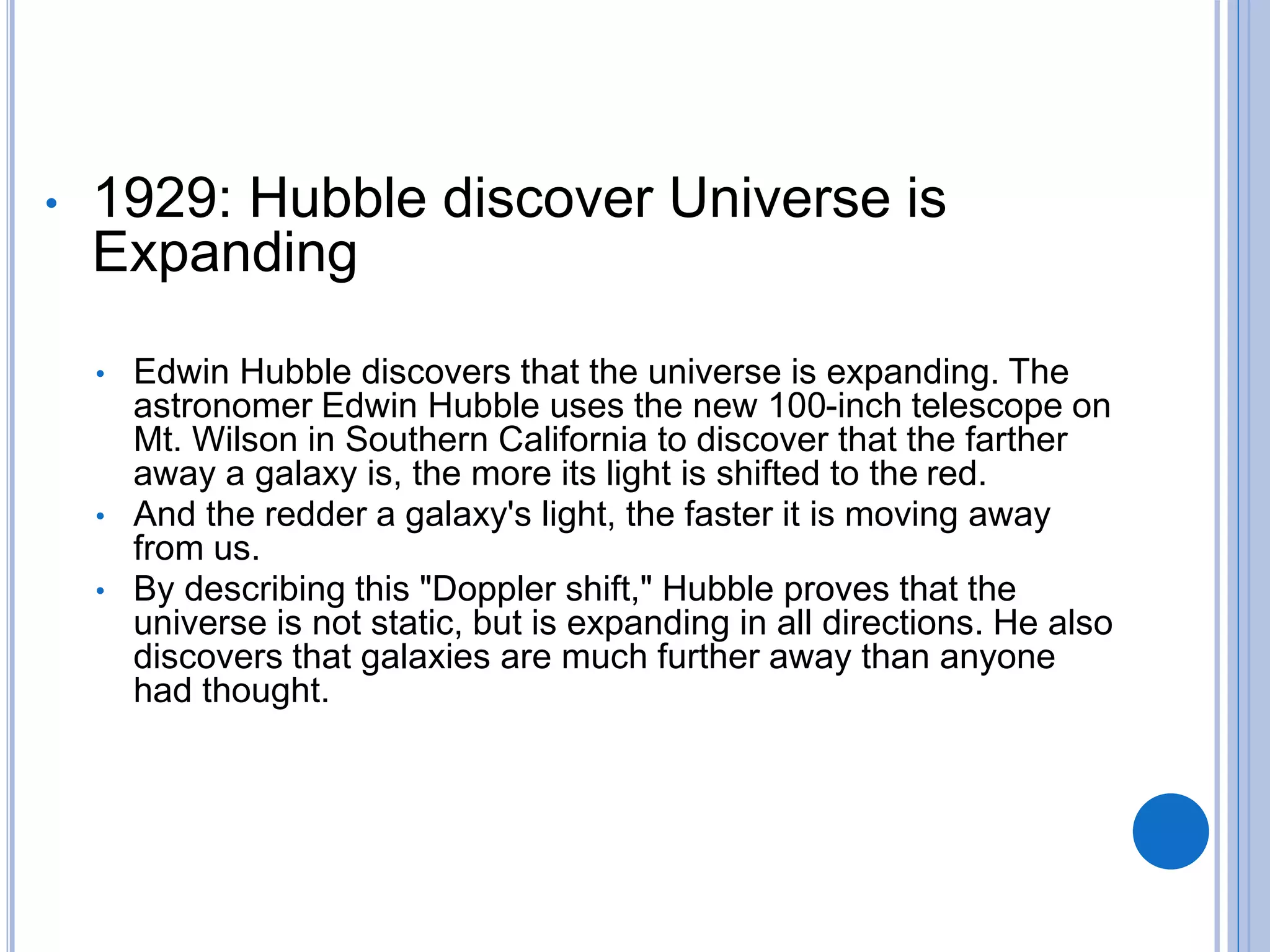
• 1929: Hubble discover Universe is
Expanding
• Edwin Hubble discovers that the universe is expanding. The
astronomer Edwin Hubble uses the new 100-inch telescope on
Mt. Wilson in Southern California to discover that the farther
away a galaxy is, the more its light is shifted to the red.
• And the redder a galaxy's light, the faster it is moving away
from us.
• By describing this "Doppler shift," Hubble proves that the
universe is not static, but is expanding in all directions. He also
discovers that galaxies are much further away than anyone
had thought.
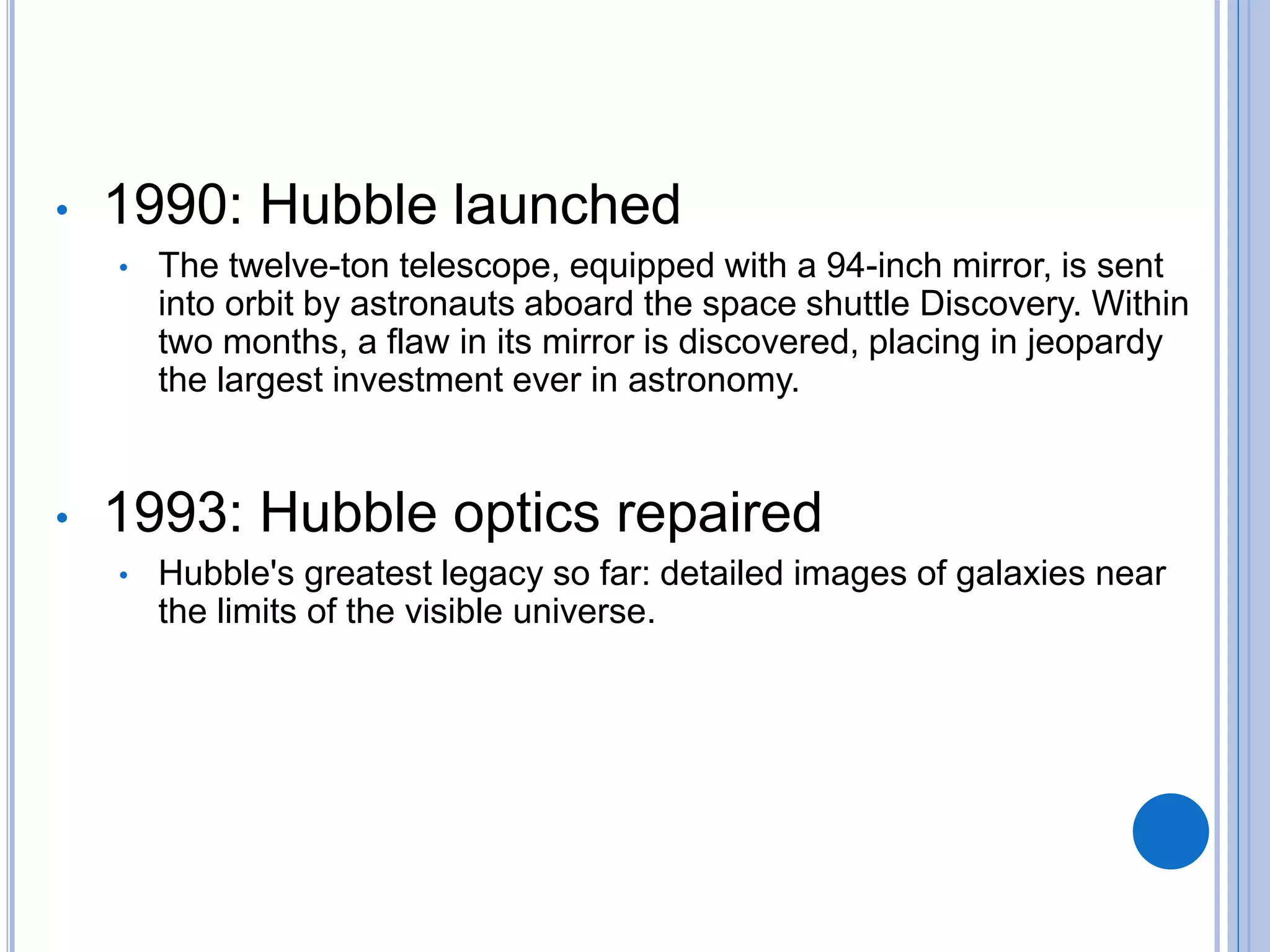
• 1990: Hubble launched
• The twelve-ton telescope, equipped with a 94-inch mirror, is sent
into orbit by astronauts aboard the space shuttle Discovery. Within
two months, a flaw in its mirror is discovered, placing in jeopardy
the largest investment ever in astronomy.
• 1993: Hubble optics repaired
• Hubble's greatest legacy so far: detailed images of galaxies near
the limits of the visible universe.
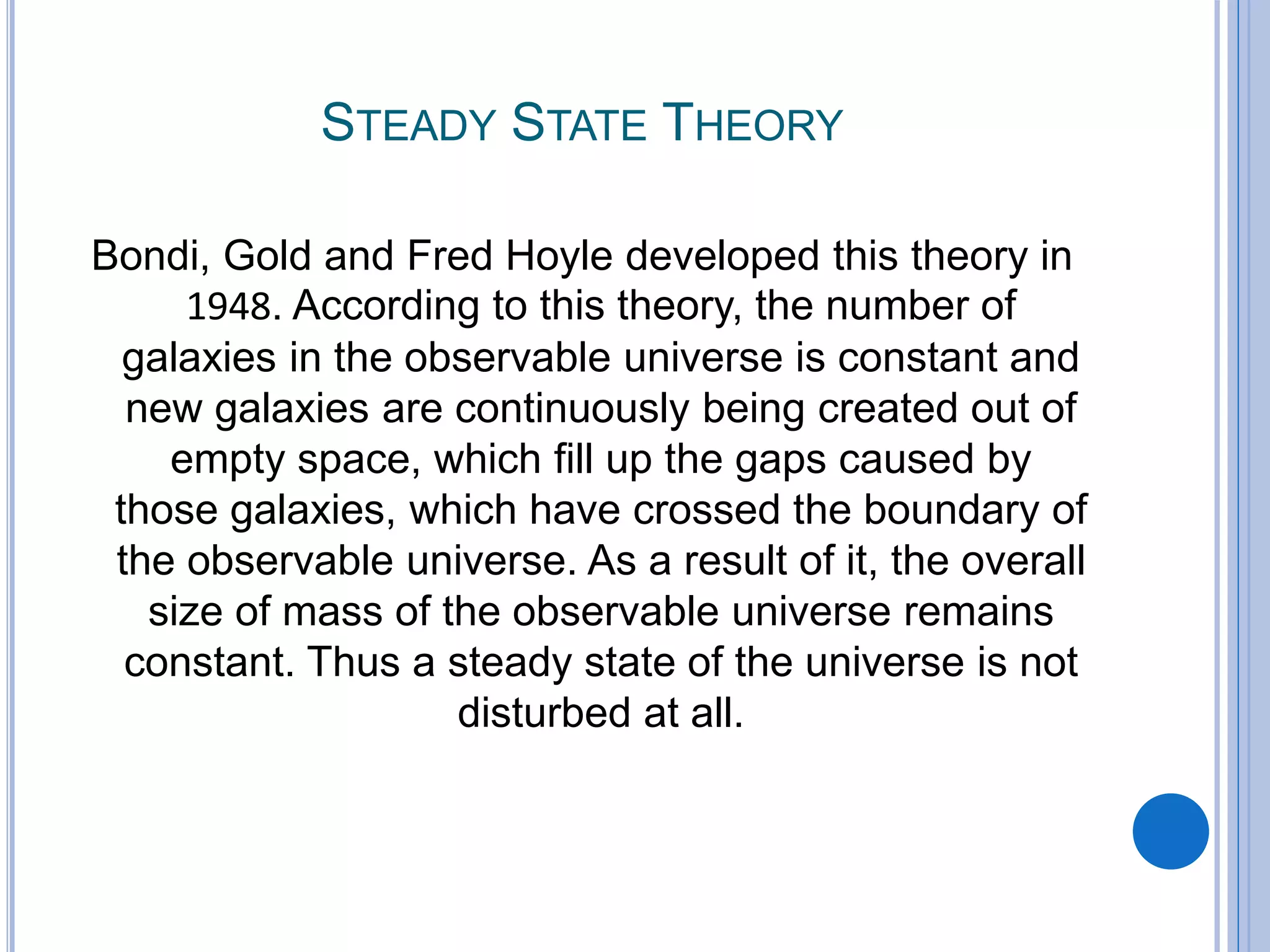
STEADY STATE THEORY
Bondi, Gold and Fred Hoyle developed this theory in
1948. According to this theory, the number of
galaxies in the observable universe is constant and
new galaxies are continuously being created out of
empty space, which fill up the gaps caused by
those galaxies, which have crossed the boundary of
the observable universe. As a result of it, the overall
size of mass of the observable universe remains
constant. Thus a steady state of the universe is not
disturbed at all.
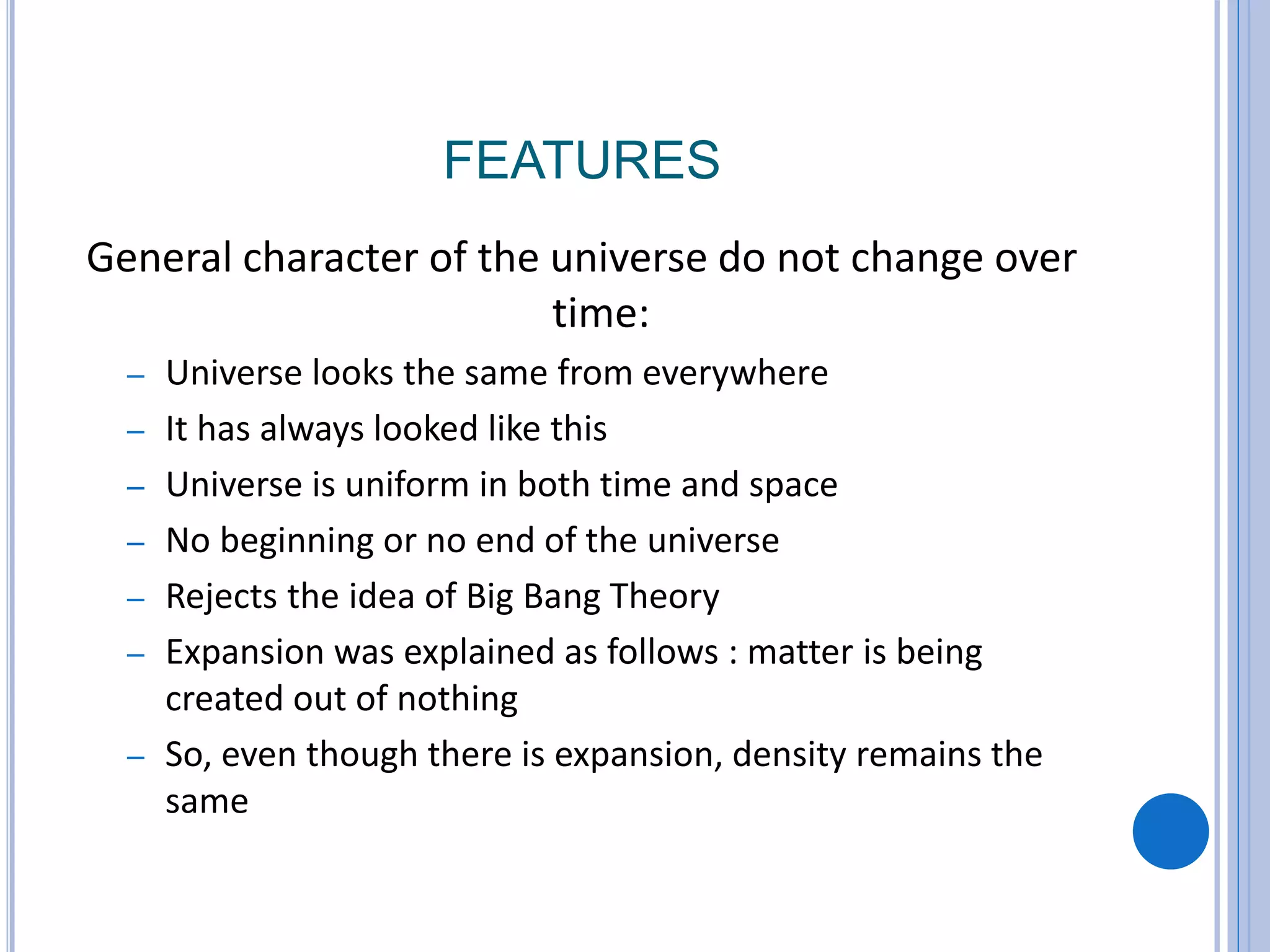
FEATURES
General character of the universe do not change over
time:
– Universe looks the same from everywhere
– It has always looked like this
– Universe is uniform in both time and space
– No beginning or no end of the universe
– Rejects the idea of Big Bang Theory
– Expansion was explained as follows : matter is being
created out of nothing
– So, even though there is expansion, density remains the
same
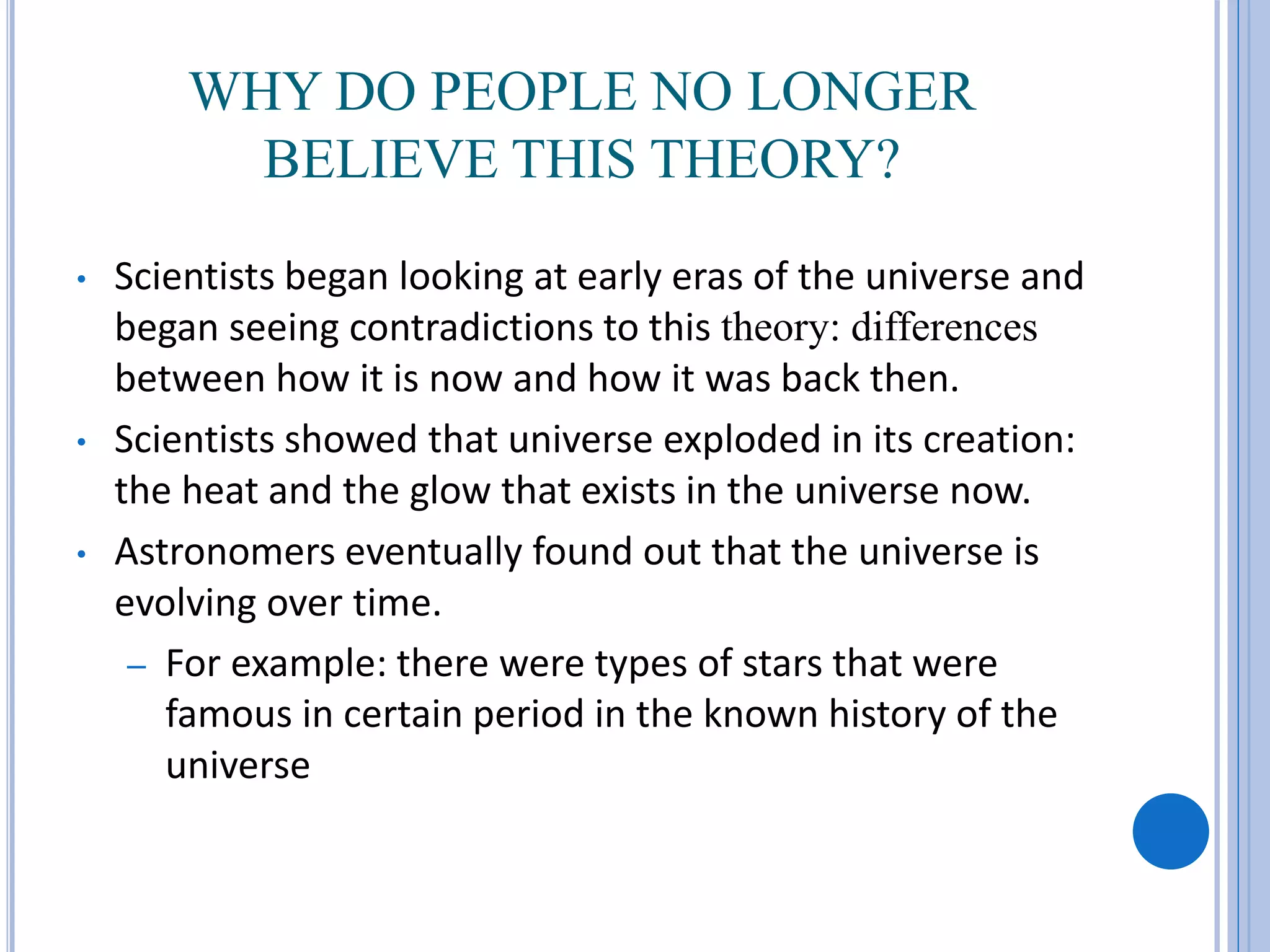
WHY DO PEOPLE NO LONGER
BELIEVE THIS THEORY?
• Scientists began looking at early eras of the universe and
began seeing contradictions to this theory: differences
between how it is now and how it was back then.
• Scientists showed that universe exploded in its creation:
the heat and the glow that exists in the universe now.
• Astronomers eventually found out that the universe is
evolving over time.
– For example: there were types of stars that were
famous in certain period in the known history of the
universe
REFINED VERSION
•It is irrelevant to science now because it has been proven
wrong.
•This theory led to its refined version: the Big Bang Theory.
This was the result of experiments and scientific evidence.
While scientists and astronomers tried proving the Steady-
state theory, they disproved it but they proved another
theory called the Big Bang Theory and the universe
expanding forever.
•There are, however, still questions whether the Steady-
State Theory and the Big Bang Theory can be combined
since both agree on expansion.
PULSATING THEORY
According to this theory, the universe is supposed to
be expanding and contracting alternately i.e.
pulsating. At present, the universe is expanding.
According to pulsating theory, it is possible that at a
certain time, the expansion of the universe may be
stopped by the gravitational pull and the may
contract again. After it has been contracted to a
certain size, explosion again occurs and the
universe will start expanding. The alternate
expansion and contraction of the universe give rise
to pulsating universe.
THANKS

Evolution of universe

  • 1.
  • 2.
    INDEX  INTRODUCTION  MAINTHEORIES  BIG BANG THEORY  STEADY STATE THEORY  PULSATING THEORY
  • 3.
    INTRODUCTION The study ofthe evolution of the universe from its first moments to the present is called Cosmology. “If being educated means having an informed sense of time and place, then it is essential for a person to be familiar with the scientific aspects of the universe and know something of its origin and structure.”
  • 4.
    MAIN THEORIES The threemain theories put forward to explain the origin and evolution of the universe are: I. The Big Bang Theory II. The Steady State Theory III. The Pulsating Theory However, Big Bang Theory is the generally accepted Theory explaining evolution of universe.
  • 5.
    THE BIG BANGTHEORY Le Maitre and Gammow proposed this theory in 1927. According to this theory, at the beginning of the universe, the whole matter of the universe was once concentrated in an extremely dense and hot (~10 12K) fireball. Then about 20 billion years ago a vast explosion (big bang) occurred. The matter was broken into pieces, which were thrown out with high speed in all directions forming stars and galaxies; which are still moving way from one another.
  • 6.
    According to Hubble'slaw, the light rays from stars and galaxies, which are situated at a distance of 20 billion light years or more, can never reach us. Thus this distance becomes the boundary of observable universe. On account of continuous recession, more and more galaxies will go beyond this boundary and the will be lost. As a result of this, the number of galaxies per unit volume will go on decreasing and ultimately a time may come when we may have empty universe. Hubble found experimental evidence (1929) – galaxies are moving away from us with speeds proportional to their distance.
  • 7.
    Big Bang –what is it? • Collapsing cloud of interstellar dust • Cloud dense and cold so collapses under its own self-gravity (cold gas has less internal pressure to counteract gravity) • Once collapsed, it immediately warms up because of release of gravitational energy during collapse • All mass and energy concentrated at a geometric point
  • 8.
    BIG BANG  ~14 or 15 billion year ago  Beginning of space and time  Expansion/cooling of universe began  Protons and neutrons formed  Cooling initiated the formation of atoms – first mostly H (the most abundant form of matter in the universe) and He (two lightest elements).
  • 9.
    Formation of galaxyand stars • Galaxy – rotating aggregation of stars, dust, gas and debris held together by gravity • Stars are massive spheres of incandescent gases • 100’s of billions of galaxies in the universe and 100’s of billions of stars in the galaxies
  • 10.
     Sun isa star  Sun plus its family of planets is our solar system  Our solar system formed about 5 BY ago  Our solar system orbits the Galaxy’s core (230 million year orbit at 280 km/s)
  • 11.
    Stars • Stars formin nebulae, large diffuse clouds of dust and gas. • Condensation theory – spinning nebula starts to shrink and heat under its own gravity • At temperature of ~10 million degrees C, nuclear fusion begins (H’s fuse to form He) which releases energy and stops shrinkage • Star is stable once fusion reactions begin (form atoms as heavy as C and O)
  • 12.
    Our Solar System Our solar nebula was struck by a supernova  Caused our condensing nebula to spin  Introduced heavy atoms to seed the formation of planets  5 BY ago, the solar nebula was 75% H, 23% He and 2% other material  Center became protosun  Outer material became planets – smaller bodies that orbit a star but do not shine by their own light
  • 13.
    OUR SOLAR SYSTEM •Most of the material in the cloud that formed our sun ended up in the sun – Chemical elements in sun similar to elements in universe • Some material ended up in the nebular disk around the sun – Formed planets, moon, asteroids, comets • This material was different in chemical composition – Elements that were contained in dust and ice formed planets • Gases not retained by sun were largely lost – Exception is some of the large, gassy outer planets
  • 14.
    Planets • Grew byaccretion – big clumps use gravitational pull to accrete condensing matter • Near sun, first materials to solidify had higher boiling points (metals and rocky minerals) – Mercury is mostly Fe, Ni. Inner rocky planets. • Next Mg, Si, H2O and O2 condensed (plus some Fe and Ni). Middle planets (e.g., Earth). • CH4 and NH3 in frigid outer zones. Outer gassy planets (Jupiter, Saturn, Uranus and Neptune).
  • 15.
    Stabilization of solarsystem • Protosun became star (sun) and nuclear fusion began • Solar wind (radiation) at the start of those reactions cleared excess particles and ended rapid accretion of inner planets.
  • 16.
    Timeline (since bigbang) • 10-35 sec ABB (The Big Bang) • The universe is an infinitely dense, hot fireball. • 10-6 sec ABB (1 millionth of a second) • Universe forms: Expansion slows down; universe cools and becomes less dense • The most basic forces in nature become distinct: first gravity, then the strong force, which holds nuclei of atoms together, followed by the weak and electromagnetic forces. By the first second, the universe is made up of fundamental particles and energy: quarks, electrons, photons, neutrinos and less familiar types. These particles smash together to form protons and neutrons.
  • 17.
    • 3 secABB • Formation of basic elements • Protons and neutrons come together to form the nuclei of simple elements: hydrogen (1 proton), helium (2 protons) and lithium (3 protons) (1, 2 and 3 in periodic table). • 300,000 yr ABB • Matter dominates • As universe expands, waves of light are stretched to lower and lower energy, while the matter travels onward largely unaffected. Neutral atoms are formed as electrons link up with hydrogen and helium nuclei. Microwave background radiation gives us a direct picture of how matter was distributed at this early time.
  • 18.
    • 300 MYABB • Birth of stars and galaxies. • Gravity amplifies slight irregularities in the density of the primordial gas. Even as the universe continues to expand rapidly, pockets of gas become more and more dense. Stars ignite within these pockets, and groups of stars become the earliest galaxies. (Still perhaps 12 to 15 billion years before the present). • 5 BY ago: Birth of the Sun •The sun forms within a cloud of gas in a spiral arm of the Milky Way Galaxy. A vast disk of gas and debris that swirls around this new star gives birth to planets, moons, and asteroids.
  • 19.
    • 3.8 BYago: Earliest Life • The Earth has cooled and an atmosphere develops. Microscopic living cells, neither plants nor animals, begin to evolve and flourish in earth's many volcanic environments. • 700 MY ago: Primitive Animals appear • These are mostly flatworms, jellyfish and algae. By 570 million years before the present, large numbers of creatures with hard shells suddenly appear. • 200 MY ago: Mammals appear • The first mammals evolved from a class of reptiles that evolved mammalian traits, such as a segmented jaw and a series of bones that make up the inner ear.
  • 20.
    • 65 MYago: Dinosaurs become extinct • An asteroid or comet slams into the northern part of the Yucatan Peninsula in Mexico. This world-wide cataclysm brings to an end the long age of the dinosaurs, and allows mammals to diversify and expand their ranges. • 600,000 yr ago: Homo sapiens evolve • Our earliest ancestors evolve in Africa from a line of creatures that descended from apes.
  • 21.
    • 1609: Galileobuilds first telescope • Five years after the appearance of the great supernova of 1604, Galileo builds his first telescope. He sees the moons of Jupiter, Saturn's rings, the phases of Venus, and the stars in the Milky Way. • 1665: Newton describes gravity • Isaac Newton realizes that gravitational force accounts for falling bodies on earth as well as the motion of the moon and the planets in orbit. One set of laws, discovered and tested on our planet, will be seen to govern the entire universe.
  • 22.
    • 1905: Einstein’sTheory of Relativity • Relativity recognizes the speed of light as the absolute speed limit in the universe and, as such, unites the previously separate concepts of space and time into a unified space time. • Eleven years later, his General Theory of Relativity replaces Newton's model of gravity with one in which the gravitational force is interpreted as the response of bodies to distortions in space time which matter itself creates. • Predictions of black holes and an expanding Universe are immediate consequences of this revolutionary theory which remains unchallenged today as our description of the cosmos.
  • 23.
    • 1929: Hubblediscover Universe is Expanding • Edwin Hubble discovers that the universe is expanding. The astronomer Edwin Hubble uses the new 100-inch telescope on Mt. Wilson in Southern California to discover that the farther away a galaxy is, the more its light is shifted to the red. • And the redder a galaxy's light, the faster it is moving away from us. • By describing this "Doppler shift," Hubble proves that the universe is not static, but is expanding in all directions. He also discovers that galaxies are much further away than anyone had thought.
  • 24.
    • 1990: Hubblelaunched • The twelve-ton telescope, equipped with a 94-inch mirror, is sent into orbit by astronauts aboard the space shuttle Discovery. Within two months, a flaw in its mirror is discovered, placing in jeopardy the largest investment ever in astronomy. • 1993: Hubble optics repaired • Hubble's greatest legacy so far: detailed images of galaxies near the limits of the visible universe.
  • 26.
    STEADY STATE THEORY Bondi,Gold and Fred Hoyle developed this theory in 1948. According to this theory, the number of galaxies in the observable universe is constant and new galaxies are continuously being created out of empty space, which fill up the gaps caused by those galaxies, which have crossed the boundary of the observable universe. As a result of it, the overall size of mass of the observable universe remains constant. Thus a steady state of the universe is not disturbed at all.
  • 27.
    FEATURES General character ofthe universe do not change over time: – Universe looks the same from everywhere – It has always looked like this – Universe is uniform in both time and space – No beginning or no end of the universe – Rejects the idea of Big Bang Theory – Expansion was explained as follows : matter is being created out of nothing – So, even though there is expansion, density remains the same
  • 28.
    WHY DO PEOPLENO LONGER BELIEVE THIS THEORY? • Scientists began looking at early eras of the universe and began seeing contradictions to this theory: differences between how it is now and how it was back then. • Scientists showed that universe exploded in its creation: the heat and the glow that exists in the universe now. • Astronomers eventually found out that the universe is evolving over time. – For example: there were types of stars that were famous in certain period in the known history of the universe
  • 29.
    REFINED VERSION •It isirrelevant to science now because it has been proven wrong. •This theory led to its refined version: the Big Bang Theory. This was the result of experiments and scientific evidence. While scientists and astronomers tried proving the Steady- state theory, they disproved it but they proved another theory called the Big Bang Theory and the universe expanding forever. •There are, however, still questions whether the Steady- State Theory and the Big Bang Theory can be combined since both agree on expansion.
  • 30.
    PULSATING THEORY According tothis theory, the universe is supposed to be expanding and contracting alternately i.e. pulsating. At present, the universe is expanding. According to pulsating theory, it is possible that at a certain time, the expansion of the universe may be stopped by the gravitational pull and the may contract again. After it has been contracted to a certain size, explosion again occurs and the universe will start expanding. The alternate expansion and contraction of the universe give rise to pulsating universe.
  • 31.