The Formation of the
Solar System
Allison Miller
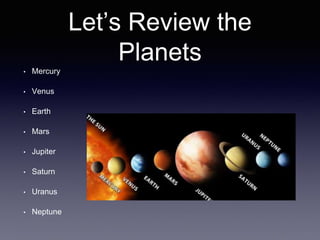
Let’s Review the
Planets
• Mercury
• Venus
• Earth
• Mars
• Jupiter
• Saturn
• Uranus
• Neptune
Mercury
• The smallest planet, and closest to
the sun
• Terrestrial planet with a thin
atmosphere
• Temperatures vary from -230
degrees to 800 degrees F
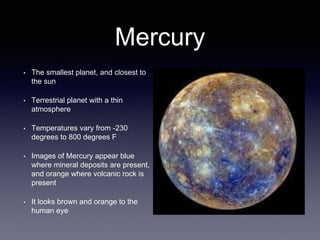
• Images of Mercury appear blue
where mineral deposits are present,
and orange where volcanic rock is
present
• It looks brown and orange to the
human eye
Venus
• Venus is a terrestrial planet slightly
smaller than Earth
• Venus rotates very slowly; One day
on Venus lasts 243 Earth days
• Venus also rotates in retrograde,
the opposite direction from Earth
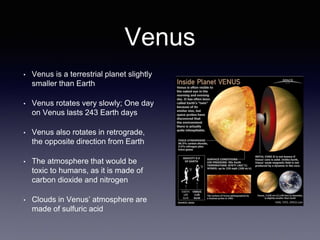
• The atmosphere that would be
toxic to humans, as it is made of
carbon dioxide and nitrogen
• Clouds in Venus’ atmosphere are
made of sulfuric acid
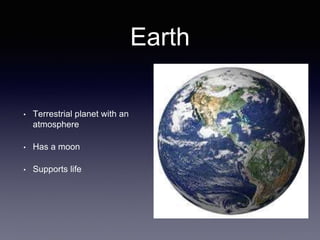
Earth
• Terrestrial planet with an
atmosphere
• Has a moon
• Supports life
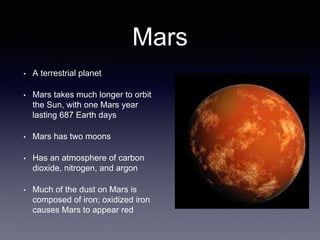
Mars
• A terrestrial planet
• Mars takes much longer to orbit
the Sun, with one Mars year
lasting 687 Earth days
• Mars has two moons
• Has an atmosphere of carbon
dioxide, nitrogen, and argon
• Much of the dust on Mars is
composed of iron; oxidized iron
causes Mars to appear red
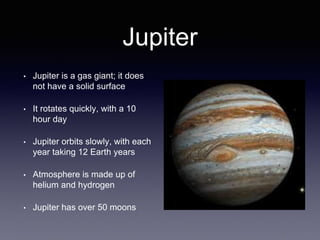
Jupiter
• Jupiter is a gas giant; it does
not have a solid surface
• It rotates quickly, with a 10
hour day
• Jupiter orbits slowly, with each
year taking 12 Earth years
• Atmosphere is made up of
helium and hydrogen
• Jupiter has over 50 moons
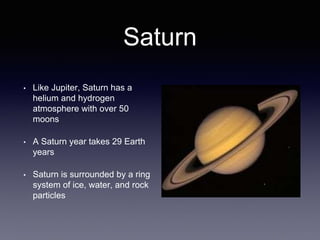
Saturn
• Like Jupiter, Saturn has a
helium and hydrogen
atmosphere with over 50
moons
• A Saturn year takes 29 Earth
years
• Saturn is surrounded by a ring
system of ice, water, and rock
particles
Uranus
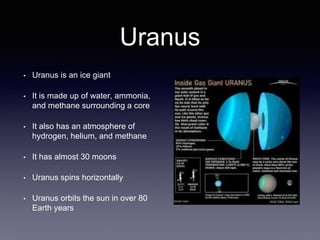
• Uranus is an ice giant
• It is made up of water, ammonia,
and methane surrounding a core
• It also has an atmosphere of
hydrogen, helium, and methane
• It has almost 30 moons
• Uranus spins horizontally
• Uranus orbits the sun in over 80
Earth years
Neptune
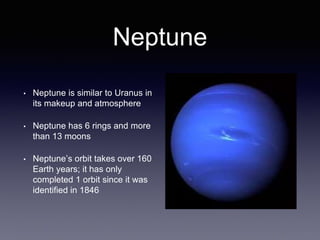
• Neptune is similar to Uranus in
its makeup and atmosphere
• Neptune has 6 rings and more
than 13 moons
• Neptune’s orbit takes over 160
Earth years; it has only
completed 1 orbit since it was
identified in 1846
Dwarf planets
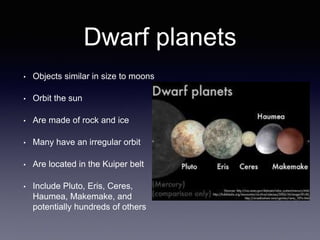
• Objects similar in size to moons
• Orbit the sun
• Are made of rock and ice
• Many have an irregular orbit
• Are located in the Kuiper belt
• Include Pluto, Eris, Ceres,
Haumea, Makemake, and
potentially hundreds of others
Core Accretion Model
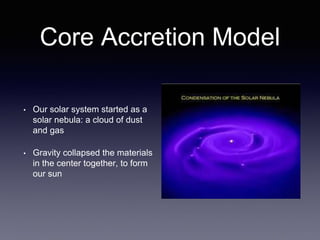
• Our solar system started as a
solar nebula: a cloud of dust
and gas
• Gravity collapsed the materials
in the center together, to form
our sun
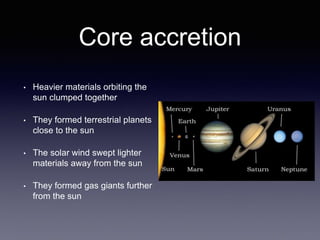
Core accretion
• Heavier materials orbiting the
sun clumped together
• They formed terrestrial planets
close to the sun
• The solar wind swept lighter
materials away from the sun
• They formed gas giants further
from the sun
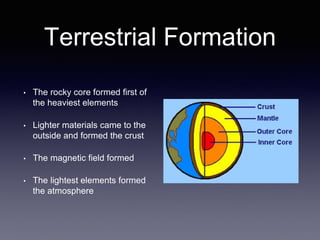
Terrestrial Formation
• The rocky core formed first of
the heaviest elements
• Lighter materials came to the
outside and formed the crust
• The magnetic field formed
• The lightest elements formed
the atmosphere
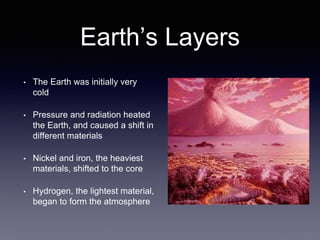
Earth’s Layers
• The Earth was initially very
cold
• Pressure and radiation heated
the Earth, and caused a shift in
different materials
• Nickel and iron, the heaviest
materials, shifted to the core
• Hydrogen, the lightest material,
began to form the atmosphere
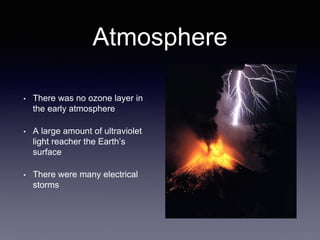
Atmosphere
• There was no ozone layer in
the early atmosphere
• A large amount of ultraviolet
light reacher the Earth’s
surface
• There were many electrical
storms
Moons
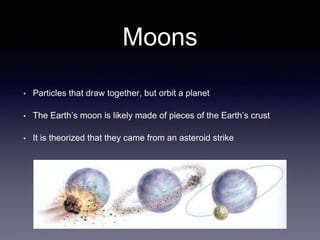
• Particles that draw together, but orbit a planet
• The Earth’s moon is likely made of pieces of the Earth’s crust
• It is theorized that they came from an asteroid strike
Plate Tectonics
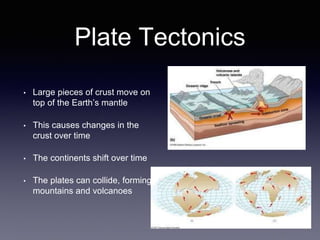
• Large pieces of crust move on
top of the Earth’s mantle
• This causes changes in the
crust over time
• The continents shift over time
• The plates can collide, forming
mountains and volcanoes
Volcanoes
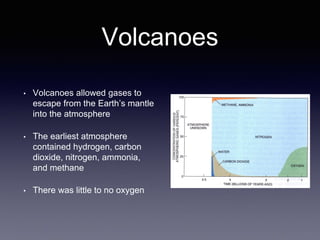
• Volcanoes allowed gases to
escape from the Earth’s mantle
into the atmosphere
• The earliest atmosphere
contained hydrogen, carbon
dioxide, nitrogen, ammonia,
and methane
• There was little to no oxygen
Water
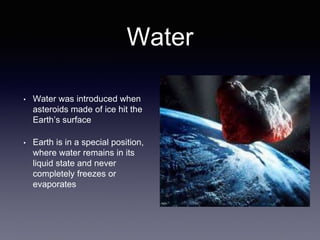
• Water was introduced when
asteroids made of ice hit the
Earth’s surface
• Earth is in a special position,
where water remains in its
liquid state and never
completely freezes or
evaporates
Water Cycle
• Water vapor came from
underground
• Massive rainstorms covered
the Earth’s crust
• Water dissolved minerals and
soluble gasses
• The early seas were formed
Disk Instability Model
• Focuses more on the formation
of gas giants
• Clumps of gas and dust bind
together
• They compact quickly into
planets that can maintain an
atmosphere

Earth's formation ppt

  • 1.
    The Formation ofthe Solar System Allison Miller
  • 2.
    Let’s Review the Planets •Mercury • Venus • Earth • Mars • Jupiter • Saturn • Uranus • Neptune
  • 3.
    Mercury • The smallestplanet, and closest to the sun • Terrestrial planet with a thin atmosphere • Temperatures vary from -230 degrees to 800 degrees F • Images of Mercury appear blue where mineral deposits are present, and orange where volcanic rock is present • It looks brown and orange to the human eye
  • 4.
    Venus • Venus isa terrestrial planet slightly smaller than Earth • Venus rotates very slowly; One day on Venus lasts 243 Earth days • Venus also rotates in retrograde, the opposite direction from Earth • The atmosphere that would be toxic to humans, as it is made of carbon dioxide and nitrogen • Clouds in Venus’ atmosphere are made of sulfuric acid
  • 5.
    Earth • Terrestrial planetwith an atmosphere • Has a moon • Supports life
  • 6.
    Mars • A terrestrialplanet • Mars takes much longer to orbit the Sun, with one Mars year lasting 687 Earth days • Mars has two moons • Has an atmosphere of carbon dioxide, nitrogen, and argon • Much of the dust on Mars is composed of iron; oxidized iron causes Mars to appear red
  • 7.
    Jupiter • Jupiter isa gas giant; it does not have a solid surface • It rotates quickly, with a 10 hour day • Jupiter orbits slowly, with each year taking 12 Earth years • Atmosphere is made up of helium and hydrogen • Jupiter has over 50 moons
  • 8.
    Saturn • Like Jupiter,Saturn has a helium and hydrogen atmosphere with over 50 moons • A Saturn year takes 29 Earth years • Saturn is surrounded by a ring system of ice, water, and rock particles
  • 9.
    Uranus • Uranus isan ice giant • It is made up of water, ammonia, and methane surrounding a core • It also has an atmosphere of hydrogen, helium, and methane • It has almost 30 moons • Uranus spins horizontally • Uranus orbits the sun in over 80 Earth years
  • 10.
    Neptune • Neptune issimilar to Uranus in its makeup and atmosphere • Neptune has 6 rings and more than 13 moons • Neptune’s orbit takes over 160 Earth years; it has only completed 1 orbit since it was identified in 1846
  • 11.
    Dwarf planets • Objectssimilar in size to moons • Orbit the sun • Are made of rock and ice • Many have an irregular orbit • Are located in the Kuiper belt • Include Pluto, Eris, Ceres, Haumea, Makemake, and potentially hundreds of others
  • 12.
    Core Accretion Model •Our solar system started as a solar nebula: a cloud of dust and gas • Gravity collapsed the materials in the center together, to form our sun
  • 13.
    Core accretion • Heaviermaterials orbiting the sun clumped together • They formed terrestrial planets close to the sun • The solar wind swept lighter materials away from the sun • They formed gas giants further from the sun
  • 14.
    Terrestrial Formation • Therocky core formed first of the heaviest elements • Lighter materials came to the outside and formed the crust • The magnetic field formed • The lightest elements formed the atmosphere
  • 15.
    Earth’s Layers • TheEarth was initially very cold • Pressure and radiation heated the Earth, and caused a shift in different materials • Nickel and iron, the heaviest materials, shifted to the core • Hydrogen, the lightest material, began to form the atmosphere
  • 16.
    Atmosphere • There wasno ozone layer in the early atmosphere • A large amount of ultraviolet light reacher the Earth’s surface • There were many electrical storms
  • 17.
    Moons • Particles thatdraw together, but orbit a planet • The Earth’s moon is likely made of pieces of the Earth’s crust • It is theorized that they came from an asteroid strike
  • 18.
    Plate Tectonics • Largepieces of crust move on top of the Earth’s mantle • This causes changes in the crust over time • The continents shift over time • The plates can collide, forming mountains and volcanoes
  • 19.
    Volcanoes • Volcanoes allowedgases to escape from the Earth’s mantle into the atmosphere • The earliest atmosphere contained hydrogen, carbon dioxide, nitrogen, ammonia, and methane • There was little to no oxygen
  • 20.
    Water • Water wasintroduced when asteroids made of ice hit the Earth’s surface • Earth is in a special position, where water remains in its liquid state and never completely freezes or evaporates
  • 21.
    Water Cycle • Watervapor came from underground • Massive rainstorms covered the Earth’s crust • Water dissolved minerals and soluble gasses • The early seas were formed
  • 22.
    Disk Instability Model •Focuses more on the formation of gas giants • Clumps of gas and dust bind together • They compact quickly into planets that can maintain an atmosphere