M.Prasad Naidu
MSc Medical Biochemistry, Ph.D,.
Theories of oxidative phosphorylation
1.Chemiosmotic theory
2.Boyer’s binding change mechanism
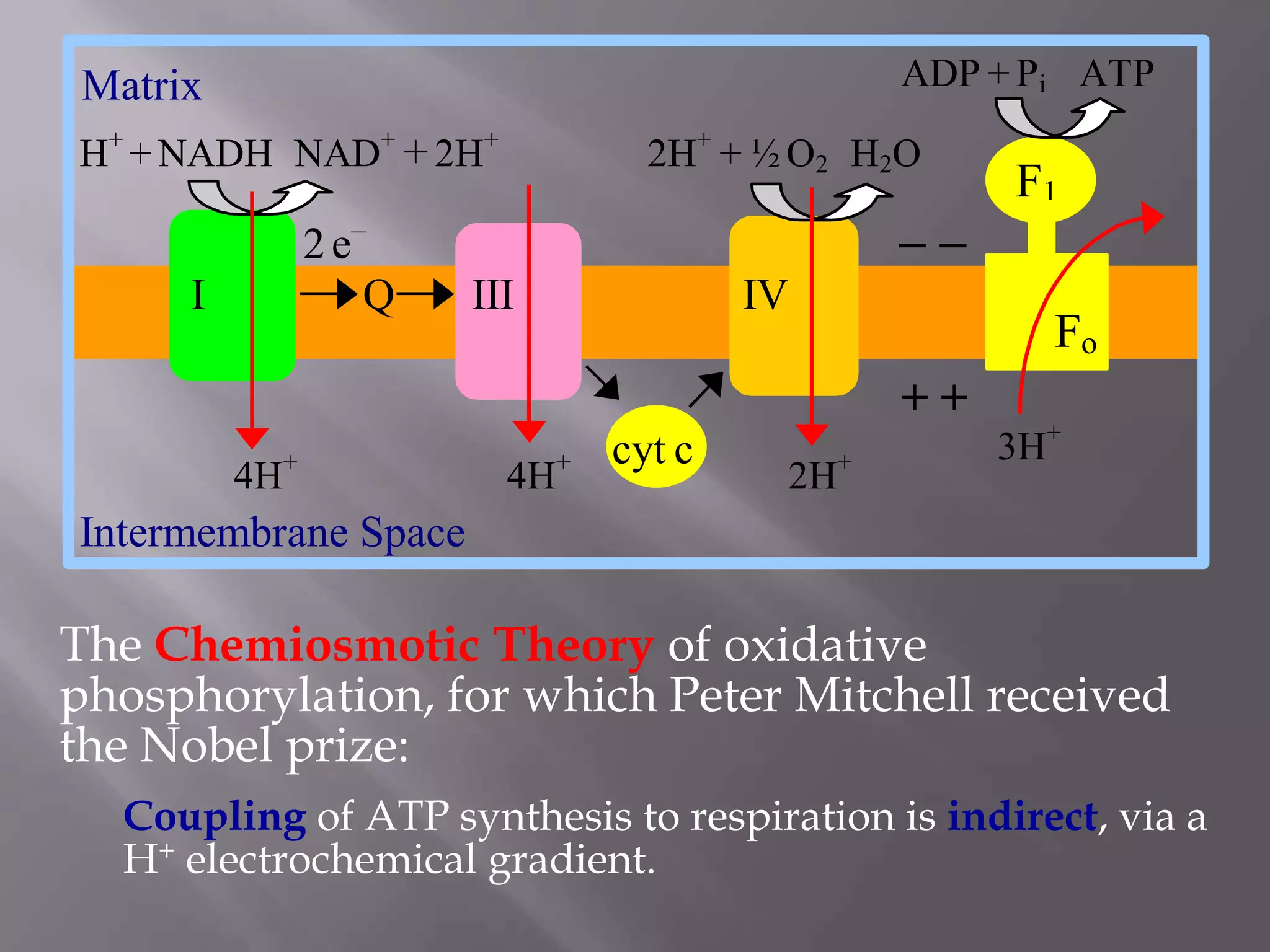
The Chemiosmotic Theory of oxidative
phosphorylation, for which Peter Mitchell received
the Nobel prize:
Coupling of ATP synthesis to respiration is indirect, via a
H+ electrochemical gradient.
Matrix
H+
+ NADH NAD+
+2H+
2H+
+ ½ O2 H2O
2e – –
I Q III IV
+ +
4H+
4H+
2H+
Intermembrane Space
cyt c 3H+
F1
Fo
ADP + Pi ATP
Chemiosmotic theory proposed by Peter Mitchell
The transport of protons from matrix to intermembrane
space is accompanied by
the generation of a proton gradient across the
membrane.
 Protons (H+) accumulate intermembrane space
creating an electrochemical potential difference,
proton gradient or electrochemical gradient.
 This proton motive force (PMF) drives the synthesis
of ATP by ATP synthase complex.
H+
H+
4H+
H+
H+
4H+
2H+
H+
4H+
2e-
IMS
ATP
ADP+Pi
4H+
4H+
4H+
IMM
OMM
H+
H+
H+H+
H+ H+
H+ H+
H+
H+
H+
H+
H+
H+
H+
H+
H+
H+
H+
H+H+
H+
H+
MATRIX
H+
H+
H+
H+
H+
H+
H+ H+
H+
H+
H+
H+
H+
H+
H+
H+
H+
H+
H+ H+
I
III
Iv
V
H+
H+
H+
H+
IMM- Inner mitochondrial membrane
IMS- Inter membrane space
OMM- outer mitochondrial
membrane
Complex I, III and IV
are proton pumps
CHEMIOSMOTIC THEORY
Peter mitchel
 Proton gradient / electrochemical gradient
 Proton motive force
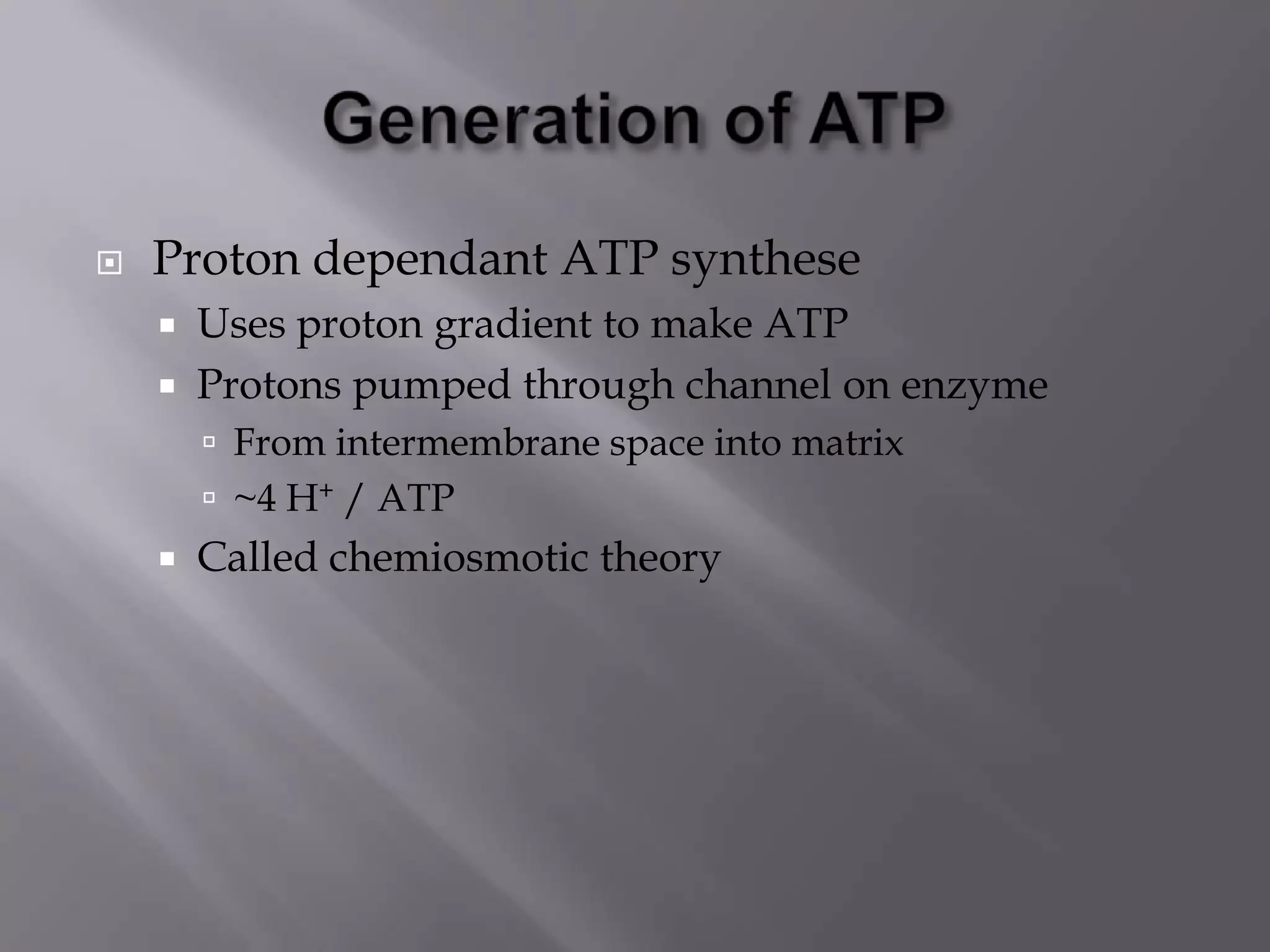
 Proton dependant ATP synthese
 Uses proton gradient to make ATP
 Protons pumped through channel on enzyme
 From intermembrane space into matrix
 ~4 H+ / ATP
 Called chemiosmotic theory
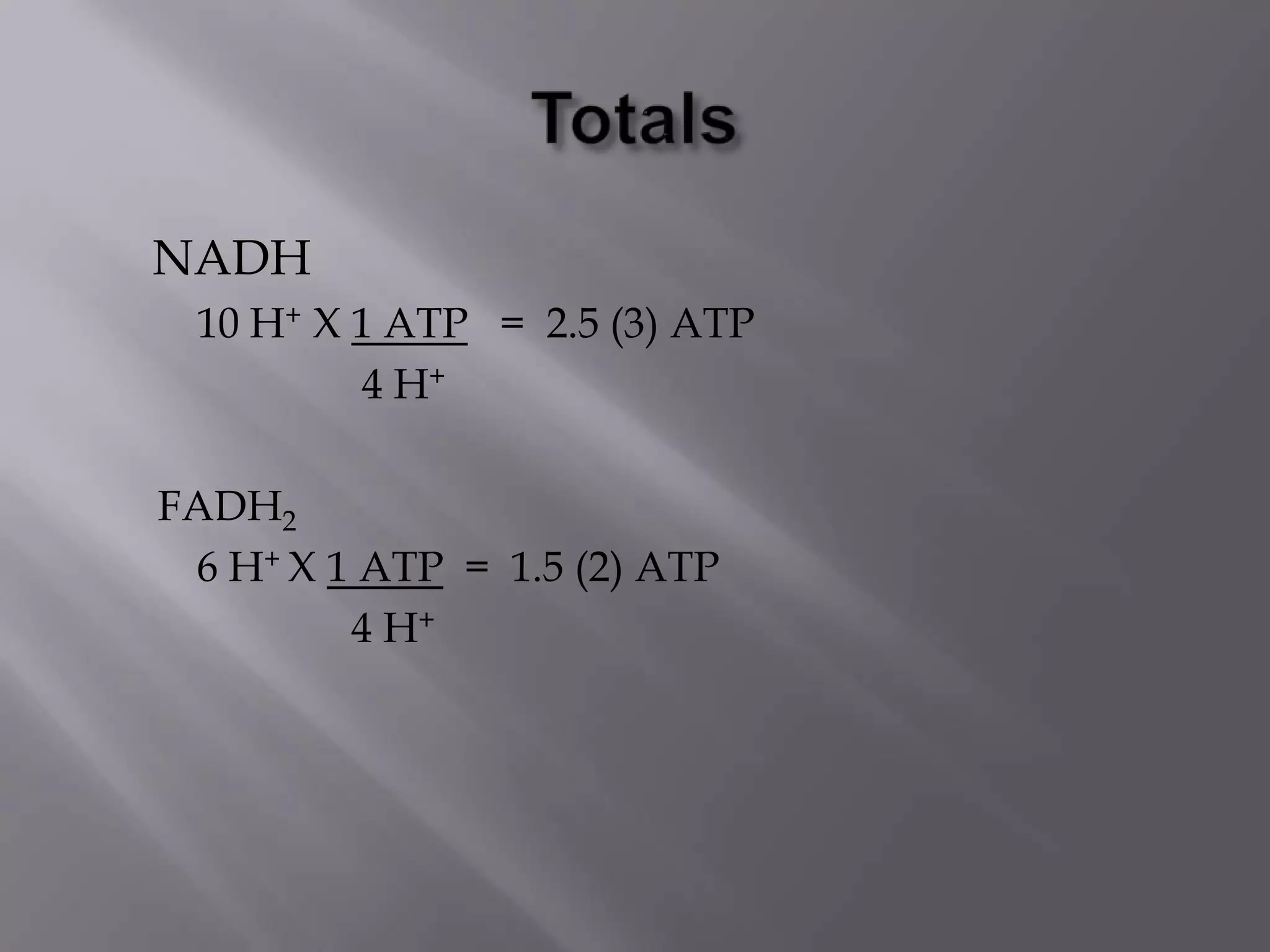
NADH
10 H+ X 1 ATP = 2.5 (3) ATP
4 H+
FADH2
6 H+ X 1 ATP = 1.5 (2) ATP
4 H+
Boyer ’s binding change mechanism:
ATP synthase is a protein assembly in the inner
mitochondrial membrane.
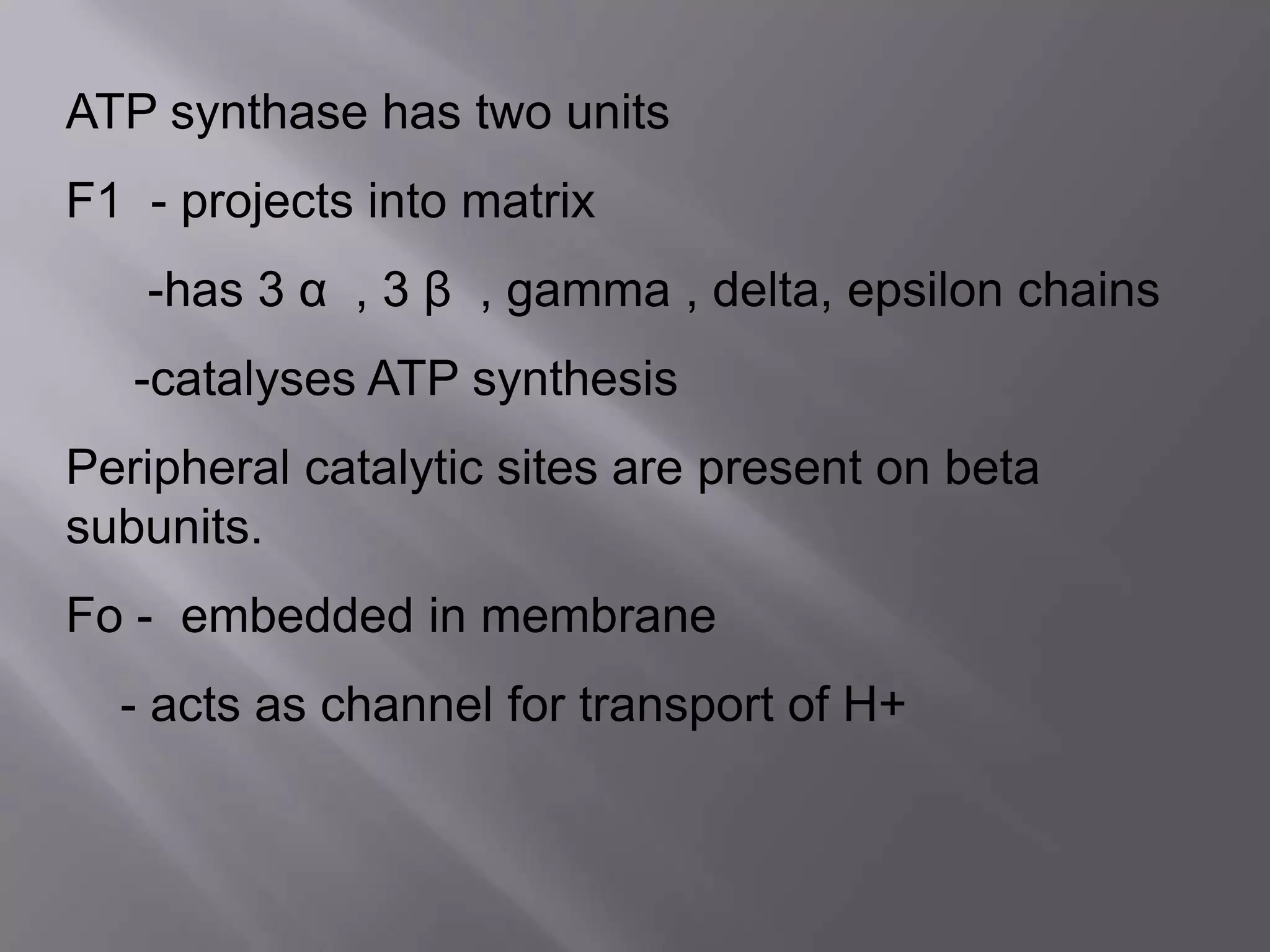
ATP synthase has two units
F1 - projects into matrix
-has 3 α , 3 β , gamma , delta, epsilon chains
-catalyses ATP synthesis
Peripheral catalytic sites are present on beta
subunits.
Fo - embedded in membrane
- acts as channel for transport of H+
ADP + Pi ATP
F1
Fo
3 H+
matrix
intermembrane
space
4
H+ H+ H+ H+H+ H+ H+ H+
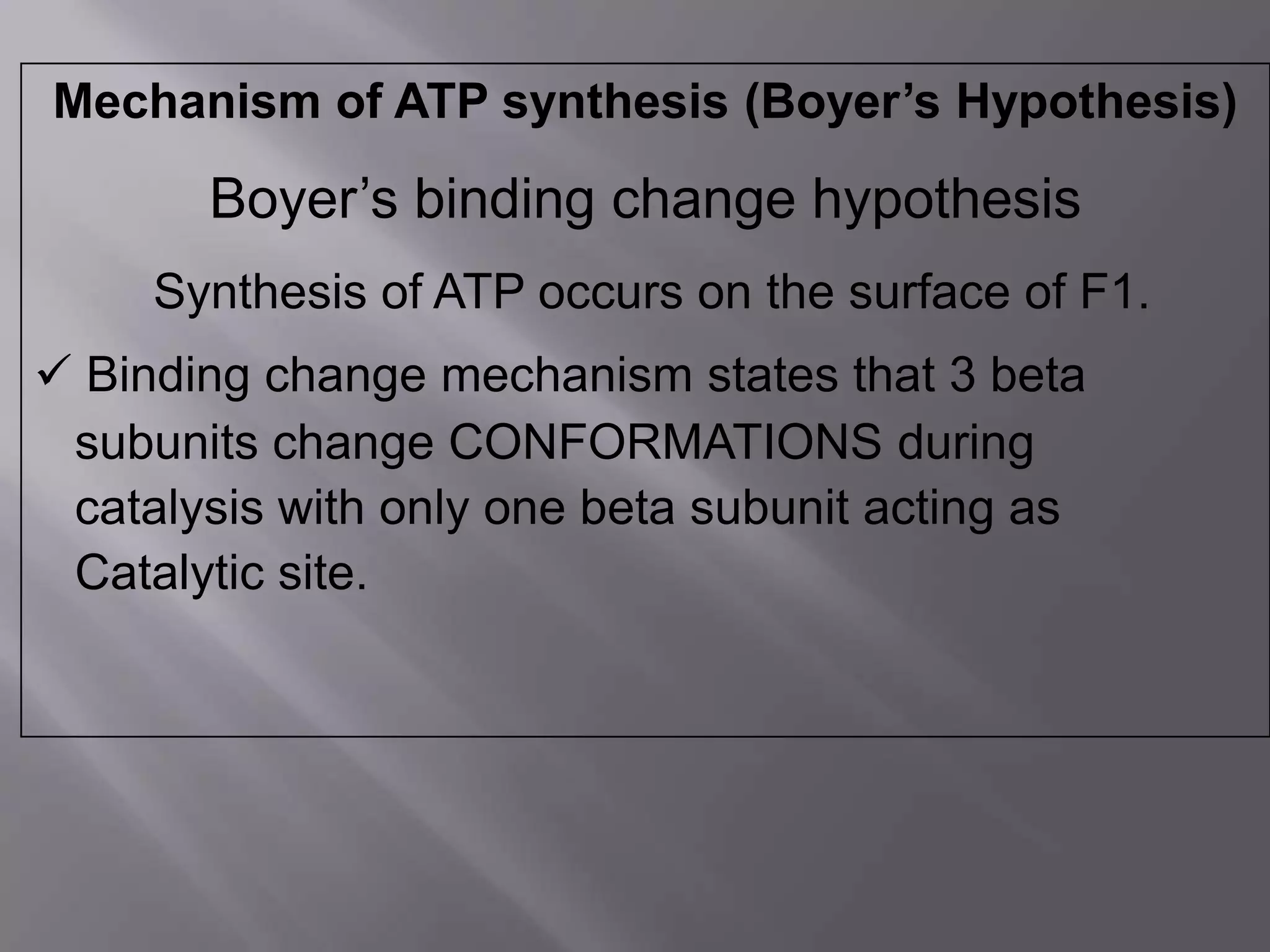
Mechanism of ATP synthesis (Boyer’s Hypothesis)
Boyer’s binding change hypothesis
Synthesis of ATP occurs on the surface of F1.
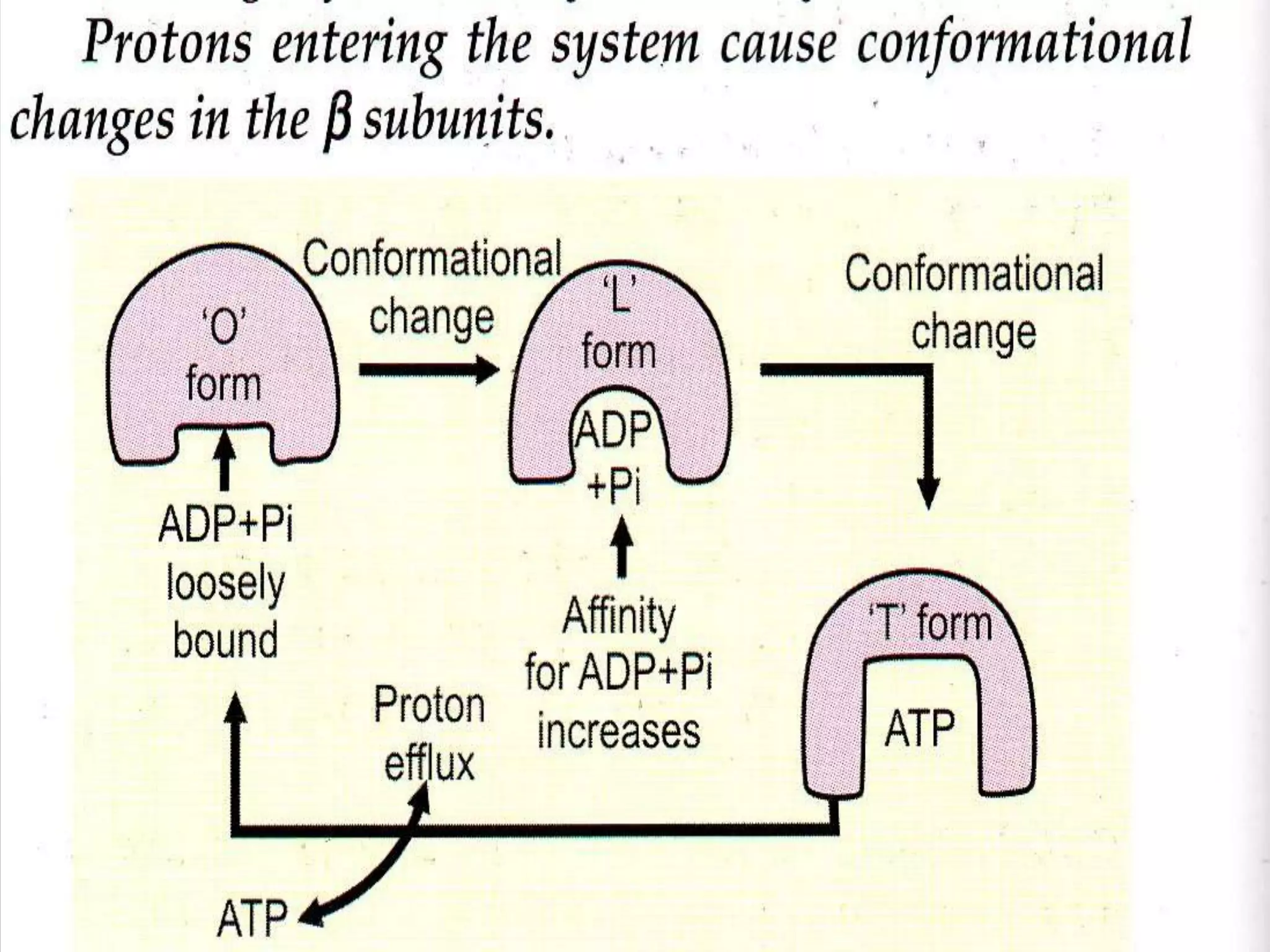
 Binding change mechanism states that 3 beta
subunits change CONFORMATIONS during
catalysis with only one beta subunit acting as
Catalytic site.
β subunits occur in 3 forms
 „O‟ form (Open form). It has low affinity for
substrates ADP +Pi
 „L‟ form (loose form). Can bind substrates ADP
and Pi but catalytically it is inactive.
 „T‟ form (Tight form). Binds substrates ADP + Pi
tightly and catalyses ATP synthesis.
 When protons pass through the disk of C subunits of
F0 unit it causes rotation of γ sub unit.
 The β subunits which are fixed to the membrane
donot rotate.
 ADP & Pi are taken up sequentially by the βsubunits
which undergo conformational changes and form
ATP.
Gamma subunit is in the form of axle . It rotates
when protons flow.
ATP synthase is smallest known MOLECULAR
MOTOR in the living cells.
ETC - inhibitors
Complex I : site I of ATP synthesis inhibitors
Rotenone, Peircidin, Amytal, Barbiturates
ComplexII:
Carboxin,Thenoyltrifluroacetone,malonate
Complex III : site II of ATP synthesis inhibitors
Antimycin, Myxothiazol , stigmatellin
Complex IV: site III of ATP synthesis inhibitors
Cyanide, azide , carbon monoxide
Complex – I inhibitors (Site I inhibitors)
Rotenone, insecticide, also used as fish poison.
Binds to complex I and prevents the reduction of
Ubiquinone.
Piercidin, Amytal (sedative), Barbiturates
– inhibit by preventing the transfer of electrons from
iron sulfur center of complex – I to Ubiquinone.
Complex – II inhibitors
Malonate acts as a competitive inhibitor with the
substrate succinate
Complex – III inhibitors (Site II Inhibitors)
Antimycin inhibit electron transfer from cytb to C1.
Myxothiazol and stigmatellin, antibiotics
inhibit electron transfer from Cytb to C1.
Complex – IV (site III inhibitors)
Cyanide and azide bind tightly to oxidized form of
heme a3 ( of complex iv ) preventing electron flow.
Cyanide is potent and rapidly acting poison.
Cyanide prevents binding of oxygen to Cytochrome
oxidase ( aa3 ).
Mitochondrial respiration and energy production stops
cell death occurs rapidly.
Carbonmonoxide binds to the reduced form of
heme a3(Fe2+) competitively with oxygen and prevents
electron transfer to oxygen.
Uncouplers of oxidative phosphorylation :
 Uncouplers will allow oxidation to proceed but
energy instead of being trapped as ATP is dissipated
as heat.
 They are hydrophobic weak acids.
 They are protonated in the intermembrane space
where a higher concentration of protons exists.
 These protonated uncouplers due to their lipophilic
nature rapidly diffuse across the membrane into
matrix where they are deprotonated since matrix has
a lower concentration of protons.
 Thus, the proton gradient is dissipated.
 2-4 dinitrophenol a classical uncoupler – electrons
from NADH to oxygen proceeds normally but ATP not
formed as proton motive force across inner
mitochondrial membrane is dissipated .
2. Penta chloro phenol
3. Dinitro cresol
4.Bilirubin
5.Thyroxine-Physiological uncoupler
6.Valinomycin
7.Nigericin
Note: They are Lipophilic
Intermembrane space
matrix
H+ H+ H+ H+
H+
H+
H+
H+
H+ H+
Physiological Uncouplers
1.Excessive thyroid hormones
2. Unconjugated hyper bilirubinaemia
3. In high doses aspirin uncouple oxidative
phospharylation which explains fever that
accompanies toxic over dosage of these drugs.
Uncoupling proteins
 UCPs occur in the inner mitochondrial membrane of
mammals, including humans.
 UCPs create a “proton leak”, that is they allow
protons to re-enter the mitochondrial matrix without
energy being captured as ATP.
 Energy is released as heat, and the process is called
nonshivering thermogenesis.
 UCP1, also called thermogenin, is responsible for the
activation of fatty acid oxidation and heat production
in the brown adipocytes of mammals.
 Brown fat , unlike the more abundant white fat, uses
almost 90% of its respiratory energy for
thermogenesis in response to cold, at birth,etc.
Inhibitors of Oxidative phosphorylation :
 Oligomycin – acts through one of the proteins
present in F0 - F1 stalk .
 Oligomycin blocks the synthesis of ATP by
preventing the movement of protons through ATP
synthase.
The regulation of the rate of oxidative
phosphorylation by ADP level is called respiratory
control.
The ADP level increases when ATP is consumed and
so oxidation is coupled to the utilization of ATP.
Under physiological conditions, electron transport is
tightly coupled to oxidative phosphorylation.
Electrons do not usually flow through the electron
transport chain to O2 unless ADP is simultaneously
phosphorylated to ATP.
In the presence of excess substrate and Oxygen,
respiration continues until all ADP is converted to
ATP.
After that the respiration rate or utilization of oxygen
decreases
In the presence of adequate oxygen and substrate, ADP
becomes rate limiting; it exerts a control over the
entire oxidative phosphorylation process
 The rate of respiration of mitochondria (Oxidative
phosphorylation) can be controlled by ADP.
 Oxidation cannot proceed via ETC without
simultaneous phosphorylation of ADP.
 Chance & Williams defined 5 conditions that can
control rate of respiration.
 Generally most cells in the resting state are in state
4 , and respiration is controlled by the availability
of ADP.
 The availability of inorganic phosphate could also
influence the respiration.
 As respiration increases (Exercise) cell approaches
state 3 ( ETC working to its full capacity ) or state 5
( Availability of O2 is a limiting factor ).
 ADP / ATP transporter may also be a rate limiting
factor
P:O ratio (ADP : O ratio)
P:O ratio is defined as number of phosphates
incorporated into ATP to 1 atom of oxygen utilized
during the transfer of 2 electrons through ETC.
For NADH P:O ratio is 3 i.e 3 ATPs are produced
(2.5)
For FADH2 P:O ratio is 2 i.e 2 ATPs are
produced(1.5)
Chemiosmotic theory
Chemiosmotic theory

Chemiosmotic theory

  • 1.
    M.Prasad Naidu MSc MedicalBiochemistry, Ph.D,.
  • 2.
    Theories of oxidativephosphorylation 1.Chemiosmotic theory 2.Boyer’s binding change mechanism
  • 3.
    The Chemiosmotic Theoryof oxidative phosphorylation, for which Peter Mitchell received the Nobel prize: Coupling of ATP synthesis to respiration is indirect, via a H+ electrochemical gradient. Matrix H+ + NADH NAD+ +2H+ 2H+ + ½ O2 H2O 2e – – I Q III IV + + 4H+ 4H+ 2H+ Intermembrane Space cyt c 3H+ F1 Fo ADP + Pi ATP
  • 4.
    Chemiosmotic theory proposedby Peter Mitchell The transport of protons from matrix to intermembrane space is accompanied by the generation of a proton gradient across the membrane.
  • 5.
     Protons (H+)accumulate intermembrane space creating an electrochemical potential difference, proton gradient or electrochemical gradient.  This proton motive force (PMF) drives the synthesis of ATP by ATP synthase complex.
  • 6.
    H+ H+ 4H+ H+ H+ 4H+ 2H+ H+ 4H+ 2e- IMS ATP ADP+Pi 4H+ 4H+ 4H+ IMM OMM H+ H+ H+H+ H+ H+ H+ H+ H+ H+ H+ H+ H+ H+ H+ H+ H+ H+ H+ H+H+ H+ H+ MATRIX H+ H+ H+ H+ H+ H+ H+H+ H+ H+ H+ H+ H+ H+ H+ H+ H+ H+ H+ H+ I III Iv V H+ H+ H+ H+ IMM- Inner mitochondrial membrane IMS- Inter membrane space OMM- outer mitochondrial membrane Complex I, III and IV are proton pumps CHEMIOSMOTIC THEORY Peter mitchel
  • 7.
     Proton gradient/ electrochemical gradient  Proton motive force
  • 8.
     Proton dependantATP synthese  Uses proton gradient to make ATP  Protons pumped through channel on enzyme  From intermembrane space into matrix  ~4 H+ / ATP  Called chemiosmotic theory
  • 9.
    NADH 10 H+ X1 ATP = 2.5 (3) ATP 4 H+ FADH2 6 H+ X 1 ATP = 1.5 (2) ATP 4 H+
  • 10.
    Boyer ’s bindingchange mechanism: ATP synthase is a protein assembly in the inner mitochondrial membrane.
  • 11.
    ATP synthase hastwo units F1 - projects into matrix -has 3 α , 3 β , gamma , delta, epsilon chains -catalyses ATP synthesis Peripheral catalytic sites are present on beta subunits. Fo - embedded in membrane - acts as channel for transport of H+
  • 12.
    ADP + PiATP F1 Fo 3 H+ matrix intermembrane space 4 H+ H+ H+ H+H+ H+ H+ H+
  • 13.
    Mechanism of ATPsynthesis (Boyer’s Hypothesis) Boyer’s binding change hypothesis Synthesis of ATP occurs on the surface of F1.  Binding change mechanism states that 3 beta subunits change CONFORMATIONS during catalysis with only one beta subunit acting as Catalytic site.
  • 14.
    β subunits occurin 3 forms  „O‟ form (Open form). It has low affinity for substrates ADP +Pi  „L‟ form (loose form). Can bind substrates ADP and Pi but catalytically it is inactive.  „T‟ form (Tight form). Binds substrates ADP + Pi tightly and catalyses ATP synthesis.
  • 15.
     When protonspass through the disk of C subunits of F0 unit it causes rotation of γ sub unit.  The β subunits which are fixed to the membrane donot rotate.  ADP & Pi are taken up sequentially by the βsubunits which undergo conformational changes and form ATP.
  • 17.
    Gamma subunit isin the form of axle . It rotates when protons flow. ATP synthase is smallest known MOLECULAR MOTOR in the living cells.
  • 18.
    ETC - inhibitors ComplexI : site I of ATP synthesis inhibitors Rotenone, Peircidin, Amytal, Barbiturates ComplexII: Carboxin,Thenoyltrifluroacetone,malonate Complex III : site II of ATP synthesis inhibitors Antimycin, Myxothiazol , stigmatellin Complex IV: site III of ATP synthesis inhibitors Cyanide, azide , carbon monoxide
  • 19.
    Complex – Iinhibitors (Site I inhibitors) Rotenone, insecticide, also used as fish poison. Binds to complex I and prevents the reduction of Ubiquinone. Piercidin, Amytal (sedative), Barbiturates – inhibit by preventing the transfer of electrons from iron sulfur center of complex – I to Ubiquinone.
  • 20.
    Complex – IIinhibitors Malonate acts as a competitive inhibitor with the substrate succinate
  • 21.
    Complex – IIIinhibitors (Site II Inhibitors) Antimycin inhibit electron transfer from cytb to C1. Myxothiazol and stigmatellin, antibiotics inhibit electron transfer from Cytb to C1.
  • 22.
    Complex – IV(site III inhibitors) Cyanide and azide bind tightly to oxidized form of heme a3 ( of complex iv ) preventing electron flow. Cyanide is potent and rapidly acting poison. Cyanide prevents binding of oxygen to Cytochrome oxidase ( aa3 ). Mitochondrial respiration and energy production stops cell death occurs rapidly.
  • 23.
    Carbonmonoxide binds tothe reduced form of heme a3(Fe2+) competitively with oxygen and prevents electron transfer to oxygen.
  • 24.
    Uncouplers of oxidativephosphorylation :  Uncouplers will allow oxidation to proceed but energy instead of being trapped as ATP is dissipated as heat.  They are hydrophobic weak acids.  They are protonated in the intermembrane space where a higher concentration of protons exists.
  • 25.
     These protonateduncouplers due to their lipophilic nature rapidly diffuse across the membrane into matrix where they are deprotonated since matrix has a lower concentration of protons.  Thus, the proton gradient is dissipated.
  • 26.
     2-4 dinitrophenola classical uncoupler – electrons from NADH to oxygen proceeds normally but ATP not formed as proton motive force across inner mitochondrial membrane is dissipated .
  • 27.
    2. Penta chlorophenol 3. Dinitro cresol 4.Bilirubin 5.Thyroxine-Physiological uncoupler 6.Valinomycin 7.Nigericin Note: They are Lipophilic
  • 28.
    Intermembrane space matrix H+ H+H+ H+ H+ H+ H+ H+ H+ H+
  • 29.
    Physiological Uncouplers 1.Excessive thyroidhormones 2. Unconjugated hyper bilirubinaemia 3. In high doses aspirin uncouple oxidative phospharylation which explains fever that accompanies toxic over dosage of these drugs.
  • 31.
    Uncoupling proteins  UCPsoccur in the inner mitochondrial membrane of mammals, including humans.  UCPs create a “proton leak”, that is they allow protons to re-enter the mitochondrial matrix without energy being captured as ATP.  Energy is released as heat, and the process is called nonshivering thermogenesis.
  • 32.
     UCP1, alsocalled thermogenin, is responsible for the activation of fatty acid oxidation and heat production in the brown adipocytes of mammals.  Brown fat , unlike the more abundant white fat, uses almost 90% of its respiratory energy for thermogenesis in response to cold, at birth,etc.
  • 33.
    Inhibitors of Oxidativephosphorylation :  Oligomycin – acts through one of the proteins present in F0 - F1 stalk .  Oligomycin blocks the synthesis of ATP by preventing the movement of protons through ATP synthase.
  • 34.
    The regulation ofthe rate of oxidative phosphorylation by ADP level is called respiratory control. The ADP level increases when ATP is consumed and so oxidation is coupled to the utilization of ATP. Under physiological conditions, electron transport is tightly coupled to oxidative phosphorylation.
  • 35.
    Electrons do notusually flow through the electron transport chain to O2 unless ADP is simultaneously phosphorylated to ATP. In the presence of excess substrate and Oxygen, respiration continues until all ADP is converted to ATP. After that the respiration rate or utilization of oxygen decreases In the presence of adequate oxygen and substrate, ADP becomes rate limiting; it exerts a control over the entire oxidative phosphorylation process
  • 36.
     The rateof respiration of mitochondria (Oxidative phosphorylation) can be controlled by ADP.  Oxidation cannot proceed via ETC without simultaneous phosphorylation of ADP.  Chance & Williams defined 5 conditions that can control rate of respiration.
  • 39.
     Generally mostcells in the resting state are in state 4 , and respiration is controlled by the availability of ADP.  The availability of inorganic phosphate could also influence the respiration.  As respiration increases (Exercise) cell approaches state 3 ( ETC working to its full capacity ) or state 5 ( Availability of O2 is a limiting factor ).  ADP / ATP transporter may also be a rate limiting factor
  • 40.
    P:O ratio (ADP: O ratio) P:O ratio is defined as number of phosphates incorporated into ATP to 1 atom of oxygen utilized during the transfer of 2 electrons through ETC. For NADH P:O ratio is 3 i.e 3 ATPs are produced (2.5) For FADH2 P:O ratio is 2 i.e 2 ATPs are produced(1.5)