BY-
AAYUSHI RAMBIA
M.Sc. SEM I
DEPARTMENT OF MICROBIOLOGY
REG. NO. 18308001
PONDICHERRY UNIVERSITY
 A shuttle system in general sense is something that goes
back and forth in order to transfer things between the two
places.
 In biological systems a shuttle system is used to transfer
reducing equivalents across the membrane , more
specifically across the inner mitochondrial membrane.
 A shuttle system is required because there are certain
reducing equivalents such as NADH which cannot cross
the membrane, but it can reduce another molecule that
can cross the membrane, so that its electrons can reach
the electron transport chain , which is the ultimate goal to
produce ATP.
 The malate aspartate shuttle is required to transport the
reducing equivalent NADH , produced during glycolysis
in the cytosol into the mitochondria as the mitochondrial
inner membrane is impermeable to NADH. The rate of
transfer through this shuttle is 10-folds higher than any
other shutlle systems
 NADH is required in the TCA cycle which operates in the
mitochondria , from where the electrons are finally
accepted by oxygen in the ETC to produce ATP , the final
energy quotient.
 The shuttle operates in the mitochondria found mainly in
the liver , kidney and heart because these three organs
are the most metabolically active organs in the body.
 The shuttle involves four major enzymes which operate
to help transfer NADH into the mitochondria :
1) Malate dehydrogenase
2) Aspartate amino transferase
3) Malate – alphaketoglutarate antiporter
4) Glutamate aspartate antiporter
 The glycolytic pathway produces two molecules of NADH
in the payoff phase :
2Glyceraldehyde-3-phosphate2− + 2Pi
2− + 2NAD+ → 2(1,3-
Bisphosphoglycerate4− )+ 2NADH + 2H+
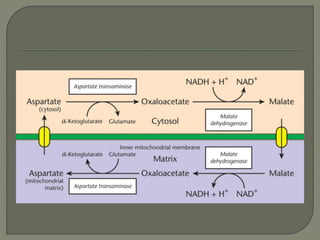
 The NADH thus formed is used to reduced oxaloacetate
present in the cytosol into malate catalysed by the
enzyme “malate dehydrogensae”.
Oxaloacetate + NADH + H+ → L-malate + NAD+
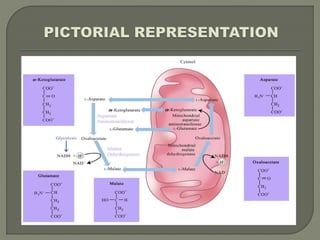
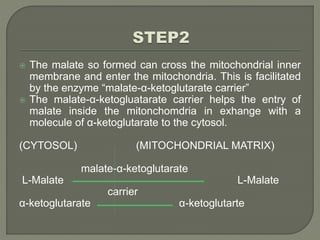
 The malate so formed can cross the mitochondrial inner
membrane and enter the mitochondria. This is facilitated
by the enzyme “malate-α-ketoglutarate carrier”
 The malate-α-ketogluatarate carrier helps the entry of
malate inside the mitonchomdria in exhange with a
molecule of α-ketoglutarate to the cytosol.
(CYTOSOL) (MITOCHONDRIAL MATRIX)
malate-α-ketoglutarate
L-Malate L-Malate
carrier
α-ketoglutarate α-ketoglutarte
 Inside the mitochondrial matrix the malate is oxidised by
NAD+ back to oxaloacetate and NADH catalysed by the
enzyme “malate dehydrogenase” (mitochondrial malate
dehydrogenase) .
Malate + NAD+ → Oxaloacetate + NADH + H+
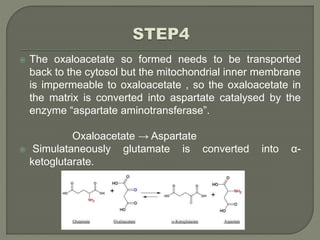
 The oxaloacetate so formed needs to be transported
back to the cytosol but the mitochondrial inner membrane
is impermeable to oxaloacetate , so the oxaloacetate in
the matrix is converted into aspartate catalysed by the
enzyme “aspartate aminotransferase”.
Oxaloacetate → Aspartate
 Simulataneously glutamate is converted into α-
ketoglutarate.
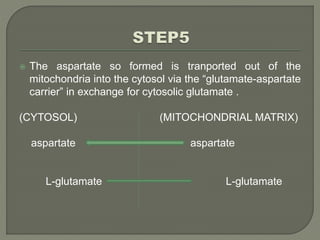
 The aspartate so formed is tranported out of the
mitochondria into the cytosol via the “glutamate-aspartate
carrier” in exchange for cytosolic glutamate .
(CYTOSOL) (MITOCHONDRIAL MATRIX)
aspartate aspartate
L-glutamate L-glutamate
 Upon reaching the cytosol , the aspartate is converted
back to oxaloacetate by the enzyme “aspartate
aminotransferase” ,thus replenishing the cytosolic
oxaloacetate .
Aspartate → oxaloacetate
 Simultaneously α-ketoglutarate in the cytosol is
converted into glutamate.
 This step ensures that there is not net movement of
substrates between the cytosol and the mitochondria and
there is only the movement of electron.
 There are two antiporter proteins located in the inner
membrane of the mitochondria, the glutamate-aspartate
transporter (transporter I) and the malate-α-ketoglutarate
transporter (transporter II). In transporter I, the efflux of
aspartate from the mitochondria is accompanied by the
stoichiometric entry of glutamate and proton into the
mitochondria. Therefore, this electrogenically driven
process is irreversible and the rate-controlling step of the
M-A shuttle.
 The proton gradient created in the cytosol as well as the
mitochondrial matrix drives the entry and exit of
substrates via the antiporters.
 Principles of Biochemistry-Lehninger edition 4th
 Biochemistry by Voet and Voet
 The Metabolic Significance of the Malate-Aspartate Cycle
in Heart. Circulation Research is published by the
American Heart Association.
 https://www.ncbi.nlm.nih.gov/pmc/articles/PMC2572303
 https://www.researchgate.net/figure/The-malate-
aspartate-shuttle-is-the-principal-mechanism-for-the-
movement-of-reducing_fig3_236857315
THANK YOU

Malate aspartate shuttle

  • 1.
    BY- AAYUSHI RAMBIA M.Sc. SEMI DEPARTMENT OF MICROBIOLOGY REG. NO. 18308001 PONDICHERRY UNIVERSITY
  • 2.
     A shuttlesystem in general sense is something that goes back and forth in order to transfer things between the two places.  In biological systems a shuttle system is used to transfer reducing equivalents across the membrane , more specifically across the inner mitochondrial membrane.  A shuttle system is required because there are certain reducing equivalents such as NADH which cannot cross the membrane, but it can reduce another molecule that can cross the membrane, so that its electrons can reach the electron transport chain , which is the ultimate goal to produce ATP.
  • 3.
     The malateaspartate shuttle is required to transport the reducing equivalent NADH , produced during glycolysis in the cytosol into the mitochondria as the mitochondrial inner membrane is impermeable to NADH. The rate of transfer through this shuttle is 10-folds higher than any other shutlle systems  NADH is required in the TCA cycle which operates in the mitochondria , from where the electrons are finally accepted by oxygen in the ETC to produce ATP , the final energy quotient.
  • 4.
     The shuttleoperates in the mitochondria found mainly in the liver , kidney and heart because these three organs are the most metabolically active organs in the body.  The shuttle involves four major enzymes which operate to help transfer NADH into the mitochondria : 1) Malate dehydrogenase 2) Aspartate amino transferase 3) Malate – alphaketoglutarate antiporter 4) Glutamate aspartate antiporter
  • 7.
     The glycolyticpathway produces two molecules of NADH in the payoff phase : 2Glyceraldehyde-3-phosphate2− + 2Pi 2− + 2NAD+ → 2(1,3- Bisphosphoglycerate4− )+ 2NADH + 2H+  The NADH thus formed is used to reduced oxaloacetate present in the cytosol into malate catalysed by the enzyme “malate dehydrogensae”. Oxaloacetate + NADH + H+ → L-malate + NAD+
  • 8.
     The malateso formed can cross the mitochondrial inner membrane and enter the mitochondria. This is facilitated by the enzyme “malate-α-ketoglutarate carrier”  The malate-α-ketogluatarate carrier helps the entry of malate inside the mitonchomdria in exhange with a molecule of α-ketoglutarate to the cytosol. (CYTOSOL) (MITOCHONDRIAL MATRIX) malate-α-ketoglutarate L-Malate L-Malate carrier α-ketoglutarate α-ketoglutarte
  • 9.
     Inside themitochondrial matrix the malate is oxidised by NAD+ back to oxaloacetate and NADH catalysed by the enzyme “malate dehydrogenase” (mitochondrial malate dehydrogenase) . Malate + NAD+ → Oxaloacetate + NADH + H+
  • 10.
     The oxaloacetateso formed needs to be transported back to the cytosol but the mitochondrial inner membrane is impermeable to oxaloacetate , so the oxaloacetate in the matrix is converted into aspartate catalysed by the enzyme “aspartate aminotransferase”. Oxaloacetate → Aspartate  Simulataneously glutamate is converted into α- ketoglutarate.
  • 11.
     The aspartateso formed is tranported out of the mitochondria into the cytosol via the “glutamate-aspartate carrier” in exchange for cytosolic glutamate . (CYTOSOL) (MITOCHONDRIAL MATRIX) aspartate aspartate L-glutamate L-glutamate
  • 12.
     Upon reachingthe cytosol , the aspartate is converted back to oxaloacetate by the enzyme “aspartate aminotransferase” ,thus replenishing the cytosolic oxaloacetate . Aspartate → oxaloacetate  Simultaneously α-ketoglutarate in the cytosol is converted into glutamate.  This step ensures that there is not net movement of substrates between the cytosol and the mitochondria and there is only the movement of electron.
  • 13.
     There aretwo antiporter proteins located in the inner membrane of the mitochondria, the glutamate-aspartate transporter (transporter I) and the malate-α-ketoglutarate transporter (transporter II). In transporter I, the efflux of aspartate from the mitochondria is accompanied by the stoichiometric entry of glutamate and proton into the mitochondria. Therefore, this electrogenically driven process is irreversible and the rate-controlling step of the M-A shuttle.  The proton gradient created in the cytosol as well as the mitochondrial matrix drives the entry and exit of substrates via the antiporters.
  • 14.
     Principles ofBiochemistry-Lehninger edition 4th  Biochemistry by Voet and Voet  The Metabolic Significance of the Malate-Aspartate Cycle in Heart. Circulation Research is published by the American Heart Association.  https://www.ncbi.nlm.nih.gov/pmc/articles/PMC2572303  https://www.researchgate.net/figure/The-malate- aspartate-shuttle-is-the-principal-mechanism-for-the- movement-of-reducing_fig3_236857315
  • 15.