Chapter 7

Biological Oxidation
Biological oxidation is the
cellular process in which the
organic substances release energy
(ATP), produce CO2 and H2O
through oxidative-reductive
reactions.
organic substances:
carbohydrate, fat and protein
7.1 Principal of Redox Reaction
The electron-donating molecule in a
oxidation-reduction reaction is called
the reducing agent or reductant;
the electron-accepting molecule is the
oxidizing agent or oxidant:
for example:
Fe2+ (ferrous) lose -e
Fe3+ (ferric) gain +e
Redox reaction = reduction-oxidation
reaction
Several forms of Biological Reduction
1. Gain of electrons
2. Hydrogenation
3. Deoxygenation

Several forms of Biological Oxidation
1. Loss of electrons
2. Dehydrogenation
3. Oxygenation
oxidation-reduction potential
( or redox potential), E : it is a
measure of the affinity of a
substance for electrons. It decide the
loss (or the gain) of electrons.
A positive E: the substance has a
higher affinity for electrons , accept
electrons easily.
A negative E: the substance has a
lower affinity for electrons , donate
electrons easily.
E0`, the standard redox
potential for a substance :is
measured under stander
condition(25℃, 1mmol/L reaction
substance),at pH7, and is expressed
in volts.
Section 7.2
Respiration Chain and
Oxidative Phosphorylation
7.2.1 Respiratory Chain
Term:
A chain in the mitochondria consists of a number of
redox carriers for transferring electrons from the substrate
to molecular oxygen to form oxygen ion, which combines
with protons to form water.
Redox carriers including 4 protein
complexes
1.Complex I:
NADH:ubiquinone oxidoreductase
NADH:CoQ oxidoreductase

2.Complex II:
Succinate dehydrogenase

3.Complex III:
cytochrome bc1 (ubiquinone Cyt c oxidoreductase)

4.Complex IV:
cytochrome oxidase
Complex I ( NADH:ubiquinone
oxidoreductase)
Function: transfer electrons from NADH to CoQ

Components:

NADH dehydrogenase (FMN)
Iron-sulfur proteins (Fe-S)
complex Ⅰ
NADH→
→CoQ

FMN; Fe-SN-1a,b; Fe-SN-4; Fe-SN-3; Fe-SN-2
R=H: NAD+;

R=H2PO3:NADP+

1. NAD(P)+: Nicotinamide Adenine Dinucleotide Phosphate)
Oxidation of NADH is a 2-electron(2e),
2-proton(2H) reaction

NAD+ or NADP+

NADH or NADPH
2. FMN can transfer 1 or 2 hydride ions
ach time
FMN: flavin mononucleotide

Accepts 1 H+ and 1 e- Accepts 2 H + and 2 e to form semiquinone
= stable free radical to give fully reduced form
3. Iron-sulfur clusters (Fe-S) transfers 1electron at a time, without proton
involved
Fe3++e-

Fe2+
4.Ubiquinone (CoQ) is lipid-soluble, not a
component of complex Ⅰ , can transfer 1 or 2
hydride ions each time.

Function:

transfer electrons and protons from
complex Ⅰ , Ⅱ to complex Ⅲ .
NADH+H+
NAD+

FMN

Reduced Fe-S

Q

FMNH2

Oxidized Fe-S

QH2

Matrix

Intermembrane space
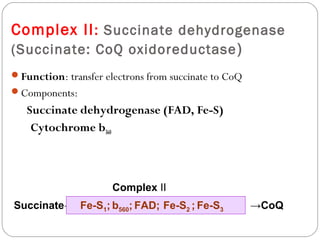
Complex II : Succinate dehydrogenase
(Succinate: CoQ oxidoreductase )
Function: transfer electrons from succinate to CoQ
Components:

Succinate dehydrogenase (FAD, Fe-S)
Cytochrome b560

Complex Ⅱ
Succinate→ Fe-S1; b560; FAD; Fe-S2 ; Fe-S3

→CoQ
Cytochromes a, b, c are heme proteins,
their heme irons participate redox
reactions of e- transport.

Fe3++e-

Fe2+
Intermembrane space

Matrix

Succinate
Complex III:
cytochrome bc1 (ubiquinone Cyt c
oxidoreductase)
Function: transfer electrons from CoQ to cytochrome c
Components: iron-sulfur protein

cytochrome b(b562, b566)
cytochrome c1

complex Ⅲ
QH2→

b562; b566; Fe-S; c1

→Cyt c
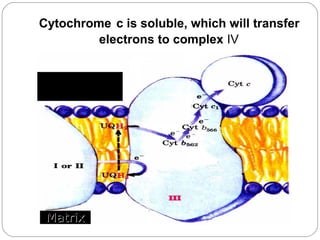
Cytochrome c is soluble, which will transfer
electrons to complex Ⅳ
Intermembrane
space

Matrix
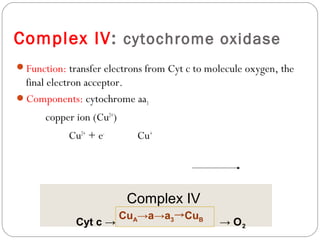
Complex IV: cytochrome oxidase
Function: transfer electrons from Cyt c to molecule oxygen, the

final electron acceptor.
Components: cytochrome aa3
copper ion (Cu2+)
Cu2+ + e-

Cu+

Complex IV
Cyt c →

CuA→a→a3→CuB

→ O2
Cytochrome c
Coenzyme Q
ubiquinone/ol
Sequence of respiratory chain
Principles:
e- tend to flow from a redox pair with a lower E°to one with a

higher E°
In the e--transport chain, e--carriers are arranged in order of
increasing redox potential, making possible the gradual release
of energy stored in NADH, FADH2
呼吸链中各种氧化还原对的标准氧化还原电位

Redox potential

氧化还原对
redox pair
NAD+/NADH+H+
FMN/ FMNH2
FAD/ FADH2
Cyt b Fe3+/Fe2+
Q10/Q10H2
Cyt c1 Fe3+/ Fe2+
Cyt c Fe3+/Fe2+
Cyt a Fe3+ / Fe2+
Cyt a3 Fe3+ / Fe2+
1/2 O2/ H2O

Eº'0(V)
E
-0.32
-0.30
-0.06
0.04(或0.10)
0.07
0.22
0.25
0.29
0.55
0.82
There are two respiratory chains
NADH respiratory chain
NADH Complex Ⅰ CoQ Complex Ⅲ
cytochrome c Complex Ⅳ O2
Succinate (FADH2) respiratory chain

Succinate ComplexⅡ CoQ ComplexⅢ cytochrome c
ComplexⅣ O2
NADH
respiration
chain

FADH2
respiration
chain
7.2.2 Oxidative Phosphorylation
The oxidation of organic nutritions produces the energy-rich

molecules, NADH and FADH2.
The oxidation of NADH or FADH2 in mitochondrial is the electron

transferring through respiration chain.
The free energy produced in electron transferring supports the
phosphorylation of ADP to form ATP.
The oxidation of NADH or FADH2 and the formation of ATP are
coupled process, called Oxidation Phosphorylation.
The Chemiosmotic Theory
The free energy of electron transport is conserved by pumping

protons from the mitochondrial matrix to the intermembrane
space so as to create an electrochemical H+ gradient across the
inner mitochondrial membrane. The electrochemical potential of
this gradient is harnessed to synthesize ATP.
Peter Mitchell
Electrochemical H+ gradient (Protonmotive force)
2 components involved
1. Chemical potential energy due to
difference in [H+]
in two regions separated by a
membrane
2. Electrical potential energy that results
from the separation of charge when a
proton moves across the membrane
without a electron.
Complex I:
4 H+ expelled
per e--pair
transferred to
Q

Complex III:
4 H+ expelled per
e--pair transferred
to Cyt c

Complex IV:
2e- + 2 H+ from
matrix convert ½ O2
to H2O; 2 further H+
expelled from
Proton pumping: Reductiondependent conformational switch of an
e--transport complex

Conformation 1
(high affinity for H+)

Conformation 2
(low affinity for H+).
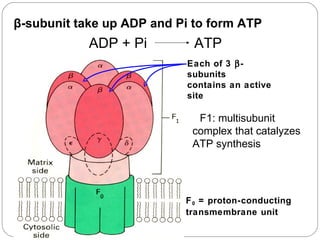
ATP Synthase
Intermembrane space

Inner
(ab2c9-12)

Membrane
Matrix

C ring

(α3β3γδε
)
β-subunit take up ADP and Pi to form ATP

ADP + Pi

ATP
Each of 3 βsubunits
contains an active
site

F1: multisubunit
complex that catalyzes
ATP synthesis

F 0 = proton-conducting
transmembrane unit
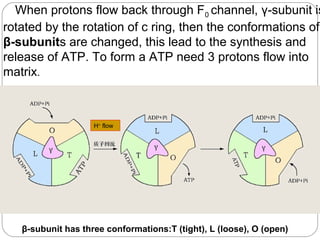
When protons flow back through F0 channel, γ-subunit is
rotated by the rotation of c ring, then the conformations of
β-subunits are changed, this lead to the synthesis and
release of ATP. To form a ATP need 3 protons flow into
matrix.

H+ flow

β-subunit has three conformations:T (tight), L (loose), O (open)
Translocation of ATP , ADP and Pi.
ADP3- ATP4-

H+

H2PO4- H+

Intermembrane
胞液侧
space

F0
基质侧
Matrix
F1

ATP4ADP3H+

H2PO4- H+
When protons flow back through F0 channel, γ-subunit is
rotated by the rotation of c ring, then the conformations of
β-subunits are changed, this lead to the synthesis and
release of ATP. To form a ATP need 3 protons flow into
matrix.

H+ flow

β-subunit has three conformations:T (tight), L (loose), O (open)
P/O ratios
P/O ratio is the rate of phosphate incorporated into ATP to

atoms of O2 utilized. It measure the number of ATP
molecules formed per two electrons transfer through the
respiratory chain.
 NADH respiratory chain : 2.5,
 FADH2 respiratory chain: 1.5
During two electrons transfer through NADH respiratory chain,

ten protons are pumped out of the matrix.
To synthesis and translocation an ATP, four protons are needed.
So, two electrons transport can result in 2.5 ATP.
To succinate respiratory chain , two electrons transport can result
in 1.5 ATP.
Regulation of Oxidative Phosphorylation
1.PMF (proton motive force) regulate the electron transport.

higher PMF
lower rate of transport
2.ADP concentration
resting condition: energy demanded is low, ADP concentration is
low, the speed of Oxidative Phosphorytion is low.
active condition: the speed is high.
Inhibitor of Oxidative
Phosphorylation
1.Inhibitor of electron transport

Succinate

Antimycin A

Cyanide, Azide
Carbon Monoxide

×
×

×

Retonone
Amytal
 2.Uncoupling agents

uncoupling protein (in brown adipose tissue),
2,4-dinitrophenol, Pentachlorophenol

heat

H+
Intermenbran space

Ⅰ

Ⅱ

H

Cyt c

uncoupling
protein

F0

Q
Ⅲ

Ⅳ
F1

Matrix

+ H+

H+

ADP+Pi ATP

2,4-dinitrophnol
3.Oligomycin bonds at the connection of F 0
and F1, inhibit the function of ATP synthase.
Intermembrane space

Matrix

Oligomycin
C ring
Succinate
Ⅱ
Retonone
Amytal

Antimycin A

×

Ⅰ

Ⅲ

×

×
Uncoupling
agent

Oligomycin

Ⅴ

×

Ⅳ

×
ATP and other Energy-rich compounts
ATP has two energy-rich phosphoric acid anhydride
bonds, the hydrolysis of each bond release more
energy than simple phosphate esters.
NH 2
N

N
OH

OH

OH

N

OH

OH
N
p O p OCH2 O
O= P O

~

~

OH

H
H

H
H

OH OH

AMP
ADP
ATP
Some Energy-rich compounds
Structure

Exemple

creatine phosphate

phosphoenolpyruvate

acetyl phosphate

Acetyl CoA

ΔGº’
The hydrolysis of energy-rich bond:

ΔGº’ = -5 ~ -15kcal/mol
The compounds with energy-rich bond are

high-energy

compounds.
The hydrolysis of low-energy bond:

ΔGº’ = -1 ~ -3kcal/mol
The compounds with low energy bond are

compounds.

low-energy
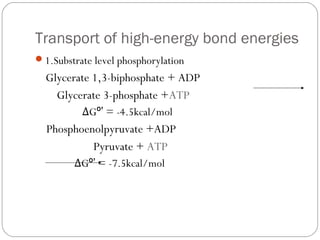
Transport of high-energy bond energies
1.Substrate level phosphorylation

Glycerate 1,3-biphosphate + ADP
Glycerate 3-phosphate +ATP
ΔGº’ = -4.5kcal/mol

Phosphoenolpyruvate +ADP
Pyruvate + ATP
ΔGº’ = -7.5kcal/mol
2.ATP is the center of energy producing and
utilizing.
ATP

Oxidative
Phosphorylation

Energy
utilization

Substrate level
phosphorylation

~P
~P

ADP
3.Other nucleoside triphosphates are
involved in energy transport.
GTP: gluconeogenesis

protein synthesis
UTP: glycogen
CTP: lipid synthesis
4.Transport of the terminal phosphate
bond of ATP to the other nucleoside
Function of nucleoside diphosphate kinase
ATP + UDP
ATP + CDP
ATP + GDP

ADP + UTP
ADP + CTP
ADP + GTP

Function of adenylate kinase
ADP + ADP

ATP + AMP
7.3 Energy from cytosolic NADH
A mitochondrial NADH produce 2.5 ATP
A cytosolic NADH must be transported into mitochondrial

for oxidation by two methods.
Glycerol phosphate shuttle
1.5 ATP
Malate aspartate shuttle
2.5 ATP
Glycerol phosphate shuttle
CH2OH

CH2OH

Electron chain

Glycerol
phosphate
dehydrogenase

NAD+

C=O

C=O

CH2O- Pi

NADH+H

+

CH2O- Pi

dihydroxyacetone
phosphate

dihydroxyacetone
phosphate

CH2OH

CH2OH

CHOH

CHOH

CH2O- Pi

CH2O- Pi

Glycerol
phosphate

FADH2

FAD

Glycerol
phosphate
Intermembran
space

Glycerol
phosphate
dehydrogenase

Inner menbran
Malate aspartate shuttle
O

Aspartate
-OOC-CH2-C-COO-

H 3N
Malate
α-ketoglutarate
carrier

+

-

-

OOC-CH2-C-COO

Aspartate

H

oxaloacetate

oxaloacetate
Glutamate

NADH
+H+

Glutamate

Electron chain
NADH
+H+

NAD+

α-ketoglutarate

α-ketoglutarate

OH

NAD+

-OOC-CH2-C-COOH

Malate

cytosol

Glutamate-aspartate
carrier

inner mitochondrial
membran

Malate
matrix
7.4 Other Biological Oxidations
Monoxygenases

dioxygenase --add 2 atoms of O2
oxygenase to organic compounds.
monoxygenase (mixed-function oxidase, hydroxylase)
--adds 1 oxygen atom to organic compounds as a hydroxyl group.

RH + NADPH + H+ + O2

ROH + NADP+ + H2O
The chief compounds of monoxygenase:
Cyt b5, Cyt P450, Cyt P450 reductase(FAD,FMN)
Free Radical Scavenging Enzymes
Free Radical: the groups with an unpaired electron.
(such as O2﹣ 、 H2O2 、• OH)
1.Superoxide dismutases(SODs)

2O2﹣ + 2H+

SOD

H2O2 + O2

peroxidase

H2O + O2
2.Glutathione peroxidase
H2O2
(ROOH)

2G –SH

NADP+

Glutathione
Glutathione
reductase

peroxidase
H2O
(ROH+H2O)

G –S – S – G

NADPH+H+
3.Catalase (in peroxisomes)

2H2O2

catalase

2H2O + O2
summary

Biological oxidation -3

  • 1.
  • 2.
    Biological oxidation isthe cellular process in which the organic substances release energy (ATP), produce CO2 and H2O through oxidative-reductive reactions. organic substances: carbohydrate, fat and protein
  • 3.
    7.1 Principal ofRedox Reaction The electron-donating molecule in a oxidation-reduction reaction is called the reducing agent or reductant; the electron-accepting molecule is the oxidizing agent or oxidant: for example: Fe2+ (ferrous) lose -e Fe3+ (ferric) gain +e
  • 4.
    Redox reaction =reduction-oxidation reaction Several forms of Biological Reduction 1. Gain of electrons 2. Hydrogenation 3. Deoxygenation Several forms of Biological Oxidation 1. Loss of electrons 2. Dehydrogenation 3. Oxygenation
  • 5.
    oxidation-reduction potential ( orredox potential), E : it is a measure of the affinity of a substance for electrons. It decide the loss (or the gain) of electrons. A positive E: the substance has a higher affinity for electrons , accept electrons easily. A negative E: the substance has a lower affinity for electrons , donate electrons easily.
  • 6.
    E0`, the standardredox potential for a substance :is measured under stander condition(25℃, 1mmol/L reaction substance),at pH7, and is expressed in volts.
  • 7.
    Section 7.2 Respiration Chainand Oxidative Phosphorylation
  • 8.
    7.2.1 Respiratory Chain Term: Achain in the mitochondria consists of a number of redox carriers for transferring electrons from the substrate to molecular oxygen to form oxygen ion, which combines with protons to form water.
  • 9.
    Redox carriers including4 protein complexes 1.Complex I: NADH:ubiquinone oxidoreductase NADH:CoQ oxidoreductase 2.Complex II: Succinate dehydrogenase 3.Complex III: cytochrome bc1 (ubiquinone Cyt c oxidoreductase) 4.Complex IV: cytochrome oxidase
  • 10.
    Complex I (NADH:ubiquinone oxidoreductase) Function: transfer electrons from NADH to CoQ Components: NADH dehydrogenase (FMN) Iron-sulfur proteins (Fe-S) complex Ⅰ NADH→ →CoQ FMN; Fe-SN-1a,b; Fe-SN-4; Fe-SN-3; Fe-SN-2
  • 11.
    R=H: NAD+; R=H2PO3:NADP+ 1. NAD(P)+:Nicotinamide Adenine Dinucleotide Phosphate)
  • 12.
    Oxidation of NADHis a 2-electron(2e), 2-proton(2H) reaction NAD+ or NADP+ NADH or NADPH
  • 13.
    2. FMN cantransfer 1 or 2 hydride ions ach time FMN: flavin mononucleotide Accepts 1 H+ and 1 e- Accepts 2 H + and 2 e to form semiquinone = stable free radical to give fully reduced form
  • 14.
    3. Iron-sulfur clusters(Fe-S) transfers 1electron at a time, without proton involved Fe3++e- Fe2+
  • 15.
    4.Ubiquinone (CoQ) islipid-soluble, not a component of complex Ⅰ , can transfer 1 or 2 hydride ions each time. Function: transfer electrons and protons from complex Ⅰ , Ⅱ to complex Ⅲ .
  • 16.
  • 17.
    Complex II :Succinate dehydrogenase (Succinate: CoQ oxidoreductase ) Function: transfer electrons from succinate to CoQ Components: Succinate dehydrogenase (FAD, Fe-S) Cytochrome b560 Complex Ⅱ Succinate→ Fe-S1; b560; FAD; Fe-S2 ; Fe-S3 →CoQ
  • 18.
    Cytochromes a, b,c are heme proteins, their heme irons participate redox reactions of e- transport. Fe3++e- Fe2+
  • 19.
  • 20.
    Complex III: cytochrome bc1(ubiquinone Cyt c oxidoreductase) Function: transfer electrons from CoQ to cytochrome c Components: iron-sulfur protein cytochrome b(b562, b566) cytochrome c1 complex Ⅲ QH2→ b562; b566; Fe-S; c1 →Cyt c
  • 21.
    Cytochrome c issoluble, which will transfer electrons to complex Ⅳ Intermembrane space Matrix
  • 22.
    Complex IV: cytochromeoxidase Function: transfer electrons from Cyt c to molecule oxygen, the final electron acceptor. Components: cytochrome aa3 copper ion (Cu2+) Cu2+ + e- Cu+ Complex IV Cyt c → CuA→a→a3→CuB → O2
  • 24.
  • 25.
    Sequence of respiratorychain Principles: e- tend to flow from a redox pair with a lower E°to one with a higher E° In the e--transport chain, e--carriers are arranged in order of increasing redox potential, making possible the gradual release of energy stored in NADH, FADH2
  • 26.
    呼吸链中各种氧化还原对的标准氧化还原电位 Redox potential 氧化还原对 redox pair NAD+/NADH+H+ FMN/FMNH2 FAD/ FADH2 Cyt b Fe3+/Fe2+ Q10/Q10H2 Cyt c1 Fe3+/ Fe2+ Cyt c Fe3+/Fe2+ Cyt a Fe3+ / Fe2+ Cyt a3 Fe3+ / Fe2+ 1/2 O2/ H2O Eº'0(V) E -0.32 -0.30 -0.06 0.04(或0.10) 0.07 0.22 0.25 0.29 0.55 0.82
  • 28.
    There are tworespiratory chains NADH respiratory chain NADH Complex Ⅰ CoQ Complex Ⅲ cytochrome c Complex Ⅳ O2 Succinate (FADH2) respiratory chain Succinate ComplexⅡ CoQ ComplexⅢ cytochrome c ComplexⅣ O2
  • 29.
  • 30.
    7.2.2 Oxidative Phosphorylation Theoxidation of organic nutritions produces the energy-rich molecules, NADH and FADH2. The oxidation of NADH or FADH2 in mitochondrial is the electron transferring through respiration chain. The free energy produced in electron transferring supports the phosphorylation of ADP to form ATP. The oxidation of NADH or FADH2 and the formation of ATP are coupled process, called Oxidation Phosphorylation.
  • 31.
    The Chemiosmotic Theory Thefree energy of electron transport is conserved by pumping protons from the mitochondrial matrix to the intermembrane space so as to create an electrochemical H+ gradient across the inner mitochondrial membrane. The electrochemical potential of this gradient is harnessed to synthesize ATP. Peter Mitchell
  • 32.
    Electrochemical H+ gradient(Protonmotive force) 2 components involved 1. Chemical potential energy due to difference in [H+] in two regions separated by a membrane 2. Electrical potential energy that results from the separation of charge when a proton moves across the membrane without a electron.
  • 33.
    Complex I: 4 H+expelled per e--pair transferred to Q Complex III: 4 H+ expelled per e--pair transferred to Cyt c Complex IV: 2e- + 2 H+ from matrix convert ½ O2 to H2O; 2 further H+ expelled from
  • 34.
    Proton pumping: Reductiondependentconformational switch of an e--transport complex Conformation 1 (high affinity for H+) Conformation 2 (low affinity for H+).
  • 35.
  • 36.
    β-subunit take upADP and Pi to form ATP ADP + Pi ATP Each of 3 βsubunits contains an active site F1: multisubunit complex that catalyzes ATP synthesis F 0 = proton-conducting transmembrane unit
  • 37.
    When protons flowback through F0 channel, γ-subunit is rotated by the rotation of c ring, then the conformations of β-subunits are changed, this lead to the synthesis and release of ATP. To form a ATP need 3 protons flow into matrix. H+ flow β-subunit has three conformations:T (tight), L (loose), O (open)
  • 38.
    Translocation of ATP, ADP and Pi. ADP3- ATP4- H+ H2PO4- H+ Intermembrane 胞液侧 space F0 基质侧 Matrix F1 ATP4ADP3H+ H2PO4- H+
  • 39.
    When protons flowback through F0 channel, γ-subunit is rotated by the rotation of c ring, then the conformations of β-subunits are changed, this lead to the synthesis and release of ATP. To form a ATP need 3 protons flow into matrix. H+ flow β-subunit has three conformations:T (tight), L (loose), O (open)
  • 41.
    P/O ratios P/O ratiois the rate of phosphate incorporated into ATP to atoms of O2 utilized. It measure the number of ATP molecules formed per two electrons transfer through the respiratory chain.  NADH respiratory chain : 2.5,  FADH2 respiratory chain: 1.5
  • 42.
    During two electronstransfer through NADH respiratory chain, ten protons are pumped out of the matrix. To synthesis and translocation an ATP, four protons are needed. So, two electrons transport can result in 2.5 ATP. To succinate respiratory chain , two electrons transport can result in 1.5 ATP.
  • 43.
    Regulation of OxidativePhosphorylation 1.PMF (proton motive force) regulate the electron transport. higher PMF lower rate of transport 2.ADP concentration resting condition: energy demanded is low, ADP concentration is low, the speed of Oxidative Phosphorytion is low. active condition: the speed is high.
  • 44.
    Inhibitor of Oxidative Phosphorylation 1.Inhibitorof electron transport Succinate Antimycin A Cyanide, Azide Carbon Monoxide × × × Retonone Amytal
  • 45.
     2.Uncoupling agents uncouplingprotein (in brown adipose tissue), 2,4-dinitrophenol, Pentachlorophenol heat H+ Intermenbran space Ⅰ Ⅱ H Cyt c uncoupling protein F0 Q Ⅲ Ⅳ F1 Matrix + H+ H+ ADP+Pi ATP 2,4-dinitrophnol
  • 46.
    3.Oligomycin bonds atthe connection of F 0 and F1, inhibit the function of ATP synthase. Intermembrane space Matrix Oligomycin C ring
  • 47.
  • 48.
    ATP and otherEnergy-rich compounts ATP has two energy-rich phosphoric acid anhydride bonds, the hydrolysis of each bond release more energy than simple phosphate esters. NH 2 N N OH OH OH N OH OH N p O p OCH2 O O= P O ~ ~ OH H H H H OH OH AMP ADP ATP
  • 49.
    Some Energy-rich compounds Structure Exemple creatinephosphate phosphoenolpyruvate acetyl phosphate Acetyl CoA ΔGº’
  • 50.
    The hydrolysis ofenergy-rich bond: ΔGº’ = -5 ~ -15kcal/mol The compounds with energy-rich bond are high-energy compounds. The hydrolysis of low-energy bond: ΔGº’ = -1 ~ -3kcal/mol The compounds with low energy bond are compounds. low-energy
  • 51.
    Transport of high-energybond energies 1.Substrate level phosphorylation Glycerate 1,3-biphosphate + ADP Glycerate 3-phosphate +ATP ΔGº’ = -4.5kcal/mol Phosphoenolpyruvate +ADP Pyruvate + ATP ΔGº’ = -7.5kcal/mol
  • 52.
    2.ATP is thecenter of energy producing and utilizing. ATP Oxidative Phosphorylation Energy utilization Substrate level phosphorylation ~P ~P ADP
  • 53.
    3.Other nucleoside triphosphatesare involved in energy transport. GTP: gluconeogenesis protein synthesis UTP: glycogen CTP: lipid synthesis
  • 54.
    4.Transport of theterminal phosphate bond of ATP to the other nucleoside Function of nucleoside diphosphate kinase ATP + UDP ATP + CDP ATP + GDP ADP + UTP ADP + CTP ADP + GTP Function of adenylate kinase ADP + ADP ATP + AMP
  • 55.
    7.3 Energy fromcytosolic NADH A mitochondrial NADH produce 2.5 ATP A cytosolic NADH must be transported into mitochondrial for oxidation by two methods. Glycerol phosphate shuttle 1.5 ATP Malate aspartate shuttle 2.5 ATP
  • 56.
    Glycerol phosphate shuttle CH2OH CH2OH Electronchain Glycerol phosphate dehydrogenase NAD+ C=O C=O CH2O- Pi NADH+H + CH2O- Pi dihydroxyacetone phosphate dihydroxyacetone phosphate CH2OH CH2OH CHOH CHOH CH2O- Pi CH2O- Pi Glycerol phosphate FADH2 FAD Glycerol phosphate Intermembran space Glycerol phosphate dehydrogenase Inner menbran
  • 57.
    Malate aspartate shuttle O Aspartate -OOC-CH2-C-COO- H3N Malate α-ketoglutarate carrier + - - OOC-CH2-C-COO Aspartate H oxaloacetate oxaloacetate Glutamate NADH +H+ Glutamate Electron chain NADH +H+ NAD+ α-ketoglutarate α-ketoglutarate OH NAD+ -OOC-CH2-C-COOH Malate cytosol Glutamate-aspartate carrier inner mitochondrial membran Malate matrix
  • 58.
    7.4 Other BiologicalOxidations Monoxygenases dioxygenase --add 2 atoms of O2 oxygenase to organic compounds. monoxygenase (mixed-function oxidase, hydroxylase) --adds 1 oxygen atom to organic compounds as a hydroxyl group. RH + NADPH + H+ + O2 ROH + NADP+ + H2O
  • 59.
    The chief compoundsof monoxygenase: Cyt b5, Cyt P450, Cyt P450 reductase(FAD,FMN)
  • 60.
    Free Radical ScavengingEnzymes Free Radical: the groups with an unpaired electron. (such as O2﹣ 、 H2O2 、• OH) 1.Superoxide dismutases(SODs) 2O2﹣ + 2H+ SOD H2O2 + O2 peroxidase H2O + O2
  • 61.
  • 62.
  • 63.