Dr. P. Suganya
Assistant Professor
Sri Kaliswari College (Autonomous)
INTRODUCTION
• The pentose phosphate pathway is a metabolic
pathway parallel to glycolysis which
generates NADPH and pentoses (5-carbon sugars) as
well as ribose 5-phosphate.
• The pentose phosphate pathway is also called as
the phosphogluconate pathway or hexose
monophosphate shunt.
• While it involves oxidation of glucose, its primary role
is anabolic rather than catabolic.
• It is an important pathway that generates precursors
for nucleotide synthesis andis especially important
in red blood cells (erythrocytes).
LOCATION
• Cytoplasm of cells of the liver, adrenal cortex,
and lactating mammary glands. In plants,
most steps take place in plastids.
PATHWAY
• Substrate: Glucose-6-phosphate.
• There are two distinct phases in the pathway.
The first is the oxidative phase, in which
NADPH is generated, and the second is the
non-oxidative synthesis of 5-carbon sugars.
REACTIONS
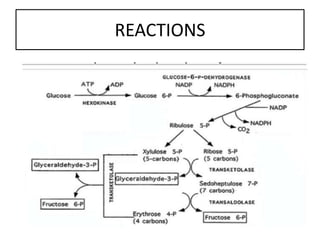
1. The Oxidative Reactions
• Glucose-6-phosphate is converted to 6-
phosphogluconolactone, and NADP+ is reduced to
NADPH + H+.
– Enzyme: glucose-6-phosphate dehydrogenase
• 6-Phosphogluconolactone is hydrolyzed to 6-
phosphogluconate.
– Enzyme: Gluconolactonase
• 6-Phosphogluconate undergoes an oxidation, followed
by a decarboxylation. CO2 is released, and a second
NADPH + H+ is generated from NADP+. The remaining
carbons form ribulose-5-phosphate.
– Enzyme: 6-phosphogluconate dehydrogenase
2. The Non-oxidative Reactions
• Ribulose-5-phosphate is isomerized to ribose-5-
phosphate or epimerized to xylulose-5-phosphate.
• Ribose-5-phosphate and xylulose-5-phosphate undergo
reactions, catalyzed by transketolase and transaldolase,
that transfer carbon units, ultimately forming fructose
6-phosphate and glyceraldehyde-3-phosphate.
– Transketolase, which requires thiamine pyrophosphate,
transfers two-carbon units.
– Transaldolase transfers three-carbon units.
•
OVERALL REACTION
• 3 Glucose-6-P + 6 NADP+→ 3 ribulose-5-P + 3
CO2 + 6 NADPH
• 3 Ribulose-5-P → 2 xylulose-5-P + Ribose-5-P
• 2 Xylulose-5-P + Ribose-5-P → 2 fructose-6-P +
Glyceraldehyde-3-P
RESULT
• Oxidative portion: Irreversible.
• Generates two NADPH, which can then be used in
fatty acid synthesis and cholesterol synthesis and for
maintaining reduced glutathione inside RBCs.
• Nonoxidative portion: Reversible.
• Generates intermediate molecules (ribose-5-
phosphate; glyceraldehyde-3-phosphate; fructose-6-
phosphate) for nucleotide synthesis and glycolysis.
•
REGULATION
• Key enzyme in the pentose-phosphate pathway is
glucose-6-phosphate dehydrogenase.
• Levels of glucose-6-phosphate dehydrogenase are
increased in the liver and adipose tissue when
large amounts of carbohydrates are consumed.
• Glucose-6-phosphate dehydrogenase is
stimulated by NADP+ and inhibited by NADPH
and by palmitoyl-CoA (part of the fatty acid
synthesis pathway).
PURPOSE
• Pentose phosphate pathway functions as an alternative
route for glucose oxidation that does not directly consume
or produce ATP.
• The pentose phosphate pathway produces NADPH for fatty
acid synthesis. Under these conditions, the fructose-6-
phosphate and glyceraldehyde-3-phosphate generated in
the pathway reenter glycolysis.
• NADPH is also used to reduce glutathione (γ-
glutamylcysteinylglycine).
• Glutathione helps to prevent oxidative damage to cells by
reducing hydrogen peroxide (H2O2).
• Glutathione is also used to transport amino acids across the
membranes of certain cells by the γ-glutamyl cycle.
• Generation of ribose-5-phosphate
• When NADPH levels are low, the oxidative
reactions of the pathway can be used to generate
ribose-5-phosphate for nucleotide biosynthesis.
• When NADPH levels are high, the reversible
nonoxidative portion of the pathway can be used
to generate ribose-5-phosphate for nucleotide
biosynthesis from fructose-6-phosphate and
glyceraldehyde-3-phosphate.
REFERENCES
• https://microbenotes.com/pentose-phosphate-pathway/
• Smith, C. M., Marks, A. D., Lieberman, M. A., Marks, D. B., & Marks, D. B.
(2005). Marks’ basic medical biochemistry: A clinical approach.
Philadelphia: Lippincott Williams & Wilkins.

PENTOSE PHOSPHATE PATHWAY.pptx

  • 1.
    Dr. P. Suganya AssistantProfessor Sri Kaliswari College (Autonomous)
  • 2.
    INTRODUCTION • The pentosephosphate pathway is a metabolic pathway parallel to glycolysis which generates NADPH and pentoses (5-carbon sugars) as well as ribose 5-phosphate. • The pentose phosphate pathway is also called as the phosphogluconate pathway or hexose monophosphate shunt. • While it involves oxidation of glucose, its primary role is anabolic rather than catabolic. • It is an important pathway that generates precursors for nucleotide synthesis andis especially important in red blood cells (erythrocytes).
  • 3.
    LOCATION • Cytoplasm ofcells of the liver, adrenal cortex, and lactating mammary glands. In plants, most steps take place in plastids.
  • 4.
    PATHWAY • Substrate: Glucose-6-phosphate. •There are two distinct phases in the pathway. The first is the oxidative phase, in which NADPH is generated, and the second is the non-oxidative synthesis of 5-carbon sugars.
  • 5.
  • 6.
    1. The OxidativeReactions • Glucose-6-phosphate is converted to 6- phosphogluconolactone, and NADP+ is reduced to NADPH + H+. – Enzyme: glucose-6-phosphate dehydrogenase • 6-Phosphogluconolactone is hydrolyzed to 6- phosphogluconate. – Enzyme: Gluconolactonase • 6-Phosphogluconate undergoes an oxidation, followed by a decarboxylation. CO2 is released, and a second NADPH + H+ is generated from NADP+. The remaining carbons form ribulose-5-phosphate. – Enzyme: 6-phosphogluconate dehydrogenase
  • 7.
    2. The Non-oxidativeReactions • Ribulose-5-phosphate is isomerized to ribose-5- phosphate or epimerized to xylulose-5-phosphate. • Ribose-5-phosphate and xylulose-5-phosphate undergo reactions, catalyzed by transketolase and transaldolase, that transfer carbon units, ultimately forming fructose 6-phosphate and glyceraldehyde-3-phosphate. – Transketolase, which requires thiamine pyrophosphate, transfers two-carbon units. – Transaldolase transfers three-carbon units. •
  • 8.
    OVERALL REACTION • 3Glucose-6-P + 6 NADP+→ 3 ribulose-5-P + 3 CO2 + 6 NADPH • 3 Ribulose-5-P → 2 xylulose-5-P + Ribose-5-P • 2 Xylulose-5-P + Ribose-5-P → 2 fructose-6-P + Glyceraldehyde-3-P
  • 9.
    RESULT • Oxidative portion:Irreversible. • Generates two NADPH, which can then be used in fatty acid synthesis and cholesterol synthesis and for maintaining reduced glutathione inside RBCs. • Nonoxidative portion: Reversible. • Generates intermediate molecules (ribose-5- phosphate; glyceraldehyde-3-phosphate; fructose-6- phosphate) for nucleotide synthesis and glycolysis. •
  • 10.
    REGULATION • Key enzymein the pentose-phosphate pathway is glucose-6-phosphate dehydrogenase. • Levels of glucose-6-phosphate dehydrogenase are increased in the liver and adipose tissue when large amounts of carbohydrates are consumed. • Glucose-6-phosphate dehydrogenase is stimulated by NADP+ and inhibited by NADPH and by palmitoyl-CoA (part of the fatty acid synthesis pathway).
  • 11.
    PURPOSE • Pentose phosphatepathway functions as an alternative route for glucose oxidation that does not directly consume or produce ATP. • The pentose phosphate pathway produces NADPH for fatty acid synthesis. Under these conditions, the fructose-6- phosphate and glyceraldehyde-3-phosphate generated in the pathway reenter glycolysis. • NADPH is also used to reduce glutathione (γ- glutamylcysteinylglycine). • Glutathione helps to prevent oxidative damage to cells by reducing hydrogen peroxide (H2O2). • Glutathione is also used to transport amino acids across the membranes of certain cells by the γ-glutamyl cycle.
  • 12.
    • Generation ofribose-5-phosphate • When NADPH levels are low, the oxidative reactions of the pathway can be used to generate ribose-5-phosphate for nucleotide biosynthesis. • When NADPH levels are high, the reversible nonoxidative portion of the pathway can be used to generate ribose-5-phosphate for nucleotide biosynthesis from fructose-6-phosphate and glyceraldehyde-3-phosphate.
  • 13.
    REFERENCES • https://microbenotes.com/pentose-phosphate-pathway/ • Smith,C. M., Marks, A. D., Lieberman, M. A., Marks, D. B., & Marks, D. B. (2005). Marks’ basic medical biochemistry: A clinical approach. Philadelphia: Lippincott Williams & Wilkins.