welcome
Biosynthesis and degradation of
purine
M.sridevi
M.Sc. microbiology
Introduction
 Purine is a heterocyclic aromatic organic
compound that consists of a pyrimidine ring
fused to an imidazole ring.
 Purine is water soluble.
 Purine are found in high concentration in meat &
meat products , especially internal organ such as
liver & kidney.
Properties
 Purine is both a very weak acid and even weaker
base.
 There are many naturally occurring purine .
 They include the nucleobases
 adenine
Guanine
 Other notable purines are hypoxanthine , xanthine,
Theo bromine , caffeine , uric acid , isoguanine .
purine metabolism
 Purine metabolism refer to the metabolic
pathway to synthesize & breakdown purine that
are present in many organism .
 Purine are biologically synthesized as
nucleotides.
 Both adenine and guanine are derived from the
nucleotide inosine monophosphate (IMP) or
inosinic acid
The synthesis of IMP
IMP is synthesized in a pathway composed of 11 reactions.
• Activation of ribose – 5 – phosphate
• Acquisition of purine atom N9
• Acquisition of purine atom C4,C5 & N7
• Acquisition of purine atom C8
• Acquisition of purine atom N3
• Formation of the purine imidazole ring
• Acquisition of C6
• Acquisition of N1
• Elimination of fumarate
• Acquisition of C2
• Cyclization to form IMP
Cont…
Step 1 :
• Ribose 5- phosphate is the starting material
for purine nucleotide synthesis .
• It react with ATP to form phosporibosyl
pyrophosphate (PRPP).
Step 2 :
• Glutamine transfer its amide nitrogen to
PRPP to replace pyrophosphate and produce 5
–phosphoribosylamine .
Step 3 :
• Phosphoribosylamine reacts with glycine
in the presence of ATP to form
glycinamide ribosyl 5 –phosphate (or)
glycinamide ribotide (GAR).
Step 4 :
• N10 –formyl tetrahydrofolate donates the
formyl group & the product formed is
formyl glycinamide ribosyl 5-phosphate.
Step 5 :
• Glutamine transfer the second amido amino
group to produce formylglycinamidine ribosyl 5-
phosphate .
Step 6 :
• The imidazole ring of the purine is closed in an
ATP dependent reaction to yield 5-amino
imidazole ribosyl 5-phosphate .
Step 7 :
• Incorporation of co2 occurs to yield
aminoimidazole carboxylate ribosyl 5-phosphate
.
Step8:
•Aspartate condenses with the product
in reaction 7 to form aminoimidazole 4
succinyl carboxamide ribosyl 5-
phosphate.
Step9:
•Adenosuccinate lyase cleaves off
fumarate and only the amino group of
aspartate is retained to yield
aminoimidazole 4-carboxamide ribosyl
5-phosphate.
Step 10:
• N 10- formyl tetrahydrofolate donates a one – carbon
moiety to produce formaminoimidazole 4 carboxamide
ribosyl 5 phosphate.
Step11:
• The final reaction catalysed by cyclohydrase leads to ring
closure with an elimination of water molecule. The product
obtained is inosine monophosphate (IMP), the parent
purine nucleotide from which other purine nucleotides can
be synthesized.
Synthesis of AMP and GMP from IMP
For the synthesis of GMP , IMP undergoes
NAD + dependent dehydrogenation to form
xanthosine monophosphate (XMP) .
Glutamine then transfer amide nitrogen to
XMP to produce GMP.
Aspartate condenses with IMP in the
presence GTP to produce adenylsuccinate
which , on cleavage , forms AMP .
Degradation of purine nucleotide
The end product of purine metabolism in
human is uric acid .
Uric acid can serve as an important
antioxidant .
The normal concentration of uric acid in the
serum of adults is in the range of 3 -7 mg/dl
Cont….
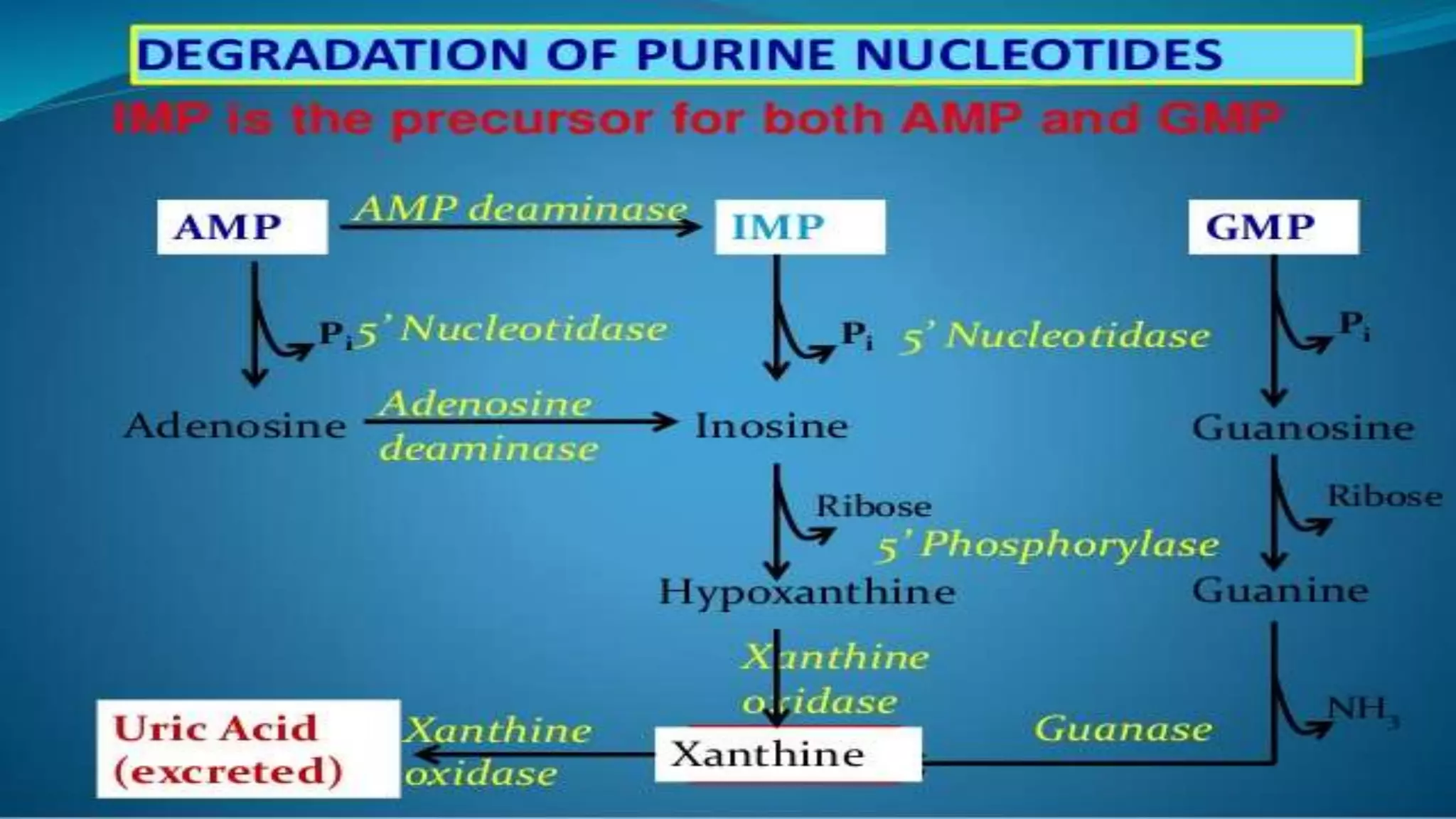
Step 1 :
• The nucleotide monophosphate (AMP, IMP
& GMP) are converted to their respective
nucleoside forms (adenosine , inosine &
guanosine ) by the action of nucleotidase.
Step 2 :
• The amino group , either from AMP or
adenosine , can be removed to produce
IMP or inosine .
Step 3:
• Inosine and guanosine are , respectively ,
converted to hypoxanthine and guanine by
purine nucleoside phosporylase .
Step 4:
• Guanine undergoes deamination by guanase to
form xanthine.
Step 5:
• Xanthine oxidase is an important enzyme that
convert hypoxanthine to xanthine , &
xanthine to uric acid.
Disorder of purine metabolism
 Gout is a genetic disorder of purine catabolism.
 It is caused by excessive formation of uric acid
due to increased purine biosynthesis .
 Two characteristic features in gout are ,
Hyperuricemia
Uricosuria
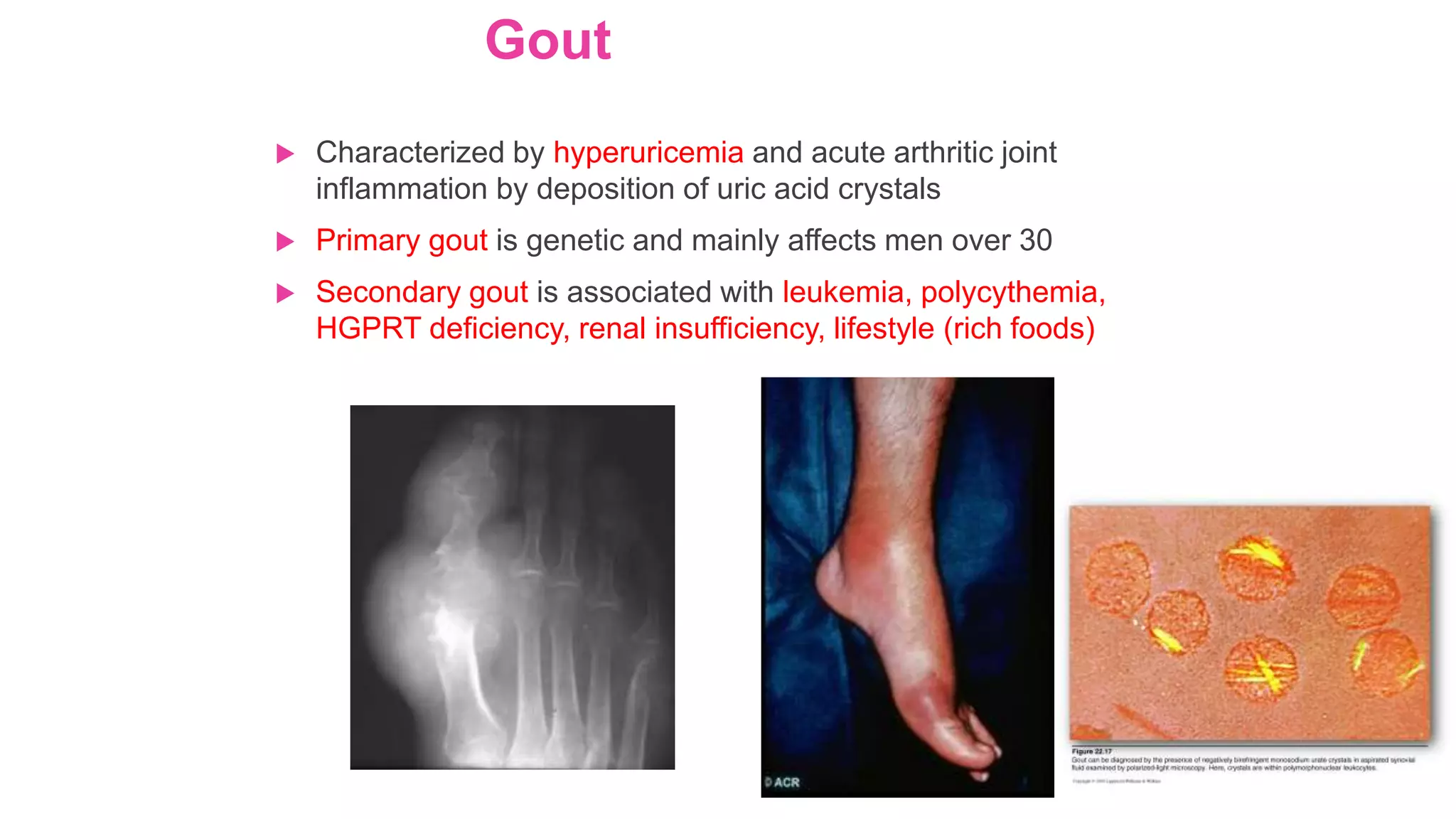
Gout
 Characterized by hyperuricemia and acute arthritic joint
inflammation by deposition of uric acid crystals
 Primary gout is genetic and mainly affects men over 30
 Secondary gout is associated with leukemia, polycythemia,
HGPRT deficiency, renal insufficiency, lifestyle (rich foods)
Purine degradation

Purine degradation

  • 1.
  • 2.
    Biosynthesis and degradationof purine M.sridevi M.Sc. microbiology
  • 3.
    Introduction  Purine isa heterocyclic aromatic organic compound that consists of a pyrimidine ring fused to an imidazole ring.  Purine is water soluble.  Purine are found in high concentration in meat & meat products , especially internal organ such as liver & kidney.
  • 4.
    Properties  Purine isboth a very weak acid and even weaker base.  There are many naturally occurring purine .  They include the nucleobases  adenine Guanine  Other notable purines are hypoxanthine , xanthine, Theo bromine , caffeine , uric acid , isoguanine .
  • 5.
    purine metabolism  Purinemetabolism refer to the metabolic pathway to synthesize & breakdown purine that are present in many organism .  Purine are biologically synthesized as nucleotides.  Both adenine and guanine are derived from the nucleotide inosine monophosphate (IMP) or inosinic acid
  • 6.
    The synthesis ofIMP IMP is synthesized in a pathway composed of 11 reactions. • Activation of ribose – 5 – phosphate • Acquisition of purine atom N9 • Acquisition of purine atom C4,C5 & N7 • Acquisition of purine atom C8 • Acquisition of purine atom N3 • Formation of the purine imidazole ring • Acquisition of C6 • Acquisition of N1 • Elimination of fumarate • Acquisition of C2 • Cyclization to form IMP
  • 7.
    Cont… Step 1 : •Ribose 5- phosphate is the starting material for purine nucleotide synthesis . • It react with ATP to form phosporibosyl pyrophosphate (PRPP). Step 2 : • Glutamine transfer its amide nitrogen to PRPP to replace pyrophosphate and produce 5 –phosphoribosylamine .
  • 8.
    Step 3 : •Phosphoribosylamine reacts with glycine in the presence of ATP to form glycinamide ribosyl 5 –phosphate (or) glycinamide ribotide (GAR). Step 4 : • N10 –formyl tetrahydrofolate donates the formyl group & the product formed is formyl glycinamide ribosyl 5-phosphate.
  • 9.
    Step 5 : •Glutamine transfer the second amido amino group to produce formylglycinamidine ribosyl 5- phosphate . Step 6 : • The imidazole ring of the purine is closed in an ATP dependent reaction to yield 5-amino imidazole ribosyl 5-phosphate . Step 7 : • Incorporation of co2 occurs to yield aminoimidazole carboxylate ribosyl 5-phosphate .
  • 10.
    Step8: •Aspartate condenses withthe product in reaction 7 to form aminoimidazole 4 succinyl carboxamide ribosyl 5- phosphate. Step9: •Adenosuccinate lyase cleaves off fumarate and only the amino group of aspartate is retained to yield aminoimidazole 4-carboxamide ribosyl 5-phosphate.
  • 11.
    Step 10: • N10- formyl tetrahydrofolate donates a one – carbon moiety to produce formaminoimidazole 4 carboxamide ribosyl 5 phosphate. Step11: • The final reaction catalysed by cyclohydrase leads to ring closure with an elimination of water molecule. The product obtained is inosine monophosphate (IMP), the parent purine nucleotide from which other purine nucleotides can be synthesized.
  • 15.
    Synthesis of AMPand GMP from IMP For the synthesis of GMP , IMP undergoes NAD + dependent dehydrogenation to form xanthosine monophosphate (XMP) . Glutamine then transfer amide nitrogen to XMP to produce GMP. Aspartate condenses with IMP in the presence GTP to produce adenylsuccinate which , on cleavage , forms AMP .
  • 17.
    Degradation of purinenucleotide The end product of purine metabolism in human is uric acid . Uric acid can serve as an important antioxidant . The normal concentration of uric acid in the serum of adults is in the range of 3 -7 mg/dl
  • 18.
    Cont…. Step 1 : •The nucleotide monophosphate (AMP, IMP & GMP) are converted to their respective nucleoside forms (adenosine , inosine & guanosine ) by the action of nucleotidase. Step 2 : • The amino group , either from AMP or adenosine , can be removed to produce IMP or inosine .
  • 19.
    Step 3: • Inosineand guanosine are , respectively , converted to hypoxanthine and guanine by purine nucleoside phosporylase . Step 4: • Guanine undergoes deamination by guanase to form xanthine. Step 5: • Xanthine oxidase is an important enzyme that convert hypoxanthine to xanthine , & xanthine to uric acid.
  • 21.
    Disorder of purinemetabolism  Gout is a genetic disorder of purine catabolism.  It is caused by excessive formation of uric acid due to increased purine biosynthesis .  Two characteristic features in gout are , Hyperuricemia Uricosuria
  • 22.
    Gout  Characterized byhyperuricemia and acute arthritic joint inflammation by deposition of uric acid crystals  Primary gout is genetic and mainly affects men over 30  Secondary gout is associated with leukemia, polycythemia, HGPRT deficiency, renal insufficiency, lifestyle (rich foods)