ELECTRONTRANSPORT CHAIN
MANJU M NAIR
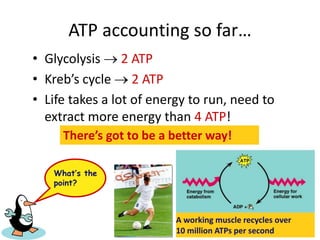
ATP accounting so far…
• Glycolysis  2 ATP
• Kreb’s cycle  2 ATP
• Life takes a lot of energy to run, need to
extract more energy than 4 ATP!
What’s the
point?
A working muscle recycles over
10 million ATPs per second
There’s got to be a better way!
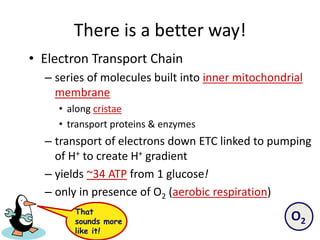
There is a better way!
• Electron Transport Chain
– series of molecules built into inner mitochondrial
membrane
• along cristae
• transport proteins & enzymes
– transport of electrons down ETC linked to pumping
of H+ to create H+ gradient
– yields ~34 ATP from 1 glucose!
– only in presence of O2 (aerobic respiration)
O2
That
sounds more
like it!
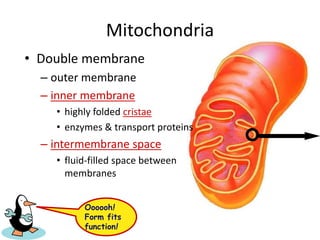
Mitochondria
• Double membrane
– outer membrane
– inner membrane
• highly folded cristae
• enzymes & transport proteins
– intermembrane space
• fluid-filled space between
membranes
Oooooh!
Form fits
function!
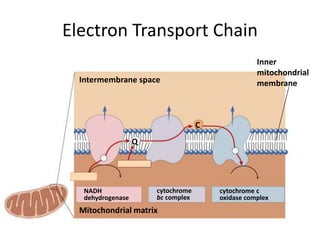
Electron Transport Chain
Intermembrane space
Mitochondrial matrix
Q
C
NADH
dehydrogenase
cytochrome
bc complex
cytochrome c
oxidase complex
Inner
mitochondrial
membrane
G3P
Glycolysis Krebs cycle
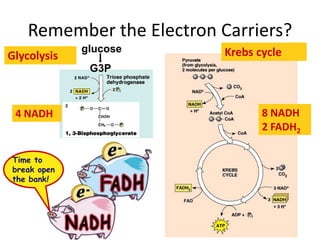
8 NADH
2 FADH2
Remember the Electron Carriers?
4 NADH
Time to
break open
the bank!
glucose
Electron Transport Chain
intermembrane
space
mitochondrial
matrix
inner
mitochondrial
membrane
NAD+
Q
C
NADH H2O
H+
e–
2H+ + O2
H+H+
e–
FADH2
1
2
NADH
dehydrogenase
cytochrome
bc complex
cytochrome c
oxidase complex
FAD
e–
H
H  e- + H+
NADH  NAD+ + H
H
p
e
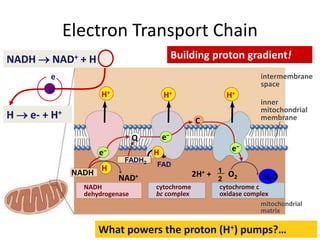
Building proton gradient!
What powers the proton (H+) pumps?…
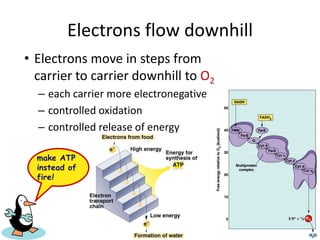
Electrons flow downhill
• Electrons move in steps from
carrier to carrier downhill to O2
– each carrier more electronegative
– controlled oxidation
– controlled release of energy
make ATP
instead of
fire!
H+
ADP + Pi
H+
H+
H+
H+ H+
H+H+
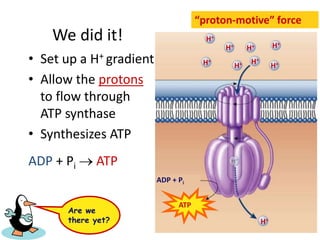
H+We did it!
ATP
• Set up a H+ gradient
• Allow the protons
to flow through
ATP synthase
• Synthesizes ATP
ADP + Pi  ATP
Are we
there yet?
“proton-motive” force
ELECTRON TRANSPORT CHAIN(ETC)
• ETC couple a chemical reaction b/w an
electron donor and electron acceptor to the
transfer of H+ ions across a membrane,
through a set of mediating biochemical
reactions
• These H+ ions are used to produce ATP
• ETC used for extracting energy from
sunlight(photosynthesis) and from redox
reactions such as the oxidation of sugar
(respiration)
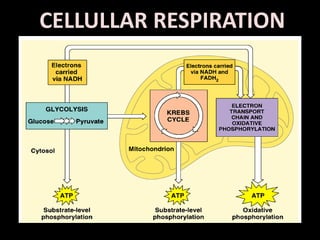
CELLULLAR RESPIRATION
COMPONENTS OF ETC
• NAD & Flavoprotein :H-carriers in celluiar
respiration
• Non heme metalloprotein (Fe-S- Protein):iron
cycles between 3+ and 2+ states.
• Ubiquinone or CoQ: region serves as an
anchor to inner mitochondrial membrane.
• Cytochromes : Electron-transfer proteins that
contain a heme prosthetic group
Composition of the Electron Transport Chain
• Four large protein complexes.
• Complex I - NADH-Coenzyme Q reductase
• Complex II - Succinate-Coenzyme Q reductase
• Complex III - Cytochrome c reductase
• Complex IV - Cytochrome c oxidase
• Many of the components are proteins with
prosthetic groups to move electrons.
• Complex I(NADH Dehydrogenase)
• Electrons pass from
• NADH  FMN  Fe-S cluster  ubiquinone
(flavin mononucleotide) (coenzyme Q)
• Complex II(succinate dehydrogenase)
• Entry point for FADH2.
• Succinate dehydrogenase (from the citric acid
cycle) directs transfer of electrons from succinate to
CoQ via FADH2.
• Acyl-CoA dehydrogenase (from -oxidation of
fatty acids) also transfers electrons to CoQ via FADH2.
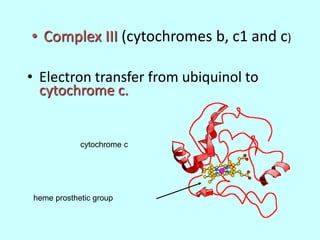
• Complex III (cytochromes b, c1 and c)
• Electron transfer from ubiquinol to
cytochrome c.
cytochrome c
heme prosthetic group
• Complex IV
• Combination of cytochromes a and a3, 10 protein
subunits, 2 types of prosthetic groups: 2 heme
and 2 Cu.
• Electrons are delivered from cytochromes a and
a3 to O2.
• Several chemicals can inhibit the pathway at
different locations.
• Cyanide and CO can block e transport between
a/a3 and O2.
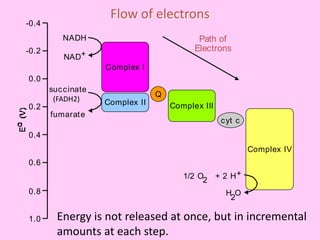
Flow of electrons
cyt c
Q
Complex I
Complex II Complex III
Complex IV
-0.4
-0.2
0.0
0.2
0.4
0.6
0.8
1.0
NADH
NAD+
succinate
fumarate
H O
2
1/2 O + 2 H
2
+
Path of
Electrons
(FADH2)
Energy is not released at once, but in incremental
amounts at each step.
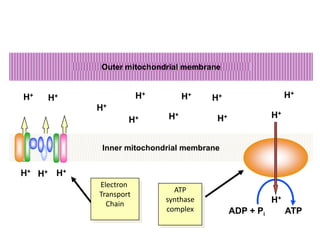
Inner mitochondrial membrane
Outer mitochondrial membrane
H+ H+
H+
H+
H+
H+H+
H+H+
H+
H+
H+ H+
H+
H+
ADP + Pi ATP
Electron
Transport
Chain
ATP
synthase
complex
FUNCTIONING OF ETC
• In ETC , the constituent molecule are arranged
in the order of
increasing redox potential
Decreasing e- pressure
Diminishing free energy level
• so along the chain there would be a step by
step flow of e- from most –ve initial donor to
most +ve terminal acceptor(O2)
• e- entering to ETC are energy rich
• As the flow down , they loss free energy
• Much of this energy get conserved in ATP
in ETC enzyme bound H is used as the fuel for
energy generation
available from the dehydrogenation reactions
of substrate oxidation
from H-donating substrates ,H-atoms are
collected by dehydrogenase , and supplied to
ETC , through NAD &FAD
They are serve as the acceptor , carrier &
donor of H.
The H atoms soon donate their e- to ETC
These H+ ions soon escape to the aquas
medium
NAD linked dehydrogenase remove 2 H-atoms
from the substrate
1-transferred to NAD as hydride ion
1-appers in the medium as H+
reduced substrate + NAD + oxidized
substrate + NADH+H
FAD-linked dehydrogenase remove 2 H atoms from
the substrate
in most case ,both of them will be accepted by
FAD ,yielding FADH2
reduced substrate + FAD oxidized
subsrtate+FADH2
from the co-enzyme channel , electrons are
funneled to molecular oxygen though chain of e-
carrier
they include flavoproteins , Fe-S,UQ, Co Q &
cytochromes
in respiratory chain e- are transferred in 3 ways
1.As e- s , 2.as H-atoms,3. as hydride ions which
bears two electrons
during the flow of e-,every members of ETC get
Alternately reduced and oxidized in cyclic manner
in this process ,iron atoms oscillates between
Fe2+ &Fe3+ states
at the initial end , this redox reaction chain is
linked to dehydrogenation reaction , and at its
terminal end to molecular oxygen
at the same time , some of its intermediate
reactions are coupled with phosphorylation of
ADP
dehydrogenation reactions maintain a steady
flow of H & Phosphorylation reaction ensure a
constant synthesis of ATP
 The coupling of redox reactions of the
respiratory chain with the phosphorylation of
ADP constitutes a reaction complex known as
oxidative phosphorylation
Oxidative phosphorylation
• The electron-transport chain moves electrons from
NADH and FADH2 to O2.
• In the mean time, ADP is phosphorylated to ATP.
• The two processes are dependent on each other.
ATP cannot be synthesized unless there is energy
from electron transport (Go’= +31 kj/mol).
Electrons do not flow to O2, unless there is need for
ATP.
3 ATP are generated when two electrons
are transported from NADH to O2.
The oxidation of FADH2 only produces 2 ATP.
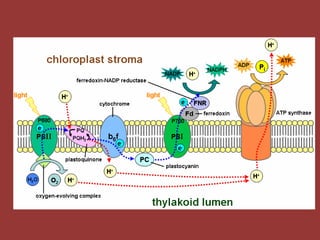
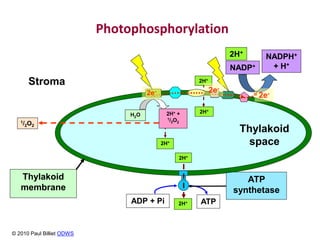
Thylakoid
space
Photophosphorylation
Stroma
ADP + Pi 2H+
2H+
2H+
2H+
2H+ +
1/2O2
H2O
ATP
ATP
synthetase
2H+
1/2O2
2e- 2e-
2H+
NADP+
NADPH+
+ H+
Thylakoid
membrane
2e-
© 2010 Paul Billiet ODWS
Electron Transport Chain ETC

Electron Transport Chain ETC

  • 1.
  • 2.
    ATP accounting sofar… • Glycolysis  2 ATP • Kreb’s cycle  2 ATP • Life takes a lot of energy to run, need to extract more energy than 4 ATP! What’s the point? A working muscle recycles over 10 million ATPs per second There’s got to be a better way!
  • 3.
    There is abetter way! • Electron Transport Chain – series of molecules built into inner mitochondrial membrane • along cristae • transport proteins & enzymes – transport of electrons down ETC linked to pumping of H+ to create H+ gradient – yields ~34 ATP from 1 glucose! – only in presence of O2 (aerobic respiration) O2 That sounds more like it!
  • 4.
    Mitochondria • Double membrane –outer membrane – inner membrane • highly folded cristae • enzymes & transport proteins – intermembrane space • fluid-filled space between membranes Oooooh! Form fits function!
  • 5.
    Electron Transport Chain Intermembranespace Mitochondrial matrix Q C NADH dehydrogenase cytochrome bc complex cytochrome c oxidase complex Inner mitochondrial membrane
  • 6.
    G3P Glycolysis Krebs cycle 8NADH 2 FADH2 Remember the Electron Carriers? 4 NADH Time to break open the bank! glucose
  • 7.
    Electron Transport Chain intermembrane space mitochondrial matrix inner mitochondrial membrane NAD+ Q C NADHH2O H+ e– 2H+ + O2 H+H+ e– FADH2 1 2 NADH dehydrogenase cytochrome bc complex cytochrome c oxidase complex FAD e– H H  e- + H+ NADH  NAD+ + H H p e Building proton gradient! What powers the proton (H+) pumps?…
  • 8.
    Electrons flow downhill •Electrons move in steps from carrier to carrier downhill to O2 – each carrier more electronegative – controlled oxidation – controlled release of energy make ATP instead of fire!
  • 9.
    H+ ADP + Pi H+ H+ H+ H+H+ H+H+ H+We did it! ATP • Set up a H+ gradient • Allow the protons to flow through ATP synthase • Synthesizes ATP ADP + Pi  ATP Are we there yet? “proton-motive” force
  • 10.
    ELECTRON TRANSPORT CHAIN(ETC) •ETC couple a chemical reaction b/w an electron donor and electron acceptor to the transfer of H+ ions across a membrane, through a set of mediating biochemical reactions • These H+ ions are used to produce ATP • ETC used for extracting energy from sunlight(photosynthesis) and from redox reactions such as the oxidation of sugar (respiration)
  • 11.
  • 12.
    COMPONENTS OF ETC •NAD & Flavoprotein :H-carriers in celluiar respiration • Non heme metalloprotein (Fe-S- Protein):iron cycles between 3+ and 2+ states. • Ubiquinone or CoQ: region serves as an anchor to inner mitochondrial membrane. • Cytochromes : Electron-transfer proteins that contain a heme prosthetic group
  • 13.
    Composition of theElectron Transport Chain • Four large protein complexes. • Complex I - NADH-Coenzyme Q reductase • Complex II - Succinate-Coenzyme Q reductase • Complex III - Cytochrome c reductase • Complex IV - Cytochrome c oxidase • Many of the components are proteins with prosthetic groups to move electrons.
  • 14.
    • Complex I(NADHDehydrogenase) • Electrons pass from • NADH  FMN  Fe-S cluster  ubiquinone (flavin mononucleotide) (coenzyme Q)
  • 15.
    • Complex II(succinatedehydrogenase) • Entry point for FADH2. • Succinate dehydrogenase (from the citric acid cycle) directs transfer of electrons from succinate to CoQ via FADH2. • Acyl-CoA dehydrogenase (from -oxidation of fatty acids) also transfers electrons to CoQ via FADH2.
  • 16.
    • Complex III(cytochromes b, c1 and c) • Electron transfer from ubiquinol to cytochrome c. cytochrome c heme prosthetic group
  • 17.
    • Complex IV •Combination of cytochromes a and a3, 10 protein subunits, 2 types of prosthetic groups: 2 heme and 2 Cu. • Electrons are delivered from cytochromes a and a3 to O2. • Several chemicals can inhibit the pathway at different locations. • Cyanide and CO can block e transport between a/a3 and O2.
  • 18.
    Flow of electrons cytc Q Complex I Complex II Complex III Complex IV -0.4 -0.2 0.0 0.2 0.4 0.6 0.8 1.0 NADH NAD+ succinate fumarate H O 2 1/2 O + 2 H 2 + Path of Electrons (FADH2) Energy is not released at once, but in incremental amounts at each step.
  • 19.
    Inner mitochondrial membrane Outermitochondrial membrane H+ H+ H+ H+ H+ H+H+ H+H+ H+ H+ H+ H+ H+ H+ ADP + Pi ATP Electron Transport Chain ATP synthase complex
  • 20.
    FUNCTIONING OF ETC •In ETC , the constituent molecule are arranged in the order of increasing redox potential Decreasing e- pressure Diminishing free energy level • so along the chain there would be a step by step flow of e- from most –ve initial donor to most +ve terminal acceptor(O2) • e- entering to ETC are energy rich • As the flow down , they loss free energy • Much of this energy get conserved in ATP
  • 21.
    in ETC enzymebound H is used as the fuel for energy generation available from the dehydrogenation reactions of substrate oxidation from H-donating substrates ,H-atoms are collected by dehydrogenase , and supplied to ETC , through NAD &FAD They are serve as the acceptor , carrier & donor of H. The H atoms soon donate their e- to ETC These H+ ions soon escape to the aquas medium
  • 22.
    NAD linked dehydrogenaseremove 2 H-atoms from the substrate 1-transferred to NAD as hydride ion 1-appers in the medium as H+ reduced substrate + NAD + oxidized substrate + NADH+H FAD-linked dehydrogenase remove 2 H atoms from the substrate in most case ,both of them will be accepted by FAD ,yielding FADH2 reduced substrate + FAD oxidized subsrtate+FADH2
  • 23.
    from the co-enzymechannel , electrons are funneled to molecular oxygen though chain of e- carrier they include flavoproteins , Fe-S,UQ, Co Q & cytochromes in respiratory chain e- are transferred in 3 ways 1.As e- s , 2.as H-atoms,3. as hydride ions which bears two electrons during the flow of e-,every members of ETC get Alternately reduced and oxidized in cyclic manner in this process ,iron atoms oscillates between Fe2+ &Fe3+ states
  • 24.
    at the initialend , this redox reaction chain is linked to dehydrogenation reaction , and at its terminal end to molecular oxygen at the same time , some of its intermediate reactions are coupled with phosphorylation of ADP dehydrogenation reactions maintain a steady flow of H & Phosphorylation reaction ensure a constant synthesis of ATP  The coupling of redox reactions of the respiratory chain with the phosphorylation of ADP constitutes a reaction complex known as oxidative phosphorylation
  • 25.
    Oxidative phosphorylation • Theelectron-transport chain moves electrons from NADH and FADH2 to O2. • In the mean time, ADP is phosphorylated to ATP. • The two processes are dependent on each other. ATP cannot be synthesized unless there is energy from electron transport (Go’= +31 kj/mol). Electrons do not flow to O2, unless there is need for ATP.
  • 26.
    3 ATP aregenerated when two electrons are transported from NADH to O2. The oxidation of FADH2 only produces 2 ATP.
  • 28.
    Thylakoid space Photophosphorylation Stroma ADP + Pi2H+ 2H+ 2H+ 2H+ 2H+ + 1/2O2 H2O ATP ATP synthetase 2H+ 1/2O2 2e- 2e- 2H+ NADP+ NADPH+ + H+ Thylakoid membrane 2e- © 2010 Paul Billiet ODWS