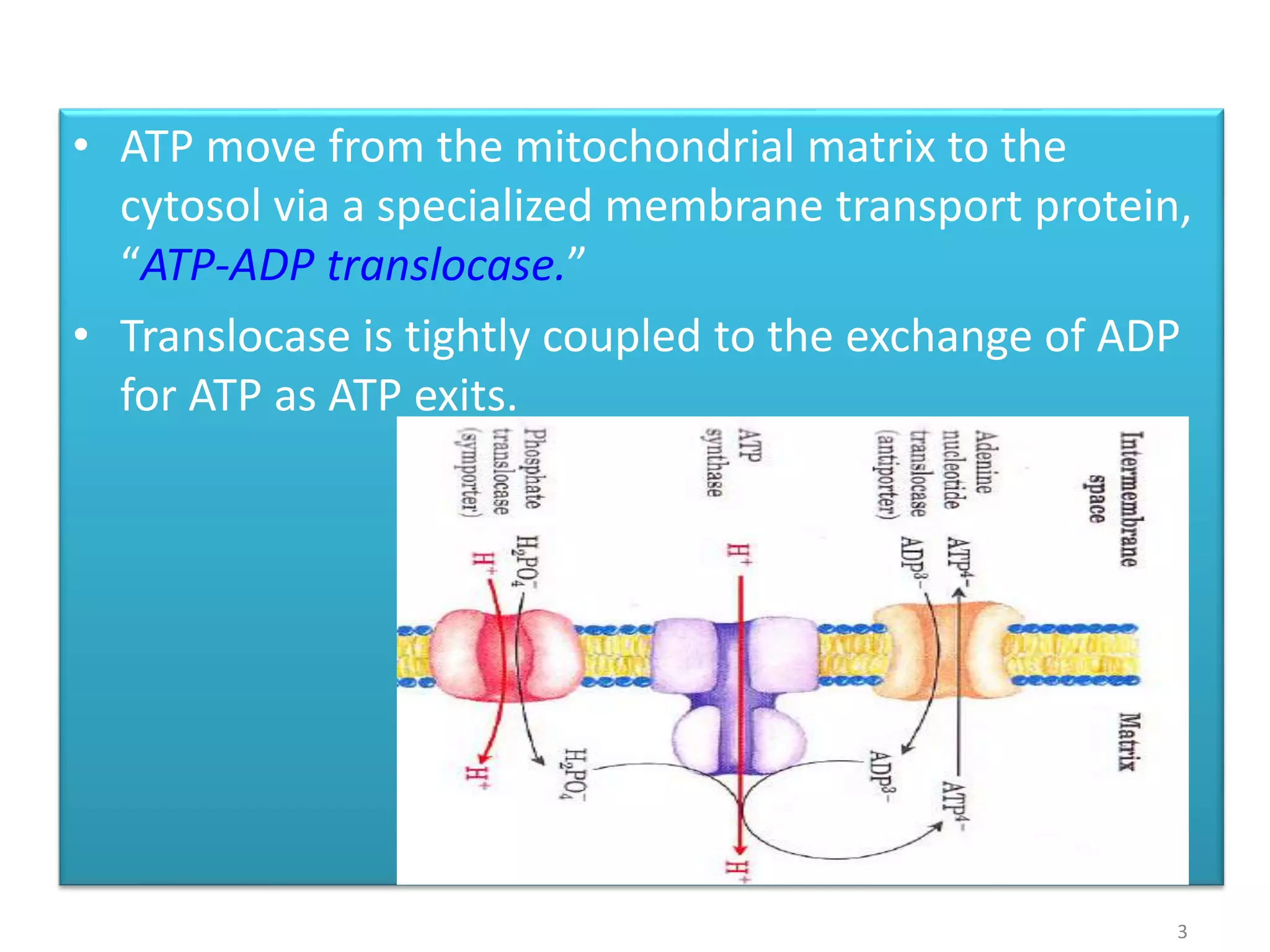
• ATP move from the mitochondrial matrix to the
cytosol via a specialized membrane transport protein,
“ATP-ADP translocase.”
• Translocase is tightly coupled to the exchange of ADP
for ATP as ATP exits.
3
Movement of ATP/ADP Through
translocase
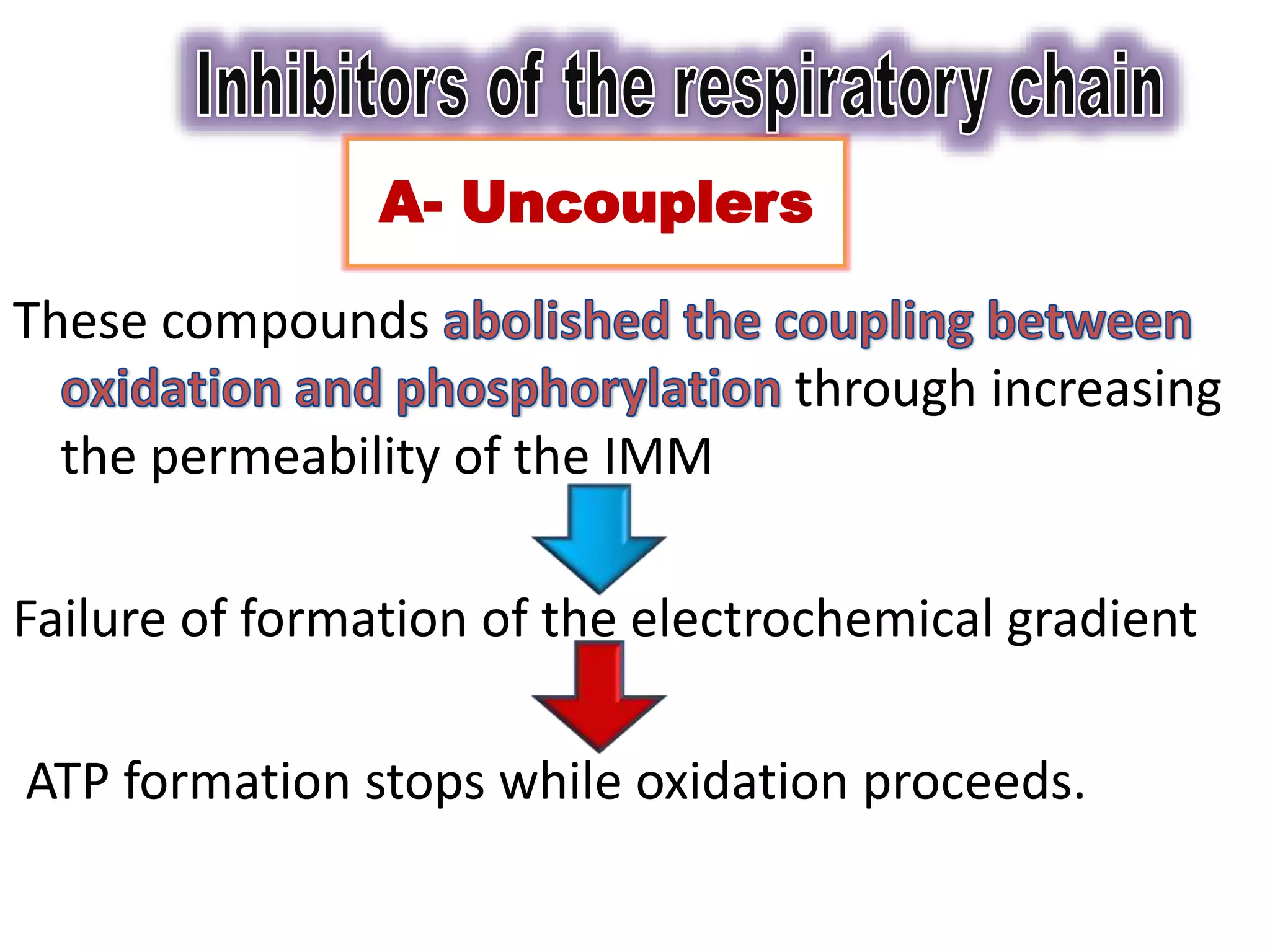
These compounds
through increasing
the permeability of the IMM
Failure of formation of the electrochemical gradient
ATP formation stops while oxidation proceeds.
A- Uncouplers
They act by transporting H+ to
inside the mitochondria without
passing through F₀F1
And energy is released as heat.
1. 2,4 dinitrophenol
2. Dinitrocresol
3. Snake venoms phospholipases
4. Pentachlorophenol
5. trifluorocarbonyl-cyanide phenyl
hydrazone
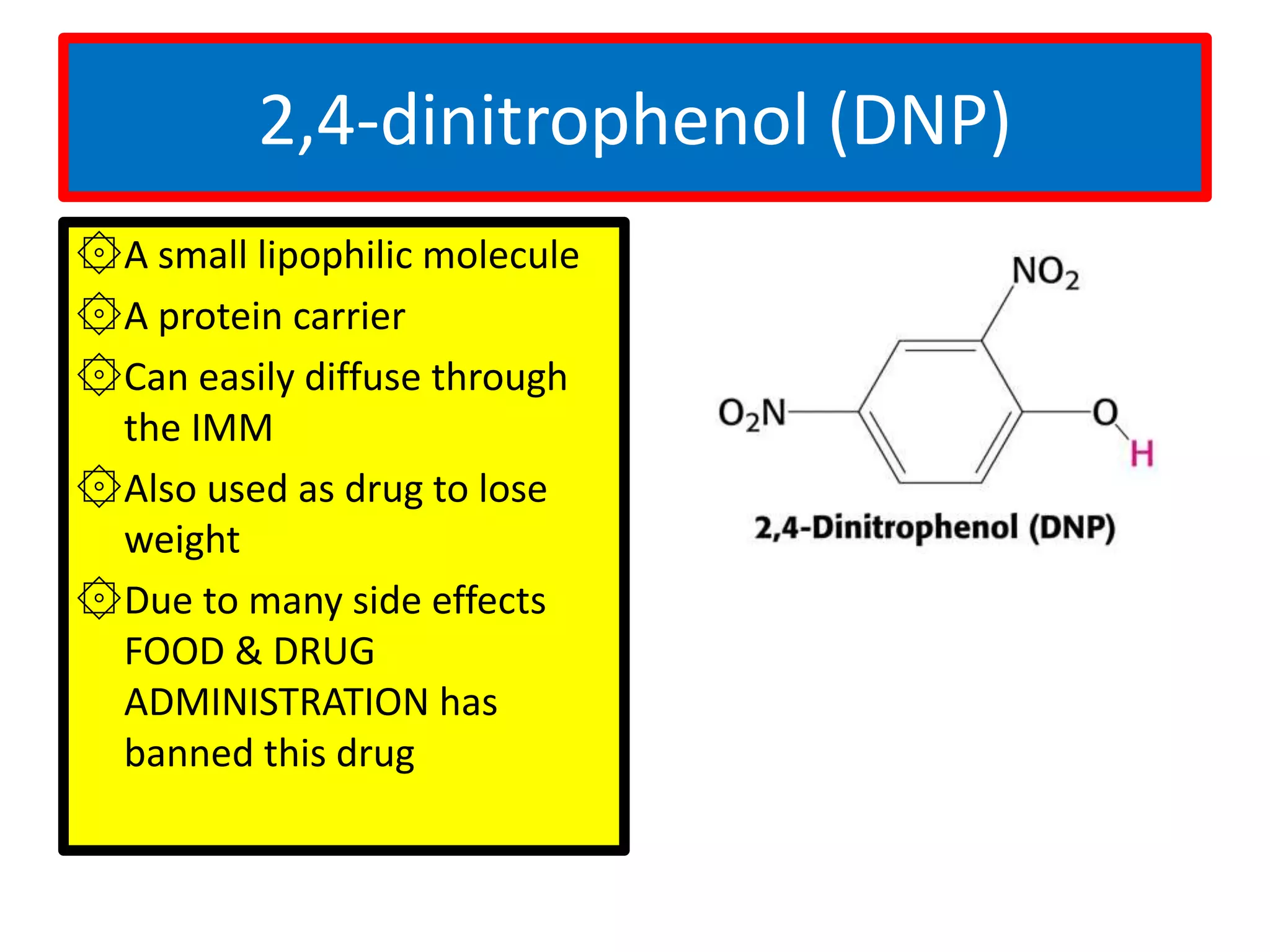
2,4-dinitrophenol (DNP)
۞A small lipophilic molecule
۞A protein carrier
۞Can easily diffuse through
the IMM
۞Also used as drug to lose
weight
۞Due to many side effects
FOOD & DRUG
ADMINISTRATION has
banned this drug
: The lipophilic substance that promote
transport of ions across membranes.
e.g. antibiotic valinomycin facilitates the entry of H+
through the IMM.
2. Some endogenous compounds when increased act as
uncouplers: Bilirubin, Thyroxine & long chain free fatty acids
Bilirubin is, however, yet to be proved beyond doubt.
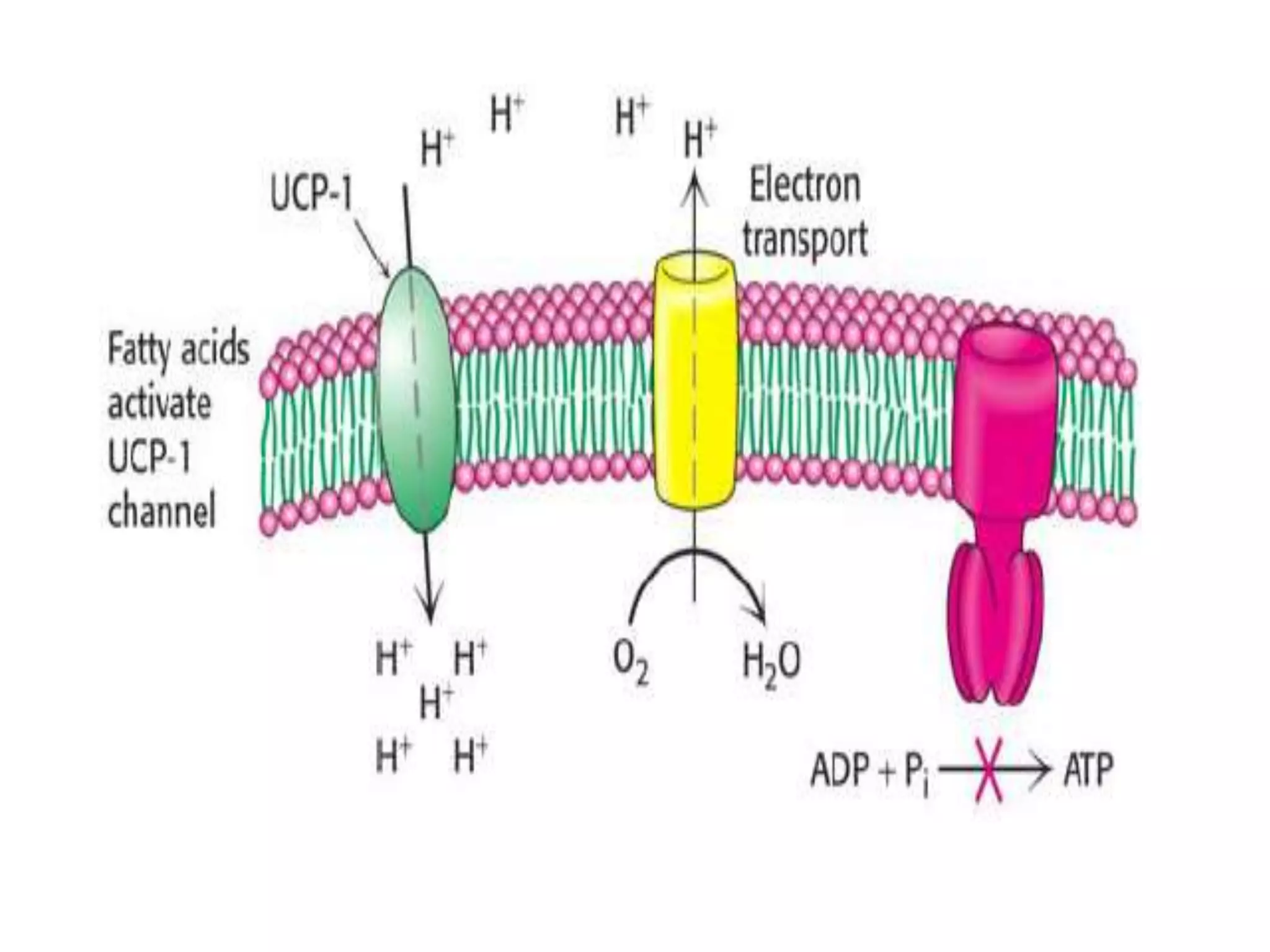
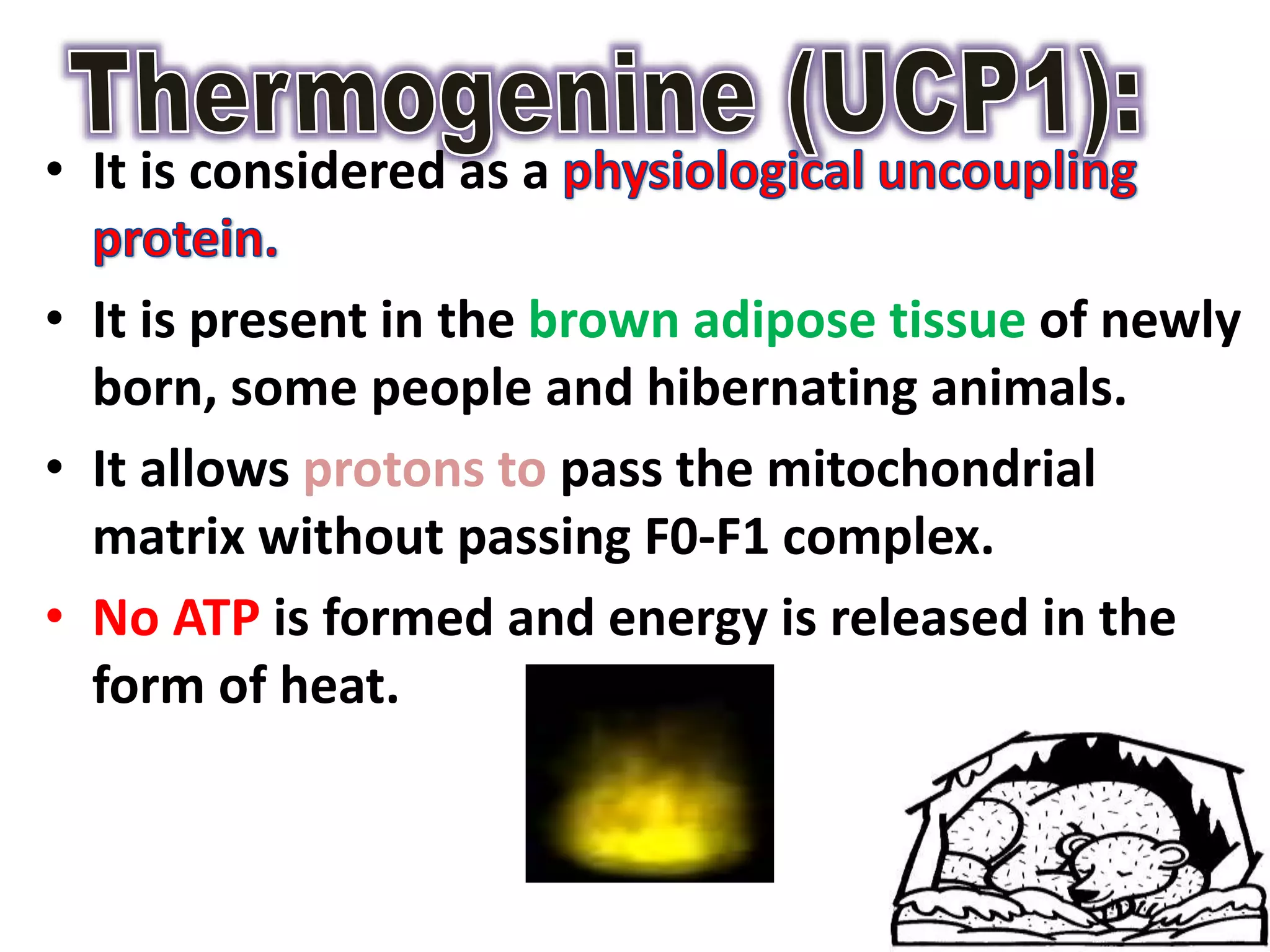
• It is considered as a
• It is present in the brown adipose tissue of newly
born, some people and hibernating animals.
• It allows protons to pass the mitochondrial
matrix without passing F0-F1 complex.
• No ATP is formed and energy is released in the
form of heat.
• Completely blocks F₀ so it inhibits
ATP synthesis
• Example: oligomycin (antibiotic)
• This is achieved by the compound
• Hibernating animals also uncouple ATP synthesis
to generate heat (nonshivering thermogenesis).
• In brown adipose tissue (which is very rich in
mitochondria), uncoupling protein (UCP) or
“thermogenin,” forms a pathway for the flow of
protons back into the matrix.
• This short circuits the proton gradient, generating
heat.
• Some flowers also generate heat this way to
voltalize fragrances that attract insects to fertilize
their flowers.
• The inner mitochondrial membrane is
impermeable to NADH. So the NADH produced in
cytosol can’t directly enter the mitochondria.
• Two different “shuttles” are operative to do this
job:
– Glycerol 3-phosphate shuttle (transfers electrons to
FADH2 .
– Malate-aspartate shuttle (transfers electrons to
NADH)
16
17
18
Aminotransferase
Aminotransferase
Cytosolic Malate
dehydrogenase
Mitochondrial
Malate
dehydrogenase
aspartate -ketoglutarate oxaloacetate glutamate
Aminotransferase (Transaminase)
COO
CH2
CH2
C
COO
O
COO
CH2
HC
COO
NH3
+
COO
CH2
CH2
HC
COO
NH3
+
COO
CH2
C
COO
O+ +
All enzymes participating in biological oxidation
belong to class oxidoreductase.
Major categories are:
1. Oxidases
2. Dehydrogenases
3. Hydroperoxidases
4. Oxygenases
• They catalyse the elimination of hydrogen
from substrate, which is mostly used to form
water.
• e.g. cytochrome oxidase, tyrosinase,
monoamine oxidase & some flavoprotiens.
Dehydrogenases
Catalyse reversible transfer of hydrogen from
on substrate to another
Thus bring about oxidation-reduction
reactions.
Examples
• NAD+ : e.g. glycerol 3-phosphate dehydrogenase
• NADP + : e.g. enoyl reductase
• FMN : e.g. NADH dehydrogenase
• FAD : e.g. succinate dehydrogenase
• Cytochromes: e.g. all Cytochromes of ETC (b, c & c1)
except terminal cytochrome complex belong to this
group.
Hydroperoxidases
• They prevent harmful effects of H2O2
produced by aerobic dehydrogenase.
• e.g. peroxidase and catalase
Oxygenases
• Catalyse direct incorporation of oxygen into
the substrate molecule.
• e.g. Dioxygenases and Monooxygenases
Electron transport in
Prokaryotes
• Lack mitochondria
• Set of e- carriers and enzymes of oxidative
phosphorylation are bound to inner cell
membrane.
Uncouplers of oxidative phosphorylation

Uncouplers of oxidative phosphorylation

  • 3.
    • ATP movefrom the mitochondrial matrix to the cytosol via a specialized membrane transport protein, “ATP-ADP translocase.” • Translocase is tightly coupled to the exchange of ADP for ATP as ATP exits. 3
  • 4.
    Movement of ATP/ADPThrough translocase
  • 5.
    These compounds through increasing thepermeability of the IMM Failure of formation of the electrochemical gradient ATP formation stops while oxidation proceeds. A- Uncouplers
  • 7.
    They act bytransporting H+ to inside the mitochondria without passing through F₀F1 And energy is released as heat.
  • 8.
    1. 2,4 dinitrophenol 2.Dinitrocresol 3. Snake venoms phospholipases 4. Pentachlorophenol 5. trifluorocarbonyl-cyanide phenyl hydrazone
  • 9.
    2,4-dinitrophenol (DNP) ۞A smalllipophilic molecule ۞A protein carrier ۞Can easily diffuse through the IMM ۞Also used as drug to lose weight ۞Due to many side effects FOOD & DRUG ADMINISTRATION has banned this drug
  • 10.
    : The lipophilicsubstance that promote transport of ions across membranes. e.g. antibiotic valinomycin facilitates the entry of H+ through the IMM. 2. Some endogenous compounds when increased act as uncouplers: Bilirubin, Thyroxine & long chain free fatty acids Bilirubin is, however, yet to be proved beyond doubt.
  • 11.
    • It isconsidered as a • It is present in the brown adipose tissue of newly born, some people and hibernating animals. • It allows protons to pass the mitochondrial matrix without passing F0-F1 complex. • No ATP is formed and energy is released in the form of heat.
  • 12.
    • Completely blocksF₀ so it inhibits ATP synthesis • Example: oligomycin (antibiotic)
  • 14.
    • This isachieved by the compound
  • 15.
    • Hibernating animalsalso uncouple ATP synthesis to generate heat (nonshivering thermogenesis). • In brown adipose tissue (which is very rich in mitochondria), uncoupling protein (UCP) or “thermogenin,” forms a pathway for the flow of protons back into the matrix. • This short circuits the proton gradient, generating heat. • Some flowers also generate heat this way to voltalize fragrances that attract insects to fertilize their flowers.
  • 16.
    • The innermitochondrial membrane is impermeable to NADH. So the NADH produced in cytosol can’t directly enter the mitochondria. • Two different “shuttles” are operative to do this job: – Glycerol 3-phosphate shuttle (transfers electrons to FADH2 . – Malate-aspartate shuttle (transfers electrons to NADH) 16
  • 17.
  • 18.
  • 19.
    aspartate -ketoglutarate oxaloacetateglutamate Aminotransferase (Transaminase) COO CH2 CH2 C COO O COO CH2 HC COO NH3 + COO CH2 CH2 HC COO NH3 + COO CH2 C COO O+ +
  • 20.
    All enzymes participatingin biological oxidation belong to class oxidoreductase. Major categories are: 1. Oxidases 2. Dehydrogenases 3. Hydroperoxidases 4. Oxygenases
  • 21.
    • They catalysethe elimination of hydrogen from substrate, which is mostly used to form water. • e.g. cytochrome oxidase, tyrosinase, monoamine oxidase & some flavoprotiens.
  • 22.
    Dehydrogenases Catalyse reversible transferof hydrogen from on substrate to another Thus bring about oxidation-reduction reactions.
  • 23.
    Examples • NAD+ :e.g. glycerol 3-phosphate dehydrogenase • NADP + : e.g. enoyl reductase • FMN : e.g. NADH dehydrogenase • FAD : e.g. succinate dehydrogenase • Cytochromes: e.g. all Cytochromes of ETC (b, c & c1) except terminal cytochrome complex belong to this group.
  • 24.
    Hydroperoxidases • They preventharmful effects of H2O2 produced by aerobic dehydrogenase. • e.g. peroxidase and catalase
  • 25.
    Oxygenases • Catalyse directincorporation of oxygen into the substrate molecule. • e.g. Dioxygenases and Monooxygenases
  • 26.
    Electron transport in Prokaryotes •Lack mitochondria • Set of e- carriers and enzymes of oxidative phosphorylation are bound to inner cell membrane.