BIOENERGETI
CS
Dr.S.S.Sethupathy,M.D.,Ph.D,
Professor of Biochemistry,
Rajah Muthiah Medical College,
Annamalai University.
Definition
 Bioenergetics or biochemical thermodynamics
is the study of energy changes
accompanying biochemical reactions or in
biological system.
Laws of thermodynamics
• First law
• The Total energy of a system is constant ,
including its surroundings.
Second law
Total entropy of a system must increase for a
spontaneous reaction to occur.
Eg: no energy is required to drop the things
scattered
But energy is required for arranging the things
from a scattered status.
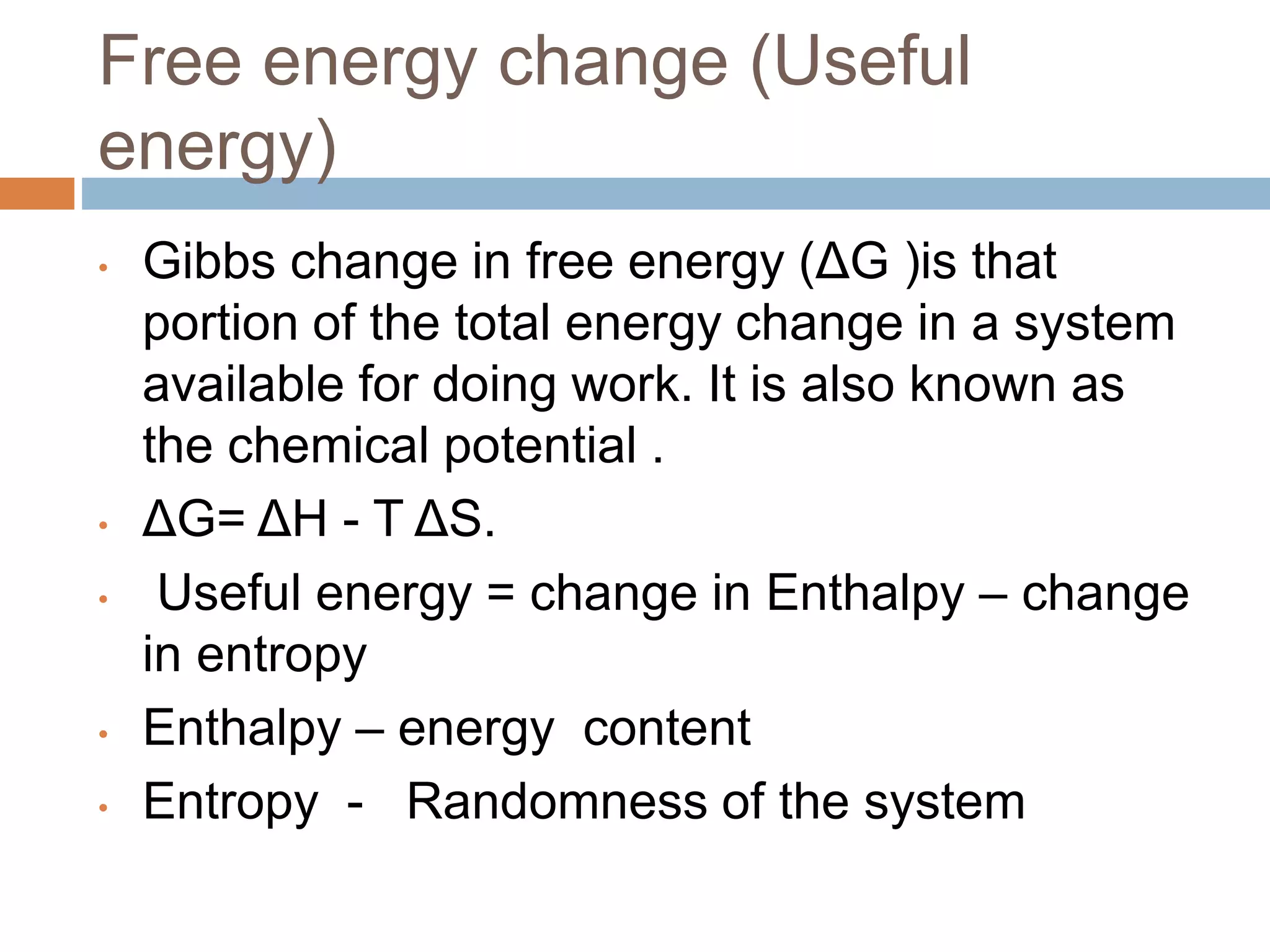
Free energy change (Useful
energy)
• Gibbs change in free energy (ΔG )is that
portion of the total energy change in a system
available for doing work. It is also known as
the chemical potential .
• ΔG= ΔH - T ΔS.
• Useful energy = change in Enthalpy – change
in entropy
• Enthalpy – energy content
• Entropy - Randomness of the system
Types of reactions
• Exergonic is a spontaneous reaction that releases
energy. If the free energy change is negative ,this
reaction is due to loss of energy from reactants,
so it is called exergonic.
E.g. catabolic reactions.
• Endergonic is an anabolic reaction that consumes
energy. If the free energy change is positive, the
reaction is called endergonic. E.g. synthetic
reactions,
• But at equilibrium, it is zero
• The energy coupling occurs by coupling of
Exergonic and endergonic reactions and liberation
of heat.
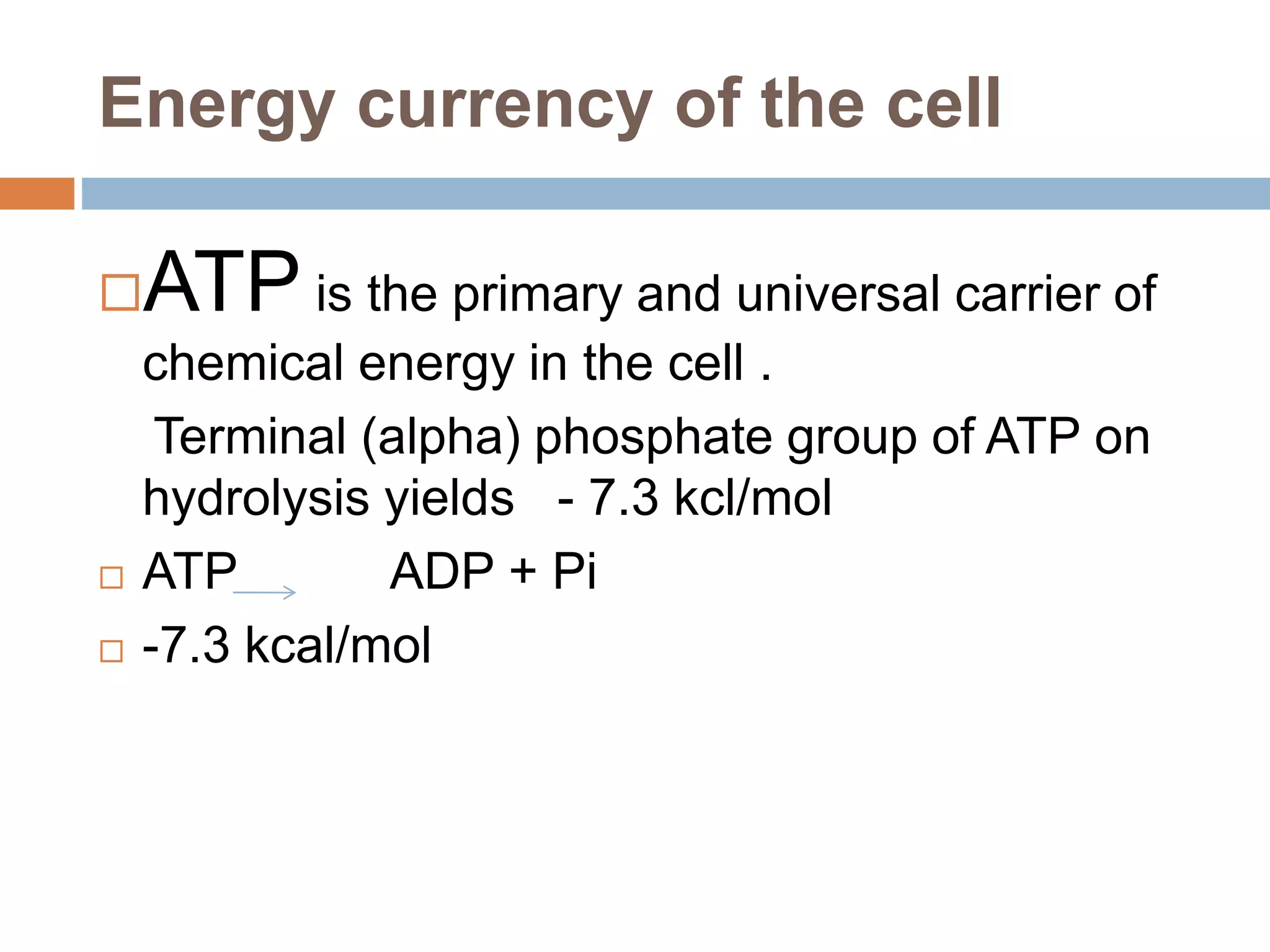
Energy currency of the cell
ATP is the primary and universal carrier of
chemical energy in the cell .
Terminal (alpha) phosphate group of ATP on
hydrolysis yields - 7.3 kcl/mol
 ATP ADP + Pi
 -7.3 kcal/mol
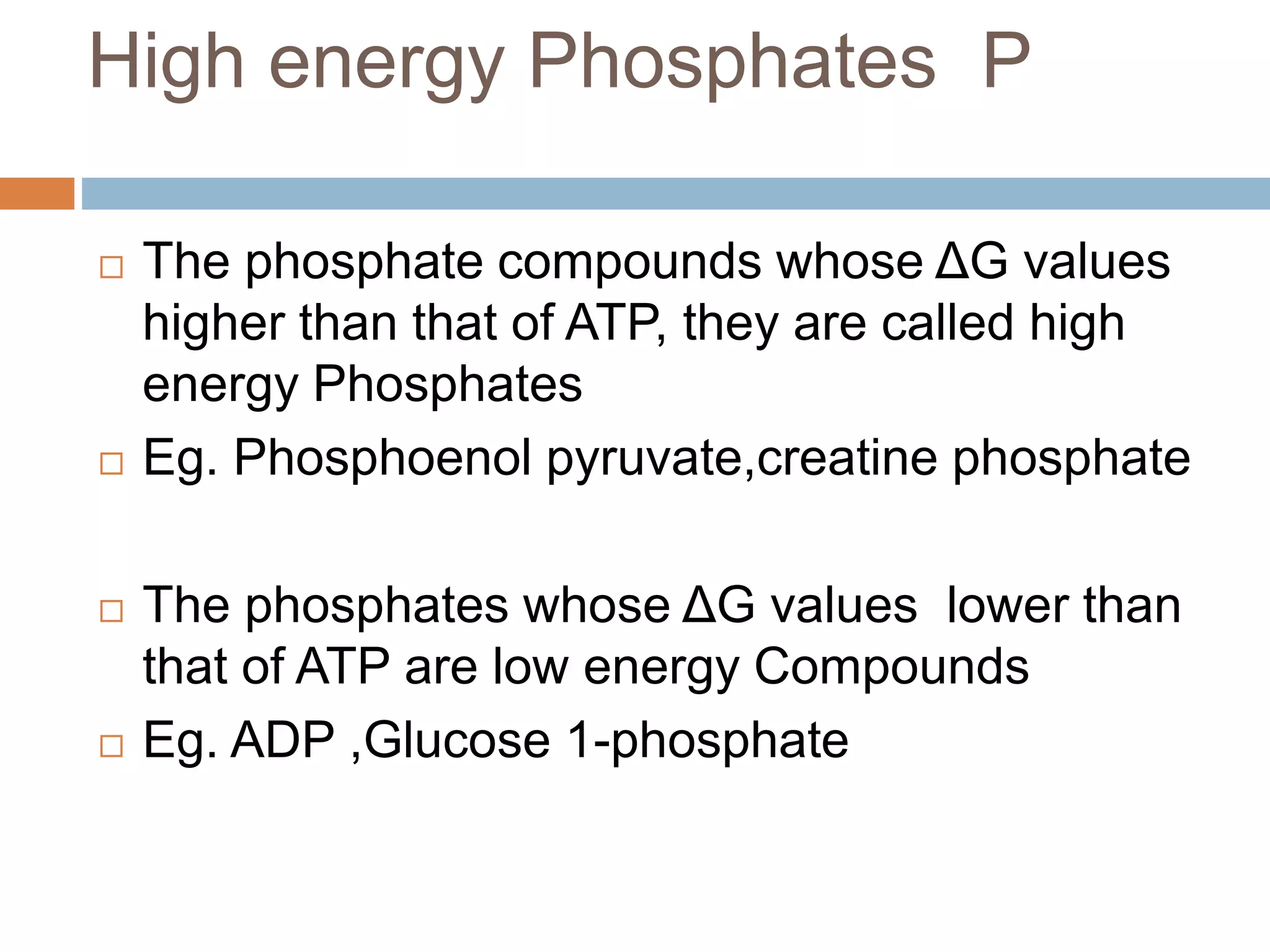
High energy Phosphates P
 The phosphate compounds whose ΔG values
higher than that of ATP, they are called high
energy Phosphates
 Eg. Phosphoenol pyruvate,creatine phosphate
 The phosphates whose ΔG values lower than
that of ATP are low energy Compounds
 Eg. ADP ,Glucose 1-phosphate
Phosphagens
 They are storage forms of high energy
phosphates.
 Eg: Creatine phosphate in vertebrate muscle
 Arginine phosphate in invertebrate muscle
 ATP + Creatine ADP + Creatine
phosphate
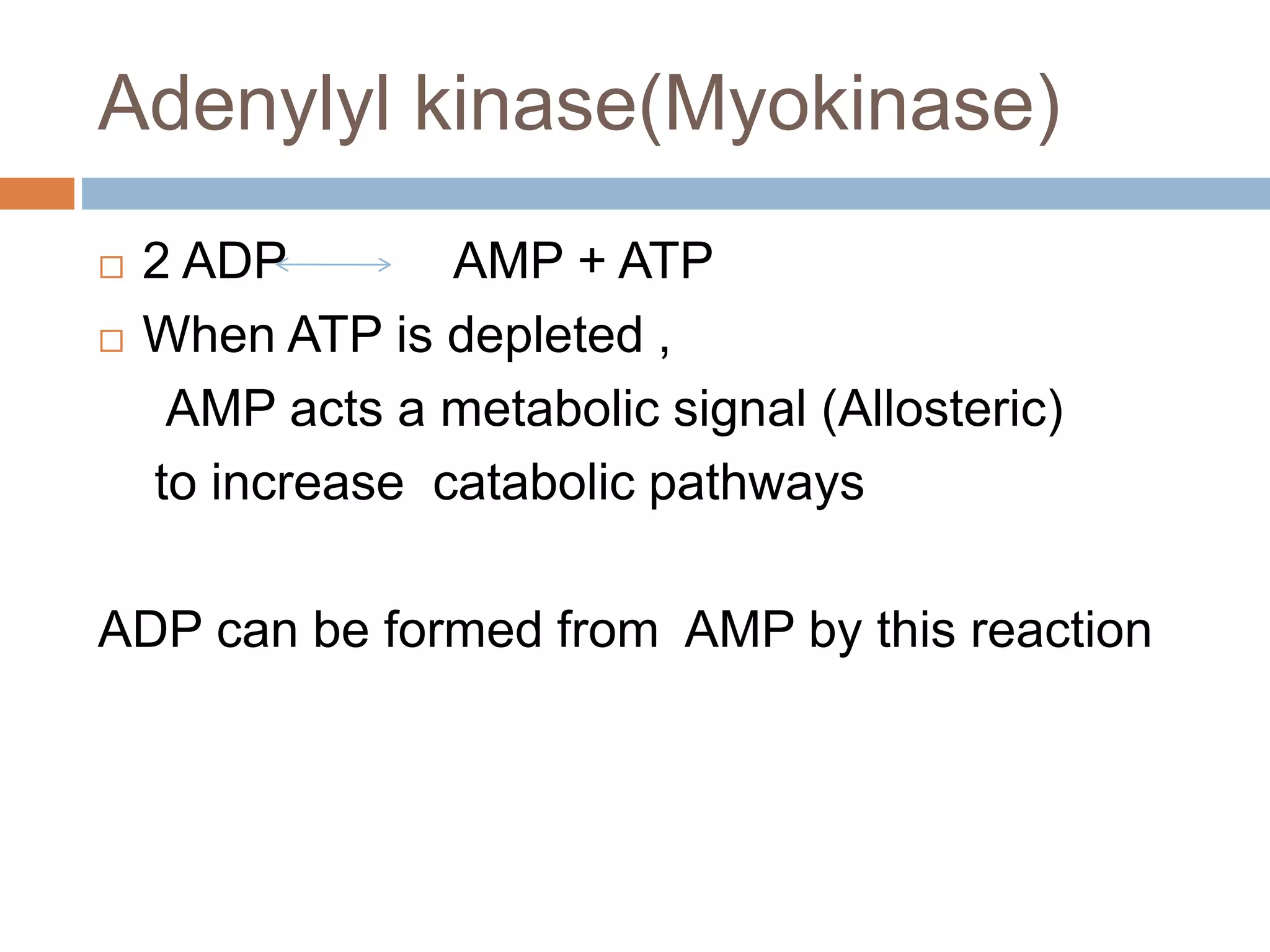
Adenylyl kinase(Myokinase)
 2 ADP AMP + ATP
 When ATP is depleted ,
AMP acts a metabolic signal (Allosteric)
to increase catabolic pathways
ADP can be formed from AMP by this reaction
Nucleoside diphosphate kinase
 ATP + UDP ADP + UTP
 By this reaction nucleoside diphosphates can
form corresponding triphosphates.
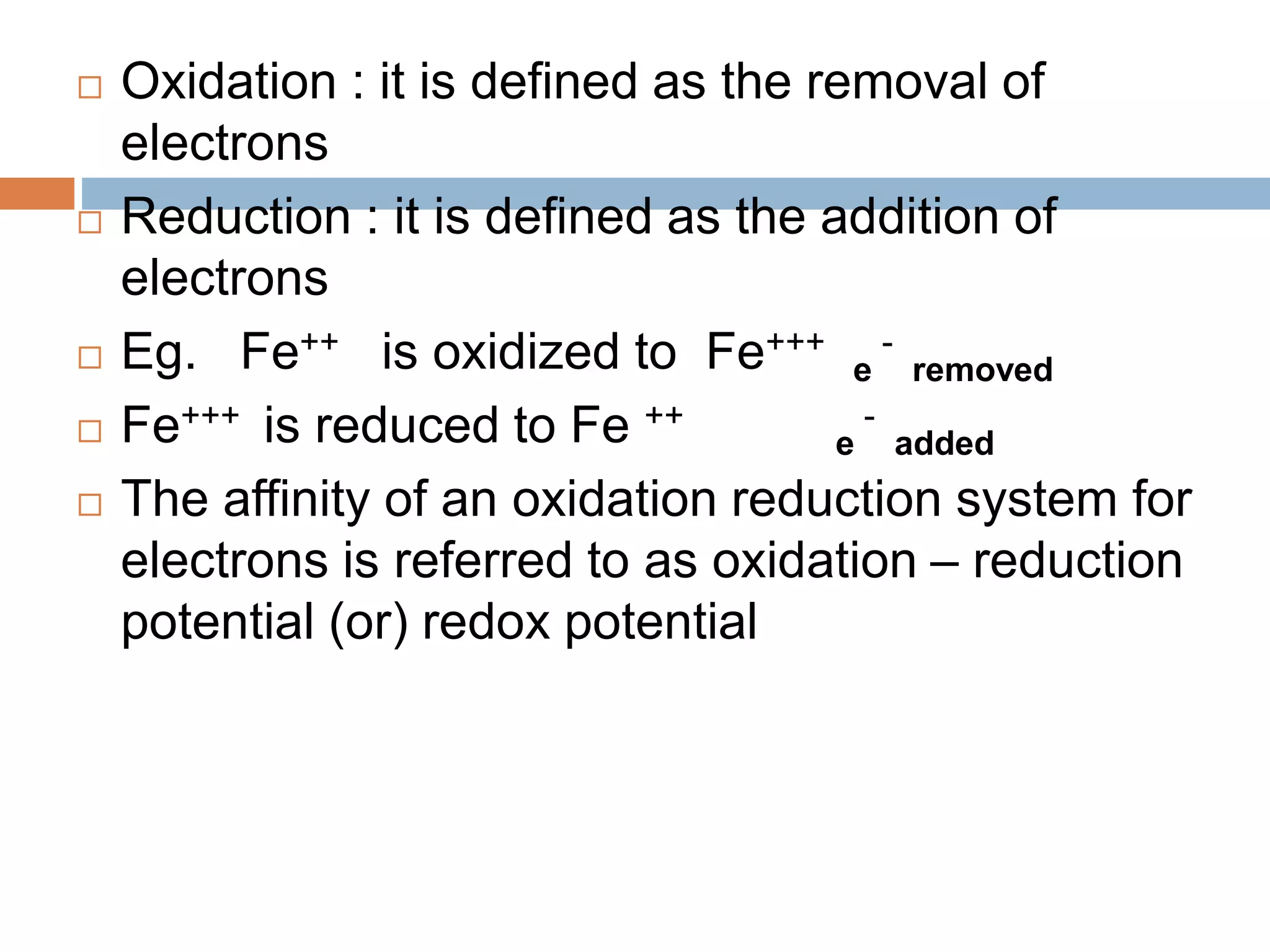
 Oxidation : it is defined as the removal of
electrons
 Reduction : it is defined as the addition of
electrons
 Eg. Fe++ is oxidized to Fe+++
e
-
removed
 Fe+++ is reduced to Fe ++
e
-
added
 The affinity of an oxidation reduction system for
electrons is referred to as oxidation – reduction
potential (or) redox potential
Redox couple
• A biological system which has a strong tendency
to donate electrons has a negative redox potential
• The redox potential of a system is usually
compared against the potential of hydrogen
electrode at pH 7. 0 with -0.42 volt in biological
system.
• Eg. Redox potential redox system (redox pair)
• -0.32 NADH/NAD+
• + 0.82 H2 / ½ O2
• The electrons flow from electro negative redox
couple to more electro positive system
Oxidoreductases
Oxidation that occurs in biological system is
called biological oxidation
 Enzymes involved in oxidation and reduction
reactions are called oxido reductases. There
are four groups of oxidoreductases
 1.Oxidases 2.Dehydrogenases
3.Hydroperoxidases 4.Oxygenases
Oxidases
 They use oxygen as hydrogen acceptor
 e.g. cytochrome oxidase (cyt aa3) (copper
containing) -Water forming
 H2O2 forming
 D amino acid oxidase (FAD linked)
 L amino acid oxidase (FMN linked)
 Xanthine oxidase (molybdenum containing)
 Aldehyde dehydrogenase (FAD-linked)
Dehydrogeneases
 Involved in transfer of hydrogen from one
substrate to other in a coupled oxidation
reduction reactions
 e.g. Nicotinamide coenzymes. NAD is involved
in oxidation reactions
 NADP is involved in reductive synthesis.
Riboflavin coenzymes : FMN & FAD
 Cytochromes except cytochrome oxidase
Hydroperoxidases
 They use hydrogen peroxide or an organic
peroxide as substrate
 e.g. catalase and peroxidases (glutathione
peroxidase containing selenium)
 Peroxisomes are rich in these enzymes
 H2O2 + H2O2 2 H2O
catalase
Oxygenases
They catalyze the direct transfer and incorporation of oxygen
into a substrate molecule
• Dioxygenases
incorporate both atoms of oxygen molecule into the
substrate
e.g. homogentisate dioxygenase (oxidase) A+O2
AO2 tryptophan dioxygenase (pyrrolase)
• Monooxygenases or mixed function oxidases
incorporate only one atom of molecular oxygen into the
substrate
e.g. cytochrome P450 – hydroxylation of steroids
cytochrome b5 helps to increase the solubility of
compounds
and so promoting excretion
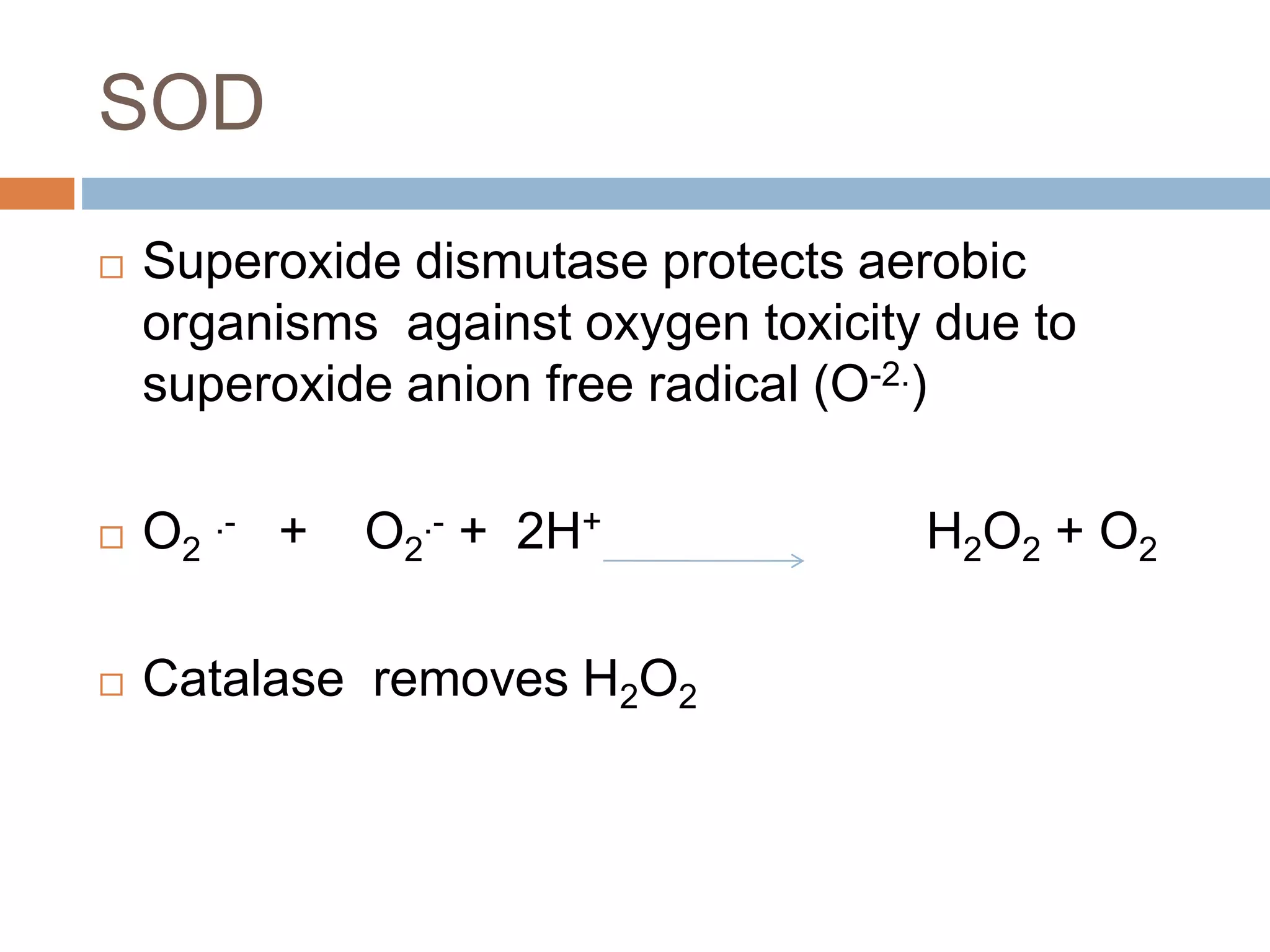
SOD
 Superoxide dismutase protects aerobic
organisms against oxygen toxicity due to
superoxide anion free radical (O-2.)
 O2
.- + O2
.- + 2H+ H2O2 + O2
 Catalase removes H2O2
Oxidative phosphorylation
 It is the process by which free energy liberated
when protons are pumped by respiratory chain
is trapped in the form of ATP by
phosphorylation of ADP with phosphate.
 The process of oxidation coupled with
phosphorylation is called oxidative
phosphorylation and it occurs in the
mitochondria.
 Most of the energy liberated during the
oxidation of carbohydrate, fatty acids and
amino acids is made available within
mitochondria as reducing equivalents (-H or
electrons)
 Reducing equivalents (Hydrogen or Electrons)
thus obtained is oxidized by oxygen forming
water and the energy liberated is used for ATP
synthesis.
 Mitochondrial inner membrane contains the
respiratory or electron transport chain that
collects and transports reducing equivalents.
Respiratory chain
• The components of respiratory chain are arranged
in order of increasing redox potential.
• ie . from NAD+ / NADH to O2/H2O redox couples
Components of respiratory chain
• Complex I : NADH : ubiquinone oxidoreductase
• Complex II : succinate : ubiquinone
oxidoreductase
• Complex III : Ubiquinol : cytochrome C
oxidoreductase
• Complex IV : cytochrome aa3: oxygen
oxidoreductase
• Iron sulphur centers (Fe-S) form prosthetic
groups of iron sulphur proteins
• Non heme proteins also function in the
transfer of electrons eg from FMNH2 to
Coenzyme Q and cytochrome b to cytochrome
c1.
• Coenzyme Q10 is a fat soluble quinone
compound
• Cytochromes b,c,c1, aa3 contain haem
• Cytochromes aa3 also contains copper
• ATP synthetase is involved in the formation of
ATP
Mitchell’s chemiosomotic
hypothesis
 Electron transport chain pumps protons into
inter membrane space across the inner
membrane which is normally not permeable to
protons. This creates an electro chemical
potential gradient. Now the protons (H+) flow
back across inner membrane through ATP
synthetase resulting in trapping of free energy
as ATP
P:O ratio
 It is the number of high energy phosphates
produced per atom of oxygen used.
 ie : for NADH+H+ - 2.5 ATP
 for FADH2 – 1.5 ATP
 Respiratory control:
 In the presence of adequate O2 and substrate,
ADP becomes rate limiting.
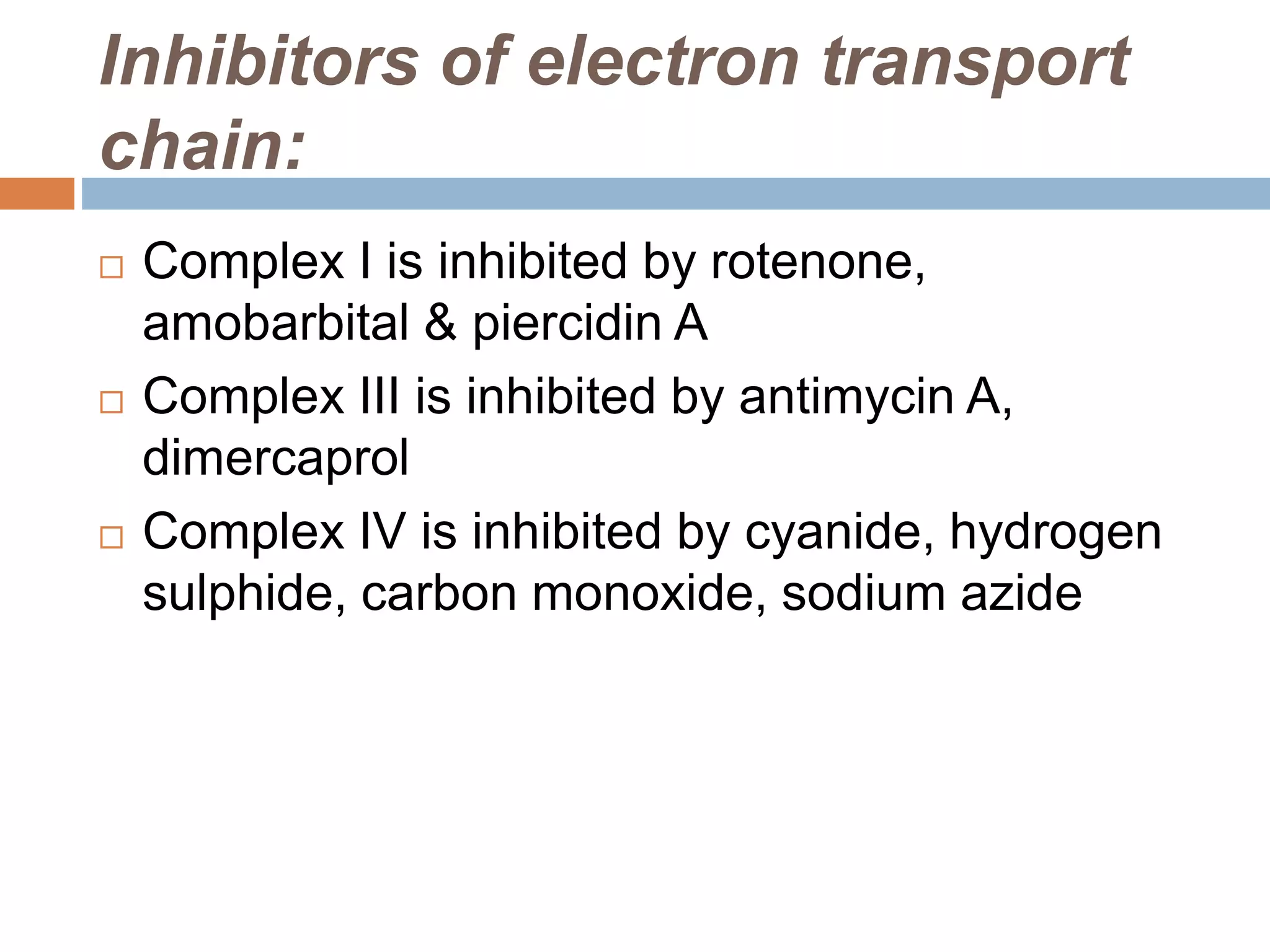
Inhibitors of electron transport
chain:
 Complex I is inhibited by rotenone,
amobarbital & piercidin A
 Complex III is inhibited by antimycin A,
dimercaprol
 Complex IV is inhibited by cyanide, hydrogen
sulphide, carbon monoxide, sodium azide
Uncouplers of oxidative
phosphorylation
• Uncouplers are the substances that allow electron
transport chain to function without phosphorylation
and so ATP is not synthesized but oxidation
proceeds. They are lipophilic and allow transport
of H+ across the inner membrane but not through
ATP synthetase and so the proton gradient is
cancelled without ATP formation and the free
energy is liberated as heat.
e.g 2.4 dinitrophenol
thermogenin (natural) – uncoupling protein
Thyroxine
1.The adenine nucleotide transporter.
ADP and ATP
2. The phosphate transporter.
 Exchange of H2PO4
- for OH-, or
cotransport of H2PO4
- with H+. Transport of
reducing equivalents across the mitochondrial
membrane from cytosol is mediated by two
important shuttles
 1.Malate - Aspartate shuttle - 2.5 ATP
 2.Flavoprotein dehydrogenase -Glycerol 3 P
shuttle- electrons to E.T.chain – 1.5 ATP
Substrate level phosphorylation
 The formation of ATP within certain steps of
metabolic pathway i.e susbstrate level without
passing through ETC is called as substrate
level phosphorylation
 e.g. pyruvate kinase, phosphoglycerate kinase
, succinate thiokinase
Mitochondrial diseases
1.MELAS(Mitochondrial encephalopathy,lactic
acidosis ,stroke due to Complex I deficiency
2.Fatal infantile mitochondrial myopathy and
renal dysfunction
3.Leber’s hereditary optic neuropathy
4. Alzheimer’s disease
5. Parkinsons’ disease
6.Diabetes mellitus
YouThank

Bioenergetics

  • 1.
  • 2.
    Definition  Bioenergetics orbiochemical thermodynamics is the study of energy changes accompanying biochemical reactions or in biological system.
  • 3.
    Laws of thermodynamics •First law • The Total energy of a system is constant , including its surroundings. Second law Total entropy of a system must increase for a spontaneous reaction to occur. Eg: no energy is required to drop the things scattered But energy is required for arranging the things from a scattered status.
  • 4.
    Free energy change(Useful energy) • Gibbs change in free energy (ΔG )is that portion of the total energy change in a system available for doing work. It is also known as the chemical potential . • ΔG= ΔH - T ΔS. • Useful energy = change in Enthalpy – change in entropy • Enthalpy – energy content • Entropy - Randomness of the system
  • 5.
    Types of reactions •Exergonic is a spontaneous reaction that releases energy. If the free energy change is negative ,this reaction is due to loss of energy from reactants, so it is called exergonic. E.g. catabolic reactions. • Endergonic is an anabolic reaction that consumes energy. If the free energy change is positive, the reaction is called endergonic. E.g. synthetic reactions, • But at equilibrium, it is zero • The energy coupling occurs by coupling of Exergonic and endergonic reactions and liberation of heat.
  • 6.
    Energy currency ofthe cell ATP is the primary and universal carrier of chemical energy in the cell . Terminal (alpha) phosphate group of ATP on hydrolysis yields - 7.3 kcl/mol  ATP ADP + Pi  -7.3 kcal/mol
  • 7.
    High energy PhosphatesP  The phosphate compounds whose ΔG values higher than that of ATP, they are called high energy Phosphates  Eg. Phosphoenol pyruvate,creatine phosphate  The phosphates whose ΔG values lower than that of ATP are low energy Compounds  Eg. ADP ,Glucose 1-phosphate
  • 8.
    Phosphagens  They arestorage forms of high energy phosphates.  Eg: Creatine phosphate in vertebrate muscle  Arginine phosphate in invertebrate muscle  ATP + Creatine ADP + Creatine phosphate
  • 9.
    Adenylyl kinase(Myokinase)  2ADP AMP + ATP  When ATP is depleted , AMP acts a metabolic signal (Allosteric) to increase catabolic pathways ADP can be formed from AMP by this reaction
  • 10.
    Nucleoside diphosphate kinase ATP + UDP ADP + UTP  By this reaction nucleoside diphosphates can form corresponding triphosphates.
  • 11.
     Oxidation :it is defined as the removal of electrons  Reduction : it is defined as the addition of electrons  Eg. Fe++ is oxidized to Fe+++ e - removed  Fe+++ is reduced to Fe ++ e - added  The affinity of an oxidation reduction system for electrons is referred to as oxidation – reduction potential (or) redox potential
  • 12.
    Redox couple • Abiological system which has a strong tendency to donate electrons has a negative redox potential • The redox potential of a system is usually compared against the potential of hydrogen electrode at pH 7. 0 with -0.42 volt in biological system. • Eg. Redox potential redox system (redox pair) • -0.32 NADH/NAD+ • + 0.82 H2 / ½ O2 • The electrons flow from electro negative redox couple to more electro positive system
  • 13.
    Oxidoreductases Oxidation that occursin biological system is called biological oxidation  Enzymes involved in oxidation and reduction reactions are called oxido reductases. There are four groups of oxidoreductases  1.Oxidases 2.Dehydrogenases 3.Hydroperoxidases 4.Oxygenases
  • 14.
    Oxidases  They useoxygen as hydrogen acceptor  e.g. cytochrome oxidase (cyt aa3) (copper containing) -Water forming  H2O2 forming  D amino acid oxidase (FAD linked)  L amino acid oxidase (FMN linked)  Xanthine oxidase (molybdenum containing)  Aldehyde dehydrogenase (FAD-linked)
  • 15.
    Dehydrogeneases  Involved intransfer of hydrogen from one substrate to other in a coupled oxidation reduction reactions  e.g. Nicotinamide coenzymes. NAD is involved in oxidation reactions  NADP is involved in reductive synthesis. Riboflavin coenzymes : FMN & FAD  Cytochromes except cytochrome oxidase
  • 16.
    Hydroperoxidases  They usehydrogen peroxide or an organic peroxide as substrate  e.g. catalase and peroxidases (glutathione peroxidase containing selenium)  Peroxisomes are rich in these enzymes  H2O2 + H2O2 2 H2O catalase
  • 17.
    Oxygenases They catalyze thedirect transfer and incorporation of oxygen into a substrate molecule • Dioxygenases incorporate both atoms of oxygen molecule into the substrate e.g. homogentisate dioxygenase (oxidase) A+O2 AO2 tryptophan dioxygenase (pyrrolase) • Monooxygenases or mixed function oxidases incorporate only one atom of molecular oxygen into the substrate e.g. cytochrome P450 – hydroxylation of steroids cytochrome b5 helps to increase the solubility of compounds and so promoting excretion
  • 18.
    SOD  Superoxide dismutaseprotects aerobic organisms against oxygen toxicity due to superoxide anion free radical (O-2.)  O2 .- + O2 .- + 2H+ H2O2 + O2  Catalase removes H2O2
  • 19.
    Oxidative phosphorylation  Itis the process by which free energy liberated when protons are pumped by respiratory chain is trapped in the form of ATP by phosphorylation of ADP with phosphate.  The process of oxidation coupled with phosphorylation is called oxidative phosphorylation and it occurs in the mitochondria.
  • 20.
     Most ofthe energy liberated during the oxidation of carbohydrate, fatty acids and amino acids is made available within mitochondria as reducing equivalents (-H or electrons)  Reducing equivalents (Hydrogen or Electrons) thus obtained is oxidized by oxygen forming water and the energy liberated is used for ATP synthesis.  Mitochondrial inner membrane contains the respiratory or electron transport chain that collects and transports reducing equivalents.
  • 21.
    Respiratory chain • Thecomponents of respiratory chain are arranged in order of increasing redox potential. • ie . from NAD+ / NADH to O2/H2O redox couples Components of respiratory chain • Complex I : NADH : ubiquinone oxidoreductase • Complex II : succinate : ubiquinone oxidoreductase • Complex III : Ubiquinol : cytochrome C oxidoreductase • Complex IV : cytochrome aa3: oxygen oxidoreductase
  • 25.
    • Iron sulphurcenters (Fe-S) form prosthetic groups of iron sulphur proteins • Non heme proteins also function in the transfer of electrons eg from FMNH2 to Coenzyme Q and cytochrome b to cytochrome c1. • Coenzyme Q10 is a fat soluble quinone compound • Cytochromes b,c,c1, aa3 contain haem • Cytochromes aa3 also contains copper • ATP synthetase is involved in the formation of ATP
  • 26.
    Mitchell’s chemiosomotic hypothesis  Electrontransport chain pumps protons into inter membrane space across the inner membrane which is normally not permeable to protons. This creates an electro chemical potential gradient. Now the protons (H+) flow back across inner membrane through ATP synthetase resulting in trapping of free energy as ATP
  • 27.
    P:O ratio  Itis the number of high energy phosphates produced per atom of oxygen used.  ie : for NADH+H+ - 2.5 ATP  for FADH2 – 1.5 ATP  Respiratory control:  In the presence of adequate O2 and substrate, ADP becomes rate limiting.
  • 28.
    Inhibitors of electrontransport chain:  Complex I is inhibited by rotenone, amobarbital & piercidin A  Complex III is inhibited by antimycin A, dimercaprol  Complex IV is inhibited by cyanide, hydrogen sulphide, carbon monoxide, sodium azide
  • 29.
    Uncouplers of oxidative phosphorylation •Uncouplers are the substances that allow electron transport chain to function without phosphorylation and so ATP is not synthesized but oxidation proceeds. They are lipophilic and allow transport of H+ across the inner membrane but not through ATP synthetase and so the proton gradient is cancelled without ATP formation and the free energy is liberated as heat. e.g 2.4 dinitrophenol thermogenin (natural) – uncoupling protein Thyroxine
  • 30.
    1.The adenine nucleotidetransporter. ADP and ATP 2. The phosphate transporter.  Exchange of H2PO4 - for OH-, or cotransport of H2PO4 - with H+. Transport of reducing equivalents across the mitochondrial membrane from cytosol is mediated by two important shuttles  1.Malate - Aspartate shuttle - 2.5 ATP  2.Flavoprotein dehydrogenase -Glycerol 3 P shuttle- electrons to E.T.chain – 1.5 ATP
  • 31.
    Substrate level phosphorylation The formation of ATP within certain steps of metabolic pathway i.e susbstrate level without passing through ETC is called as substrate level phosphorylation  e.g. pyruvate kinase, phosphoglycerate kinase , succinate thiokinase
  • 32.
    Mitochondrial diseases 1.MELAS(Mitochondrial encephalopathy,lactic acidosis,stroke due to Complex I deficiency 2.Fatal infantile mitochondrial myopathy and renal dysfunction 3.Leber’s hereditary optic neuropathy 4. Alzheimer’s disease 5. Parkinsons’ disease 6.Diabetes mellitus
  • 33.