M.Mahalingam
2nd year
Biomedical science
Bdu trichy
Urea Cycle
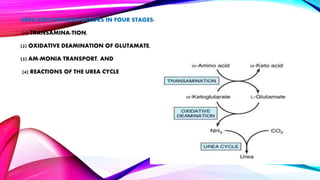
UREA BIOSYNTHESIS OCCURS IN FOUR STAGES:
(1) TRANSAMINA-TION,
(2) OXIDATIVE DEAMINATION OF GLUTAMATE,
(3) AM-MONIA TRANSPORT, AND
(4) REACTIONS OF THE UREA CYCLE
INTRODUCTION
• The continuous degradation and synthesis of cellular proteins
occurs in all life forms
• Each day, humans turnover 1-2% of their protein , principally
muscle protein
• Of the liberated amino acid , approximately 75% are reutilized
• Since excess amino acid are not stored , those not
immediately incorporated into new protein are rapidly
degraded to ambhibolic intermediates
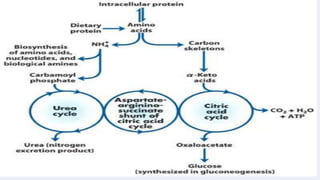
• The excess nitrogen forms urea
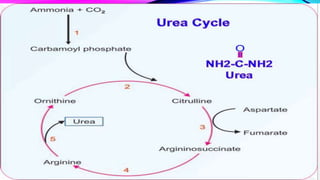
UREA CYCLE
• The urea cycle is the first metabolic pathway to be elucidated
• The cycle is known as Krebs–Henseleit or Ornithine cycle
• Urea is synthesized in liver & transported to kidneys for excretion in
urea
• The two nitrogen atoms of urea are derived from two different
sources,
 one from ammonia & the other directly from the a- amino group of
aspartic acid.
• Urea is the end product of protein metabolism (amino acid metabolism).
• Urea accounts for 80-90% of the nitrogen containing components of urine
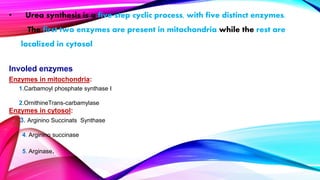
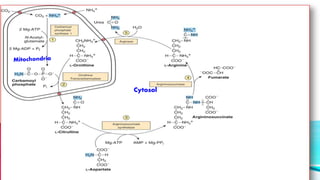
• Urea synthesis is a five-step cyclic process, with five distinct enzymes.
The first two enzymes are present in mitochondria while the rest are
localized in cytosol
Involed enzymes
Enzymes in mitochondria:
1.Carbamoyl phosphate synthase I
2.OrnithineTrans-carbamylase
Enzymes in cytosol:
3. Arginino Succinats Synthase
4. Arginino succinase
5. Arginase.
Cytosol
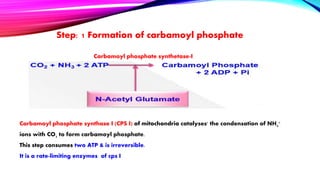
Step: 1 Formation of carbamoyl phosphate
Carbamoyl phosphate synthetase-I
Carbamoyl phosphate synthase I (CPS I) of mitochondria catalyses' the condensation of NH4
+
ions with CO2 to form carbamoyl phosphate.
This step consumes two ATP & is irreversible.
It is a rate-limiting enzymes of cps I
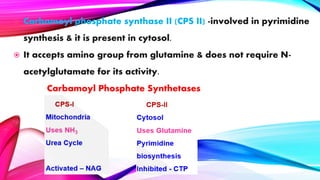
 Carbamoyl phosphate synthase II (CPS II) -involved in pyrimidine
synthesis & it is present in cytosol.
 It accepts amino group from glutamine & does not require N-
acetylglutamate for its activity.
Carbamoyl Phosphate Synthetases

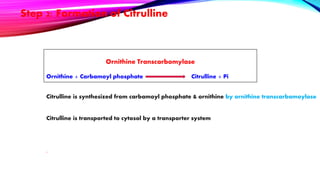
Step 2: Formation of Citrulline
Ornithine Transcarbomylase
Ornithine + Carbamoyl phosphate Citrulline + Pi
Citrulline is synthesized from carbamoyl phosphate & ornithine by ornithine transcarbamoylase
Citrulline is transported to cytosol by a transporter system
.
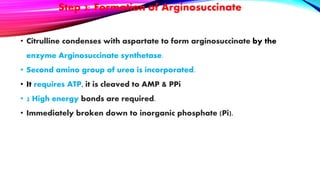
Step 3: Formation of Arginosuccinate
• Citrulline condenses with aspartate to form arginosuccinate by the
enzyme Arginosuccinate synthetase.
• Second amino group of urea is incorporated.
• It requires ATP, it is cleaved to AMP & PPi
• 2 High energy bonds are required.
• Immediately broken down to inorganic phosphate (Pi).
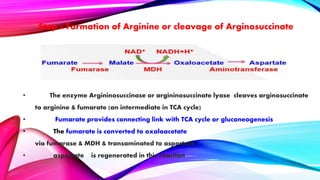
Step:4 Formation of Arginine or cleavage of Arginosuccinate
• The enzyme Argininosuccinase or argininosuccinate lyase cleaves arginosuccinate
to arginine & fumarate (an intermediate in TCA cycle)
• Fumarate provides connecting link with TCA cycle or gluconeogenesis
• The fumarate is converted to oxaloacetate
via fumarase & MDH & transaminated to aspartate.
• aspartate is regenerated in this reaction
STEP 5: FORMATION OF UREA
• Arginase is the 5th and final enzyme that cleaves arginine to yield urea &
ornithine.
• Ornithine is regenerated, enters mitochondria for its reuse in the urea
cycle.
• Arginase is activated by Co2+ & Mn2
• Arginase is mostly found in the liver
ENERGETICS OF UREA CYCLE
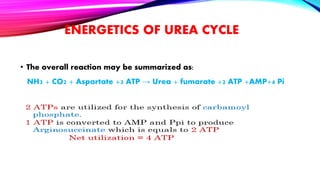
• The overall reaction may be summarized as:
NH3 + CO2 + Aspartate +3 ATP → Urea + fumarate +2 ATP +AMP+4 Pi
REGULATION OF UREA CYCLE
• Carbamoyl phosphate synthase (CPS-I) is rate limiting enzyme in
urea cycle.
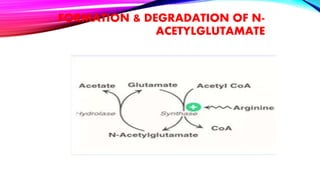
• CPS-I is allosterically activated by N-acetylglutamate (NAG). .
• The rate of urea synthesis in liver is correlated with the
concentration of N-acetylglutamate.
• Carbamoyl phosphate synthase I and glutamate dehydrogenase are located
in mitochondria. They coordinate each other in the formation of NH3, and its
utilization for the synthesis of carbamoyl phosphate
FORMATION & DEGRADATION OF N-
ACETYLGLUTAMATE
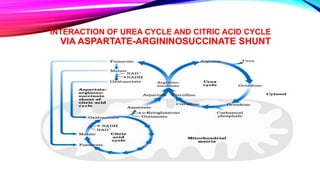
INTERACTION OF UREA CYCLE AND CITRIC ACID CYCLE
VIA ASPARTATE-ARGININOSUCCINATE SHUNT
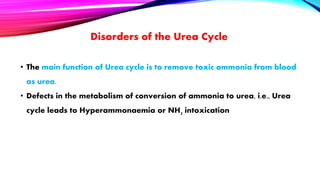
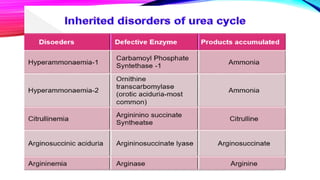
Disorders of the Urea Cycle
• The main function of Urea cycle is to remove toxic ammonia from blood
as urea.
• Defects in the metabolism of conversion of ammonia to urea, i.e., Urea
cycle leads to Hyperammonaemia or NH3 intoxication
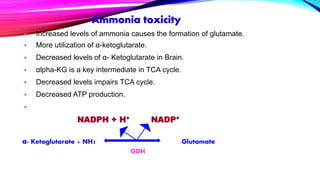
 Increased levels of ammonia causes the formation of glutamate.
 More utilization of α-ketoglutarate.
 Decreased levels of α- Ketoglutarate in Brain.
 αlpha-KG is a key intermediate in TCA cycle.
 Decreased levels impairs TCA cycle.
 Decreased ATP production.

NADPH + H+ NADP+
α- Ketoglutarate + NH3 Glutamate
GDH
urea cycle & its regulation

urea cycle & its regulation

  • 1.
  • 2.
    UREA BIOSYNTHESIS OCCURSIN FOUR STAGES: (1) TRANSAMINA-TION, (2) OXIDATIVE DEAMINATION OF GLUTAMATE, (3) AM-MONIA TRANSPORT, AND (4) REACTIONS OF THE UREA CYCLE
  • 3.
    INTRODUCTION • The continuousdegradation and synthesis of cellular proteins occurs in all life forms • Each day, humans turnover 1-2% of their protein , principally muscle protein • Of the liberated amino acid , approximately 75% are reutilized • Since excess amino acid are not stored , those not immediately incorporated into new protein are rapidly degraded to ambhibolic intermediates • The excess nitrogen forms urea
  • 4.
  • 5.
    • The ureacycle is the first metabolic pathway to be elucidated • The cycle is known as Krebs–Henseleit or Ornithine cycle • Urea is synthesized in liver & transported to kidneys for excretion in urea • The two nitrogen atoms of urea are derived from two different sources,  one from ammonia & the other directly from the a- amino group of aspartic acid. • Urea is the end product of protein metabolism (amino acid metabolism). • Urea accounts for 80-90% of the nitrogen containing components of urine
  • 7.
    • Urea synthesisis a five-step cyclic process, with five distinct enzymes. The first two enzymes are present in mitochondria while the rest are localized in cytosol Involed enzymes Enzymes in mitochondria: 1.Carbamoyl phosphate synthase I 2.OrnithineTrans-carbamylase Enzymes in cytosol: 3. Arginino Succinats Synthase 4. Arginino succinase 5. Arginase.
  • 8.
  • 9.
    Step: 1 Formationof carbamoyl phosphate Carbamoyl phosphate synthetase-I Carbamoyl phosphate synthase I (CPS I) of mitochondria catalyses' the condensation of NH4 + ions with CO2 to form carbamoyl phosphate. This step consumes two ATP & is irreversible. It is a rate-limiting enzymes of cps I
  • 10.
     Carbamoyl phosphatesynthase II (CPS II) -involved in pyrimidine synthesis & it is present in cytosol.  It accepts amino group from glutamine & does not require N- acetylglutamate for its activity. Carbamoyl Phosphate Synthetases 
  • 11.
    Step 2: Formationof Citrulline Ornithine Transcarbomylase Ornithine + Carbamoyl phosphate Citrulline + Pi Citrulline is synthesized from carbamoyl phosphate & ornithine by ornithine transcarbamoylase Citrulline is transported to cytosol by a transporter system .
  • 12.
    Step 3: Formationof Arginosuccinate • Citrulline condenses with aspartate to form arginosuccinate by the enzyme Arginosuccinate synthetase. • Second amino group of urea is incorporated. • It requires ATP, it is cleaved to AMP & PPi • 2 High energy bonds are required. • Immediately broken down to inorganic phosphate (Pi).
  • 13.
    Step:4 Formation ofArginine or cleavage of Arginosuccinate • The enzyme Argininosuccinase or argininosuccinate lyase cleaves arginosuccinate to arginine & fumarate (an intermediate in TCA cycle) • Fumarate provides connecting link with TCA cycle or gluconeogenesis • The fumarate is converted to oxaloacetate via fumarase & MDH & transaminated to aspartate. • aspartate is regenerated in this reaction
  • 14.
    STEP 5: FORMATIONOF UREA • Arginase is the 5th and final enzyme that cleaves arginine to yield urea & ornithine. • Ornithine is regenerated, enters mitochondria for its reuse in the urea cycle. • Arginase is activated by Co2+ & Mn2 • Arginase is mostly found in the liver
  • 15.
    ENERGETICS OF UREACYCLE • The overall reaction may be summarized as: NH3 + CO2 + Aspartate +3 ATP → Urea + fumarate +2 ATP +AMP+4 Pi
  • 16.
    REGULATION OF UREACYCLE • Carbamoyl phosphate synthase (CPS-I) is rate limiting enzyme in urea cycle. • CPS-I is allosterically activated by N-acetylglutamate (NAG). . • The rate of urea synthesis in liver is correlated with the concentration of N-acetylglutamate. • Carbamoyl phosphate synthase I and glutamate dehydrogenase are located in mitochondria. They coordinate each other in the formation of NH3, and its utilization for the synthesis of carbamoyl phosphate
  • 17.
    FORMATION & DEGRADATIONOF N- ACETYLGLUTAMATE
  • 18.
    INTERACTION OF UREACYCLE AND CITRIC ACID CYCLE VIA ASPARTATE-ARGININOSUCCINATE SHUNT
  • 19.
    Disorders of theUrea Cycle • The main function of Urea cycle is to remove toxic ammonia from blood as urea. • Defects in the metabolism of conversion of ammonia to urea, i.e., Urea cycle leads to Hyperammonaemia or NH3 intoxication
  • 21.
     Increased levelsof ammonia causes the formation of glutamate.  More utilization of α-ketoglutarate.  Decreased levels of α- Ketoglutarate in Brain.  αlpha-KG is a key intermediate in TCA cycle.  Decreased levels impairs TCA cycle.  Decreased ATP production.  NADPH + H+ NADP+ α- Ketoglutarate + NH3 Glutamate GDH