ADP + Pi
ATP
b2
δ
α
α
α
β
β β
H+
Fo
F1
( Part –III )
Definition
➢The synthesis of ATP from ADP
(phosphorylation), that occurs when
NADH and FADH2 are oxidized by
through electron transport chain
(respiratory chain)
➢Oxidation coupled with phosphorylation
is called Oxidative phosphorylation
➢Mitochondria are the site of oxidative
phosphorylation in eukaryotes
Oxidative Phosphorylation
During transfer of electrons through the
ETC energy is produced.
This energy is coupled to the formation of
ATP from ADP.
By an enzyme F0F1 ATPase.
✓ Oxidative phosphorylation :
the phosphorylation of ADP to ATP coupled to electron
transfer
✓ Substrate level phosphorylation :
direct transfer the phosphate from chemical intermediate
(also called substrate ) to ADP or GDP forming ATP or GTP,
independent of electron transfer chain.
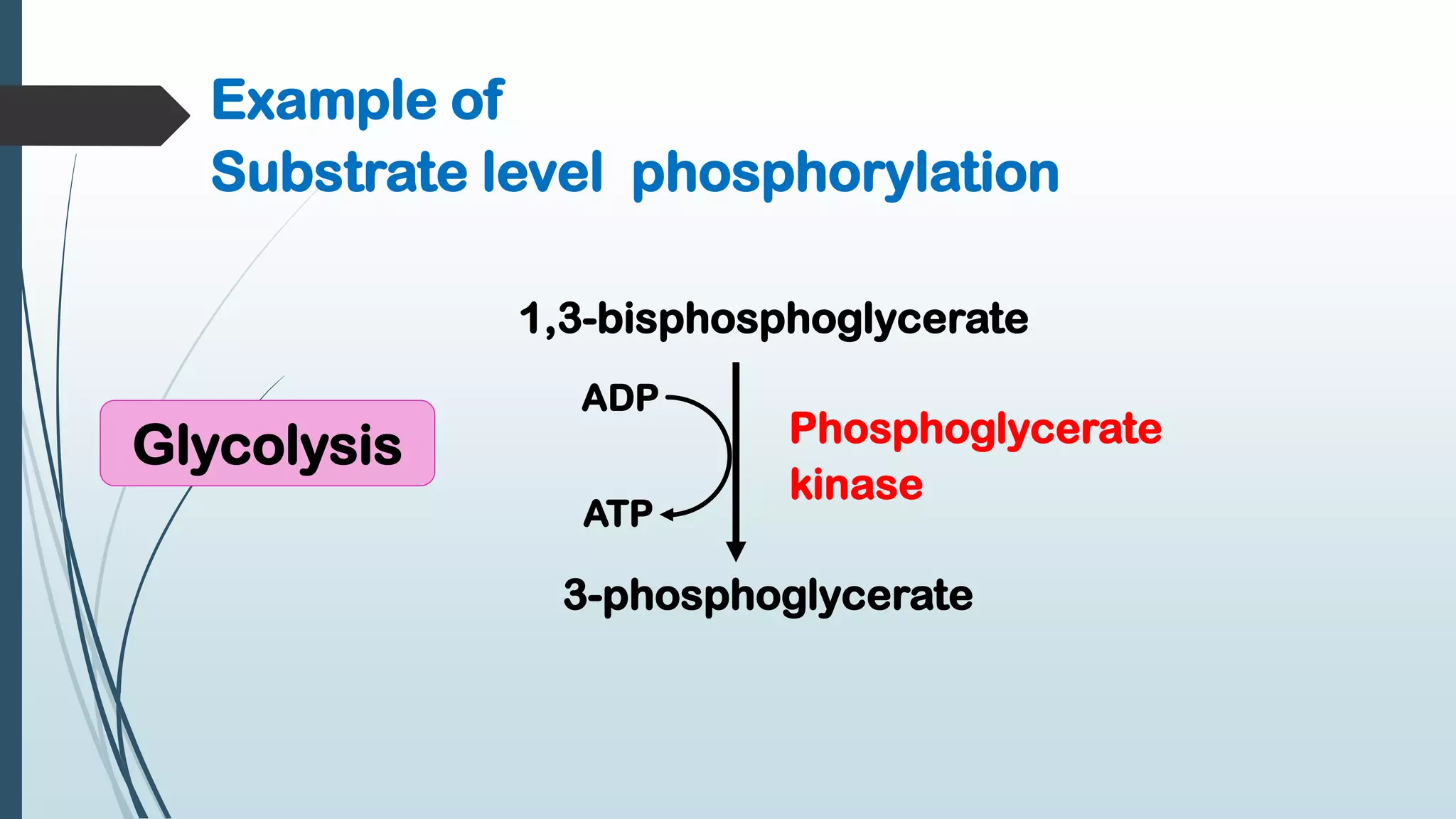
Example of
Substrate level phosphorylation
Glycolysis Phosphoglycerate
kinase
1,3-bisphosphoglycerate
3-phosphoglycerate
ADP
ATP
Phosphoenolpyruvate
ADP
ATP
Pyruvate
Pyruvate kinase
Succinyl CoA
GDP
GTP
succinate
succinyl CoA
synthetase
Glycolysis
TCA cycle
Several hypotheses have been put forth to explain the
process of oxidative phosphorylation.
The most important among them-namely,
This hypothesis was put forth by Edward Slater (1953)
According to this hypothesis, during the course of
electron transfer in respiratory chain, a series of
phosphorylated high-energy intermediates are first
produced which are utilized for the synthesis of ATP.
These reactions are believed to be analogous to the
substrate level phosphorylation that occurs in
glycolysis or citric acid cycle.
However, this hypothesis lacks experimental evidence.
CHEMIOSMOTIC
THEORY
Peter Mitchell
1920-1992
This hypothesis is the most accepted theory.
proposed by Peter Mitchell in 1961.
To explain the oxidative phosphorylation.
Nobel Prize, in 1978
It explains how the transport of electrons through
the respiratory chain (ETC) is effectively utilized to
produce ATP from ADP + Pi.
There are three basic principles of the theory.
1. Pumping of protons via electron carrier proteins
2. Generation of electrochemical potential.
i. Membrane potential
ii. Proton gradient (chemical potential)
3.Electron transport flow back to matrix through
ATPase.
The inner mitochondrial membrane, is
impermeable to protons & hydroxyl ions.
The transport of electrons through ETC is
coupled with the translocation of protons (H+)
across the inner mitochondrial membrane from
the matrix to the intermembrane space.
This results in an electrochemical or proton
gradient.
Electrochemical
gradient
10H+
Complex
III
4H+
2H+
4H+
4H+4H+
2H+
NADH+ +H+
NAD+
O2
H2O
FoF1
Negative
(Alkaline)
Positive
(Acidic)
Outer mitochondrial membrane
10H+
2.5ADP
+2.5Pi
2.5
ATP
Chemiosmotic theory
Complex I and complex III
pumps 4 protons each
Complex IV pumps 2 protons
To inter-membranous space
10 protons are pumped by the
electron transport chain
The transfer of two electrons
from NADH+ H+ to O2 is
accompanied by the outward
pumping of 10 H+
10 protons are pumped out per NADH
1. 4 must flow in to produce 1 ATP
2. The proton-based P/O ratio is 2.5 for NADH as the electron donor and 1.5
(6/4) for succinate
ATP generation (old and new values)
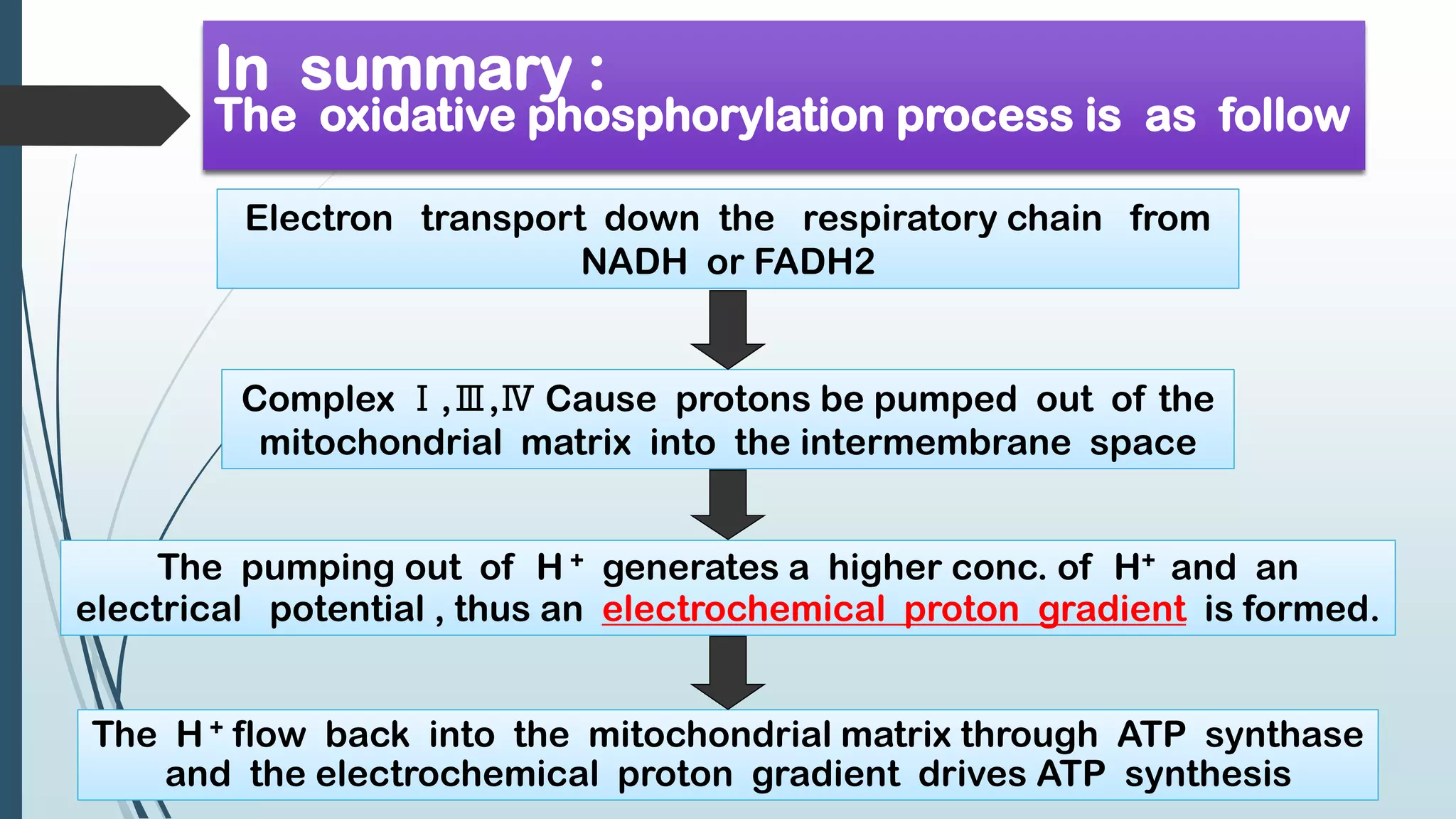
In summary :
The oxidative phosphorylation process is as follow
Electron transport down the respiratory chain from
NADH or FADH2
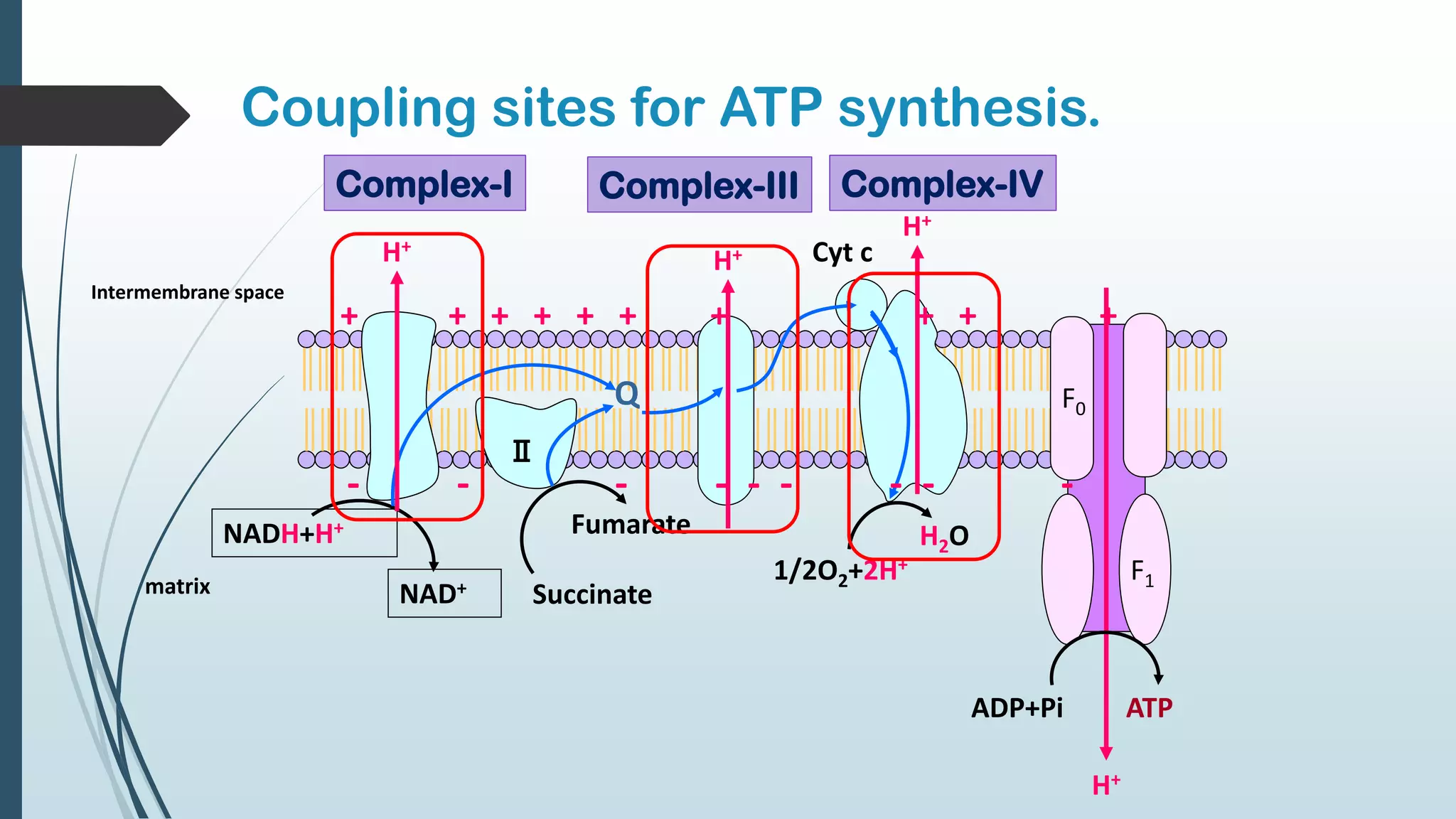
Complex Ⅰ,Ⅲ,Ⅳ Cause protons be pumped out of the
mitochondrial matrix into the intermembrane space
The pumping out of H + generates a higher conc. of H+ and an
electrical potential , thus an electrochemical proton gradient is formed.
The H + flow back into the mitochondrial matrix through ATP synthase
and the electrochemical proton gradient drives ATP synthesis
Proposed by Paul Boyer in 1964
(Nobel Prize, 1997)
Fo F1 ATPase
F0
F1
Also called ATP
synthase.
Embedded in the
inner membrane
ADP + Pi
ATP
b2
δ
α
α
α
β
β β
H+
Fo
F1
⚫Also called complex Ⅴ
⚫It is the enzyme that actually
synthesize ATP
⚫It located in the inner
mitochondrial membrane
⚫It utilizes energy from the proton
gradient to promote phosphorylation of
ADP forming ATP
ADP + Pi
ATP
b2
δ
α
α
α
β
β β
H+
Fo
F1
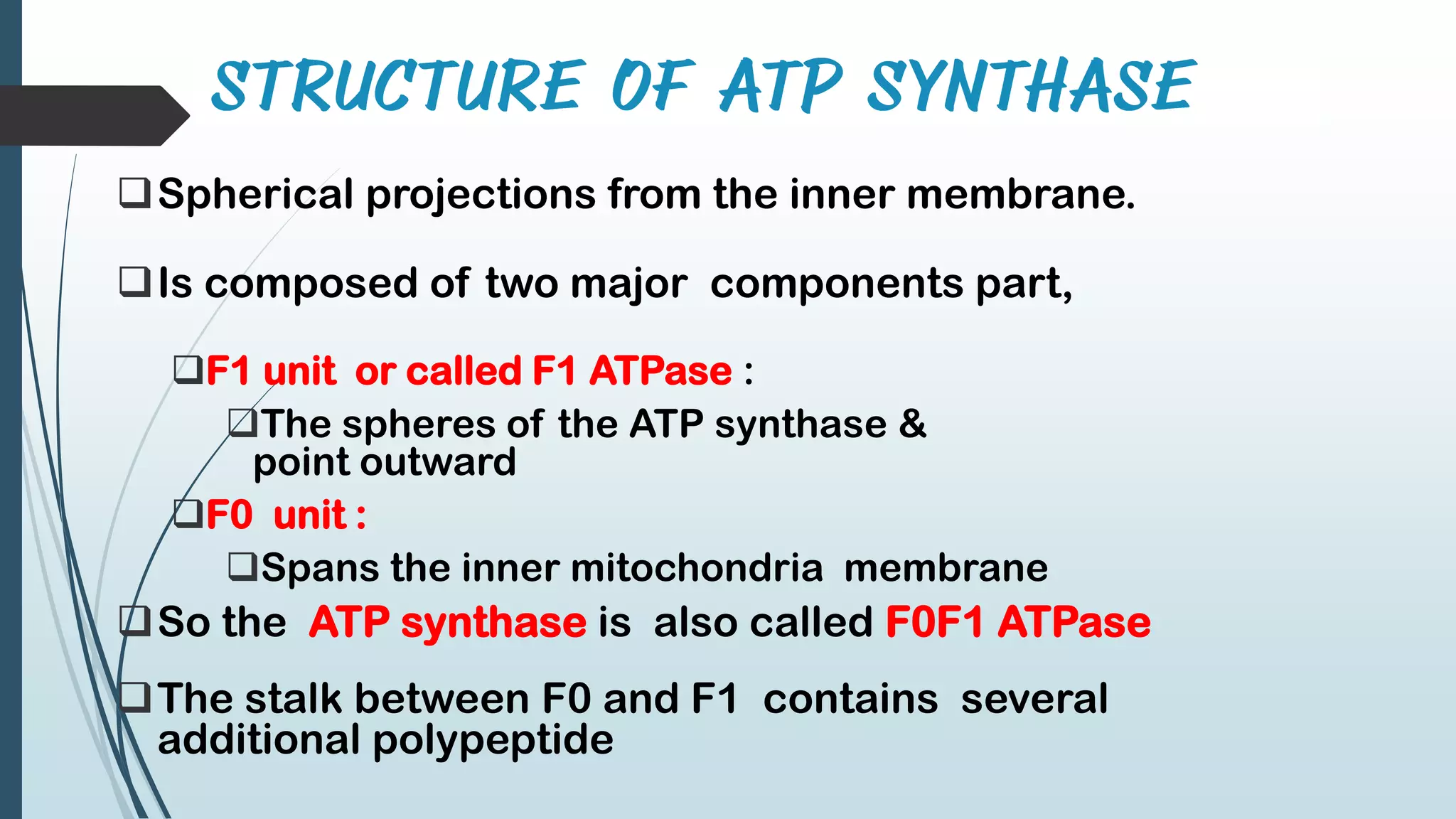
❑Spherical projections from the inner membrane.
❑Is composed of two major components part,
❑F1 unit or called F1 ATPase :
❑The spheres of the ATP synthase &
point outward
❑F0 unit :
❑Spans the inner mitochondria membrane
❑So the ATP synthase is also called F0F1 ATPase
❑The stalk between F0 and F1 contains several
additional polypeptide
F1 unit :
Contains 5 types of polypeptides
Arranged in α3β3γδε.
F0 unit:
Made of abc polypeptides,
Is proton channel / proton transport.
F1 with F0 together can synthesize ATP
Only F1 components have ATPase activity, so also
called ATPase,
ADP + Pi
ATP
b2
δ
α
α
α
β
β β
H+
Fo
F1
ETC and Oxidative phosphorylation
P:O ratio
The P:O ratio refers to the number of inorganic
phosphate molecules incorporated into ATP for
every atom of oxygen consumed.
When a pair of electrons from NADH reduces an
atom of oxygen (½ O2), 2.5 mol of ATP are formed
per 0.5 mol of O2 consumed.
This results in conversion of energy required for
production of only 3 ATP from NADH and 2 ATP from
FADH2
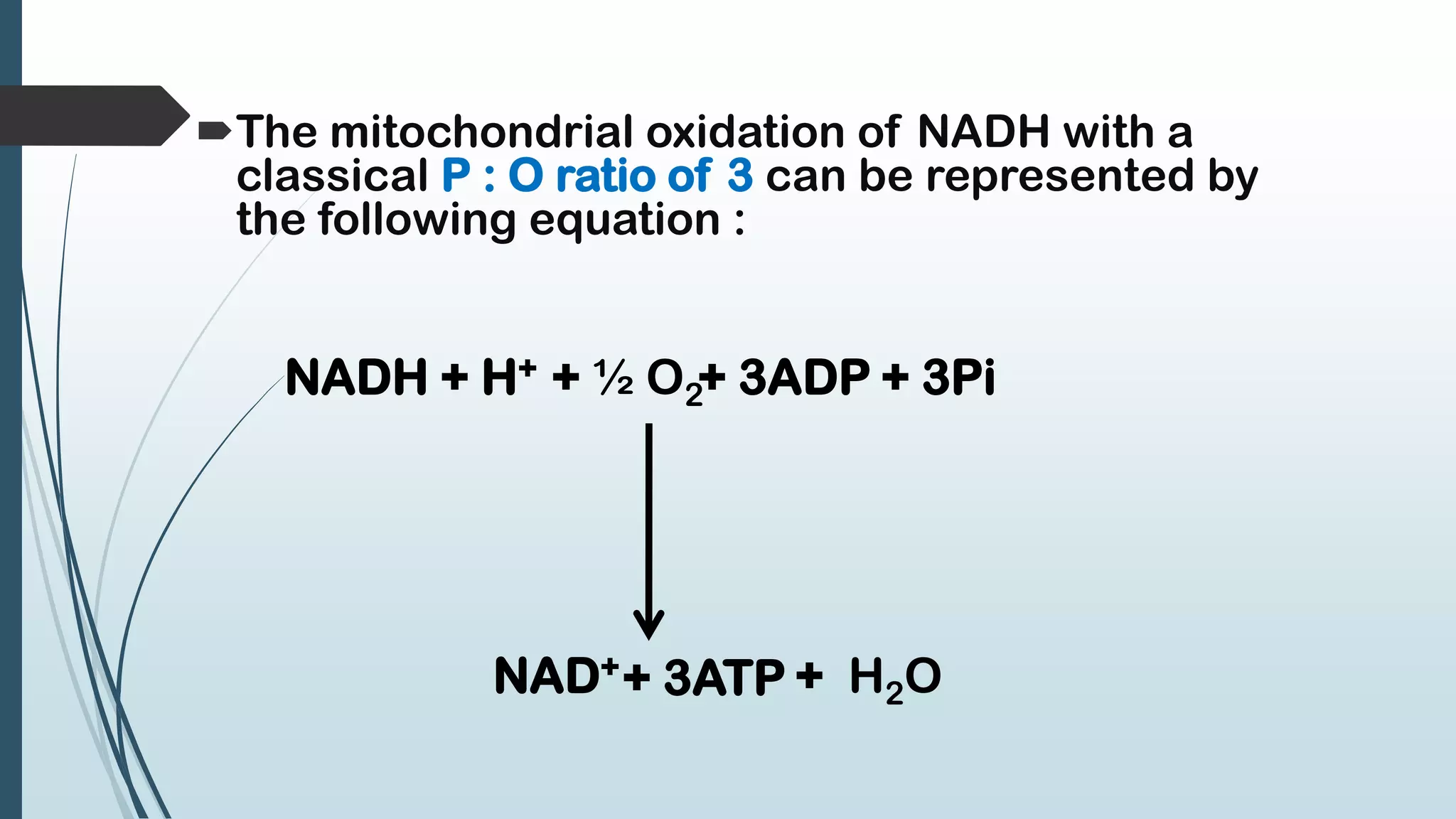
The mitochondrial oxidation of NADH with a
classical P : O ratio of 3 can be represented by
the following equation :
NADH + H+ + ½ O2+ 3ADP + 3Pi
NAD+ + H2O+ 3ATP
Current Concept, Energetics of ATP Synthesis
According to the estimated free energy of synthesis, it was
presumed that around 3 protons are required per ATP
synthesized.
Hence when 1 NADH transfers its electrons to oxygen, 10
protons are pumped out.
This would account for the synthesis of approximately 3 ATP.
Similarly the oxidation of 1 FADH2 is accompanied by the
pumping of 6 protons, accounting for 2 molecules of ATP.
However, Peter Hinkle recently proved that the actual energy
production is less, because there is always leakage of protons.
This results in harnessing of energy required for the
production of 2.5 ATP from NADH and 1.5 ATP from FADH2.
Complex-I
Ⅱ
Complex-IV
F0
F1
Complex-III
Cyt c
Q
NADH+H+
NAD+
Fumarate
Succinate
H+
1/2O2+2H+
H2O
ADP+Pi ATP
H+
H+
H+
Intermembrane space
matrix
+ + + + + + + + + +
- - - - - - - - -
Coupling sites for ATP synthesis.
Generate ATP sums
2.5 ATP are synthesized per NADH oxidized
through the NADH respiratory chain
1.5 ATP are synthesized per FADH2 oxidized
through the FADH2 respiratory chain
Why ATP synthesize from FADH2 respiratory chain is
less than NADH respiratory chain?
NADH respiratory have 3 H+ pump, complex
Ⅰ,Ⅲ,Ⅳ
 FADH2 respiratory only have 2 H+ pump,
complex Ⅲ,Ⅳ
So the ATP made from FADH2 is less than from
NADH
Uncouplers
Electron transport is normally tightly coupled to
ATP synthesis
Electrons do not flow through the ETC to O2
unless ADP is simultaneously phosphorylated to
ATP.
Also, ATP is not synthesized unless
electron transport is occurring to provide the
proton gradient
The transport of electrons is tightly coupled with
oxidative phosphorylation (ATP synthesis).
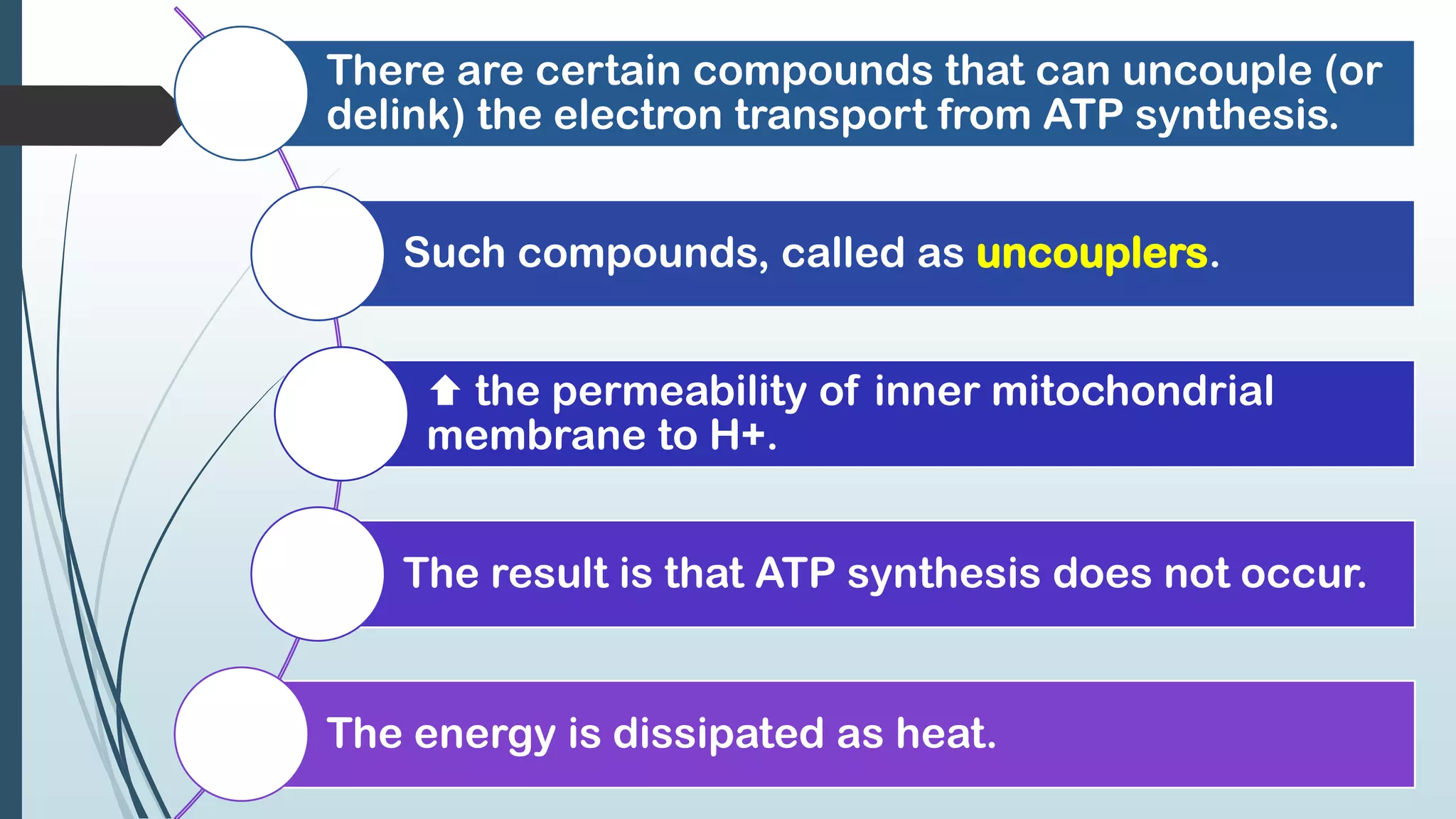
There are certain compounds that can uncouple (or
delink) the electron transport from ATP synthesis.
Such compounds, called as uncouplers.
 the permeability of inner mitochondrial
membrane to H+.
The result is that ATP synthesis does not occur.
The energy is dissipated as heat.
What is uncouplers?
There are certain compounds that can
uncouple (or delink) the electron
transport from ATP synthesis.
2,4-dinitrophenol
(DNP)
Thermogenin
(Natural uncoupling
protein)
2,4-dinitrophenol (DNP)
?
?
◆ electron transport occurs and pump out H+ ions
across the inner mitochondrial membrane to build the
H+ gradient .
◆But DNP in the same membrane carriers the H+ ions
back into the mitochondrion , preventing formation of
a proton gradient.
◆Since no proton gradient forms, so no ATP can be
made by oxidative phosphorylation
◆the energy derived from electron transport is
released as heat.
There is brown adipose tissue in the body,
 This tissue is rich in mitochondria, the
inner mitochondrial membranes of which
contains a protein called uncoupling
protein or thermogenin.
How uncoupling protein work ?
Uncoupling protein can be seen as a H+ passageway,
allows H+ to flow back into mitochondria without
having to enter the ATP synthase, thus
 Preventing formation of a proton gradient , so
uncouples electron transport & oxidative
phosphorylation.
Energy derived from electron transport is released
as heat
mechanism of uncoupling protein
(brown adipose tissue mitochondrial )
Ⅲ
Ⅰ Ⅱ
F0
F1
Ⅳ
Cyt c
Q
Intermembrane space
Matrix
Uncoupling
protein
Heat energy
H+
H+
ADP+Pi ATP
◆The production of heat by uncoupling is called
non-shivering thermogenesis.
◆It is important in certain biological situation ,
◆For example ,the brown adipose tissue is found in
sensitive body areas of some new brown animals
(including human ), where the heat production
provides protection from cold condition
◆In addition, thermogenesis by brown adipose
tissue plays a important role in maintaining body
temperature in hibernating animals
The availability of ADP regulates the process.
When ATP level is low and ADP level is high,
oxidative phosphorylation proceeds at a rapid rate.
This is called respiratory control or acceptor
control.
This mechanism ensures that electrons flow down
the chain only when ATP synthesis is needed.
If the level of ATP is high, ADP is low,
no electron transport occurs
NADH and FADH2 build up,
so does excess citrate
citric acid cycle & glycolysis are all inhibited
Over all
ADP high
Oxidative phosphorylation rises
Oxygen consumption rises
ADP low
Oxidative phosphorylation falls
Oxygen consumption falls
ATP
Adenosine triphosphate: ATP
Glycosidic
bond
N
O
CH2O
OHOH
N
N
N
NH2
P
O
OH
OP
O
OH
OP
O
OH
OH
ATP
Ester bond
αβr
Ribose
Adenine
Production and application of ATP
ATP
ADP
oxidative
Phosphorylation
~P
~P
Mechnism energy
Osmotic energy
Chemical energy
Electric energy
Hot energy
substrate level
Phosphorylation
The inner membrane of mitochondria
impermeable to some molecule and ions
Permeable to :
pyruvate, succinate, Citrate, α-
ketoglutarate, malate, Glu etc
Impermeable to :
H+, NADH, NADPH, oxaloacetate, etc
◆The inner mitochondrial membrane is
impermeable to NADH.
◆Therefore NADH produced in the cytoplasm
during glycolysis go into the mitochondria through
the membrane shuttle , then in the mitochondria go
into the respiratory chain .
◆The membrane shuttle is a combination of enzyme
reaction that bypass this impermeability barrier
Which reaction of glycolysis produce NADH
Glyceraldehyde 3-phosphate
1,3-bisphosphoglycerate
Glyceraldehyde 3-phosphate
Dehydrogenase
NAD+
NADH
The reaction take place in the cytosol
There is two shuttle system in the
mitochondrial membrane
NADH+H+
Glycerol
3-phosphate
DH
FADH2
NAD+
FAD
inner
Membrane
outer
Membrane
Intermembrane
Space
matrix
electron
chain
DHAP
Glycerol
3-P
Glycerol 3-phosphate shuttle
Glycerol
3-phosphate
DH
DHAP
Glycerol
3-P
Note :
◼ The shuttle does not allow cytoplasm NADH to
enter the mitochondrion,
◼ But transports the two electrons from NADH into
the mitochondria
◼ Feed the electron into the FADH2 electron transport
chain .
◼ So synthesize 2ATPs
NADH
+H+
NAD+
-OOC-CH2-C-COO-
O
-OOC-CH2-C-COO-
OH
H
NADH
+H+
NAD+
glutamate –
aspartate
carrier
malate
α-ketoglutarate
carrier
-OOC-CH2-C-COO-
OH
H
malate
-OOC-CH2-C-COO-
O
oxaloacetate
-OOC-CH2-CH2-C-COO-
O
-OOC-CH2-CH2-C-COO-
O
-
OOC-CH2
-CH2
-C-COO
-
H3
N
+
H
glutamate
malate
dehydrogenase
aspartate
aminotransferase
intermembrane space
inner
memebrane
matrix
-
OOC-CH2
-C-COO
-
H3
N
+
H
asparate
-
OOC-CH2
-C-COO
-
H3
N
+
H
-
OOC-CH2
-CH2
-C-COO
-
H3
N
+
H
α-ketoglutarate
malate
α-ketoglutarate
glutamate
this cycle of reactions is to transfer the electrons from
NADH in the cytosol to NADH in the mitochondrial
matrix ,
The NADH in the mitochondria is then reoxidized by the
NADH electron transport chain
So synthesize 3ATPs
Note
In summary :
Cytosol NADH go into the mitochondria by this two shuttele
• glycerol 3-phosphate shuttle
in the mitochondria go into the FADH2 respiratory chain.
so produce 2 ATPs
Malate-asparate shuttle:
in the mitochondria go into the NADH respiratory chain.
so produce 3ATPs
Biological oxidation  (part - III)  Oxidative Phosphorylation

Biological oxidation (part - III) Oxidative Phosphorylation

  • 1.
    ADP + Pi ATP b2 δ α α α β ββ H+ Fo F1 ( Part –III )
  • 2.
    Definition ➢The synthesis ofATP from ADP (phosphorylation), that occurs when NADH and FADH2 are oxidized by through electron transport chain (respiratory chain) ➢Oxidation coupled with phosphorylation is called Oxidative phosphorylation ➢Mitochondria are the site of oxidative phosphorylation in eukaryotes Oxidative Phosphorylation
  • 3.
    During transfer ofelectrons through the ETC energy is produced. This energy is coupled to the formation of ATP from ADP. By an enzyme F0F1 ATPase.
  • 5.
    ✓ Oxidative phosphorylation: the phosphorylation of ADP to ATP coupled to electron transfer ✓ Substrate level phosphorylation : direct transfer the phosphate from chemical intermediate (also called substrate ) to ADP or GDP forming ATP or GTP, independent of electron transfer chain.
  • 6.
    Example of Substrate levelphosphorylation Glycolysis Phosphoglycerate kinase 1,3-bisphosphoglycerate 3-phosphoglycerate ADP ATP
  • 7.
  • 9.
    Several hypotheses havebeen put forth to explain the process of oxidative phosphorylation. The most important among them-namely,
  • 10.
    This hypothesis wasput forth by Edward Slater (1953) According to this hypothesis, during the course of electron transfer in respiratory chain, a series of phosphorylated high-energy intermediates are first produced which are utilized for the synthesis of ATP. These reactions are believed to be analogous to the substrate level phosphorylation that occurs in glycolysis or citric acid cycle. However, this hypothesis lacks experimental evidence.
  • 11.
  • 12.
    This hypothesis isthe most accepted theory. proposed by Peter Mitchell in 1961. To explain the oxidative phosphorylation. Nobel Prize, in 1978 It explains how the transport of electrons through the respiratory chain (ETC) is effectively utilized to produce ATP from ADP + Pi.
  • 13.
    There are threebasic principles of the theory. 1. Pumping of protons via electron carrier proteins 2. Generation of electrochemical potential. i. Membrane potential ii. Proton gradient (chemical potential) 3.Electron transport flow back to matrix through ATPase.
  • 14.
    The inner mitochondrialmembrane, is impermeable to protons & hydroxyl ions. The transport of electrons through ETC is coupled with the translocation of protons (H+) across the inner mitochondrial membrane from the matrix to the intermembrane space. This results in an electrochemical or proton gradient.
  • 15.
  • 17.
  • 18.
    Complex I andcomplex III pumps 4 protons each Complex IV pumps 2 protons To inter-membranous space 10 protons are pumped by the electron transport chain The transfer of two electrons from NADH+ H+ to O2 is accompanied by the outward pumping of 10 H+ 10 protons are pumped out per NADH 1. 4 must flow in to produce 1 ATP 2. The proton-based P/O ratio is 2.5 for NADH as the electron donor and 1.5 (6/4) for succinate
  • 19.
    ATP generation (oldand new values)
  • 20.
    In summary : Theoxidative phosphorylation process is as follow Electron transport down the respiratory chain from NADH or FADH2 Complex Ⅰ,Ⅲ,Ⅳ Cause protons be pumped out of the mitochondrial matrix into the intermembrane space The pumping out of H + generates a higher conc. of H+ and an electrical potential , thus an electrochemical proton gradient is formed. The H + flow back into the mitochondrial matrix through ATP synthase and the electrochemical proton gradient drives ATP synthesis
  • 21.
    Proposed by PaulBoyer in 1964 (Nobel Prize, 1997)
  • 22.
    Fo F1 ATPase F0 F1 Alsocalled ATP synthase. Embedded in the inner membrane ADP + Pi ATP b2 δ α α α β β β H+ Fo F1
  • 23.
    ⚫Also called complexⅤ ⚫It is the enzyme that actually synthesize ATP ⚫It located in the inner mitochondrial membrane ⚫It utilizes energy from the proton gradient to promote phosphorylation of ADP forming ATP ADP + Pi ATP b2 δ α α α β β β H+ Fo F1
  • 24.
    ❑Spherical projections fromthe inner membrane. ❑Is composed of two major components part, ❑F1 unit or called F1 ATPase : ❑The spheres of the ATP synthase & point outward ❑F0 unit : ❑Spans the inner mitochondria membrane ❑So the ATP synthase is also called F0F1 ATPase ❑The stalk between F0 and F1 contains several additional polypeptide
  • 25.
    F1 unit : Contains5 types of polypeptides Arranged in α3β3γδε. F0 unit: Made of abc polypeptides, Is proton channel / proton transport. F1 with F0 together can synthesize ATP Only F1 components have ATPase activity, so also called ATPase, ADP + Pi ATP b2 δ α α α β β β H+ Fo F1
  • 26.
    ETC and Oxidativephosphorylation
  • 29.
    P:O ratio The P:Oratio refers to the number of inorganic phosphate molecules incorporated into ATP for every atom of oxygen consumed. When a pair of electrons from NADH reduces an atom of oxygen (½ O2), 2.5 mol of ATP are formed per 0.5 mol of O2 consumed. This results in conversion of energy required for production of only 3 ATP from NADH and 2 ATP from FADH2
  • 30.
    The mitochondrial oxidationof NADH with a classical P : O ratio of 3 can be represented by the following equation : NADH + H+ + ½ O2+ 3ADP + 3Pi NAD+ + H2O+ 3ATP
  • 31.
    Current Concept, Energeticsof ATP Synthesis According to the estimated free energy of synthesis, it was presumed that around 3 protons are required per ATP synthesized. Hence when 1 NADH transfers its electrons to oxygen, 10 protons are pumped out. This would account for the synthesis of approximately 3 ATP. Similarly the oxidation of 1 FADH2 is accompanied by the pumping of 6 protons, accounting for 2 molecules of ATP. However, Peter Hinkle recently proved that the actual energy production is less, because there is always leakage of protons. This results in harnessing of energy required for the production of 2.5 ATP from NADH and 1.5 ATP from FADH2.
  • 32.
  • 33.
    Generate ATP sums 2.5ATP are synthesized per NADH oxidized through the NADH respiratory chain 1.5 ATP are synthesized per FADH2 oxidized through the FADH2 respiratory chain
  • 34.
    Why ATP synthesizefrom FADH2 respiratory chain is less than NADH respiratory chain? NADH respiratory have 3 H+ pump, complex Ⅰ,Ⅲ,Ⅳ  FADH2 respiratory only have 2 H+ pump, complex Ⅲ,Ⅳ So the ATP made from FADH2 is less than from NADH
  • 36.
  • 37.
    Electron transport isnormally tightly coupled to ATP synthesis Electrons do not flow through the ETC to O2 unless ADP is simultaneously phosphorylated to ATP. Also, ATP is not synthesized unless electron transport is occurring to provide the proton gradient The transport of electrons is tightly coupled with oxidative phosphorylation (ATP synthesis).
  • 38.
    There are certaincompounds that can uncouple (or delink) the electron transport from ATP synthesis. Such compounds, called as uncouplers.  the permeability of inner mitochondrial membrane to H+. The result is that ATP synthesis does not occur. The energy is dissipated as heat.
  • 39.
    What is uncouplers? Thereare certain compounds that can uncouple (or delink) the electron transport from ATP synthesis. 2,4-dinitrophenol (DNP) Thermogenin (Natural uncoupling protein)
  • 40.
  • 41.
  • 42.
    ? ◆ electron transportoccurs and pump out H+ ions across the inner mitochondrial membrane to build the H+ gradient . ◆But DNP in the same membrane carriers the H+ ions back into the mitochondrion , preventing formation of a proton gradient. ◆Since no proton gradient forms, so no ATP can be made by oxidative phosphorylation ◆the energy derived from electron transport is released as heat.
  • 43.
    There is brownadipose tissue in the body,  This tissue is rich in mitochondria, the inner mitochondrial membranes of which contains a protein called uncoupling protein or thermogenin.
  • 44.
    How uncoupling proteinwork ? Uncoupling protein can be seen as a H+ passageway, allows H+ to flow back into mitochondria without having to enter the ATP synthase, thus  Preventing formation of a proton gradient , so uncouples electron transport & oxidative phosphorylation. Energy derived from electron transport is released as heat
  • 45.
    mechanism of uncouplingprotein (brown adipose tissue mitochondrial ) Ⅲ Ⅰ Ⅱ F0 F1 Ⅳ Cyt c Q Intermembrane space Matrix Uncoupling protein Heat energy H+ H+ ADP+Pi ATP
  • 46.
    ◆The production ofheat by uncoupling is called non-shivering thermogenesis. ◆It is important in certain biological situation , ◆For example ,the brown adipose tissue is found in sensitive body areas of some new brown animals (including human ), where the heat production provides protection from cold condition ◆In addition, thermogenesis by brown adipose tissue plays a important role in maintaining body temperature in hibernating animals
  • 51.
    The availability ofADP regulates the process. When ATP level is low and ADP level is high, oxidative phosphorylation proceeds at a rapid rate. This is called respiratory control or acceptor control.
  • 52.
    This mechanism ensuresthat electrons flow down the chain only when ATP synthesis is needed. If the level of ATP is high, ADP is low, no electron transport occurs NADH and FADH2 build up, so does excess citrate citric acid cycle & glycolysis are all inhibited
  • 53.
    Over all ADP high Oxidativephosphorylation rises Oxygen consumption rises ADP low Oxidative phosphorylation falls Oxygen consumption falls
  • 54.
  • 55.
  • 56.
    Production and applicationof ATP ATP ADP oxidative Phosphorylation ~P ~P Mechnism energy Osmotic energy Chemical energy Electric energy Hot energy substrate level Phosphorylation
  • 58.
    The inner membraneof mitochondria impermeable to some molecule and ions Permeable to : pyruvate, succinate, Citrate, α- ketoglutarate, malate, Glu etc Impermeable to : H+, NADH, NADPH, oxaloacetate, etc
  • 59.
    ◆The inner mitochondrialmembrane is impermeable to NADH. ◆Therefore NADH produced in the cytoplasm during glycolysis go into the mitochondria through the membrane shuttle , then in the mitochondria go into the respiratory chain . ◆The membrane shuttle is a combination of enzyme reaction that bypass this impermeability barrier
  • 60.
    Which reaction ofglycolysis produce NADH Glyceraldehyde 3-phosphate 1,3-bisphosphoglycerate Glyceraldehyde 3-phosphate Dehydrogenase NAD+ NADH The reaction take place in the cytosol
  • 61.
    There is twoshuttle system in the mitochondrial membrane
  • 62.
  • 63.
    Note : ◼ Theshuttle does not allow cytoplasm NADH to enter the mitochondrion, ◼ But transports the two electrons from NADH into the mitochondria ◼ Feed the electron into the FADH2 electron transport chain . ◼ So synthesize 2ATPs
  • 64.
  • 65.
    this cycle ofreactions is to transfer the electrons from NADH in the cytosol to NADH in the mitochondrial matrix , The NADH in the mitochondria is then reoxidized by the NADH electron transport chain So synthesize 3ATPs Note
  • 66.
    In summary : CytosolNADH go into the mitochondria by this two shuttele • glycerol 3-phosphate shuttle in the mitochondria go into the FADH2 respiratory chain. so produce 2 ATPs Malate-asparate shuttle: in the mitochondria go into the NADH respiratory chain. so produce 3ATPs