PRESENTATION OF
BIOCHEMISTRY
RESPIRATION
Respiration – a process by which cells
derive energy with a controlled reaction
between H+ and O2; the end product being
water.
Aerobic organisms are able to capture a
far greater proportion of the available free
energy of respiratory substrates than
anaerobic organisms
RESPIRATION
• The objective of respiration is to produce
ATP.
• Energy is released from oxidation
reactions in the form of electrons
• Electrons are shuttled by electron carriers
(e.g. NAD+) to an electron transport chain
• Electron energy is converted to ATP in the
electron transport chain
METABOLISM
• Metabolism is the sum of the chemical
reactions in an organism.
• Catabolism is the energy-releasing
processes.
• Anabolism is the energy-using processes.
• Catabolism provides the building blocks
and energy for anabolism.
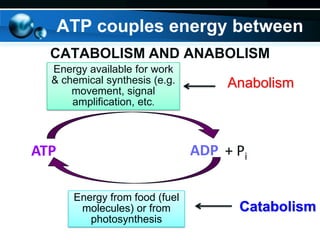
ATP couples energy between
CATABOLISM AND ANABOLISM
Energy available for work
& chemical synthesis (e.g.
movement, signal
amplification, etc.

Anabolism

ADP + Pi

ATP
Energy from food (fuel
molecules) or from
photosynthesis

Catabolism
• Oxidative phosphorylation is the process by
which the energy stored in NADH and FADH2
is used to produce ATP.
• A. Oxidation step: electron transport chain
NADH + H+ + O2
NAD+ + H2O
FADH2 + O2
FAD + H2O
B. Phosphorylation step
ADP + Pi
ATP
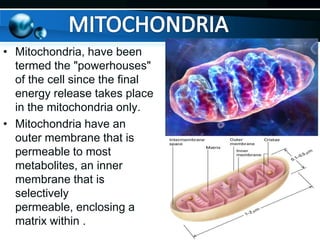
• Mitochondria, have been
termed the "powerhouses"
of the cell since the final
energy release takes place
in the mitochondria only.
• Mitochondria have an
outer membrane that is
permeable to most
metabolites, an inner
membrane that is
selectively
permeable, enclosing a
matrix within .
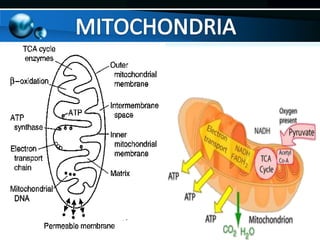
• The outer membrane is characterized by the presence
of various enzymes, including acyl-CoA synthetase
and glycerol phosphate dehydrogenase.
• Adenylyl kinase and creatine kinase are found in the
intermembrane space.
• The phospholipid cardiolipin is concentrated in the
inner membrane together with the enzymes of the
respiratory chain, ATP synthase and various
membrane transporters.
• The matrix encloses the enzymes of TCA cycle, beta
oxidation and pyruvate dehydrogenase complex.
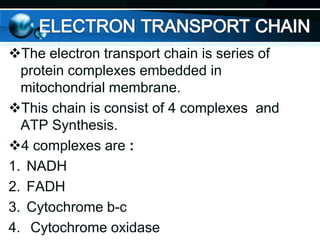
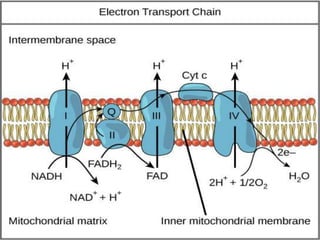
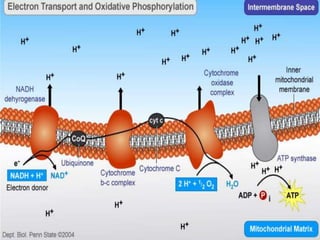
The electron transport chain is series of
protein complexes embedded in
mitochondrial membrane.
This chain is consist of 4 complexes and
ATP Synthesis.
4 complexes are :
1. NADH
2. FADH
3. Cytochrome b-c
4. Cytochrome oxidase
Electrons are come from electron carriers and
they travel through the electron transport chain
where the electrons final destination is oxygen
which will help to reduce Oxygen to form water.
So oxygen is known as final acceptor.
Electrons captured from donor molecules are
transferred through 4 complexes.
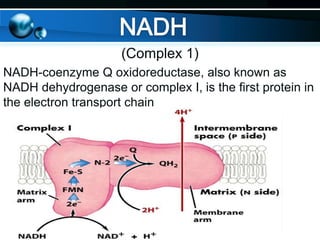
(Complex 1)
NADH-coenzyme Q oxidoreductase, also known as
NADH dehydrogenase or complex I, is the first protein in
the electron transport chain
• In Complex I, In which NADH dehydrogenase oxidized
to NAD+H+,this process obtain two electrons which
will first given to FMN(flavin mononucleotide) from
here the electrons are transfered one at a time
through a series of iron sulfur center than 2 electrons
create a proton gradient which bring 2 hydrogen ions
from the matrix and bound to ubiquinone and as a
biase ubiquinone it will reduced to ubiquinol(QH2).
• Complex I can transfer 4 protons from the matrix inner
membrane space.It will be seen that transfer of four
protons in to inner membrane space is equivalent to
formation of one ATP molecule.
FADH2

(Complex 2)
Succinate-Q oxidoreductase , also known as
complex 2 or succinate dehydrogenase,(from the
citric acid cycle)is a second entry point to the
electron transport chain.
FADH2

It contains FAD(Flavin adenine dinucleotide)
and Fe-S centers; it lacks proton pump activity.
It oxidizes succinate to fumarate and reduces
ubiquinone. The two hydrogen atoms are first
taken up by FAD to form FADH2 then passed
through a series of iron sulfur centers and
passed to ubquinone.
 As this reaction releases less energy than the
oxidation of NADH, complex II does not
transport protons across the membrane and
does not contribute to the proton gradient.
FADH2

For this reason, whereas transfer of two
hydrogen from NADH+H+ to coenzyme Q by
the complex 1 results in formation of one
ATP,the transfer of two H atoms from FADH2
to coenzyme Q does not give rise to any ATP.
• Coenzymes Q ubiquinone flows to the inner membrane
• its purpose is to carry electron through different
complexes because it is a mobile protein where the
complexes are stationary coenzymes travel to the inner
membrane with 2 electrons.It would not associate with
complex 2 but it would associate with complex 3.
Complex 3
Cytochrome b-c complex also called
cytochrome c oxireductase
Complex 3 has a few important sub unit or 3
imp structure
1. Iron sulphr (Fe-S) protein
2. Cytochrome b
3. Cytochrome c
• Cytochromes are protein containing heme
group.
• When Electrons are donated from NADH to
NADH dehydrogenase, a large protein complex
that pumps protons across the inner
membrane.
• Then, electrons are transported to the
coenzyme Q (Q), also termed ubiquinon; then
ubiquinon travel to the inner membrane and
associate with the subunit of complex 3.
In complex 3 cytochrome c is not a part of any
enzyme complex, is freely soluble and occurs in
the inter membrane space
Cytochrome c is also called mobile protein
because it travel to the inter membrane space
and attached or bind to the complex 4
cytochrome oxidase.
Complex 4
The final step of ETC is the reduction of
molecular oxygen by electrons derived from
cyt-c.
Complex 4 consist of 3 important sub unit
1. Subunit 1 has two heme group a and a3
2. Subunit 2 contains two Cu ions
3. Subunit 3 is essential for the activity of
complex 4
The cytochrome oxidase complexes then
transfer electrons from cytochrome c to
oxygen, the terminal electron acceptor, and
water is formed as the product.
 Cytochrome oxidase also pumps 2 protons
across the membrane.
The transfer of protons generates a proton
motive force across the membrane of the
mitochondrion.
 Electrons are transported between all these
complexes and where will rise at oxygen so oxygen is
final electron aceptor.
 These electrons are come from 1NADH and so now if
we calculate all the protons pumped from 1 NADH to
all the complexs.
Complex 1 = 4 protons
Complex 3 = 4 protons
Complex 4 = 2 protons
These 10 hydrogen ion it would go through the ATP
synthase to produce ATP
Chemiosmotic Theory
• The chemiosmotic theory was developed by the British
biochemist, Peter Mitchell which explain the mechanism of ATP
formation.
• According to this theory, the tranfer of electrons down an
electron transport system through a series of oxidationreduction reactions releases energy .As electrons are
transferred along the electron Transport chain from electron
donor to electron acceptor in the inner mitochondrial
membrane,free energy is released. This energy allows certain
carriers in the chain to transport hydrogen ions (protons) which
thus contains a higher concentration of protons than the matrix.
This creates an electrochemical gradient across the inner
membrane. The energized state of the membrane as a result of
this charge separation is called proton motive force or PMF.
Chemiosmotic Theory
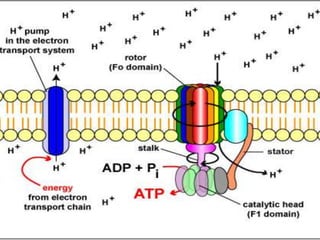
• This proton motive force provides the energy
necessary for enzymes called ATP synthases, to
catalyze the synthesis of ATP from ADP and
phosphate.
• This generation of ATP occurs as the protons across
the membrane through the ATP synthase complexes
re-enter the matrix of the mitochondria. As the
protons move down the concentration gradient
through the ATP synthase, the energy released
causes the rotor (F0) and stalk of the ATP synthase to
rotate. The mechanical energy from this rotation is
converted into chemical energy as phosphate is added
to ADP to form ATP in the catalytic head (F1 domain)
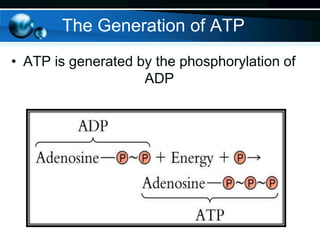
The Generation of ATP
• ATP is generated by the phosphorylation of
ADP
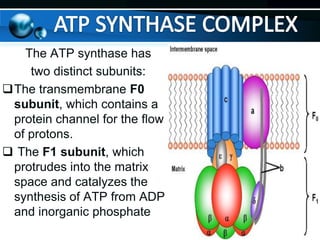
The ATP synthase has
two distinct subunits:
The transmembrane F0
subunit, which contains a
protein channel for the flow
of protons.
 The F1 subunit, which
protrudes into the matrix
space and catalyzes the
synthesis of ATP from ADP
and inorganic phosphate
 ATP synthase is embedded in the
inner membrane, together with the
respiratory chain complexes .
 Several subunits of the protein
form a ball-like shape arranged
around an axis known as F1, which
projects into the matrix and
contains the phosphorylation
mechanism .
 F1 is attached to a membrane
protein complex known as
F0, which also consists of several
protein subunits.
 F0 spans the membrane and forms
The flow of protons through F0 causes it to
rotate, driving the production of ATP in the F1
complex.
A portion of the F1 subunit termed the stalk
links the two subunits.
 As protons flow through the channel in the F0
subunit, they cause the embedded stalk to
rotate in the stationary F1 subunit, thereby
converting the energy of the electrochemical
gradient into mechanical energy.
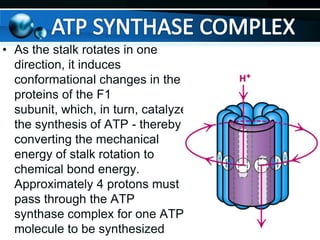
• As the stalk rotates in one
direction, it induces
conformational changes in the
proteins of the F1
subunit, which, in turn, catalyze
the synthesis of ATP - thereby
converting the mechanical
energy of stalk rotation to
chemical bond energy.
Approximately 4 protons must
pass through the ATP
synthase complex for one ATP
molecule to be synthesized
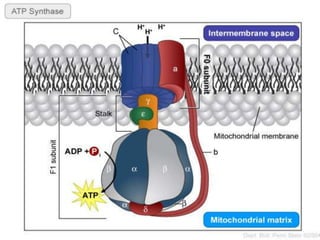
• The hydrogen concentration is much greater
in the inter membrane space than in the
matrix, thus generating an electrochemical
proton gradient. This gradient drives protons
back across the inner membrane through the
ATP synthase (shown in gray) that catalyzes
the synthesis of ATP from ADP and inorganic
phosphate (Pi).
Oxidative phosphorylation

Oxidative phosphorylation

  • 1.
  • 2.
    RESPIRATION Respiration – aprocess by which cells derive energy with a controlled reaction between H+ and O2; the end product being water. Aerobic organisms are able to capture a far greater proportion of the available free energy of respiratory substrates than anaerobic organisms
  • 3.
    RESPIRATION • The objectiveof respiration is to produce ATP. • Energy is released from oxidation reactions in the form of electrons • Electrons are shuttled by electron carriers (e.g. NAD+) to an electron transport chain • Electron energy is converted to ATP in the electron transport chain
  • 4.
    METABOLISM • Metabolism isthe sum of the chemical reactions in an organism. • Catabolism is the energy-releasing processes. • Anabolism is the energy-using processes. • Catabolism provides the building blocks and energy for anabolism.
  • 5.
    ATP couples energybetween CATABOLISM AND ANABOLISM Energy available for work & chemical synthesis (e.g. movement, signal amplification, etc. Anabolism ADP + Pi ATP Energy from food (fuel molecules) or from photosynthesis Catabolism
  • 6.
    • Oxidative phosphorylationis the process by which the energy stored in NADH and FADH2 is used to produce ATP. • A. Oxidation step: electron transport chain NADH + H+ + O2 NAD+ + H2O FADH2 + O2 FAD + H2O B. Phosphorylation step ADP + Pi ATP
  • 7.
    • Mitochondria, havebeen termed the "powerhouses" of the cell since the final energy release takes place in the mitochondria only. • Mitochondria have an outer membrane that is permeable to most metabolites, an inner membrane that is selectively permeable, enclosing a matrix within .
  • 8.
    • The outermembrane is characterized by the presence of various enzymes, including acyl-CoA synthetase and glycerol phosphate dehydrogenase. • Adenylyl kinase and creatine kinase are found in the intermembrane space. • The phospholipid cardiolipin is concentrated in the inner membrane together with the enzymes of the respiratory chain, ATP synthase and various membrane transporters. • The matrix encloses the enzymes of TCA cycle, beta oxidation and pyruvate dehydrogenase complex.
  • 10.
    The electron transportchain is series of protein complexes embedded in mitochondrial membrane. This chain is consist of 4 complexes and ATP Synthesis. 4 complexes are : 1. NADH 2. FADH 3. Cytochrome b-c 4. Cytochrome oxidase
  • 12.
    Electrons are comefrom electron carriers and they travel through the electron transport chain where the electrons final destination is oxygen which will help to reduce Oxygen to form water. So oxygen is known as final acceptor. Electrons captured from donor molecules are transferred through 4 complexes.
  • 13.
    (Complex 1) NADH-coenzyme Qoxidoreductase, also known as NADH dehydrogenase or complex I, is the first protein in the electron transport chain
  • 14.
    • In ComplexI, In which NADH dehydrogenase oxidized to NAD+H+,this process obtain two electrons which will first given to FMN(flavin mononucleotide) from here the electrons are transfered one at a time through a series of iron sulfur center than 2 electrons create a proton gradient which bring 2 hydrogen ions from the matrix and bound to ubiquinone and as a biase ubiquinone it will reduced to ubiquinol(QH2). • Complex I can transfer 4 protons from the matrix inner membrane space.It will be seen that transfer of four protons in to inner membrane space is equivalent to formation of one ATP molecule.
  • 15.
    FADH2 (Complex 2) Succinate-Q oxidoreductase, also known as complex 2 or succinate dehydrogenase,(from the citric acid cycle)is a second entry point to the electron transport chain.
  • 16.
    FADH2 It contains FAD(Flavinadenine dinucleotide) and Fe-S centers; it lacks proton pump activity. It oxidizes succinate to fumarate and reduces ubiquinone. The two hydrogen atoms are first taken up by FAD to form FADH2 then passed through a series of iron sulfur centers and passed to ubquinone.  As this reaction releases less energy than the oxidation of NADH, complex II does not transport protons across the membrane and does not contribute to the proton gradient.
  • 17.
    FADH2 For this reason,whereas transfer of two hydrogen from NADH+H+ to coenzyme Q by the complex 1 results in formation of one ATP,the transfer of two H atoms from FADH2 to coenzyme Q does not give rise to any ATP.
  • 18.
    • Coenzymes Qubiquinone flows to the inner membrane • its purpose is to carry electron through different complexes because it is a mobile protein where the complexes are stationary coenzymes travel to the inner membrane with 2 electrons.It would not associate with complex 2 but it would associate with complex 3.
  • 19.
    Complex 3 Cytochrome b-ccomplex also called cytochrome c oxireductase Complex 3 has a few important sub unit or 3 imp structure 1. Iron sulphr (Fe-S) protein 2. Cytochrome b 3. Cytochrome c
  • 20.
    • Cytochromes areprotein containing heme group. • When Electrons are donated from NADH to NADH dehydrogenase, a large protein complex that pumps protons across the inner membrane. • Then, electrons are transported to the coenzyme Q (Q), also termed ubiquinon; then ubiquinon travel to the inner membrane and associate with the subunit of complex 3.
  • 22.
    In complex 3cytochrome c is not a part of any enzyme complex, is freely soluble and occurs in the inter membrane space Cytochrome c is also called mobile protein because it travel to the inter membrane space and attached or bind to the complex 4 cytochrome oxidase.
  • 23.
    Complex 4 The finalstep of ETC is the reduction of molecular oxygen by electrons derived from cyt-c. Complex 4 consist of 3 important sub unit 1. Subunit 1 has two heme group a and a3 2. Subunit 2 contains two Cu ions 3. Subunit 3 is essential for the activity of complex 4
  • 25.
    The cytochrome oxidasecomplexes then transfer electrons from cytochrome c to oxygen, the terminal electron acceptor, and water is formed as the product.  Cytochrome oxidase also pumps 2 protons across the membrane. The transfer of protons generates a proton motive force across the membrane of the mitochondrion.
  • 26.
     Electrons aretransported between all these complexes and where will rise at oxygen so oxygen is final electron aceptor.  These electrons are come from 1NADH and so now if we calculate all the protons pumped from 1 NADH to all the complexs. Complex 1 = 4 protons Complex 3 = 4 protons Complex 4 = 2 protons These 10 hydrogen ion it would go through the ATP synthase to produce ATP
  • 27.
    Chemiosmotic Theory • Thechemiosmotic theory was developed by the British biochemist, Peter Mitchell which explain the mechanism of ATP formation. • According to this theory, the tranfer of electrons down an electron transport system through a series of oxidationreduction reactions releases energy .As electrons are transferred along the electron Transport chain from electron donor to electron acceptor in the inner mitochondrial membrane,free energy is released. This energy allows certain carriers in the chain to transport hydrogen ions (protons) which thus contains a higher concentration of protons than the matrix. This creates an electrochemical gradient across the inner membrane. The energized state of the membrane as a result of this charge separation is called proton motive force or PMF.
  • 29.
    Chemiosmotic Theory • Thisproton motive force provides the energy necessary for enzymes called ATP synthases, to catalyze the synthesis of ATP from ADP and phosphate. • This generation of ATP occurs as the protons across the membrane through the ATP synthase complexes re-enter the matrix of the mitochondria. As the protons move down the concentration gradient through the ATP synthase, the energy released causes the rotor (F0) and stalk of the ATP synthase to rotate. The mechanical energy from this rotation is converted into chemical energy as phosphate is added to ADP to form ATP in the catalytic head (F1 domain)
  • 30.
    The Generation ofATP • ATP is generated by the phosphorylation of ADP
  • 31.
    The ATP synthasehas two distinct subunits: The transmembrane F0 subunit, which contains a protein channel for the flow of protons.  The F1 subunit, which protrudes into the matrix space and catalyzes the synthesis of ATP from ADP and inorganic phosphate
  • 32.
     ATP synthaseis embedded in the inner membrane, together with the respiratory chain complexes .  Several subunits of the protein form a ball-like shape arranged around an axis known as F1, which projects into the matrix and contains the phosphorylation mechanism .  F1 is attached to a membrane protein complex known as F0, which also consists of several protein subunits.  F0 spans the membrane and forms
  • 33.
    The flow ofprotons through F0 causes it to rotate, driving the production of ATP in the F1 complex. A portion of the F1 subunit termed the stalk links the two subunits.  As protons flow through the channel in the F0 subunit, they cause the embedded stalk to rotate in the stationary F1 subunit, thereby converting the energy of the electrochemical gradient into mechanical energy.
  • 35.
    • As thestalk rotates in one direction, it induces conformational changes in the proteins of the F1 subunit, which, in turn, catalyze the synthesis of ATP - thereby converting the mechanical energy of stalk rotation to chemical bond energy. Approximately 4 protons must pass through the ATP synthase complex for one ATP molecule to be synthesized
  • 36.
    • The hydrogenconcentration is much greater in the inter membrane space than in the matrix, thus generating an electrochemical proton gradient. This gradient drives protons back across the inner membrane through the ATP synthase (shown in gray) that catalyzes the synthesis of ATP from ADP and inorganic phosphate (Pi).