ORGANIC
CHEMISTRY II
CHM301

AMIDES
NURUL’ AIN BINTI JAMION
INTRODUCTION





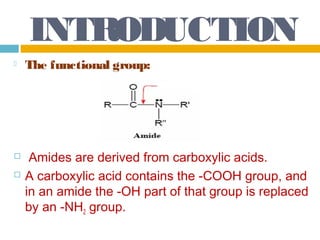
The functional group:

Amides are derived from carboxylic acids.
A carboxylic acid contains the -COOH group, and
in an amide the -OH part of that group is replaced
by an -NH2 group.
Nomenclature of amides


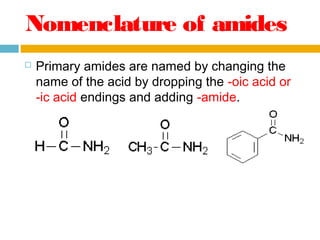
Primary amides are named by changing the
name of the acid by dropping the -oic acid or
-ic acid endings and adding -amide.
Nomenclature of amides




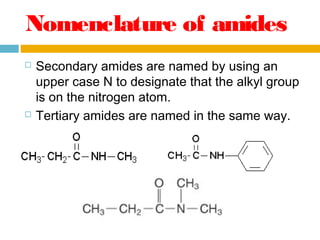
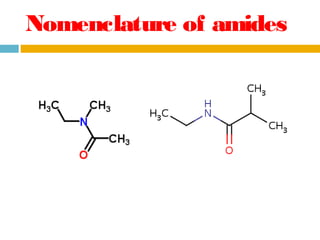
Secondary amides are named by using an
upper case N to designate that the alkyl group
is on the nitrogen atom.
Tertiary amides are named in the same way.
Nomenclature of amides
Preparation of Amides
Carboxylic acids
 Acid chlorides

Preparation of Amides


Carboxylic acids




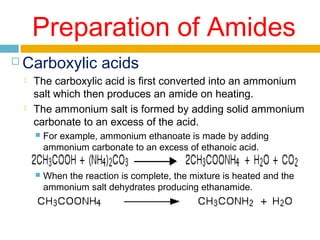
The carboxylic acid is first converted into an ammonium
salt which then produces an amide on heating.
The ammonium salt is formed by adding solid ammonium
carbonate to an excess of the acid.


For example, ammonium ethanoate is made by adding
ammonium carbonate to an excess of ethanoic acid.



When the reaction is complete, the mixture is heated and the
ammonium salt dehydrates producing ethanamide.
Preparation of Amides


Acid chlorides


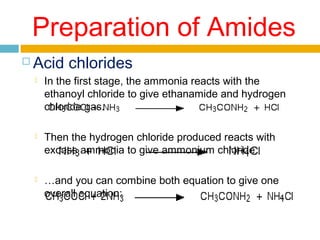
In the first stage, the ammonia reacts with the
ethanoyl chloride to give ethanamide and hydrogen
chloride gas.



Then the hydrogen chloride produced reacts with
excess ammonia to give ammonium chloride.



…and you can combine both equation to give one
overall equation:
Reactions of amides
1.
2.
3.
4.
5.

Hydrolysis
With nitrous acid
Reduction
Hoffmann degradation
Dehydration
Reactions of amides
1.

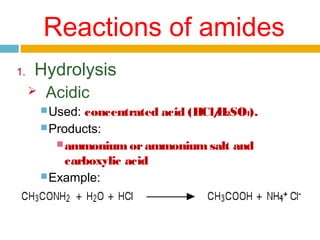
Hydrolysis


Acidic
 Used:

concentrated acid (HCl/ 2SO4).
H
 Products:
 ammonium or ammonium salt and
carboxylic acid
 Example:
Reactions of amides
1.

Hydrolysis
Acidic





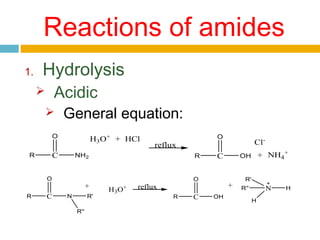
General equation:

O

H3O+ + HCl

C

R

O

NH2

R

O

+
R

C

N

R'
R''

C

O

H3 O+

Cl-

reflux

+

reflux
R

C

OH

+ NH4+

OH

R'

N

R''
H

H
Reactions of amides
1.

Hydrolysis


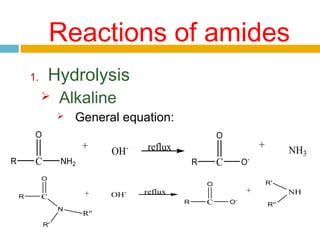
Alkaline
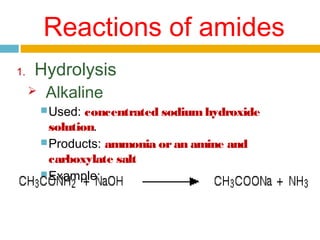
 Used:

concentrated sodium hydroxide
solution.
 Products: ammonia or an amine and
carboxylate salt
 Example:
Reactions of amides
Hydrolysis

1.



Alkaline


General equation:

O

+
C

R

NH2

O

OH-

+

OH-

R''

+

reflux
R

N
R'

R'

O

C

C

NH3

O-

C

R

O
R

+

reflux

O-

NH
R''
Reactions of amides
With nitrous acid

2.

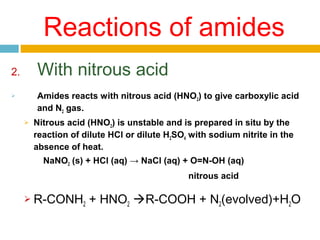
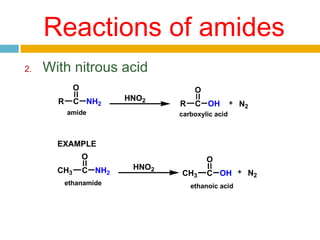
Amides reacts with nitrous acid (HNO2) to give carboxylic acid
and N2 gas.





Nitrous acid (HNO2) is unstable and is prepared in situ by the
reaction of dilute HCl or dilute H2SO4 with sodium nitrite in the
absence of heat.
NaNO2 (s) + HCl (aq) → NaCl (aq) + O=N-OH (aq)
nitrous acid



R-CONH2 + HNO2 R-COOH + N2(evolved)+H2O
Reactions of amides
2.

With nitrous acid
O
R

C NH2

HNO2

amide

O
R

C OH

N2

carboxylic acid

EXAMPLE
O
CH3

C NH2

ethanamide

HNO2

O
CH3

C OH

ethanoic acid

N2
Reactions of amides
Reduction

3.




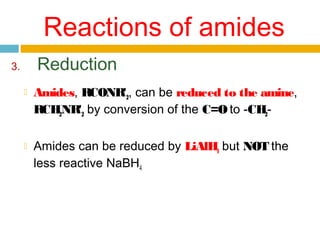
Amides, RCONR'2, can be reduced to the amine,
RCH2NR'2 by conversion of the C=O to -CH2Amides can be reduced by LiAlH4 but NOT the
less reactive NaBH4
Reactions of amides
Reduction

3.


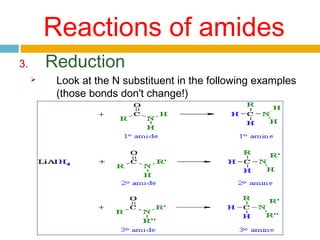
Look at the N substituent in the following examples
(those bonds don't change!)
Reactions of amides
Hoffmann degradation

4.






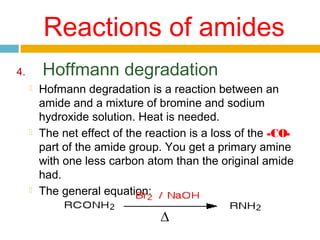
Hofmann degradation is a reaction between an
amide and a mixture of bromine and sodium
hydroxide solution. Heat is needed.
The net effect of the reaction is a loss of the -COpart of the amide group. You get a primary amine
with one less carbon atom than the original amide
had.
The general equation:

∆
Reactions of amides
Hoffmann degradation

4.


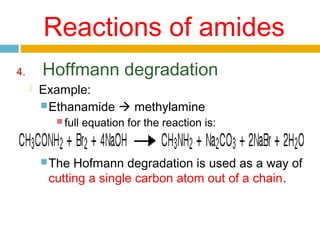
Example:
 Ethanamide  methylamine
 full

 The

equation for the reaction is:

Hofmann degradation is used as a way of
cutting a single carbon atom out of a chain.
Reactions of amides
Dehydration

5.


Amides are dehydrated by heating a solid mixture of
the amide and phosphorus(V) oxide, P4O10 /
phosphorus oxychloride, POCl3 .



Water is removed from the amide group to leave a
nitrile group, -CN. The liquid nitrile is collected by
simple distillation.
For example, with ethanamide, you will get
ethanenitrile.


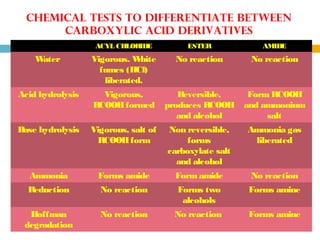
CHEMICAL TESTS TO DIFFERENTIATE BETWEEN
CARBOXYLIC ACID DERIVATIVES
ACYL CHLORIDE

ESTER

AMIDE

W
ater

Vigorous. W
hite
fumes (HCl)
liberated.

No reaction

No reaction

Acid hydrolysis

Vigorous,
RCOOH formed

Reversible,
produces RCOOH
and alcohol

Form RCOOH
and ammonium
salt

Base hydrolysis

Vigorous, salt of
RCOOH form

Non reversible,
forms
carboxylate salt
and alcohol

Ammonia gas
liberated

Ammonia

Forms amide

Form amide

No reaction

Reduction

No reaction

Forms two
alcohols

Forms amine

Hoffman
degradation

No reaction

No reaction

Forms amine

Chapter 8 amide

  • 1.
  • 2.
    INTRODUCTION    The functional group: Amidesare derived from carboxylic acids. A carboxylic acid contains the -COOH group, and in an amide the -OH part of that group is replaced by an -NH2 group.
  • 3.
    Nomenclature of amides  Primaryamides are named by changing the name of the acid by dropping the -oic acid or -ic acid endings and adding -amide.
  • 4.
    Nomenclature of amides   Secondaryamides are named by using an upper case N to designate that the alkyl group is on the nitrogen atom. Tertiary amides are named in the same way.
  • 5.
  • 6.
    Preparation of Amides Carboxylicacids  Acid chlorides 
  • 7.
    Preparation of Amides  Carboxylicacids   The carboxylic acid is first converted into an ammonium salt which then produces an amide on heating. The ammonium salt is formed by adding solid ammonium carbonate to an excess of the acid.  For example, ammonium ethanoate is made by adding ammonium carbonate to an excess of ethanoic acid.  When the reaction is complete, the mixture is heated and the ammonium salt dehydrates producing ethanamide.
  • 8.
    Preparation of Amides  Acidchlorides  In the first stage, the ammonia reacts with the ethanoyl chloride to give ethanamide and hydrogen chloride gas.  Then the hydrogen chloride produced reacts with excess ammonia to give ammonium chloride.  …and you can combine both equation to give one overall equation:
  • 9.
    Reactions of amides 1. 2. 3. 4. 5. Hydrolysis Withnitrous acid Reduction Hoffmann degradation Dehydration
  • 10.
    Reactions of amides 1. Hydrolysis  Acidic Used: concentrated acid (HCl/ 2SO4). H  Products:  ammonium or ammonium salt and carboxylic acid  Example:
  • 11.
    Reactions of amides 1. Hydrolysis Acidic   Generalequation: O H3O+ + HCl C R O NH2 R O + R C N R' R'' C O H3 O+ Cl- reflux + reflux R C OH + NH4+ OH R' N R'' H H
  • 12.
    Reactions of amides 1. Hydrolysis  Alkaline Used: concentrated sodium hydroxide solution.  Products: ammonia or an amine and carboxylate salt  Example:
  • 13.
    Reactions of amides Hydrolysis 1.  Alkaline  Generalequation: O + C R NH2 O OH- + OH- R'' + reflux R N R' R' O C C NH3 O- C R O R + reflux O- NH R''
  • 14.
    Reactions of amides Withnitrous acid 2. Amides reacts with nitrous acid (HNO2) to give carboxylic acid and N2 gas.   Nitrous acid (HNO2) is unstable and is prepared in situ by the reaction of dilute HCl or dilute H2SO4 with sodium nitrite in the absence of heat. NaNO2 (s) + HCl (aq) → NaCl (aq) + O=N-OH (aq) nitrous acid  R-CONH2 + HNO2 R-COOH + N2(evolved)+H2O
  • 15.
    Reactions of amides 2. Withnitrous acid O R C NH2 HNO2 amide O R C OH N2 carboxylic acid EXAMPLE O CH3 C NH2 ethanamide HNO2 O CH3 C OH ethanoic acid N2
  • 16.
    Reactions of amides Reduction 3.   Amides,RCONR'2, can be reduced to the amine, RCH2NR'2 by conversion of the C=O to -CH2Amides can be reduced by LiAlH4 but NOT the less reactive NaBH4
  • 17.
    Reactions of amides Reduction 3.  Lookat the N substituent in the following examples (those bonds don't change!)
  • 18.
    Reactions of amides Hoffmanndegradation 4.    Hofmann degradation is a reaction between an amide and a mixture of bromine and sodium hydroxide solution. Heat is needed. The net effect of the reaction is a loss of the -COpart of the amide group. You get a primary amine with one less carbon atom than the original amide had. The general equation: ∆
  • 19.
    Reactions of amides Hoffmanndegradation 4.  Example:  Ethanamide  methylamine  full  The equation for the reaction is: Hofmann degradation is used as a way of cutting a single carbon atom out of a chain.
  • 20.
    Reactions of amides Dehydration 5.  Amidesare dehydrated by heating a solid mixture of the amide and phosphorus(V) oxide, P4O10 / phosphorus oxychloride, POCl3 .  Water is removed from the amide group to leave a nitrile group, -CN. The liquid nitrile is collected by simple distillation. For example, with ethanamide, you will get ethanenitrile. 
  • 21.
    CHEMICAL TESTS TODIFFERENTIATE BETWEEN CARBOXYLIC ACID DERIVATIVES ACYL CHLORIDE ESTER AMIDE W ater Vigorous. W hite fumes (HCl) liberated. No reaction No reaction Acid hydrolysis Vigorous, RCOOH formed Reversible, produces RCOOH and alcohol Form RCOOH and ammonium salt Base hydrolysis Vigorous, salt of RCOOH form Non reversible, forms carboxylate salt and alcohol Ammonia gas liberated Ammonia Forms amide Form amide No reaction Reduction No reaction Forms two alcohols Forms amine Hoffman degradation No reaction No reaction Forms amine