Amines


Lecture Presented by:
      Victor R. Oribe
Amines
Amines are carbon – hydrogen – nitrogen
compounds.
Amines occurs widely in living organisms.
Many amines are         naturally occurring
compounds        that   are    very  active
physiologically.

Numerous drugs used for the treatment of
mental illness, hay fever, heart problems,
and other physical disorders are amines.
Bonding Characteristics of Nitrogen
  Atoms in Organic Compounds
 An   understanding      of    the   bonding
characteristics of the Nitrogen atom is a
prerequisite to our study of amines.
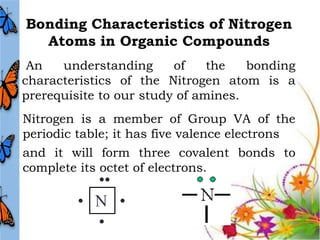
Nitrogen is a member of Group VA of the
periodic table; it has five valence electrons
and it will form three covalent bonds to
complete its octet of electrons.
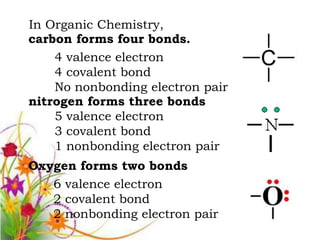
In Organic Chemistry,
carbon forms four bonds.
    4 valence electron
    4 covalent bond
    No nonbonding electron pair
nitrogen forms three bonds
    5 valence electron
    3 covalent bond
    1 nonbonding electron pair
Oxygen forms two bonds
   6 valence electron
   2 covalent bond
   2 nonbonding electron pair
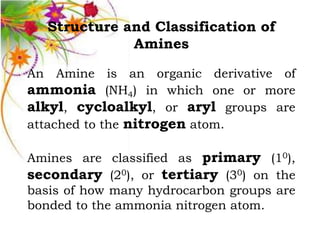
Structure and Classification of
              Amines

An Amine is an organic derivative of
ammonia (NH4) in which one or more
alkyl, cycloalkyl, or aryl groups are
attached to the nitrogen atom.

Amines are classified as primary (10),
secondary (20), or tertiary (30) on the
basis of how many hydrocarbon groups are
bonded to the ammonia nitrogen atom.
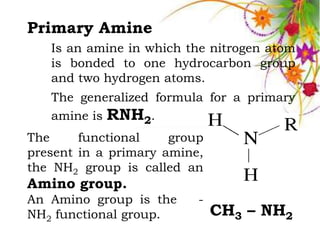
Primary Amine
   Is an amine in which the nitrogen atom
   is bonded to one hydrocarbon group
   and two hydrogen atoms.
   The generalized formula for a primary
   amine is RNH2.
The     functional    group
present in a primary amine,
the NH2 group is called an
Amino group.
An Amino group is the     -
NH2 functional group.         CH3 – NH2
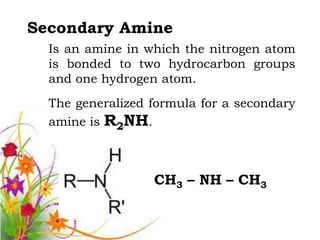
Secondary Amine
  Is an amine in which the nitrogen atom
  is bonded to two hydrocarbon groups
  and one hydrogen atom.
  The generalized formula for a secondary
  amine is R2NH.


                  CH3 – NH – CH3
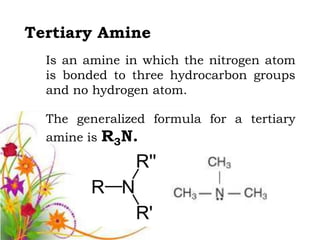
Tertiary Amine
  Is an amine in which the nitrogen atom
  is bonded to three hydrocarbon groups
  and no hydrogen atom.

  The generalized formula for a tertiary
  amine is R3N.
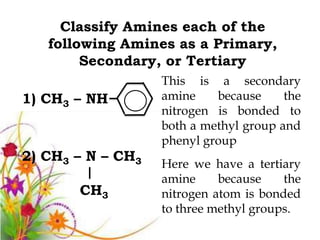
Classify Amines each of the
   following Amines as a Primary,
        Secondary, or Tertiary
                   This is a secondary
1) CH3 – NH        amine    because     the
                   nitrogen is bonded to
                   both a methyl group and
                   phenyl group
2) CH3 – N – CH3   Here we have a tertiary
                   amine     because    the
       CH3         nitrogen atom is bonded
                   to three methyl groups.
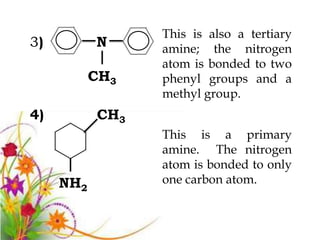
This is also a tertiary
3)         N     amine; the nitrogen
                 atom is bonded to two
           CH3   phenyl groups and a
                 methyl group.
4)         CH3
                 This is a primary
                 amine. The nitrogen
                 atom is bonded to only
     NH2         one carbon atom.
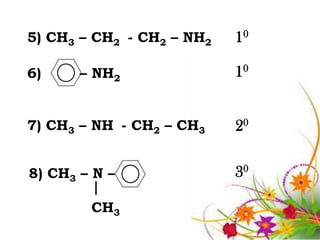
5) CH3 – CH2 - CH2 – NH2   10

6)     – NH2               10


7) CH3 – NH - CH2 – CH3    20

8) CH3 – N –               30

        CH3
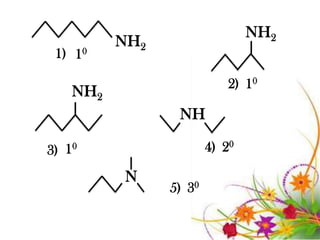
NH2
            NH2
 1) 10

                              2) 10
      NH2
                   NH

3)   10                   4) 20

            N
                  5) 30
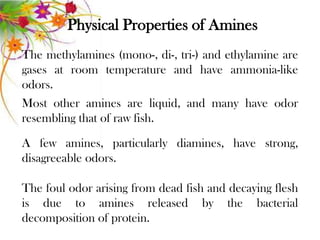
Physical Properties of Amines
The methylamines (mono-, di-, tri-) and ethylamine are
gases at room temperature and have ammonia-like
odors.
Most other amines are liquid, and many have odor
resembling that of raw fish.

A few amines, particularly diamines, have strong,
disagreeable odors.

The foul odor arising from dead fish and decaying flesh
is due to amines released by the bacterial
decomposition of protein.
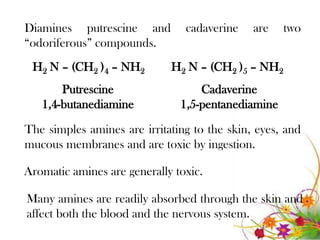
Diamines putrescine and         cadaverine    are   two
“odoriferous” compounds.
 H2 N – (CH2 )4 – NH2        H2 N – (CH2 )5 – NH2
       Putrescine                  Cadaverine
   1,4-butanediamine           1,5-pentanediamine

The simples amines are irritating to the skin, eyes, and
mucous membranes and are toxic by ingestion.

Aromatic amines are generally toxic.

Many amines are readily absorbed through the skin and
affect both the blood and the nervous system.
The boiling points of amines are intermediate
between those of alkanes and alcohols of similar
molecular mass.
Amines are higher than alkane boiling point,
because hydrogen bonding is possible between
amine molecules but not between alkane molecules.

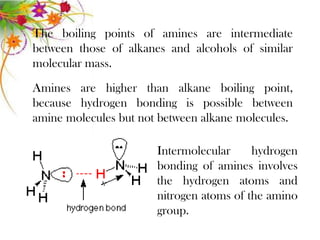
                       Intermolecular     hydrogen
                       bonding of amines involves
                       the hydrogen atoms and
                       nitrogen atoms of the amino
                       group.
Tertiary amines have lower boiling point
than primary and secondary amines
because     intermolecular    hydrogen
bonding is not possible in tertiary
amines.

Secondary and tertiary amines have no
hydrogen atoms directly bonded to the
nitrogen atom.
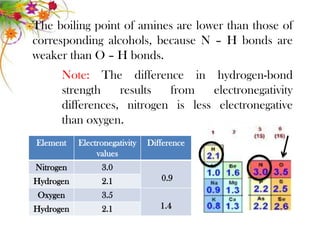
The boiling point of amines are lower than those of
corresponding alcohols, because N – H bonds are
weaker than O – H bonds.
      Note: The difference in hydrogen-bond
      strength    results  from    electronegativity
      differences, nitrogen is less electronegative
      than oxygen.
Element    Electronegativity   Difference
                values
Nitrogen         3.0
Hydrogen         2.1              0.9
 Oxygen          3.5
Hydrogen         2.1              1.4
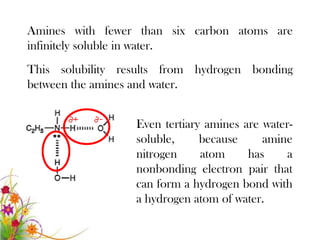
Amines with fewer than six carbon atoms are
infinitely soluble in water.
This solubility results from hydrogen bonding
between the amines and water.


                  Even tertiary amines are water-
                  soluble,     because     amine
                  nitrogen     atom     has    a
                  nonbonding electron pair that
                  can form a hydrogen bond with
                  a hydrogen atom of water.
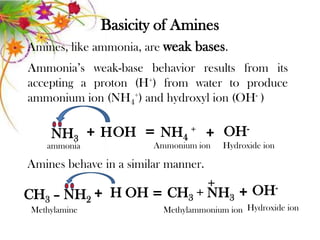
Basicity of Amines
Amines, like ammonia, are weak bases.
Ammonia’s weak-base behavior results from its
accepting a proton (H+) from water to produce
ammonium ion (NH4+) and hydroxyl ion (OH- )

    NH3 + HOH = NH4 + + OH-
   ammonia              Ammonium ion    Hydroxide ion

Amines behave in a similar manner.
                         +
CH3 – NH2 + H OH = CH3 + NH3 + OH-
Methylamine               Methylammonium ion Hydroxide ion
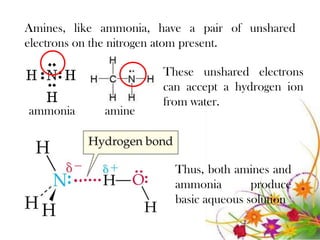
Amines, like ammonia, have a pair of unshared
electrons on the nitrogen atom present.

                       These unshared electrons
                       can accept a hydrogen ion
                       from water.
ammonia      amine


                         Thus, both amines and
                         ammonia        produce
                         basic aqueous solution
The result of the interaction of an amine
with water is a basic solution containing
substituted ammonium ions and
hydroxide ions.
A substituted ammonium ion is an
ammonium ion in which one or more alkyl,
cycloalkyl, or aryl groups have been
substituted for hydrogen atom.
Substituted   ammonium       ions always
contain one or more hydrogen atom than
their “parent” amine. They also always
carry a +1 charge, whereas the “parent”
amine is a neutral molecule.
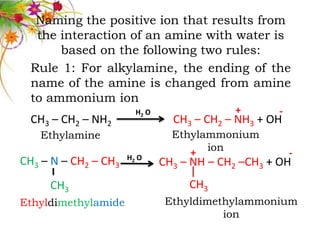
Naming the positive ion that results from
   the interaction of an amine with water is
       based on the following two rules:
  Rule 1: For alkylamine, the ending of the
  name of the amine is changed from amine
  to ammonium ion
                        H2 O                +       -
  CH3 – CH2 – NH2                CH3 – CH2 – NH3 + OH
   Ethylamine                    Ethylammonium

                      H2 O
                                    + ion               -
CH3 – N – CH2 – CH3            CH3 – NH – CH2 –CH3 + OH
     CH3                            CH3
Ethyldimethylamide              Ethyldimethylammonium
                                          ion
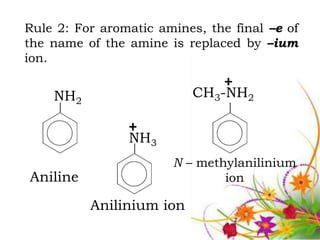
Rule 2: For aromatic amines, the final –e of
the name of the amine is replaced by –ium
ion.
                                +
    NH2                    CH3-NH2

                +
                NH3
                       N – methylanilinium
Aniline                        ion

          Anilinium ion
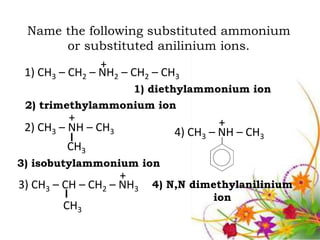
Name the following substituted ammonium
          or substituted anilinium ions.
                +
 1) CH3 – CH2 – NH2 – CH2 – CH3
                      1) diethylammonium ion
 2) trimethylammonium ion
          +                           +
 2) CH3 – NH – CH3           4) CH3 – NH – CH3
         CH3
3) isobutylammonium ion
                    +
3) CH3 – CH – CH2 – NH3   4) N,N dimethylanilinium
                                    ion
        CH3
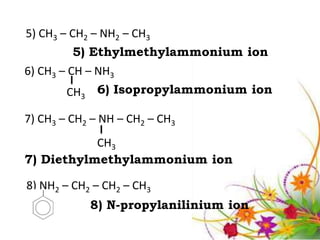
5) CH3 – CH2 – NH2 – CH3
         5) Ethylmethylammonium ion
6) CH3 – CH – NH3
        CH3 6) Isopropylammonium ion

7) CH3 – CH2 – NH – CH2 – CH3
           CH3
7) Diethylmethylammonium ion

8) NH2 – CH2 – CH2 – CH3
            8) N-propylanilinium ion
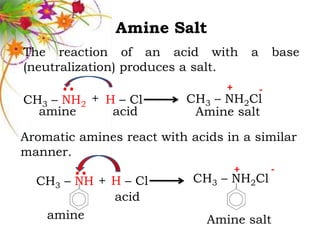
Amine Salt
The reaction of an acid with             a       base
(neutralization) produces a salt.

CH3
       ..
     – NH     + H – Cl
                                 +
                           CH3 – NH2Cl
                                             -
          2
  amine          acid       Amine salt

Aromatic amines react with acids in a similar
manner.

  CH3
          .. + H – Cl
        – NH
                                     +
                            CH3 – NH2Cl
                                                 -

                 acid
    amine                     Amine salt
An amine salt is an organic compound in
which the positive ion is a mono-, di-, or
trisubstituted ammonium ion (RNH3 + ,
R2NH2+ , or R3NH+ ) and the negative ion
comes from an acid.

Amine salt can be obtained in crystalline
form    (odorless,  white     crystals)  by
evaporating the water from the acidic
solutions in which amine salt are prepared.
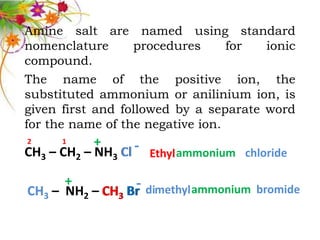
Amine salt are named using standard
nomenclature      procedures      for  ionic
compound.
The name of the positive ion, the
substituted ammonium or anilinium ion, is
given first and followed by a separate word
for the name of the negative ion.
2     1     +
CH3 – CH2 – NH3 Cl - Ethyl ammonium chloride

      +          - dimethyl ammonium bromide
CH3 – NH2 – CH3 Br
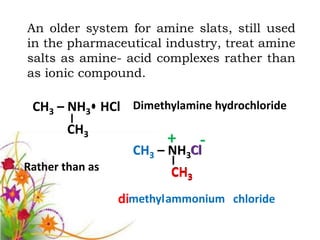
An older system for amine slats, still used
in the pharmaceutical industry, treat amine
salts as amine- acid complexes rather than
as ionic compound.

 CH3 – NH3 HCl Dimethylamine hydrochloride
        CH3
                         +     -
                   CH3 – NH3Cl
Rather than as           CH3
                 dimethyl ammonium chloride
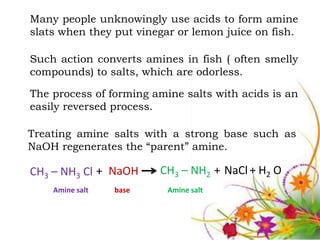
Many people unknowingly use acids to form amine
slats when they put vinegar or lemon juice on fish.

Such action converts amines in fish ( often smelly
compounds) to salts, which are odorless.

The process of forming amine salts with acids is an
easily reversed process.

Treating amine salts with a strong base such as
NaOH regenerates the “parent” amine.

CH3 – NH3 Cl + NaOH     CH3 – NH2 + NaCl + H2 O
    Amine salt   base     Amine salt
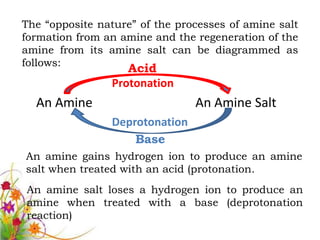
The “opposite nature” of the processes of amine salt
formation from an amine and the regeneration of the
amine from its amine salt can be diagrammed as
follows:
                   Acid
                Protonation
  An Amine                      An Amine Salt
                Deprotonation
                    Base
An amine gains hydrogen ion to produce an amine
salt when treated with an acid (protonation.
An amine salt loses a hydrogen ion to produce an
amine when treated with a base (deprotonation
reaction)
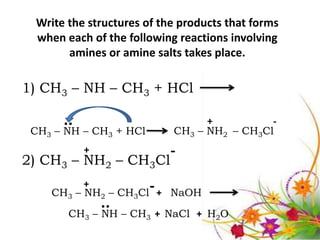
Write the structures of the products that forms
 when each of the following reactions involving
       amines or amine salts takes place.

1) CH3 – NH – CH3 + HCl

                                 +          -
      ¨
 CH3 – NH – CH3 + HCl      CH3 – NH2 – CH3Cl
          +                -
2) CH3 – NH2 – CH3Cl
          +          -
    CH3 – NH2 – CH3Cl + NaOH

              ¨
       CH3 – NH – CH3 + NaCl + H2O
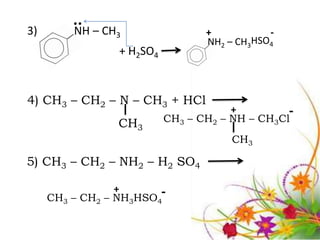
3)       ¨ – CH
         NH     3                  +           -
                                   NH2 – CH3HSO4
                  + H2SO4


4) CH3 – CH2 – N – CH3 + HCl
                                        +
                            CH3 – CH2 – NH – CH3Cl
                                                  -
                  CH3
                                        CH3

5) CH3 – CH2 – NH2 – H2 SO4

                 +
     CH3 – CH2 – NH3HSO4-
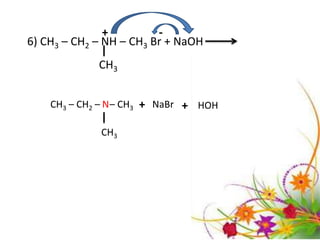
+         -
6) CH3 – CH2 – NH – CH3 Br + NaOH
             CH3


    CH3 – CH2 – N – CH3 + NaBr + HOH

             CH3
Heterocyclic Amines
Heterocyclic amine is an organic compound
in which nitrogen atoms of amine group are
part of either an aromatic or a nonaromatic
ring system.
Heterocyclic amine are the most common
type of heterocyclic organic compound
Heterocyclic   amines  are   the    first
heterocyclic   compounds    we     have
encountered     that   have    nitrogen
heteroatoms.
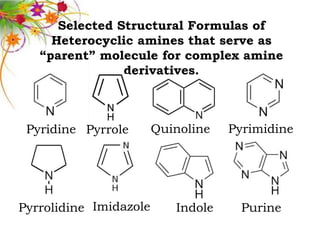
Selected Structural Formulas of
     Heterocyclic amines that serve as
   “parent” molecule for complex amine
                derivatives.


 Pyridine Pyrrole       Quinoline   Pyrimidine


Pyrrolidine Imidazole      Indole    Purine
Heterocyclic amines often have strong odor,
some agreeable and others disagreeable.

The pleasant aroma of many heat-treated
food is caused by heterocyclic amines
formed during the treatment.

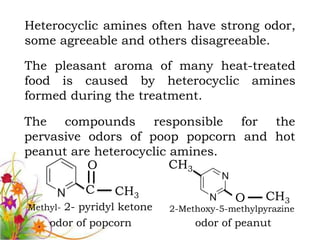
The compounds responsible for the
pervasive odors of poop popcorn and hot
peanut are heterocyclic amines.
          O             CH3

           C     CH3
                                         O      CH3
Methyl- 2- pyridyl ketone   2-Methoxy-5-methylpyrazine
    odor of popcorn              odor of peanut
Isomerism for Amines
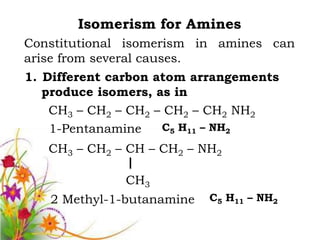
Constitutional isomerism in amines can
arise from several causes.
1. Different carbon atom arrangements
   produce isomers, as in
    CH3 – CH2 – CH2 – CH2 – CH2 NH2
    1-Pentanamine    C5 H11 – NH2

   CH3 – CH2 – CH – CH2 – NH2

              CH3
   2 Methyl-1-butanamine   C5 H11 – NH2
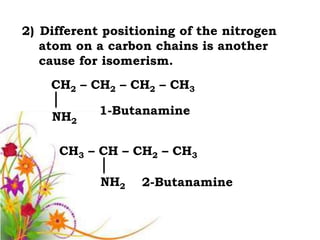
2) Different positioning of the nitrogen
   atom on a carbon chains is another
   cause for isomerism.
    CH2 – CH2 – CH2 – CH3

    NH2     1-Butanamine


     CH3 – CH – CH2 – CH3

            NH2   2-Butanamine
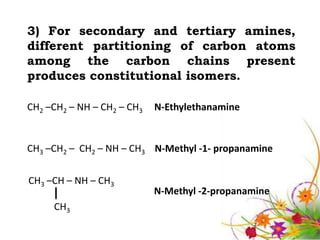
3) For secondary and tertiary amines,
different partitioning of carbon atoms
among the carbon chains present
produces constitutional isomers.

CH2 –CH2 – NH – CH2 – CH3   N-Ethylethanamine


CH3 –CH2 – CH2 – NH – CH3 N-Methyl -1- propanamine


CH3 –CH – NH – CH3
                            N-Methyl -2-propanamine
     CH3
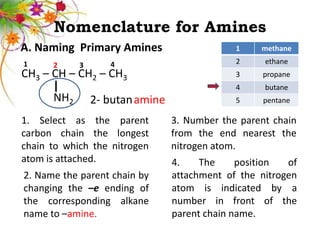
Nomenclature for Amines
A. Naming Primary Amines                      1    methane
1     2     3      4                          2     ethane
CH3 – CH – CH2 – CH3                          3     propane
                                              4     butane
      NH2       2- butan amine                5     pentane

1. Select as the parent          3. Number the parent chain
carbon chain the longest         from the end nearest the
chain to which the nitrogen      nitrogen atom.
atom is attached.                4.    The     position  of
2. Name the parent chain by      attachment of the nitrogen
changing the –e ending of        atom is indicated by a
the corresponding alkane         number in front of the
name to –amine.                  parent chain name.
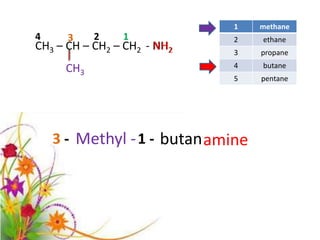
1     methane
4     3    2    1            2     ethane
CH3 – CH – CH2 – CH2 - NH2   3     propane

     CH3                     4     butane
                             5     pentane


    3 - Methyl - 1 - butan amine
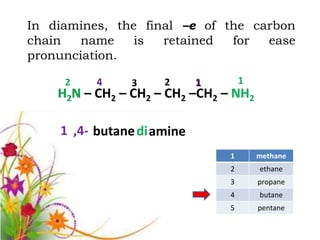
In diamines, the final –e of the carbon
chain   name    is  retained  for  ease
pronunciation.

     2    4     3    2      1       1
    H2N – CH2 – CH2 – CH2 –CH2 – NH2

    1 ,4- butane di amine
                                1       methane
                                2       ethane
                                3       propane
                                4       butane
                                5       pentane
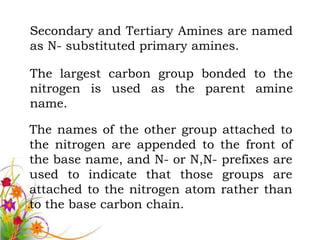
Secondary and Tertiary Amines are named
as N- substituted primary amines.

The largest carbon group bonded to the
nitrogen is used as the parent amine
name.

The names of the other group attached to
the nitrogen are appended to the front of
the base name, and N- or N,N- prefixes are
used to indicate that those groups are
attached to the nitrogen atom rather than
to the base carbon chain.
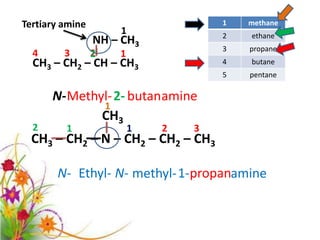
Tertiary amine                       1   methane
                     1               2   ethane
                 NH – CH3
                                     3   propane
  4      3       2   1
  CH3 – CH2 – CH – CH3               4   butane
                                     5   pentane

      N- Methyl- 2- butanamine
              1
              CH3
  2      1               1   2   3
  CH3 – CH2 – N – CH2 – CH2 – CH3

       N- Ethyl- N- methyl- 1-propanamine
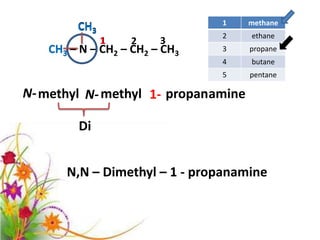
1     methane
        CH3
                               2     ethane
              1   2     3
   CH3 – N – CH2 – CH2 – CH3   3     propane
                               4     butane
                               5     pentane

N- methyl N- methyl 1- propanamine

        Di


      N,N – Dimethyl – 1 - propanamine
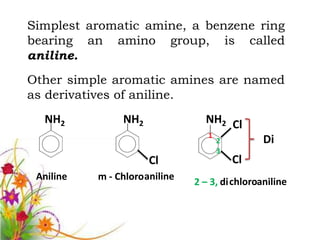
Simplest aromatic amine, a benzene ring
bearing an amino group, is called
aniline.
Other simple aromatic amines are named
as derivatives of aniline.
  NH2           NH2               NH2 Cl
                                   1
                                       2         Di
                                       3
                       Cl                  Cl
 Aniline   m - Chloro aniline
                                2 – 3, di chloroaniline
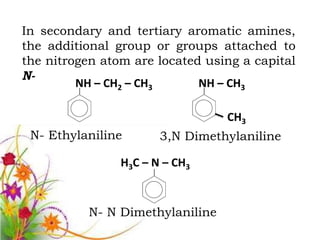
In secondary and tertiary aromatic amines,
the additional group or groups attached to
the nitrogen atom are located using a capital
N-
         NH – CH2 – CH3      NH – CH3

                                 CH3
 N- Ethylaniline       3,N Dimethylaniline

                H3C – N – CH3


          N- N Dimethylaniline
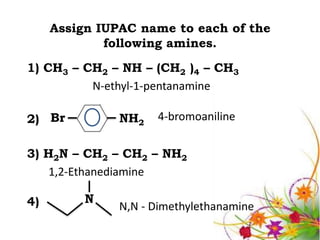
Assign IUPAC name to each of the
             following amines.
1) CH3 – CH2 – NH – (CH2 )4 – CH3
          N-ethyl-1-pentanamine

2) Br          NH2   4-bromoaniline


3) H2N – CH2 – CH2 – NH2
    1,2-Ethanediamine

4)        N
               N,N - Dimethylethanamine
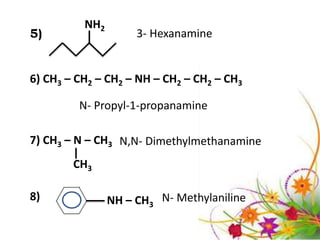
NH2
5)                   3- Hexanamine


6) CH3 – CH2 – CH2 – NH – CH2 – CH2 – CH3

         N- Propyl-1-propanamine

7) CH3 – N – CH3 N,N- Dimethylmethanamine
        CH3

8)              NH – CH3 N- Methylaniline

Amines

  • 1.
  • 2.
    Amines Amines are carbon– hydrogen – nitrogen compounds. Amines occurs widely in living organisms. Many amines are naturally occurring compounds that are very active physiologically. Numerous drugs used for the treatment of mental illness, hay fever, heart problems, and other physical disorders are amines.
  • 3.
    Bonding Characteristics ofNitrogen Atoms in Organic Compounds An understanding of the bonding characteristics of the Nitrogen atom is a prerequisite to our study of amines. Nitrogen is a member of Group VA of the periodic table; it has five valence electrons and it will form three covalent bonds to complete its octet of electrons.
  • 4.
    In Organic Chemistry, carbonforms four bonds. 4 valence electron 4 covalent bond No nonbonding electron pair nitrogen forms three bonds 5 valence electron 3 covalent bond 1 nonbonding electron pair Oxygen forms two bonds 6 valence electron 2 covalent bond 2 nonbonding electron pair
  • 5.
    Structure and Classificationof Amines An Amine is an organic derivative of ammonia (NH4) in which one or more alkyl, cycloalkyl, or aryl groups are attached to the nitrogen atom. Amines are classified as primary (10), secondary (20), or tertiary (30) on the basis of how many hydrocarbon groups are bonded to the ammonia nitrogen atom.
  • 6.
    Primary Amine Is an amine in which the nitrogen atom is bonded to one hydrocarbon group and two hydrogen atoms. The generalized formula for a primary amine is RNH2. The functional group present in a primary amine, the NH2 group is called an Amino group. An Amino group is the - NH2 functional group. CH3 – NH2
  • 7.
    Secondary Amine Is an amine in which the nitrogen atom is bonded to two hydrocarbon groups and one hydrogen atom. The generalized formula for a secondary amine is R2NH. CH3 – NH – CH3
  • 8.
    Tertiary Amine Is an amine in which the nitrogen atom is bonded to three hydrocarbon groups and no hydrogen atom. The generalized formula for a tertiary amine is R3N.
  • 9.
    Classify Amines eachof the following Amines as a Primary, Secondary, or Tertiary This is a secondary 1) CH3 – NH amine because the nitrogen is bonded to both a methyl group and phenyl group 2) CH3 – N – CH3 Here we have a tertiary amine because the CH3 nitrogen atom is bonded to three methyl groups.
  • 10.
    This is alsoa tertiary 3) N amine; the nitrogen atom is bonded to two CH3 phenyl groups and a methyl group. 4) CH3 This is a primary amine. The nitrogen atom is bonded to only NH2 one carbon atom.
  • 11.
    5) CH3 –CH2 - CH2 – NH2 10 6) – NH2 10 7) CH3 – NH - CH2 – CH3 20 8) CH3 – N – 30 CH3
  • 12.
    NH2 NH2 1) 10 2) 10 NH2 NH 3) 10 4) 20 N 5) 30
  • 13.
    Physical Properties ofAmines The methylamines (mono-, di-, tri-) and ethylamine are gases at room temperature and have ammonia-like odors. Most other amines are liquid, and many have odor resembling that of raw fish. A few amines, particularly diamines, have strong, disagreeable odors. The foul odor arising from dead fish and decaying flesh is due to amines released by the bacterial decomposition of protein.
  • 14.
    Diamines putrescine and cadaverine are two “odoriferous” compounds. H2 N – (CH2 )4 – NH2 H2 N – (CH2 )5 – NH2 Putrescine Cadaverine 1,4-butanediamine 1,5-pentanediamine The simples amines are irritating to the skin, eyes, and mucous membranes and are toxic by ingestion. Aromatic amines are generally toxic. Many amines are readily absorbed through the skin and affect both the blood and the nervous system.
  • 15.
    The boiling pointsof amines are intermediate between those of alkanes and alcohols of similar molecular mass. Amines are higher than alkane boiling point, because hydrogen bonding is possible between amine molecules but not between alkane molecules. Intermolecular hydrogen bonding of amines involves the hydrogen atoms and nitrogen atoms of the amino group.
  • 16.
    Tertiary amines havelower boiling point than primary and secondary amines because intermolecular hydrogen bonding is not possible in tertiary amines. Secondary and tertiary amines have no hydrogen atoms directly bonded to the nitrogen atom.
  • 17.
    The boiling pointof amines are lower than those of corresponding alcohols, because N – H bonds are weaker than O – H bonds. Note: The difference in hydrogen-bond strength results from electronegativity differences, nitrogen is less electronegative than oxygen. Element Electronegativity Difference values Nitrogen 3.0 Hydrogen 2.1 0.9 Oxygen 3.5 Hydrogen 2.1 1.4
  • 18.
    Amines with fewerthan six carbon atoms are infinitely soluble in water. This solubility results from hydrogen bonding between the amines and water. Even tertiary amines are water- soluble, because amine nitrogen atom has a nonbonding electron pair that can form a hydrogen bond with a hydrogen atom of water.
  • 19.
    Basicity of Amines Amines,like ammonia, are weak bases. Ammonia’s weak-base behavior results from its accepting a proton (H+) from water to produce ammonium ion (NH4+) and hydroxyl ion (OH- ) NH3 + HOH = NH4 + + OH- ammonia Ammonium ion Hydroxide ion Amines behave in a similar manner. + CH3 – NH2 + H OH = CH3 + NH3 + OH- Methylamine Methylammonium ion Hydroxide ion
  • 20.
    Amines, like ammonia,have a pair of unshared electrons on the nitrogen atom present. These unshared electrons can accept a hydrogen ion from water. ammonia amine Thus, both amines and ammonia produce basic aqueous solution
  • 21.
    The result ofthe interaction of an amine with water is a basic solution containing substituted ammonium ions and hydroxide ions. A substituted ammonium ion is an ammonium ion in which one or more alkyl, cycloalkyl, or aryl groups have been substituted for hydrogen atom. Substituted ammonium ions always contain one or more hydrogen atom than their “parent” amine. They also always carry a +1 charge, whereas the “parent” amine is a neutral molecule.
  • 22.
    Naming the positiveion that results from the interaction of an amine with water is based on the following two rules: Rule 1: For alkylamine, the ending of the name of the amine is changed from amine to ammonium ion H2 O + - CH3 – CH2 – NH2 CH3 – CH2 – NH3 + OH Ethylamine Ethylammonium H2 O + ion - CH3 – N – CH2 – CH3 CH3 – NH – CH2 –CH3 + OH CH3 CH3 Ethyldimethylamide Ethyldimethylammonium ion
  • 23.
    Rule 2: Foraromatic amines, the final –e of the name of the amine is replaced by –ium ion. + NH2 CH3-NH2 + NH3 N – methylanilinium Aniline ion Anilinium ion
  • 24.
    Name the followingsubstituted ammonium or substituted anilinium ions. + 1) CH3 – CH2 – NH2 – CH2 – CH3 1) diethylammonium ion 2) trimethylammonium ion + + 2) CH3 – NH – CH3 4) CH3 – NH – CH3 CH3 3) isobutylammonium ion + 3) CH3 – CH – CH2 – NH3 4) N,N dimethylanilinium ion CH3
  • 25.
    5) CH3 –CH2 – NH2 – CH3 5) Ethylmethylammonium ion 6) CH3 – CH – NH3 CH3 6) Isopropylammonium ion 7) CH3 – CH2 – NH – CH2 – CH3 CH3 7) Diethylmethylammonium ion 8) NH2 – CH2 – CH2 – CH3 8) N-propylanilinium ion
  • 26.
    Amine Salt The reactionof an acid with a base (neutralization) produces a salt. CH3 .. – NH + H – Cl + CH3 – NH2Cl - 2 amine acid Amine salt Aromatic amines react with acids in a similar manner. CH3 .. + H – Cl – NH + CH3 – NH2Cl - acid amine Amine salt
  • 27.
    An amine saltis an organic compound in which the positive ion is a mono-, di-, or trisubstituted ammonium ion (RNH3 + , R2NH2+ , or R3NH+ ) and the negative ion comes from an acid. Amine salt can be obtained in crystalline form (odorless, white crystals) by evaporating the water from the acidic solutions in which amine salt are prepared.
  • 28.
    Amine salt arenamed using standard nomenclature procedures for ionic compound. The name of the positive ion, the substituted ammonium or anilinium ion, is given first and followed by a separate word for the name of the negative ion. 2 1 + CH3 – CH2 – NH3 Cl - Ethyl ammonium chloride + - dimethyl ammonium bromide CH3 – NH2 – CH3 Br
  • 29.
    An older systemfor amine slats, still used in the pharmaceutical industry, treat amine salts as amine- acid complexes rather than as ionic compound. CH3 – NH3 HCl Dimethylamine hydrochloride CH3 + - CH3 – NH3Cl Rather than as CH3 dimethyl ammonium chloride
  • 30.
    Many people unknowinglyuse acids to form amine slats when they put vinegar or lemon juice on fish. Such action converts amines in fish ( often smelly compounds) to salts, which are odorless. The process of forming amine salts with acids is an easily reversed process. Treating amine salts with a strong base such as NaOH regenerates the “parent” amine. CH3 – NH3 Cl + NaOH CH3 – NH2 + NaCl + H2 O Amine salt base Amine salt
  • 31.
    The “opposite nature”of the processes of amine salt formation from an amine and the regeneration of the amine from its amine salt can be diagrammed as follows: Acid Protonation An Amine An Amine Salt Deprotonation Base An amine gains hydrogen ion to produce an amine salt when treated with an acid (protonation. An amine salt loses a hydrogen ion to produce an amine when treated with a base (deprotonation reaction)
  • 32.
    Write the structuresof the products that forms when each of the following reactions involving amines or amine salts takes place. 1) CH3 – NH – CH3 + HCl + - ¨ CH3 – NH – CH3 + HCl CH3 – NH2 – CH3Cl + - 2) CH3 – NH2 – CH3Cl + - CH3 – NH2 – CH3Cl + NaOH ¨ CH3 – NH – CH3 + NaCl + H2O
  • 33.
    3) ¨ – CH NH 3 + - NH2 – CH3HSO4 + H2SO4 4) CH3 – CH2 – N – CH3 + HCl + CH3 – CH2 – NH – CH3Cl - CH3 CH3 5) CH3 – CH2 – NH2 – H2 SO4 + CH3 – CH2 – NH3HSO4-
  • 34.
    + - 6) CH3 – CH2 – NH – CH3 Br + NaOH CH3 CH3 – CH2 – N – CH3 + NaBr + HOH CH3
  • 35.
    Heterocyclic Amines Heterocyclic amineis an organic compound in which nitrogen atoms of amine group are part of either an aromatic or a nonaromatic ring system. Heterocyclic amine are the most common type of heterocyclic organic compound Heterocyclic amines are the first heterocyclic compounds we have encountered that have nitrogen heteroatoms.
  • 36.
    Selected Structural Formulasof Heterocyclic amines that serve as “parent” molecule for complex amine derivatives. Pyridine Pyrrole Quinoline Pyrimidine Pyrrolidine Imidazole Indole Purine
  • 37.
    Heterocyclic amines oftenhave strong odor, some agreeable and others disagreeable. The pleasant aroma of many heat-treated food is caused by heterocyclic amines formed during the treatment. The compounds responsible for the pervasive odors of poop popcorn and hot peanut are heterocyclic amines. O CH3 C CH3 O CH3 Methyl- 2- pyridyl ketone 2-Methoxy-5-methylpyrazine odor of popcorn odor of peanut
  • 38.
    Isomerism for Amines Constitutionalisomerism in amines can arise from several causes. 1. Different carbon atom arrangements produce isomers, as in CH3 – CH2 – CH2 – CH2 – CH2 NH2 1-Pentanamine C5 H11 – NH2 CH3 – CH2 – CH – CH2 – NH2 CH3 2 Methyl-1-butanamine C5 H11 – NH2
  • 39.
    2) Different positioningof the nitrogen atom on a carbon chains is another cause for isomerism. CH2 – CH2 – CH2 – CH3 NH2 1-Butanamine CH3 – CH – CH2 – CH3 NH2 2-Butanamine
  • 40.
    3) For secondaryand tertiary amines, different partitioning of carbon atoms among the carbon chains present produces constitutional isomers. CH2 –CH2 – NH – CH2 – CH3 N-Ethylethanamine CH3 –CH2 – CH2 – NH – CH3 N-Methyl -1- propanamine CH3 –CH – NH – CH3 N-Methyl -2-propanamine CH3
  • 41.
    Nomenclature for Amines A.Naming Primary Amines 1 methane 1 2 3 4 2 ethane CH3 – CH – CH2 – CH3 3 propane 4 butane NH2 2- butan amine 5 pentane 1. Select as the parent 3. Number the parent chain carbon chain the longest from the end nearest the chain to which the nitrogen nitrogen atom. atom is attached. 4. The position of 2. Name the parent chain by attachment of the nitrogen changing the –e ending of atom is indicated by a the corresponding alkane number in front of the name to –amine. parent chain name.
  • 42.
    1 methane 4 3 2 1 2 ethane CH3 – CH – CH2 – CH2 - NH2 3 propane CH3 4 butane 5 pentane 3 - Methyl - 1 - butan amine
  • 43.
    In diamines, thefinal –e of the carbon chain name is retained for ease pronunciation. 2 4 3 2 1 1 H2N – CH2 – CH2 – CH2 –CH2 – NH2 1 ,4- butane di amine 1 methane 2 ethane 3 propane 4 butane 5 pentane
  • 44.
    Secondary and TertiaryAmines are named as N- substituted primary amines. The largest carbon group bonded to the nitrogen is used as the parent amine name. The names of the other group attached to the nitrogen are appended to the front of the base name, and N- or N,N- prefixes are used to indicate that those groups are attached to the nitrogen atom rather than to the base carbon chain.
  • 45.
    Tertiary amine 1 methane 1 2 ethane NH – CH3 3 propane 4 3 2 1 CH3 – CH2 – CH – CH3 4 butane 5 pentane N- Methyl- 2- butanamine 1 CH3 2 1 1 2 3 CH3 – CH2 – N – CH2 – CH2 – CH3 N- Ethyl- N- methyl- 1-propanamine
  • 46.
    1 methane CH3 2 ethane 1 2 3 CH3 – N – CH2 – CH2 – CH3 3 propane 4 butane 5 pentane N- methyl N- methyl 1- propanamine Di N,N – Dimethyl – 1 - propanamine
  • 47.
    Simplest aromatic amine,a benzene ring bearing an amino group, is called aniline. Other simple aromatic amines are named as derivatives of aniline. NH2 NH2 NH2 Cl 1 2 Di 3 Cl Cl Aniline m - Chloro aniline 2 – 3, di chloroaniline
  • 48.
    In secondary andtertiary aromatic amines, the additional group or groups attached to the nitrogen atom are located using a capital N- NH – CH2 – CH3 NH – CH3 CH3 N- Ethylaniline 3,N Dimethylaniline H3C – N – CH3 N- N Dimethylaniline
  • 49.
    Assign IUPAC nameto each of the following amines. 1) CH3 – CH2 – NH – (CH2 )4 – CH3 N-ethyl-1-pentanamine 2) Br NH2 4-bromoaniline 3) H2N – CH2 – CH2 – NH2 1,2-Ethanediamine 4) N N,N - Dimethylethanamine
  • 50.
    NH2 5) 3- Hexanamine 6) CH3 – CH2 – CH2 – NH – CH2 – CH2 – CH3 N- Propyl-1-propanamine 7) CH3 – N – CH3 N,N- Dimethylmethanamine CH3 8) NH – CH3 N- Methylaniline