Chapter 3: KETONE
Norfazrin Mohd Hanif
Faculty of Applied Science
UiTM Negeri Sembilan
SUBTOPICS
Nomenclature
– common and IUPAC names for ketones
Physical properties of ketones : Boiling points and solubility

Preparation of ketone
Oxidation of 2 °Alcohol
Friedel – Crafts Acylation
Reactions of aldehyde
Reduction To 2 ° Alcohol
Nucleophilic Addition
Reaction with Grignard Reagent
Iodoform Reaction
Ketones
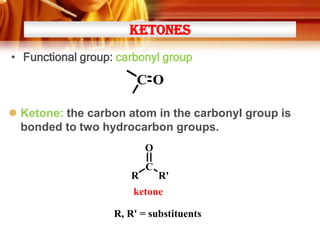
• Functional group: carbonyl group

C O
 Ketone: the carbon atom in the carbonyl group is
bonded to two hydrocarbon groups.
O
R

C

R'

ketone
R, R' = substituents
IUPAC NAME
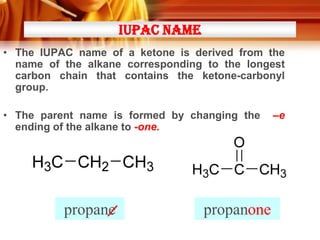
• The IUPAC name of a ketone is derived from the
name of the alkane corresponding to the longest
carbon chain that contains the ketone-carbonyl
group.

• The parent name is formed by changing the
ending of the alkane to -one.

propane

propanone
one

–e
IUPAC NAME
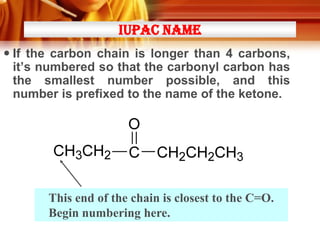
 If the carbon chain is longer than 4 carbons,
it’s numbered so that the carbonyl carbon has
the smallest number possible, and this
number is prefixed to the name of the ketone.

This end of the chain is closest to the C=O.
Begin numbering here.
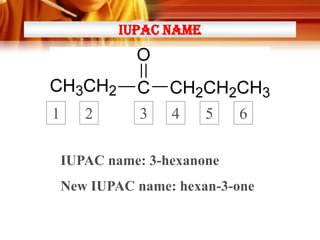
IUPAC NAME

1

2

3

4

5

6

IUPAC name: 3-hexanone
New IUPAC name: hexan-3-one
Common Names of Ketones
:O:
R

C

•
R'

alkyl alkyl ketone

7

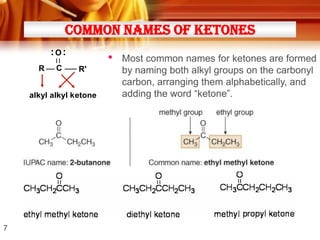
Most common names for ketones are formed
by naming both alkyl groups on the carbonyl
carbon, arranging them alphabetically, and
adding the word “ketone”.
NOMENCLATURE OF CYCLIC KETONES
AND AROMATIC COMPOUNDS
•

•

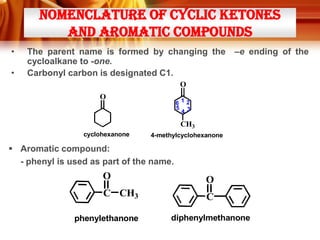
The parent name is formed by changing the
cycloalkane to -one.
Carbonyl carbon is designated C1.

–e ending of the

O
O

612
5 3
4

CH3
cyclohexanone

4-methylcyclohexanone

 Aromatic compound:
- phenyl is used as part of the name.

O

O

C CH3

C

phenylethanone

diphenylmethanone
NOMENCLATURE OF KETONES CONTAINING
TWO DIFFERENT FUNCTIONAL GROUPS
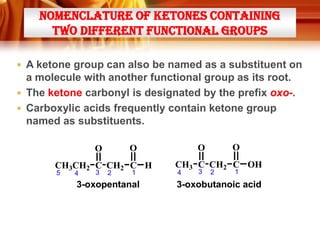
 A ketone group can also be named as a substituent on

a molecule with another functional group as its root.
 The ketone carbonyl is designated by the prefix oxo-.
 Carboxylic acids frequently contain ketone group
named as substituents.

CH3CH2 C CH2 C H
5

4

3

2

1

3-oxopentanal

O

O

O

O

CH3 C CH2 C OH
4

3

2

1

3-oxobutanoic acid
Physical Properties : Boiling point

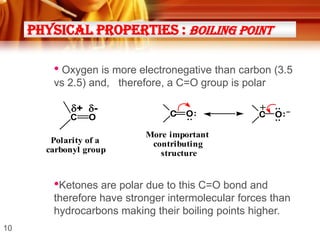
• Oxygen is more electronegative than carbon (3.5
vs 2.5) and, therefore, a C=O group is polar
O

Polarity of a
carbonyl group

O:

:

C

C

+

C

: :

+ -

O: –

More important
contributing
structure

•Ketones are polar due to this C=O bond and
therefore have stronger intermolecular forces than
hydrocarbons making their boiling points higher.
10
Physical Properties : solubility





The reason for the solubility is that they can form hydrogen
bond with water molecules.



11

The small ketones are freely soluble in water but solubility falls
with chain length.

One of the slightly positive hydrogen atoms in a water
molecule can be sufficiently attracted to one of the lone pairs
on the oxygen atom of a ketone for a hydrogen bond to be
formed.

11
Physical Properties : solubility
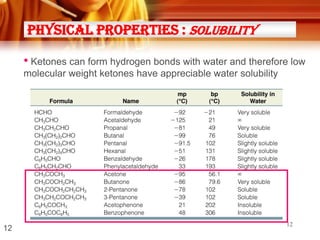
• Ketones can form hydrogen bonds with water and therefore low
molecular weight ketones have appreciable water solubility

12

12
PreparationS

OXIDATION OF 2 °ALCOHOL

FRIEDEL – CRAFTS ACYLATION

13
2.1 Oxidation of 2 °Alcohol

• Ketones can be made from 2o alcohols by oxidation
* [O] =

• Examples

14
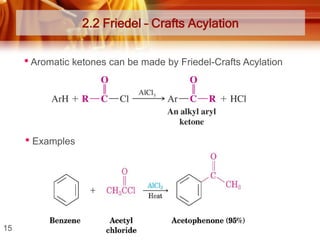
2.2 Friedel – Crafts Acylation

• Aromatic ketones can be made by Friedel-Crafts Acylation

• Examples

15
REACTIONS

REDUCTION TO 2 ° ALCOHOL

NUCLEOPHILIC addition
REACTION with grignard reagent
IODOFORM REACTION

16
REACTIONS OF KETONES
 Reduction
 Addition
 Condensation
 Iodoform reaction
 Reaction with Grignard reagent
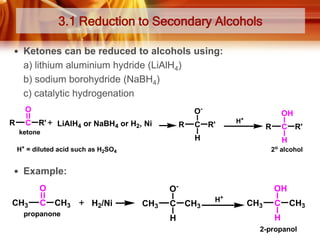
3.1 Reduction to Secondary Alcohols
 Ketones can be reduced to alcohols using:

a) lithium aluminium hydride (LiAlH4)
b) sodium borohydride (NaBH4)
c) catalytic hydrogenation
O
R

O-

C R'

LiAlH4 or NaBH4 or H2, Ni

R

ketone

C R'

OH

+

H

R

C R'

H

H

+

o

H = diluted acid such as H2SO4

2 alcohol

 Example:

O-

O
CH3

C

CH3

propanone

H2/Ni

CH3

C
H

OH
CH3

H+

CH3

C

CH3

H
2-propanol
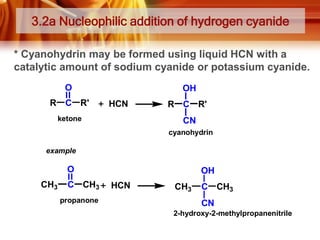
3.2a Nucleophilic addition of hydrogen cyanide
* Cyanohydrin may be formed using liquid HCN with a
catalytic amount of sodium cyanide or potassium cyanide.
O
R C R'

OH
HCN

ketone

R C R'
CN
cyanohydrin

example

O
CH3

C CH3
propanone

OH
HCN

CH3

C CH3
CN

2-hydroxy-2-methylpropanenitrile
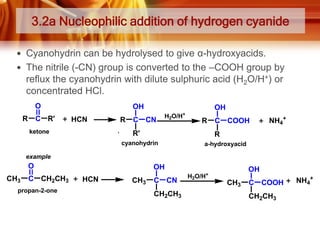
3.2a Nucleophilic addition of hydrogen cyanide
 Cyanohydrin can be hydrolysed to give α-hydroxyacids.
 The nitrile (-CN) group is converted to the –COOH group by

reflux the cyanohydrin with dilute sulphuric acid (H2O/H+) or
concentrated HCl.
O
R

C R'

OH
HCN

ketone

R
'

OH

C CN

H2O/H+

R

R'

C COOH

NH4+

R

cyanohydrin

a-hydroxyacid

example

O
CH3

C CH2CH3

propan-2-one

OH
HCN

OH

+

CH3

C CN
CH2CH3

H2O/H

CH3

C COOH
CH2CH3

NH4+
3.2b Nucleophilic addition of sodium bisulphite
(NaHSO3)
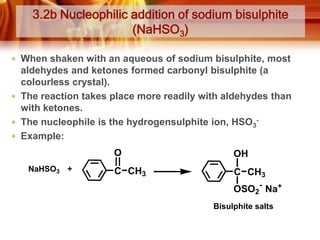
 When shaken with an aqueous of sodium bisulphite, most

aldehydes and ketones formed carbonyl bisulphite (a
colourless crystal).
 The reaction takes place more readily with aldehydes than
with ketones.
 The nucleophile is the hydrogensulphite ion, HSO3 Example:
O
NaHSO3

OH

C CH3

C CH3
OSO2- Na+
Bisulphite salts
3.3 Condensation with hydrazines, hydroxlamine,
phenylhydrazine and 2,4-dinitrophenylhydrazine
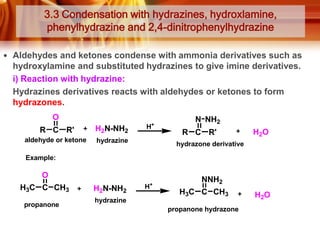
 Aldehydes and ketones condense with ammonia derivatives such as

hydroxylamine and substituted hydrazines to give imine derivatives.
i) Reaction with hydrazine:
Hydrazines derivatives reacts with aldehydes or ketones to form
hydrazones.
O
R C R'

H2N-NH2

aldehyde or ketone

+

H

hydrazine

N NH2
R C R'

H2O

hydrazone derivative

Example:

O
H3C C CH3
propanone

H2N-NH2

+

H

NNH2
H3C C CH3

hydrazine
propanone hydrazone

H2O
3.3 Condensation with hydrazines, hydroxlamine,
phenylhydrazine and 2,4-dinitrophenylhydrazine
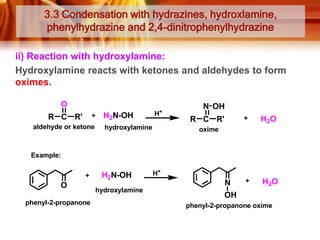
ii) Reaction with hydroxylamine:
Hydroxylamine reacts with ketones and aldehydes to form
oximes.
O
R C R'
aldehyde or ketone

H2N-OH

+

H

hydroxylamine

N OH
H2O

R C R'
oxime

Example:

H2N-OH
O
phenyl-2-propanone

hydroxylamine

H+

N

H2O

OH
phenyl-2-propanone oxime
3.3 Condensation with hydrazines, hydroxlamine,
phenylhydrazine and 2,4-dinitrophenylhydrazine
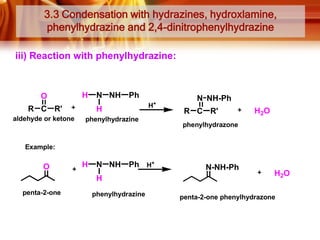
iii) Reaction with phenylhydrazine:

O

H

R C R'
aldehyde or ketone

N NH Ph
H

+

H

phenylhydrazine

N NH-Ph
R C R'

H2O

phenylhydrazone

Example:

O

H

N NH Ph H+
H

penta-2-one

phenylhydrazine

N-NH-Ph

H2O

penta-2-one phenylhydrazone
3.3 Condensation with hydrazines, hydroxlamine,
phenylhydrazine and 2,4-dinitrophenylhydrazine

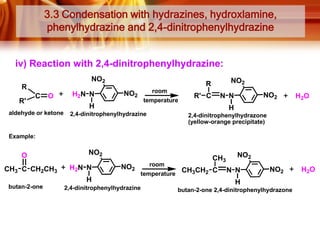
iv) Reaction with 2,4-dinitrophenylhydrazine:
NO2
R
R'

C

O

aldehyde or ketone

H2N N

NO2

R
room

NO2

temperature

H

R' C

NO2

N N

H2O

H

2,4-dinitrophenylhydrazine

2,4-dinitrophenylhydrazone
(yellow-orange precipitate)

Example:

O
CH3 C CH2CH3

NO2
H2N N
H

butan-2-one

NO2

room
temperature

2,4-dinitrophenylhydrazine

CH3
CH3CH2 C

NO2
N N

NO2

H
butan-2-one 2,4-dinitrophenylhydrazone

H2O
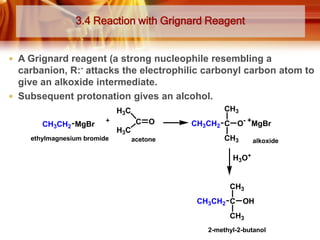
3.4 Reaction with Grignard Reagent

 A Grignard reagent (a strong nucleophile resembling a

carbanion, R:- attacks the electrophilic carbonyl carbon atom to
give an alkoxide intermediate.
 Subsequent protonation gives an alcohol.
CH3

H3C
CH3CH2 MgBr
ethylmagnesium bromide

C O

CH3CH2 C O- +MgBr

acetone

CH3

H3C

alkoxide

H3O+

CH3
CH3CH2 C OH
CH3
2-methyl-2-butanol
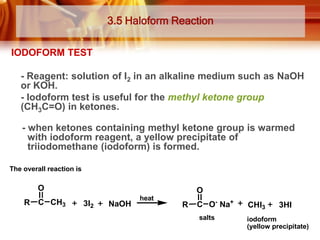
3.5 Haloform Reaction
IODOFORM TEST
- Reagent: solution of I2 in an alkaline medium such as NaOH
or KOH.
- Iodoform test is useful for the methyl ketone group
(CH3C=O) in ketones.
- when ketones containing methyl ketone group is warmed
with iodoform reagent, a yellow precipitate of
triiodomethane (iodoform) is formed.
The overall reaction is

O
R

C CH3

O
3I2

NaOH

heat

R

C O- Na+
salts

CHI3

3HI

iodoform
(yellow precipitate)
Tests to Distinguish Aldehydes and Ketones, and Aliphatic Aldehydes and
Aromatic Aldehydes
TESTS

ALDEHYDES

KETONES

Tollens’ Test / silver mirror test
Reagent and condition:
- ammoniacal silver nitrate
solution ([Ag(NH3)2]+)

Observation:
Formation of silver mirror

Observation:
Silver mirror did not formed
* Ketones do not react with
Tollens’ reagent

Fehling’s test / Benedict’s test
Reagent and condition:
-Solution of Cu2+ (aq) ions in an
alkaline solution of sodium
potassium tartate.

Observation;
Blue colour of the Fehling’s
solution dissappears and
brick-red precipitate is
obtained
* Except benzaldehyde

Observation:
Blue colour remains.
* Ketones do not react with
Fehling’s/Benedict’s reagent

Observation:
Formation of magenta-pink
colour (simple aldehydes)
* Except benzaldehyde and
a few aromatic aldehydes)

Observation:
Ketones (except propanone)
do not react with Schiff’s
reagent.

*Can be used to distinguish
between:
i) Aldehydes and ketones
ii) Aliphatic aldehydes and
benzaldehyde
Schiff’s test
Reagent and condition:
- Schiff’s reagent
Thank you!
CHM 301
Chapter 1 : Alcohol
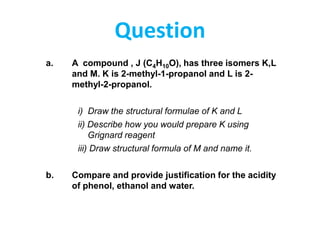
Question
a.

A compound , J (C4H10O), has three isomers K,L
and M. K is 2-methyl-1-propanol and L is 2methyl-2-propanol.
i) Draw the structural formulae of K and L
ii) Describe how you would prepare K using
Grignard reagent
iii) Draw structural formula of M and name it.

b.

Compare and provide justification for the acidity
of phenol, ethanol and water.
Chapter 3 ketone

Chapter 3 ketone

  • 1.
    Chapter 3: KETONE NorfazrinMohd Hanif Faculty of Applied Science UiTM Negeri Sembilan
  • 2.
    SUBTOPICS Nomenclature – common andIUPAC names for ketones Physical properties of ketones : Boiling points and solubility Preparation of ketone Oxidation of 2 °Alcohol Friedel – Crafts Acylation Reactions of aldehyde Reduction To 2 ° Alcohol Nucleophilic Addition Reaction with Grignard Reagent Iodoform Reaction
  • 3.
    Ketones • Functional group:carbonyl group C O  Ketone: the carbon atom in the carbonyl group is bonded to two hydrocarbon groups. O R C R' ketone R, R' = substituents
  • 4.
    IUPAC NAME • TheIUPAC name of a ketone is derived from the name of the alkane corresponding to the longest carbon chain that contains the ketone-carbonyl group. • The parent name is formed by changing the ending of the alkane to -one. propane propanone one –e
  • 5.
    IUPAC NAME  Ifthe carbon chain is longer than 4 carbons, it’s numbered so that the carbonyl carbon has the smallest number possible, and this number is prefixed to the name of the ketone. This end of the chain is closest to the C=O. Begin numbering here.
  • 6.
    IUPAC NAME 1 2 3 4 5 6 IUPAC name:3-hexanone New IUPAC name: hexan-3-one
  • 7.
    Common Names ofKetones :O: R C • R' alkyl alkyl ketone 7 Most common names for ketones are formed by naming both alkyl groups on the carbonyl carbon, arranging them alphabetically, and adding the word “ketone”.
  • 8.
    NOMENCLATURE OF CYCLICKETONES AND AROMATIC COMPOUNDS • • The parent name is formed by changing the cycloalkane to -one. Carbonyl carbon is designated C1. –e ending of the O O 612 5 3 4 CH3 cyclohexanone 4-methylcyclohexanone  Aromatic compound: - phenyl is used as part of the name. O O C CH3 C phenylethanone diphenylmethanone
  • 9.
    NOMENCLATURE OF KETONESCONTAINING TWO DIFFERENT FUNCTIONAL GROUPS  A ketone group can also be named as a substituent on a molecule with another functional group as its root.  The ketone carbonyl is designated by the prefix oxo-.  Carboxylic acids frequently contain ketone group named as substituents. CH3CH2 C CH2 C H 5 4 3 2 1 3-oxopentanal O O O O CH3 C CH2 C OH 4 3 2 1 3-oxobutanoic acid
  • 10.
    Physical Properties :Boiling point • Oxygen is more electronegative than carbon (3.5 vs 2.5) and, therefore, a C=O group is polar O Polarity of a carbonyl group O: : C C + C : : + - O: – More important contributing structure •Ketones are polar due to this C=O bond and therefore have stronger intermolecular forces than hydrocarbons making their boiling points higher. 10
  • 11.
    Physical Properties :solubility   The reason for the solubility is that they can form hydrogen bond with water molecules.  11 The small ketones are freely soluble in water but solubility falls with chain length. One of the slightly positive hydrogen atoms in a water molecule can be sufficiently attracted to one of the lone pairs on the oxygen atom of a ketone for a hydrogen bond to be formed. 11
  • 12.
    Physical Properties :solubility • Ketones can form hydrogen bonds with water and therefore low molecular weight ketones have appreciable water solubility 12 12
  • 13.
    PreparationS OXIDATION OF 2°ALCOHOL FRIEDEL – CRAFTS ACYLATION 13
  • 14.
    2.1 Oxidation of2 °Alcohol • Ketones can be made from 2o alcohols by oxidation * [O] = • Examples 14
  • 15.
    2.2 Friedel –Crafts Acylation • Aromatic ketones can be made by Friedel-Crafts Acylation • Examples 15
  • 16.
    REACTIONS REDUCTION TO 2° ALCOHOL NUCLEOPHILIC addition REACTION with grignard reagent IODOFORM REACTION 16
  • 17.
    REACTIONS OF KETONES Reduction  Addition  Condensation  Iodoform reaction  Reaction with Grignard reagent
  • 18.
    3.1 Reduction toSecondary Alcohols  Ketones can be reduced to alcohols using: a) lithium aluminium hydride (LiAlH4) b) sodium borohydride (NaBH4) c) catalytic hydrogenation O R O- C R' LiAlH4 or NaBH4 or H2, Ni R ketone C R' OH + H R C R' H H + o H = diluted acid such as H2SO4 2 alcohol  Example: O- O CH3 C CH3 propanone H2/Ni CH3 C H OH CH3 H+ CH3 C CH3 H 2-propanol
  • 19.
    3.2a Nucleophilic additionof hydrogen cyanide * Cyanohydrin may be formed using liquid HCN with a catalytic amount of sodium cyanide or potassium cyanide. O R C R' OH HCN ketone R C R' CN cyanohydrin example O CH3 C CH3 propanone OH HCN CH3 C CH3 CN 2-hydroxy-2-methylpropanenitrile
  • 20.
    3.2a Nucleophilic additionof hydrogen cyanide  Cyanohydrin can be hydrolysed to give α-hydroxyacids.  The nitrile (-CN) group is converted to the –COOH group by reflux the cyanohydrin with dilute sulphuric acid (H2O/H+) or concentrated HCl. O R C R' OH HCN ketone R ' OH C CN H2O/H+ R R' C COOH NH4+ R cyanohydrin a-hydroxyacid example O CH3 C CH2CH3 propan-2-one OH HCN OH + CH3 C CN CH2CH3 H2O/H CH3 C COOH CH2CH3 NH4+
  • 21.
    3.2b Nucleophilic additionof sodium bisulphite (NaHSO3)  When shaken with an aqueous of sodium bisulphite, most aldehydes and ketones formed carbonyl bisulphite (a colourless crystal).  The reaction takes place more readily with aldehydes than with ketones.  The nucleophile is the hydrogensulphite ion, HSO3 Example: O NaHSO3 OH C CH3 C CH3 OSO2- Na+ Bisulphite salts
  • 22.
    3.3 Condensation withhydrazines, hydroxlamine, phenylhydrazine and 2,4-dinitrophenylhydrazine  Aldehydes and ketones condense with ammonia derivatives such as hydroxylamine and substituted hydrazines to give imine derivatives. i) Reaction with hydrazine: Hydrazines derivatives reacts with aldehydes or ketones to form hydrazones. O R C R' H2N-NH2 aldehyde or ketone + H hydrazine N NH2 R C R' H2O hydrazone derivative Example: O H3C C CH3 propanone H2N-NH2 + H NNH2 H3C C CH3 hydrazine propanone hydrazone H2O
  • 23.
    3.3 Condensation withhydrazines, hydroxlamine, phenylhydrazine and 2,4-dinitrophenylhydrazine ii) Reaction with hydroxylamine: Hydroxylamine reacts with ketones and aldehydes to form oximes. O R C R' aldehyde or ketone H2N-OH + H hydroxylamine N OH H2O R C R' oxime Example: H2N-OH O phenyl-2-propanone hydroxylamine H+ N H2O OH phenyl-2-propanone oxime
  • 24.
    3.3 Condensation withhydrazines, hydroxlamine, phenylhydrazine and 2,4-dinitrophenylhydrazine iii) Reaction with phenylhydrazine: O H R C R' aldehyde or ketone N NH Ph H + H phenylhydrazine N NH-Ph R C R' H2O phenylhydrazone Example: O H N NH Ph H+ H penta-2-one phenylhydrazine N-NH-Ph H2O penta-2-one phenylhydrazone
  • 25.
    3.3 Condensation withhydrazines, hydroxlamine, phenylhydrazine and 2,4-dinitrophenylhydrazine iv) Reaction with 2,4-dinitrophenylhydrazine: NO2 R R' C O aldehyde or ketone H2N N NO2 R room NO2 temperature H R' C NO2 N N H2O H 2,4-dinitrophenylhydrazine 2,4-dinitrophenylhydrazone (yellow-orange precipitate) Example: O CH3 C CH2CH3 NO2 H2N N H butan-2-one NO2 room temperature 2,4-dinitrophenylhydrazine CH3 CH3CH2 C NO2 N N NO2 H butan-2-one 2,4-dinitrophenylhydrazone H2O
  • 26.
    3.4 Reaction withGrignard Reagent  A Grignard reagent (a strong nucleophile resembling a carbanion, R:- attacks the electrophilic carbonyl carbon atom to give an alkoxide intermediate.  Subsequent protonation gives an alcohol. CH3 H3C CH3CH2 MgBr ethylmagnesium bromide C O CH3CH2 C O- +MgBr acetone CH3 H3C alkoxide H3O+ CH3 CH3CH2 C OH CH3 2-methyl-2-butanol
  • 27.
    3.5 Haloform Reaction IODOFORMTEST - Reagent: solution of I2 in an alkaline medium such as NaOH or KOH. - Iodoform test is useful for the methyl ketone group (CH3C=O) in ketones. - when ketones containing methyl ketone group is warmed with iodoform reagent, a yellow precipitate of triiodomethane (iodoform) is formed. The overall reaction is O R C CH3 O 3I2 NaOH heat R C O- Na+ salts CHI3 3HI iodoform (yellow precipitate)
  • 28.
    Tests to DistinguishAldehydes and Ketones, and Aliphatic Aldehydes and Aromatic Aldehydes TESTS ALDEHYDES KETONES Tollens’ Test / silver mirror test Reagent and condition: - ammoniacal silver nitrate solution ([Ag(NH3)2]+) Observation: Formation of silver mirror Observation: Silver mirror did not formed * Ketones do not react with Tollens’ reagent Fehling’s test / Benedict’s test Reagent and condition: -Solution of Cu2+ (aq) ions in an alkaline solution of sodium potassium tartate. Observation; Blue colour of the Fehling’s solution dissappears and brick-red precipitate is obtained * Except benzaldehyde Observation: Blue colour remains. * Ketones do not react with Fehling’s/Benedict’s reagent Observation: Formation of magenta-pink colour (simple aldehydes) * Except benzaldehyde and a few aromatic aldehydes) Observation: Ketones (except propanone) do not react with Schiff’s reagent. *Can be used to distinguish between: i) Aldehydes and ketones ii) Aliphatic aldehydes and benzaldehyde Schiff’s test Reagent and condition: - Schiff’s reagent
  • 29.
  • 30.
  • 31.
    Question a. A compound ,J (C4H10O), has three isomers K,L and M. K is 2-methyl-1-propanol and L is 2methyl-2-propanol. i) Draw the structural formulae of K and L ii) Describe how you would prepare K using Grignard reagent iii) Draw structural formula of M and name it. b. Compare and provide justification for the acidity of phenol, ethanol and water.