Chapter 8
ESTERS
Norfazrin Mohd Hanif
Faculty of Applied Science
UiTM Negeri Sembilan
STRUCTURE OF ESTERS


Carboxylic acid derivatives in which the hydroxy
group (-OH) is replaced by an alkoxy group (-OR).



General formula:
O
R



C O R' or RCOOR' or RCO2R'

Esters have pleasant odors such as smell like fruits
(apples or bananas) and flower, especially those
with low molecular weight.
NOMENCLATURE

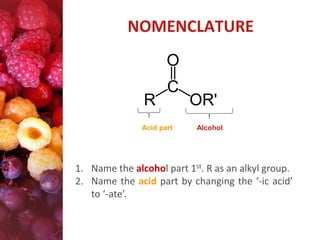
Acid part

Alcohol

1. Name the alcohol part 1st. R as an alkyl group.
2. Name the acid part by changing the ‘-ic acid’
to ‘-ate’.
NOMENCLATURE
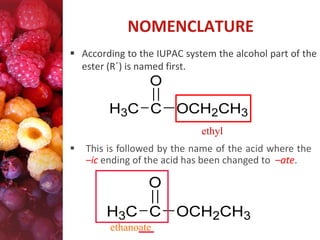
 According to the IUPAC system the alcohol part of the
ester (R΄) is named first.

ethyl


This is followed by the name of the acid where the
–ic ending of the acid has been changed to –ate.

ethanoate
NOMENCLATURE

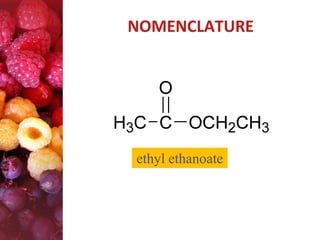
ethyl ethanoate
PREPARATION

• FROM CARBOXYLIC ACIDS
• FROM ACYL CHLORIDES
• FROM ACID ANHYDRIDES
FROM CARBOXYLIC ACIDS
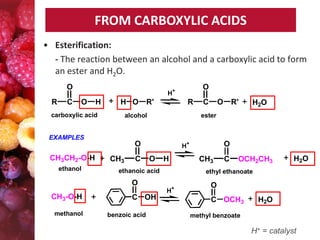
• Esterification:
- The reaction between an alcohol and a carboxylic acid to form
an ester and H2O.
O
R

C

O

H+

O

H

H O

carboxylic acid

ethanol

O
CH3

C

methanol

O

R'

H2O

O

H+

O

H

ethanoic acid

C OH
benzoic acid

C
ester

O
CH3-O-H

R

alcohol

EXAMPLES

CH3CH2-O-H

R'

CH3

C

OCH2CH3

H2O

ethyl ethanoate
H+

O
C OCH3

H2O

methyl benzoate

H+ = catalyst
FROM ACYL CLORIDES
 Acyl chloride react with an alcohol and phenols to produce an ester.
 Does not require catalyst even through alcohol is a weak nucleophile
because acyl chloride is highly reactive.
 The reaction is irreversible unlike the reaction of carboxylic acid with
alcohol.
 Pyridine is added to prevent side reaction between HCl and ROH.
O

O
R

C

Cl

R-OH

pyridine

R

C

OR

HCl

Example:
O
H3C C Cl

O
pyridine

CH3CH2

O H

CH3

C OCH2CH3

HCl
FROM ACID ANHYDRIDES
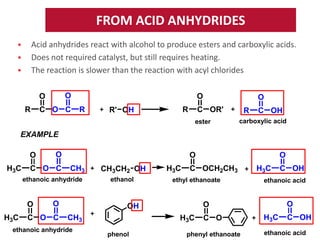
Acid anhydrides react with alcohol to produce esters and carboxylic acids.
Does not required catalyst, but still requires heating.
The reaction is slower than the reaction with acyl chlorides






O

O
R

C O C

O
R

R

R' OH

O

C OR'
ester

R

C OH

carboxylic acid

EXAMPLE
O
H3C

O

C O C

O
CH3

ethanoic anhydride

O
H3C

O

C O C

CH3CH2 OH
ethanol

H3C

C OCH2CH3

ethyl ethanoate

ethanoic anhydride

H3C
phenol

H3C

C O

phenyl ethanoate

C OH

ethanoic acid

O

O

OH
CH3

O

H3C

C OH

ethanoic acid
REACTIONS

•
•
•
•

HYDROLYSIS
AMMONOLYSIS
REACTION WITH GRIGNARD REAGENT
TRANSESTERIFICATION
HYDROLYSIS






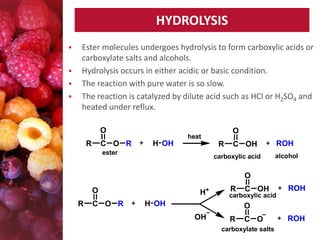
Ester molecules undergoes hydrolysis to form carboxylic acids or
carboxylate salts and alcohols.
Hydrolysis occurs in either acidic or basic condition.
The reaction with pure water is so slow.
The reaction is catalyzed by dilute acid such as HCl or H2SO4 and
heated under reflux.
O
R

C O R

O

heat

H OH

R

ester

C OH

carboxylic acid

ROH
alcohol

O
O
R

C O R

H+

R

C OH

ROH

carboxylic acid

H OH

O
OH

R

C O

carboxylate salts

ROH
AMMONOLYSIS
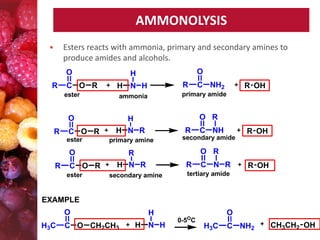
Esters reacts with ammonia, primary and secondary amines to
produce amides and alcohols.



O
R

C O R
ester

H N H

R

ammonia

primary amide

O
R

C O R
ester

C O R
ester

C NH2

R OH

O R

H
R

H N R

C NH

primary amine

secondary amide

R

R OH

O R

O
R

O

H

R

H N R
secondary amine

C N R

R OH

tertiary amide

EXAMPLE
O
H3C

C O CH2CH3

H
H N H

O

O

0-5 C

H3C

C NH2

CH3CH2 OH
REACTION WITH GRIGNARD REAGENT
Esters undergo nucleophilic acyl substitution then nucleophilic
addition with two equivalents moles of Grignard reagent, RMgX to
yield two different alcohols which one of them is tertiary.



O
R

H3O+
2RMgX
C O R
Grignard reagent ether
ester

O
C O CH3
ester

ROH

R
tertiary alcohol

EXAMPLE
CH3CH2

R
R C OH

2CH3MgCl

H3O+
ether

CH3CH2

CH3
C OH
CH3

CH3OH
MECHANISM



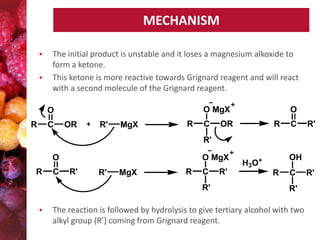
The initial product is unstable and it loses a magnesium alkoxide to
form a ketone.
This ketone is more reactive towards Grignard reagent and will react
with a second molecule of the Grignard reagent.
O MgX

O
R

C

OR

R'

MgX

R

C

O

OR

R

C

R'

R'
O
R

C

O MgX
R'

R'

MgX

R

C
R'



R'

OH

H3O+
R

C
R'

The reaction is followed by hydrolysis to give tertiary alcohol with two
alkyl group (R’) coming from Grignard reagent.

R'
TRANSESTERIFICATION




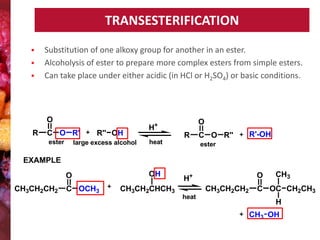
Substitution of one alkoxy group for another in an ester.
Alcoholysis of ester to prepare more complex esters from simple esters.
Can take place under either acidic (in HCl or H2SO4) or basic conditions.

O
R

O

+

C O R'
ester

R'' OH

large excess alcohol

H

R
heat

C O R''

R'-OH

ester

EXAMPLE
O
CH3CH2CH2

C OCH3

OH

O

H+
CH3CH2CH2

CH3CH2CHCH3
heat

CH3

C OC CH2CH3
H
CH3 OH
Thank you…

Chapter 7 ester

  • 1.
    Chapter 8 ESTERS Norfazrin MohdHanif Faculty of Applied Science UiTM Negeri Sembilan
  • 2.
    STRUCTURE OF ESTERS  Carboxylicacid derivatives in which the hydroxy group (-OH) is replaced by an alkoxy group (-OR).  General formula: O R  C O R' or RCOOR' or RCO2R' Esters have pleasant odors such as smell like fruits (apples or bananas) and flower, especially those with low molecular weight.
  • 3.
    NOMENCLATURE Acid part Alcohol 1. Namethe alcohol part 1st. R as an alkyl group. 2. Name the acid part by changing the ‘-ic acid’ to ‘-ate’.
  • 4.
    NOMENCLATURE  According tothe IUPAC system the alcohol part of the ester (R΄) is named first. ethyl  This is followed by the name of the acid where the –ic ending of the acid has been changed to –ate. ethanoate
  • 5.
  • 6.
    PREPARATION • FROM CARBOXYLICACIDS • FROM ACYL CHLORIDES • FROM ACID ANHYDRIDES
  • 7.
    FROM CARBOXYLIC ACIDS •Esterification: - The reaction between an alcohol and a carboxylic acid to form an ester and H2O. O R C O H+ O H H O carboxylic acid ethanol O CH3 C methanol O R' H2O O H+ O H ethanoic acid C OH benzoic acid C ester O CH3-O-H R alcohol EXAMPLES CH3CH2-O-H R' CH3 C OCH2CH3 H2O ethyl ethanoate H+ O C OCH3 H2O methyl benzoate H+ = catalyst
  • 8.
    FROM ACYL CLORIDES Acyl chloride react with an alcohol and phenols to produce an ester.  Does not require catalyst even through alcohol is a weak nucleophile because acyl chloride is highly reactive.  The reaction is irreversible unlike the reaction of carboxylic acid with alcohol.  Pyridine is added to prevent side reaction between HCl and ROH. O O R C Cl R-OH pyridine R C OR HCl Example: O H3C C Cl O pyridine CH3CH2 O H CH3 C OCH2CH3 HCl
  • 9.
    FROM ACID ANHYDRIDES Acidanhydrides react with alcohol to produce esters and carboxylic acids. Does not required catalyst, but still requires heating. The reaction is slower than the reaction with acyl chlorides    O O R C O C O R R R' OH O C OR' ester R C OH carboxylic acid EXAMPLE O H3C O C O C O CH3 ethanoic anhydride O H3C O C O C CH3CH2 OH ethanol H3C C OCH2CH3 ethyl ethanoate ethanoic anhydride H3C phenol H3C C O phenyl ethanoate C OH ethanoic acid O O OH CH3 O H3C C OH ethanoic acid
  • 10.
  • 11.
    HYDROLYSIS     Ester molecules undergoeshydrolysis to form carboxylic acids or carboxylate salts and alcohols. Hydrolysis occurs in either acidic or basic condition. The reaction with pure water is so slow. The reaction is catalyzed by dilute acid such as HCl or H2SO4 and heated under reflux. O R C O R O heat H OH R ester C OH carboxylic acid ROH alcohol O O R C O R H+ R C OH ROH carboxylic acid H OH O OH R C O carboxylate salts ROH
  • 12.
    AMMONOLYSIS Esters reacts withammonia, primary and secondary amines to produce amides and alcohols.  O R C O R ester H N H R ammonia primary amide O R C O R ester C O R ester C NH2 R OH O R H R H N R C NH primary amine secondary amide R R OH O R O R O H R H N R secondary amine C N R R OH tertiary amide EXAMPLE O H3C C O CH2CH3 H H N H O O 0-5 C H3C C NH2 CH3CH2 OH
  • 13.
    REACTION WITH GRIGNARDREAGENT Esters undergo nucleophilic acyl substitution then nucleophilic addition with two equivalents moles of Grignard reagent, RMgX to yield two different alcohols which one of them is tertiary.  O R H3O+ 2RMgX C O R Grignard reagent ether ester O C O CH3 ester ROH R tertiary alcohol EXAMPLE CH3CH2 R R C OH 2CH3MgCl H3O+ ether CH3CH2 CH3 C OH CH3 CH3OH
  • 14.
    MECHANISM   The initial productis unstable and it loses a magnesium alkoxide to form a ketone. This ketone is more reactive towards Grignard reagent and will react with a second molecule of the Grignard reagent. O MgX O R C OR R' MgX R C O OR R C R' R' O R C O MgX R' R' MgX R C R'  R' OH H3O+ R C R' The reaction is followed by hydrolysis to give tertiary alcohol with two alkyl group (R’) coming from Grignard reagent. R'
  • 15.
    TRANSESTERIFICATION    Substitution of onealkoxy group for another in an ester. Alcoholysis of ester to prepare more complex esters from simple esters. Can take place under either acidic (in HCl or H2SO4) or basic conditions. O R O + C O R' ester R'' OH large excess alcohol H R heat C O R'' R'-OH ester EXAMPLE O CH3CH2CH2 C OCH3 OH O H+ CH3CH2CH2 CH3CH2CHCH3 heat CH3 C OC CH2CH3 H CH3 OH
  • 16.