Alkynes
Group Members
Novella I.C               (20)
Nurul Izzatil A.          (21)
R. Dandy Y.               (22)
Raka S.W.S                (23)
Reyan P.B.                (24)
Rizqi Cahyo .Y            (25)
Rosita Devi               (26)
Sabrina Amelia J.         (27)
Zaynita A . A             (28)
Alkynes
        Alkynes are aliphatic hydrocarbons (strai
ght chain), unsaturated hydrocarbon with a
triple bond between two carbon atoms.
        Alkynes are traditionally known as
acetylenes, although the name acetylene also
refers specifically to C2H2, known formally
as ethyne using IUPAC nomenclature.
        Like other hydrocarbons, alkynes are
generally hydrophobic but tend to be more
reactive. It is widely thought to be the greatest
of all the functional groups.
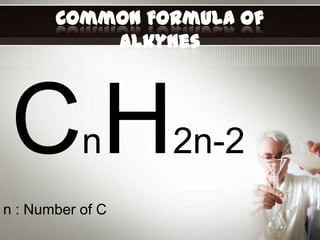
Common Formula of
           Alkynes


           n      2n-2
n : Number of C
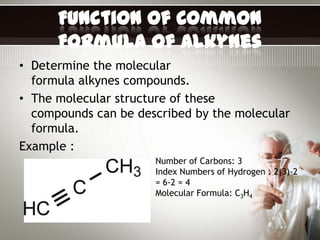
Function of Common
      Formula of Alkynes
• Determine the molecular
  formula alkynes compounds.
• The molecular structure of these
  compounds can be described by the molecular
  formula.
Example :
                      Number of Carbons: 3
                      Index Numbers of Hydrogen : 2(3)-2
                      = 6-2 = 4
                      Molecular Formula: C3H4
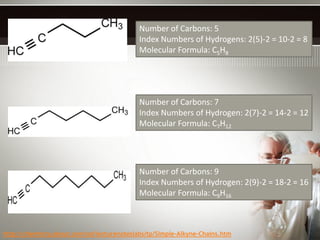
Number of Carbons: 5
                                            Index Numbers of Hydrogens: 2(5)-2 = 10-2 = 8
                                            Molecular Formula: C5H8


                                            Number of Carbons: 7
                                            Index Numbers of Hydrogen: 2(7)-2 = 14-2 = 12
                                            Molecular Formula: C7H12


                                            Number of Carbons: 9
                                            Index Numbers of Hydrogen: 2(9)-2 = 18-2 = 16
                                            Molecular Formula: C9H16


http://chemistry.about.com/od/lecturenoteslabs/tp/Simple-Alkyne-Chains.htm
Nomenclatur
e of Alkynes
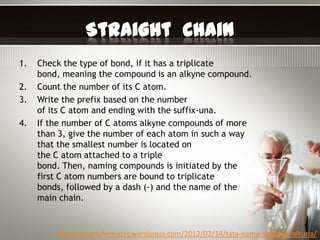
Straight Chain
1.   Check the type of bond, if it has a triplicate
     bond, meaning the compound is an alkyne compound.
2.   Count the number of its C atom.
3.   Write the prefix based on the number
     of its C atom and ending with the suffix-una.
4.   If the number of C atoms alkyne compounds of more
     than 3, give the number of each atom in such a way
     that the smallest number is located on
     the C atom attached to a triple
     bond. Then, naming compounds is initiated by the
     first C atom numbers are bound to triplicate
     bonds, followed by a dash (-) and the name of the
     main chain.


         http://smartchemistry.wordpress.com/2012/02/14/tata-nama-senyawa-alkuna/
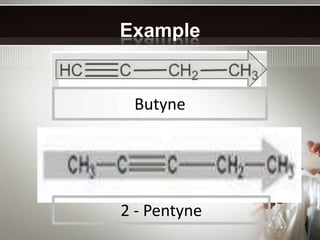
Example


 Butyne


2 - Pentyne
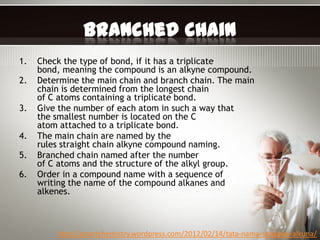
Branched Chain
1.   Check the type of bond, if it has a triplicate
     bond, meaning the compound is an alkyne compound.
2.   Determine the main chain and branch chain. The main
     chain is determined from the longest chain
     of C atoms containing a triplicate bond.
3.   Give the number of each atom in such a way that
     the smallest number is located on the C
     atom attached to a triplicate bond.
4.   The main chain are named by the
     rules straight chain alkyne compound naming.
5.   Branched chain named after the number
     of C atoms and the structure of the alkyl group.
6.   Order in a compound name with a sequence of
     writing the name of the compound alkanes and
     alkenes.


         http://smartchemistry.wordpress.com/2012/02/14/tata-nama-senyawa-alkuna/
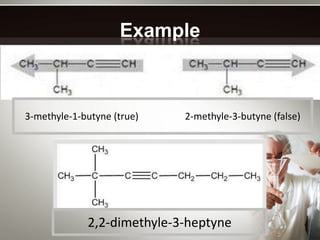
Example


3-methyle-1-butyne (true)   2-methyle-3-butyne (false)


             2,2-dimethyle-3-heptyne
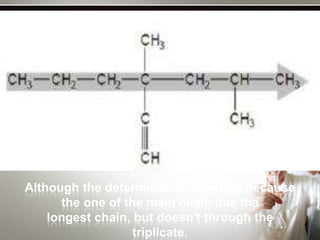
Although the determination is wrong because
      the one of the main chain has the
    longest chain, but doesn't through the
                   triplicate.
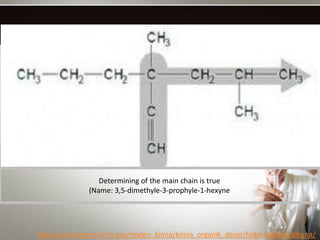
Determining of the main chain is true
               (Name: 3,5-dimethyle-3-prophyle-1-hexyne


http://www.chem-is-try.org/materi_kimia/kimia_organik_dasar/hidro-karbon/alkuna/
Triplicate bond More than
             One
1.   Check the type of bond, if it has a triple bond, meaning the
     compound is an alkyne compound.
2.   Count the number of its C atom.
3.   Count the number of triplicate bond.
4.   If the number of all triplicate bonds = 2, compound names
     end with the suffix-diuna. If the number of all triplicate
     bonds = 3, compound names end with the suffix-triuna.
5.   Give the number of each atom in such a way that the
     smallest number is located in two or three C atoms bound to
     the first triplicate bond. Then, naming compounds C atom
     numbers preceded by the first and second / third that
     bound to the triplicate bond, followed by a dash (-) and the
     name of the main chain.
6.   If there is a branched-chain, branched chain names similar
     to the naming of alkyne compounds.
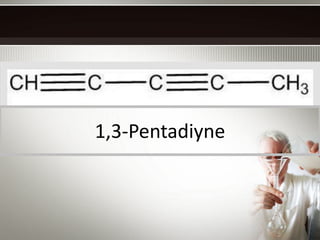
1,3-Pentadiyne
Physical and
   Chemical
Properties of
    Alkyne
Physical Properties of
           Alkyne
• Alkyne is non-
  polar, have intermolecular
  forces are weak and have
  a molecular masssimilar
  to alkanes and alkenes.
• The higher interest alkyne, the
  greater the boiling point.
• At room temperature, the
  first three tribes are gaseous, the
  next rates are liquid, while the
  greater rates are in solid shape
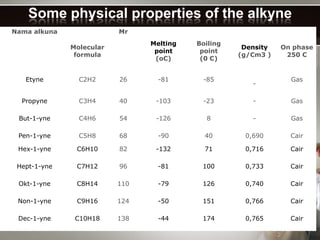
Some physical properties of the alkyne
Nama alkuna               Mr
                                Melting   Boiling
              Molecular                              Density   On phase
                                 point     point
               formula                              (g/Cm3 )    250 C
                                 (oC)      (0 C)


   Etyne        C2H2      26      -81      -85                   Gas
                                                       -

  Propyne       C3H4      40     -103      -23         -         Gas

 But-1-yne      C4H6      54     -126       8          -         Gas

 Pen-1-yne      C5H8      68      -90       40       0,690       Cair

 Hex-1-yne     C6H10      82     -132       71       0,716       Cair

 Hept-1-yne    C7H12      96      -81      100       0,733       Cair

 Okt-1-yne     C8H14      110     -79      126       0,740       Cair

 Non-1-yne     C9H16      124     -50      151       0,766       Cair

 Dec-1-yne     C10H18     138     -44      174       0,765       Cair
Chemical Properties of
          Alkyne
• With the same amount of C, the alkyne is
  more reactive than alkanes
• The existence of a triple bond which is
  owned alkyne allow the addition reactions,
  polymerization, substitution and combustio
  n
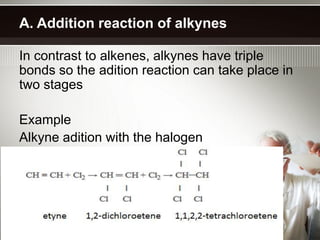
A. Addition reaction of alkynes

In contrast to alkenes, alkynes have triple
bonds so the adition reaction can take place in
two stages

Example
Alkyne adition with the halogen
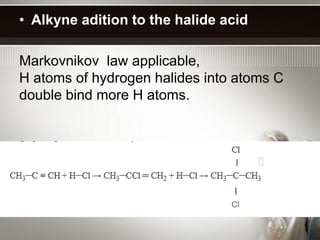
• Alkyne adition to the halide acid

Markovnikov law applicable,
H atoms of hydrogen halides into atoms C
double bind more H atoms.
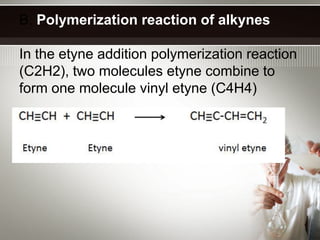
B. Polymerization reaction of alkynes

In the etyne addition polymerization reaction
(C2H2), two molecules etyne combine to
form one molecule vinyl etyne (C4H4)
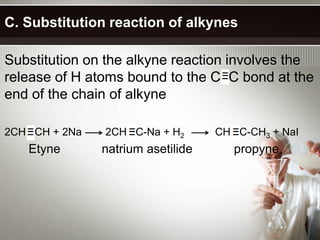
C. Substitution reaction of alkynes

Substitution on the alkyne reaction involves the
release of H atoms bound to the C C bond at the
end of the chain of alkyne

2CH CH + 2Na   2CH C-Na + H2       CH C-CH3 + NaI
   Etyne       natrium asetilide      propyne
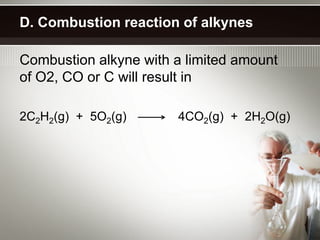
D. Combustion reaction of alkynes

Combustion alkyne with a limited amount
of O2, CO or C will result in

2C2H2(g) + 5O2(g)      4CO2(g) + 2H2O(g)
Alkyne Isom
    ers
Alkyne Isomers
Type of the alkyne isomers i structure
isomers, namely framework/chain isomers
and position isomers. Isomers of alkyne is
started from alkyne butyne.
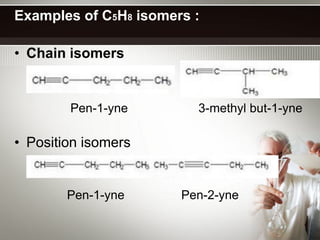
Examples of C5H8 isomers :

• Chain isomers


        Pen-1-yne        3-methyl but-1-yne

• Position isomers


        Pen-1-yne      Pen-2-yne
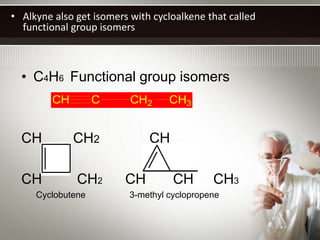
• Alkyne also get isomers with cycloalkene that called
  functional group isomers


  • C4H6 Functional group isomers
         CH        C      CH2      CH3


  CH          CH2             CH

  CH          CH2        CH         CH       CH3
     Cyclobutene          3-methyl cyclopropene
Thank
 You

Alkynes

  • 1.
  • 2.
    Group Members Novella I.C (20) Nurul Izzatil A. (21) R. Dandy Y. (22) Raka S.W.S (23) Reyan P.B. (24) Rizqi Cahyo .Y (25) Rosita Devi (26) Sabrina Amelia J. (27) Zaynita A . A (28)
  • 3.
    Alkynes Alkynes are aliphatic hydrocarbons (strai ght chain), unsaturated hydrocarbon with a triple bond between two carbon atoms. Alkynes are traditionally known as acetylenes, although the name acetylene also refers specifically to C2H2, known formally as ethyne using IUPAC nomenclature. Like other hydrocarbons, alkynes are generally hydrophobic but tend to be more reactive. It is widely thought to be the greatest of all the functional groups.
  • 4.
    Common Formula of Alkynes n 2n-2 n : Number of C
  • 5.
    Function of Common Formula of Alkynes • Determine the molecular formula alkynes compounds. • The molecular structure of these compounds can be described by the molecular formula. Example : Number of Carbons: 3 Index Numbers of Hydrogen : 2(3)-2 = 6-2 = 4 Molecular Formula: C3H4
  • 6.
    Number of Carbons:5 Index Numbers of Hydrogens: 2(5)-2 = 10-2 = 8 Molecular Formula: C5H8 Number of Carbons: 7 Index Numbers of Hydrogen: 2(7)-2 = 14-2 = 12 Molecular Formula: C7H12 Number of Carbons: 9 Index Numbers of Hydrogen: 2(9)-2 = 18-2 = 16 Molecular Formula: C9H16 http://chemistry.about.com/od/lecturenoteslabs/tp/Simple-Alkyne-Chains.htm
  • 7.
  • 8.
    Straight Chain 1. Check the type of bond, if it has a triplicate bond, meaning the compound is an alkyne compound. 2. Count the number of its C atom. 3. Write the prefix based on the number of its C atom and ending with the suffix-una. 4. If the number of C atoms alkyne compounds of more than 3, give the number of each atom in such a way that the smallest number is located on the C atom attached to a triple bond. Then, naming compounds is initiated by the first C atom numbers are bound to triplicate bonds, followed by a dash (-) and the name of the main chain. http://smartchemistry.wordpress.com/2012/02/14/tata-nama-senyawa-alkuna/
  • 9.
  • 10.
    Branched Chain 1. Check the type of bond, if it has a triplicate bond, meaning the compound is an alkyne compound. 2. Determine the main chain and branch chain. The main chain is determined from the longest chain of C atoms containing a triplicate bond. 3. Give the number of each atom in such a way that the smallest number is located on the C atom attached to a triplicate bond. 4. The main chain are named by the rules straight chain alkyne compound naming. 5. Branched chain named after the number of C atoms and the structure of the alkyl group. 6. Order in a compound name with a sequence of writing the name of the compound alkanes and alkenes. http://smartchemistry.wordpress.com/2012/02/14/tata-nama-senyawa-alkuna/
  • 11.
    Example 3-methyle-1-butyne (true) 2-methyle-3-butyne (false) 2,2-dimethyle-3-heptyne
  • 12.
    Although the determinationis wrong because the one of the main chain has the longest chain, but doesn't through the triplicate.
  • 13.
    Determining of themain chain is true (Name: 3,5-dimethyle-3-prophyle-1-hexyne http://www.chem-is-try.org/materi_kimia/kimia_organik_dasar/hidro-karbon/alkuna/
  • 14.
    Triplicate bond Morethan One 1. Check the type of bond, if it has a triple bond, meaning the compound is an alkyne compound. 2. Count the number of its C atom. 3. Count the number of triplicate bond. 4. If the number of all triplicate bonds = 2, compound names end with the suffix-diuna. If the number of all triplicate bonds = 3, compound names end with the suffix-triuna. 5. Give the number of each atom in such a way that the smallest number is located in two or three C atoms bound to the first triplicate bond. Then, naming compounds C atom numbers preceded by the first and second / third that bound to the triplicate bond, followed by a dash (-) and the name of the main chain. 6. If there is a branched-chain, branched chain names similar to the naming of alkyne compounds.
  • 15.
  • 16.
    Physical and Chemical Properties of Alkyne
  • 17.
    Physical Properties of Alkyne • Alkyne is non- polar, have intermolecular forces are weak and have a molecular masssimilar to alkanes and alkenes. • The higher interest alkyne, the greater the boiling point. • At room temperature, the first three tribes are gaseous, the next rates are liquid, while the greater rates are in solid shape
  • 18.
    Some physical propertiesof the alkyne Nama alkuna Mr Melting Boiling Molecular Density On phase point point formula (g/Cm3 ) 250 C (oC) (0 C) Etyne C2H2 26 -81 -85 Gas - Propyne C3H4 40 -103 -23 - Gas But-1-yne C4H6 54 -126 8 - Gas Pen-1-yne C5H8 68 -90 40 0,690 Cair Hex-1-yne C6H10 82 -132 71 0,716 Cair Hept-1-yne C7H12 96 -81 100 0,733 Cair Okt-1-yne C8H14 110 -79 126 0,740 Cair Non-1-yne C9H16 124 -50 151 0,766 Cair Dec-1-yne C10H18 138 -44 174 0,765 Cair
  • 19.
    Chemical Properties of Alkyne • With the same amount of C, the alkyne is more reactive than alkanes • The existence of a triple bond which is owned alkyne allow the addition reactions, polymerization, substitution and combustio n
  • 20.
    A. Addition reactionof alkynes In contrast to alkenes, alkynes have triple bonds so the adition reaction can take place in two stages Example Alkyne adition with the halogen
  • 21.
    • Alkyne aditionto the halide acid Markovnikov law applicable, H atoms of hydrogen halides into atoms C double bind more H atoms.
  • 22.
    B. Polymerization reactionof alkynes In the etyne addition polymerization reaction (C2H2), two molecules etyne combine to form one molecule vinyl etyne (C4H4)
  • 23.
    C. Substitution reactionof alkynes Substitution on the alkyne reaction involves the release of H atoms bound to the C C bond at the end of the chain of alkyne 2CH CH + 2Na 2CH C-Na + H2 CH C-CH3 + NaI Etyne natrium asetilide propyne
  • 24.
    D. Combustion reactionof alkynes Combustion alkyne with a limited amount of O2, CO or C will result in 2C2H2(g) + 5O2(g) 4CO2(g) + 2H2O(g)
  • 25.
  • 26.
    Alkyne Isomers Type ofthe alkyne isomers i structure isomers, namely framework/chain isomers and position isomers. Isomers of alkyne is started from alkyne butyne.
  • 27.
    Examples of C5H8isomers : • Chain isomers Pen-1-yne 3-methyl but-1-yne • Position isomers Pen-1-yne Pen-2-yne
  • 28.
    • Alkyne alsoget isomers with cycloalkene that called functional group isomers • C4H6 Functional group isomers CH C CH2 CH3 CH CH2 CH CH CH2 CH CH CH3 Cyclobutene 3-methyl cyclopropene
  • 29.