P.M. Jadhav
Assistant Professor
Dept. of Chemistry
M.S.P. Mandals, Shri Muktanand
college,
Gangapur, Dist: Aurangabad.
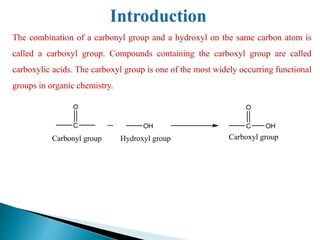
The combination of a carbonyl group and a hydroxyl on the same carbon atom is
called a carboxyl group. Compounds containing the carboxyl group are called
carboxylic acids. The carboxyl group is one of the most widely occurring functional
groups in organic chemistry.
C
O
OH C
O
OH
Carbonyl group Hydroxyl group Carboxyl group
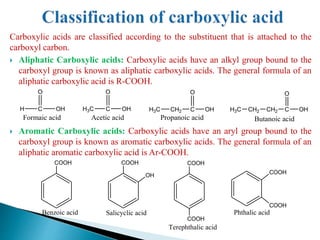
Carboxylic acids are classified according to the substituent that is attached to the
carboxyl carbon.
 Aliphatic Carboxylic acids: Carboxylic acids have an alkyl group bound to the
carboxyl group is known as aliphatic carboxylic acids. The general formula of an
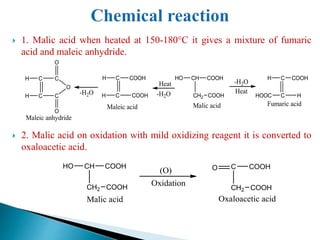
aliphatic carboxylic acid is R-COOH.
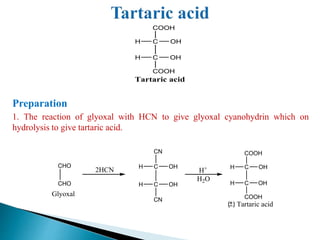
 Aromatic Carboxylic acids: Carboxylic acids have an aryl group bound to the
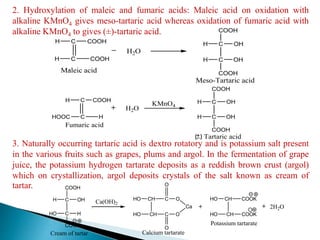
carboxyl group is known as aromatic carboxylic acids. The general formula of an
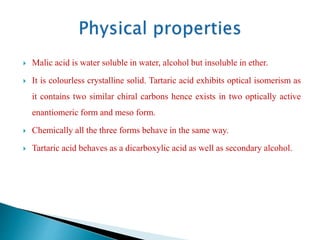
aliphatic aromatic carboxylic acid is Ar-COOH.
H3C C
O
OHH C
O
OH H3C CH2 C
O
OH
Formaic acid Acetic acid Propanoic acid
H3C CH2 CH2 C
O
OH
Butanoic acid
COOH COOH
OH
Benzoic acid Salicyclic acid
COOH
COOH
Phthalic acid
COOH
COOH
Terephthalic acid
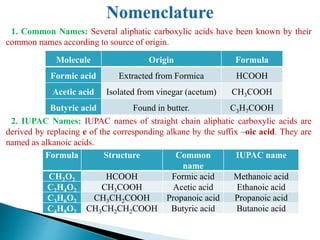
1. Common Names: Several aliphatic carboxylic acids have been known by their
common names according to source of origin.
2. IUPAC Names: IUPAC names of straight chain aliphatic carboxylic acids are
derived by replacing e of the corresponding alkane by the suffix –oic acid. They are
named as alkanoic acids.
Molecule Origin Formula
Formic acid Extracted from Formica HCOOH
Acetic acid Isolated from vinegar (acetum) CH3COOH
Butyric acid Found in butter. C3H7COOH
Formula Structure Common
name
IUPAC name
CH2O2 HCOOH Formic acid Methanoic acid
C2H4O2 CH3COOH Acetic acid Ethanoic acid
C3H6O2 CH3CH2COOH Propanoic acid Propanoic acid
C4H8O2 CH3CH2CH2COOH Butyric acid Butanoic acid
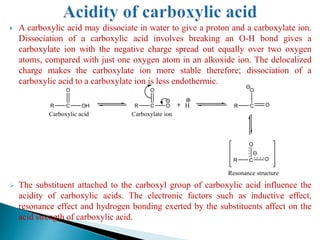
 A carboxylic acid may dissociate in water to give a proton and a carboxylate ion.
Dissociation of a carboxylic acid involves breaking an O-H bond gives a
carboxylate ion with the negative charge spread out equally over two oxygen
atoms, compared with just one oxygen atom in an alkoxide ion. The delocalized
charge makes the carboxylate ion more stable therefore; dissociation of a
carboxylic acid to a carboxylate ion is less endothermic.
 The substituent attached to the carboxyl group of carboxylic acid influence the
acidity of carboxylic acids. The electronic factors such as inductive effect,
resonance effect and hydrogen bonding exerted by the substituents affect on the
acid strength of carboxylic acid.
R C
O
OH R C
O
O H R C
O
O
R C
O
O
Carboxylate ion
Resonance structure
Carboxylic acid
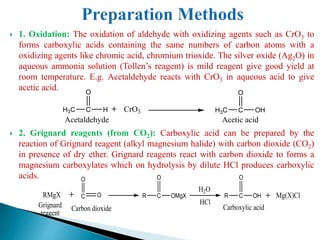
 1. Oxidation: The oxidation of aldehyde with oxidizing agents such as CrO3 to
forms carboxylic acids containing the same numbers of carbon atoms with a
oxidizing agents like chromic acid, chromium trioxide. The silver oxide (Ag2O) in
aqueous ammonia solution (Tollen’s reagent) is mild reagent give good yield at
room temperature. E.g. Acetaldehyde reacts with CrO3 in aqueous acid to give
acetic acid.
 2. Grignard reagents (from CO2): Carboxylic acid can be prepared by the
reaction of Grignard reagent (alkyl magnesium halide) with carbon dioxide (CO2)
in presence of dry ether. Grignard reagents react with carbon dioxide to forms a
magnesium carboxylates which on hydrolysis by dilute HCl produces carboxylic
acids.
C
O
HH3C
Acetaldehyde
CrO3 C
O
OHH3C
Acetic acid
H2O
RMgX C O
O
R C
O
OMgX
HCl
R C
O
OH Mg(X)Cl
Grignard
reagent
Carbon dioxide Carboxylic acid
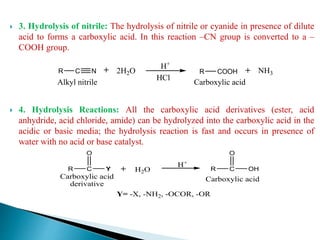
 3. Hydrolysis of nitrile: The hydrolysis of nitrile or cyanide in presence of dilute
acid to forms a carboxylic acid. In this reaction –CN group is converted to a –
COOH group.
 4. Hydrolysis Reactions: All the carboxylic acid derivatives (ester, acid
anhydride, acid chloride, amide) can be hydrolyzed into the carboxylic acid in the
acidic or basic media; the hydrolysis reaction is fast and occurs in presence of
water with no acid or base catalyst.
R C R COOH2H2O
H+
Carboxylic acid
N
HCl
Alkyl nitrile
NH3
R C
O
Y R C
O
OHH2O
Carboxylic acid
derivative
Carboxylic acid
H+
Y= -X, -NH2, -OCOR, -OR
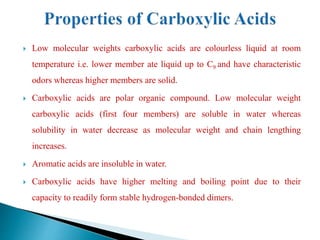
 Low molecular weights carboxylic acids are colourless liquid at room
temperature i.e. lower member ate liquid up to C9 and have characteristic
odors whereas higher members are solid.
 Carboxylic acids are polar organic compound. Low molecular weight
carboxylic acids (first four members) are soluble in water whereas
solubility in water decrease as molecular weight and chain lengthing
increases.
 Aromatic acids are insoluble in water.
 Carboxylic acids have higher melting and boiling point due to their
capacity to readily form stable hydrogen-bonded dimers.
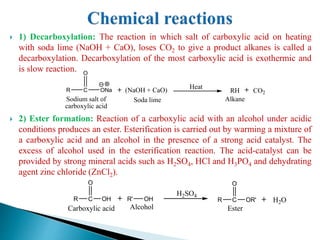
 1) Decarboxylation: The reaction in which salt of carboxylic acid on heating
with soda lime (NaOH + CaO), loses CO2 to give a product alkanes is called a
decarboxylation. Decarboxylation of the most carboxylic acid is exothermic and
is slow reaction.
 2) Ester formation: Reaction of a carboxylic acid with an alcohol under acidic
conditions produces an ester. Esterification is carried out by warming a mixture of
a carboxylic acid and an alcohol in the presence of a strong acid catalyst. The
excess of alcohol used in the esterification reaction. The acid-catalyst can be
provided by strong mineral acids such as H2SO4, HCl and H3PO4 and dehydrating
agent zinc chloride (ZnCl2).
R C
O
ONa
Sodium salt of
carboxylic acid
(NaOH + CaO)
Soda lime
RH CO2
Heat
Alkane
R C
O
OH R' OH
Carboxylic acid Alcohol
R C
O
OR' H2O
Ester
H2SO4
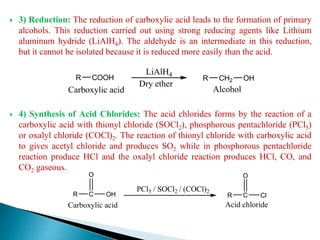
 3) Reduction: The reduction of carboxylic acid leads to the formation of primary
alcohols. This reduction carried out using strong reducing agents like Lithium
aluminum hydride (LiAlH4). The aldehyde is an intermediate in this reduction,
but it cannot be isolated because it is reduced more easily than the acid.
 4) Synthesis of Acid Chlorides: The acid chlorides forms by the reaction of a
carboxylic acid with thionyl chloride (SOCl2), phosphorous pentachloride (PCl5)
or oxalyl chloride (COCl)2. The reaction of thionyl chloride with carboxylic acid
to gives acetyl chloride and produces SO2 while in phosphorous pentachloride
reaction produce HCl and the oxalyl chloride reaction produces HCl, CO, and
CO2 gaseous.
R C
PCl5 / SOCl2 / (COCl)2
O
OH
Carboxylic acid
R C
O
Cl
Acid chloride
R COOH
LiAlH4
Dry ether
R CH2 OH
Carboxylic acid Alcohol
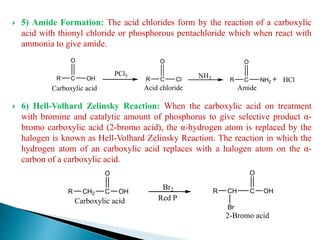
 5) Amide Formation: The acid chlorides form by the reaction of a carboxylic
acid with thionyl chloride or phosphorous pentachloride which when react with
ammonia to give amide.
 6) Hell-Volhard Zelinsky Reaction: When the carboxylic acid on treatment
with bromine and catalytic amount of phosphorus to give selective product α-
bromo carboxylic acid (2-bromo acid), the α-hydrogen atom is replaced by the
halogen is known as Hell-Volhard Zelinsky Reaction. The reaction in which the
hydrogen atom of an carboxylic acid replaces with a halogen atom on the α-
carbon of a carboxylic acid.
R C
PCl5
O
OH
Carboxylic acid
R C
O
Cl
Acid chloride
NH3 HClR C
O
NH2
Amide
R CH2 C
O
OH
Carboxylic acid
R CH C
O
OH
Br2
Red P
Br
2-Bromo acid
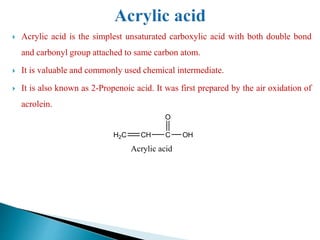
 Acrylic acid is the simplest unsaturated carboxylic acid with both double bond
and carbonyl group attached to same carbon atom.
 It is valuable and commonly used chemical intermediate.
 It is also known as 2-Propenoic acid. It was first prepared by the air oxidation of
acrolein.
H2C CH C
O
OH
Acrylic acid
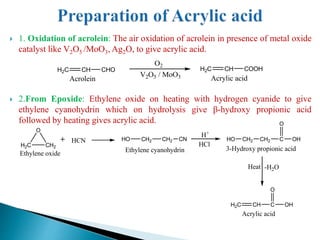
 1. Oxidation of acrolein: The air oxidation of acrolein in presence of metal oxide
catalyst like V2O5 /MoO3, Ag2O, to give acrylic acid.
 2.From Epoxide: Ethylene oxide on heating with hydrogen cyanide to give
ethylene cyanohydrin which on hydrolysis give β-hydroxy propionic acid
followed by heating gives acrylic acid.
H2C CH CHO
V2O5 / MoO3
H2C CH COOH
Acrolein Acrylic acid
O2
Heat
CH2
O
H2C
HCN CH2 CH2HO CN
Ethylene cyanohydrin
Ethylene oxide
C
O
OHCH2CH2HO
3-Hydroxy propionic acid
H+
HCl
-H2O
H2C CH C
Acrylic acid
O
OH
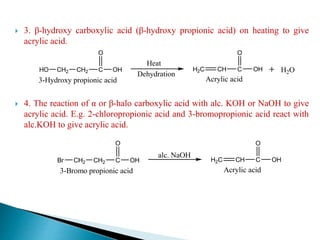
 3. β-hydroxy carboxylic acid (β-hydroxy propionic acid) on heating to give
acrylic acid.
 4. The reaction of α or β-halo carboxylic acid with alc. KOH or NaOH to give
acrylic acid. E.g. 2-chloropropionic acid and 3-bromopropionic acid react with
alc.KOH to give acrylic acid.
C
O
OHCH2CH2HO
Dehydration
H2OH2C CH C
Acrylic acid
O
OH
Heat
3-Hydroxy propionic acid
C
O
OHCH2CH2Br H2C CH C
Acrylic acid
O
OH
3-Bromo propionic acid
alc. NaOH
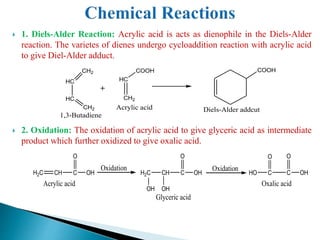
 1. Diels-Alder Reaction: Acrylic acid is acts as dienophile in the Diels-Alder
reaction. The varietes of dienes undergo cycloaddition reaction with acrylic acid
to give Diel-Alder adduct.
 2. Oxidation: The oxidation of acrylic acid to give glyceric acid as intermediate
product which further oxidized to give oxalic acid.
Acrylic acid
CH2
HC
HC
CH2
1,3-Butadiene
CH2
HC
COOH COOH
Diels-Alder addcut
H2C CH C
O
OH
Acrylic acid
H2C CH C
O
OH
OHOH
Glyceric acid
HO C C
O
OH
O
Oxalic acid
OxidationOxidation
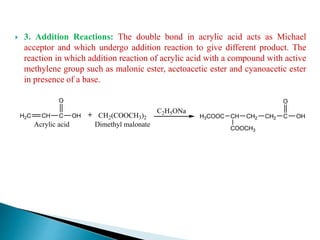
 3. Addition Reactions: The double bond in acrylic acid acts as Michael
acceptor and which undergo addition reaction to give different product. The
reaction in which addition reaction of acrylic acid with a compound with active
methylene group such as malonic ester, acetoacetic ester and cyanoacetic ester
in presence of a base.
H2C CH C
O
OH
Acrylic acid
CH2(COOCH3)2
C2H5ONa
CH CH2 CH2 C
O
OHH3COOC
COOCH3
Dimethyl malonate
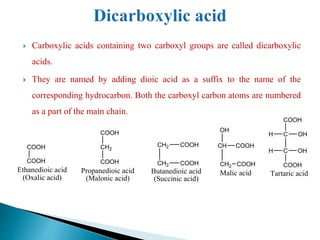
 Carboxylic acids containing two carboxyl groups are called dicarboxylic
acids.
 They are named by adding dioic acid as a suffix to the name of the
corresponding hydrocarbon. Both the carboxyl carbon atoms are numbered
as a part of the main chain.
CH
CH2
COOH
COOH
OH
Malic acid
C
C
OH
OH
H
COOH
H
COOH
Tartaric acid
COOH
COOH
Ethanedioic acid
(Oxalic acid)
CH2
COOH
COOH
Propanedioic acid
(Malonic acid)
CH2
CH2
COOH
COOH
Butanedioic acid
(Succinic acid)
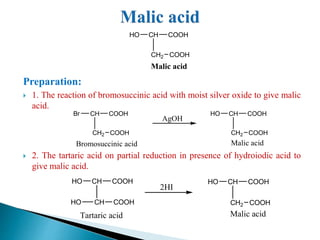
Preparation:
 1. The reaction of bromosuccinic acid with moist silver oxide to give malic
acid.
 2. The tartaric acid on partial reduction in presence of hydroiodic acid to
give malic acid.
CH
CH2
COOH
COOH
HO
Malic acid
CH
CH2
COOH
COOH
HO
Malic acid
AgOH
CH
CH2
COOH
COOH
Br
Bromosuccinic acid
2HI
CH
CH
COOH
COOH
HO
HO
Tartaric acid
CH
CH2
COOH
COOH
HO
Malic acid
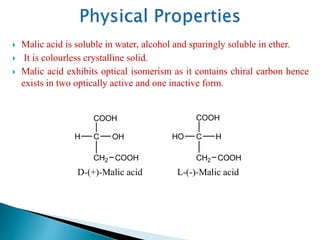
 Malic acid is soluble in water, alcohol and sparingly soluble in ether.
 It is colourless crystalline solid.
 Malic acid exhibits optical isomerism as it contains chiral carbon hence
exists in two optically active and one inactive form.
C
CH2
H
COOH
HO
L-(-)-Malic acid
COOH
C
CH2
OH
COOH
H
COOH
D-(+)-Malic acid
 1. Malic acid when heated at 150-180°C it gives a mixture of fumaric
acid and maleic anhydride.
 2. Malic acid on oxidation with mild oxidizing reagent it is converted to
oxaloacetic acid.
CH
CH2
COOH
COOH
HO
Malic acid
C
C
COOH
HOOC
H
H
Fumaric acid
C
C
COOH
H
H
COOH
Maleic acid
C
C
C
H
H
C
O
O
O
Maleic anhydride
-H2O
-H2O
-H2O
Heat
Heat
CH
CH2
COOH
COOH
HO
Malic acid
Oxidation
(O) C
CH2
COOH
COOH
O
Oxaloacetic acid
Preparation
1. The reaction of glyoxal with HCN to give glyoxal cyanohydrin which on
hydrolysis to give tartaric acid.
C
C
OH
OH
H
COOH
H
COOH
Tartaric acid
CHO
CHO
2HCN C
C
CN
CN
H
H OH
OH
H2O
H+ C
C
OH
OH
H
COOH
H
COOH
Tartaric acid
Glyoxal
2. Hydroxylation of maleic and fumaric acids: Maleic acid on oxidation with
alkaline KMnO4 gives meso-tartaric acid whereas oxidation of fumaric acid with
alkaline KMnO4 to gives (±)-tartaric acid.
3. Naturally occurring tartaric acid is dextro rotatory and is potassium salt present
in the various fruits such as grapes, plums and argol. In the fermentation of grape
juice, the potassium hydrogen tartarate deposits as a reddish brown crust (argol)
which on crystallization, argol deposits crystals of the salt known as cream of
tartar.
C
C
COOH
H
H
COOH
Maleic acid
H2O
C
C
OH
OH
H
COOH
H
COOH
Meso-Tartaric acid
H2O
C
C
COOH
HOOC
H
H
Fumaric acid
KMnO4
C
C
OH
OH
H
COOH
H
COOH
Tartaric acid
C
C
OH
H
H
COOH
CH
CH
C
HO
HO
C
O
O
OHO
COOK
O
Ca
Calcium tartarate
CH
CH
COOK
HO
HO
COOK
Potassium tartarate
Ca(OH)2
2H2O
Cream of tartar
 Malic acid is water soluble in water, alcohol but insoluble in ether.
 It is colourless crystalline solid. Tartaric acid exhibits optical isomerism as
it contains two similar chiral carbons hence exists in two optically active
enantiomeric form and meso form.
 Chemically all the three forms behave in the same way.
 Tartaric acid behaves as a dicarboxylic acid as well as secondary alcohol.
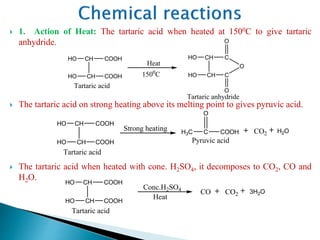
 1. Action of Heat: The tartaric acid when heated at 1500C to give tartaric
anhydride.
 The tartaric acid on strong heating above its melting point to gives pyruvic acid.
 The tartaric acid when heated with cone. H2SO4, it decomposes to CO2, CO and
H2O.
CH
CH
C
HO
HO
C
O
O
O
CH
CH
COOH
HO
HO
COOH
Heat
1500
C
Tartaric acid
Tartaric anhydride
C COOH H2OH3C
CH
CH
COOH
HO
HO
COOH
Strong heating
Tartaric acid
CO2
O
Pyruvic acid
3H2O
CH
CH
COOH
HO
HO
COOH
Tartaric acid
CO2CO
Conc.H2SO4
Heat
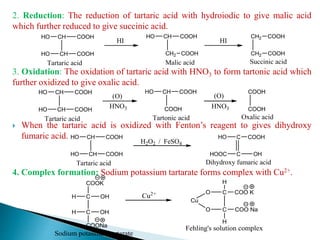
2. Reduction: The reduction of tartaric acid with hydroiodic to give malic acid
which further reduced to give succinic acid.
3. Oxidation: The oxidation of tartaric acid with HNO3 to form tartonic acid which
further oxidized to give oxalic acid.
 When the tartaric acid is oxidized with Fenton’s reagent to gives dihydroxy
fumaric acid.
4. Complex formation: Sodium potassium tartarate forms complex with Cu2+.
CH
CH2
COOH
COOH
HO
Malic acid
CH
CH
COOH
HO
HO
COOH
Tartaric acid
CH2
CH2
COOH
COOH
Succinic acid
HI HI
CH
COOH
COOHHO
Tartonic acid
CH
CH
COOH
HO
HO
COOH
Tartaric acid
COOH
COOH
Oxalic acid
(O) (O)
HNO3HNO3
C
C
COOH
HOOC
HO
OH
Dihydroxy fumaric acid
CH
CH
COOH
HO
HO
COOH
Tartaric acid
H2O2 / FeSO4
C
C
OH
OH
H
COOK
H
COONa
C
C
COO K
COO Na
O
Sodium potassium tartarate
Cu2+
O
H
H
Cu
Fehling's solution complex
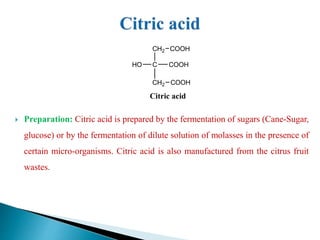
 Preparation: Citric acid is prepared by the fermentation of sugars (Cane-Sugar,
glucose) or by the fermentation of dilute solution of molasses in the presence of
certain micro-organisms. Citric acid is also manufactured from the citrus fruit
wastes.
C
CH2
COOH
COOH
HO
Citric acid
CH2 COOH
 Citric acid is colourless crystalline solid.
 It is soluble in water and alcohol and sparingly soluble in ether.
 A molecule of citric acid contains one tertiary hydroxyl group and three
carboxyl groups.
 Citric acid exhibits the properties of both alcohol and carboxylic acid.
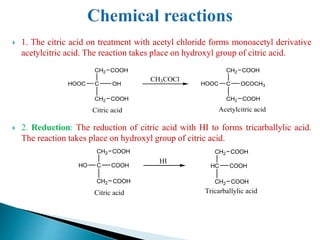
 1. The citric acid on treatment with acetyl chloride forms monoacetyl derivative
acetylcitric acid. The reaction takes place on hydroxyl group of citric acid.
 2. Reduction: The reduction of citric acid with HI to forms tricarballylic acid.
The reaction takes place on hydroxyl group of citric acid.
C
CH2
OCOCH3
COOH
HOOC
Acetylcitric acid
CH2 COOH
C
CH2
HOOC
COOH
OH
Citric acid
CH2 COOH
CH3COCl
HC
CH2
COOH
COOH
Tricarballylic acid
CH2 COOH
C
CH2
COOH
COOH
HO
Citric acid
CH2 COOH
HI
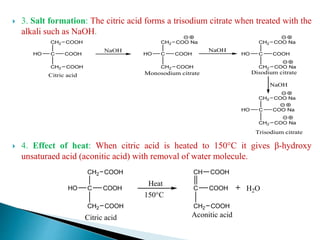
 3. Salt formation: The citric acid forms a trisodium citrate when treated with the
alkali such as NaOH.
 4. Effect of heat: When citric acid is heated to 150°C it gives β-hydroxy
unsaturaed acid (aconitic acid) with removal of water molecule.
C
CH2
COOH
COOH
HO
Citric acid
CH2 COOH
NaOH
C
CH2
COOH
COOH
HO
Monosodium citrate
CH2 COO Na
C
CH2
COOH
COO Na
HO
CH2 COO Na
NaOH
NaOH
C
CH2
COO Na
COO Na
HO
CH2 COO Na
Trisodium citrate
Disodium citrate
C
CH2
COOH
COOH
HO
Citric acid
CH2 COOH
Heat
C
CH2
COOH
COOH
CH COOH
H2O
Aconitic acid
150°C
Carboxylic acids

Carboxylic acids

  • 1.
    P.M. Jadhav Assistant Professor Dept.of Chemistry M.S.P. Mandals, Shri Muktanand college, Gangapur, Dist: Aurangabad.
  • 2.
    The combination ofa carbonyl group and a hydroxyl on the same carbon atom is called a carboxyl group. Compounds containing the carboxyl group are called carboxylic acids. The carboxyl group is one of the most widely occurring functional groups in organic chemistry. C O OH C O OH Carbonyl group Hydroxyl group Carboxyl group
  • 3.
    Carboxylic acids areclassified according to the substituent that is attached to the carboxyl carbon.  Aliphatic Carboxylic acids: Carboxylic acids have an alkyl group bound to the carboxyl group is known as aliphatic carboxylic acids. The general formula of an aliphatic carboxylic acid is R-COOH.  Aromatic Carboxylic acids: Carboxylic acids have an aryl group bound to the carboxyl group is known as aromatic carboxylic acids. The general formula of an aliphatic aromatic carboxylic acid is Ar-COOH. H3C C O OHH C O OH H3C CH2 C O OH Formaic acid Acetic acid Propanoic acid H3C CH2 CH2 C O OH Butanoic acid COOH COOH OH Benzoic acid Salicyclic acid COOH COOH Phthalic acid COOH COOH Terephthalic acid
  • 4.
    1. Common Names:Several aliphatic carboxylic acids have been known by their common names according to source of origin. 2. IUPAC Names: IUPAC names of straight chain aliphatic carboxylic acids are derived by replacing e of the corresponding alkane by the suffix –oic acid. They are named as alkanoic acids. Molecule Origin Formula Formic acid Extracted from Formica HCOOH Acetic acid Isolated from vinegar (acetum) CH3COOH Butyric acid Found in butter. C3H7COOH Formula Structure Common name IUPAC name CH2O2 HCOOH Formic acid Methanoic acid C2H4O2 CH3COOH Acetic acid Ethanoic acid C3H6O2 CH3CH2COOH Propanoic acid Propanoic acid C4H8O2 CH3CH2CH2COOH Butyric acid Butanoic acid
  • 5.
     A carboxylicacid may dissociate in water to give a proton and a carboxylate ion. Dissociation of a carboxylic acid involves breaking an O-H bond gives a carboxylate ion with the negative charge spread out equally over two oxygen atoms, compared with just one oxygen atom in an alkoxide ion. The delocalized charge makes the carboxylate ion more stable therefore; dissociation of a carboxylic acid to a carboxylate ion is less endothermic.  The substituent attached to the carboxyl group of carboxylic acid influence the acidity of carboxylic acids. The electronic factors such as inductive effect, resonance effect and hydrogen bonding exerted by the substituents affect on the acid strength of carboxylic acid. R C O OH R C O O H R C O O R C O O Carboxylate ion Resonance structure Carboxylic acid
  • 6.
     1. Oxidation:The oxidation of aldehyde with oxidizing agents such as CrO3 to forms carboxylic acids containing the same numbers of carbon atoms with a oxidizing agents like chromic acid, chromium trioxide. The silver oxide (Ag2O) in aqueous ammonia solution (Tollen’s reagent) is mild reagent give good yield at room temperature. E.g. Acetaldehyde reacts with CrO3 in aqueous acid to give acetic acid.  2. Grignard reagents (from CO2): Carboxylic acid can be prepared by the reaction of Grignard reagent (alkyl magnesium halide) with carbon dioxide (CO2) in presence of dry ether. Grignard reagents react with carbon dioxide to forms a magnesium carboxylates which on hydrolysis by dilute HCl produces carboxylic acids. C O HH3C Acetaldehyde CrO3 C O OHH3C Acetic acid H2O RMgX C O O R C O OMgX HCl R C O OH Mg(X)Cl Grignard reagent Carbon dioxide Carboxylic acid
  • 7.
     3. Hydrolysisof nitrile: The hydrolysis of nitrile or cyanide in presence of dilute acid to forms a carboxylic acid. In this reaction –CN group is converted to a – COOH group.  4. Hydrolysis Reactions: All the carboxylic acid derivatives (ester, acid anhydride, acid chloride, amide) can be hydrolyzed into the carboxylic acid in the acidic or basic media; the hydrolysis reaction is fast and occurs in presence of water with no acid or base catalyst. R C R COOH2H2O H+ Carboxylic acid N HCl Alkyl nitrile NH3 R C O Y R C O OHH2O Carboxylic acid derivative Carboxylic acid H+ Y= -X, -NH2, -OCOR, -OR
  • 8.
     Low molecularweights carboxylic acids are colourless liquid at room temperature i.e. lower member ate liquid up to C9 and have characteristic odors whereas higher members are solid.  Carboxylic acids are polar organic compound. Low molecular weight carboxylic acids (first four members) are soluble in water whereas solubility in water decrease as molecular weight and chain lengthing increases.  Aromatic acids are insoluble in water.  Carboxylic acids have higher melting and boiling point due to their capacity to readily form stable hydrogen-bonded dimers.
  • 9.
     1) Decarboxylation:The reaction in which salt of carboxylic acid on heating with soda lime (NaOH + CaO), loses CO2 to give a product alkanes is called a decarboxylation. Decarboxylation of the most carboxylic acid is exothermic and is slow reaction.  2) Ester formation: Reaction of a carboxylic acid with an alcohol under acidic conditions produces an ester. Esterification is carried out by warming a mixture of a carboxylic acid and an alcohol in the presence of a strong acid catalyst. The excess of alcohol used in the esterification reaction. The acid-catalyst can be provided by strong mineral acids such as H2SO4, HCl and H3PO4 and dehydrating agent zinc chloride (ZnCl2). R C O ONa Sodium salt of carboxylic acid (NaOH + CaO) Soda lime RH CO2 Heat Alkane R C O OH R' OH Carboxylic acid Alcohol R C O OR' H2O Ester H2SO4
  • 10.
     3) Reduction:The reduction of carboxylic acid leads to the formation of primary alcohols. This reduction carried out using strong reducing agents like Lithium aluminum hydride (LiAlH4). The aldehyde is an intermediate in this reduction, but it cannot be isolated because it is reduced more easily than the acid.  4) Synthesis of Acid Chlorides: The acid chlorides forms by the reaction of a carboxylic acid with thionyl chloride (SOCl2), phosphorous pentachloride (PCl5) or oxalyl chloride (COCl)2. The reaction of thionyl chloride with carboxylic acid to gives acetyl chloride and produces SO2 while in phosphorous pentachloride reaction produce HCl and the oxalyl chloride reaction produces HCl, CO, and CO2 gaseous. R C PCl5 / SOCl2 / (COCl)2 O OH Carboxylic acid R C O Cl Acid chloride R COOH LiAlH4 Dry ether R CH2 OH Carboxylic acid Alcohol
  • 11.
     5) AmideFormation: The acid chlorides form by the reaction of a carboxylic acid with thionyl chloride or phosphorous pentachloride which when react with ammonia to give amide.  6) Hell-Volhard Zelinsky Reaction: When the carboxylic acid on treatment with bromine and catalytic amount of phosphorus to give selective product α- bromo carboxylic acid (2-bromo acid), the α-hydrogen atom is replaced by the halogen is known as Hell-Volhard Zelinsky Reaction. The reaction in which the hydrogen atom of an carboxylic acid replaces with a halogen atom on the α- carbon of a carboxylic acid. R C PCl5 O OH Carboxylic acid R C O Cl Acid chloride NH3 HClR C O NH2 Amide R CH2 C O OH Carboxylic acid R CH C O OH Br2 Red P Br 2-Bromo acid
  • 12.
     Acrylic acidis the simplest unsaturated carboxylic acid with both double bond and carbonyl group attached to same carbon atom.  It is valuable and commonly used chemical intermediate.  It is also known as 2-Propenoic acid. It was first prepared by the air oxidation of acrolein. H2C CH C O OH Acrylic acid
  • 13.
     1. Oxidationof acrolein: The air oxidation of acrolein in presence of metal oxide catalyst like V2O5 /MoO3, Ag2O, to give acrylic acid.  2.From Epoxide: Ethylene oxide on heating with hydrogen cyanide to give ethylene cyanohydrin which on hydrolysis give β-hydroxy propionic acid followed by heating gives acrylic acid. H2C CH CHO V2O5 / MoO3 H2C CH COOH Acrolein Acrylic acid O2 Heat CH2 O H2C HCN CH2 CH2HO CN Ethylene cyanohydrin Ethylene oxide C O OHCH2CH2HO 3-Hydroxy propionic acid H+ HCl -H2O H2C CH C Acrylic acid O OH
  • 14.
     3. β-hydroxycarboxylic acid (β-hydroxy propionic acid) on heating to give acrylic acid.  4. The reaction of α or β-halo carboxylic acid with alc. KOH or NaOH to give acrylic acid. E.g. 2-chloropropionic acid and 3-bromopropionic acid react with alc.KOH to give acrylic acid. C O OHCH2CH2HO Dehydration H2OH2C CH C Acrylic acid O OH Heat 3-Hydroxy propionic acid C O OHCH2CH2Br H2C CH C Acrylic acid O OH 3-Bromo propionic acid alc. NaOH
  • 15.
     1. Diels-AlderReaction: Acrylic acid is acts as dienophile in the Diels-Alder reaction. The varietes of dienes undergo cycloaddition reaction with acrylic acid to give Diel-Alder adduct.  2. Oxidation: The oxidation of acrylic acid to give glyceric acid as intermediate product which further oxidized to give oxalic acid. Acrylic acid CH2 HC HC CH2 1,3-Butadiene CH2 HC COOH COOH Diels-Alder addcut H2C CH C O OH Acrylic acid H2C CH C O OH OHOH Glyceric acid HO C C O OH O Oxalic acid OxidationOxidation
  • 16.
     3. AdditionReactions: The double bond in acrylic acid acts as Michael acceptor and which undergo addition reaction to give different product. The reaction in which addition reaction of acrylic acid with a compound with active methylene group such as malonic ester, acetoacetic ester and cyanoacetic ester in presence of a base. H2C CH C O OH Acrylic acid CH2(COOCH3)2 C2H5ONa CH CH2 CH2 C O OHH3COOC COOCH3 Dimethyl malonate
  • 17.
     Carboxylic acidscontaining two carboxyl groups are called dicarboxylic acids.  They are named by adding dioic acid as a suffix to the name of the corresponding hydrocarbon. Both the carboxyl carbon atoms are numbered as a part of the main chain. CH CH2 COOH COOH OH Malic acid C C OH OH H COOH H COOH Tartaric acid COOH COOH Ethanedioic acid (Oxalic acid) CH2 COOH COOH Propanedioic acid (Malonic acid) CH2 CH2 COOH COOH Butanedioic acid (Succinic acid)
  • 18.
    Preparation:  1. Thereaction of bromosuccinic acid with moist silver oxide to give malic acid.  2. The tartaric acid on partial reduction in presence of hydroiodic acid to give malic acid. CH CH2 COOH COOH HO Malic acid CH CH2 COOH COOH HO Malic acid AgOH CH CH2 COOH COOH Br Bromosuccinic acid 2HI CH CH COOH COOH HO HO Tartaric acid CH CH2 COOH COOH HO Malic acid
  • 19.
     Malic acidis soluble in water, alcohol and sparingly soluble in ether.  It is colourless crystalline solid.  Malic acid exhibits optical isomerism as it contains chiral carbon hence exists in two optically active and one inactive form. C CH2 H COOH HO L-(-)-Malic acid COOH C CH2 OH COOH H COOH D-(+)-Malic acid
  • 20.
     1. Malicacid when heated at 150-180°C it gives a mixture of fumaric acid and maleic anhydride.  2. Malic acid on oxidation with mild oxidizing reagent it is converted to oxaloacetic acid. CH CH2 COOH COOH HO Malic acid C C COOH HOOC H H Fumaric acid C C COOH H H COOH Maleic acid C C C H H C O O O Maleic anhydride -H2O -H2O -H2O Heat Heat CH CH2 COOH COOH HO Malic acid Oxidation (O) C CH2 COOH COOH O Oxaloacetic acid
  • 21.
    Preparation 1. The reactionof glyoxal with HCN to give glyoxal cyanohydrin which on hydrolysis to give tartaric acid. C C OH OH H COOH H COOH Tartaric acid CHO CHO 2HCN C C CN CN H H OH OH H2O H+ C C OH OH H COOH H COOH Tartaric acid Glyoxal
  • 22.
    2. Hydroxylation ofmaleic and fumaric acids: Maleic acid on oxidation with alkaline KMnO4 gives meso-tartaric acid whereas oxidation of fumaric acid with alkaline KMnO4 to gives (±)-tartaric acid. 3. Naturally occurring tartaric acid is dextro rotatory and is potassium salt present in the various fruits such as grapes, plums and argol. In the fermentation of grape juice, the potassium hydrogen tartarate deposits as a reddish brown crust (argol) which on crystallization, argol deposits crystals of the salt known as cream of tartar. C C COOH H H COOH Maleic acid H2O C C OH OH H COOH H COOH Meso-Tartaric acid H2O C C COOH HOOC H H Fumaric acid KMnO4 C C OH OH H COOH H COOH Tartaric acid C C OH H H COOH CH CH C HO HO C O O OHO COOK O Ca Calcium tartarate CH CH COOK HO HO COOK Potassium tartarate Ca(OH)2 2H2O Cream of tartar
  • 23.
     Malic acidis water soluble in water, alcohol but insoluble in ether.  It is colourless crystalline solid. Tartaric acid exhibits optical isomerism as it contains two similar chiral carbons hence exists in two optically active enantiomeric form and meso form.  Chemically all the three forms behave in the same way.  Tartaric acid behaves as a dicarboxylic acid as well as secondary alcohol.
  • 24.
     1. Actionof Heat: The tartaric acid when heated at 1500C to give tartaric anhydride.  The tartaric acid on strong heating above its melting point to gives pyruvic acid.  The tartaric acid when heated with cone. H2SO4, it decomposes to CO2, CO and H2O. CH CH C HO HO C O O O CH CH COOH HO HO COOH Heat 1500 C Tartaric acid Tartaric anhydride C COOH H2OH3C CH CH COOH HO HO COOH Strong heating Tartaric acid CO2 O Pyruvic acid 3H2O CH CH COOH HO HO COOH Tartaric acid CO2CO Conc.H2SO4 Heat
  • 25.
    2. Reduction: Thereduction of tartaric acid with hydroiodic to give malic acid which further reduced to give succinic acid. 3. Oxidation: The oxidation of tartaric acid with HNO3 to form tartonic acid which further oxidized to give oxalic acid.  When the tartaric acid is oxidized with Fenton’s reagent to gives dihydroxy fumaric acid. 4. Complex formation: Sodium potassium tartarate forms complex with Cu2+. CH CH2 COOH COOH HO Malic acid CH CH COOH HO HO COOH Tartaric acid CH2 CH2 COOH COOH Succinic acid HI HI CH COOH COOHHO Tartonic acid CH CH COOH HO HO COOH Tartaric acid COOH COOH Oxalic acid (O) (O) HNO3HNO3 C C COOH HOOC HO OH Dihydroxy fumaric acid CH CH COOH HO HO COOH Tartaric acid H2O2 / FeSO4 C C OH OH H COOK H COONa C C COO K COO Na O Sodium potassium tartarate Cu2+ O H H Cu Fehling's solution complex
  • 26.
     Preparation: Citricacid is prepared by the fermentation of sugars (Cane-Sugar, glucose) or by the fermentation of dilute solution of molasses in the presence of certain micro-organisms. Citric acid is also manufactured from the citrus fruit wastes. C CH2 COOH COOH HO Citric acid CH2 COOH
  • 27.
     Citric acidis colourless crystalline solid.  It is soluble in water and alcohol and sparingly soluble in ether.  A molecule of citric acid contains one tertiary hydroxyl group and three carboxyl groups.  Citric acid exhibits the properties of both alcohol and carboxylic acid.
  • 28.
     1. Thecitric acid on treatment with acetyl chloride forms monoacetyl derivative acetylcitric acid. The reaction takes place on hydroxyl group of citric acid.  2. Reduction: The reduction of citric acid with HI to forms tricarballylic acid. The reaction takes place on hydroxyl group of citric acid. C CH2 OCOCH3 COOH HOOC Acetylcitric acid CH2 COOH C CH2 HOOC COOH OH Citric acid CH2 COOH CH3COCl HC CH2 COOH COOH Tricarballylic acid CH2 COOH C CH2 COOH COOH HO Citric acid CH2 COOH HI
  • 29.
     3. Saltformation: The citric acid forms a trisodium citrate when treated with the alkali such as NaOH.  4. Effect of heat: When citric acid is heated to 150°C it gives β-hydroxy unsaturaed acid (aconitic acid) with removal of water molecule. C CH2 COOH COOH HO Citric acid CH2 COOH NaOH C CH2 COOH COOH HO Monosodium citrate CH2 COO Na C CH2 COOH COO Na HO CH2 COO Na NaOH NaOH C CH2 COO Na COO Na HO CH2 COO Na Trisodium citrate Disodium citrate C CH2 COOH COOH HO Citric acid CH2 COOH Heat C CH2 COOH COOH CH COOH H2O Aconitic acid 150°C