AMINES
Mr. Mote G.D.
ADCBP, Ashta Dist: Sangli
Maharashtra
AMINES
• Amines are derivatives of ammonia in which
one or more hydrogen atoms have been
replaced by alkyl group.
CH3 NH2
Methyl amine
CH3 N H
CH3
Dimethyl amine
CH3 N CH3
CH3
Trimethyl amine
AMINES
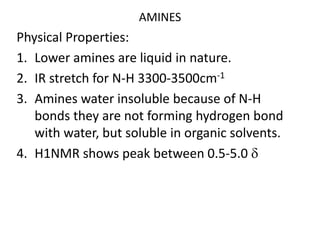
Physical Properties:
1. Lower amines are liquid in nature.
2. IR stretch for N-H 3300-3500cm-1
3. Amines water insoluble because of N-H
bonds they are not forming hydrogen bond
with water, but soluble in organic solvents.
4. H1NMR shows peak between 0.5-5.0 
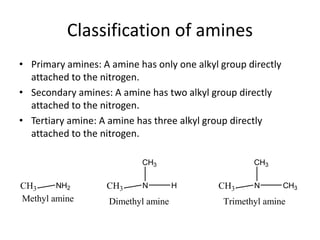
Classification of amines
• Primary amines: A amine has only one alkyl group directly
attached to the nitrogen.
• Secondary amines: A amine has two alkyl group directly
attached to the nitrogen.
• Tertiary amine: A amine has three alkyl group directly
attached to the nitrogen.
CH3 NH2
Methyl amine
CH3 N H
CH3
Dimethyl amine
CH3 N CH3
CH3
Trimethyl amine
Basicity of amines
• Amines are act as Lewis base because it denotes lone pair of
electron to form a new bond to a hydrogen.
R NH2
H2O RNH3
OH
Kb= (RNH3)(OH-)
(RNH2)
If the base is strong at that time equilibrium shifted to right and Kb value is higher
The strength of base is measured in terms of pKa value, more pka value indicates more
basic.
Kb= (H3O)(RNH2)
(RNH3)
R NH3
H2O H3O RNH2
Measurement of amine basicity through acidity of conjugate acids.
Equilibrium shifted to right and pKa value will be greater for conjugated acid.
Basicity of amines.
Sr. No name Pka of conjugate
acid
1 Diethyl amine 10.98
2 Dimethyl amine 10.64
3 Ethyl amine 10.63
4 Triethyl amine 10.65
5 Methyl amine 10.62
6 ammonia 9.3
Substituent effect on basicity
• Alkylation effect:
• Any factor that increases electron density on the N atom
increase an amine basicity.
• E. g. ammonia is least basic , alkyl group having electron
density hence alkyl group adds electron density means
alkylated ammonia is strong base
N
H
H H N
H
R H N
R
R H N
R
R R
1° 2° 3°
< < <
Ammonia
primary amine sec amine ter amine
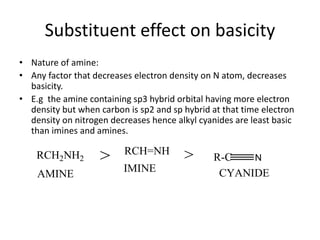
Substituent effect on basicity
• Nature of amine:
• Any factor that decreases electron density on N atom, decreases
basicity.
• E.g the amine containing sp3 hybrid orbital having more electron
density but when carbon is sp2 and sp hybrid at that time electron
density on nitrogen decreases hence alkyl cyanides are least basic
than imines and amines.
RCH2NH2
RCH=NH
R-C N> >
AMINE
IMINE CYANIDE
Preparation of amines
1. Reaction of alkyl halide with ammonia.
2. Gabriel phthalimide method.
3. Reduction of nitroalkanes.
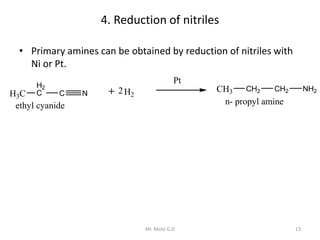
4. Reduction of nitriles.
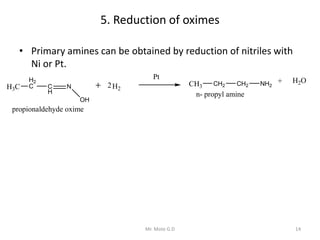
5. Reduction of oximes
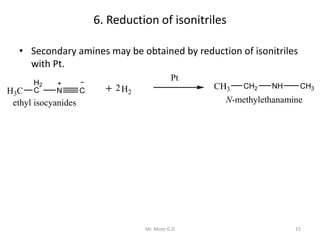
6. Reduction of isonitriles.
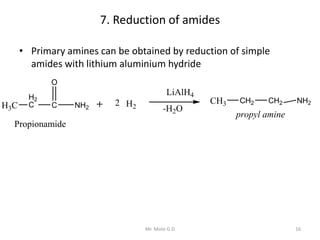
7. Reduction of amides.
8. Reductive amination of aldehyde and ketones.
9. Reduction of alkyl azide
10. Hoffman degradation of amide
11. Reduction of acyl azide( Curtis rearrangment)
1. Reaction of alkyl halides with ammonia to form
amine
• Alkyl halides react with alcoholic solution of ammonia to form
amines.
10Mr. Mote G.D
H3C
H2
C NH3
CH3 CH2 NH2
ethyl amine
Br
HBr
ethyl bromide
Ethanol
2. Gabriel phthalimide method
• This involves the treatment of phthalimide with pottasium
hydroxide to form the potassium salt.
11Mr. Mote G.D
C
C
O
O
NH
KOH
C
C
O
O
NK
CH3CH2Cl
C
C
O
O
NCH2CH3
KOH/H2O
COOK
COOK
+ CH3CH2NH2
ethyl amine
Potassium phthalate
Phthalimide Potassiumphthalimide
n-ethyl phthalimide
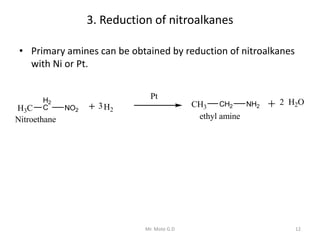
3. Reduction of nitroalkanes
• Primary amines can be obtained by reduction of nitroalkanes
with Ni or Pt.
12Mr. Mote G.D
H3C
H2
C H2
CH3 CH2 NH2
ethyl amine
H2O
Pt
3 2
NO2
Nitroethane
4. Reduction of nitriles
• Primary amines can be obtained by reduction of nitriles with
Ni or Pt.
13Mr. Mote G.D
H3C
H2
C H2
CH3 CH2 CH2
n- propyl amine
Pt
2C N
ethyl cyanide
NH2
5. Reduction of oximes
• Primary amines can be obtained by reduction of nitriles with
Ni or Pt.
14Mr. Mote G.D
H3C
H2
C H2
CH3 CH2 CH2
n- propyl amine
Pt
2C
H
N NH2
OH
+ H2O
propionaldehyde oxime
6. Reduction of isonitriles
• Secondary amines may be obtained by reduction of isonitriles
with Pt.
15Mr. Mote G.D
H3C
H2
C H2
CH3 CH2 NH
Pt
2N C
ethyl isocyanides
CH3
N-methylethanamine
7. Reduction of amides
• Primary amines can be obtained by reduction of simple
amides with lithium aluminium hydride
16Mr. Mote G.D
H3C
H2
C H2
CH3 CH2 CH2
LiAlH4
C NH2
NH2
propyl amine
O
Propionamide
2
-H2O
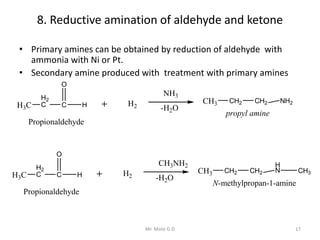
8. Reductive amination of aldehyde and ketone
• Primary amines can be obtained by reduction of aldehyde with
ammonia with Ni or Pt.
• Secondary amine produced with treatment with primary amines
17Mr. Mote G.D
H3C
H2
C H2
CH3 CH2 CH2
NH3
C H
NH2
propyl amine
O
Propionaldehyde
-H2O
H3C
H2
C H2
CH3 CH2 CH2
CH3NH2
C H
H
N
O
Propionaldehyde
-H2O
CH3
N-methylpropan-1-amine
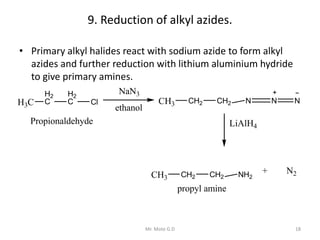
9. Reduction of alkyl azides.
• Primary alkyl halides react with sodium azide to form alkyl
azides and further reduction with lithium aluminium hydride
to give primary amines.
18Mr. Mote G.D
H3C
H2
C CH3 CH2 CH2
NaN3H2
C Cl N
Propionaldehyde
ethanol
N N
LiAlH4
CH3 CH2 CH2 NH2
N2+
propyl amine
10. Hofmann’s degradation of amides.
• Conversion amide into amine with the help of sodium hypo
halides is known as hofmann’s degradation.
19Mr. Mote G.D
H3C
H2
C Br2
CH3 CH2 NH2
NaOH
C NH2
O
Propionamide
4
Na2CO3
2NaBr
H2O
+
+ 2
ethyl amine
H3C
H2
C C N
O
NaOH Na+
+ OH-
H
H
+ OH-
-H2O H3C
H2
C C N
O
H
Br Br
H3C
H2
C C N
O
H
Br
OH-
+
-H2OH3C
H2
C C N
O Br
+Na
NaBr
H3C
H2
C C N_
O
N CH2 CH3CO H2O
CH3 CH2 NH2
Mechanism
11. Curtis rearrangement.
• This reaction converts acyl azide to primary amine.
20Mr. Mote G.D
H3C
H2
C CH3 CH2 C
NaN3
C Cl
O
propanoyl chloride
O
N N N
H2OHeat
CH3 CH2 NH2
CO2 N2++
ethyl amine
Reactions of amines.
1. Salt formation
2. Reaction with alkyl halides
3. Reaction with acid chlorides
4. Reaction with nitrous acid
5. Reaction with benzenesulfonyl chloride
6. Carbylamines reaction
21Mr. Mote G.D
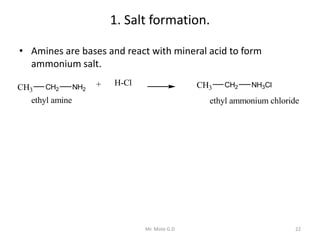
1. Salt formation.
• Amines are bases and react with mineral acid to form
ammonium salt.
22Mr. Mote G.D
CH3 CH2 NH2
ethyl amine
H-Cl+ CH3 CH2 NH3Cl
ethyl ammonium chloride
2. Reaction with alkyl halides.
• Primary amines can be obtained by reduction of nitriles with
Ni or Pt.
23Mr. Mote G.D
CH3 CH2 NH2
ethyl amine
CH3-Cl+
CH3 CH2 NH CH3
CH3-Cl
CH3 CH2 N CH3
CH3
-HCl
-HCl
N-methylethanamine
N,N-dimethylethanamine
CH3Cl
CH3 CH2 N CH3
CH3
CH3
Quaternary ammonium salt
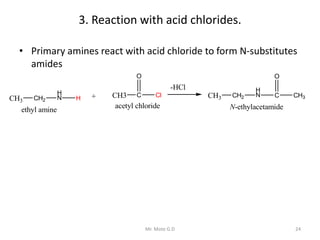
3. Reaction with acid chlorides.
• Primary amines react with acid chloride to form N-substitutes
amides
24Mr. Mote G.D
CH3 CH2
H
N
ethyl amine
H + CH3 C
O
Cl
-HCl
CH3 CH2
H
N C
O
CH3
acetyl chloride N-ethylacetamide
4. Reaction with nitrous acid.
• Primary amines react with nitrous acid to form diazonium
salts and salt hydrolyzes to form alcohol
25Mr. Mote G.D
CH3 C
H
NH2
propyl amine
CH3
NaNO2
HCl, 0°C CH3 C
H
N2Cl
CH3
-N2, -Cl2
CH3 CH
CH3
H2O
CH3 CH
CH3
OH
propan-2-ol
5. Reaction with benzenesulfonyl chloride
• Primary amines react with benzene sulfonyl chloride to form
n-alkyl benzene sulfonamide.
26Mr. Mote G.D
CH3 C
H
NH2
CH3
+ S
O
O
Cl
S
O
O
NH C
H
CH3
CH3
N-isopropylbenzenesulfonamide
HCl+
6. Carbylamines reaction.
• Primary amines react with chloroform and solution of KOH in
ethanol to form isocyanides.
27Mr. Mote G.D
CH3 NH2
+ CHCl3 + KOH CH3 N C + KCl3 + 3H2O
methyl amine methyl isocyanide
Qualitative test for amines
Name of test Observation Inference
1. Salt test: 0.1 gm sample and 5 ml
10% HCl
Clear solution Amine present
2. Carbylamines test: 0.1 gm sample+2
drops of chloroform+ 2 ml Alc. KOH
Foul smell of
isocyanides
Primary Aliphatic or
Aromatic amine
3. Diazotization test: 0.1 gm of sample
+ 10 Drops of Conc. HCl, boil and cool
in ice water + 4-5 drops of NaNO2 in
water and 2-naphtol in NaOH
Yellow solid
Red color
Orange ppt
Secondary amine
Tertiary amine
Primary amine
4. Hinsberg Test: 0.1 gm sample+ 0.3
gm of benzene sulfonyl chloride+ 5-10
ml ice cold water
Yellow ppt dissolves
in 5% NaOH
PPT insoluble in 5%
NaOH
PPt soluble in 10%
HCl
Primary amine
Secondary Amine
Tertiary amine
Structure and uses
• Ethylene diamine: used in manufacturing of fuel additives,
bleach activators, chelating agents, corrosion inhibitors.
• Ethanolamine: it is used as feedstock in the production of
detergents, emulsifier, polishes, corrosion inhibitors, chemical
intermediates.
• Amphetamine: nerve stimulants, it treats attention deficit
hyperactivity disorder.
29Mr. Mote G.D
H2
C
H2
C NHO
H2C
CH2OH
CH2CH2OH
ethanolamine
C
H2
H2C
H2N
NH2
ethylene diamine
NH2
CH3
amphetamine

Amines

  • 1.
    AMINES Mr. Mote G.D. ADCBP,Ashta Dist: Sangli Maharashtra
  • 2.
    AMINES • Amines arederivatives of ammonia in which one or more hydrogen atoms have been replaced by alkyl group. CH3 NH2 Methyl amine CH3 N H CH3 Dimethyl amine CH3 N CH3 CH3 Trimethyl amine
  • 3.
    AMINES Physical Properties: 1. Loweramines are liquid in nature. 2. IR stretch for N-H 3300-3500cm-1 3. Amines water insoluble because of N-H bonds they are not forming hydrogen bond with water, but soluble in organic solvents. 4. H1NMR shows peak between 0.5-5.0 
  • 4.
    Classification of amines •Primary amines: A amine has only one alkyl group directly attached to the nitrogen. • Secondary amines: A amine has two alkyl group directly attached to the nitrogen. • Tertiary amine: A amine has three alkyl group directly attached to the nitrogen. CH3 NH2 Methyl amine CH3 N H CH3 Dimethyl amine CH3 N CH3 CH3 Trimethyl amine
  • 5.
    Basicity of amines •Amines are act as Lewis base because it denotes lone pair of electron to form a new bond to a hydrogen. R NH2 H2O RNH3 OH Kb= (RNH3)(OH-) (RNH2) If the base is strong at that time equilibrium shifted to right and Kb value is higher The strength of base is measured in terms of pKa value, more pka value indicates more basic. Kb= (H3O)(RNH2) (RNH3) R NH3 H2O H3O RNH2 Measurement of amine basicity through acidity of conjugate acids. Equilibrium shifted to right and pKa value will be greater for conjugated acid.
  • 6.
    Basicity of amines. Sr.No name Pka of conjugate acid 1 Diethyl amine 10.98 2 Dimethyl amine 10.64 3 Ethyl amine 10.63 4 Triethyl amine 10.65 5 Methyl amine 10.62 6 ammonia 9.3
  • 7.
    Substituent effect onbasicity • Alkylation effect: • Any factor that increases electron density on the N atom increase an amine basicity. • E. g. ammonia is least basic , alkyl group having electron density hence alkyl group adds electron density means alkylated ammonia is strong base N H H H N H R H N R R H N R R R 1° 2° 3° < < < Ammonia primary amine sec amine ter amine
  • 8.
    Substituent effect onbasicity • Nature of amine: • Any factor that decreases electron density on N atom, decreases basicity. • E.g the amine containing sp3 hybrid orbital having more electron density but when carbon is sp2 and sp hybrid at that time electron density on nitrogen decreases hence alkyl cyanides are least basic than imines and amines. RCH2NH2 RCH=NH R-C N> > AMINE IMINE CYANIDE
  • 9.
    Preparation of amines 1.Reaction of alkyl halide with ammonia. 2. Gabriel phthalimide method. 3. Reduction of nitroalkanes. 4. Reduction of nitriles. 5. Reduction of oximes 6. Reduction of isonitriles. 7. Reduction of amides. 8. Reductive amination of aldehyde and ketones. 9. Reduction of alkyl azide 10. Hoffman degradation of amide 11. Reduction of acyl azide( Curtis rearrangment)
  • 10.
    1. Reaction ofalkyl halides with ammonia to form amine • Alkyl halides react with alcoholic solution of ammonia to form amines. 10Mr. Mote G.D H3C H2 C NH3 CH3 CH2 NH2 ethyl amine Br HBr ethyl bromide Ethanol
  • 11.
    2. Gabriel phthalimidemethod • This involves the treatment of phthalimide with pottasium hydroxide to form the potassium salt. 11Mr. Mote G.D C C O O NH KOH C C O O NK CH3CH2Cl C C O O NCH2CH3 KOH/H2O COOK COOK + CH3CH2NH2 ethyl amine Potassium phthalate Phthalimide Potassiumphthalimide n-ethyl phthalimide
  • 12.
    3. Reduction ofnitroalkanes • Primary amines can be obtained by reduction of nitroalkanes with Ni or Pt. 12Mr. Mote G.D H3C H2 C H2 CH3 CH2 NH2 ethyl amine H2O Pt 3 2 NO2 Nitroethane
  • 13.
    4. Reduction ofnitriles • Primary amines can be obtained by reduction of nitriles with Ni or Pt. 13Mr. Mote G.D H3C H2 C H2 CH3 CH2 CH2 n- propyl amine Pt 2C N ethyl cyanide NH2
  • 14.
    5. Reduction ofoximes • Primary amines can be obtained by reduction of nitriles with Ni or Pt. 14Mr. Mote G.D H3C H2 C H2 CH3 CH2 CH2 n- propyl amine Pt 2C H N NH2 OH + H2O propionaldehyde oxime
  • 15.
    6. Reduction ofisonitriles • Secondary amines may be obtained by reduction of isonitriles with Pt. 15Mr. Mote G.D H3C H2 C H2 CH3 CH2 NH Pt 2N C ethyl isocyanides CH3 N-methylethanamine
  • 16.
    7. Reduction ofamides • Primary amines can be obtained by reduction of simple amides with lithium aluminium hydride 16Mr. Mote G.D H3C H2 C H2 CH3 CH2 CH2 LiAlH4 C NH2 NH2 propyl amine O Propionamide 2 -H2O
  • 17.
    8. Reductive aminationof aldehyde and ketone • Primary amines can be obtained by reduction of aldehyde with ammonia with Ni or Pt. • Secondary amine produced with treatment with primary amines 17Mr. Mote G.D H3C H2 C H2 CH3 CH2 CH2 NH3 C H NH2 propyl amine O Propionaldehyde -H2O H3C H2 C H2 CH3 CH2 CH2 CH3NH2 C H H N O Propionaldehyde -H2O CH3 N-methylpropan-1-amine
  • 18.
    9. Reduction ofalkyl azides. • Primary alkyl halides react with sodium azide to form alkyl azides and further reduction with lithium aluminium hydride to give primary amines. 18Mr. Mote G.D H3C H2 C CH3 CH2 CH2 NaN3H2 C Cl N Propionaldehyde ethanol N N LiAlH4 CH3 CH2 CH2 NH2 N2+ propyl amine
  • 19.
    10. Hofmann’s degradationof amides. • Conversion amide into amine with the help of sodium hypo halides is known as hofmann’s degradation. 19Mr. Mote G.D H3C H2 C Br2 CH3 CH2 NH2 NaOH C NH2 O Propionamide 4 Na2CO3 2NaBr H2O + + 2 ethyl amine H3C H2 C C N O NaOH Na+ + OH- H H + OH- -H2O H3C H2 C C N O H Br Br H3C H2 C C N O H Br OH- + -H2OH3C H2 C C N O Br +Na NaBr H3C H2 C C N_ O N CH2 CH3CO H2O CH3 CH2 NH2 Mechanism
  • 20.
    11. Curtis rearrangement. •This reaction converts acyl azide to primary amine. 20Mr. Mote G.D H3C H2 C CH3 CH2 C NaN3 C Cl O propanoyl chloride O N N N H2OHeat CH3 CH2 NH2 CO2 N2++ ethyl amine
  • 21.
    Reactions of amines. 1.Salt formation 2. Reaction with alkyl halides 3. Reaction with acid chlorides 4. Reaction with nitrous acid 5. Reaction with benzenesulfonyl chloride 6. Carbylamines reaction 21Mr. Mote G.D
  • 22.
    1. Salt formation. •Amines are bases and react with mineral acid to form ammonium salt. 22Mr. Mote G.D CH3 CH2 NH2 ethyl amine H-Cl+ CH3 CH2 NH3Cl ethyl ammonium chloride
  • 23.
    2. Reaction withalkyl halides. • Primary amines can be obtained by reduction of nitriles with Ni or Pt. 23Mr. Mote G.D CH3 CH2 NH2 ethyl amine CH3-Cl+ CH3 CH2 NH CH3 CH3-Cl CH3 CH2 N CH3 CH3 -HCl -HCl N-methylethanamine N,N-dimethylethanamine CH3Cl CH3 CH2 N CH3 CH3 CH3 Quaternary ammonium salt
  • 24.
    3. Reaction withacid chlorides. • Primary amines react with acid chloride to form N-substitutes amides 24Mr. Mote G.D CH3 CH2 H N ethyl amine H + CH3 C O Cl -HCl CH3 CH2 H N C O CH3 acetyl chloride N-ethylacetamide
  • 25.
    4. Reaction withnitrous acid. • Primary amines react with nitrous acid to form diazonium salts and salt hydrolyzes to form alcohol 25Mr. Mote G.D CH3 C H NH2 propyl amine CH3 NaNO2 HCl, 0°C CH3 C H N2Cl CH3 -N2, -Cl2 CH3 CH CH3 H2O CH3 CH CH3 OH propan-2-ol
  • 26.
    5. Reaction withbenzenesulfonyl chloride • Primary amines react with benzene sulfonyl chloride to form n-alkyl benzene sulfonamide. 26Mr. Mote G.D CH3 C H NH2 CH3 + S O O Cl S O O NH C H CH3 CH3 N-isopropylbenzenesulfonamide HCl+
  • 27.
    6. Carbylamines reaction. •Primary amines react with chloroform and solution of KOH in ethanol to form isocyanides. 27Mr. Mote G.D CH3 NH2 + CHCl3 + KOH CH3 N C + KCl3 + 3H2O methyl amine methyl isocyanide
  • 28.
    Qualitative test foramines Name of test Observation Inference 1. Salt test: 0.1 gm sample and 5 ml 10% HCl Clear solution Amine present 2. Carbylamines test: 0.1 gm sample+2 drops of chloroform+ 2 ml Alc. KOH Foul smell of isocyanides Primary Aliphatic or Aromatic amine 3. Diazotization test: 0.1 gm of sample + 10 Drops of Conc. HCl, boil and cool in ice water + 4-5 drops of NaNO2 in water and 2-naphtol in NaOH Yellow solid Red color Orange ppt Secondary amine Tertiary amine Primary amine 4. Hinsberg Test: 0.1 gm sample+ 0.3 gm of benzene sulfonyl chloride+ 5-10 ml ice cold water Yellow ppt dissolves in 5% NaOH PPT insoluble in 5% NaOH PPt soluble in 10% HCl Primary amine Secondary Amine Tertiary amine
  • 29.
    Structure and uses •Ethylene diamine: used in manufacturing of fuel additives, bleach activators, chelating agents, corrosion inhibitors. • Ethanolamine: it is used as feedstock in the production of detergents, emulsifier, polishes, corrosion inhibitors, chemical intermediates. • Amphetamine: nerve stimulants, it treats attention deficit hyperactivity disorder. 29Mr. Mote G.D H2 C H2 C NHO H2C CH2OH CH2CH2OH ethanolamine C H2 H2C H2N NH2 ethylene diamine NH2 CH3 amphetamine