Chapter 2 : ALDEHYDE
Norfazrin Mohd Hanif
Faculty of Applied Science
UiTM Negeri Sembilan
SUBTOPICS
Nomenclature
– common and IUPAC names for aldehyde
Physical properties of aldehyde : Boiling points and solubility
Preparation of aldehyde
Oxidation of alcohol
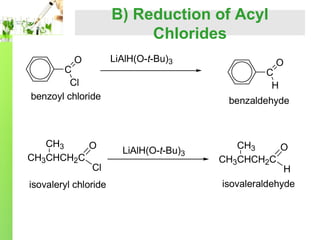
Reduction of acid chlorides
Reactions of aldehyde
Oxidation
Reduction
Addition (with HCN, NaHSO3, H2O, Grignard reagents
Condensation (with ammonia, hydrazine and their
derivatives)
Iodoform reaction
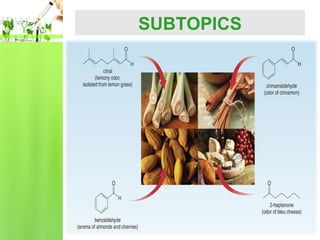
SUBTOPICS
INTRODUCTION
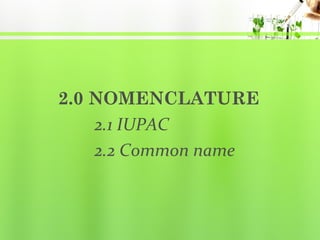
Aldehyde contain the carbonyl group – a group in
which a carbon atom has a double bond to oxygen :
O
C
R

Oxygen Carbonyl
Carbon Carbonyl

H

Carbonyl group

The carbonyl group in aldehyde is bonded to at
least one hydrogen atom.
Using R, we can designate the general formula as:
O
C
R

H

or RCHO ( R = alkyl or aryl or H)
2.0 NOMENCLATURE
2.1 IUPAC
2.2 Common name
2.1 IUPAC Names
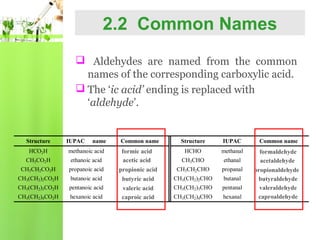
 Aldehydes are named by replacing the final -e of the
name of the corresponding alkane with –al.
~ The aldehyde functional group is always carbon 1
& need not be numbered.

IUPAC :
COMMON:

IUPAC :
COMMON:
2.1 IUPAC Names
 Aldehyde functional groups bonded to a ring are
named using the suffix carbaldehyde.
~ Benzaldehyde is used more commonly than
the name benzenecarbaldehyde.

IUPAC :
COMMON:
2.2 Common Names
 Aldehydes are named from the common
names of the corresponding carboxylic acid.
 The ‘ic acid’ ending is replaced with
‘aldehyde’.

Structure

IUPAC

name

HCO2H

methanoic acid

CH3CO2H

ethanoic acid

CH3CH2CO2H

propanoic acid

CH3(CH2)2CO2H

butanoic acid

CH3(CH2)3CO2H

pentanoic acid

CH3(CH2)4CO2H

hexanoic acid

Common name

formic acid
acetic acid
propionic acid
butyric acid
valeric acid
caproic acid

Structure

IUPAC

Common name

HCHO

methanal

CH3CHO

ethanal

CH3CH2CHO

propanal

CH3(CH2)2CHO

butanal

CH3(CH2)3CHO

pentanal

CH3(CH2)4CHO

hexanal

formaldehyde
acetaldehyde
propionaldehyde
butyraldehyde
valeraldehyde
caproaldehyde
2.2 Common Names
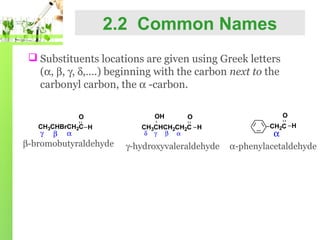
 Substituents locations are given using Greek letters
(α, β, γ, δ,….) beginning with the carbon next to the
carbonyl carbon, the α -carbon.
O
CH3CHBrCH2C H

γ

β

α

β-bromobutyraldehyde

OH

O

CH3CHCH2CH2C H
δ γ β α

γ-hydroxyvaleraldehyde

O
CH2C H

α
α-phenylacetaldehyde
2.0 PHYSICAL PROPERTIES
2.1 Boiling Point
2.2 Solubility
2.2 Physical Properties
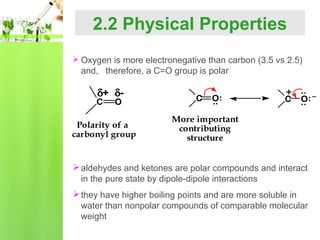
 Oxygen is more electronegative than carbon (3.5 vs 2.5)

and, therefore, a C=O group is polar

Polarity of a
carbonyl group

+

C

O: –

:

O

O:

:

C

C

:

δ+ δ-

More important
contributing
structure

 aldehydes and ketones are polar compounds and interact
in the pure state by dipole-dipole interactions
 they have higher boiling points and are more soluble in
water than nonpolar compounds of comparable molecular
weight
2.2 Physical Properties
PROPERTY

OBSERVATION

Boiling
Point

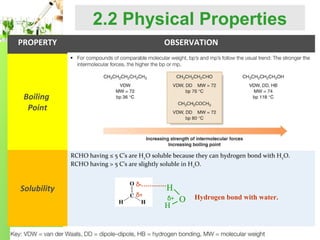
RCHO having ≤ 5 C’s are H2O soluble because they can hydrogen bond with H2O.
RCHO having > 5 C’s are slightly soluble in H2O.

Solubility

δ-…………
δ+

H
δ+

H

O

Hydrogen bond with water.
2.2 Physical Properties
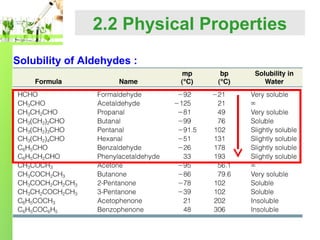
Solubility of Aldehydes :
2.0 PREPARATION OFALDEHYDE
2.1 Oxidation of 1° alcohol
2.2 Reduction of
2.2.1 Acyl Chlorides,
2.2.2 Esters
2.2.3 Nitriles
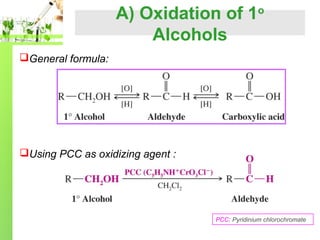
A) Oxidation of 1o
Alcohols
General formula:

Using PCC as oxidizing agent :

PCC: Pyridinium chlorochromate
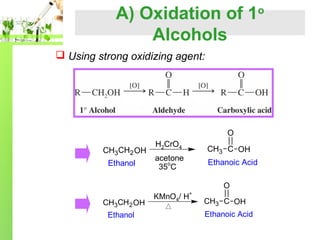
A) Oxidation of 1o
Alcohols
 Using strong oxidizing agent:

O
CH3CH2 OH
Ethanol

H2CrO4
acetone
35oC

CH3 C OH
Ethanoic Acid
O

CH3CH2 OH
Ethanol

KMnO4/ H+

CH3 C OH
Ethanoic Acid
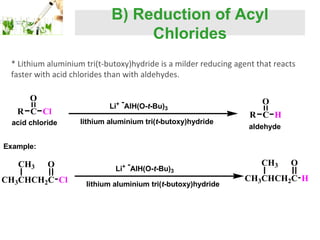
B) Reduction of Acyl
Chlorides
* Lithium aluminium tri(t-butoxy)hydride is a milder reducing agent that reacts
faster with acid chlorides than with aldehydes.
O
R C Cl
acid chloride

Li+ AlH(O-t-Bu)3
lithium aluminium tri(t-butoxy)hydride

O
R C H
aldehyde

Example:

CH3

O

CH3CHCH2C Cl

Li+ AlH(O-t-Bu)3
lithium aluminium tri(t-butoxy)hydride

CH3

O

CH3CHCH2C H
B) Reduction of Acyl
Chlorides
O

C
Cl
benzoyl chloride

CH3
O
CH3CHCH2C
Cl
isovaleryl chloride

LiAlH(O-t-Bu)3

O

C
H

benzaldehyde

LiAlH(O-t-Bu)3

CH3
O
CH3CHCH2C
H
isovaleraldehyde
3.0 REACTIONS
3.1
3.2
3.3
3.4

Oxidation
Reduction
Nucleophilic Addition
Aldol Condensation &
Cannizaro Reaction
3.5 Iodoform reaction
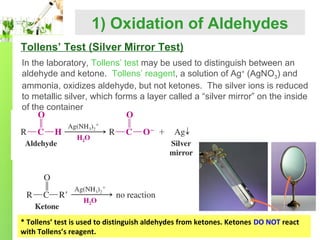
1) Oxidation of Aldehydes
 Aldehydes are easily oxidized to carboxylic acid by:
 strong oxidizing agent such as potassium permanganate,KMnO4
 mild oxidizing agent such as silver oxide, Ag2O in aqueous ammonia
(Tollen’s Test : differentiate between aldehyde & ketone)
 General Reaction

O

O

[o]

C
R

R

H

OH

[O] :
KMnO4, OHK2Cr2O7/H2SO4
Ag(NH3)2+OH- (Tollen’s reagent)

Carboxylic Acid

Aldehyde
 Examples

CH3─ CH2─ CH2─ CH2─ C─ H

O
K2Cr2O7
H2SO4

Pentanal

=

=

O

CH3─ CH2─ CH2─ CH2─ C─ OH
Pentanoic acid
1) Oxidation of Aldehydes
Tollens’ Test (Silver Mirror Test)
In the laboratory, Tollens’ test may be used to distinguish between an
aldehyde and ketone. Tollens’ reagent, a solution of Ag+ (AgNO3) and
ammonia, oxidizes aldehyde, but not ketones. The silver ions is reduced
to metallic silver, which forms a layer called a “silver mirror” on the inside
of the container

* Tollens’ test is used to distinguish aldehydes from ketones. Ketones DO NOT react
with Tollens’s reagent.
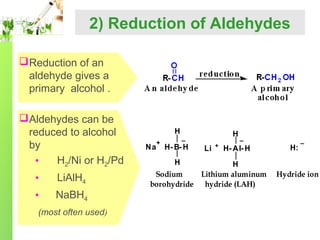
2) Reduction of Aldehydes
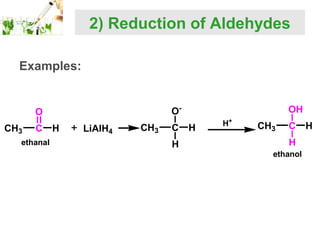
 Reduction of an
aldehyde gives a
primary alcohol .
 Aldehydes can be
reduced to alcohol
by
H2/Ni or H2/Pd
•
•

LiAlH4

•

NaBH4

(most often used)

H
Na

+

H- B- H

H
Li

+

H- A l- H

H
H
Sodium
Lithium aluminum
borohydride hydride (LAH)

H:
Hydride ion
2) Reduction of Aldehydes
Examples:

CH3

C

ethanal

OH

O-

O
H

LiAlH4

CH3

C
H

H

H+

CH3

C
H

ethanol

H
3.3

Nucleophilic Addition Reaction Of
3.3.1 HCN: Cyanohydrin Formation
3.3.2 Ammonia & Its Derivatives
3.3.3 Grignard Reagent :
Formation of Alcohol
3) Nucleophilic Addition
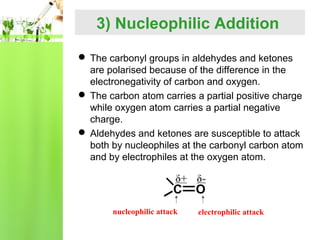
 The carbonyl groups in aldehydes and ketones
are polarised because of the difference in the
electronegativity of carbon and oxygen.
 The carbon atom carries a partial positive charge
while oxygen atom carries a partial negative
charge.
 Aldehydes and ketones are susceptible to attack
both by nucleophiles at the carbonyl carbon atom
and by electrophiles at the oxygen atom.

δ+ δ-

C
nucleophilic attack

O

electrophilic attack
3) Nucleophilic Addition

Nucleophilic Addition Reaction of :
a. HCN: Cyanohydrin Formation
b. NaHSO3
c. Grignard Reagent :
Formation of Alcohol
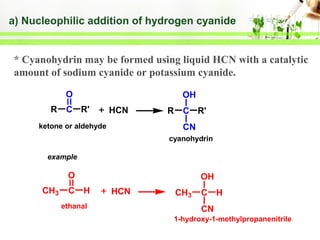
a) Nucleophilic addition of hydrogen cyanide

* Cyanohydrin may be formed using liquid HCN with a catalytic
amount of sodium cyanide or potassium cyanide.
O
R

C R'

OH
HCN

ketone or aldehyde

R

C R'
CN

cyanohydrin
example

O
CH3

C H
ethanal

OH
HCN

CH3

C H
CN

1-hydroxy-1-methylpropanenitrile
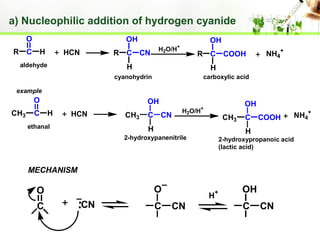
a) Nucleophilic addition of hydrogen cyanide
O

OH

R C

H

HCN

R C CN

aldehyde

OH

+

H2O/H

R C COOH

H

NH4

+

H

cyanohydrin

carboxylic acid

example

O
CH3

C

OH
H

HCN

ethanal

CH3

C CN

OH

+

H2O/H

CH3

H

C COOH
H

2-hydroxypanenitrile

2-hydroxypropanoic acid
(lactic acid)

MECHANISM

O

O
C

CN

C

H+

CN

NH4+

OH
C

CN
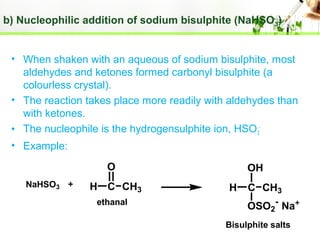
b) Nucleophilic addition of sodium bisulphite (NaHSO 3)
• When shaken with an aqueous of sodium bisulphite, most
aldehydes and ketones formed carbonyl bisulphite (a
colourless crystal).
• The reaction takes place more readily with aldehydes than
with ketones.
• The nucleophile is the hydrogensulphite ion, HSO3• Example:
O
NaHSO3

H C CH3
ethanal

OH
H

C CH3
OSO2- Na+

Bisulphite salts
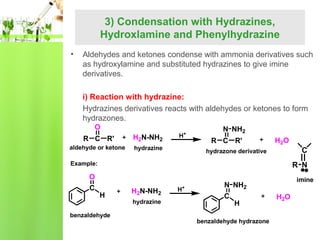
3) Condensation with Hydrazines,
Hydroxlamine and Phenylhydrazine
•

Aldehydes and ketones condense with ammonia derivatives such
as hydroxylamine and substituted hydrazines to give imine
derivatives.
i) Reaction with hydrazine:
Hydrazines derivatives reacts with aldehydes or ketones to form
hydrazones.
O
R C R'

H2N-NH2

aldehyde or ketone

+

H

hydrazine

N NH2
R C R'

H2O

C

hydrazone derivative

Example:

R N

O
C

H

benzaldehyde

H2N-NH2
hydrazine

H+

imine

N NH2
C

H

benzaldehyde hydrazone

H2O
3) Condensation with Hydrazines,
Hydroxlamine and Phenylhydrazine
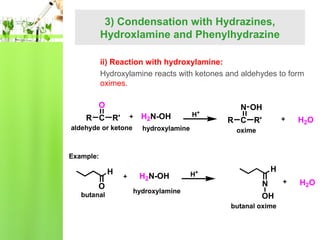
ii) Reaction with hydroxylamine:
Hydroxylamine reacts with ketones and aldehydes to form
oximes.

O
R C R'
aldehyde or ketone

H2N-OH

+

H

hydroxylamine

N OH
H 2O

R C R'
oxime

Example:

H
O
butanal

H2N-OH
hydroxylamine

H

H+

N
OH
butanal oxime

H 2O
3) Condensation with Hydrazines,
Hydroxlamine and Phenylhydrazine
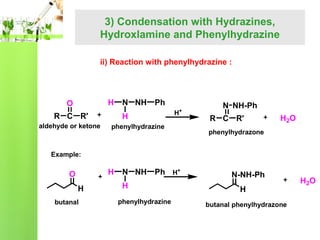
ii) Reaction with phenylhydrazine :

H

O
R C R'
aldehyde or ketone

N NH Ph
H

+

H

phenylhydrazine

N NH-Ph
R C R'

H 2O

phenylhydrazone

Example:

H

O
H
butanal

N NH Ph H+
H
phenylhydrazine

N-NH-Ph
H
butanal phenylhydrazone

H2O
3a) Condensation with 2,4dinitrophenylhydrazine (2,4-dnp)
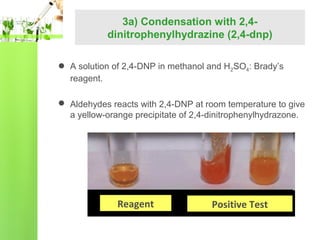
 A solution of 2,4-DNP in methanol and H2SO4: Brady’s
reagent.
 Aldehydes reacts with 2,4-DNP at room temperature to give
a yellow-orange precipitate of 2,4-dinitrophenylhydrazone.

Reagent

Positive Test
3a) Condensation with 2,4dinitrophenylhydrazine (2,4-dnp)
NO2

H
C

O

NO2

H

benzaldehyde

room
temperature

O

H2N N

NO2

H

N N

NO2

H2O

benzaldehyde 2,4-dinitrophenylhydrazone
(yellow-orange precipitate)

NO2
C

C

NO2
H

2,4-dinitrophenylhydrazine

R
R'

H2N N

H

room
temperature

R
R' C

2,4-dinitrophenylhydrazine

NO2
N N

NO2

H

•

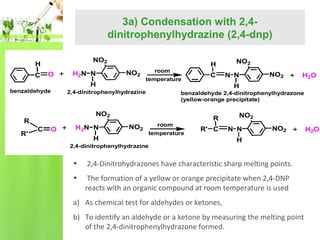
2,4-Dinitrohydrazones have characteristic sharp melting points.

•

The formation of a yellow or orange precipitate when 2,4-DNP
reacts with an organic compound at room temperature is used

a) As chemical test for aldehydes or ketones,
b) To identify an aldehyde or a ketone by measuring the melting point
of the 2,4-dinitrophenylhydrazone formed.

H2O
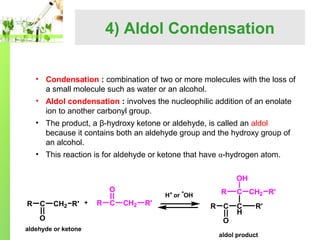
4) Aldol Condensation
• Condensation : combination of two or more molecules with the loss of
a small molecule such as water or an alcohol.
• Aldol condensation : involves the nucleophilic addition of an enolate
ion to another carbonyl group.
• The product, a β-hydroxy ketone or aldehyde, is called an aldol
because it contains both an aldehyde group and the hydroxy group of
an alcohol.
• This reaction is for aldehyde or ketone that have α-hydrogen atom.
OH
O
R

C

CH2 R'

O
aldehyde or ketone

R

C

R

H+ or OH

CH2

R'

R

C CH2 R'

C

C
H

R'

O
aldol product
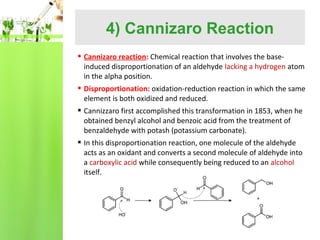
4) Cannizaro Reaction
 Cannizaro reaction: Chemical reaction that involves the baseinduced disproportionation of an aldehyde lacking a hydrogen atom
in the alpha position.
 Disproportionation: oxidation-reduction reaction in which the same
element is both oxidized and reduced.
 Cannizzaro first accomplished this transformation in 1853, when he
obtained benzyl alcohol and benzoic acid from the treatment of
benzaldehyde with potash (potassium carbonate).
 In this disproportionation reaction, one molecule of the aldehyde
acts as an oxidant and converts a second molecule of aldehyde into
a carboxylic acid while consequently being reduced to an alcohol
itself.
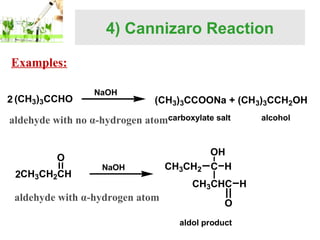
4) Cannizaro Reaction
Examples:
2 (CH3)3CCHO

NaOH

(CH3)3CCOONa + (CH3)3CCH2OH

aldehyde with no α-hydrogen atomcarboxylate salt
O
2CH3CH2CH

NaOH

aldehyde with α-hydrogen atom

CH3CH2

OH
C H

CH3CHC H
O
aldol product

alcohol
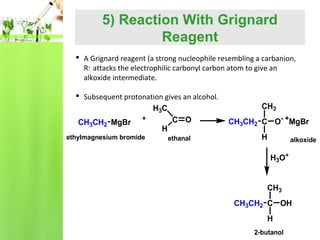
5) Reaction With Grignard
Reagent
 A Grignard reagent (a strong nucleophile resembling a carbanion,
R:- attacks the electrophilic carbonyl carbon atom to give an
alkoxide intermediate.
 Subsequent protonation gives an alcohol.
H3C
C O
CH3CH2 MgBr
H
ethylmagnesium bromide

ethanal

CH3
CH3CH2 C O- +MgBr
H

alkoxide

H3O+
CH3
CH3CH2 C OH
H
2-butanol
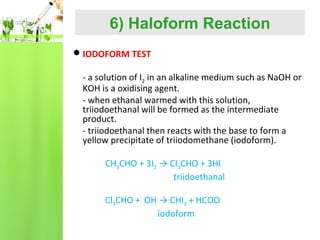
6) Haloform Reaction
IODOFORM TEST

- a solution of I2 in an alkaline medium such as NaOH or
KOH is a oxidising agent.
- when ethanal warmed with this solution,
triiodoethanal will be formed as the intermediate
product.
- triiodoethanal then reacts with the base to form a
yellow precipitate of triiodomethane (iodoform).
CH3CHO + 3I2 → CI3CHO + 3HI
triidoethanal
Cl3CHO + -OH → CHI3 + HCOOiodoform
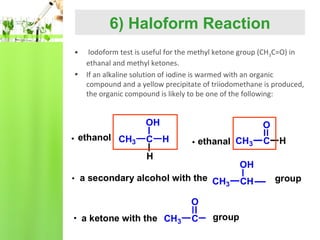
6) Haloform Reaction
•
•

Iodoform test is useful for the methyl ketone group (CH3C=O) in
ethanal and methyl ketones.
If an alkaline solution of iodine is warmed with an organic
compound and a yellow precipitate of triiodomethane is produced,
the organic compound is likely to be one of the following:

OH
ethanol CH3

C

O
H

ethanal CH3

H

OH

a secondary alcohol with the CH
3
O
a ketone with the CH3

C H

C

group

CH

group
6) Haloform Reaction
 Iodoform test can be used to distinguish:

i) ethanal from other aldehydes, because ethanal is the only
aldehydes that gives a positive iodoform test.
ii) ethanol and secondary alcohols that contains the
CH3CH(OH)- group give a positive iodoform test.
iii) methyl ketones (ketones that contain CH3CO- group) give
positive iodoform test.
For example, propanone and phenylethanone give a yellow
precipitate, but 3-pentanone and diphenylmethanone
give negative iodoform tests.
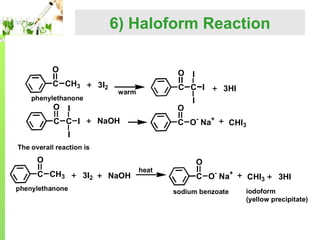
6) Haloform Reaction
O

O

C CH3

3I2

phenylethanone

O

C C I

warm

O

I

3HI

I

C O- Na+

NaOH

C C I

I

CHI3

I
The overall reaction is

O
C CH3
phenylethanone

3I2

NaOH

heat

O
C O- Na+
sodium benzoate

CHI3

3HI

iodoform
(yellow precipitate)
Thank you!

Chapter 2 aldehyde

  • 1.
    Chapter 2 :ALDEHYDE Norfazrin Mohd Hanif Faculty of Applied Science UiTM Negeri Sembilan
  • 2.
    SUBTOPICS Nomenclature – common andIUPAC names for aldehyde Physical properties of aldehyde : Boiling points and solubility Preparation of aldehyde Oxidation of alcohol Reduction of acid chlorides Reactions of aldehyde Oxidation Reduction Addition (with HCN, NaHSO3, H2O, Grignard reagents Condensation (with ammonia, hydrazine and their derivatives) Iodoform reaction
  • 3.
  • 4.
    INTRODUCTION Aldehyde contain thecarbonyl group – a group in which a carbon atom has a double bond to oxygen : O C R Oxygen Carbonyl Carbon Carbonyl H Carbonyl group The carbonyl group in aldehyde is bonded to at least one hydrogen atom. Using R, we can designate the general formula as: O C R H or RCHO ( R = alkyl or aryl or H)
  • 5.
  • 6.
    2.1 IUPAC Names Aldehydes are named by replacing the final -e of the name of the corresponding alkane with –al. ~ The aldehyde functional group is always carbon 1 & need not be numbered. IUPAC : COMMON: IUPAC : COMMON:
  • 7.
    2.1 IUPAC Names Aldehyde functional groups bonded to a ring are named using the suffix carbaldehyde. ~ Benzaldehyde is used more commonly than the name benzenecarbaldehyde. IUPAC : COMMON:
  • 8.
    2.2 Common Names Aldehydes are named from the common names of the corresponding carboxylic acid.  The ‘ic acid’ ending is replaced with ‘aldehyde’. Structure IUPAC name HCO2H methanoic acid CH3CO2H ethanoic acid CH3CH2CO2H propanoic acid CH3(CH2)2CO2H butanoic acid CH3(CH2)3CO2H pentanoic acid CH3(CH2)4CO2H hexanoic acid Common name formic acid acetic acid propionic acid butyric acid valeric acid caproic acid Structure IUPAC Common name HCHO methanal CH3CHO ethanal CH3CH2CHO propanal CH3(CH2)2CHO butanal CH3(CH2)3CHO pentanal CH3(CH2)4CHO hexanal formaldehyde acetaldehyde propionaldehyde butyraldehyde valeraldehyde caproaldehyde
  • 9.
    2.2 Common Names Substituents locations are given using Greek letters (α, β, γ, δ,….) beginning with the carbon next to the carbonyl carbon, the α -carbon. O CH3CHBrCH2C H γ β α β-bromobutyraldehyde OH O CH3CHCH2CH2C H δ γ β α γ-hydroxyvaleraldehyde O CH2C H α α-phenylacetaldehyde
  • 10.
    2.0 PHYSICAL PROPERTIES 2.1Boiling Point 2.2 Solubility
  • 11.
    2.2 Physical Properties Oxygen is more electronegative than carbon (3.5 vs 2.5) and, therefore, a C=O group is polar Polarity of a carbonyl group + C O: – : O O: : C C : δ+ δ- More important contributing structure  aldehydes and ketones are polar compounds and interact in the pure state by dipole-dipole interactions  they have higher boiling points and are more soluble in water than nonpolar compounds of comparable molecular weight
  • 12.
    2.2 Physical Properties PROPERTY OBSERVATION Boiling Point RCHOhaving ≤ 5 C’s are H2O soluble because they can hydrogen bond with H2O. RCHO having > 5 C’s are slightly soluble in H2O. Solubility δ-………… δ+ H δ+ H O Hydrogen bond with water.
  • 13.
  • 14.
    2.0 PREPARATION OFALDEHYDE 2.1Oxidation of 1° alcohol 2.2 Reduction of 2.2.1 Acyl Chlorides, 2.2.2 Esters 2.2.3 Nitriles
  • 15.
    A) Oxidation of1o Alcohols General formula: Using PCC as oxidizing agent : PCC: Pyridinium chlorochromate
  • 16.
    A) Oxidation of1o Alcohols  Using strong oxidizing agent: O CH3CH2 OH Ethanol H2CrO4 acetone 35oC CH3 C OH Ethanoic Acid O CH3CH2 OH Ethanol KMnO4/ H+ CH3 C OH Ethanoic Acid
  • 17.
    B) Reduction ofAcyl Chlorides * Lithium aluminium tri(t-butoxy)hydride is a milder reducing agent that reacts faster with acid chlorides than with aldehydes. O R C Cl acid chloride Li+ AlH(O-t-Bu)3 lithium aluminium tri(t-butoxy)hydride O R C H aldehyde Example: CH3 O CH3CHCH2C Cl Li+ AlH(O-t-Bu)3 lithium aluminium tri(t-butoxy)hydride CH3 O CH3CHCH2C H
  • 18.
    B) Reduction ofAcyl Chlorides O C Cl benzoyl chloride CH3 O CH3CHCH2C Cl isovaleryl chloride LiAlH(O-t-Bu)3 O C H benzaldehyde LiAlH(O-t-Bu)3 CH3 O CH3CHCH2C H isovaleraldehyde
  • 19.
    3.0 REACTIONS 3.1 3.2 3.3 3.4 Oxidation Reduction Nucleophilic Addition AldolCondensation & Cannizaro Reaction 3.5 Iodoform reaction
  • 20.
    1) Oxidation ofAldehydes  Aldehydes are easily oxidized to carboxylic acid by:  strong oxidizing agent such as potassium permanganate,KMnO4  mild oxidizing agent such as silver oxide, Ag2O in aqueous ammonia (Tollen’s Test : differentiate between aldehyde & ketone)  General Reaction O O [o] C R R H OH [O] : KMnO4, OHK2Cr2O7/H2SO4 Ag(NH3)2+OH- (Tollen’s reagent) Carboxylic Acid Aldehyde  Examples CH3─ CH2─ CH2─ CH2─ C─ H O K2Cr2O7 H2SO4 Pentanal = = O CH3─ CH2─ CH2─ CH2─ C─ OH Pentanoic acid
  • 21.
    1) Oxidation ofAldehydes Tollens’ Test (Silver Mirror Test) In the laboratory, Tollens’ test may be used to distinguish between an aldehyde and ketone. Tollens’ reagent, a solution of Ag+ (AgNO3) and ammonia, oxidizes aldehyde, but not ketones. The silver ions is reduced to metallic silver, which forms a layer called a “silver mirror” on the inside of the container * Tollens’ test is used to distinguish aldehydes from ketones. Ketones DO NOT react with Tollens’s reagent.
  • 22.
    2) Reduction ofAldehydes  Reduction of an aldehyde gives a primary alcohol .  Aldehydes can be reduced to alcohol by H2/Ni or H2/Pd • • LiAlH4 • NaBH4 (most often used) H Na + H- B- H H Li + H- A l- H H H Sodium Lithium aluminum borohydride hydride (LAH) H: Hydride ion
  • 23.
    2) Reduction ofAldehydes Examples: CH3 C ethanal OH O- O H LiAlH4 CH3 C H H H+ CH3 C H ethanol H
  • 24.
    3.3 Nucleophilic Addition ReactionOf 3.3.1 HCN: Cyanohydrin Formation 3.3.2 Ammonia & Its Derivatives 3.3.3 Grignard Reagent : Formation of Alcohol
  • 25.
    3) Nucleophilic Addition The carbonyl groups in aldehydes and ketones are polarised because of the difference in the electronegativity of carbon and oxygen.  The carbon atom carries a partial positive charge while oxygen atom carries a partial negative charge.  Aldehydes and ketones are susceptible to attack both by nucleophiles at the carbonyl carbon atom and by electrophiles at the oxygen atom. δ+ δ- C nucleophilic attack O electrophilic attack
  • 26.
    3) Nucleophilic Addition NucleophilicAddition Reaction of : a. HCN: Cyanohydrin Formation b. NaHSO3 c. Grignard Reagent : Formation of Alcohol
  • 27.
    a) Nucleophilic additionof hydrogen cyanide * Cyanohydrin may be formed using liquid HCN with a catalytic amount of sodium cyanide or potassium cyanide. O R C R' OH HCN ketone or aldehyde R C R' CN cyanohydrin example O CH3 C H ethanal OH HCN CH3 C H CN 1-hydroxy-1-methylpropanenitrile
  • 28.
    a) Nucleophilic additionof hydrogen cyanide O OH R C H HCN R C CN aldehyde OH + H2O/H R C COOH H NH4 + H cyanohydrin carboxylic acid example O CH3 C OH H HCN ethanal CH3 C CN OH + H2O/H CH3 H C COOH H 2-hydroxypanenitrile 2-hydroxypropanoic acid (lactic acid) MECHANISM O O C CN C H+ CN NH4+ OH C CN
  • 29.
    b) Nucleophilic additionof sodium bisulphite (NaHSO 3) • When shaken with an aqueous of sodium bisulphite, most aldehydes and ketones formed carbonyl bisulphite (a colourless crystal). • The reaction takes place more readily with aldehydes than with ketones. • The nucleophile is the hydrogensulphite ion, HSO3• Example: O NaHSO3 H C CH3 ethanal OH H C CH3 OSO2- Na+ Bisulphite salts
  • 30.
    3) Condensation withHydrazines, Hydroxlamine and Phenylhydrazine • Aldehydes and ketones condense with ammonia derivatives such as hydroxylamine and substituted hydrazines to give imine derivatives. i) Reaction with hydrazine: Hydrazines derivatives reacts with aldehydes or ketones to form hydrazones. O R C R' H2N-NH2 aldehyde or ketone + H hydrazine N NH2 R C R' H2O C hydrazone derivative Example: R N O C H benzaldehyde H2N-NH2 hydrazine H+ imine N NH2 C H benzaldehyde hydrazone H2O
  • 31.
    3) Condensation withHydrazines, Hydroxlamine and Phenylhydrazine ii) Reaction with hydroxylamine: Hydroxylamine reacts with ketones and aldehydes to form oximes. O R C R' aldehyde or ketone H2N-OH + H hydroxylamine N OH H 2O R C R' oxime Example: H O butanal H2N-OH hydroxylamine H H+ N OH butanal oxime H 2O
  • 32.
    3) Condensation withHydrazines, Hydroxlamine and Phenylhydrazine ii) Reaction with phenylhydrazine : H O R C R' aldehyde or ketone N NH Ph H + H phenylhydrazine N NH-Ph R C R' H 2O phenylhydrazone Example: H O H butanal N NH Ph H+ H phenylhydrazine N-NH-Ph H butanal phenylhydrazone H2O
  • 33.
    3a) Condensation with2,4dinitrophenylhydrazine (2,4-dnp)  A solution of 2,4-DNP in methanol and H2SO4: Brady’s reagent.  Aldehydes reacts with 2,4-DNP at room temperature to give a yellow-orange precipitate of 2,4-dinitrophenylhydrazone. Reagent Positive Test
  • 34.
    3a) Condensation with2,4dinitrophenylhydrazine (2,4-dnp) NO2 H C O NO2 H benzaldehyde room temperature O H2N N NO2 H N N NO2 H2O benzaldehyde 2,4-dinitrophenylhydrazone (yellow-orange precipitate) NO2 C C NO2 H 2,4-dinitrophenylhydrazine R R' H2N N H room temperature R R' C 2,4-dinitrophenylhydrazine NO2 N N NO2 H • 2,4-Dinitrohydrazones have characteristic sharp melting points. • The formation of a yellow or orange precipitate when 2,4-DNP reacts with an organic compound at room temperature is used a) As chemical test for aldehydes or ketones, b) To identify an aldehyde or a ketone by measuring the melting point of the 2,4-dinitrophenylhydrazone formed. H2O
  • 35.
    4) Aldol Condensation •Condensation : combination of two or more molecules with the loss of a small molecule such as water or an alcohol. • Aldol condensation : involves the nucleophilic addition of an enolate ion to another carbonyl group. • The product, a β-hydroxy ketone or aldehyde, is called an aldol because it contains both an aldehyde group and the hydroxy group of an alcohol. • This reaction is for aldehyde or ketone that have α-hydrogen atom. OH O R C CH2 R' O aldehyde or ketone R C R H+ or OH CH2 R' R C CH2 R' C C H R' O aldol product
  • 36.
    4) Cannizaro Reaction Cannizaro reaction: Chemical reaction that involves the baseinduced disproportionation of an aldehyde lacking a hydrogen atom in the alpha position.  Disproportionation: oxidation-reduction reaction in which the same element is both oxidized and reduced.  Cannizzaro first accomplished this transformation in 1853, when he obtained benzyl alcohol and benzoic acid from the treatment of benzaldehyde with potash (potassium carbonate).  In this disproportionation reaction, one molecule of the aldehyde acts as an oxidant and converts a second molecule of aldehyde into a carboxylic acid while consequently being reduced to an alcohol itself.
  • 37.
    4) Cannizaro Reaction Examples: 2(CH3)3CCHO NaOH (CH3)3CCOONa + (CH3)3CCH2OH aldehyde with no α-hydrogen atomcarboxylate salt O 2CH3CH2CH NaOH aldehyde with α-hydrogen atom CH3CH2 OH C H CH3CHC H O aldol product alcohol
  • 38.
    5) Reaction WithGrignard Reagent  A Grignard reagent (a strong nucleophile resembling a carbanion, R:- attacks the electrophilic carbonyl carbon atom to give an alkoxide intermediate.  Subsequent protonation gives an alcohol. H3C C O CH3CH2 MgBr H ethylmagnesium bromide ethanal CH3 CH3CH2 C O- +MgBr H alkoxide H3O+ CH3 CH3CH2 C OH H 2-butanol
  • 39.
    6) Haloform Reaction IODOFORMTEST - a solution of I2 in an alkaline medium such as NaOH or KOH is a oxidising agent. - when ethanal warmed with this solution, triiodoethanal will be formed as the intermediate product. - triiodoethanal then reacts with the base to form a yellow precipitate of triiodomethane (iodoform). CH3CHO + 3I2 → CI3CHO + 3HI triidoethanal Cl3CHO + -OH → CHI3 + HCOOiodoform
  • 40.
    6) Haloform Reaction • • Iodoformtest is useful for the methyl ketone group (CH3C=O) in ethanal and methyl ketones. If an alkaline solution of iodine is warmed with an organic compound and a yellow precipitate of triiodomethane is produced, the organic compound is likely to be one of the following: OH ethanol CH3 C O H ethanal CH3 H OH a secondary alcohol with the CH 3 O a ketone with the CH3 C H C group CH group
  • 41.
    6) Haloform Reaction Iodoform test can be used to distinguish: i) ethanal from other aldehydes, because ethanal is the only aldehydes that gives a positive iodoform test. ii) ethanol and secondary alcohols that contains the CH3CH(OH)- group give a positive iodoform test. iii) methyl ketones (ketones that contain CH3CO- group) give positive iodoform test. For example, propanone and phenylethanone give a yellow precipitate, but 3-pentanone and diphenylmethanone give negative iodoform tests.
  • 42.
    6) Haloform Reaction O O CCH3 3I2 phenylethanone O C C I warm O I 3HI I C O- Na+ NaOH C C I I CHI3 I The overall reaction is O C CH3 phenylethanone 3I2 NaOH heat O C O- Na+ sodium benzoate CHI3 3HI iodoform (yellow precipitate)
  • 43.