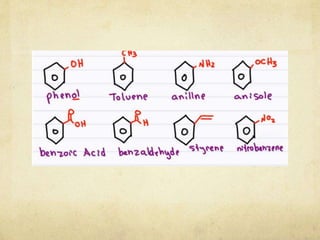
ALCOHOL and
PHENOL
ALCOHOL
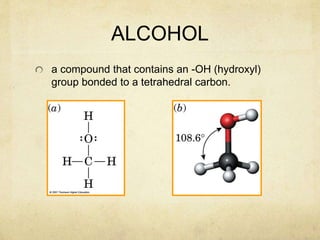
a compound that contains an -OH (hydroxyl)
group bonded to a tetrahedral carbon.
Naming Alcohols
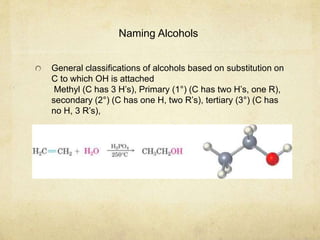
General classifications of alcohols based on substitution on
C to which OH is attached
Methyl (C has 3 H’s), Primary (1°) (C has two H’s, one R),
secondary (2°) (C has one H, two R’s), tertiary (3°) (C has
no H, 3 R’s),
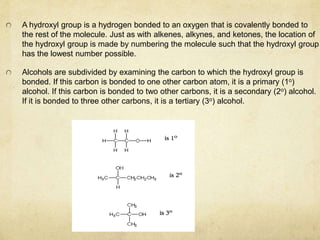
A hydroxyl group is a hydrogen bonded to an oxygen that is covalently bonded to
the rest of the molecule. Just as with alkenes, alkynes, and ketones, the location of
the hydroxyl group is made by numbering the molecule such that the hydroxyl group
has the lowest number possible.
Alcohols are subdivided by examining the carbon to which the hydroxyl group is
bonded. If this carbon is bonded to one other carbon atom, it is a primary (1o)
alcohol. If this carbon is bonded to two other carbons, it is a secondary (2o) alcohol.
If it is bonded to three other carbons, it is a tertiary (3o) alcohol.
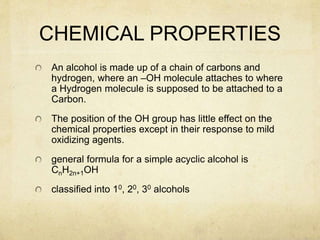
CHEMICAL PROPERTIES
An alcohol is made up of a chain of carbons and
hydrogen, where an –OH molecule attaches to where
a Hydrogen molecule is supposed to be attached to a
Carbon.
The position of the OH group has little effect on the
chemical properties except in their response to mild
oxidizing agents.
general formula for a simple acyclic alcohol is
CnH2n+1OH
classified into 10, 20, 30 alcohols
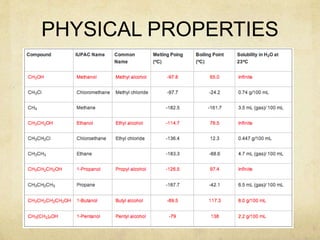
PHYSICAL PROPERTIES
IUPAC Rules for Naming Alcohol
Select the longest carbon chain containing the
hydroxyl group, and derive the parent name by
replacing the -e ending of the corresponding
alkane with -ol
Number the chain from the end nearer the
hydroxyl group
Number substituents according to position on
chain, listing the substituents in alphabetical
order
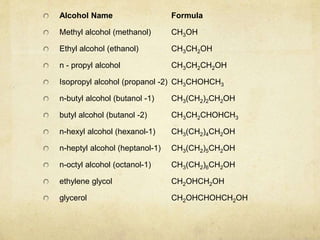
Alcohol Name Formula
Methyl alcohol (methanol) CH3OH
Ethyl alcohol (ethanol) CH3CH2OH
n - propyl alcohol CH3CH2CH2OH
Isopropyl alcohol (propanol -2) CH3CHOHCH3
n-butyl alcohol (butanol -1) CH3(CH2)2CH2OH
butyl alcohol (butanol -2) CH3CH2CHOHCH3
n-hexyl alcohol (hexanol-1) CH3(CH2)4CH2OH
n-heptyl alcohol (heptanol-1) CH3(CH2)5CH2OH
n-octyl alcohol (octanol-1) CH3(CH2)6CH2OH
ethylene glycol CH2OHCH2OH
glycerol CH2OHCHOHCH2OH
USES of ALCOHOL
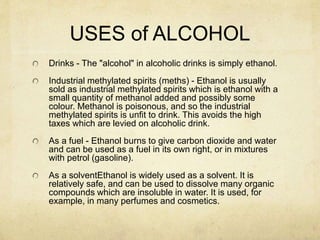
Drinks - The "alcohol" in alcoholic drinks is simply ethanol.
Industrial methylated spirits (meths) - Ethanol is usually
sold as industrial methylated spirits which is ethanol with a
small quantity of methanol added and possibly some
colour. Methanol is poisonous, and so the industrial
methylated spirits is unfit to drink. This avoids the high
taxes which are levied on alcoholic drink.
As a fuel - Ethanol burns to give carbon dioxide and water
and can be used as a fuel in its own right, or in mixtures
with petrol (gasoline).
As a solventEthanol is widely used as a solvent. It is
relatively safe, and can be used to dissolve many organic
compounds which are insoluble in water. It is used, for
example, in many perfumes and cosmetics.
USES of ALCOHOL
Disinfectants
Solvents
Liquor
High efficiency fuels
Used to synthesize other organic compounds
Fungicides
Cosmetics
Used to make vinegar
Used in the manufacturing of plastics
USES OF ALCOHOL
Isopropyl Alcohol
- Rubbing alcohol
- Rapid evaporation
- Antiseptic
- More toxic than ethanol, but induces vomiting
- Used for the manufacture of acetone
REACTIONS
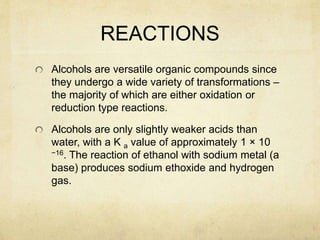
Alcohols are versatile organic compounds since
they undergo a wide variety of transformations –
the majority of which are either oxidation or
reduction type reactions.
Alcohols are only slightly weaker acids than
water, with a K a value of approximately 1 × 10
−16. The reaction of ethanol with sodium metal (a
base) produces sodium ethoxide and hydrogen
gas.
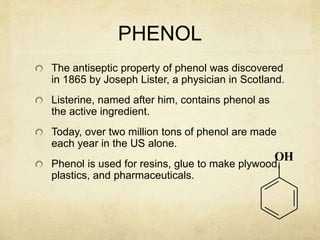
PHENOL
The antiseptic property of phenol was discovered
in 1865 by Joseph Lister, a physician in Scotland.
Listerine, named after him, contains phenol as
the active ingredient.
Today, over two million tons of phenol are made
each year in the US alone.
Phenol is used for resins, glue to make plywood,
plastics, and pharmaceuticals.
OH
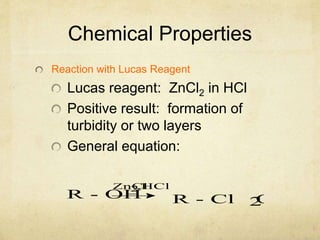
Chemical Properties
Reaction with Lucas Reagent
Lucas reagent: ZnCl2 in HCl
Positive result: formation of
turbidity or two layers
General equation:
R - OH R - Cl + H2O
ZnCl2,HCl
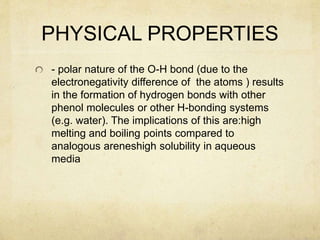
PHYSICAL PROPERTIES
- polar nature of the O-H bond (due to the
electronegativity difference of the atoms ) results
in the formation of hydrogen bonds with other
phenol molecules or other H-bonding systems
(e.g. water). The implications of this are:high
melting and boiling points compared to
analogous areneshigh solubility in aqueous
media
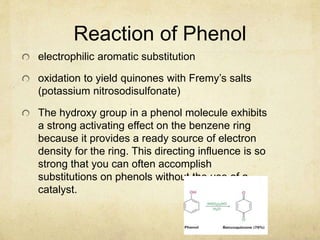
Reaction of Phenol
electrophilic aromatic substitution
oxidation to yield quinones with Fremy’s salts
(potassium nitrosodisulfonate)
The hydroxy group in a phenol molecule exhibits
a strong activating effect on the benzene ring
because it provides a ready source of electron
density for the ring. This directing influence is so
strong that you can often accomplish
substitutions on phenols without the use of a
catalyst.
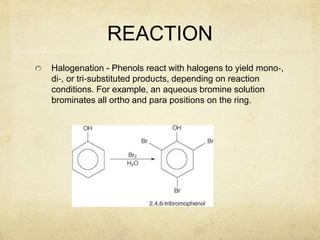
REACTION
Halogenation - Phenols react with halogens to yield mono‐,
di‐, or tri‐substituted products, depending on reaction
conditions. For example, an aqueous bromine solution
brominates all ortho and para positions on the ring.
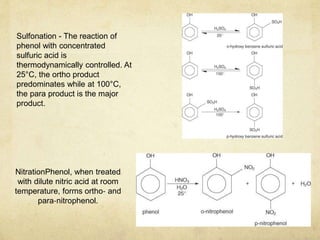
NitrationPhenol, when treated
with dilute nitric acid at room
temperature, forms ortho‐ and
para‐nitrophenol.
Sulfonation - The reaction of
phenol with concentrated
sulfuric acid is
thermodynamically controlled. At
25°C, the ortho product
predominates while at 100°C,
the para product is the major
product.
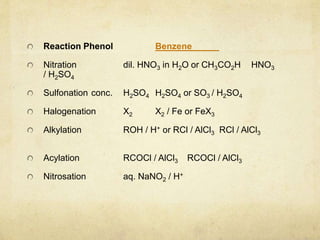
Reaction Phenol Benzene
Nitration dil. HNO3 in H2O or CH3CO2H HNO3
/ H2SO4
Sulfonation conc. H2SO4 H2SO4 or SO3 / H2SO4
Halogenation X2 X2 / Fe or FeX3
Alkylation ROH / H+ or RCl / AlCl3 RCl / AlCl3
Acylation RCOCl / AlCl3 RCOCl / AlCl3
Nitrosation aq. NaNO2 / H+
USES
embalming of bodies and as an oral analgesic in
the manufacture of cosmetics and drugs.
The hydrocarbon is used in the health industry
as an antiseptic for surgical instruments.
Used a raw material for the production of plastic
additives, dyes, and herbicides.
END

ALCOHOL and PHENOL

  • 1.
  • 2.
    ALCOHOL a compound thatcontains an -OH (hydroxyl) group bonded to a tetrahedral carbon.
  • 3.
    Naming Alcohols General classificationsof alcohols based on substitution on C to which OH is attached Methyl (C has 3 H’s), Primary (1°) (C has two H’s, one R), secondary (2°) (C has one H, two R’s), tertiary (3°) (C has no H, 3 R’s),
  • 4.
    A hydroxyl groupis a hydrogen bonded to an oxygen that is covalently bonded to the rest of the molecule. Just as with alkenes, alkynes, and ketones, the location of the hydroxyl group is made by numbering the molecule such that the hydroxyl group has the lowest number possible. Alcohols are subdivided by examining the carbon to which the hydroxyl group is bonded. If this carbon is bonded to one other carbon atom, it is a primary (1o) alcohol. If this carbon is bonded to two other carbons, it is a secondary (2o) alcohol. If it is bonded to three other carbons, it is a tertiary (3o) alcohol.
  • 5.
    CHEMICAL PROPERTIES An alcoholis made up of a chain of carbons and hydrogen, where an –OH molecule attaches to where a Hydrogen molecule is supposed to be attached to a Carbon. The position of the OH group has little effect on the chemical properties except in their response to mild oxidizing agents. general formula for a simple acyclic alcohol is CnH2n+1OH classified into 10, 20, 30 alcohols
  • 6.
  • 7.
    IUPAC Rules forNaming Alcohol Select the longest carbon chain containing the hydroxyl group, and derive the parent name by replacing the -e ending of the corresponding alkane with -ol Number the chain from the end nearer the hydroxyl group Number substituents according to position on chain, listing the substituents in alphabetical order
  • 8.
    Alcohol Name Formula Methylalcohol (methanol) CH3OH Ethyl alcohol (ethanol) CH3CH2OH n - propyl alcohol CH3CH2CH2OH Isopropyl alcohol (propanol -2) CH3CHOHCH3 n-butyl alcohol (butanol -1) CH3(CH2)2CH2OH butyl alcohol (butanol -2) CH3CH2CHOHCH3 n-hexyl alcohol (hexanol-1) CH3(CH2)4CH2OH n-heptyl alcohol (heptanol-1) CH3(CH2)5CH2OH n-octyl alcohol (octanol-1) CH3(CH2)6CH2OH ethylene glycol CH2OHCH2OH glycerol CH2OHCHOHCH2OH
  • 9.
    USES of ALCOHOL Drinks- The "alcohol" in alcoholic drinks is simply ethanol. Industrial methylated spirits (meths) - Ethanol is usually sold as industrial methylated spirits which is ethanol with a small quantity of methanol added and possibly some colour. Methanol is poisonous, and so the industrial methylated spirits is unfit to drink. This avoids the high taxes which are levied on alcoholic drink. As a fuel - Ethanol burns to give carbon dioxide and water and can be used as a fuel in its own right, or in mixtures with petrol (gasoline). As a solventEthanol is widely used as a solvent. It is relatively safe, and can be used to dissolve many organic compounds which are insoluble in water. It is used, for example, in many perfumes and cosmetics.
  • 10.
    USES of ALCOHOL Disinfectants Solvents Liquor Highefficiency fuels Used to synthesize other organic compounds Fungicides Cosmetics Used to make vinegar Used in the manufacturing of plastics
  • 11.
    USES OF ALCOHOL IsopropylAlcohol - Rubbing alcohol - Rapid evaporation - Antiseptic - More toxic than ethanol, but induces vomiting - Used for the manufacture of acetone
  • 12.
    REACTIONS Alcohols are versatileorganic compounds since they undergo a wide variety of transformations – the majority of which are either oxidation or reduction type reactions. Alcohols are only slightly weaker acids than water, with a K a value of approximately 1 × 10 −16. The reaction of ethanol with sodium metal (a base) produces sodium ethoxide and hydrogen gas.
  • 13.
    PHENOL The antiseptic propertyof phenol was discovered in 1865 by Joseph Lister, a physician in Scotland. Listerine, named after him, contains phenol as the active ingredient. Today, over two million tons of phenol are made each year in the US alone. Phenol is used for resins, glue to make plywood, plastics, and pharmaceuticals. OH
  • 14.
    Chemical Properties Reaction withLucas Reagent Lucas reagent: ZnCl2 in HCl Positive result: formation of turbidity or two layers General equation: R - OH R - Cl + H2O ZnCl2,HCl
  • 15.
    PHYSICAL PROPERTIES - polarnature of the O-H bond (due to the electronegativity difference of the atoms ) results in the formation of hydrogen bonds with other phenol molecules or other H-bonding systems (e.g. water). The implications of this are:high melting and boiling points compared to analogous areneshigh solubility in aqueous media
  • 16.
    Reaction of Phenol electrophilicaromatic substitution oxidation to yield quinones with Fremy’s salts (potassium nitrosodisulfonate) The hydroxy group in a phenol molecule exhibits a strong activating effect on the benzene ring because it provides a ready source of electron density for the ring. This directing influence is so strong that you can often accomplish substitutions on phenols without the use of a catalyst.
  • 17.
    REACTION Halogenation - Phenolsreact with halogens to yield mono‐, di‐, or tri‐substituted products, depending on reaction conditions. For example, an aqueous bromine solution brominates all ortho and para positions on the ring.
  • 18.
    NitrationPhenol, when treated withdilute nitric acid at room temperature, forms ortho‐ and para‐nitrophenol. Sulfonation - The reaction of phenol with concentrated sulfuric acid is thermodynamically controlled. At 25°C, the ortho product predominates while at 100°C, the para product is the major product.
  • 19.
    Reaction Phenol Benzene Nitrationdil. HNO3 in H2O or CH3CO2H HNO3 / H2SO4 Sulfonation conc. H2SO4 H2SO4 or SO3 / H2SO4 Halogenation X2 X2 / Fe or FeX3 Alkylation ROH / H+ or RCl / AlCl3 RCl / AlCl3 Acylation RCOCl / AlCl3 RCOCl / AlCl3 Nitrosation aq. NaNO2 / H+
  • 21.
    USES embalming of bodiesand as an oral analgesic in the manufacture of cosmetics and drugs. The hydrocarbon is used in the health industry as an antiseptic for surgical instruments. Used a raw material for the production of plastic additives, dyes, and herbicides.
  • 22.