Phase Diagrams
Introduction
 Phase: A region in a material that differs in structure and function

from other regions.
 Phase diagrams:
 Represents phases present in metal at different conditions
(Temperature, pressure and composition).
 Indicates equilibrium solid solubility of one element in
another.
 Indicates temperature range under which solidification
occurs.
 Indicates temperature at which different phases start to
melt.

2
Phase Diagram of Pure Substance
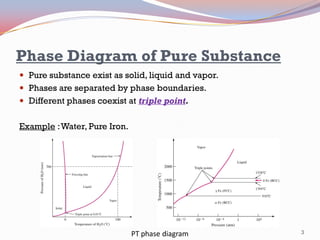
 Pure substance exist as solid, liquid and vapor.

 Phases are separated by phase boundaries.
 Different phases coexist at triple point.

Example : Water, Pure Iron.

PT phase diagram

3
Question 1
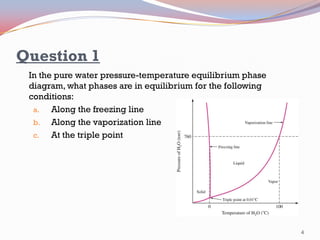
In the pure water pressure-temperature equilibrium phase
diagram, what phases are in equilibrium for the following
conditions:
a.
Along the freezing line
b. Along the vaporization line
c.
At the triple point

4
Question 2
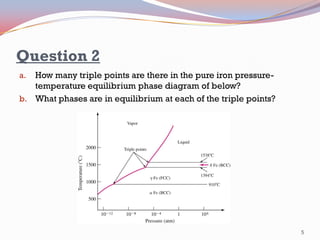
How many triple points are there in the pure iron pressuretemperature equilibrium phase diagram of below?
b. What phases are in equilibrium at each of the triple points?
a.

5
Gibbs Phase Rule

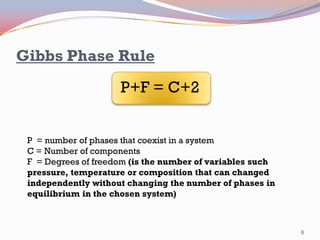
P+F = C+2
P = number of phases that coexist in a system
C = Number of components
F = Degrees of freedom (is the number of variables such
pressure, temperature or composition that can changed
independently without changing the number of phases in
equilibrium in the chosen system)

6
Example 1

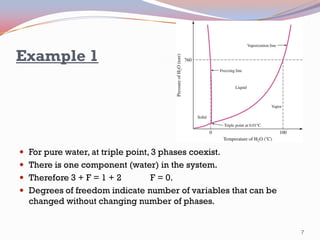
 For pure water, at triple point, 3 phases coexist.

 There is one component (water) in the system.
 Therefore 3 + F = 1 + 2

F = 0.
 Degrees of freedom indicate number of variables that can be
changed without changing number of phases.

7
Question 3
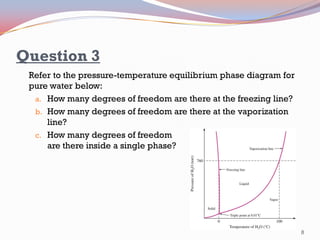
Refer to the pressure-temperature equilibrium phase diagram for
pure water below:
a. How many degrees of freedom are there at the freezing line?
b. How many degrees of freedom are there at the vaporization
line?
c. How many degrees of freedom
are there inside a single phase?

8
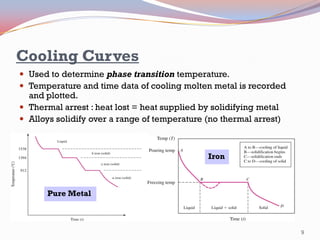
Cooling Curves
 Used to determine phase transition temperature.
 Temperature and time data of cooling molten metal is recorded

and plotted.
 Thermal arrest : heat lost = heat supplied by solidifying metal
 Alloys solidify over a range of temperature (no thermal arrest)

Iron

Pure Metal

9
Binary Alloy
 Consider a mixture or alloy of two metals instead of pure

substances.
 A mixture of two metals is called a binary alloy and constitutes a
two component.
Example:
pure substance : cooper is one component
alloy : cooper + nickel is two component

Binary alloy

Mixture of
two systems

Two component
system

10
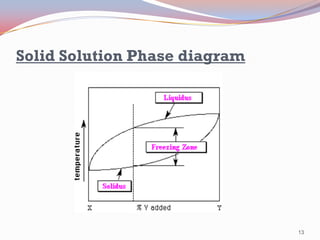
 Isomorphous system:

Two elements completely soluble in each other in liquid and solid
state.

11
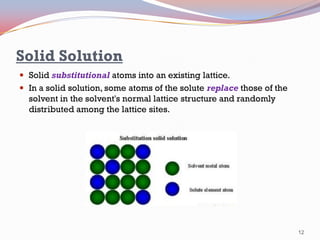
Solid Solution
 Solid substitutional atoms into an existing lattice.

 In a solid solution, some atoms of the solute replace those of the
solvent in the solvent's normal lattice structure and randomly
distributed among the lattice sites.

12
Solid Solution Phase diagram

13
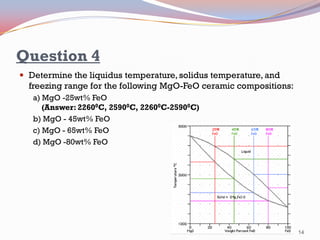
Question 4
 Determine the liquidus temperature, solidus temperature, and

freezing range for the following MgO-FeO ceramic compositions:
a) MgO -25wt% FeO
(Answer: 22600C, 25900C, 22600C-25900C)
b) MgO - 45wt% FeO
c) MgO - 65wt% FeO
d) MgO -80wt% FeO

14
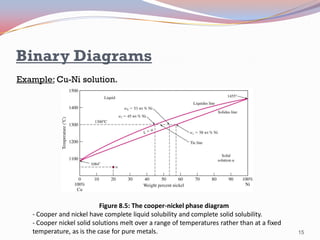
Binary Diagrams
Example: Cu-Ni solution.

Figure 8.5: The cooper-nickel phase diagram
- Cooper and nickel have complete liquid solubility and complete solid solubility.
- Cooper nickel solid solutions melt over a range of temperatures rather than at a fixed
temperature, as is the case for pure metals.

15
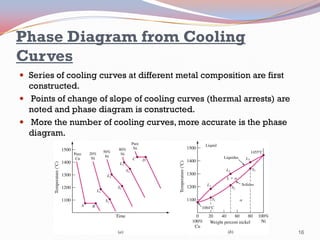
Phase Diagram from Cooling
Curves
 Series of cooling curves at different metal composition are first

constructed.
 Points of change of slope of cooling curves (thermal arrests) are
noted and phase diagram is constructed.
 More the number of cooling curves, more accurate is the phase
diagram.

16
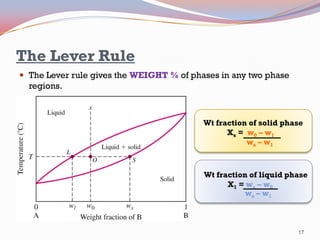
The Lever Rule
 The Lever rule gives the WEIGHT % of phases in any two phase

regions.

Wt fraction of solid phase
X s = w0 – w1
ws – w1

Wt fraction of liquid phase
X1 = ws – w0
ws – w1

17
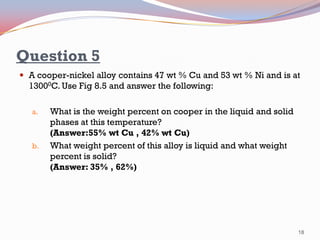
Question 5
 A cooper-nickel alloy contains 47 wt % Cu and 53 wt % Ni and is at

13000C. Use Fig 8.5 and answer the following:
a.

b.

What is the weight percent on cooper in the liquid and solid
phases at this temperature?
(Answer:55% wt Cu , 42% wt Cu)
What weight percent of this alloy is liquid and what weight
percent is solid?
(Answer: 35% , 62%)

18
Binary Eutectic Alloy System
 In some binary alloy systems, components have limited solid

solubility.
Example : Pb-Sn alloy.
 Eutectic composition freezes at lower temperature than all other

compositions.
 This lowest temperature is called eutectic temperature.

19
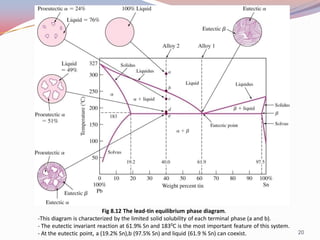
Fig 8.12 The lead-tin equilibrium phase diagram.
-This diagram is characterized by the limited solid solubility of each terminal phase (a and b).
- The eutectic invariant reaction at 61.9% Sn and 1830C is the most important feature of this system.
- At the eutectic point, a (19.2% Sn),b (97.5% Sn) and liquid (61.9 % Sn) can coexist.

20
 In simple binary eutectic systems like the Pb-Sn, there is a specific

alloy composition known as the eutectic composition that freezes
at lower temperature than all other compositions.
 Eutectic temperature is the low temperature which corresponds

to the lowest temperature at which the liquid phase can exist when
cooled slowly.
 In the Pb-Sn system, the eutectic temperature (1830C) determine a

point on the phase diagram called the eutectic point.

21
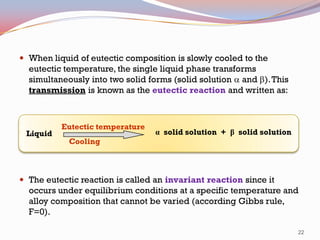
 When liquid of eutectic composition is slowly cooled to the

eutectic temperature, the single liquid phase transforms
simultaneously into two solid forms (solid solution a and b). This
transmission is known as the eutectic reaction and written as:

Liquid

Eutectic temperature

α solid solution + β solid solution

Cooling

 The eutectic reaction is called an invariant reaction since it

occurs under equilibrium conditions at a specific temperature and
alloy composition that cannot be varied (according Gibbs rule,
F=0).
22
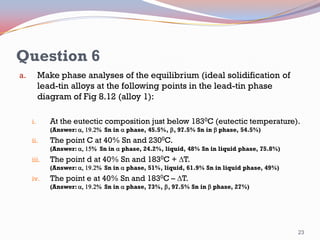
Question 6
Make phase analyses of the equilibrium (ideal solidification of
lead-tin alloys at the following points in the lead-tin phase
diagram of Fig 8.12 (alloy 1):

a.

i.

At the eutectic composition just below 1830C (eutectic temperature).
(Answer: a, 19.2% Sn in a phase, 45.5%, b, 97.5% Sn in b phase, 54.5%)

ii.

The point C at 40% Sn and 2300C.

(Answer: a, 15% Sn in a phase, 24.2%, liquid, 48% Sn in liquid phase, 75.8%)

iii.

The point d at 40% Sn and 1830C + T.

(Answer: a, 19.2% Sn in a phase, 51%, liquid, 61.9% Sn in liquid phase, 49%)

iv.

The point e at 40% Sn and 1830C – T.

(Answer: a, 19.2% Sn in a phase, 73%, b, 97.5% Sn in b phase, 27%)

23
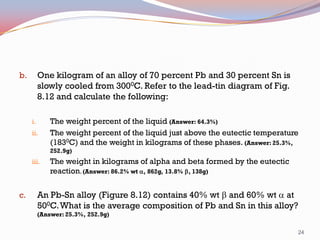
One kilogram of an alloy of 70 percent Pb and 30 percent Sn is
slowly cooled from 3000C. Refer to the lead-tin diagram of Fig.
8.12 and calculate the following:

b.

i.
ii.

The weight percent of the liquid (Answer: 64.3%)
The weight percent of the liquid just above the eutectic temperature
(1830C) and the weight in kilograms of these phases. (Answer: 25.3%,
252.9g)

iii.

c.

The weight in kilograms of alpha and beta formed by the eutectic
reaction. (Answer: 86.2% wt a, 862g, 13.8% b, 138g)

An Pb-Sn alloy (Figure 8.12) contains 40% wt b and 60% wt a at
500C. What is the average composition of Pb and Sn in this alloy?
(Answer: 25.3%, 252.9g)
24
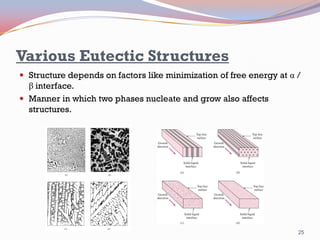
Various Eutectic Structures
 Structure depends on factors like minimization of free energy at α /

β interface.
 Manner in which two phases nucleate and grow also affects
structures.

25
Binary Peritectic Alloy System
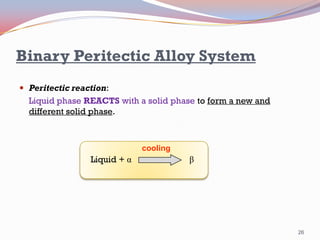
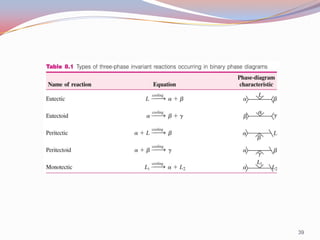
 Peritectic reaction:

Liquid phase REACTS with a solid phase to form a new and
different solid phase.

cooling

Liquid + α

β

26
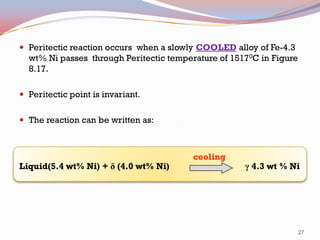
 Peritectic reaction occurs when a slowly COOLED alloy of Fe-4.3

wt% Ni passes through Peritectic temperature of 15170C in Figure
8.17.
 Peritectic point is invariant.
 The reaction can be written as:

Liquid(5.4 wt% Ni) + δ (4.0 wt% Ni)

cooling

γ 4.3 wt % Ni

27
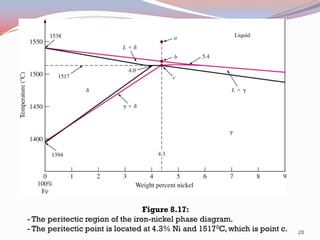
Figure 8.17:
- The peritectic region of the iron-nickel phase diagram.
- The peritectic point is located at 4.3% Ni and 15170C, which is point c.

28
Question 7
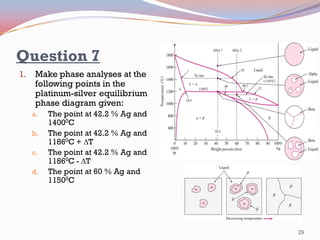
1.

Make phase analyses at the
following points in the
platinum-silver equilibrium
phase diagram given:
a.
b.
c.
d.

The point at 42.2 % Ag and
14000C
The point at 42.2 % Ag and
11860C + T
The point at 42.2 % Ag and
11860C - T
The point at 60 % Ag and
11500C

29
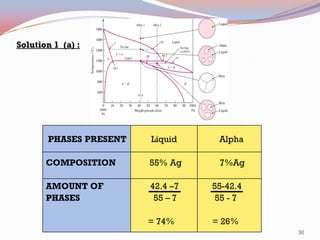
Solution 1 (a) :

PHASES PRESENT

Liquid

Alpha

COMPOSITION

55% Ag

7%Ag

AMOUNT OF
PHASES

42.4 –7
55 – 7

55-42.4
55 - 7

= 74%

= 26%
30
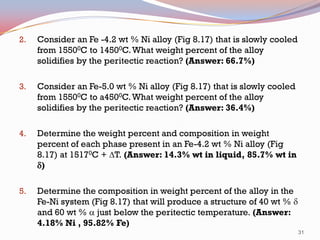
2.

Consider an Fe -4.2 wt % Ni alloy (Fig 8.17) that is slowly cooled
from 15500C to 14500C. What weight percent of the alloy
solidifies by the peritectic reaction? (Answer: 66.7%)

3.

Consider an Fe-5.0 wt % Ni alloy (Fig 8.17) that is slowly cooled
from 15500C to a4500C. What weight percent of the alloy
solidifies by the peritectic reaction? (Answer: 36.4%)

4.

Determine the weight percent and composition in weight
percent of each phase present in an Fe-4.2 wt % Ni alloy (Fig
8.17) at 15170C + T. (Answer: 14.3% wt in liquid, 85.7% wt in
d)

5.

Determine the composition in weight percent of the alloy in the
Fe-Ni system (Fig 8.17) that will produce a structure of 40 wt % d
and 60 wt % a just below the peritectic temperature. (Answer:
4.18% Ni , 95.82% Fe)
31
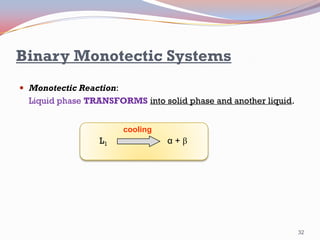
Binary Monotectic Systems
 Monotectic Reaction:

Liquid phase TRANSFORMS into solid phase and another liquid.
cooling

L1

α+β

32
 Two liquids are immiscible.

Example:Copper – Lead (system at 9550C and 36% Pb)

33
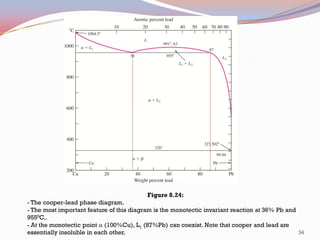
Figure 8.24:
- The cooper-lead phase diagram.
- The most important feature of this diagram is the monotectic invariant reaction at 36% Pb and
9550C,.
- At the monotectic point a (100%Cu), L1 (87%Pb) can coexist. Note that cooper and lead are
34
essentially insoluble in each other.
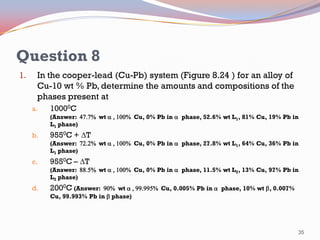
Question 8
1.

In the cooper-lead (Cu-Pb) system (Figure 8.24 ) for an alloy of
Cu-10 wt % Pb, determine the amounts and compositions of the
phases present at
a.

10000C
(Answer: 47.7% wt a , 100% Cu, 0% Pb in a phase, 52.6% wt L1, 81% Cu, 19% Pb in
L1 phase)

b.

9550C + T

(Answer: 72.2% wt a , 100% Cu, 0% Pb in a phase, 27.8% wt L1, 64% Cu, 36% Pb in
L1 phase)

c.

9550C – T

(Answer: 88.5% wt a , 100% Cu, 0% Pb in a phase, 11.5% wt L2, 13% Cu, 97% Pb in
L2 phase)

d.

2000C (Answer:

90% wt a , 99.995% Cu, 0.005% Pb in a phase, 10% wt b, 0.007%
Cu, 99.993% Pb in b phase)

35
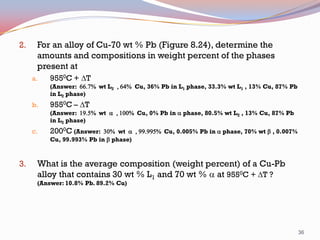
2.

For an alloy of Cu-70 wt % Pb (Figure 8.24), determine the
amounts and compositions in weight percent of the phases
present at
a.

9550C + T

(Answer: 66.7% wt L2 , 64% Cu, 36% Pb in L1 phase, 33.3% wt L1 , 13% Cu, 87% Pb
in L2 phase)

b.

9550C – T

(Answer: 19.5% wt a , 100% Cu, 0% Pb in a phase, 80.5% wt L2 , 13% Cu, 87% Pb
in L2 phase)

c.

3.

2000C (Answer:

30% wt a , 99.995% Cu, 0.005% Pb in a phase, 70% wt b , 0.007%
Cu, 99.993% Pb in b phase)

What is the average composition (weight percent) of a Cu-Pb
alloy that contains 30 wt % L1 and 70 wt % a at 9550C + T ?
(Answer: 10.8% Pb. 89.2% Cu)

36
Invariant Reaction
Eutectoid Reaction
 Eutectoid reaction is similar with eutectic reaction which two solid

phases are formed from one phase on cooling.
 However, in the eutectoid reaction, the decomposing phase is

solid.

37
Peritectoid Reaction
 Peritectoid reaction two solid phase reacts to form new solid
phase.

38
39
References
 A.G. Guy (1972) Introduction to Material Science, McGraw Hill.

 J.F. Shackelford (2000). Introduction to Material Science for

Engineers, (5th Edition), Prentice Hall.
 W.F. Smith (1996). Priciple to Material Science and
Engineering, (3rd Edition), McGraw Hill.
 W.D. Callister Jr. (1997) Material Science and Engineering: An
Introduction, (4th Edition) John Wiley.

40

Phy351 ch 5

  • 1.
  • 2.
    Introduction  Phase: Aregion in a material that differs in structure and function from other regions.  Phase diagrams:  Represents phases present in metal at different conditions (Temperature, pressure and composition).  Indicates equilibrium solid solubility of one element in another.  Indicates temperature range under which solidification occurs.  Indicates temperature at which different phases start to melt. 2
  • 3.
    Phase Diagram ofPure Substance  Pure substance exist as solid, liquid and vapor.  Phases are separated by phase boundaries.  Different phases coexist at triple point. Example : Water, Pure Iron. PT phase diagram 3
  • 4.
    Question 1 In thepure water pressure-temperature equilibrium phase diagram, what phases are in equilibrium for the following conditions: a. Along the freezing line b. Along the vaporization line c. At the triple point 4
  • 5.
    Question 2 How manytriple points are there in the pure iron pressuretemperature equilibrium phase diagram of below? b. What phases are in equilibrium at each of the triple points? a. 5
  • 6.
    Gibbs Phase Rule P+F= C+2 P = number of phases that coexist in a system C = Number of components F = Degrees of freedom (is the number of variables such pressure, temperature or composition that can changed independently without changing the number of phases in equilibrium in the chosen system) 6
  • 7.
    Example 1  Forpure water, at triple point, 3 phases coexist.  There is one component (water) in the system.  Therefore 3 + F = 1 + 2 F = 0.  Degrees of freedom indicate number of variables that can be changed without changing number of phases. 7
  • 8.
    Question 3 Refer tothe pressure-temperature equilibrium phase diagram for pure water below: a. How many degrees of freedom are there at the freezing line? b. How many degrees of freedom are there at the vaporization line? c. How many degrees of freedom are there inside a single phase? 8
  • 9.
    Cooling Curves  Usedto determine phase transition temperature.  Temperature and time data of cooling molten metal is recorded and plotted.  Thermal arrest : heat lost = heat supplied by solidifying metal  Alloys solidify over a range of temperature (no thermal arrest) Iron Pure Metal 9
  • 10.
    Binary Alloy  Considera mixture or alloy of two metals instead of pure substances.  A mixture of two metals is called a binary alloy and constitutes a two component. Example: pure substance : cooper is one component alloy : cooper + nickel is two component Binary alloy Mixture of two systems Two component system 10
  • 11.
     Isomorphous system: Twoelements completely soluble in each other in liquid and solid state. 11
  • 12.
    Solid Solution  Solidsubstitutional atoms into an existing lattice.  In a solid solution, some atoms of the solute replace those of the solvent in the solvent's normal lattice structure and randomly distributed among the lattice sites. 12
  • 13.
  • 14.
    Question 4  Determinethe liquidus temperature, solidus temperature, and freezing range for the following MgO-FeO ceramic compositions: a) MgO -25wt% FeO (Answer: 22600C, 25900C, 22600C-25900C) b) MgO - 45wt% FeO c) MgO - 65wt% FeO d) MgO -80wt% FeO 14
  • 15.
    Binary Diagrams Example: Cu-Nisolution. Figure 8.5: The cooper-nickel phase diagram - Cooper and nickel have complete liquid solubility and complete solid solubility. - Cooper nickel solid solutions melt over a range of temperatures rather than at a fixed temperature, as is the case for pure metals. 15
  • 16.
    Phase Diagram fromCooling Curves  Series of cooling curves at different metal composition are first constructed.  Points of change of slope of cooling curves (thermal arrests) are noted and phase diagram is constructed.  More the number of cooling curves, more accurate is the phase diagram. 16
  • 17.
    The Lever Rule The Lever rule gives the WEIGHT % of phases in any two phase regions. Wt fraction of solid phase X s = w0 – w1 ws – w1 Wt fraction of liquid phase X1 = ws – w0 ws – w1 17
  • 18.
    Question 5  Acooper-nickel alloy contains 47 wt % Cu and 53 wt % Ni and is at 13000C. Use Fig 8.5 and answer the following: a. b. What is the weight percent on cooper in the liquid and solid phases at this temperature? (Answer:55% wt Cu , 42% wt Cu) What weight percent of this alloy is liquid and what weight percent is solid? (Answer: 35% , 62%) 18
  • 19.
    Binary Eutectic AlloySystem  In some binary alloy systems, components have limited solid solubility. Example : Pb-Sn alloy.  Eutectic composition freezes at lower temperature than all other compositions.  This lowest temperature is called eutectic temperature. 19
  • 20.
    Fig 8.12 Thelead-tin equilibrium phase diagram. -This diagram is characterized by the limited solid solubility of each terminal phase (a and b). - The eutectic invariant reaction at 61.9% Sn and 1830C is the most important feature of this system. - At the eutectic point, a (19.2% Sn),b (97.5% Sn) and liquid (61.9 % Sn) can coexist. 20
  • 21.
     In simplebinary eutectic systems like the Pb-Sn, there is a specific alloy composition known as the eutectic composition that freezes at lower temperature than all other compositions.  Eutectic temperature is the low temperature which corresponds to the lowest temperature at which the liquid phase can exist when cooled slowly.  In the Pb-Sn system, the eutectic temperature (1830C) determine a point on the phase diagram called the eutectic point. 21
  • 22.
     When liquidof eutectic composition is slowly cooled to the eutectic temperature, the single liquid phase transforms simultaneously into two solid forms (solid solution a and b). This transmission is known as the eutectic reaction and written as: Liquid Eutectic temperature α solid solution + β solid solution Cooling  The eutectic reaction is called an invariant reaction since it occurs under equilibrium conditions at a specific temperature and alloy composition that cannot be varied (according Gibbs rule, F=0). 22
  • 23.
    Question 6 Make phaseanalyses of the equilibrium (ideal solidification of lead-tin alloys at the following points in the lead-tin phase diagram of Fig 8.12 (alloy 1): a. i. At the eutectic composition just below 1830C (eutectic temperature). (Answer: a, 19.2% Sn in a phase, 45.5%, b, 97.5% Sn in b phase, 54.5%) ii. The point C at 40% Sn and 2300C. (Answer: a, 15% Sn in a phase, 24.2%, liquid, 48% Sn in liquid phase, 75.8%) iii. The point d at 40% Sn and 1830C + T. (Answer: a, 19.2% Sn in a phase, 51%, liquid, 61.9% Sn in liquid phase, 49%) iv. The point e at 40% Sn and 1830C – T. (Answer: a, 19.2% Sn in a phase, 73%, b, 97.5% Sn in b phase, 27%) 23
  • 24.
    One kilogram ofan alloy of 70 percent Pb and 30 percent Sn is slowly cooled from 3000C. Refer to the lead-tin diagram of Fig. 8.12 and calculate the following: b. i. ii. The weight percent of the liquid (Answer: 64.3%) The weight percent of the liquid just above the eutectic temperature (1830C) and the weight in kilograms of these phases. (Answer: 25.3%, 252.9g) iii. c. The weight in kilograms of alpha and beta formed by the eutectic reaction. (Answer: 86.2% wt a, 862g, 13.8% b, 138g) An Pb-Sn alloy (Figure 8.12) contains 40% wt b and 60% wt a at 500C. What is the average composition of Pb and Sn in this alloy? (Answer: 25.3%, 252.9g) 24
  • 25.
    Various Eutectic Structures Structure depends on factors like minimization of free energy at α / β interface.  Manner in which two phases nucleate and grow also affects structures. 25
  • 26.
    Binary Peritectic AlloySystem  Peritectic reaction: Liquid phase REACTS with a solid phase to form a new and different solid phase. cooling Liquid + α β 26
  • 27.
     Peritectic reactionoccurs when a slowly COOLED alloy of Fe-4.3 wt% Ni passes through Peritectic temperature of 15170C in Figure 8.17.  Peritectic point is invariant.  The reaction can be written as: Liquid(5.4 wt% Ni) + δ (4.0 wt% Ni) cooling γ 4.3 wt % Ni 27
  • 28.
    Figure 8.17: - Theperitectic region of the iron-nickel phase diagram. - The peritectic point is located at 4.3% Ni and 15170C, which is point c. 28
  • 29.
    Question 7 1. Make phaseanalyses at the following points in the platinum-silver equilibrium phase diagram given: a. b. c. d. The point at 42.2 % Ag and 14000C The point at 42.2 % Ag and 11860C + T The point at 42.2 % Ag and 11860C - T The point at 60 % Ag and 11500C 29
  • 30.
    Solution 1 (a): PHASES PRESENT Liquid Alpha COMPOSITION 55% Ag 7%Ag AMOUNT OF PHASES 42.4 –7 55 – 7 55-42.4 55 - 7 = 74% = 26% 30
  • 31.
    2. Consider an Fe-4.2 wt % Ni alloy (Fig 8.17) that is slowly cooled from 15500C to 14500C. What weight percent of the alloy solidifies by the peritectic reaction? (Answer: 66.7%) 3. Consider an Fe-5.0 wt % Ni alloy (Fig 8.17) that is slowly cooled from 15500C to a4500C. What weight percent of the alloy solidifies by the peritectic reaction? (Answer: 36.4%) 4. Determine the weight percent and composition in weight percent of each phase present in an Fe-4.2 wt % Ni alloy (Fig 8.17) at 15170C + T. (Answer: 14.3% wt in liquid, 85.7% wt in d) 5. Determine the composition in weight percent of the alloy in the Fe-Ni system (Fig 8.17) that will produce a structure of 40 wt % d and 60 wt % a just below the peritectic temperature. (Answer: 4.18% Ni , 95.82% Fe) 31
  • 32.
    Binary Monotectic Systems Monotectic Reaction: Liquid phase TRANSFORMS into solid phase and another liquid. cooling L1 α+β 32
  • 33.
     Two liquidsare immiscible. Example:Copper – Lead (system at 9550C and 36% Pb) 33
  • 34.
    Figure 8.24: - Thecooper-lead phase diagram. - The most important feature of this diagram is the monotectic invariant reaction at 36% Pb and 9550C,. - At the monotectic point a (100%Cu), L1 (87%Pb) can coexist. Note that cooper and lead are 34 essentially insoluble in each other.
  • 35.
    Question 8 1. In thecooper-lead (Cu-Pb) system (Figure 8.24 ) for an alloy of Cu-10 wt % Pb, determine the amounts and compositions of the phases present at a. 10000C (Answer: 47.7% wt a , 100% Cu, 0% Pb in a phase, 52.6% wt L1, 81% Cu, 19% Pb in L1 phase) b. 9550C + T (Answer: 72.2% wt a , 100% Cu, 0% Pb in a phase, 27.8% wt L1, 64% Cu, 36% Pb in L1 phase) c. 9550C – T (Answer: 88.5% wt a , 100% Cu, 0% Pb in a phase, 11.5% wt L2, 13% Cu, 97% Pb in L2 phase) d. 2000C (Answer: 90% wt a , 99.995% Cu, 0.005% Pb in a phase, 10% wt b, 0.007% Cu, 99.993% Pb in b phase) 35
  • 36.
    2. For an alloyof Cu-70 wt % Pb (Figure 8.24), determine the amounts and compositions in weight percent of the phases present at a. 9550C + T (Answer: 66.7% wt L2 , 64% Cu, 36% Pb in L1 phase, 33.3% wt L1 , 13% Cu, 87% Pb in L2 phase) b. 9550C – T (Answer: 19.5% wt a , 100% Cu, 0% Pb in a phase, 80.5% wt L2 , 13% Cu, 87% Pb in L2 phase) c. 3. 2000C (Answer: 30% wt a , 99.995% Cu, 0.005% Pb in a phase, 70% wt b , 0.007% Cu, 99.993% Pb in b phase) What is the average composition (weight percent) of a Cu-Pb alloy that contains 30 wt % L1 and 70 wt % a at 9550C + T ? (Answer: 10.8% Pb. 89.2% Cu) 36
  • 37.
    Invariant Reaction Eutectoid Reaction Eutectoid reaction is similar with eutectic reaction which two solid phases are formed from one phase on cooling.  However, in the eutectoid reaction, the decomposing phase is solid. 37
  • 38.
    Peritectoid Reaction  Peritectoidreaction two solid phase reacts to form new solid phase. 38
  • 39.
  • 40.
    References  A.G. Guy(1972) Introduction to Material Science, McGraw Hill.  J.F. Shackelford (2000). Introduction to Material Science for Engineers, (5th Edition), Prentice Hall.  W.F. Smith (1996). Priciple to Material Science and Engineering, (3rd Edition), McGraw Hill.  W.D. Callister Jr. (1997) Material Science and Engineering: An Introduction, (4th Edition) John Wiley. 40