
borhan/cmt458/L3-4borhan/cmt458/L3-4 11
Terms & definitionsTerms & definitions
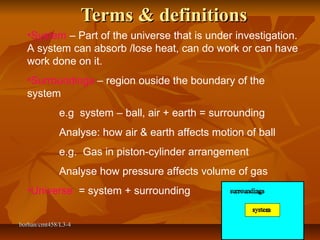
•System – Part of the universe that is under investigation.
A system can absorb /lose heat, can do work or can have
work done on it.
•Surroundings – region ouside the boundary of the
system
e.g system – ball, air + earth = surrounding
Analyse: how air & earth affects motion of ball
e.g. Gas in piston-cylinder arrangement
Analyse how pressure affects volume of gas
•Universe = system + surrounding
borhan/cmt458/L3-4borhan/cmt458/L3-4 22
Terms & definitionsTerms & definitions
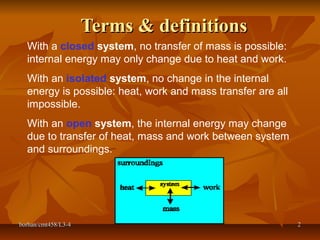
With a closed system, no transfer of mass is possible:
internal energy may only change due to heat and work.
With an isolated system, no change in the internal
energy is possible: heat, work and mass transfer are all
impossible.
With an open system, the internal energy may change
due to transfer of heat, mass and work between system
and surroundings.
borhan/cmt458/L3-4borhan/cmt458/L3-4 33
Terms & definitionsTerms & definitions
Homogeneous system,
a single-phase system where the property of
system is uniform over the system (same value
regardless of where it is measured)
Heterogeneous system
a multiple-phase system
the measured property varies with location where it
is evaluated
borhan/cmt458/L3-4borhan/cmt458/L3-4 44
Terms & DefinitionTerms & Definition
Intensive Property – A property that is independent of
amount of matter. It is non-additive
e.g density, temperature, pressure, specific heat
capacity
Extensive Property - A property that depends on amount
of matter. It is an additive property.
e.g mass, volume, heat capacity, enthalpy
Extensive/extensive = intensive property
Note: specific quantity = property/mass
e.g specific volume = volume/mass
specific internal energy = internal energy/mass
specific heat capacity = heat capacity/mass
borhan/cmt458/L3-4 5
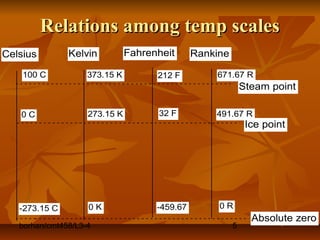
Relations among temp scalesRelations among temp scales
Celsius Kelvin Fahrenheit Rankine
Absolute zero
Ice point
Steam point
-273.15 C -459.670 K 0 R
0 C
100 C
273.15 K
373.15 K
32 F
212 F
491.67 R
671.67 R
borhan/cmt458/L3-4 6
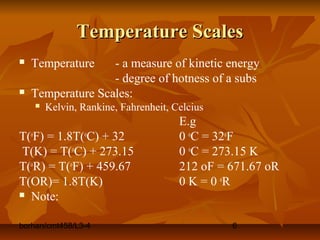
Temperature ScalesTemperature Scales
 Temperature - a measure of kinetic energy
- degree of hotness of a subs
 Temperature Scales:
 Kelvin, Rankine, Fahrenheit, Celcius
E.g
T(o
F) = 1.8T(o
C) + 32 0 o
C = 32o
F
T(K) = T(o
C) + 273.15 0 o
C = 273.15 K
T(o
R) = T(o
F) + 459.67 212 oF = 671.67 oR
T(OR)= 1.8T(K) 0 K = 0 o
R
 Note:
borhan/cmt458/L3-4 7
StateState
 Some terms associated with ‘state’Some terms associated with ‘state’
 StateState
 Change of stateChange of state
 Equation of stateEquation of state
 States of matterStates of matter
 State/Path functionsState/Path functions
borhan/cmt458/L3-4 8
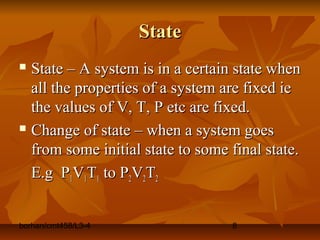
StateState
 State – A system is in a certain state whenState – A system is in a certain state when
all the properties of a system are fixed ieall the properties of a system are fixed ie
the values of V, T, P etc are fixed.the values of V, T, P etc are fixed.
 Change of state – when a system goesChange of state – when a system goes
from some initial state to some final state.from some initial state to some final state.
E.g PE.g P11VV11TT11 to Pto P22VV22TT22
borhan/cmt458/L3-4 9
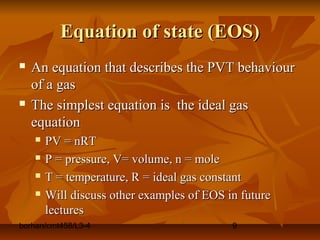
Equation of state (EOS)Equation of state (EOS)
 An equation that describes the PVT behaviourAn equation that describes the PVT behaviour
of a gasof a gas
 The simplest equation is the ideal gasThe simplest equation is the ideal gas
equationequation
 PV = nRTPV = nRT
 P = pressure, V= volume, n = moleP = pressure, V= volume, n = mole
 T = temperature, R = ideal gas constantT = temperature, R = ideal gas constant
 Will discuss other examples of EOS in futureWill discuss other examples of EOS in future
lectureslectures
borhan/cmt458/L3-4 10
States of MatterStates of Matter
 Solids – has definite volume &shapeSolids – has definite volume &shape
 Liquids – has volume no definite shapeLiquids – has volume no definite shape
 They flow and can be pouredThey flow and can be poured
 Gas – no definite volume and no def.Gas – no definite volume and no def.
shape –takes the volume and shape ofshape –takes the volume and shape of
containercontainer
 Plasma? – No def. volume or shapePlasma? – No def. volume or shape
 Composed of electrically charged particlesComposed of electrically charged particles
borhan/cmt458/L3-4 11
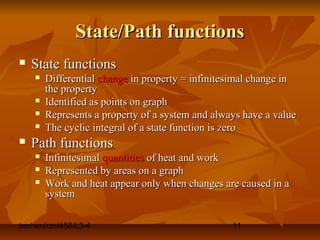
State/Path functionsState/Path functions
 State functionsState functions
 DifferentialDifferential changechange in property = infinitesimal change inin property = infinitesimal change in
the propertythe property
 Identified as points on graphIdentified as points on graph
 Represents a property of a system and always have a valueRepresents a property of a system and always have a value
 The cyclic integral of a state function is zeroThe cyclic integral of a state function is zero
 Path functionsPath functions
 InfinitesimalInfinitesimal quantitiesquantities of heat and workof heat and work
 Represented by areas on a graphRepresented by areas on a graph
 Work and heat appear only when changes are caused in aWork and heat appear only when changes are caused in a
systemsystem
borhan/cmt458/L3-4borhan/cmt458/L3-4 1212
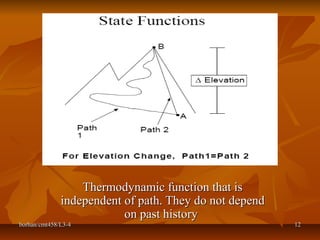
Thermodynamic function that isThermodynamic function that is
independent of path. They do not dependindependent of path. They do not depend
on past historyon past history
borhan/cmt458/L3-4 13
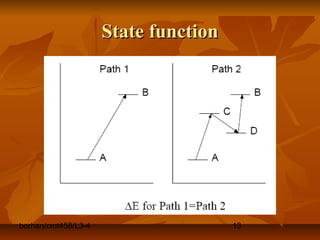
State functionState function
borhan/cmt458/L3-4 14
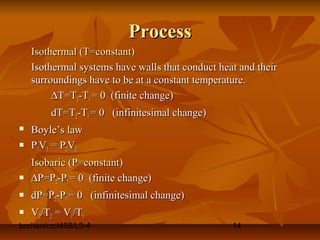
ProcessProcess
Isothermal (T=constant)Isothermal (T=constant)
Isothermal systems have walls that conduct heat and theirIsothermal systems have walls that conduct heat and their
surroundings have to be at a constant temperature.surroundings have to be at a constant temperature.
∆∆T=TT=T22-T-T11 = 0 (finite change)= 0 (finite change)
dT=TdT=T22-T-T11 = 0 (infinitesimal change)= 0 (infinitesimal change)
 Boyle’s lawBoyle’s law
 PP11VV11 = P= P22VV22
Isobaric (P=constant)Isobaric (P=constant)
 ∆∆P=PP=P22-P-P11 = 0 (finite change)= 0 (finite change)
 dP=PdP=P22-P-P11 = 0 (infinitesimal change)= 0 (infinitesimal change)
 VV22/T/T22 = V= V11/T/T11
borhan/cmt458/L3-4 15
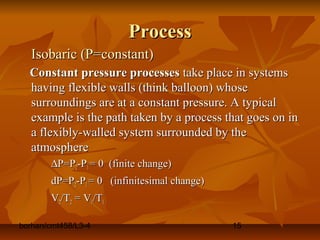
ProcessProcess
Isobaric (P=constant)Isobaric (P=constant)
Constant pressure processesConstant pressure processes take place in systemstake place in systems
having flexible walls (think balloon) whosehaving flexible walls (think balloon) whose
surroundings are at a constant pressure. A typicalsurroundings are at a constant pressure. A typical
example is the path taken by a process that goes on inexample is the path taken by a process that goes on in
a flexibly-walled system surrounded by thea flexibly-walled system surrounded by the
atmosphereatmosphere
∆∆P=PP=P22-P-P11 = 0 (finite change)= 0 (finite change)
dP=PdP=P22-P-P11 = 0 (infinitesimal change)= 0 (infinitesimal change)
VV22/T/T22 = V= V11/T/T11
borhan/cmt458/L3-4 16
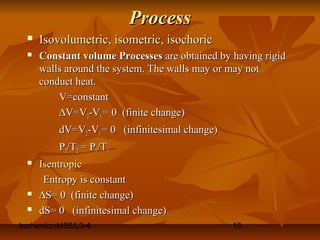
ProcessProcess
 Isovolumetric, isometric, isochoricIsovolumetric, isometric, isochoric
 Constant volume ProcessesConstant volume Processes are obtained by having rigidare obtained by having rigid
walls around the system. The walls may or may notwalls around the system. The walls may or may not
conduct heat.conduct heat.
V=constantV=constant
∆∆V=VV=V22-V-V11 = 0 (finite change)= 0 (finite change)
dV=VdV=V22-V-V11 = 0 (infinitesimal change)= 0 (infinitesimal change)
PP22/T/T22 = P= P11/T/T11
 IsentropicIsentropic
Entropy is constantEntropy is constant
 ∆∆S= 0 (finite change)S= 0 (finite change)
 dS= 0 (infinitesimal change)dS= 0 (infinitesimal change)
borhan/cmt458/L3-4 17
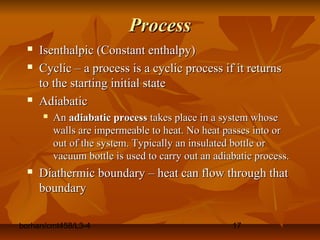
ProcessProcess
 Isenthalpic (Constant enthalpy)Isenthalpic (Constant enthalpy)
 Cyclic – a process is a cyclic process if it returnsCyclic – a process is a cyclic process if it returns
to the starting initial stateto the starting initial state
 AdiabaticAdiabatic
 AnAn adiabatic processadiabatic process takes place in a system whosetakes place in a system whose
walls are impermeable to heat. No heat passes into orwalls are impermeable to heat. No heat passes into or
out of the system. Typically an insulated bottle orout of the system. Typically an insulated bottle or
vacuum bottle is used to carry out an adiabatic process.vacuum bottle is used to carry out an adiabatic process.
 Diathermic boundary – heat can flow through thatDiathermic boundary – heat can flow through that
boundaryboundary
borhan/cmt458/L3-4 18
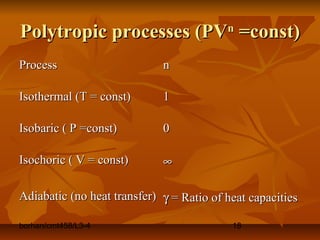
Polytropic processes (PVPolytropic processes (PVnn
=const)=const)
ProcessProcess nn
Isothermal (T = const)Isothermal (T = const) 11
Isobaric ( P =const)Isobaric ( P =const) 00
Isochoric ( V = const)Isochoric ( V = const) ∞∞
Adiabatic (no heat transfer)Adiabatic (no heat transfer) γγ = Ratio of heat capacities= Ratio of heat capacities
borhan/cmt458/L3-4 19
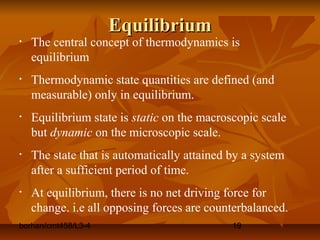
EquilibriumEquilibrium
• The central concept of thermodynamics is
equilibrium
• Thermodynamic state quantities are defined (and
measurable) only in equilibrium.
• Equilibrium state is static on the macroscopic scale
but dynamic on the microscopic scale.
• The state that is automatically attained by a system
after a sufficient period of time.
• At equilibrium, there is no net driving force for
change. i.e all opposing forces are counterbalanced.
borhan/cmt458/L3-4 20
EquilibriumEquilibrium
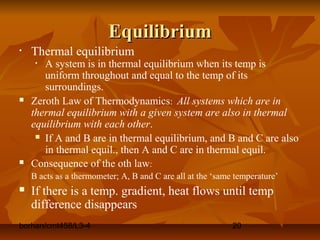
• Thermal equilibrium
• A system is in thermal equilibrium when its temp is
uniform throughout and equal to the temp of its
surroundings.
 Zeroth Law of Thermodynamics: All systems which are in
thermal equilibrium with a given system are also in thermal
equilibrium with each other.
 If A and B are in thermal equilibrium, and B and C are also
in thermal equil., then A and C are in thermal equil.
 Consequence of the oth law:
B acts as a thermometer; A, B and C are all at the ‘same temperature’
 If there is a temp. gradient, heat flows until temp
difference disappears
borhan/cmt458/L3-4 21
EquilibriumEquilibrium
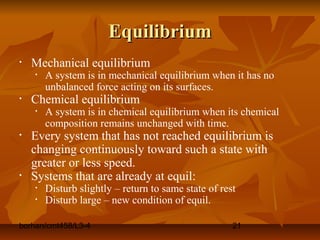
• Mechanical equilibrium
• A system is in mechanical equilibrium when it has no
unbalanced force acting on its surfaces.
• Chemical equilibrium
• A system is in chemical equilibrium when its chemical
composition remains unchanged with time.
• Every system that has not reached equilibrium is
changing continuously toward such a state with
greater or less speed.
• Systems that are already at equil:
• Disturb slightly – return to same state of rest
• Disturb large – new condition of equil.
borhan/cmt458/L3-4 22
Reversible ProcessReversible Process
 In thermodynamics, many situations are assumed to
be ideal situations in order to simplify problems e.g
reversibility
 A process is reversible when its direction can be
reversed at any point by an infinitesimal change in
external conditions.
 A reversible process never moves more than
differentially away from equilibrium.
 A process is reversible if the work and heat effects
from the process are sufficient to restore the system to
its original state.
borhan/cmt458/L3-4 23
Conditions of ReversibilityConditions of Reversibility
 Absence of dissipative processes such as friction
 The existence of the system in equilibrium state s at
all times.
 The maintainence of only infinitesimal differences in
thermodynamic potential between the systems and its
surroundings
 A reversible process produces the maximum or
requires the minimum amount of work
 For a reversible expansion/compression of a gas, the
external pressure is approximately the same as the
pressure of the gas i.e Pext =Pgas
borhan/cmt458/L3-4 24
PhasesPhases
 A region of uniformity in a system i.e a region ofA region of uniformity in a system i.e a region of
uniform (homogeneous) chemical compositionuniform (homogeneous) chemical composition
and uniform physical properties – separated byand uniform physical properties – separated by
definite physical boundarydefinite physical boundary
 A system containing liquid and vapour has twoA system containing liquid and vapour has two
regions of uniformity. In the vapour phase theregions of uniformity. In the vapour phase the
density is uniform throughout. In the liquid phase,density is uniform throughout. In the liquid phase,
the density is uniform throughout but has a valuethe density is uniform throughout but has a value
different from that in vap.different from that in vap.
 E.g A system containing CClE.g A system containing CCl44, H, H22O and air has 3O and air has 3
phases.phases.

Cmt458 lect3

  • 1.
    borhan/cmt458/L3-4borhan/cmt458/L3-4 11 Terms &definitionsTerms & definitions •System – Part of the universe that is under investigation. A system can absorb /lose heat, can do work or can have work done on it. •Surroundings – region ouside the boundary of the system e.g system – ball, air + earth = surrounding Analyse: how air & earth affects motion of ball e.g. Gas in piston-cylinder arrangement Analyse how pressure affects volume of gas •Universe = system + surrounding
  • 2.
    borhan/cmt458/L3-4borhan/cmt458/L3-4 22 Terms &definitionsTerms & definitions With a closed system, no transfer of mass is possible: internal energy may only change due to heat and work. With an isolated system, no change in the internal energy is possible: heat, work and mass transfer are all impossible. With an open system, the internal energy may change due to transfer of heat, mass and work between system and surroundings.
  • 3.
    borhan/cmt458/L3-4borhan/cmt458/L3-4 33 Terms &definitionsTerms & definitions Homogeneous system, a single-phase system where the property of system is uniform over the system (same value regardless of where it is measured) Heterogeneous system a multiple-phase system the measured property varies with location where it is evaluated
  • 4.
    borhan/cmt458/L3-4borhan/cmt458/L3-4 44 Terms &DefinitionTerms & Definition Intensive Property – A property that is independent of amount of matter. It is non-additive e.g density, temperature, pressure, specific heat capacity Extensive Property - A property that depends on amount of matter. It is an additive property. e.g mass, volume, heat capacity, enthalpy Extensive/extensive = intensive property Note: specific quantity = property/mass e.g specific volume = volume/mass specific internal energy = internal energy/mass specific heat capacity = heat capacity/mass
  • 5.
    borhan/cmt458/L3-4 5 Relations amongtemp scalesRelations among temp scales Celsius Kelvin Fahrenheit Rankine Absolute zero Ice point Steam point -273.15 C -459.670 K 0 R 0 C 100 C 273.15 K 373.15 K 32 F 212 F 491.67 R 671.67 R
  • 6.
    borhan/cmt458/L3-4 6 Temperature ScalesTemperatureScales  Temperature - a measure of kinetic energy - degree of hotness of a subs  Temperature Scales:  Kelvin, Rankine, Fahrenheit, Celcius E.g T(o F) = 1.8T(o C) + 32 0 o C = 32o F T(K) = T(o C) + 273.15 0 o C = 273.15 K T(o R) = T(o F) + 459.67 212 oF = 671.67 oR T(OR)= 1.8T(K) 0 K = 0 o R  Note:
  • 7.
    borhan/cmt458/L3-4 7 StateState  Someterms associated with ‘state’Some terms associated with ‘state’  StateState  Change of stateChange of state  Equation of stateEquation of state  States of matterStates of matter  State/Path functionsState/Path functions
  • 8.
    borhan/cmt458/L3-4 8 StateState  State– A system is in a certain state whenState – A system is in a certain state when all the properties of a system are fixed ieall the properties of a system are fixed ie the values of V, T, P etc are fixed.the values of V, T, P etc are fixed.  Change of state – when a system goesChange of state – when a system goes from some initial state to some final state.from some initial state to some final state. E.g PE.g P11VV11TT11 to Pto P22VV22TT22
  • 9.
    borhan/cmt458/L3-4 9 Equation ofstate (EOS)Equation of state (EOS)  An equation that describes the PVT behaviourAn equation that describes the PVT behaviour of a gasof a gas  The simplest equation is the ideal gasThe simplest equation is the ideal gas equationequation  PV = nRTPV = nRT  P = pressure, V= volume, n = moleP = pressure, V= volume, n = mole  T = temperature, R = ideal gas constantT = temperature, R = ideal gas constant  Will discuss other examples of EOS in futureWill discuss other examples of EOS in future lectureslectures
  • 10.
    borhan/cmt458/L3-4 10 States ofMatterStates of Matter  Solids – has definite volume &shapeSolids – has definite volume &shape  Liquids – has volume no definite shapeLiquids – has volume no definite shape  They flow and can be pouredThey flow and can be poured  Gas – no definite volume and no def.Gas – no definite volume and no def. shape –takes the volume and shape ofshape –takes the volume and shape of containercontainer  Plasma? – No def. volume or shapePlasma? – No def. volume or shape  Composed of electrically charged particlesComposed of electrically charged particles
  • 11.
    borhan/cmt458/L3-4 11 State/Path functionsState/Pathfunctions  State functionsState functions  DifferentialDifferential changechange in property = infinitesimal change inin property = infinitesimal change in the propertythe property  Identified as points on graphIdentified as points on graph  Represents a property of a system and always have a valueRepresents a property of a system and always have a value  The cyclic integral of a state function is zeroThe cyclic integral of a state function is zero  Path functionsPath functions  InfinitesimalInfinitesimal quantitiesquantities of heat and workof heat and work  Represented by areas on a graphRepresented by areas on a graph  Work and heat appear only when changes are caused in aWork and heat appear only when changes are caused in a systemsystem
  • 12.
    borhan/cmt458/L3-4borhan/cmt458/L3-4 1212 Thermodynamic functionthat isThermodynamic function that is independent of path. They do not dependindependent of path. They do not depend on past historyon past history
  • 13.
  • 14.
    borhan/cmt458/L3-4 14 ProcessProcess Isothermal (T=constant)Isothermal(T=constant) Isothermal systems have walls that conduct heat and theirIsothermal systems have walls that conduct heat and their surroundings have to be at a constant temperature.surroundings have to be at a constant temperature. ∆∆T=TT=T22-T-T11 = 0 (finite change)= 0 (finite change) dT=TdT=T22-T-T11 = 0 (infinitesimal change)= 0 (infinitesimal change)  Boyle’s lawBoyle’s law  PP11VV11 = P= P22VV22 Isobaric (P=constant)Isobaric (P=constant)  ∆∆P=PP=P22-P-P11 = 0 (finite change)= 0 (finite change)  dP=PdP=P22-P-P11 = 0 (infinitesimal change)= 0 (infinitesimal change)  VV22/T/T22 = V= V11/T/T11
  • 15.
    borhan/cmt458/L3-4 15 ProcessProcess Isobaric (P=constant)Isobaric(P=constant) Constant pressure processesConstant pressure processes take place in systemstake place in systems having flexible walls (think balloon) whosehaving flexible walls (think balloon) whose surroundings are at a constant pressure. A typicalsurroundings are at a constant pressure. A typical example is the path taken by a process that goes on inexample is the path taken by a process that goes on in a flexibly-walled system surrounded by thea flexibly-walled system surrounded by the atmosphereatmosphere ∆∆P=PP=P22-P-P11 = 0 (finite change)= 0 (finite change) dP=PdP=P22-P-P11 = 0 (infinitesimal change)= 0 (infinitesimal change) VV22/T/T22 = V= V11/T/T11
  • 16.
    borhan/cmt458/L3-4 16 ProcessProcess  Isovolumetric,isometric, isochoricIsovolumetric, isometric, isochoric  Constant volume ProcessesConstant volume Processes are obtained by having rigidare obtained by having rigid walls around the system. The walls may or may notwalls around the system. The walls may or may not conduct heat.conduct heat. V=constantV=constant ∆∆V=VV=V22-V-V11 = 0 (finite change)= 0 (finite change) dV=VdV=V22-V-V11 = 0 (infinitesimal change)= 0 (infinitesimal change) PP22/T/T22 = P= P11/T/T11  IsentropicIsentropic Entropy is constantEntropy is constant  ∆∆S= 0 (finite change)S= 0 (finite change)  dS= 0 (infinitesimal change)dS= 0 (infinitesimal change)
  • 17.
    borhan/cmt458/L3-4 17 ProcessProcess  Isenthalpic(Constant enthalpy)Isenthalpic (Constant enthalpy)  Cyclic – a process is a cyclic process if it returnsCyclic – a process is a cyclic process if it returns to the starting initial stateto the starting initial state  AdiabaticAdiabatic  AnAn adiabatic processadiabatic process takes place in a system whosetakes place in a system whose walls are impermeable to heat. No heat passes into orwalls are impermeable to heat. No heat passes into or out of the system. Typically an insulated bottle orout of the system. Typically an insulated bottle or vacuum bottle is used to carry out an adiabatic process.vacuum bottle is used to carry out an adiabatic process.  Diathermic boundary – heat can flow through thatDiathermic boundary – heat can flow through that boundaryboundary
  • 18.
    borhan/cmt458/L3-4 18 Polytropic processes(PVPolytropic processes (PVnn =const)=const) ProcessProcess nn Isothermal (T = const)Isothermal (T = const) 11 Isobaric ( P =const)Isobaric ( P =const) 00 Isochoric ( V = const)Isochoric ( V = const) ∞∞ Adiabatic (no heat transfer)Adiabatic (no heat transfer) γγ = Ratio of heat capacities= Ratio of heat capacities
  • 19.
    borhan/cmt458/L3-4 19 EquilibriumEquilibrium • Thecentral concept of thermodynamics is equilibrium • Thermodynamic state quantities are defined (and measurable) only in equilibrium. • Equilibrium state is static on the macroscopic scale but dynamic on the microscopic scale. • The state that is automatically attained by a system after a sufficient period of time. • At equilibrium, there is no net driving force for change. i.e all opposing forces are counterbalanced.
  • 20.
    borhan/cmt458/L3-4 20 EquilibriumEquilibrium • Thermalequilibrium • A system is in thermal equilibrium when its temp is uniform throughout and equal to the temp of its surroundings.  Zeroth Law of Thermodynamics: All systems which are in thermal equilibrium with a given system are also in thermal equilibrium with each other.  If A and B are in thermal equilibrium, and B and C are also in thermal equil., then A and C are in thermal equil.  Consequence of the oth law: B acts as a thermometer; A, B and C are all at the ‘same temperature’  If there is a temp. gradient, heat flows until temp difference disappears
  • 21.
    borhan/cmt458/L3-4 21 EquilibriumEquilibrium • Mechanicalequilibrium • A system is in mechanical equilibrium when it has no unbalanced force acting on its surfaces. • Chemical equilibrium • A system is in chemical equilibrium when its chemical composition remains unchanged with time. • Every system that has not reached equilibrium is changing continuously toward such a state with greater or less speed. • Systems that are already at equil: • Disturb slightly – return to same state of rest • Disturb large – new condition of equil.
  • 22.
    borhan/cmt458/L3-4 22 Reversible ProcessReversibleProcess  In thermodynamics, many situations are assumed to be ideal situations in order to simplify problems e.g reversibility  A process is reversible when its direction can be reversed at any point by an infinitesimal change in external conditions.  A reversible process never moves more than differentially away from equilibrium.  A process is reversible if the work and heat effects from the process are sufficient to restore the system to its original state.
  • 23.
    borhan/cmt458/L3-4 23 Conditions ofReversibilityConditions of Reversibility  Absence of dissipative processes such as friction  The existence of the system in equilibrium state s at all times.  The maintainence of only infinitesimal differences in thermodynamic potential between the systems and its surroundings  A reversible process produces the maximum or requires the minimum amount of work  For a reversible expansion/compression of a gas, the external pressure is approximately the same as the pressure of the gas i.e Pext =Pgas
  • 24.
    borhan/cmt458/L3-4 24 PhasesPhases  Aregion of uniformity in a system i.e a region ofA region of uniformity in a system i.e a region of uniform (homogeneous) chemical compositionuniform (homogeneous) chemical composition and uniform physical properties – separated byand uniform physical properties – separated by definite physical boundarydefinite physical boundary  A system containing liquid and vapour has twoA system containing liquid and vapour has two regions of uniformity. In the vapour phase theregions of uniformity. In the vapour phase the density is uniform throughout. In the liquid phase,density is uniform throughout. In the liquid phase, the density is uniform throughout but has a valuethe density is uniform throughout but has a value different from that in vap.different from that in vap.  E.g A system containing CClE.g A system containing CCl44, H, H22O and air has 3O and air has 3 phases.phases.