Carbonyl Compounds
and Nucleophilic
Addition
Md. Saiful Islam
BPharm, MSc
North South University
Fb Group: Pharmacy Universe
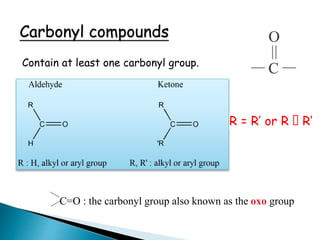
Carbonyl compounds
Contain at least one carbonyl group.
R = R’ or R R’
C=O : the carbonyl group also known as the oxo group
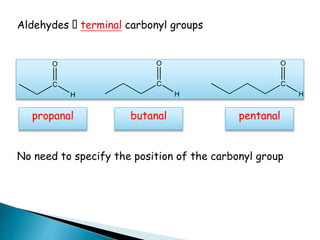
Aldehydes terminal carbonyl groups
C
H
O
C
H
O
C
H
O
propanal butanal pentanal
No need to specify the position of the carbonyl group
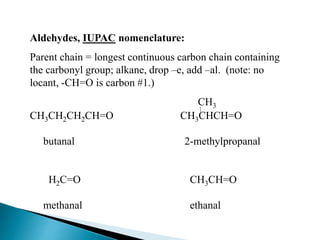
Aldehydes, IUPAC nomenclature:
Parent chain = longest continuous carbon chain containing
the carbonyl group; alkane, drop –e, add –al. (note: no
locant, -CH=O is carbon #1.)
CH3
CH3CH2CH2CH=O CH3CHCH=O
butanal 2-methylpropanal
H2C=O CH3CH=O
methanal ethanal
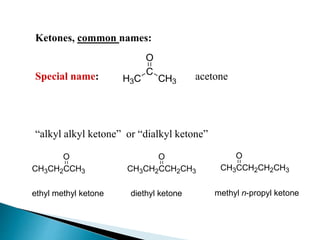
Ketones, common names:
Special name: acetone
“alkyl alkyl ketone” or “dialkyl ketone”
H3C
C
CH3
O
CH3CH2CCH3
O
CH3CH2CCH2CH3
O
ethyl methyl ketone diethyl ketone
CH3CCH2CH2CH3
O
methyl n-propyl ketone
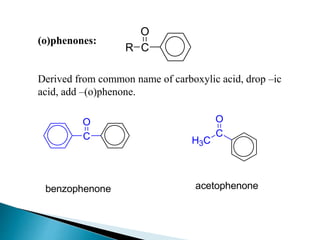
(o)phenones:
Derived from common name of carboxylic acid, drop –ic
acid, add –(o)phenone.
CR
O
C
O
H3C
C
O
benzophenone acetophenone
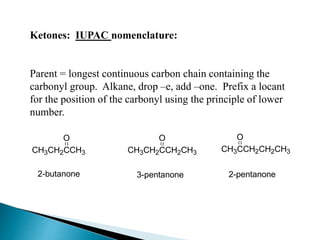
Ketones: IUPAC nomenclature:
Parent = longest continuous carbon chain containing the
carbonyl group. Alkane, drop –e, add –one. Prefix a locant
for the position of the carbonyl using the principle of lower
number.
CH3CH2CCH3
O
CH3CH2CCH2CH3
O
2-butanone 3-pentanone
CH3CCH2CH2CH3
O
2-pentanone
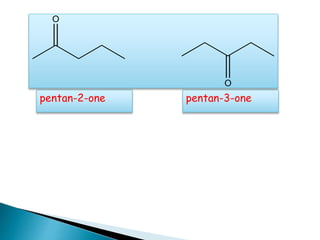
pentan-2-one pentan-3-one
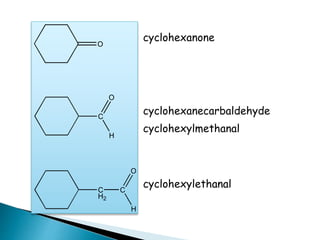
O
O
O
C
H
O
C
H2
C
H
O
cyclohexanone
cyclohexanecarbaldehyde
cyclohexylethanal
cyclohexylmethanal
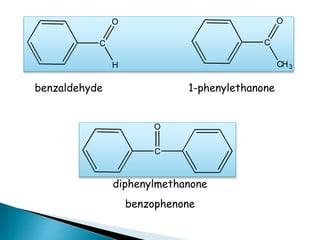
C
H
O
C
CH3
O
benzaldehyde 1-phenylethanone
C
O
benzophenone
diphenylmethanone
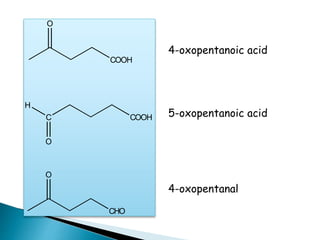
COOH
O
C COOH
H
O
CHO
O
4-oxopentanoic acid
5-oxopentanoic acid
4-oxopentanal
Physical Properties
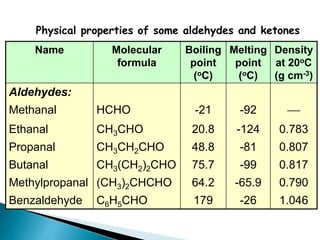
Most simple aliphatic ketones and aldehydes are liquids at
room temperature except methanal (b.p. = -21°C) and
ethanal (b.p. = 20.8°C)
Aliphatic aldehydes have an unpleasant and pungent smell
Ketones and aromatic aldehydes have a pleasant and
sweet odor
Name Molecular
formula
Boiling
point
(oC)
Melting
point
(oC)
Density
at 20oC
(g cm-3)
Aldehydes:
Methanal HCHO -21 -92 
Ethanal CH3CHO 20.8 -124 0.783
Propanal CH3CH2CHO 48.8 -81 0.807
Butanal CH3(CH2)2CHO 75.7 -99 0.817
Methylpropanal (CH3)2CHCHO 64.2 -65.9 0.790
Benzaldehyde C6H5CHO 179 -26 1.046
Physical properties of some aldehydes and ketones
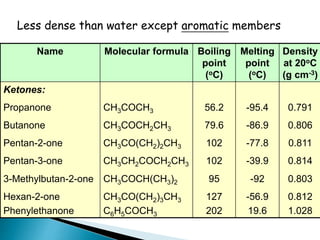
Less dense than water except aromatic members
Name Molecular formula Boiling
point
(oC)
Melting
point
(oC)
Density
at 20oC
(g cm-3)
Ketones:
Propanone CH3COCH3 56.2 -95.4 0.791
Butanone CH3COCH2CH3 79.6 -86.9 0.806
Pentan-2-one CH3CO(CH2)2CH3 102 -77.8 0.811
Pentan-3-one CH3CH2COCH2CH3 102 -39.9 0.814
3-Methylbutan-2-one CH3COCH(CH3)2 95 -92 0.803
Hexan-2-one
Phenylethanone
CH3CO(CH2)3CH3
C6H5COCH3
127
202
-56.9
19.6
0.812
1.028
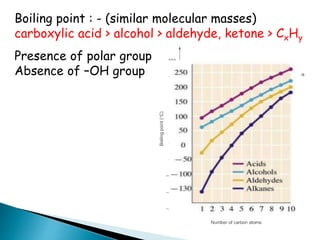
Boiling point : - (similar molecular masses)
carboxylic acid > alcohol > aldehyde, ketone > CxHy
Presence of polar group
Absence of –OH group
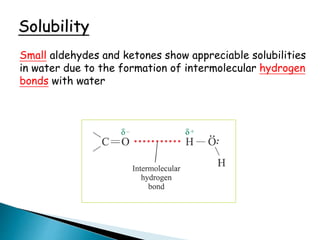
Solubility
Small aldehydes and ketones show appreciable solubilities
in water due to the formation of intermolecular hydrogen
bonds with water
Solubility
Ethanal and propanone are miscible with water in all
proportions.
Propanone(acetone) is volatile and miscible with water
Once used to clean quick-fit apparatus
potentially carcinogenic
Solubility
Methanal gas dissolves readily in water
Aqueous solutions of methanal (Formalin) are used to
preserve biological specimens
Methanal(formaldehyde) is highly toxic
Industrial preparation
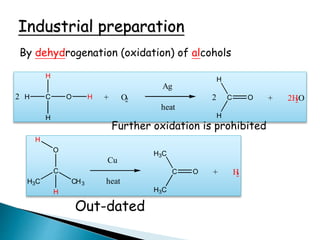
By dehydrogenation (oxidation) of alcohols
C
H
H
H
O H2 + O2
Ag
heat
C O
H
H
2 + 2H2O
Cu
heat
C O
H3C
H3C
+ H2
H3C
C
CH3
O
H
H
Out-dated
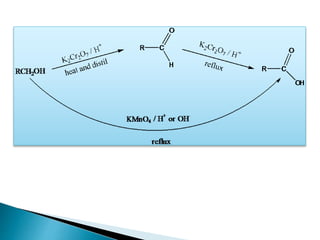
Further oxidation is prohibited
Laboratory preparation
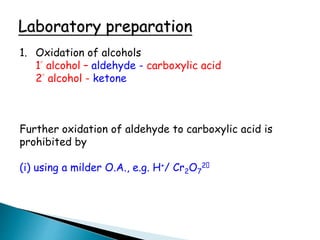
1. Oxidation of alcohols
1° alcohol – aldehyde - carboxylic acid
2° alcohol - ketone
Further oxidation of aldehyde to carboxylic acid is
prohibited by
(i) using a milder O.A., e.g. H+/ Cr2O7
2
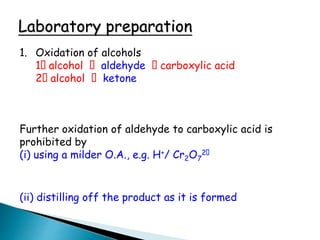
Laboratory preparation
1. Oxidation of alcohols
1 alcohol aldehyde carboxylic acid
2 alcohol ketone
Further oxidation of aldehyde to carboxylic acid is
prohibited by
(i) using a milder O.A., e.g. H+/ Cr2O7
2
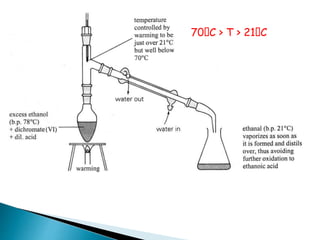
(ii) distilling off the product as it is formed
70 C > T > 21 C
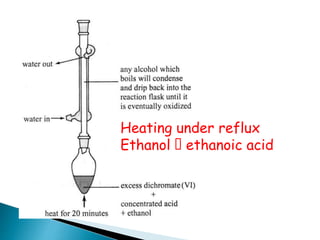
Heating under reflux
Ethanol ethanoic acid
2 alcohol ketone
Further oxidation of ketone to carboxylic acid has not
synthetic application since
carboxylic acid
C O
H3C
H3C
[o] H3C
C O
HO
+ other products
High T
1. it requires more drastic reaction conditions
2. it results in a mixture of organic products
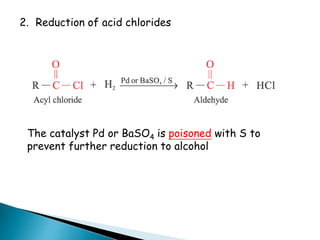
The catalyst Pd or BaSO4 is poisoned with S to
prevent further reduction to alcohol
2. Reduction of acid chlorides
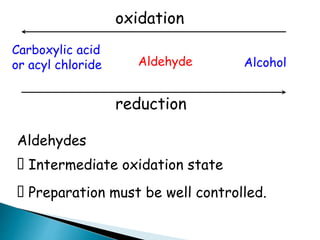
Carboxylic acid
or acyl chloride Aldehyde Alcohol
oxidation
reduction
Preparation must be well controlled.
Intermediate oxidation state
Aldehydes
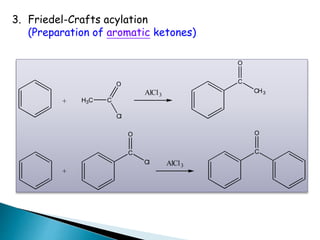
3. Friedel-Crafts acylation
(Preparation of aromatic ketones)
+ H3C C
Cl
O
AlCl3
+
C
Cl
O
AlCl3
C
CH3
O
C
O
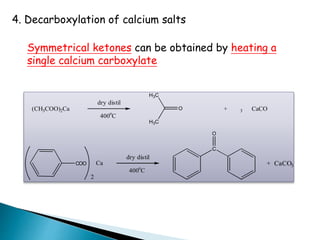
4. Decarboxylation of calcium salts
Symmetrical ketones can be obtained by heating a
single calcium carboxylate
(CH3COO)2Ca + CaCO3
dry distil
400o
C
O
H3C
H3C
COO
2
Ca
dry distil
400o
C
C
O
+ CaCO3
4. Decarboxylation of calcium salts
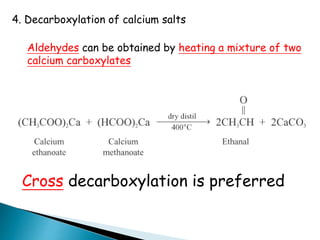
Aldehydes can be obtained by heating a mixture of two
calcium carboxylates
Cross decarboxylation is preferred
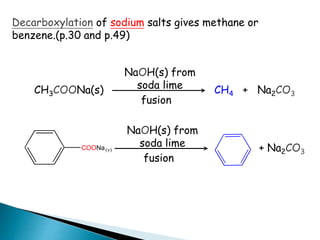
Decarboxylation of sodium salts gives methane or
benzene.(p.30 and p.49)
NaOH(s) from
soda lime
fusion
CH3COONa(s) CH4 + Na2CO3
NaOH(s) from
soda lime
fusion
+ Na2CO3
COONa(s)
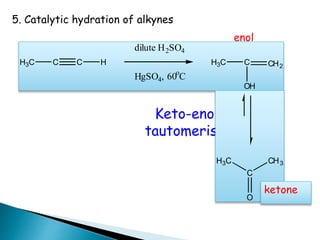
5. Catalytic hydration of alkynes
Keto-enol
tautomerism
C C HH3C
dilute H2SO4
HgSO4, 60o
C
H3C C
OH
CH2
enol
H3C
C
CH3
O
ketone
C C HH
dilute H2SO4
HgSO4, 60o
C
H2C C
OH
H3C
C
H
O
H
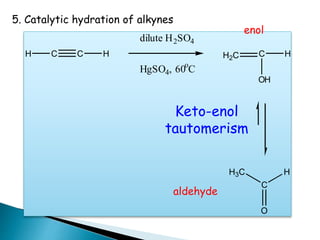
5. Catalytic hydration of alkynes
Keto-enol
tautomerism
enol
aldehyde
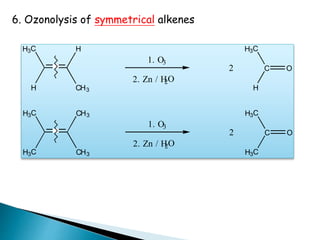
6. Ozonolysis of symmetrical alkenes
CH3
H
H
H3C
1. O3
2. Zn / H2O
C O
H
H3C
2
CH3
CH3
H3C
H3C
1. O3
2. Zn / H2O
C O
H3C
H3C
2
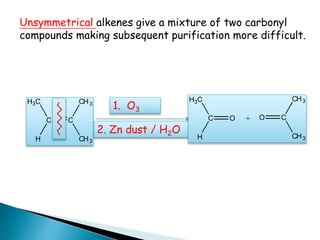
Unsymmetrical alkenes give a mixture of two carbonyl
compounds making subsequent purification more difficult.
1. O3
2. Zn dust / H2O
C C
H
H3C
CH3
CH3
O C
CH3
CH3
C O
H
H3C
+
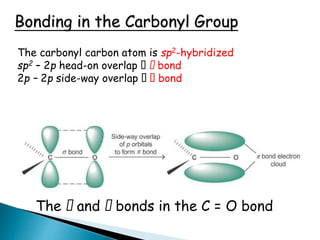
Bonding in the Carbonyl Group
The carbonyl carbon atom is sp2-hybridized
sp2 – 2p head-on overlap bond
2p – 2p side-way overlap bond
The and bonds in the C = O bond
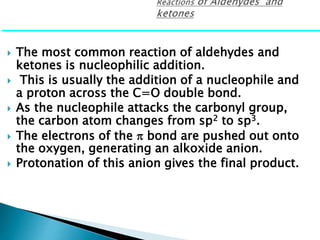
 The most common reaction of aldehydes and
ketones is nucleophilic addition.
 This is usually the addition of a nucleophile and
a proton across the C=O double bond.
 As the nucleophile attacks the carbonyl group,
the carbon atom changes from sp2 to sp3.
 The electrons of the  bond are pushed out onto
the oxygen, generating an alkoxide anion.
 Protonation of this anion gives the final product.
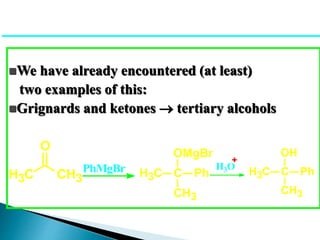
We have already encountered (at least)
two examples of this:
Grignards and ketones  tertiary alcohols
PhMgBr
H3C CH3
O
H3C C
OMgBr
CH3
Ph
H3O
+
H3C C
OH
CH3
Ph
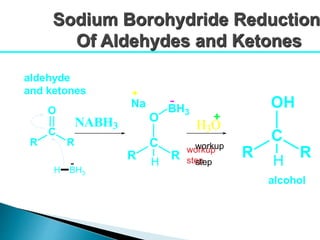
Sodium Borohydride Reduction
Of Aldehydes and Ketones
H BH3
-
workup
step
alcohol
aldehyde
and ketones
R
C
R
O
NABH3
R
C
R
O
BH3
H
Na
+
-
+
H3O
R
C
R
OH
H
workup
step
LITHIUM ALUMINUM HYDRIDE
REDUCTIONS
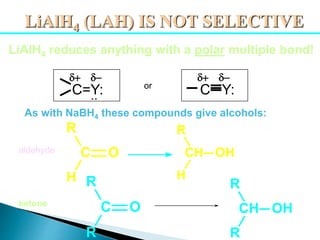
LiAlH4 reduces anything with a polar multiple bond!
aldehyde
ketone
LiAlH4 (LAH) IS NOT SELECTIVE
As with NaBH4 these compounds give alcohols:
C=Y:
d+ d-
or
C Y:
d+ d-
..
H
C
R
O
H
CH
R
OH
R
CH
R
OH
R
C
R
O
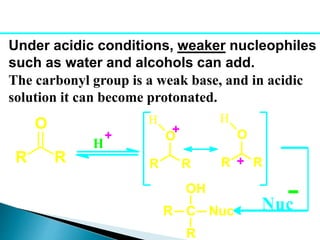
Under acidic conditions, weaker nucleophiles
such as water and alcohols can add.
The carbonyl group is a weak base, and in acidic
solution it can become protonated.
R R
O
H
+
R R
O
H
+
R R
O
H
+
Nuc-R C
OH
R
Nuc
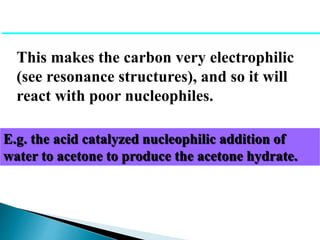
This makes the carbon very electrophilic
(see resonance structures), and so it will
react with poor nucleophiles.
E.g. the acid catalyzed nucleophilic addition of
water to acetone to produce the acetone hydrate.
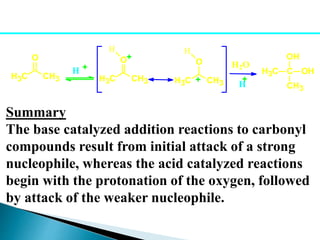
Summary
The base catalyzed addition reactions to carbonyl
compounds result from initial attack of a strong
nucleophile, whereas the acid catalyzed reactions
begin with the protonation of the oxygen, followed
by attack of the weaker nucleophile.
H3C C
OH
CH3
OH
H3C CH3
O
H +
H
+
H2O
H3C CH3
O
H
+
H3C CH3
O
H
+
Aldehydes are more reactive than ketones.
This (like all things) stems from two
factors: (1) electronics
(2) sterics
Relative Reactivity
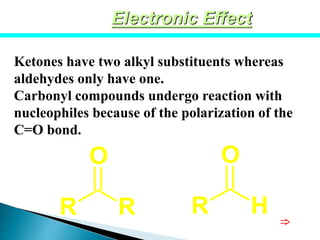
Electronic Effect
Ketones have two alkyl substituents whereas
aldehydes only have one.
Carbonyl compounds undergo reaction with
nucleophiles because of the polarization of the
C=O bond.
R R
O
R H
O
Alkyl groups are electron donating, and
so ketones have their effective partial
positive charge reduced more than
aldehydes (two alkyl substituents vs.
one alkyl substituent).
(Aldehydes more reactive than ketones)
The electrophilic carbon is the site that the
nucleophile must approach for reaction to
occur.
In ketones the two alkyl substituents create
more steric hindrance than the single
substituent that aldehydes have.
Therefore ketones offer more steric resistance
to nucleophilic attack.
(Aldehydes more reactive than ketones).
Therefore both factors make aldehydes more
reactive than ketones.
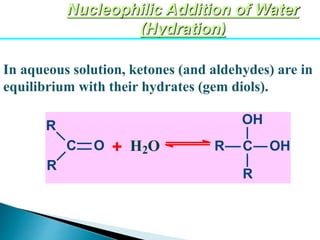
Nucleophilic Addition of Water
(Hydration)
In aqueous solution, ketones (and aldehydes) are in
equilibrium with their hydrates (gem diols).
H2O R C
OH
R
OHC O
R
R
+
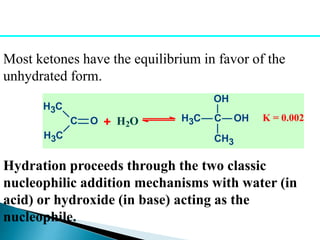
Most ketones have the equilibrium in favor of the
unhydrated form.
H2O H3C C
OH
CH3
OHC O
H3C
H3C
+ K = 0.002
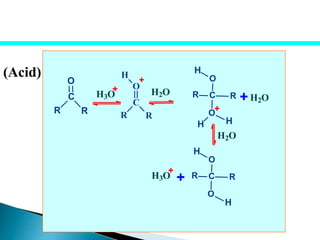
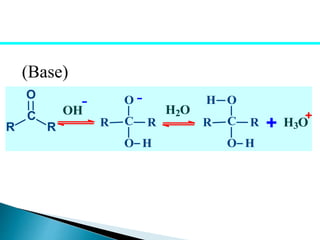
Hydration proceeds through the two classic
nucleophilic addition mechanisms with water (in
acid) or hydroxide (in base) acting as the
nucleophile.
(Acid)
H3OC
O
R R
+
+
R C
O
R
H
O
HH
+
H2O
H2O
H3O
+
R C
O
R
H
O
H
C
O
H
R R
+
H2O
+
(Base)
H3O
+C
O
R R
O H
+
OHC
O
R R
H2O
- -
C
O
R R
O H
H
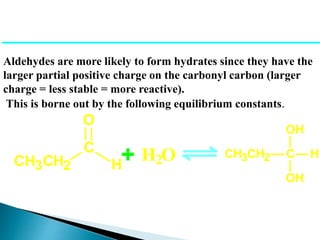
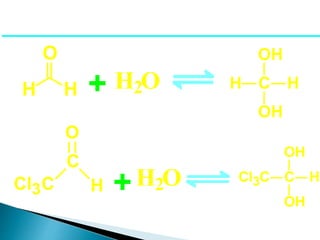
Aldehydes are more likely to form hydrates since they have the
larger partial positive charge on the carbonyl carbon (larger
charge = less stable = more reactive).
This is borne out by the following equilibrium constants.
CH3CH2
C
H
O
+ H2O CH3CH2 C
OH
OH
H
H H
O
+ H C
OH
OH
H
Cl3C
C
H
O
H2O+
H2O
Cl3C C
OH
OH
H
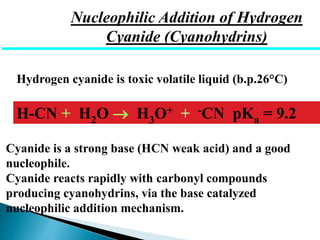
Nucleophilic Addition of Hydrogen
Cyanide (Cyanohydrins)
Hydrogen cyanide is toxic volatile liquid (b.p.26°C)
H-CN + H2O  H3O+ + -CN pKa = 9.2
Cyanide is a strong base (HCN weak acid) and a good
nucleophile.
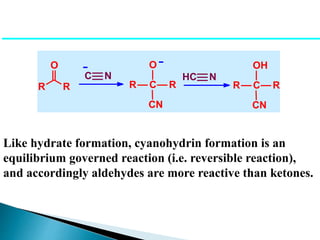
Cyanide reacts rapidly with carbonyl compounds
producing cyanohydrins, via the base catalyzed
nucleophilic addition mechanism.
R R
O
R C
O
CN
R
C N
- -
HC N
R C
OH
CN
R
Like hydrate formation, cyanohydrin formation is an
equilibrium governed reaction (i.e. reversible reaction),
and accordingly aldehydes are more reactive than ketones.
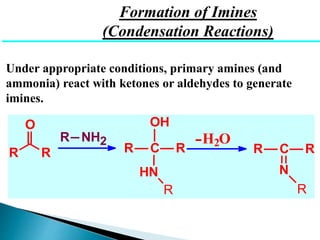
Formation of Imines
(Condensation Reactions)
Under appropriate conditions, primary amines (and
ammonia) react with ketones or aldehydes to generate
imines.
H2O
R R
O
R C
OH
HN
R
R
R NH2 - R C
N
R
R
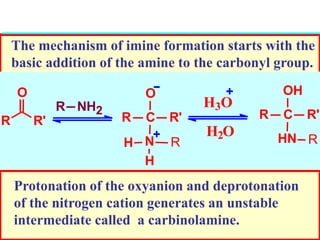
The mechanism of imine formation starts with the
basic addition of the amine to the carbonyl group.
H2O+
R R'
O
R NH2
-
R C
O
N
R'
RH
H
H3O
+
R C
OH
HN
R'
R
Protonation of the oxyanion and deprotonation
of the nitrogen cation generates an unstable
intermediate called a carbinolamine.
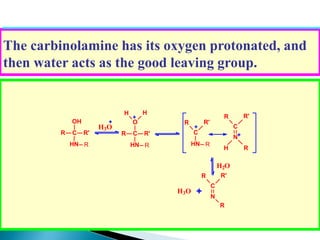
The carbinolamine has its oxygen protonated, and
then water acts as the good leaving group.
H2O
+
H3O
+
R C
OH
HN
R'
R
R C
O
HN
R'
R
HH
R
C
HN
R'
R
+
+
R
C
R'
N
R
R
C
R'
N
H R
H3O +
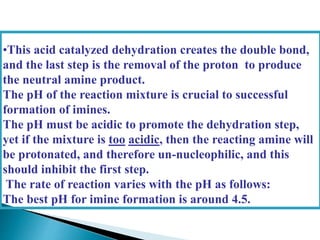
•This acid catalyzed dehydration creates the double bond,
and the last step is the removal of the proton to produce
the neutral amine product.
The pH of the reaction mixture is crucial to successful
formation of imines.
The pH must be acidic to promote the dehydration step,
yet if the mixture is too acidic, then the reacting amine will
be protonated, and therefore un-nucleophilic, and this
should inhibit the first step.
The rate of reaction varies with the pH as follows:
The best pH for imine formation is around 4.5.
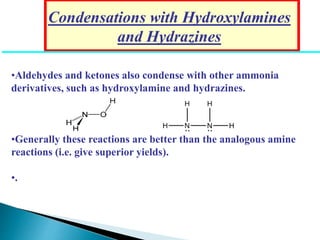
Condensations with Hydroxylamines
and Hydrazines
•Aldehydes and ketones also condense with other ammonia
derivatives, such as hydroxylamine and hydrazines.
•Generally these reactions are better than the analogous amine
reactions (i.e. give superior yields).
•.
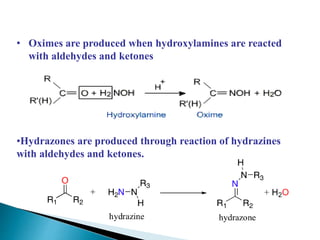
• Oximes are produced when hydroxylamines are reacted
with aldehydes and ketones
•Hydrazones are produced through reaction of hydrazines
with aldehydes and ketones.
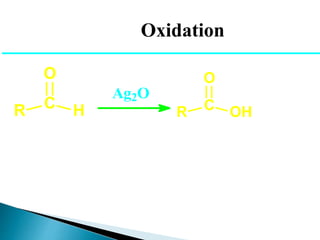
Oxidation
•Unlike ketones, aldehydes can be oxidized easily to
carboxylic acids (Chromic acid, permanganate etc).
R C H
O
[O]
R C OH
O
Even weak oxidants like silver (I) oxide can perform this
reaction, and this is a good, mild selective way to prepare
carboxylic acids in the presence of other (oxidizable)
functionalities. E.g.
Oxidation
R C H
O
R C OH
O
Ag2O
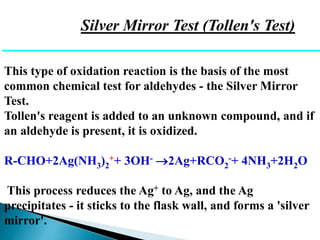
Silver Mirror Test (Tollen's Test)
This type of oxidation reaction is the basis of the most
common chemical test for aldehydes - the Silver Mirror
Test.
Tollen's reagent is added to an unknown compound, and if
an aldehyde is present, it is oxidized.
R-CHO+2Ag(NH3)2
++ 3OH- 2Ag+RCO2
-+ 4NH3+2H2O
This process reduces the Ag+ to Ag, and the Ag
precipitates - it sticks to the flask wall, and forms a 'silver
mirror'.

carbonyl compounds (short)

  • 1.
    Carbonyl Compounds and Nucleophilic Addition Md.Saiful Islam BPharm, MSc North South University Fb Group: Pharmacy Universe
  • 2.
    Carbonyl compounds Contain atleast one carbonyl group. R = R’ or R R’ C=O : the carbonyl group also known as the oxo group
  • 3.
    Aldehydes terminal carbonylgroups C H O C H O C H O propanal butanal pentanal No need to specify the position of the carbonyl group
  • 4.
    Aldehydes, IUPAC nomenclature: Parentchain = longest continuous carbon chain containing the carbonyl group; alkane, drop –e, add –al. (note: no locant, -CH=O is carbon #1.) CH3 CH3CH2CH2CH=O CH3CHCH=O butanal 2-methylpropanal H2C=O CH3CH=O methanal ethanal
  • 5.
    Ketones, common names: Specialname: acetone “alkyl alkyl ketone” or “dialkyl ketone” H3C C CH3 O CH3CH2CCH3 O CH3CH2CCH2CH3 O ethyl methyl ketone diethyl ketone CH3CCH2CH2CH3 O methyl n-propyl ketone
  • 6.
    (o)phenones: Derived from commonname of carboxylic acid, drop –ic acid, add –(o)phenone. CR O C O H3C C O benzophenone acetophenone
  • 7.
    Ketones: IUPAC nomenclature: Parent= longest continuous carbon chain containing the carbonyl group. Alkane, drop –e, add –one. Prefix a locant for the position of the carbonyl using the principle of lower number. CH3CH2CCH3 O CH3CH2CCH2CH3 O 2-butanone 3-pentanone CH3CCH2CH2CH3 O 2-pentanone
  • 8.
  • 9.
  • 10.
  • 11.
  • 12.
    Physical Properties Most simplealiphatic ketones and aldehydes are liquids at room temperature except methanal (b.p. = -21°C) and ethanal (b.p. = 20.8°C) Aliphatic aldehydes have an unpleasant and pungent smell Ketones and aromatic aldehydes have a pleasant and sweet odor
  • 13.
    Name Molecular formula Boiling point (oC) Melting point (oC) Density at 20oC (gcm-3) Aldehydes: Methanal HCHO -21 -92  Ethanal CH3CHO 20.8 -124 0.783 Propanal CH3CH2CHO 48.8 -81 0.807 Butanal CH3(CH2)2CHO 75.7 -99 0.817 Methylpropanal (CH3)2CHCHO 64.2 -65.9 0.790 Benzaldehyde C6H5CHO 179 -26 1.046 Physical properties of some aldehydes and ketones
  • 14.
    Less dense thanwater except aromatic members Name Molecular formula Boiling point (oC) Melting point (oC) Density at 20oC (g cm-3) Ketones: Propanone CH3COCH3 56.2 -95.4 0.791 Butanone CH3COCH2CH3 79.6 -86.9 0.806 Pentan-2-one CH3CO(CH2)2CH3 102 -77.8 0.811 Pentan-3-one CH3CH2COCH2CH3 102 -39.9 0.814 3-Methylbutan-2-one CH3COCH(CH3)2 95 -92 0.803 Hexan-2-one Phenylethanone CH3CO(CH2)3CH3 C6H5COCH3 127 202 -56.9 19.6 0.812 1.028
  • 15.
    Boiling point :- (similar molecular masses) carboxylic acid > alcohol > aldehyde, ketone > CxHy Presence of polar group Absence of –OH group
  • 16.
    Solubility Small aldehydes andketones show appreciable solubilities in water due to the formation of intermolecular hydrogen bonds with water
  • 17.
    Solubility Ethanal and propanoneare miscible with water in all proportions. Propanone(acetone) is volatile and miscible with water Once used to clean quick-fit apparatus potentially carcinogenic
  • 18.
    Solubility Methanal gas dissolvesreadily in water Aqueous solutions of methanal (Formalin) are used to preserve biological specimens Methanal(formaldehyde) is highly toxic
  • 19.
    Industrial preparation By dehydrogenation(oxidation) of alcohols C H H H O H2 + O2 Ag heat C O H H 2 + 2H2O Cu heat C O H3C H3C + H2 H3C C CH3 O H H Out-dated Further oxidation is prohibited
  • 20.
    Laboratory preparation 1. Oxidationof alcohols 1° alcohol – aldehyde - carboxylic acid 2° alcohol - ketone Further oxidation of aldehyde to carboxylic acid is prohibited by (i) using a milder O.A., e.g. H+/ Cr2O7 2
  • 22.
    Laboratory preparation 1. Oxidationof alcohols 1 alcohol aldehyde carboxylic acid 2 alcohol ketone Further oxidation of aldehyde to carboxylic acid is prohibited by (i) using a milder O.A., e.g. H+/ Cr2O7 2 (ii) distilling off the product as it is formed
  • 23.
    70 C >T > 21 C
  • 24.
  • 25.
    2 alcohol ketone Furtheroxidation of ketone to carboxylic acid has not synthetic application since carboxylic acid C O H3C H3C [o] H3C C O HO + other products High T 1. it requires more drastic reaction conditions 2. it results in a mixture of organic products
  • 26.
    The catalyst Pdor BaSO4 is poisoned with S to prevent further reduction to alcohol 2. Reduction of acid chlorides
  • 27.
    Carboxylic acid or acylchloride Aldehyde Alcohol oxidation reduction Preparation must be well controlled. Intermediate oxidation state Aldehydes
  • 28.
    3. Friedel-Crafts acylation (Preparationof aromatic ketones) + H3C C Cl O AlCl3 + C Cl O AlCl3 C CH3 O C O
  • 29.
    4. Decarboxylation ofcalcium salts Symmetrical ketones can be obtained by heating a single calcium carboxylate (CH3COO)2Ca + CaCO3 dry distil 400o C O H3C H3C COO 2 Ca dry distil 400o C C O + CaCO3
  • 30.
    4. Decarboxylation ofcalcium salts Aldehydes can be obtained by heating a mixture of two calcium carboxylates Cross decarboxylation is preferred
  • 31.
    Decarboxylation of sodiumsalts gives methane or benzene.(p.30 and p.49) NaOH(s) from soda lime fusion CH3COONa(s) CH4 + Na2CO3 NaOH(s) from soda lime fusion + Na2CO3 COONa(s)
  • 32.
    5. Catalytic hydrationof alkynes Keto-enol tautomerism C C HH3C dilute H2SO4 HgSO4, 60o C H3C C OH CH2 enol H3C C CH3 O ketone
  • 33.
    C C HH diluteH2SO4 HgSO4, 60o C H2C C OH H3C C H O H 5. Catalytic hydration of alkynes Keto-enol tautomerism enol aldehyde
  • 34.
    6. Ozonolysis ofsymmetrical alkenes CH3 H H H3C 1. O3 2. Zn / H2O C O H H3C 2 CH3 CH3 H3C H3C 1. O3 2. Zn / H2O C O H3C H3C 2
  • 35.
    Unsymmetrical alkenes givea mixture of two carbonyl compounds making subsequent purification more difficult. 1. O3 2. Zn dust / H2O C C H H3C CH3 CH3 O C CH3 CH3 C O H H3C +
  • 36.
    Bonding in theCarbonyl Group The carbonyl carbon atom is sp2-hybridized sp2 – 2p head-on overlap bond 2p – 2p side-way overlap bond The and bonds in the C = O bond
  • 38.
     The mostcommon reaction of aldehydes and ketones is nucleophilic addition.  This is usually the addition of a nucleophile and a proton across the C=O double bond.  As the nucleophile attacks the carbonyl group, the carbon atom changes from sp2 to sp3.  The electrons of the  bond are pushed out onto the oxygen, generating an alkoxide anion.  Protonation of this anion gives the final product.
  • 39.
    We have alreadyencountered (at least) two examples of this: Grignards and ketones  tertiary alcohols PhMgBr H3C CH3 O H3C C OMgBr CH3 Ph H3O + H3C C OH CH3 Ph
  • 40.
    Sodium Borohydride Reduction OfAldehydes and Ketones H BH3 - workup step alcohol aldehyde and ketones R C R O NABH3 R C R O BH3 H Na + - + H3O R C R OH H workup step
  • 41.
  • 42.
    LiAlH4 reduces anythingwith a polar multiple bond! aldehyde ketone LiAlH4 (LAH) IS NOT SELECTIVE As with NaBH4 these compounds give alcohols: C=Y: d+ d- or C Y: d+ d- .. H C R O H CH R OH R CH R OH R C R O
  • 43.
    Under acidic conditions,weaker nucleophiles such as water and alcohols can add. The carbonyl group is a weak base, and in acidic solution it can become protonated. R R O H + R R O H + R R O H + Nuc-R C OH R Nuc
  • 44.
    This makes thecarbon very electrophilic (see resonance structures), and so it will react with poor nucleophiles. E.g. the acid catalyzed nucleophilic addition of water to acetone to produce the acetone hydrate.
  • 45.
    Summary The base catalyzedaddition reactions to carbonyl compounds result from initial attack of a strong nucleophile, whereas the acid catalyzed reactions begin with the protonation of the oxygen, followed by attack of the weaker nucleophile. H3C C OH CH3 OH H3C CH3 O H + H + H2O H3C CH3 O H + H3C CH3 O H +
  • 46.
    Aldehydes are morereactive than ketones. This (like all things) stems from two factors: (1) electronics (2) sterics Relative Reactivity
  • 47.
    Electronic Effect Ketones havetwo alkyl substituents whereas aldehydes only have one. Carbonyl compounds undergo reaction with nucleophiles because of the polarization of the C=O bond. R R O R H O
  • 48.
    Alkyl groups areelectron donating, and so ketones have their effective partial positive charge reduced more than aldehydes (two alkyl substituents vs. one alkyl substituent). (Aldehydes more reactive than ketones)
  • 49.
    The electrophilic carbonis the site that the nucleophile must approach for reaction to occur. In ketones the two alkyl substituents create more steric hindrance than the single substituent that aldehydes have. Therefore ketones offer more steric resistance to nucleophilic attack. (Aldehydes more reactive than ketones). Therefore both factors make aldehydes more reactive than ketones.
  • 50.
    Nucleophilic Addition ofWater (Hydration) In aqueous solution, ketones (and aldehydes) are in equilibrium with their hydrates (gem diols). H2O R C OH R OHC O R R +
  • 51.
    Most ketones havethe equilibrium in favor of the unhydrated form. H2O H3C C OH CH3 OHC O H3C H3C + K = 0.002 Hydration proceeds through the two classic nucleophilic addition mechanisms with water (in acid) or hydroxide (in base) acting as the nucleophile.
  • 52.
  • 53.
    (Base) H3O +C O R R O H + OHC O RR H2O - - C O R R O H H
  • 54.
    Aldehydes are morelikely to form hydrates since they have the larger partial positive charge on the carbonyl carbon (larger charge = less stable = more reactive). This is borne out by the following equilibrium constants. CH3CH2 C H O + H2O CH3CH2 C OH OH H
  • 55.
    H H O + HC OH OH H Cl3C C H O H2O+ H2O Cl3C C OH OH H
  • 56.
    Nucleophilic Addition ofHydrogen Cyanide (Cyanohydrins) Hydrogen cyanide is toxic volatile liquid (b.p.26°C) H-CN + H2O  H3O+ + -CN pKa = 9.2 Cyanide is a strong base (HCN weak acid) and a good nucleophile. Cyanide reacts rapidly with carbonyl compounds producing cyanohydrins, via the base catalyzed nucleophilic addition mechanism.
  • 57.
    R R O R C O CN R CN - - HC N R C OH CN R Like hydrate formation, cyanohydrin formation is an equilibrium governed reaction (i.e. reversible reaction), and accordingly aldehydes are more reactive than ketones.
  • 58.
    Formation of Imines (CondensationReactions) Under appropriate conditions, primary amines (and ammonia) react with ketones or aldehydes to generate imines. H2O R R O R C OH HN R R R NH2 - R C N R R
  • 59.
    The mechanism ofimine formation starts with the basic addition of the amine to the carbonyl group. H2O+ R R' O R NH2 - R C O N R' RH H H3O + R C OH HN R' R Protonation of the oxyanion and deprotonation of the nitrogen cation generates an unstable intermediate called a carbinolamine.
  • 60.
    The carbinolamine hasits oxygen protonated, and then water acts as the good leaving group. H2O + H3O + R C OH HN R' R R C O HN R' R HH R C HN R' R + + R C R' N R R C R' N H R H3O +
  • 61.
    •This acid catalyzeddehydration creates the double bond, and the last step is the removal of the proton to produce the neutral amine product. The pH of the reaction mixture is crucial to successful formation of imines. The pH must be acidic to promote the dehydration step, yet if the mixture is too acidic, then the reacting amine will be protonated, and therefore un-nucleophilic, and this should inhibit the first step. The rate of reaction varies with the pH as follows: The best pH for imine formation is around 4.5.
  • 62.
    Condensations with Hydroxylamines andHydrazines •Aldehydes and ketones also condense with other ammonia derivatives, such as hydroxylamine and hydrazines. •Generally these reactions are better than the analogous amine reactions (i.e. give superior yields). •.
  • 63.
    • Oximes areproduced when hydroxylamines are reacted with aldehydes and ketones •Hydrazones are produced through reaction of hydrazines with aldehydes and ketones.
  • 64.
    Oxidation •Unlike ketones, aldehydescan be oxidized easily to carboxylic acids (Chromic acid, permanganate etc). R C H O [O] R C OH O Even weak oxidants like silver (I) oxide can perform this reaction, and this is a good, mild selective way to prepare carboxylic acids in the presence of other (oxidizable) functionalities. E.g.
  • 65.
  • 66.
    Silver Mirror Test(Tollen's Test) This type of oxidation reaction is the basis of the most common chemical test for aldehydes - the Silver Mirror Test. Tollen's reagent is added to an unknown compound, and if an aldehyde is present, it is oxidized. R-CHO+2Ag(NH3)2 ++ 3OH- 2Ag+RCO2 -+ 4NH3+2H2O This process reduces the Ag+ to Ag, and the Ag precipitates - it sticks to the flask wall, and forms a 'silver mirror'.