Pharmaceutical Organic Chemistry-I
(BP202T)
Unit-4
Carbonyl Compounds
(Aldehydes & Ketones)
Mr. Krishan Kr. Verma, Assistant Professor
Ram-Eesh Institute of Vocational & Technical Education
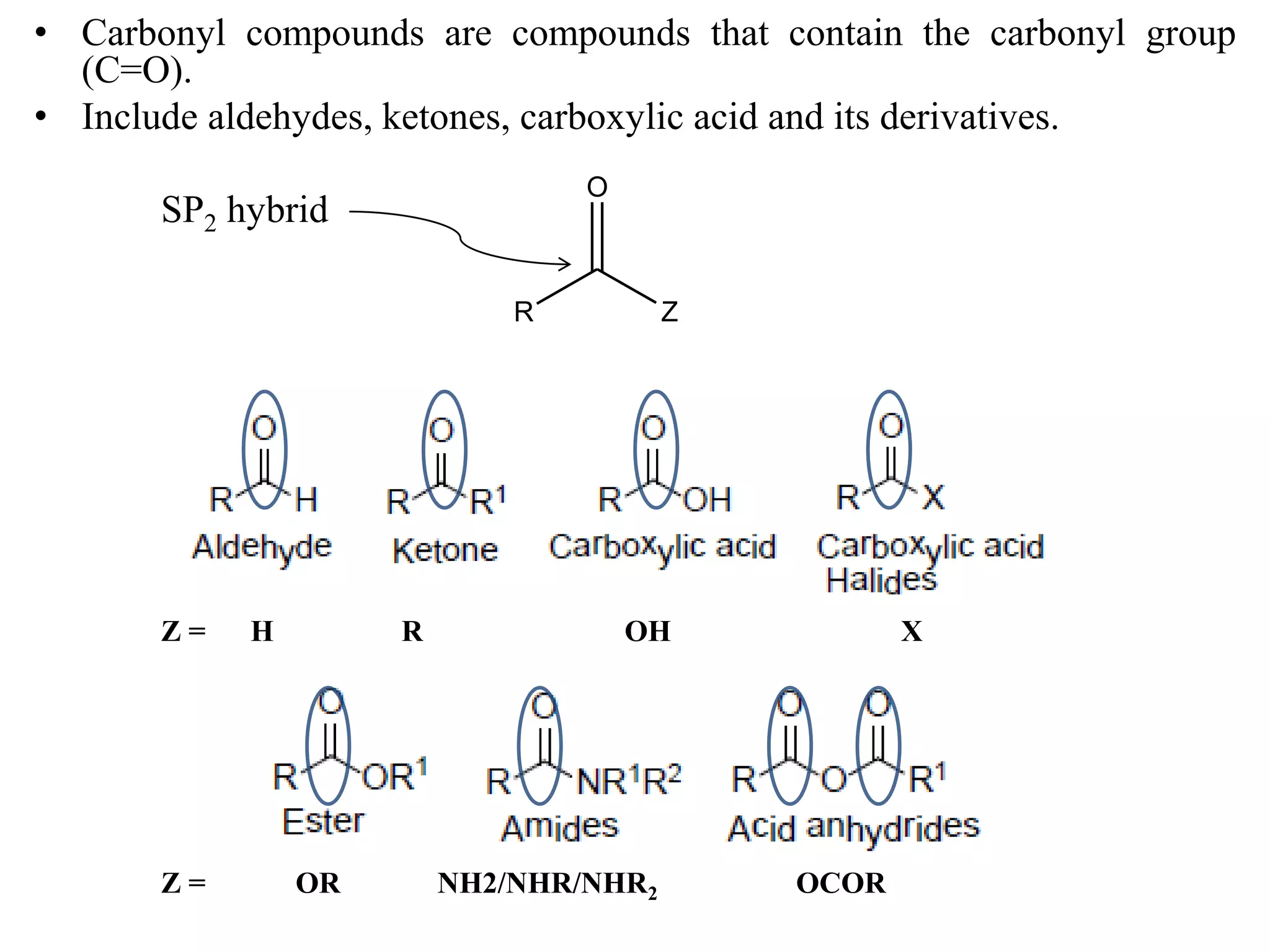
• Carbonyl compounds are compounds that contain the carbonyl group
(C=O).
• Include aldehydes, ketones, carboxylic acid and its derivatives.
SP2 hybrid
Z = H R OH X
Z = OR NH2/NHR/NHR2 OCOR
R Z
O
IUPAC Nomanclature
• The name of the parent hydrocarbon (alkane or alkene or
alkyne) is determined while counting the carbonyl carbon as a
methyl group for aldehydes and as a methylene group for
ketones.
• The substituents are named as it is done for the hydrocarbon.
• The name of the alkane is modified to alkanal for an aldehyde.
• In case of ketones, the name is modified to alkanone. The
position of the carbonyl group is denoted as numerical prefix
to –one.
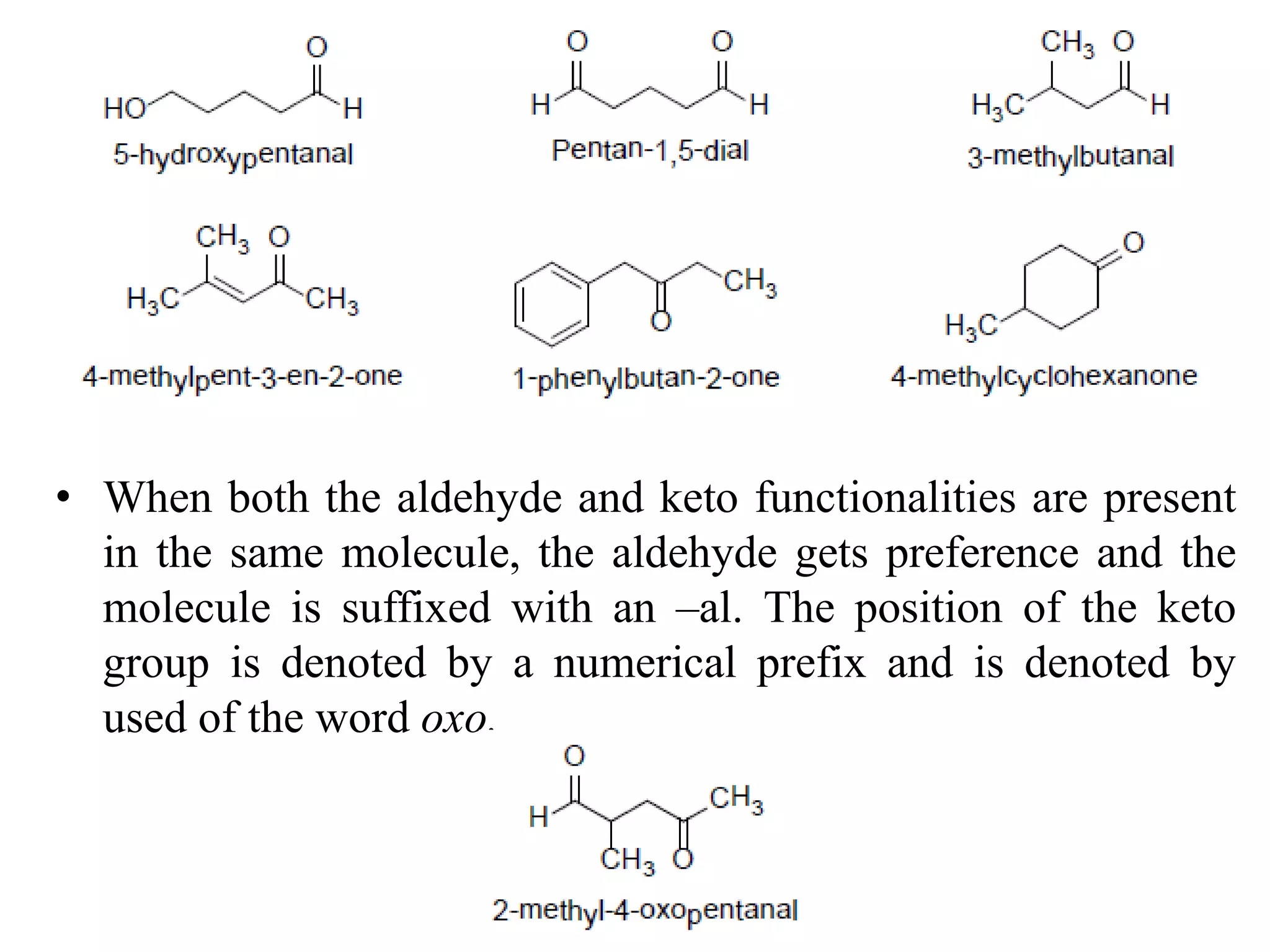
• When both the aldehyde and keto functionalities are present
in the same molecule, the aldehyde gets preference and the
molecule is suffixed with an –al. The position of the keto
group is denoted by a numerical prefix and is denoted by
used of the word oxo.
Methods for Preparation Aldehydes and Ketones
1. Oxidation of Alcohols:
Ketones may be prepared by the oxidation of secondary alcohols
in the presence of acid dichromate.
In case of primary alcohol, this process may lead to oxidation of
the alcohol to carboxylic acid.
This problem is overcome by using mild oxidizing agent. e.g.
pyridinium Chlorochromate and pyridinium dichromate.
R OH
R O
PCC/PDC
CH2Cl2
• The ketones may also be generated from the secondary
alcohols using aluminium t-butoxide / aluminium
isopropoxide in the presence of acetone.
• This reaction is known as Oppenauer Oxidation.
2. Reduction of acid chlorides
• Aldehydes can also be prepared by the reduction of acid
chloride with hydrogen using a palladium catalyst suspended
on barium Sulphate.
• This reaction is known as Rosenmund reduction.
3. Oxidative Cleavage of Alkenes (Ozonolysis of Alkenes)
• Both aldehydes and ketones may be formed by ozonolysis of
suitable alkenes.
R Cl
R H
Pd/BaSO4
O
O
• The ozonolysis of alkenes of the type RCH=CHR1 leads to the
formation of aldehydes while the tetrasubstituted alkenes will
give ketones as product.
(i) O3
R
R 1
(ii) H3O+
R H
O
R1 H
O
(i) O3
R
R
3
(ii) H3O+
R
1
R
2
O
R
R
1
O
R
3
R
2
4. Hydration of Alkynes
• The hydration of alkynes by the mercuration-demercuration
procedure can be utilized to prepare acetaldehyde and ketones.
• The hydration of acetylene gives acetaldehyde while the
hydration of any other alkyne leads to formation of ketones.
5. Acylation of Arenes (Friedel-Craft acylation)
• Friedel Craft acylation may be used to prepare alkyl aryl
ketones or diaryl ketones.
• In this process, an arene is usually treated with an acid halide
or acid anhydride in the presence of a Lewis acid catalyst.
Physical Properties
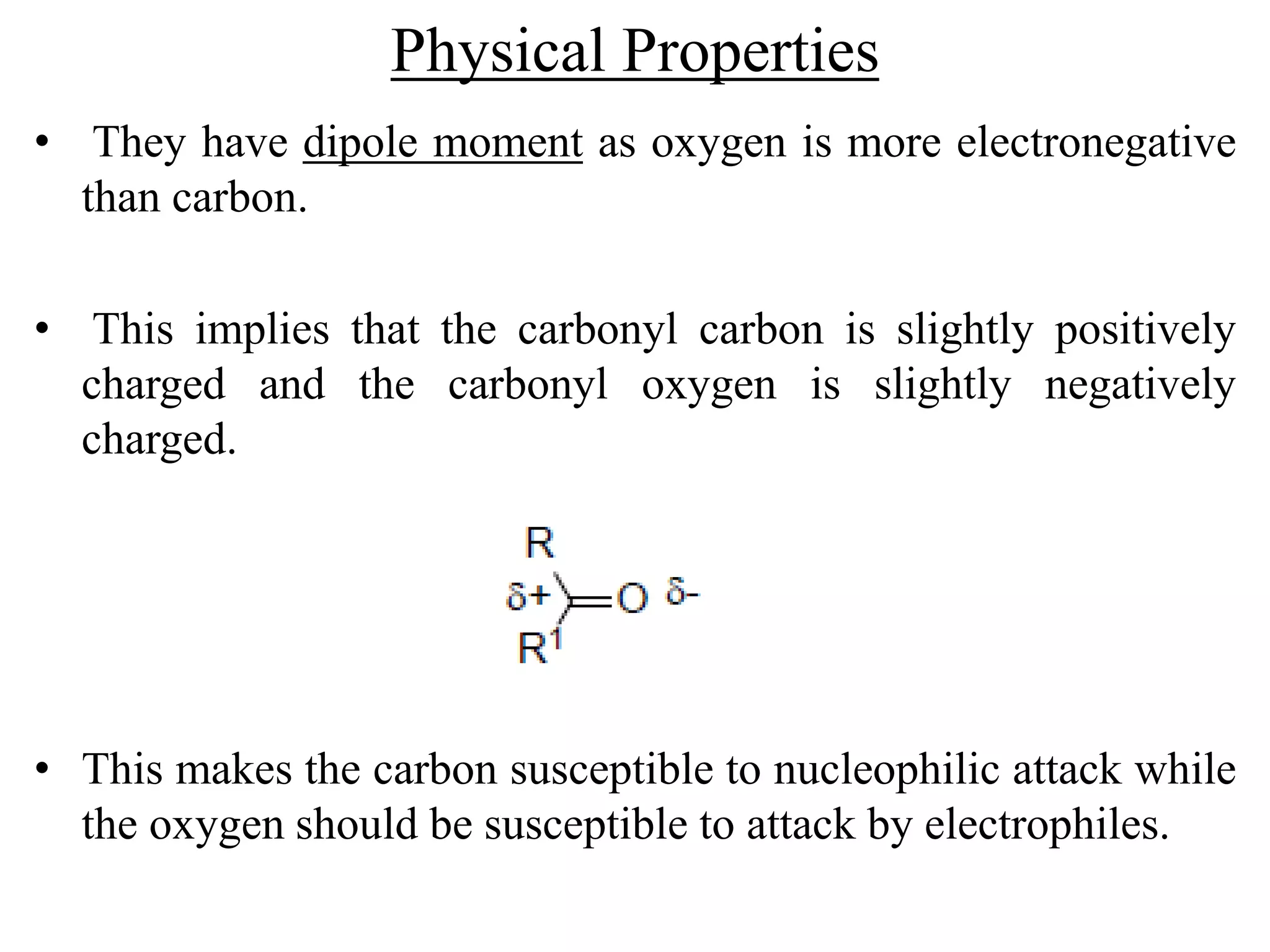
• They have dipole moment as oxygen is more electronegative
than carbon.
• This implies that the carbonyl carbon is slightly positively
charged and the carbonyl oxygen is slightly negatively
charged.
• This makes the carbon susceptible to nucleophilic attack while
the oxygen should be susceptible to attack by electrophiles.
Chemical Reactions
1. Nucleophilic Addition Reactions:
• The nucleophilic addition to the carbonyl group is the most
important reaction of aldehydes and ketones.
• Several nucleophiles such as water, alcohols, cyanide etc
attack the carbonyl carbon.
• The reaction can be catalyzed by the presence of both acids
and bases.
Acid Catalyzed Nucleophilic Additions Mechanism
O
H+
O
H
OH
:Nu-
OH
Nu
Base Catalyzed Nucleophilic Additions Mechanism
O
:Nu-
O
Nu
OH
Nu
H+
Relative Reactivities of Aldehydes & Ketones for
Nucleophilic Additions
• Any group that increases the positive charge on carbonyl
carbon increases the reactivity of carbonyl group towards
nucleophilic additions.
• Therefore, electron releasing groups tend to neutralize the
positive charge of carbonyl carbon and decrease the reactivity.
• Whereas, electron withdrawing groups enhance the positive
charge of carbonyl carbon and increase the reactivity.
Questions
1. Why Aldehydes are more reactive than ketones in nucleophilic
addition additions?
2. Why formaldehydeis more reactive than acetaldehyde?
3. Why aromatic aldehydes and ketones are less reactive than
aliphatic aldehydes and ketones towards nucleophilic addition?
Nucleophilic Addition Reactions
1. Addition of Grignard reagent.
2. Addition of HCN.
O
R
1
R
R2
Mg
X
O
R
1
R
R
2
MgX
OH
R
1
R
R
2
H3O+
O
R
1
R
OH
R
1
R
CN
OH
R
1
R
2H2OHCN
Cyanohydrin
HCl
COOH
Hydroxy Acid
3. Addition of Sodium Bisulphite.
4. Addition of Water (Hydration).
5. Addition of Alcohols.
O
H
OH
H
SO3Na
NaHSO3
Sodium Bisulphite Adduct
O
R
1
R
OH
R
1
R
OH
HOH
gem-diols
O
H
R
OH
H
R
OR1
R1OH
Hemiacetals
OR2
H
R
OR1
Acetals
R2OHH+
O
R
3
R
OH
R
3
R
OR1
R1OH
Hemiketals
OR2
R
3
R
OR1
Ketals
R2OHH+
2. Reduction Reactions:
• LiAlH4 or NaBH4 can be used to reduce both aldehydes and
ketones to their corresponding alcohols.
Meerwein Pondorf Verley (MPV) Reduction:
• This method is used to reduce ketones to alcohols reversibly in
presence of aluminium isopropoxide and isopropanol solvent.
This is reverse of Oppenauer oxidation.
R-CHO H2 R-CH2OH
LiAlH4 / NaBH4
OR
R
1
OH Al-(OCHMe2)3
OHR
R
1
O
Ketone Alcohol isopropanoneIsopropanol
(solvent)
Wolff Kishner Reduction:
• The Wolff–Kishner reduction reaction is used to
convert carbonyl functionalities into methylene groups.
Clemmensen Reduction:
• This method is used to reduce carbonyl group to methylene
group in presence of zinc amalgam and hydrochloric acid.
NH2NH2
OR
R
1
Base
R
R
1
H
H
Zn / Hg
OR
R
1
HCl
R
R
1
H
H
3. Condensation Reactions
• The aldehydes and ketones undergo another class of reactions
which may be called addition elimination reaction or
condensation reactions. In these reactions, they react with a
reagent to form an adduct, which may then under suitable
conditions undergo elimination of a water molecule to form
the product.
(i) Aldol Condensation:
Two molecules of aldehydes or ketone having α hydrogen atom
combine together i.p.o. base to form β- hydroxy aldehyde or β-
hydroxy ketone that further upon dehydration yields α, β-
unsaturated carbonyl compound.
O
H
O
H OH
O
H
OH-
H+
O
H
Acetaldehyde Acetaldehyde
ß-hydroxy Aldehyde (Aldol)
3-hydroxy butanal
H2O
2- butenal
O O O
OH-
H+
O
Acetone Acetone
ß-hydroxy Ketone
4-hydroxy - 4-methyl- 2-pentanone
H2O
4-methyl- 3-pentenone
OH
Mechanism of Aldol Condensation
• The reaction involves formation of carbanion that acts as
neucleophile and attacks second aldehyde molecule.
H
H
O
H
H
OH-
-H2O
CH2CHOH
O
+
O
CHO
CH2CHO
O
CHO + H2O
OH
CHO
-OH-
OH
CHO
-H2O
CHO
Crossed Aldol Condensation
• Between two different aldehydes and ketones.
CH3CHO + CH3COCH3
CH3CH(OH)CH2COCH3
CH3CH(OH)CH2CHO
(CH3)2C(OH)CH2COCH3
(CH3)2C(OH)CH2CHO
2. Claisen Schmidt Reaction
3. Claisen Reaction
4. Perkin Reaction
Ar
O
H
CH2 O
O O
Ar
O
H
O
O
O
Ar
O
H
O
O
O
O
O
H
Ar
O
O
O
O
H
Ar
O
O
H
H
-CH3COOH
O
H Ar
O
H
OH
Ar O
H+
5. Benzoin Condensation
6. Reformatsky Reaction
Condensation with ammonia derivarives
Mannich Reaction
4. Hydride Transfer Reaction
Cannizaro Reaction
Aldehydes without α hydrogen atom undergo disportionation
i.p.o. strong base to form equal amounts of corresponding
alcohol and carboxylic acid salt.
One aldehyde acts as hydride (H-) donor whereas other
aldehyde acts as hydride acceptor.
5. Oxidation Reactions
Electromeric Effect
• It is an temporary effect observed in unsaturated compounds
only in presence of some reagent available nearby.
• Electromeric effect involves complete transfer of π electrons of
multiple bond. e.g. during attack on a carbonyl group by
nucleophile, the π electron pair of C=O bond is transferred
completely to oxygen (due to greater electro-negativity of
oxygen), and therefore polarize the carbonyl group.
• The positevely charged carbon is then attacked by nuclephile.
O O
“ The complete transfer of shared pair of electrons of a multiple
bond to the more electronegative atom of the bonded atoms due
to the requirements of an attacking reagent is called
electromeric effect ”.
Electromeric effect is of two types- +E effect and –E effect
+E Effect : when the transfer of π electrons take place towards
the attacking reagent (Electrophile).
-E Effect : when the transfer of π electrons take place away
from the attacking reagent (Nucleophile).
O O
Nu
Nu
E
E
STRUCTURE AND USES
1. Formaldehyde
Structure:
Uses:
• It is used as an general antiseptic.
• It is used as local anesthetic.
• It is used in preservation of biological specimens.
• It is used in the manufacturing of plastics such as bakellite.
O
H
H
2. Paraldehyde
Structure: it is a cyclic trimer of acetaldehyde
Uses:
• It is used as in the manufacturing of resins.
• It is used as CNS depressant, sedative and hypnotic.
• It is used as expectorant.
O O
O
3. Acetone
Structure:
Uses:
• It is used as a organic solvent.
• It is used in the synthesis of chloroform.
• It is used in the synthesis of iodoform.
• It is used in the preparation of thermo softening plastic,
perspex.
O
CH3
H3C
4. Chloral Hydrate
Structure:
Uses:
• It is used as insecticide.
• It is used as hypnotic.
• It is used in the preparation of DDT.
OH
OHCl
Cl
Cl
5. Hexamine
Structure:
Uses:
• It is used as a urinary antiseptic.
• It is used as disinfectant.
• It is used as absorbent for absorbing poisonous gases.
• Hexamine nitrate is used to get explosive cyclonite or RDX.
• Used in adhesives, coating and sealing compounds.
N
N
N
N
6. Benzaldehyde
Structure:
Uses:
• It is used in the manufacturing of cinnamic acid.
• It is used in the preparation of malachite green dye.
• It is used as flavoring agent.
• It is used as bee repellent.
OH
7. Vanillin
Structure:
Uses:
• It is used as flavoring agent in ice creams and chocolates.
• It is used in perfume industry.
• It is used to mask the unpleasant taste of medicines.
O
H
HO
O CH3

Carbonyl compounds

  • 1.
    Pharmaceutical Organic Chemistry-I (BP202T) Unit-4 CarbonylCompounds (Aldehydes & Ketones) Mr. Krishan Kr. Verma, Assistant Professor Ram-Eesh Institute of Vocational & Technical Education
  • 2.
    • Carbonyl compoundsare compounds that contain the carbonyl group (C=O). • Include aldehydes, ketones, carboxylic acid and its derivatives. SP2 hybrid Z = H R OH X Z = OR NH2/NHR/NHR2 OCOR R Z O
  • 3.
    IUPAC Nomanclature • Thename of the parent hydrocarbon (alkane or alkene or alkyne) is determined while counting the carbonyl carbon as a methyl group for aldehydes and as a methylene group for ketones. • The substituents are named as it is done for the hydrocarbon. • The name of the alkane is modified to alkanal for an aldehyde. • In case of ketones, the name is modified to alkanone. The position of the carbonyl group is denoted as numerical prefix to –one.
  • 4.
    • When boththe aldehyde and keto functionalities are present in the same molecule, the aldehyde gets preference and the molecule is suffixed with an –al. The position of the keto group is denoted by a numerical prefix and is denoted by used of the word oxo.
  • 5.
    Methods for PreparationAldehydes and Ketones 1. Oxidation of Alcohols: Ketones may be prepared by the oxidation of secondary alcohols in the presence of acid dichromate. In case of primary alcohol, this process may lead to oxidation of the alcohol to carboxylic acid. This problem is overcome by using mild oxidizing agent. e.g. pyridinium Chlorochromate and pyridinium dichromate. R OH R O PCC/PDC CH2Cl2
  • 6.
    • The ketonesmay also be generated from the secondary alcohols using aluminium t-butoxide / aluminium isopropoxide in the presence of acetone. • This reaction is known as Oppenauer Oxidation.
  • 7.
    2. Reduction ofacid chlorides • Aldehydes can also be prepared by the reduction of acid chloride with hydrogen using a palladium catalyst suspended on barium Sulphate. • This reaction is known as Rosenmund reduction. 3. Oxidative Cleavage of Alkenes (Ozonolysis of Alkenes) • Both aldehydes and ketones may be formed by ozonolysis of suitable alkenes. R Cl R H Pd/BaSO4 O O
  • 8.
    • The ozonolysisof alkenes of the type RCH=CHR1 leads to the formation of aldehydes while the tetrasubstituted alkenes will give ketones as product. (i) O3 R R 1 (ii) H3O+ R H O R1 H O (i) O3 R R 3 (ii) H3O+ R 1 R 2 O R R 1 O R 3 R 2
  • 9.
    4. Hydration ofAlkynes • The hydration of alkynes by the mercuration-demercuration procedure can be utilized to prepare acetaldehyde and ketones. • The hydration of acetylene gives acetaldehyde while the hydration of any other alkyne leads to formation of ketones.
  • 10.
    5. Acylation ofArenes (Friedel-Craft acylation) • Friedel Craft acylation may be used to prepare alkyl aryl ketones or diaryl ketones. • In this process, an arene is usually treated with an acid halide or acid anhydride in the presence of a Lewis acid catalyst.
  • 11.
    Physical Properties • Theyhave dipole moment as oxygen is more electronegative than carbon. • This implies that the carbonyl carbon is slightly positively charged and the carbonyl oxygen is slightly negatively charged. • This makes the carbon susceptible to nucleophilic attack while the oxygen should be susceptible to attack by electrophiles.
  • 12.
    Chemical Reactions 1. NucleophilicAddition Reactions: • The nucleophilic addition to the carbonyl group is the most important reaction of aldehydes and ketones. • Several nucleophiles such as water, alcohols, cyanide etc attack the carbonyl carbon. • The reaction can be catalyzed by the presence of both acids and bases.
  • 13.
    Acid Catalyzed NucleophilicAdditions Mechanism O H+ O H OH :Nu- OH Nu Base Catalyzed Nucleophilic Additions Mechanism O :Nu- O Nu OH Nu H+
  • 14.
    Relative Reactivities ofAldehydes & Ketones for Nucleophilic Additions • Any group that increases the positive charge on carbonyl carbon increases the reactivity of carbonyl group towards nucleophilic additions. • Therefore, electron releasing groups tend to neutralize the positive charge of carbonyl carbon and decrease the reactivity. • Whereas, electron withdrawing groups enhance the positive charge of carbonyl carbon and increase the reactivity.
  • 15.
    Questions 1. Why Aldehydesare more reactive than ketones in nucleophilic addition additions? 2. Why formaldehydeis more reactive than acetaldehyde? 3. Why aromatic aldehydes and ketones are less reactive than aliphatic aldehydes and ketones towards nucleophilic addition?
  • 16.
    Nucleophilic Addition Reactions 1.Addition of Grignard reagent. 2. Addition of HCN. O R 1 R R2 Mg X O R 1 R R 2 MgX OH R 1 R R 2 H3O+ O R 1 R OH R 1 R CN OH R 1 R 2H2OHCN Cyanohydrin HCl COOH Hydroxy Acid
  • 17.
    3. Addition ofSodium Bisulphite. 4. Addition of Water (Hydration). 5. Addition of Alcohols. O H OH H SO3Na NaHSO3 Sodium Bisulphite Adduct O R 1 R OH R 1 R OH HOH gem-diols O H R OH H R OR1 R1OH Hemiacetals OR2 H R OR1 Acetals R2OHH+ O R 3 R OH R 3 R OR1 R1OH Hemiketals OR2 R 3 R OR1 Ketals R2OHH+
  • 18.
    2. Reduction Reactions: •LiAlH4 or NaBH4 can be used to reduce both aldehydes and ketones to their corresponding alcohols. Meerwein Pondorf Verley (MPV) Reduction: • This method is used to reduce ketones to alcohols reversibly in presence of aluminium isopropoxide and isopropanol solvent. This is reverse of Oppenauer oxidation. R-CHO H2 R-CH2OH LiAlH4 / NaBH4 OR R 1 OH Al-(OCHMe2)3 OHR R 1 O Ketone Alcohol isopropanoneIsopropanol (solvent)
  • 19.
    Wolff Kishner Reduction: •The Wolff–Kishner reduction reaction is used to convert carbonyl functionalities into methylene groups. Clemmensen Reduction: • This method is used to reduce carbonyl group to methylene group in presence of zinc amalgam and hydrochloric acid. NH2NH2 OR R 1 Base R R 1 H H Zn / Hg OR R 1 HCl R R 1 H H
  • 20.
    3. Condensation Reactions •The aldehydes and ketones undergo another class of reactions which may be called addition elimination reaction or condensation reactions. In these reactions, they react with a reagent to form an adduct, which may then under suitable conditions undergo elimination of a water molecule to form the product. (i) Aldol Condensation: Two molecules of aldehydes or ketone having α hydrogen atom combine together i.p.o. base to form β- hydroxy aldehyde or β- hydroxy ketone that further upon dehydration yields α, β- unsaturated carbonyl compound.
  • 21.
    O H O H OH O H OH- H+ O H Acetaldehyde Acetaldehyde ß-hydroxyAldehyde (Aldol) 3-hydroxy butanal H2O 2- butenal
  • 22.
    O O O OH- H+ O AcetoneAcetone ß-hydroxy Ketone 4-hydroxy - 4-methyl- 2-pentanone H2O 4-methyl- 3-pentenone OH
  • 23.
    Mechanism of AldolCondensation • The reaction involves formation of carbanion that acts as neucleophile and attacks second aldehyde molecule. H H O H H OH- -H2O CH2CHOH O + O CHO CH2CHO O CHO + H2O OH CHO -OH- OH CHO -H2O CHO
  • 24.
    Crossed Aldol Condensation •Between two different aldehydes and ketones. CH3CHO + CH3COCH3 CH3CH(OH)CH2COCH3 CH3CH(OH)CH2CHO (CH3)2C(OH)CH2COCH3 (CH3)2C(OH)CH2CHO
  • 25.
  • 26.
  • 27.
  • 29.
  • 30.
  • 31.
  • 33.
  • 34.
  • 35.
  • 37.
    4. Hydride TransferReaction Cannizaro Reaction Aldehydes without α hydrogen atom undergo disportionation i.p.o. strong base to form equal amounts of corresponding alcohol and carboxylic acid salt. One aldehyde acts as hydride (H-) donor whereas other aldehyde acts as hydride acceptor.
  • 39.
  • 40.
    Electromeric Effect • Itis an temporary effect observed in unsaturated compounds only in presence of some reagent available nearby. • Electromeric effect involves complete transfer of π electrons of multiple bond. e.g. during attack on a carbonyl group by nucleophile, the π electron pair of C=O bond is transferred completely to oxygen (due to greater electro-negativity of oxygen), and therefore polarize the carbonyl group. • The positevely charged carbon is then attacked by nuclephile. O O
  • 41.
    “ The completetransfer of shared pair of electrons of a multiple bond to the more electronegative atom of the bonded atoms due to the requirements of an attacking reagent is called electromeric effect ”. Electromeric effect is of two types- +E effect and –E effect +E Effect : when the transfer of π electrons take place towards the attacking reagent (Electrophile). -E Effect : when the transfer of π electrons take place away from the attacking reagent (Nucleophile).
  • 42.
  • 43.
    STRUCTURE AND USES 1.Formaldehyde Structure: Uses: • It is used as an general antiseptic. • It is used as local anesthetic. • It is used in preservation of biological specimens. • It is used in the manufacturing of plastics such as bakellite. O H H
  • 44.
    2. Paraldehyde Structure: itis a cyclic trimer of acetaldehyde Uses: • It is used as in the manufacturing of resins. • It is used as CNS depressant, sedative and hypnotic. • It is used as expectorant. O O O
  • 45.
    3. Acetone Structure: Uses: • Itis used as a organic solvent. • It is used in the synthesis of chloroform. • It is used in the synthesis of iodoform. • It is used in the preparation of thermo softening plastic, perspex. O CH3 H3C
  • 46.
    4. Chloral Hydrate Structure: Uses: •It is used as insecticide. • It is used as hypnotic. • It is used in the preparation of DDT. OH OHCl Cl Cl
  • 47.
    5. Hexamine Structure: Uses: • Itis used as a urinary antiseptic. • It is used as disinfectant. • It is used as absorbent for absorbing poisonous gases. • Hexamine nitrate is used to get explosive cyclonite or RDX. • Used in adhesives, coating and sealing compounds. N N N N
  • 48.
    6. Benzaldehyde Structure: Uses: • Itis used in the manufacturing of cinnamic acid. • It is used in the preparation of malachite green dye. • It is used as flavoring agent. • It is used as bee repellent. OH
  • 49.
    7. Vanillin Structure: Uses: • Itis used as flavoring agent in ice creams and chocolates. • It is used in perfume industry. • It is used to mask the unpleasant taste of medicines. O H HO O CH3