UNIT 13: AMINES
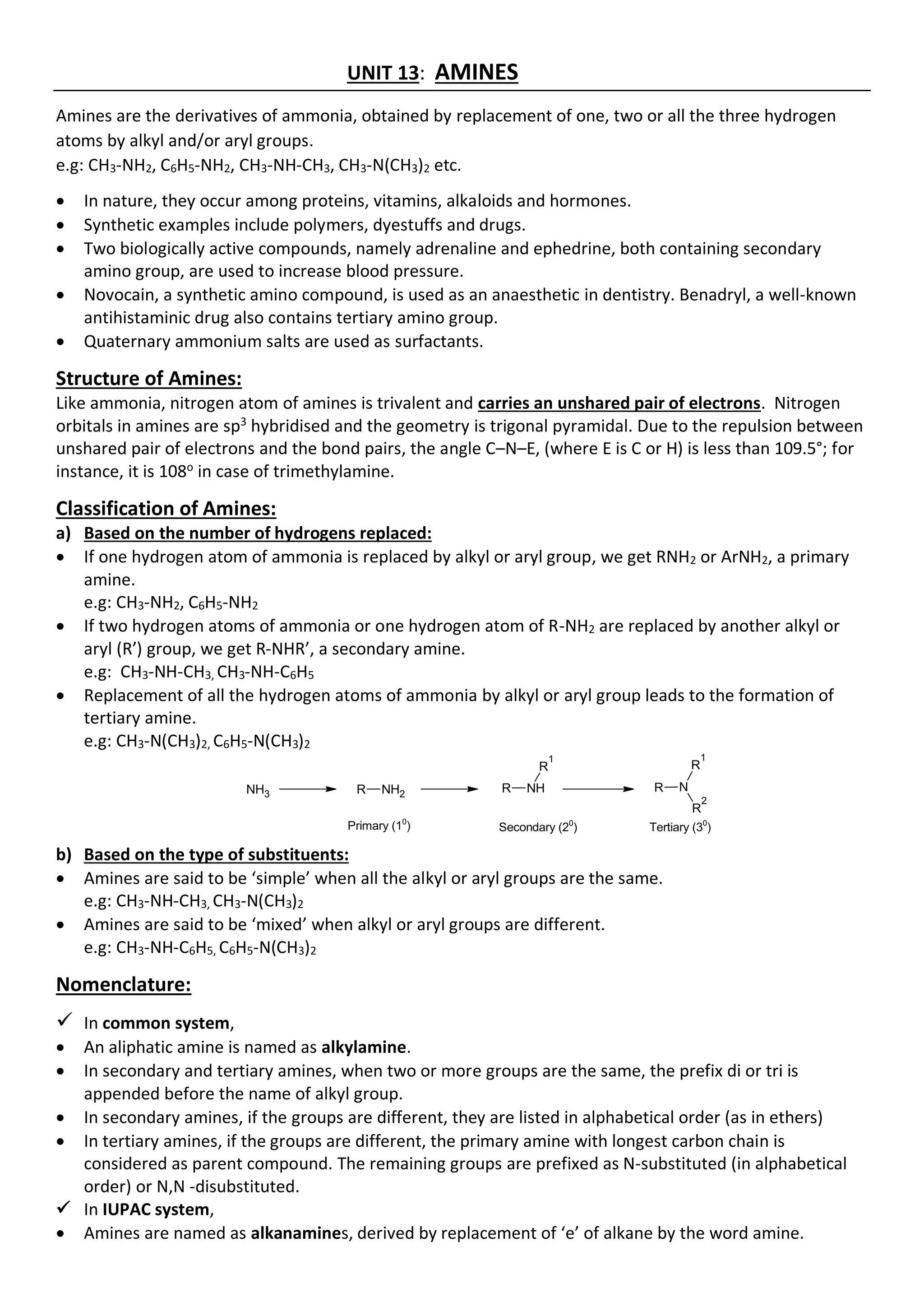
Amines are the derivatives of ammonia, obtained by replacement of one, two or all the three hydrogen
atoms by alkyl and/or aryl groups.
e.g: CH3-NH2, C6H5-NH2, CH3-NH-CH3, CH3-N(CH3)2 etc.
• In nature, they occur among proteins, vitamins, alkaloids and hormones.
• Synthetic examples include polymers, dyestuffs and drugs.
• Two biologically active compounds, namely adrenaline and ephedrine, both containing secondary
amino group, are used to increase blood pressure.
• Novocain, a synthetic amino compound, is used as an anaesthetic in dentistry. Benadryl, a well-known
antihistaminic drug also contains tertiary amino group.
• Quaternary ammonium salts are used as surfactants.
Structure of Amines:
Like ammonia, nitrogen atom of amines is trivalent and carries an unshared pair of electrons. Nitrogen
orbitals in amines are sp3
hybridised and the geometry is trigonal pyramidal. Due to the repulsion between
unshared pair of electrons and the bond pairs, the angle C–N–E, (where E is C or H) is less than 109.5°; for
instance, it is 108o
in case of trimethylamine.
Classification of Amines:
a) Based on the number of hydrogens replaced:
• If one hydrogen atom of ammonia is replaced by alkyl or aryl group, we get RNH2 or ArNH2, a primary
amine.
e.g: CH3-NH2, C6H5-NH2
• If two hydrogen atoms of ammonia or one hydrogen atom of R-NH2 are replaced by another alkyl or
aryl (R’) group, we get R-NHR’, a secondary amine.
e.g: CH3-NH-CH3, CH3-NH-C6H5
• Replacement of all the hydrogen atoms of ammonia by alkyl or aryl group leads to the formation of
tertiary amine.
e.g: CH3-N(CH3)2, C6H5-N(CH3)2
NH3 R NH2 R NH
R
1
R N
R
1
R
2
Primary (10
) Secondary (20
) Tertiary (30
)
b) Based on the type of substituents:
• Amines are said to be ‘simple’ when all the alkyl or aryl groups are the same.
e.g: CH3-NH-CH3, CH3-N(CH3)2
• Amines are said to be ‘mixed’ when alkyl or aryl groups are different.
e.g: CH3-NH-C6H5, C6H5-N(CH3)2
Nomenclature:
✓ In common system,
• An aliphatic amine is named as alkylamine.
• In secondary and tertiary amines, when two or more groups are the same, the prefix di or tri is
appended before the name of alkyl group.
• In secondary amines, if the groups are different, they are listed in alphabetical order (as in ethers)
• In tertiary amines, if the groups are different, the primary amine with longest carbon chain is
considered as parent compound. The remaining groups are prefixed as N-substituted (in alphabetical
order) or N,N -disubstituted.
✓ In IUPAC system,
• Amines are named as alkanamines, derived by replacement of ‘e’ of alkane by the word amine.
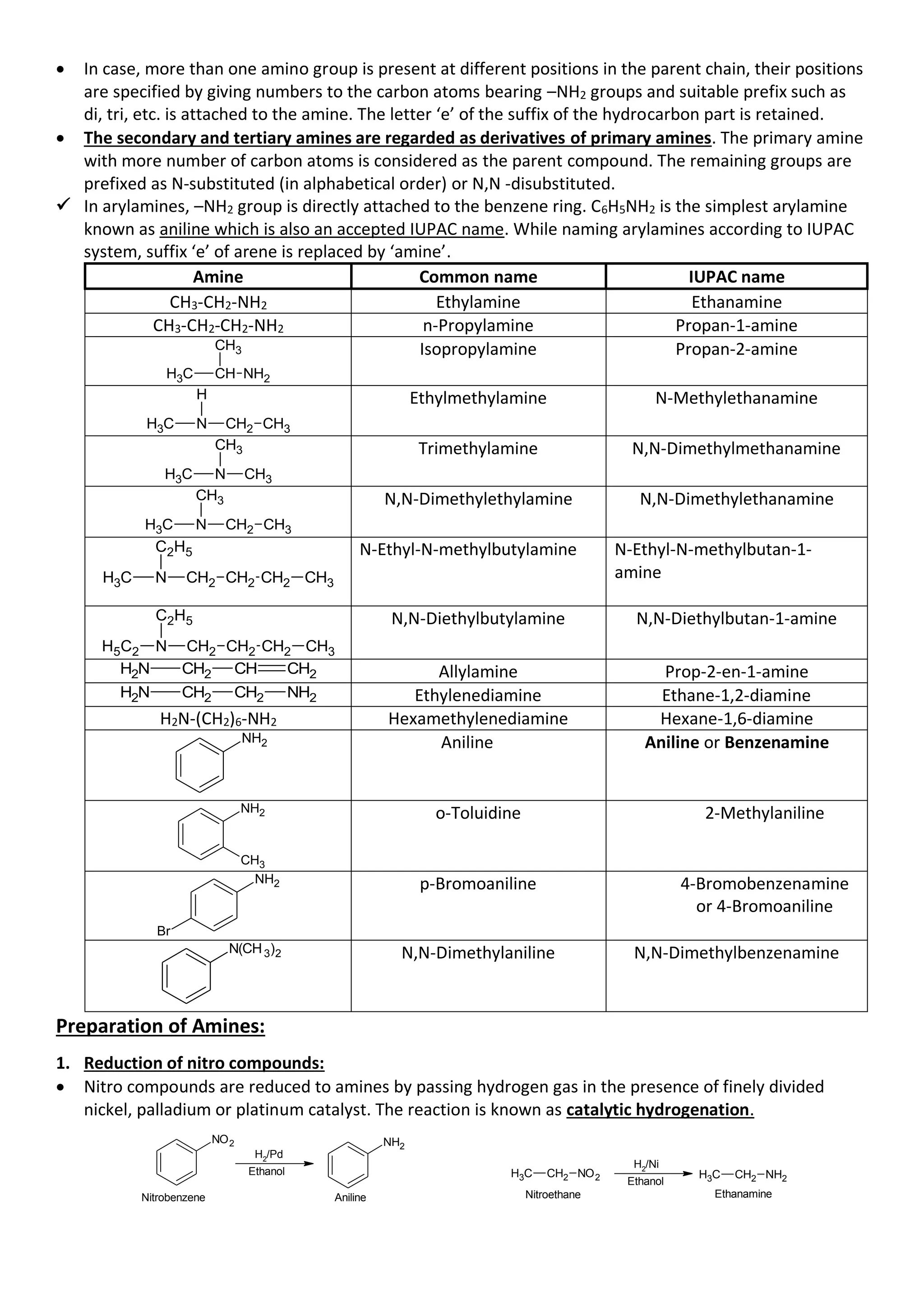
• In case, more than one amino group is present at different positions in the parent chain, their positions
are specified by giving numbers to the carbon atoms bearing –NH2 groups and suitable prefix such as
di, tri, etc. is attached to the amine. The letter ‘e’ of the suffix of the hydrocarbon part is retained.
• The secondary and tertiary amines are regarded as derivatives of primary amines. The primary amine
with more number of carbon atoms is considered as the parent compound. The remaining groups are
prefixed as N-substituted (in alphabetical order) or N,N -disubstituted.
✓ In arylamines, –NH2 group is directly attached to the benzene ring. C6H5NH2 is the simplest arylamine
known as aniline which is also an accepted IUPAC name. While naming arylamines according to IUPAC
system, suffix ‘e’ of arene is replaced by ‘amine’.
Amine Common name IUPAC name
CH3-CH2-NH2 Ethylamine Ethanamine
CH3-CH2-CH2-NH2 n-Propylamine Propan-1-amine
CH NH2
C
H3
CH3 Isopropylamine Propan-2-amine
N CH2
C
H3
H
CH3
Ethylmethylamine N-Methylethanamine
N CH3
C
H3
CH3 Trimethylamine N,N-Dimethylmethanamine
N CH2
C
H3
CH3
CH3
N,N-Dimethylethylamine N,N-Dimethylethanamine
N CH2
C
H3
C2H5
CH2 CH2 CH3
N-Ethyl-N-methylbutylamine N-Ethyl-N-methylbutan-1-
amine
N CH2
H5C2
C2H5
CH2 CH2 CH3
N,N-Diethylbutylamine N,N-Diethylbutan-1-amine
N
H2 CH2 CH CH2 Allylamine Prop-2-en-1-amine
N
H2 CH2 CH2 NH2 Ethylenediamine Ethane-1,2-diamine
H2N-(CH2)6-NH2 Hexamethylenediamine Hexane-1,6-diamine
NH2 Aniline Aniline or Benzenamine
NH2
CH3
o-Toluidine 2-Methylaniline
NH2
Br
p-Bromoaniline 4-Bromobenzenamine
or 4-Bromoaniline
N(CH3)2 N,N-Dimethylaniline N,N-Dimethylbenzenamine
Preparation of Amines:
1. Reduction of nitro compounds:
• Nitro compounds are reduced to amines by passing hydrogen gas in the presence of finely divided
nickel, palladium or platinum catalyst. The reaction is known as catalytic hydrogenation.
NO2
H2
/Pd
Ethanol
NH2
Nitrobenzene Aniline
C
H3 CH2 NO2
H2
/Ni
Ethanol
Nitroethane
C
H3 CH2 NH2
Ethanamine
• Nitro compounds are reduced to amines by reduction with metals in acidic medium. Reduction with
iron scrap and hydrochloric acid is preferred because FeCl2 formed gets hydrolysed to release
hydrochloric acid during the reaction. Thus, only a small amount of hydrochloric acid is required to
initiate the reaction.
Nitrobenzene Aniline
NO2
Sn + HCl
or Fe + HCl
NH2
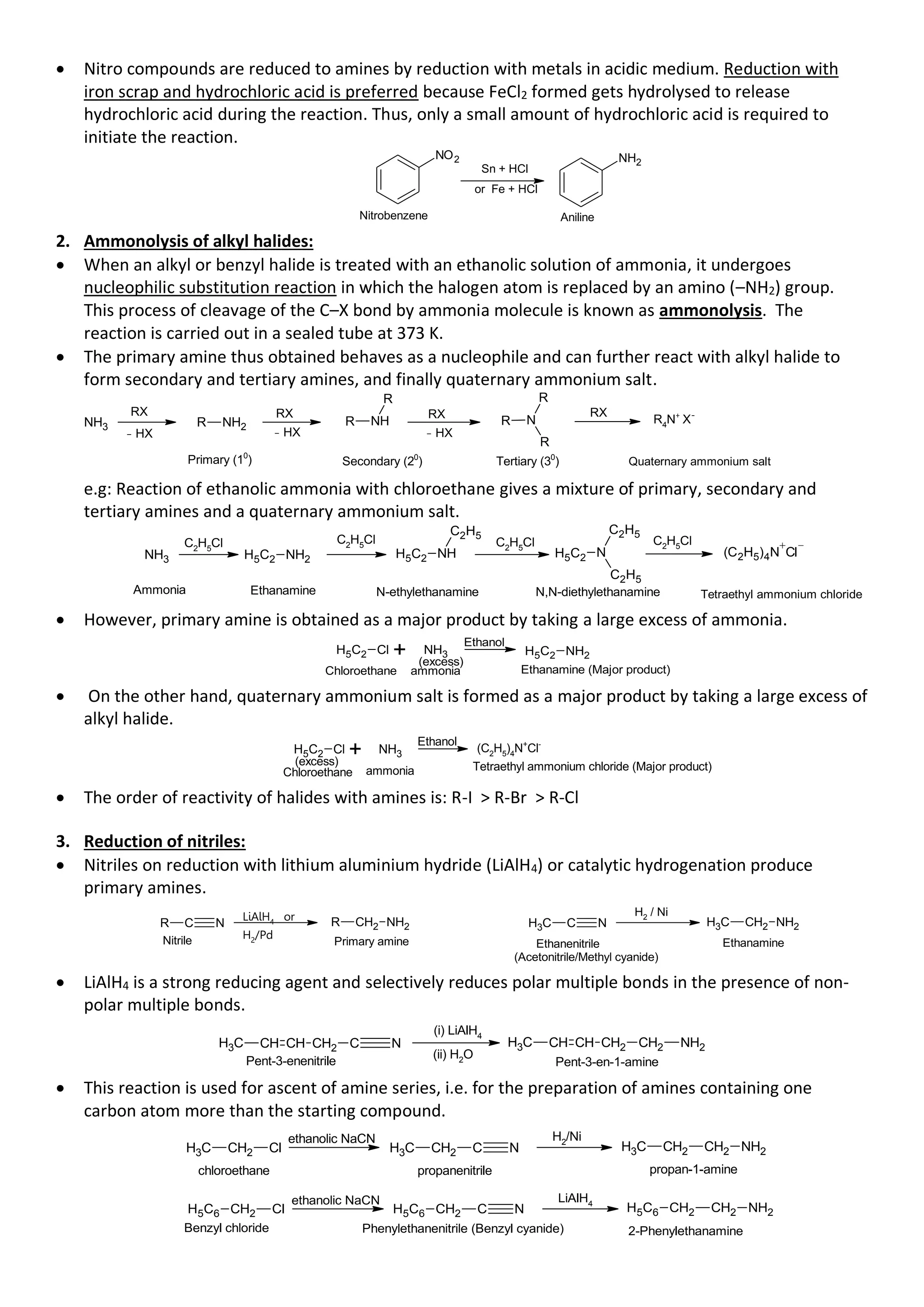
2. Ammonolysis of alkyl halides:
• When an alkyl or benzyl halide is treated with an ethanolic solution of ammonia, it undergoes
nucleophilic substitution reaction in which the halogen atom is replaced by an amino (–NH2) group.
This process of cleavage of the C–X bond by ammonia molecule is known as ammonolysis. The
reaction is carried out in a sealed tube at 373 K.
• The primary amine thus obtained behaves as a nucleophile and can further react with alkyl halide to
form secondary and tertiary amines, and finally quaternary ammonium salt.
NH3 R NH2 R NH
R
R N
R
R
Primary (10
) Secondary (20
) Tertiary (30
)
RX RX RX RX
R4
N+
X-
Quaternary ammonium salt
- HX - HX - HX
e.g: Reaction of ethanolic ammonia with chloroethane gives a mixture of primary, secondary and
tertiary amines and a quaternary ammonium salt.
NH3 H5C2 NH2 H5C2 NH
C2H5
H5C2 N
C2H5
C2H5
Ethanamine N-ethylethanamine N,N-diethylethanamine
C2
H5
Cl C2
H5
Cl
Tetraethyl ammonium chloride
C2H5Cl C2
H5
Cl
(C2H5)4N Cl
Ammonia
• However, primary amine is obtained as a major product by taking a large excess of ammonia.
H5C2 Cl + NH3
ammonia
Chloroethane
(excess)
Ethanol
H5C2 NH2
Ethanamine (Major product)
• On the other hand, quaternary ammonium salt is formed as a major product by taking a large excess of
alkyl halide.
H5C2 Cl + NH3
ammonia
Chloroethane
(excess)
Ethanol
Tetraethyl ammonium chloride (Major product)
(C2
H5
)4
N+
Cl-
• The order of reactivity of halides with amines is: R-I > R-Br > R-Cl
3. Reduction of nitriles:
• Nitriles on reduction with lithium aluminium hydride (LiAlH4) or catalytic hydrogenation produce
primary amines.
R C N
LiAlH4
or
H2/Pd
R CH2 NH2
Nitrile Primary amine
C
H3 C N C
H3 CH2 NH2
H2 / Ni
Ethanenitrile
(Acetonitrile/Methyl cyanide)
Ethanamine
• LiAlH4 is a strong reducing agent and selectively reduces polar multiple bonds in the presence of non-
polar multiple bonds.
CH CH CH2 C N
C
H3
Pent-3-enenitrile
(i) LiAlH4
(ii) H2O
CH CH CH2 CH2 NH2
C
H3
Pent-3-en-1-amine
• This reaction is used for ascent of amine series, i.e. for the preparation of amines containing one
carbon atom more than the starting compound.
C
H3 CH2 Cl
ethanolic NaCN
C
H3 CH2 C N
H2/Ni
C
H3 CH2 CH2 NH2
propan-1-amine
propanenitrile
chloroethane
H5C6 CH2 Cl
ethanolic NaCN
H5C6 CH2 C N
LiAlH4
H5C6 CH2 CH2 NH2
Benzyl chloride Phenylethanenitrile (Benzyl cyanide) 2-Phenylethanamine
• Nitriles on treatment with sodium amalgam in ethanol reduce to corresponding primary amine and the
reaction is known as Mendius reaction.
C N
CH2
C
H3 CH2 NH2
CH2
C
H3
propanenitrile
(Ethyl cyanide)
propan-1-amine
Na-Hg/ Ethanol
4. Reduction of Amides:
• The amides on reduction with lithium aluminium hydride yield corresponding amines.
C NH2
R
O
CH2 NH2
R
(i) LiAlH4
(ii) H2
O
C NH2
C
H3
O
CH2 NH2
C
H3
Ethanamide (acetamide) Ethanamine
(i) LiAlH4
(ii) H2O
C NHCH 3
C
H3
O
CH2 NHCH 3
C
H3
(i) LiAlH4
(ii) H2O
N-methylethanamide N-Methylethanamine
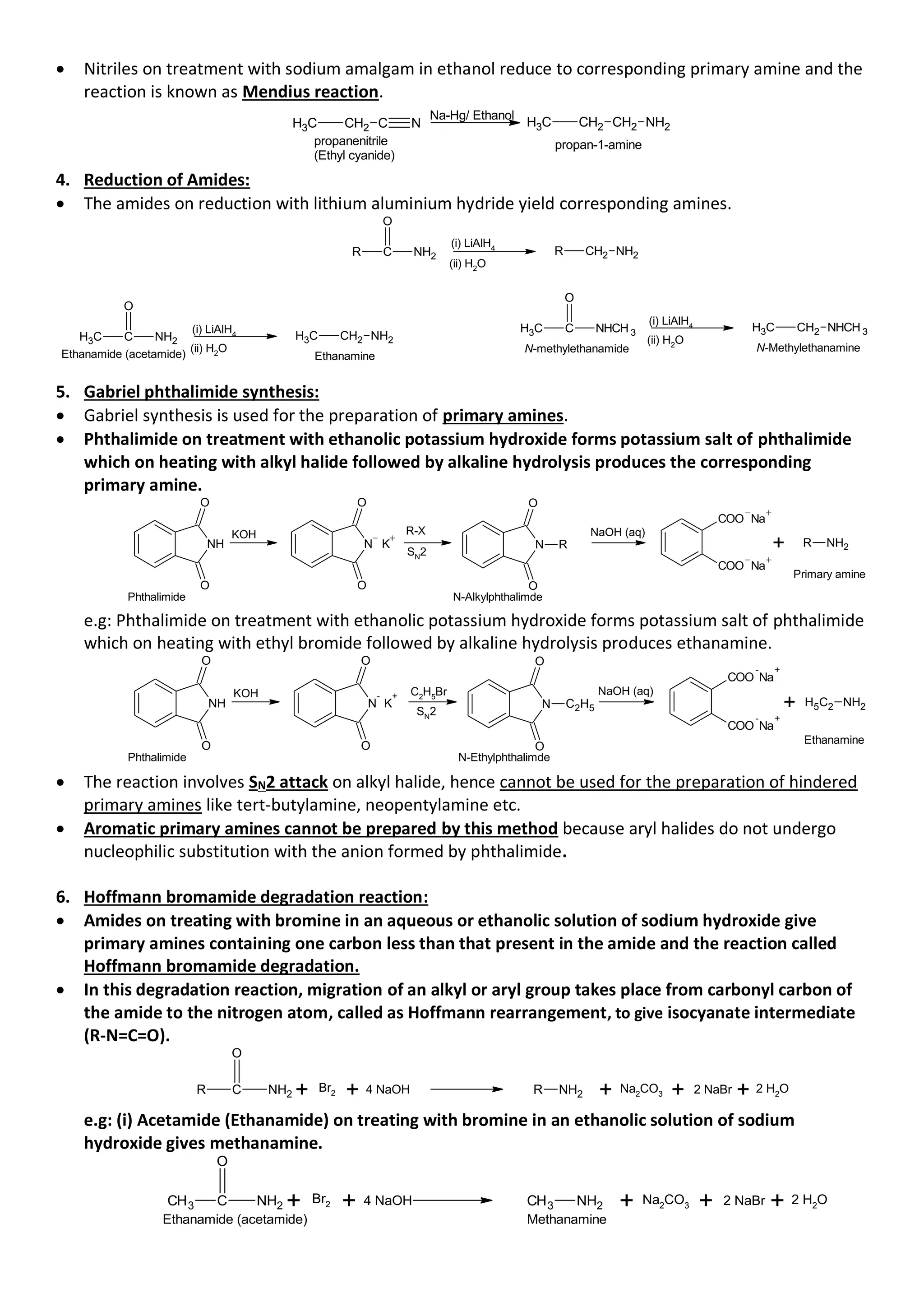
5. Gabriel phthalimide synthesis:
• Gabriel synthesis is used for the preparation of primary amines.
• Phthalimide on treatment with ethanolic potassium hydroxide forms potassium salt of phthalimide
which on heating with alkyl halide followed by alkaline hydrolysis produces the corresponding
primary amine.
NH
O
O
N K
O
O
N
O
O
R
COO Na
COO Na
+
Phthalimide N-Alkylphthalimde
Primary amine
KOH R-X NaOH (aq)
R NH2
SN2
e.g: Phthalimide on treatment with ethanolic potassium hydroxide forms potassium salt of phthalimide
which on heating with ethyl bromide followed by alkaline hydrolysis produces ethanamine.
NH
O
O
N
-
K
+
O
O
N
O
O
C2H5
COO
-
Na
+
COO
-
Na
+
+ H5C2 NH2
Phthalimide N-Ethylphthalimde
Ethanamine
KOH C2
H5
Br NaOH (aq)
SN
2
• The reaction involves SN2 attack on alkyl halide, hence cannot be used for the preparation of hindered
primary amines like tert-butylamine, neopentylamine etc.
• Aromatic primary amines cannot be prepared by this method because aryl halides do not undergo
nucleophilic substitution with the anion formed by phthalimide.
6. Hoffmann bromamide degradation reaction:
• Amides on treating with bromine in an aqueous or ethanolic solution of sodium hydroxide give
primary amines containing one carbon less than that present in the amide and the reaction called
Hoffmann bromamide degradation.
• In this degradation reaction, migration of an alkyl or aryl group takes place from carbonyl carbon of
the amide to the nitrogen atom, called as Hoffmann rearrangement, to give isocyanate intermediate
(R-N=C=O).
C NH2
O
R + Br2 + 4 NaOH + Na2
CO3 + 2 NaBr + 2 H2
O
R NH2
e.g: (i) Acetamide (Ethanamide) on treating with bromine in an ethanolic solution of sodium
hydroxide gives methanamine.
C
CH3 NH2
O
+ Br2 + 4 NaOH NH2
CH3 + Na2
CO3 + 2 NaBr + 2 H2
O
Ethanamide (acetamide) Methanamine
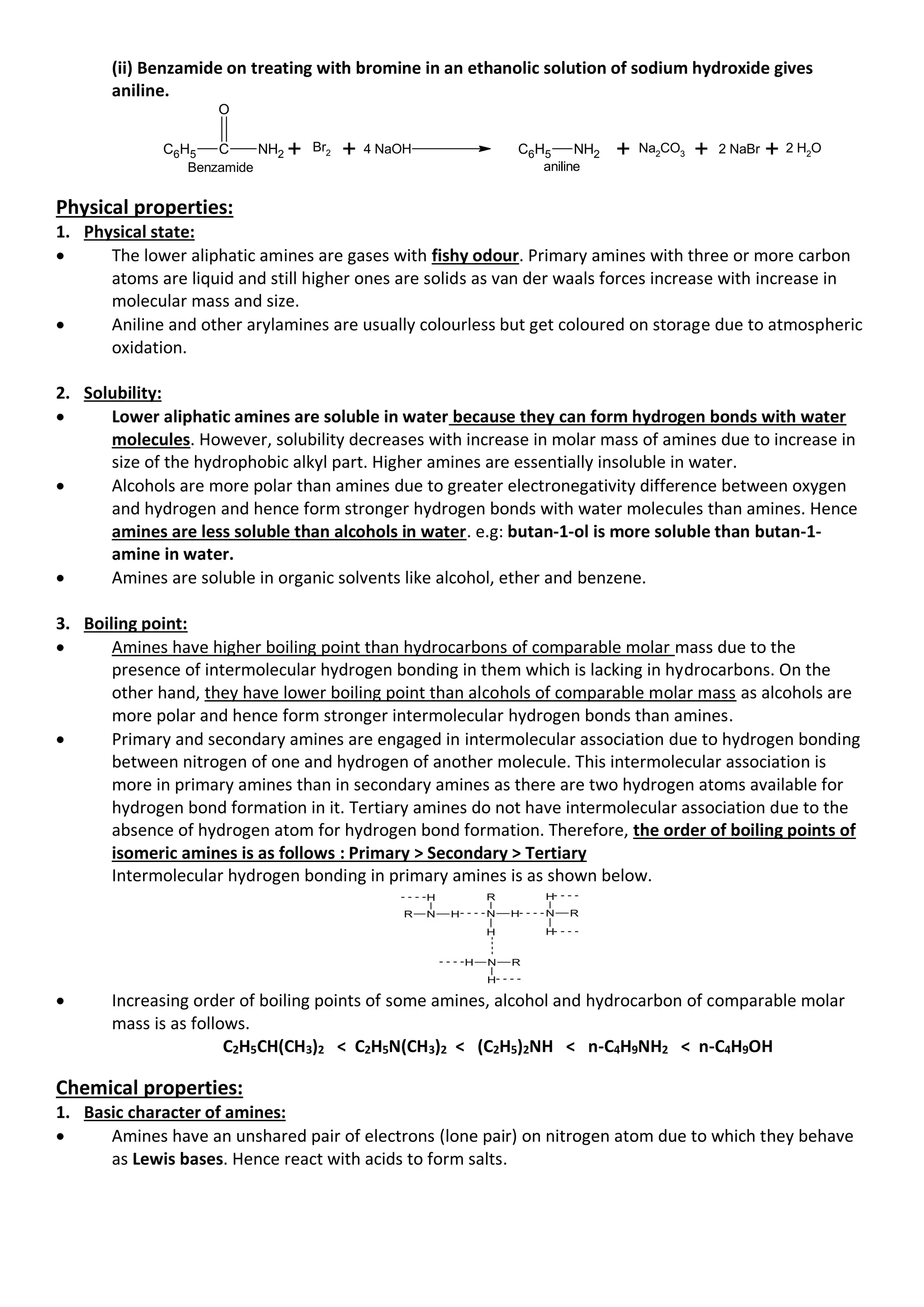
(ii) Benzamide on treating with bromine in an ethanolic solution of sodium hydroxide gives
aniline.
C
C6H5 NH2
O
+ Br2 + 4 NaOH NH2
C6H5 + Na2CO3 + 2 NaBr + 2 H2O
Benzamide aniline
Physical properties:
1. Physical state:
• The lower aliphatic amines are gases with fishy odour. Primary amines with three or more carbon
atoms are liquid and still higher ones are solids as van der waals forces increase with increase in
molecular mass and size.
• Aniline and other arylamines are usually colourless but get coloured on storage due to atmospheric
oxidation.
2. Solubility:
• Lower aliphatic amines are soluble in water because they can form hydrogen bonds with water
molecules. However, solubility decreases with increase in molar mass of amines due to increase in
size of the hydrophobic alkyl part. Higher amines are essentially insoluble in water.
• Alcohols are more polar than amines due to greater electronegativity difference between oxygen
and hydrogen and hence form stronger hydrogen bonds with water molecules than amines. Hence
amines are less soluble than alcohols in water. e.g: butan-1-ol is more soluble than butan-1-
amine in water.
• Amines are soluble in organic solvents like alcohol, ether and benzene.
3. Boiling point:
• Amines have higher boiling point than hydrocarbons of comparable molar mass due to the
presence of intermolecular hydrogen bonding in them which is lacking in hydrocarbons. On the
other hand, they have lower boiling point than alcohols of comparable molar mass as alcohols are
more polar and hence form stronger intermolecular hydrogen bonds than amines.
• Primary and secondary amines are engaged in intermolecular association due to hydrogen bonding
between nitrogen of one and hydrogen of another molecule. This intermolecular association is
more in primary amines than in secondary amines as there are two hydrogen atoms available for
hydrogen bond formation in it. Tertiary amines do not have intermolecular association due to the
absence of hydrogen atom for hydrogen bond formation. Therefore, the order of boiling points of
isomeric amines is as follows : Primary > Secondary > Tertiary
Intermolecular hydrogen bonding in primary amines is as shown below.
N H
H
R
N H
H
R N R
H
H
N R
H
H
- - - - - - - -
- - - - - - - -
- - - -
- - - -
- - - -
-
-
-
-
• Increasing order of boiling points of some amines, alcohol and hydrocarbon of comparable molar
mass is as follows.
C2H5CH(CH3)2 < C2H5N(CH3)2 < (C2H5)2NH < n-C4H9NH2 < n-C4H9OH
Chemical properties:
1. Basic character of amines:
• Amines have an unshared pair of electrons (lone pair) on nitrogen atom due to which they behave
as Lewis bases. Hence react with acids to form salts.
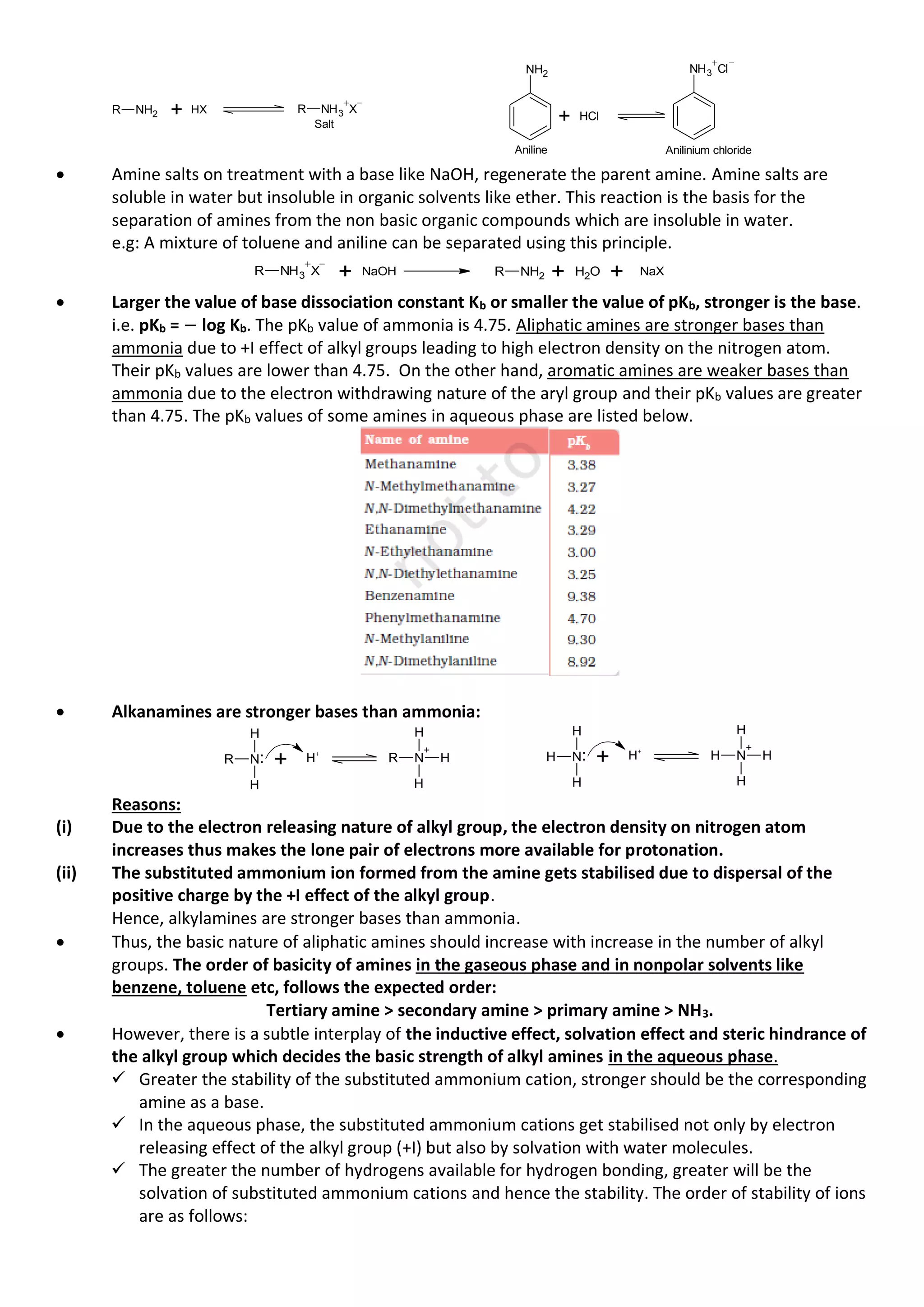
R NH2 + HX R NH3 X
Salt
NH2 NH3 Cl
+ Cl
H
Aniline Anilinium chloride
• Amine salts on treatment with a base like NaOH, regenerate the parent amine. Amine salts are
soluble in water but insoluble in organic solvents like ether. This reaction is the basis for the
separation of amines from the non basic organic compounds which are insoluble in water.
e.g: A mixture of toluene and aniline can be separated using this principle.
R NH3 X + NaOH R NH2 + O
H2 + NaX
• Larger the value of base dissociation constant Kb or smaller the value of pKb, stronger is the base.
i.e. pKb = − log Kb. The pKb value of ammonia is 4.75. Aliphatic amines are stronger bases than
ammonia due to +I effect of alkyl groups leading to high electron density on the nitrogen atom.
Their pKb values are lower than 4.75. On the other hand, aromatic amines are weaker bases than
ammonia due to the electron withdrawing nature of the aryl group and their pKb values are greater
than 4.75. The pKb values of some amines in aqueous phase are listed below.
• Alkanamines are stronger bases than ammonia:
R N
H
H
+ H+
.
.
R N
+
H
H
H H N
H
H
+ H+
.
.
H N
+
H
H
H
Reasons:
(i) Due to the electron releasing nature of alkyl group, the electron density on nitrogen atom
increases thus makes the lone pair of electrons more available for protonation.
(ii) The substituted ammonium ion formed from the amine gets stabilised due to dispersal of the
positive charge by the +I effect of the alkyl group.
Hence, alkylamines are stronger bases than ammonia.
• Thus, the basic nature of aliphatic amines should increase with increase in the number of alkyl
groups. The order of basicity of amines in the gaseous phase and in nonpolar solvents like
benzene, toluene etc, follows the expected order:
Tertiary amine > secondary amine > primary amine > NH3.
• However, there is a subtle interplay of the inductive effect, solvation effect and steric hindrance of
the alkyl group which decides the basic strength of alkyl amines in the aqueous phase.
✓ Greater the stability of the substituted ammonium cation, stronger should be the corresponding
amine as a base.
✓ In the aqueous phase, the substituted ammonium cations get stabilised not only by electron
releasing effect of the alkyl group (+I) but also by solvation with water molecules.
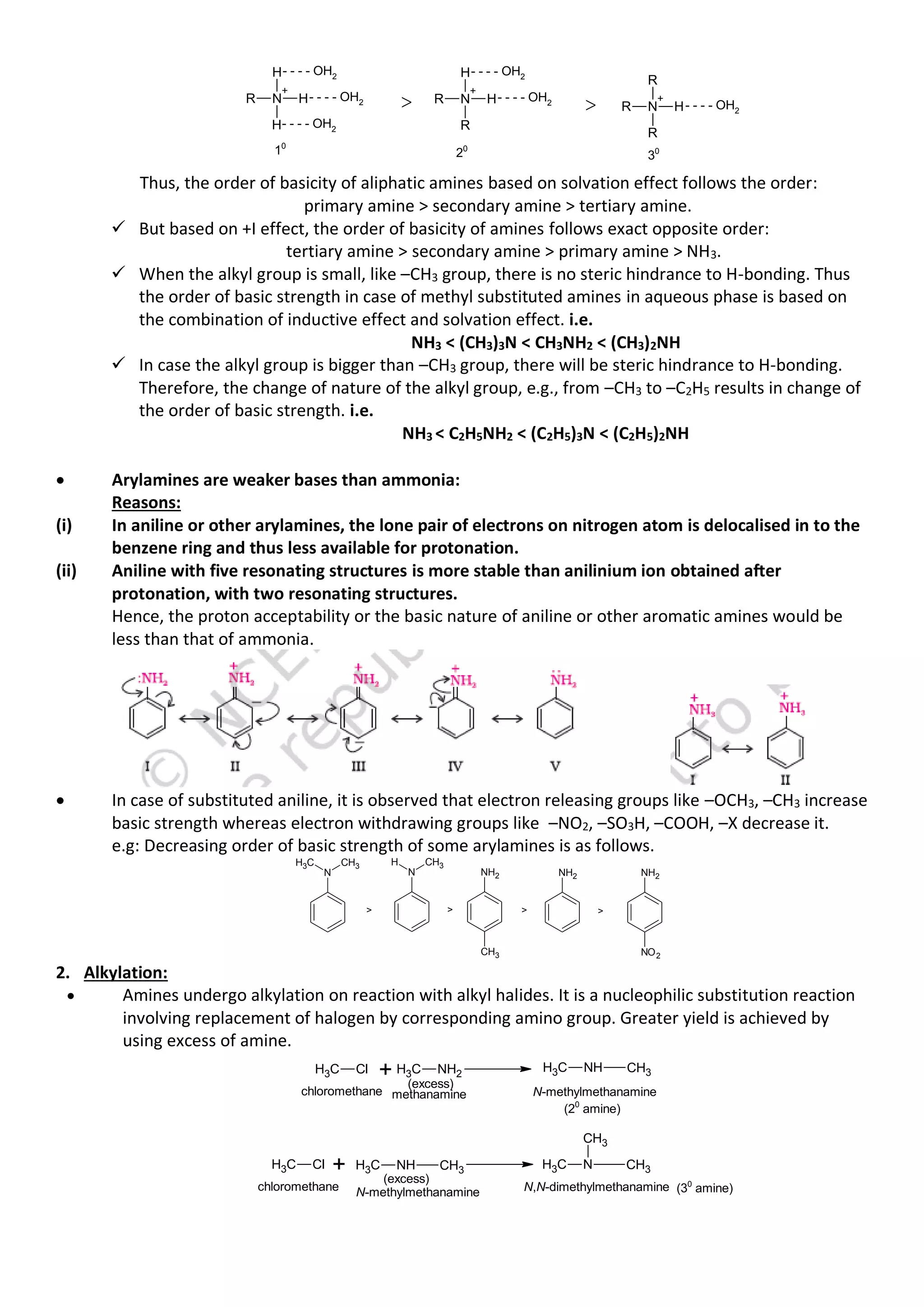
✓ The greater the number of hydrogens available for hydrogen bonding, greater will be the
solvation of substituted ammonium cations and hence the stability. The order of stability of ions
are as follows:
R N
+
H
H
H- - - - OH2
- - - - OH2
- - - - OH2
> R N
+
R
H
H- - - - OH2
- - - - OH2
> R N
+
R
R
H- - - - OH2
10
20
30
Thus, the order of basicity of aliphatic amines based on solvation effect follows the order:
primary amine > secondary amine > tertiary amine.
✓ But based on +I effect, the order of basicity of amines follows exact opposite order:
tertiary amine > secondary amine > primary amine > NH3.
✓ When the alkyl group is small, like –CH3 group, there is no steric hindrance to H-bonding. Thus
the order of basic strength in case of methyl substituted amines in aqueous phase is based on
the combination of inductive effect and solvation effect. i.e.
NH3 < (CH3)3N < CH3NH2 < (CH3)2NH
✓ In case the alkyl group is bigger than –CH3 group, there will be steric hindrance to H-bonding.
Therefore, the change of nature of the alkyl group, e.g., from –CH3 to –C2H5 results in change of
the order of basic strength. i.e.
NH3 < C2H5NH2 < (C2H5)3N < (C2H5)2NH
• Arylamines are weaker bases than ammonia:
Reasons:
(i) In aniline or other arylamines, the lone pair of electrons on nitrogen atom is delocalised in to the
benzene ring and thus less available for protonation.
(ii) Aniline with five resonating structures is more stable than anilinium ion obtained after
protonation, with two resonating structures.
Hence, the proton acceptability or the basic nature of aniline or other aromatic amines would be
less than that of ammonia.
• In case of substituted aniline, it is observed that electron releasing groups like –OCH3, –CH3 increase
basic strength whereas electron withdrawing groups like –NO2, –SO3H, –COOH, –X decrease it.
e.g: Decreasing order of basic strength of some arylamines is as follows.
N
CH3
C
H3
N
CH3
H
NH2
CH3
NH2 NH2
NO2
> > > >
2. Alkylation:
• Amines undergo alkylation on reaction with alkyl halides. It is a nucleophilic substitution reaction
involving replacement of halogen by corresponding amino group. Greater yield is achieved by
using excess of amine.
C
H3 Cl C
H3 NH2
+ (excess)
chloromethane methanamine N-methylmethanamine
C
H3 Cl C
H3 N CH3
CH3
C
H3 NH CH3
C
H3 NH CH3
+ (excess)
chloromethane N-methylmethanamine N,N-dimethylmethanamine
(20
amine)
(30
amine)
3. Acylation and benzoylation:
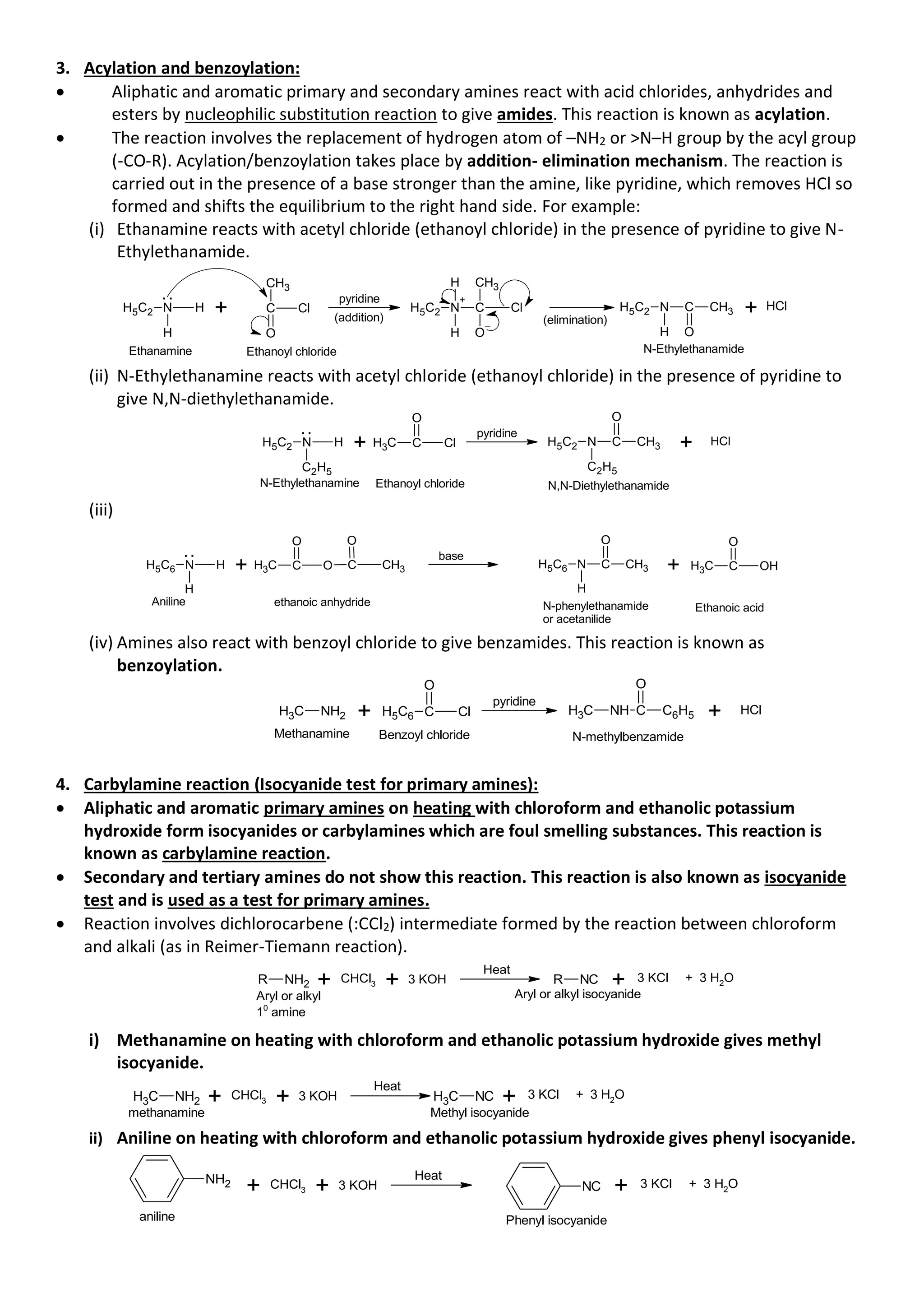
• Aliphatic and aromatic primary and secondary amines react with acid chlorides, anhydrides and
esters by nucleophilic substitution reaction to give amides. This reaction is known as acylation.
• The reaction involves the replacement of hydrogen atom of –NH2 or >N–H group by the acyl group
(-CO-R). Acylation/benzoylation takes place by addition- elimination mechanism. The reaction is
carried out in the presence of a base stronger than the amine, like pyridine, which removes HCl so
formed and shifts the equilibrium to the right hand side. For example:
(i) Ethanamine reacts with acetyl chloride (ethanoyl chloride) in the presence of pyridine to give N-
Ethylethanamide.
H5C2 N H
H
. .
+ C Cl
O
CH3
pyridine
(addition)
H5C2 N
+
H
C Cl
O
CH3
H
Ethanamine Ethanoyl chloride
(elimination)
H5C2 N
H
C
O
CH3
N-Ethylethanamide
+ Cl
H
(ii) N-Ethylethanamine reacts with acetyl chloride (ethanoyl chloride) in the presence of pyridine to
give N,N-diethylethanamide.
H5C2 N H
C2H5
. .
+ C Cl
C
H3
O
pyridine
H5C2 N
C2H5
C CH3
O
+ HCl
N-Ethylethanamine Ethanoyl chloride N,N-Diethylethanamide
(iii)
H5C6 N H
H
. .
+ C O
C
H3
O
C CH3
O
base
H5C6 N
H
C CH3
O
+ C OH
C
H3
O
Aniline ethanoic anhydride N-phenylethanamide
or acetanilide
Ethanoic acid
(iv) Amines also react with benzoyl chloride to give benzamides. This reaction is known as
benzoylation.
C
H3 NH2 + C Cl
H5C6
O
pyridine
C
H3 NH C C6H5
O
+ HCl
Methanamine Benzoyl chloride N-methylbenzamide
4. Carbylamine reaction (Isocyanide test for primary amines):
• Aliphatic and aromatic primary amines on heating with chloroform and ethanolic potassium
hydroxide form isocyanides or carbylamines which are foul smelling substances. This reaction is
known as carbylamine reaction.
• Secondary and tertiary amines do not show this reaction. This reaction is also known as isocyanide
test and is used as a test for primary amines.
• Reaction involves dichlorocarbene (:CCl2) intermediate formed by the reaction between chloroform
and alkali (as in Reimer-Tiemann reaction).
R NH2 + CHCl3 + 3 KOH
Heat
R NC + 3 KCl + 3 H2
O
Aryl or alkyl
10
amine
Aryl or alkyl isocyanide
i) Methanamine on heating with chloroform and ethanolic potassium hydroxide gives methyl
isocyanide.
C
H3 NH2 + CHCl3 + 3 KOH
Heat
C
H3 NC + 3 KCl + 3 H2
O
methanamine Methyl isocyanide
ii) Aniline on heating with chloroform and ethanolic potassium hydroxide gives phenyl isocyanide.
+ CHCl3 + 3 KOH
Heat
+ 3 KCl + 3 H2
O
NH2 NC
aniline Phenyl isocyanide
5. Reaction with nitrous acid:
• Three classes of amines (10
, 20
and 30
amines) react differently with nitrous acid which is prepared in
situ from a mineral acid and sodium nitrite.
• Primary aliphatic amines react with nitrous acid to form aliphatic diazonium salts which being
unstable, liberate nitrogen gas quantitatively and alcohols. Quantitative evolution of nitrogen is used in
estimation of amino acids and proteins.
R NH2
NaNO2
+ HCl
R N2
+
Cl
-
[ ] R OH + N2 + HCl
Alkyl diazonium chloride
H2
O
+ HNO2
e.g: Methanamine reacts with nitrous acid to form methyl diazonium salt which decomposes to
methanol liberating nitrogen gas.
C
H3 NH2
NaNO2 + HCl
C
H3 N2
+
Cl
-
[ ] C
H3 OH + N2
+ HCl
methanamine methanol
Methyl diazonium chloride
H2
O
• Aromatic primary amines react with nitrous acid at low temperatures (273-278 K) to form diazonium
salts which are stable at this temperature in solution. Arene diazonium salts are a very important class
of compounds used for synthesis of a variety of aromatic compounds.
NaNO2
+ 2HCl
Benzene diazonium chloride
NH2
273 - 278K
N2 Cl
+ NaCl + O
H2
2
aniline
• Secondary and tertiary amines react with nitrous acid in a different manner.
6. Reaction with arylsulphonyl chloride:
• Benzenesulphonyl chloride (C6H5SO2Cl), which is also known as Hinsberg’s reagent, reacts with
primary and secondary amines to form sulphonamides. Tertiary amines do not react with
benzenesulphonyl chloride. This property of amines reacting with benzenesulphonyl chloride in a
different manner is used for the distinction of primary, secondary and tertiary amines and also for the
separation of a mixture of amines.
• These days benzenesulphonyl chloride is replaced by p-toluenesulphonyl chloride.
✓ The reaction of benzenesulphonyl chloride with primary amine yields N-alkylbenzenesulphonamide
which is soluble in alkali.
S
O
O
Cl + H N C2H5
H
Ethanamine
Benzenesulphonyl chloride
S
O
O
NH C2H5 + Cl
H
N-Ethylbenzenesulphonamide
The hydrogen attached to nitrogen in this sulphonamide is strongly acidic due to the presence of strong
electron withdrawing sulphonyl group. Hence, it is soluble in alkali.
✓ The reaction of benzenesulphonyl chloride with secondary amine yields N,N-
dialkylbenzenesulphonamide which is insoluble in alkali.
S
O
O
Cl + H N C2H5
C2H5
N-Ethylethanamine
Benzenesulphonyl chloride
S
O
O
N C2H5
C2H5
+ Cl
H
N,N-Diethylbenzenesulphonamide
Since N,N-dialkylbenzenesulphonamide does not contain any hydrogen atom attached to nitrogen
atom, it is not acidic and hence insoluble in alkali,
✓ Tertiary amines do not react with benzenesulphonyl chloride.
7. Electrophilic substitution:
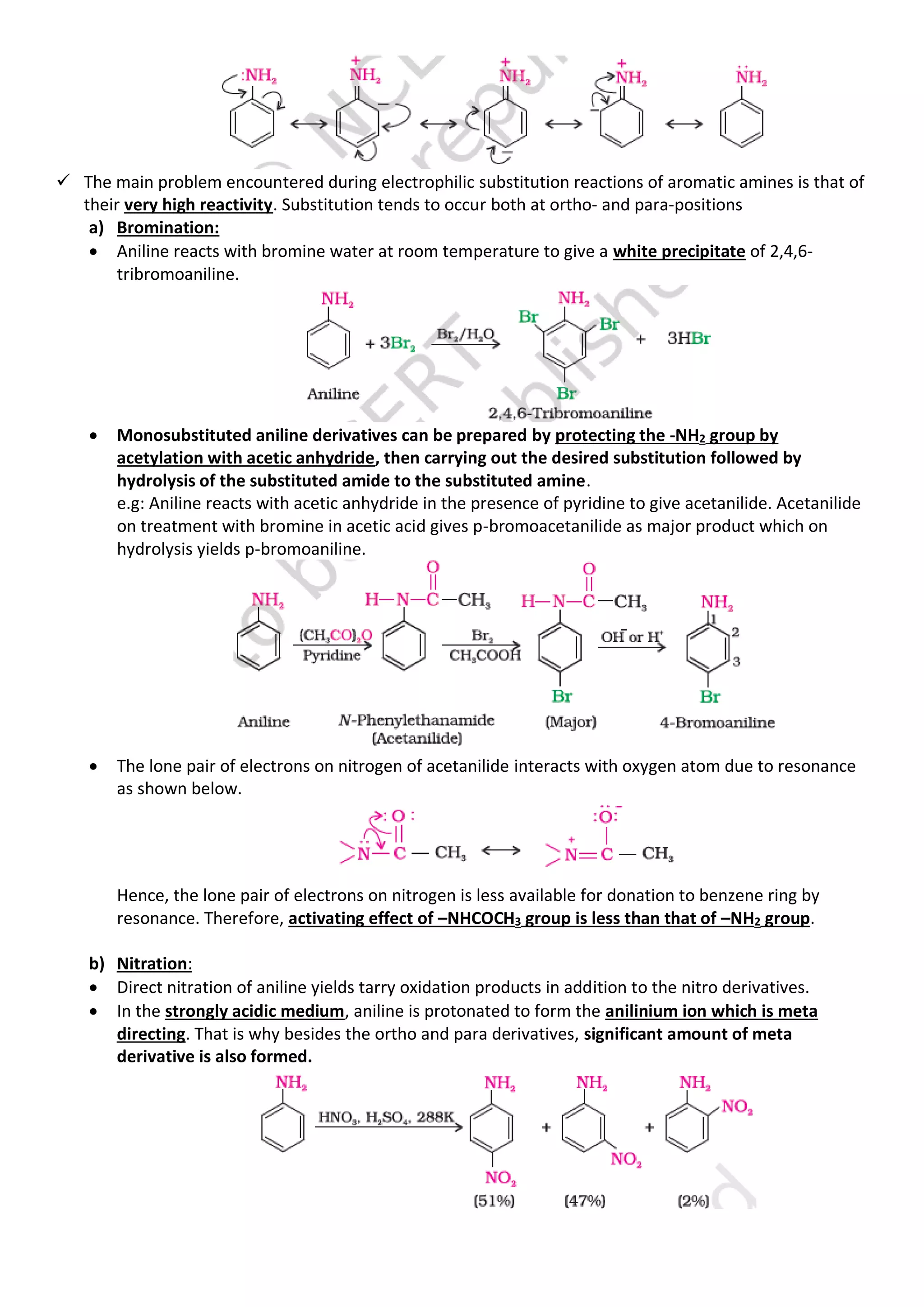
✓ The –NH2 group is a powerful ring activating and ortho-, para- directing group. It is evident from the
following resonance structures.
✓ The main problem encountered during electrophilic substitution reactions of aromatic amines is that of
their very high reactivity. Substitution tends to occur both at ortho- and para-positions
a) Bromination:
• Aniline reacts with bromine water at room temperature to give a white precipitate of 2,4,6-
tribromoaniline.
• Monosubstituted aniline derivatives can be prepared by protecting the -NH2 group by
acetylation with acetic anhydride, then carrying out the desired substitution followed by
hydrolysis of the substituted amide to the substituted amine.
e.g: Aniline reacts with acetic anhydride in the presence of pyridine to give acetanilide. Acetanilide
on treatment with bromine in acetic acid gives p-bromoacetanilide as major product which on
hydrolysis yields p-bromoaniline.
• The lone pair of electrons on nitrogen of acetanilide interacts with oxygen atom due to resonance
as shown below.
Hence, the lone pair of electrons on nitrogen is less available for donation to benzene ring by
resonance. Therefore, activating effect of –NHCOCH3 group is less than that of –NH2 group.
b) Nitration:
• Direct nitration of aniline yields tarry oxidation products in addition to the nitro derivatives.
• In the strongly acidic medium, aniline is protonated to form the anilinium ion which is meta
directing. That is why besides the ortho and para derivatives, significant amount of meta
derivative is also formed.
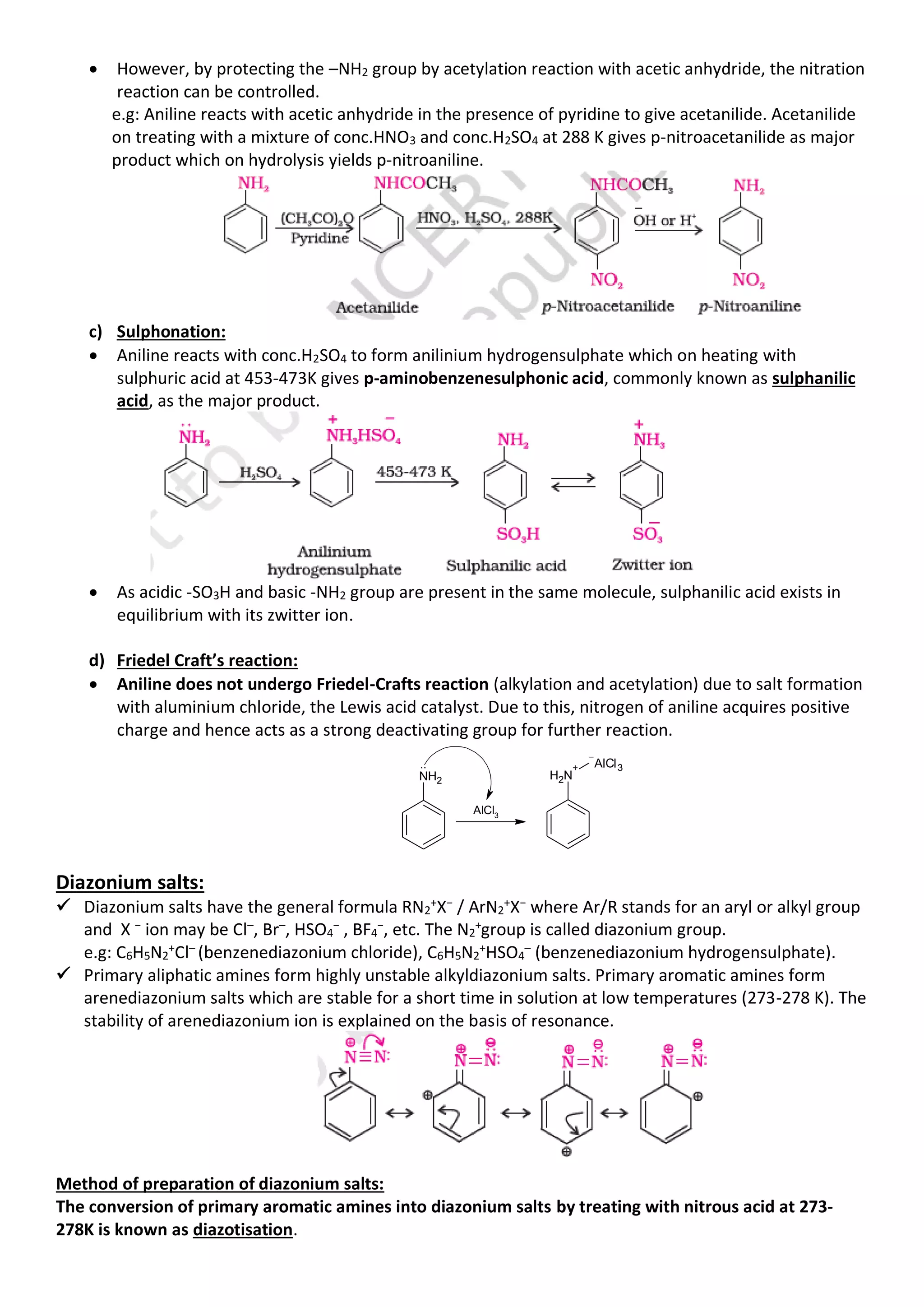
• However, by protecting the –NH2 group by acetylation reaction with acetic anhydride, the nitration
reaction can be controlled.
e.g: Aniline reacts with acetic anhydride in the presence of pyridine to give acetanilide. Acetanilide
on treating with a mixture of conc.HNO3 and conc.H2SO4 at 288 K gives p-nitroacetanilide as major
product which on hydrolysis yields p-nitroaniline.
c) Sulphonation:
• Aniline reacts with conc.H2SO4 to form anilinium hydrogensulphate which on heating with
sulphuric acid at 453-473K gives p-aminobenzenesulphonic acid, commonly known as sulphanilic
acid, as the major product.
• As acidic -SO3H and basic -NH2 group are present in the same molecule, sulphanilic acid exists in
equilibrium with its zwitter ion.
d) Friedel Craft’s reaction:
• Aniline does not undergo Friedel-Crafts reaction (alkylation and acetylation) due to salt formation
with aluminium chloride, the Lewis acid catalyst. Due to this, nitrogen of aniline acquires positive
charge and hence acts as a strong deactivating group for further reaction.
NH2
AlCl3
..
N
H2
+ AlCl3
Diazonium salts:
✓ Diazonium salts have the general formula RN2
+X− / ArN2
+X− where Ar/R stands for an aryl or alkyl group
and X − ion may be Cl–, Br–, HSO4
− , BF4
−, etc. The N2
+group is called diazonium group.
e.g: C6H5N2
+
Cl–
(benzenediazonium chloride), C6H5N2
+
HSO4
–
(benzenediazonium hydrogensulphate).
✓ Primary aliphatic amines form highly unstable alkyldiazonium salts. Primary aromatic amines form
arenediazonium salts which are stable for a short time in solution at low temperatures (273-278 K). The
stability of arenediazonium ion is explained on the basis of resonance.
Method of preparation of diazonium salts:
The conversion of primary aromatic amines into diazonium salts by treating with nitrous acid at 273-
278K is known as diazotisation.
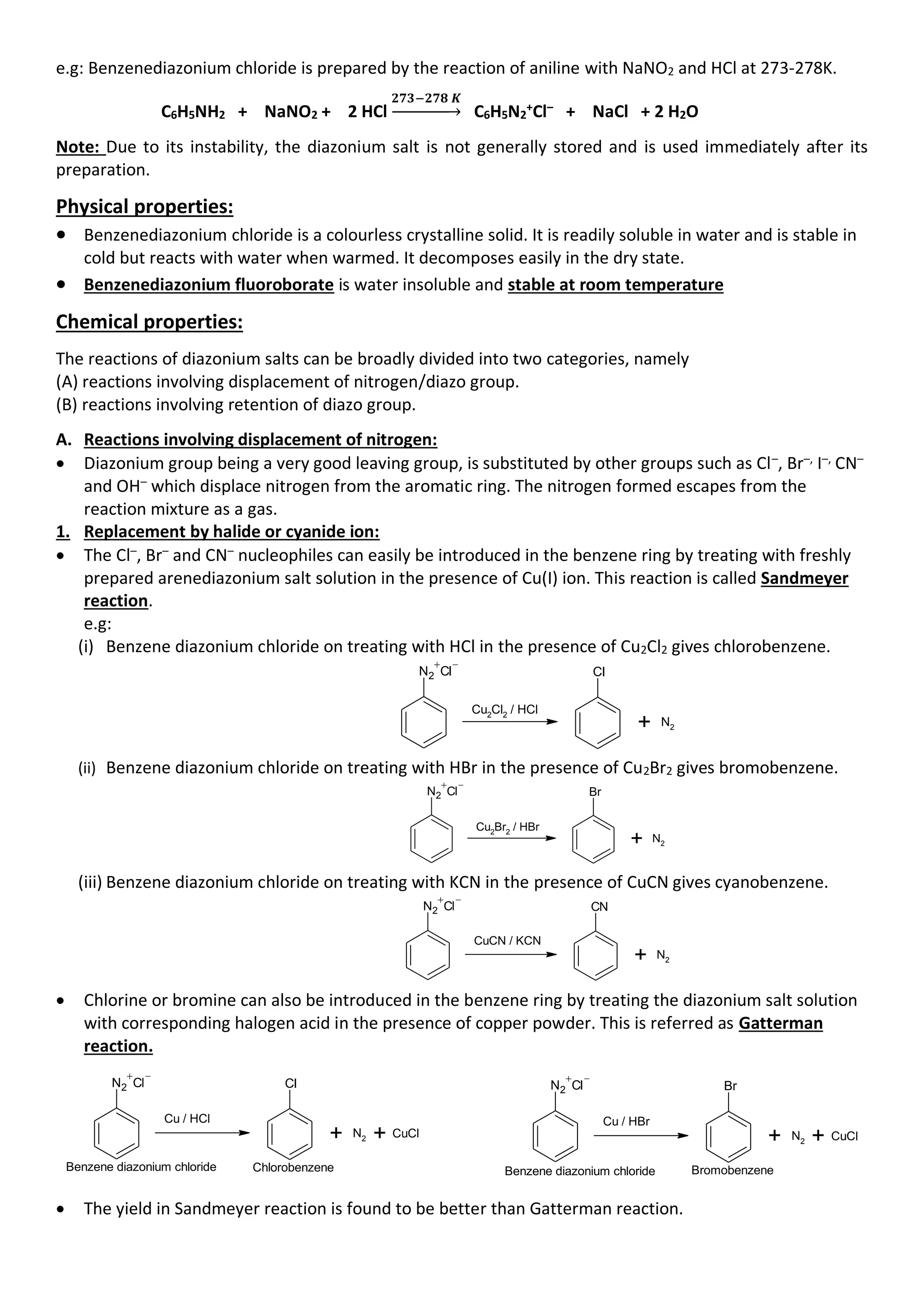
e.g: Benzenediazonium chloride is prepared by the reaction of aniline with NaNO2 and HCl at 273-278K.
C6H5NH2 + NaNO2 + 2 HCl
𝟐𝟕𝟑−𝟐𝟕𝟖 𝑲
→ C6H5N2
+
Cl–
+ NaCl + 2 H2O
Note: Due to its instability, the diazonium salt is not generally stored and is used immediately after its
preparation.
Physical properties:
• Benzenediazonium chloride is a colourless crystalline solid. It is readily soluble in water and is stable in
cold but reacts with water when warmed. It decomposes easily in the dry state.
• Benzenediazonium fluoroborate is water insoluble and stable at room temperature
Chemical properties:
The reactions of diazonium salts can be broadly divided into two categories, namely
(A) reactions involving displacement of nitrogen/diazo group.
(B) reactions involving retention of diazo group.
A. Reactions involving displacement of nitrogen:
• Diazonium group being a very good leaving group, is substituted by other groups such as Cl–
, Br–,
I–,
CN–
and OH–
which displace nitrogen from the aromatic ring. The nitrogen formed escapes from the
reaction mixture as a gas.
1. Replacement by halide or cyanide ion:
• The Cl–
, Br–
and CN–
nucleophiles can easily be introduced in the benzene ring by treating with freshly
prepared arenediazonium salt solution in the presence of Cu(I) ion. This reaction is called Sandmeyer
reaction.
e.g:
(i) Benzene diazonium chloride on treating with HCl in the presence of Cu2Cl2 gives chlorobenzene.
N2 Cl Cl
Cu2
Cl2
/ HCl
+ N2
(ii) Benzene diazonium chloride on treating with HBr in the presence of Cu2Br2 gives bromobenzene.
N2 Cl Br
Cu2Br2 / HBr
+ N2
(iii) Benzene diazonium chloride on treating with KCN in the presence of CuCN gives cyanobenzene.
N2 Cl CN
CuCN / KCN
+ N2
• Chlorine or bromine can also be introduced in the benzene ring by treating the diazonium salt solution
with corresponding halogen acid in the presence of copper powder. This is referred as Gatterman
reaction.
N2 Cl Cl
Cu / HCl
+ N2 + CuCl
Benzene diazonium chloride Chlorobenzene
N2 Cl Br
Cu / HBr
+ N2 + CuCl
Benzene diazonium chloride Bromobenzene
• The yield in Sandmeyer reaction is found to be better than Gatterman reaction.
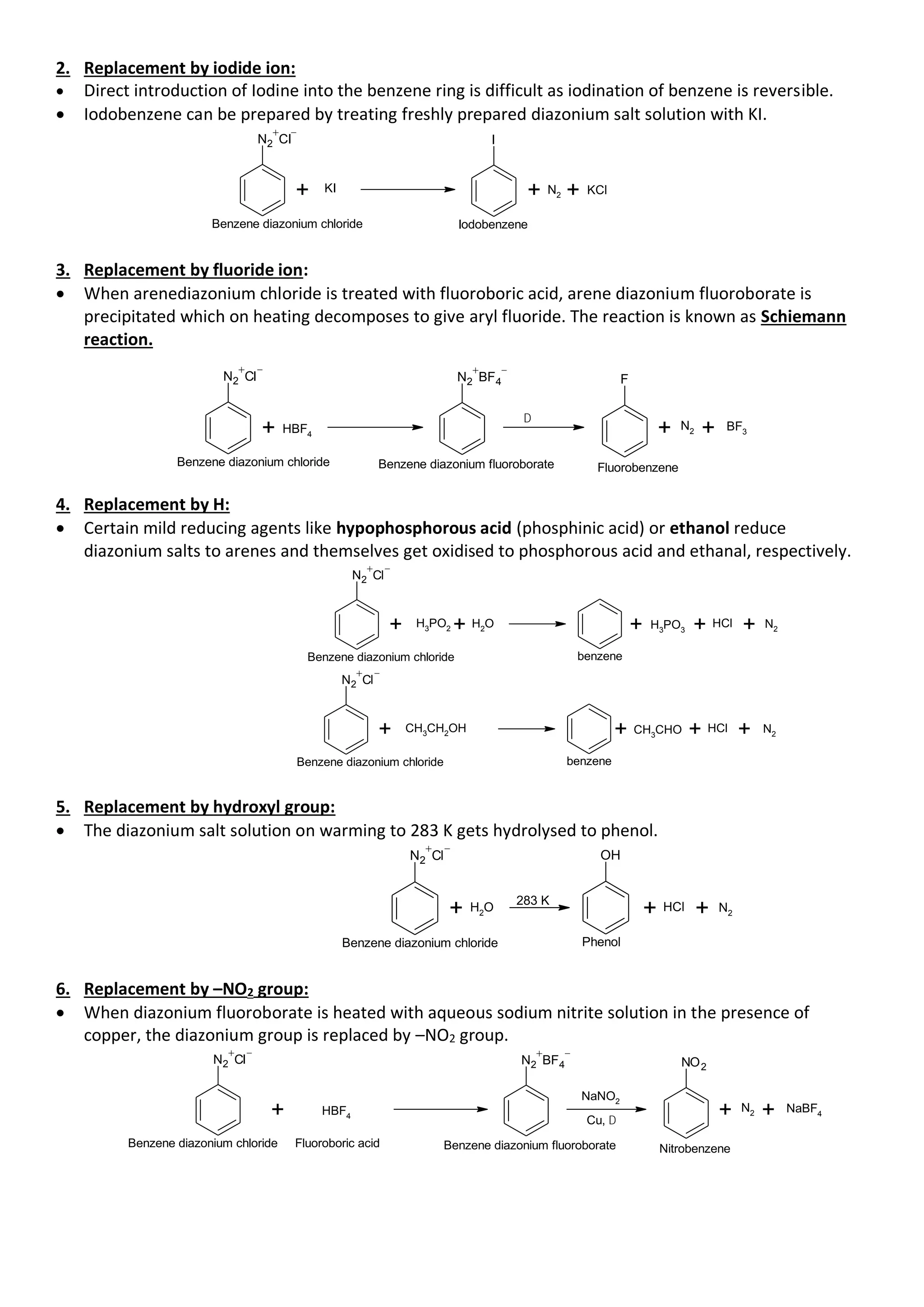
2. Replacement by iodide ion:
• Direct introduction of Iodine into the benzene ring is difficult as iodination of benzene is reversible.
• Iodobenzene can be prepared by treating freshly prepared diazonium salt solution with KI.
N2 Cl I
+ N2 + KCl
Benzene diazonium chloride Iodobenzene
+ KI
3. Replacement by fluoride ion:
• When arenediazonium chloride is treated with fluoroboric acid, arene diazonium fluoroborate is
precipitated which on heating decomposes to give aryl fluoride. The reaction is known as Schiemann
reaction.
N2 Cl N2 BF4
Benzene diazonium chloride
+ HBF4
D
F
+ N2 + BF3
Benzene diazonium fluoroborate Fluorobenzene
4. Replacement by H:
• Certain mild reducing agents like hypophosphorous acid (phosphinic acid) or ethanol reduce
diazonium salts to arenes and themselves get oxidised to phosphorous acid and ethanal, respectively.
N2 Cl
Benzene diazonium chloride
+ H3
PO2 + H2
O + H3
PO3 + HCl + N2
benzene
N2 Cl
Benzene diazonium chloride
+ CH3
CH2
OH + CH3
CHO + HCl + N2
benzene
5. Replacement by hydroxyl group:
• The diazonium salt solution on warming to 283 K gets hydrolysed to phenol.
N2 Cl
Benzene diazonium chloride
+ H2
O
OH
+ HCl + N2
Phenol
283 K
6. Replacement by –NO2 group:
• When diazonium fluoroborate is heated with aqueous sodium nitrite solution in the presence of
copper, the diazonium group is replaced by –NO2 group.
N2 Cl N2 BF4
Benzene diazonium chloride
+ HBF4
Cu, D
NO2
+ N2 + NaBF4
Benzene diazonium fluoroborate Nitrobenzene
Fluoroboric acid
NaNO2
B. Reactions involving retention of diazo group:
Coupling reaction:
• Diazonium salts react with electron rich substituted benzenes like phenols or arylamines to give azo
products which have an extended conjugated system with two aromatic rings joined through the–N=N–
bond. The reaction is known as Coupling reaction. This is an example of electrophilic substitution
reaction.
• These compounds are often coloured and are used as dyes. Since only arene diazonium salts produce
coloured dyes, the reaction is used to distinguish between aliphatic and aromatic primary amines,
famously known as azo dye test.
(i) Benzene diazonium chloride reacts with phenol in the presence of a base catalyst to form p-
Hydroxyazobenzene (orange dye).
(ii) Benzene diazonium chloride reacts with aniline in the presence of an acid catalyst to form p-
Aminoazobenzene (yellow dye).
Importance of diazonium salts in organic synthesis:
✓ Diazonium salts are very good intermediates for the introduction of –F, –Cl, –Br, –I, –CN, –OH, –NO2
groups into the aromatic ring.
✓ Aryl fluorides and iodides cannot be prepared by direct halogenation. The cyano group cannot be
introduced by nucleophilic substitution of chlorine in chlorobenzene. Thus, the replacement of diazo
group by other groups is helpful in preparing those substituted aromatic compounds which cannot be
prepared by direct substitution in benzene or substituted benzene.
Summary of reactions of diazonium salts:
N2 Cl
Cl
Br
CN
I
F
OH
NO2
N N OH
N N NH2
Cu2
Cl2
/HCl or
Cu/HCl
Cu2Br2/HBr or
Cu/HBr
CuCN/KCN
KI
(i) HBF
4
(ii) D
H2O , 283 K
H3PO2
or
C2H5OH
(i) HBF 4
(ii) NaNO 2
/ Cu,
D
OH
OH-
NH2
H+
***************************************************************************************

Notes-Amines.pdf

  • 1.
    UNIT 13: AMINES Aminesare the derivatives of ammonia, obtained by replacement of one, two or all the three hydrogen atoms by alkyl and/or aryl groups. e.g: CH3-NH2, C6H5-NH2, CH3-NH-CH3, CH3-N(CH3)2 etc. • In nature, they occur among proteins, vitamins, alkaloids and hormones. • Synthetic examples include polymers, dyestuffs and drugs. • Two biologically active compounds, namely adrenaline and ephedrine, both containing secondary amino group, are used to increase blood pressure. • Novocain, a synthetic amino compound, is used as an anaesthetic in dentistry. Benadryl, a well-known antihistaminic drug also contains tertiary amino group. • Quaternary ammonium salts are used as surfactants. Structure of Amines: Like ammonia, nitrogen atom of amines is trivalent and carries an unshared pair of electrons. Nitrogen orbitals in amines are sp3 hybridised and the geometry is trigonal pyramidal. Due to the repulsion between unshared pair of electrons and the bond pairs, the angle C–N–E, (where E is C or H) is less than 109.5°; for instance, it is 108o in case of trimethylamine. Classification of Amines: a) Based on the number of hydrogens replaced: • If one hydrogen atom of ammonia is replaced by alkyl or aryl group, we get RNH2 or ArNH2, a primary amine. e.g: CH3-NH2, C6H5-NH2 • If two hydrogen atoms of ammonia or one hydrogen atom of R-NH2 are replaced by another alkyl or aryl (R’) group, we get R-NHR’, a secondary amine. e.g: CH3-NH-CH3, CH3-NH-C6H5 • Replacement of all the hydrogen atoms of ammonia by alkyl or aryl group leads to the formation of tertiary amine. e.g: CH3-N(CH3)2, C6H5-N(CH3)2 NH3 R NH2 R NH R 1 R N R 1 R 2 Primary (10 ) Secondary (20 ) Tertiary (30 ) b) Based on the type of substituents: • Amines are said to be ‘simple’ when all the alkyl or aryl groups are the same. e.g: CH3-NH-CH3, CH3-N(CH3)2 • Amines are said to be ‘mixed’ when alkyl or aryl groups are different. e.g: CH3-NH-C6H5, C6H5-N(CH3)2 Nomenclature: ✓ In common system, • An aliphatic amine is named as alkylamine. • In secondary and tertiary amines, when two or more groups are the same, the prefix di or tri is appended before the name of alkyl group. • In secondary amines, if the groups are different, they are listed in alphabetical order (as in ethers) • In tertiary amines, if the groups are different, the primary amine with longest carbon chain is considered as parent compound. The remaining groups are prefixed as N-substituted (in alphabetical order) or N,N -disubstituted. ✓ In IUPAC system, • Amines are named as alkanamines, derived by replacement of ‘e’ of alkane by the word amine.
  • 2.
    • In case,more than one amino group is present at different positions in the parent chain, their positions are specified by giving numbers to the carbon atoms bearing –NH2 groups and suitable prefix such as di, tri, etc. is attached to the amine. The letter ‘e’ of the suffix of the hydrocarbon part is retained. • The secondary and tertiary amines are regarded as derivatives of primary amines. The primary amine with more number of carbon atoms is considered as the parent compound. The remaining groups are prefixed as N-substituted (in alphabetical order) or N,N -disubstituted. ✓ In arylamines, –NH2 group is directly attached to the benzene ring. C6H5NH2 is the simplest arylamine known as aniline which is also an accepted IUPAC name. While naming arylamines according to IUPAC system, suffix ‘e’ of arene is replaced by ‘amine’. Amine Common name IUPAC name CH3-CH2-NH2 Ethylamine Ethanamine CH3-CH2-CH2-NH2 n-Propylamine Propan-1-amine CH NH2 C H3 CH3 Isopropylamine Propan-2-amine N CH2 C H3 H CH3 Ethylmethylamine N-Methylethanamine N CH3 C H3 CH3 Trimethylamine N,N-Dimethylmethanamine N CH2 C H3 CH3 CH3 N,N-Dimethylethylamine N,N-Dimethylethanamine N CH2 C H3 C2H5 CH2 CH2 CH3 N-Ethyl-N-methylbutylamine N-Ethyl-N-methylbutan-1- amine N CH2 H5C2 C2H5 CH2 CH2 CH3 N,N-Diethylbutylamine N,N-Diethylbutan-1-amine N H2 CH2 CH CH2 Allylamine Prop-2-en-1-amine N H2 CH2 CH2 NH2 Ethylenediamine Ethane-1,2-diamine H2N-(CH2)6-NH2 Hexamethylenediamine Hexane-1,6-diamine NH2 Aniline Aniline or Benzenamine NH2 CH3 o-Toluidine 2-Methylaniline NH2 Br p-Bromoaniline 4-Bromobenzenamine or 4-Bromoaniline N(CH3)2 N,N-Dimethylaniline N,N-Dimethylbenzenamine Preparation of Amines: 1. Reduction of nitro compounds: • Nitro compounds are reduced to amines by passing hydrogen gas in the presence of finely divided nickel, palladium or platinum catalyst. The reaction is known as catalytic hydrogenation. NO2 H2 /Pd Ethanol NH2 Nitrobenzene Aniline C H3 CH2 NO2 H2 /Ni Ethanol Nitroethane C H3 CH2 NH2 Ethanamine
  • 3.
    • Nitro compoundsare reduced to amines by reduction with metals in acidic medium. Reduction with iron scrap and hydrochloric acid is preferred because FeCl2 formed gets hydrolysed to release hydrochloric acid during the reaction. Thus, only a small amount of hydrochloric acid is required to initiate the reaction. Nitrobenzene Aniline NO2 Sn + HCl or Fe + HCl NH2 2. Ammonolysis of alkyl halides: • When an alkyl or benzyl halide is treated with an ethanolic solution of ammonia, it undergoes nucleophilic substitution reaction in which the halogen atom is replaced by an amino (–NH2) group. This process of cleavage of the C–X bond by ammonia molecule is known as ammonolysis. The reaction is carried out in a sealed tube at 373 K. • The primary amine thus obtained behaves as a nucleophile and can further react with alkyl halide to form secondary and tertiary amines, and finally quaternary ammonium salt. NH3 R NH2 R NH R R N R R Primary (10 ) Secondary (20 ) Tertiary (30 ) RX RX RX RX R4 N+ X- Quaternary ammonium salt - HX - HX - HX e.g: Reaction of ethanolic ammonia with chloroethane gives a mixture of primary, secondary and tertiary amines and a quaternary ammonium salt. NH3 H5C2 NH2 H5C2 NH C2H5 H5C2 N C2H5 C2H5 Ethanamine N-ethylethanamine N,N-diethylethanamine C2 H5 Cl C2 H5 Cl Tetraethyl ammonium chloride C2H5Cl C2 H5 Cl (C2H5)4N Cl Ammonia • However, primary amine is obtained as a major product by taking a large excess of ammonia. H5C2 Cl + NH3 ammonia Chloroethane (excess) Ethanol H5C2 NH2 Ethanamine (Major product) • On the other hand, quaternary ammonium salt is formed as a major product by taking a large excess of alkyl halide. H5C2 Cl + NH3 ammonia Chloroethane (excess) Ethanol Tetraethyl ammonium chloride (Major product) (C2 H5 )4 N+ Cl- • The order of reactivity of halides with amines is: R-I > R-Br > R-Cl 3. Reduction of nitriles: • Nitriles on reduction with lithium aluminium hydride (LiAlH4) or catalytic hydrogenation produce primary amines. R C N LiAlH4 or H2/Pd R CH2 NH2 Nitrile Primary amine C H3 C N C H3 CH2 NH2 H2 / Ni Ethanenitrile (Acetonitrile/Methyl cyanide) Ethanamine • LiAlH4 is a strong reducing agent and selectively reduces polar multiple bonds in the presence of non- polar multiple bonds. CH CH CH2 C N C H3 Pent-3-enenitrile (i) LiAlH4 (ii) H2O CH CH CH2 CH2 NH2 C H3 Pent-3-en-1-amine • This reaction is used for ascent of amine series, i.e. for the preparation of amines containing one carbon atom more than the starting compound. C H3 CH2 Cl ethanolic NaCN C H3 CH2 C N H2/Ni C H3 CH2 CH2 NH2 propan-1-amine propanenitrile chloroethane H5C6 CH2 Cl ethanolic NaCN H5C6 CH2 C N LiAlH4 H5C6 CH2 CH2 NH2 Benzyl chloride Phenylethanenitrile (Benzyl cyanide) 2-Phenylethanamine
  • 4.
    • Nitriles ontreatment with sodium amalgam in ethanol reduce to corresponding primary amine and the reaction is known as Mendius reaction. C N CH2 C H3 CH2 NH2 CH2 C H3 propanenitrile (Ethyl cyanide) propan-1-amine Na-Hg/ Ethanol 4. Reduction of Amides: • The amides on reduction with lithium aluminium hydride yield corresponding amines. C NH2 R O CH2 NH2 R (i) LiAlH4 (ii) H2 O C NH2 C H3 O CH2 NH2 C H3 Ethanamide (acetamide) Ethanamine (i) LiAlH4 (ii) H2O C NHCH 3 C H3 O CH2 NHCH 3 C H3 (i) LiAlH4 (ii) H2O N-methylethanamide N-Methylethanamine 5. Gabriel phthalimide synthesis: • Gabriel synthesis is used for the preparation of primary amines. • Phthalimide on treatment with ethanolic potassium hydroxide forms potassium salt of phthalimide which on heating with alkyl halide followed by alkaline hydrolysis produces the corresponding primary amine. NH O O N K O O N O O R COO Na COO Na + Phthalimide N-Alkylphthalimde Primary amine KOH R-X NaOH (aq) R NH2 SN2 e.g: Phthalimide on treatment with ethanolic potassium hydroxide forms potassium salt of phthalimide which on heating with ethyl bromide followed by alkaline hydrolysis produces ethanamine. NH O O N - K + O O N O O C2H5 COO - Na + COO - Na + + H5C2 NH2 Phthalimide N-Ethylphthalimde Ethanamine KOH C2 H5 Br NaOH (aq) SN 2 • The reaction involves SN2 attack on alkyl halide, hence cannot be used for the preparation of hindered primary amines like tert-butylamine, neopentylamine etc. • Aromatic primary amines cannot be prepared by this method because aryl halides do not undergo nucleophilic substitution with the anion formed by phthalimide. 6. Hoffmann bromamide degradation reaction: • Amides on treating with bromine in an aqueous or ethanolic solution of sodium hydroxide give primary amines containing one carbon less than that present in the amide and the reaction called Hoffmann bromamide degradation. • In this degradation reaction, migration of an alkyl or aryl group takes place from carbonyl carbon of the amide to the nitrogen atom, called as Hoffmann rearrangement, to give isocyanate intermediate (R-N=C=O). C NH2 O R + Br2 + 4 NaOH + Na2 CO3 + 2 NaBr + 2 H2 O R NH2 e.g: (i) Acetamide (Ethanamide) on treating with bromine in an ethanolic solution of sodium hydroxide gives methanamine. C CH3 NH2 O + Br2 + 4 NaOH NH2 CH3 + Na2 CO3 + 2 NaBr + 2 H2 O Ethanamide (acetamide) Methanamine
  • 5.
    (ii) Benzamide ontreating with bromine in an ethanolic solution of sodium hydroxide gives aniline. C C6H5 NH2 O + Br2 + 4 NaOH NH2 C6H5 + Na2CO3 + 2 NaBr + 2 H2O Benzamide aniline Physical properties: 1. Physical state: • The lower aliphatic amines are gases with fishy odour. Primary amines with three or more carbon atoms are liquid and still higher ones are solids as van der waals forces increase with increase in molecular mass and size. • Aniline and other arylamines are usually colourless but get coloured on storage due to atmospheric oxidation. 2. Solubility: • Lower aliphatic amines are soluble in water because they can form hydrogen bonds with water molecules. However, solubility decreases with increase in molar mass of amines due to increase in size of the hydrophobic alkyl part. Higher amines are essentially insoluble in water. • Alcohols are more polar than amines due to greater electronegativity difference between oxygen and hydrogen and hence form stronger hydrogen bonds with water molecules than amines. Hence amines are less soluble than alcohols in water. e.g: butan-1-ol is more soluble than butan-1- amine in water. • Amines are soluble in organic solvents like alcohol, ether and benzene. 3. Boiling point: • Amines have higher boiling point than hydrocarbons of comparable molar mass due to the presence of intermolecular hydrogen bonding in them which is lacking in hydrocarbons. On the other hand, they have lower boiling point than alcohols of comparable molar mass as alcohols are more polar and hence form stronger intermolecular hydrogen bonds than amines. • Primary and secondary amines are engaged in intermolecular association due to hydrogen bonding between nitrogen of one and hydrogen of another molecule. This intermolecular association is more in primary amines than in secondary amines as there are two hydrogen atoms available for hydrogen bond formation in it. Tertiary amines do not have intermolecular association due to the absence of hydrogen atom for hydrogen bond formation. Therefore, the order of boiling points of isomeric amines is as follows : Primary > Secondary > Tertiary Intermolecular hydrogen bonding in primary amines is as shown below. N H H R N H H R N R H H N R H H - - - - - - - - - - - - - - - - - - - - - - - - - - - - - - - - • Increasing order of boiling points of some amines, alcohol and hydrocarbon of comparable molar mass is as follows. C2H5CH(CH3)2 < C2H5N(CH3)2 < (C2H5)2NH < n-C4H9NH2 < n-C4H9OH Chemical properties: 1. Basic character of amines: • Amines have an unshared pair of electrons (lone pair) on nitrogen atom due to which they behave as Lewis bases. Hence react with acids to form salts.
  • 6.
    R NH2 +HX R NH3 X Salt NH2 NH3 Cl + Cl H Aniline Anilinium chloride • Amine salts on treatment with a base like NaOH, regenerate the parent amine. Amine salts are soluble in water but insoluble in organic solvents like ether. This reaction is the basis for the separation of amines from the non basic organic compounds which are insoluble in water. e.g: A mixture of toluene and aniline can be separated using this principle. R NH3 X + NaOH R NH2 + O H2 + NaX • Larger the value of base dissociation constant Kb or smaller the value of pKb, stronger is the base. i.e. pKb = − log Kb. The pKb value of ammonia is 4.75. Aliphatic amines are stronger bases than ammonia due to +I effect of alkyl groups leading to high electron density on the nitrogen atom. Their pKb values are lower than 4.75. On the other hand, aromatic amines are weaker bases than ammonia due to the electron withdrawing nature of the aryl group and their pKb values are greater than 4.75. The pKb values of some amines in aqueous phase are listed below. • Alkanamines are stronger bases than ammonia: R N H H + H+ . . R N + H H H H N H H + H+ . . H N + H H H Reasons: (i) Due to the electron releasing nature of alkyl group, the electron density on nitrogen atom increases thus makes the lone pair of electrons more available for protonation. (ii) The substituted ammonium ion formed from the amine gets stabilised due to dispersal of the positive charge by the +I effect of the alkyl group. Hence, alkylamines are stronger bases than ammonia. • Thus, the basic nature of aliphatic amines should increase with increase in the number of alkyl groups. The order of basicity of amines in the gaseous phase and in nonpolar solvents like benzene, toluene etc, follows the expected order: Tertiary amine > secondary amine > primary amine > NH3. • However, there is a subtle interplay of the inductive effect, solvation effect and steric hindrance of the alkyl group which decides the basic strength of alkyl amines in the aqueous phase. ✓ Greater the stability of the substituted ammonium cation, stronger should be the corresponding amine as a base. ✓ In the aqueous phase, the substituted ammonium cations get stabilised not only by electron releasing effect of the alkyl group (+I) but also by solvation with water molecules. ✓ The greater the number of hydrogens available for hydrogen bonding, greater will be the solvation of substituted ammonium cations and hence the stability. The order of stability of ions are as follows:
  • 7.
    R N + H H H- -- - OH2 - - - - OH2 - - - - OH2 > R N + R H H- - - - OH2 - - - - OH2 > R N + R R H- - - - OH2 10 20 30 Thus, the order of basicity of aliphatic amines based on solvation effect follows the order: primary amine > secondary amine > tertiary amine. ✓ But based on +I effect, the order of basicity of amines follows exact opposite order: tertiary amine > secondary amine > primary amine > NH3. ✓ When the alkyl group is small, like –CH3 group, there is no steric hindrance to H-bonding. Thus the order of basic strength in case of methyl substituted amines in aqueous phase is based on the combination of inductive effect and solvation effect. i.e. NH3 < (CH3)3N < CH3NH2 < (CH3)2NH ✓ In case the alkyl group is bigger than –CH3 group, there will be steric hindrance to H-bonding. Therefore, the change of nature of the alkyl group, e.g., from –CH3 to –C2H5 results in change of the order of basic strength. i.e. NH3 < C2H5NH2 < (C2H5)3N < (C2H5)2NH • Arylamines are weaker bases than ammonia: Reasons: (i) In aniline or other arylamines, the lone pair of electrons on nitrogen atom is delocalised in to the benzene ring and thus less available for protonation. (ii) Aniline with five resonating structures is more stable than anilinium ion obtained after protonation, with two resonating structures. Hence, the proton acceptability or the basic nature of aniline or other aromatic amines would be less than that of ammonia. • In case of substituted aniline, it is observed that electron releasing groups like –OCH3, –CH3 increase basic strength whereas electron withdrawing groups like –NO2, –SO3H, –COOH, –X decrease it. e.g: Decreasing order of basic strength of some arylamines is as follows. N CH3 C H3 N CH3 H NH2 CH3 NH2 NH2 NO2 > > > > 2. Alkylation: • Amines undergo alkylation on reaction with alkyl halides. It is a nucleophilic substitution reaction involving replacement of halogen by corresponding amino group. Greater yield is achieved by using excess of amine. C H3 Cl C H3 NH2 + (excess) chloromethane methanamine N-methylmethanamine C H3 Cl C H3 N CH3 CH3 C H3 NH CH3 C H3 NH CH3 + (excess) chloromethane N-methylmethanamine N,N-dimethylmethanamine (20 amine) (30 amine)
  • 8.
    3. Acylation andbenzoylation: • Aliphatic and aromatic primary and secondary amines react with acid chlorides, anhydrides and esters by nucleophilic substitution reaction to give amides. This reaction is known as acylation. • The reaction involves the replacement of hydrogen atom of –NH2 or >N–H group by the acyl group (-CO-R). Acylation/benzoylation takes place by addition- elimination mechanism. The reaction is carried out in the presence of a base stronger than the amine, like pyridine, which removes HCl so formed and shifts the equilibrium to the right hand side. For example: (i) Ethanamine reacts with acetyl chloride (ethanoyl chloride) in the presence of pyridine to give N- Ethylethanamide. H5C2 N H H . . + C Cl O CH3 pyridine (addition) H5C2 N + H C Cl O CH3 H Ethanamine Ethanoyl chloride (elimination) H5C2 N H C O CH3 N-Ethylethanamide + Cl H (ii) N-Ethylethanamine reacts with acetyl chloride (ethanoyl chloride) in the presence of pyridine to give N,N-diethylethanamide. H5C2 N H C2H5 . . + C Cl C H3 O pyridine H5C2 N C2H5 C CH3 O + HCl N-Ethylethanamine Ethanoyl chloride N,N-Diethylethanamide (iii) H5C6 N H H . . + C O C H3 O C CH3 O base H5C6 N H C CH3 O + C OH C H3 O Aniline ethanoic anhydride N-phenylethanamide or acetanilide Ethanoic acid (iv) Amines also react with benzoyl chloride to give benzamides. This reaction is known as benzoylation. C H3 NH2 + C Cl H5C6 O pyridine C H3 NH C C6H5 O + HCl Methanamine Benzoyl chloride N-methylbenzamide 4. Carbylamine reaction (Isocyanide test for primary amines): • Aliphatic and aromatic primary amines on heating with chloroform and ethanolic potassium hydroxide form isocyanides or carbylamines which are foul smelling substances. This reaction is known as carbylamine reaction. • Secondary and tertiary amines do not show this reaction. This reaction is also known as isocyanide test and is used as a test for primary amines. • Reaction involves dichlorocarbene (:CCl2) intermediate formed by the reaction between chloroform and alkali (as in Reimer-Tiemann reaction). R NH2 + CHCl3 + 3 KOH Heat R NC + 3 KCl + 3 H2 O Aryl or alkyl 10 amine Aryl or alkyl isocyanide i) Methanamine on heating with chloroform and ethanolic potassium hydroxide gives methyl isocyanide. C H3 NH2 + CHCl3 + 3 KOH Heat C H3 NC + 3 KCl + 3 H2 O methanamine Methyl isocyanide ii) Aniline on heating with chloroform and ethanolic potassium hydroxide gives phenyl isocyanide. + CHCl3 + 3 KOH Heat + 3 KCl + 3 H2 O NH2 NC aniline Phenyl isocyanide
  • 9.
    5. Reaction withnitrous acid: • Three classes of amines (10 , 20 and 30 amines) react differently with nitrous acid which is prepared in situ from a mineral acid and sodium nitrite. • Primary aliphatic amines react with nitrous acid to form aliphatic diazonium salts which being unstable, liberate nitrogen gas quantitatively and alcohols. Quantitative evolution of nitrogen is used in estimation of amino acids and proteins. R NH2 NaNO2 + HCl R N2 + Cl - [ ] R OH + N2 + HCl Alkyl diazonium chloride H2 O + HNO2 e.g: Methanamine reacts with nitrous acid to form methyl diazonium salt which decomposes to methanol liberating nitrogen gas. C H3 NH2 NaNO2 + HCl C H3 N2 + Cl - [ ] C H3 OH + N2 + HCl methanamine methanol Methyl diazonium chloride H2 O • Aromatic primary amines react with nitrous acid at low temperatures (273-278 K) to form diazonium salts which are stable at this temperature in solution. Arene diazonium salts are a very important class of compounds used for synthesis of a variety of aromatic compounds. NaNO2 + 2HCl Benzene diazonium chloride NH2 273 - 278K N2 Cl + NaCl + O H2 2 aniline • Secondary and tertiary amines react with nitrous acid in a different manner. 6. Reaction with arylsulphonyl chloride: • Benzenesulphonyl chloride (C6H5SO2Cl), which is also known as Hinsberg’s reagent, reacts with primary and secondary amines to form sulphonamides. Tertiary amines do not react with benzenesulphonyl chloride. This property of amines reacting with benzenesulphonyl chloride in a different manner is used for the distinction of primary, secondary and tertiary amines and also for the separation of a mixture of amines. • These days benzenesulphonyl chloride is replaced by p-toluenesulphonyl chloride. ✓ The reaction of benzenesulphonyl chloride with primary amine yields N-alkylbenzenesulphonamide which is soluble in alkali. S O O Cl + H N C2H5 H Ethanamine Benzenesulphonyl chloride S O O NH C2H5 + Cl H N-Ethylbenzenesulphonamide The hydrogen attached to nitrogen in this sulphonamide is strongly acidic due to the presence of strong electron withdrawing sulphonyl group. Hence, it is soluble in alkali. ✓ The reaction of benzenesulphonyl chloride with secondary amine yields N,N- dialkylbenzenesulphonamide which is insoluble in alkali. S O O Cl + H N C2H5 C2H5 N-Ethylethanamine Benzenesulphonyl chloride S O O N C2H5 C2H5 + Cl H N,N-Diethylbenzenesulphonamide Since N,N-dialkylbenzenesulphonamide does not contain any hydrogen atom attached to nitrogen atom, it is not acidic and hence insoluble in alkali, ✓ Tertiary amines do not react with benzenesulphonyl chloride. 7. Electrophilic substitution: ✓ The –NH2 group is a powerful ring activating and ortho-, para- directing group. It is evident from the following resonance structures.
  • 10.
    ✓ The mainproblem encountered during electrophilic substitution reactions of aromatic amines is that of their very high reactivity. Substitution tends to occur both at ortho- and para-positions a) Bromination: • Aniline reacts with bromine water at room temperature to give a white precipitate of 2,4,6- tribromoaniline. • Monosubstituted aniline derivatives can be prepared by protecting the -NH2 group by acetylation with acetic anhydride, then carrying out the desired substitution followed by hydrolysis of the substituted amide to the substituted amine. e.g: Aniline reacts with acetic anhydride in the presence of pyridine to give acetanilide. Acetanilide on treatment with bromine in acetic acid gives p-bromoacetanilide as major product which on hydrolysis yields p-bromoaniline. • The lone pair of electrons on nitrogen of acetanilide interacts with oxygen atom due to resonance as shown below. Hence, the lone pair of electrons on nitrogen is less available for donation to benzene ring by resonance. Therefore, activating effect of –NHCOCH3 group is less than that of –NH2 group. b) Nitration: • Direct nitration of aniline yields tarry oxidation products in addition to the nitro derivatives. • In the strongly acidic medium, aniline is protonated to form the anilinium ion which is meta directing. That is why besides the ortho and para derivatives, significant amount of meta derivative is also formed.
  • 11.
    • However, byprotecting the –NH2 group by acetylation reaction with acetic anhydride, the nitration reaction can be controlled. e.g: Aniline reacts with acetic anhydride in the presence of pyridine to give acetanilide. Acetanilide on treating with a mixture of conc.HNO3 and conc.H2SO4 at 288 K gives p-nitroacetanilide as major product which on hydrolysis yields p-nitroaniline. c) Sulphonation: • Aniline reacts with conc.H2SO4 to form anilinium hydrogensulphate which on heating with sulphuric acid at 453-473K gives p-aminobenzenesulphonic acid, commonly known as sulphanilic acid, as the major product. • As acidic -SO3H and basic -NH2 group are present in the same molecule, sulphanilic acid exists in equilibrium with its zwitter ion. d) Friedel Craft’s reaction: • Aniline does not undergo Friedel-Crafts reaction (alkylation and acetylation) due to salt formation with aluminium chloride, the Lewis acid catalyst. Due to this, nitrogen of aniline acquires positive charge and hence acts as a strong deactivating group for further reaction. NH2 AlCl3 .. N H2 + AlCl3 Diazonium salts: ✓ Diazonium salts have the general formula RN2 +X− / ArN2 +X− where Ar/R stands for an aryl or alkyl group and X − ion may be Cl–, Br–, HSO4 − , BF4 −, etc. The N2 +group is called diazonium group. e.g: C6H5N2 + Cl– (benzenediazonium chloride), C6H5N2 + HSO4 – (benzenediazonium hydrogensulphate). ✓ Primary aliphatic amines form highly unstable alkyldiazonium salts. Primary aromatic amines form arenediazonium salts which are stable for a short time in solution at low temperatures (273-278 K). The stability of arenediazonium ion is explained on the basis of resonance. Method of preparation of diazonium salts: The conversion of primary aromatic amines into diazonium salts by treating with nitrous acid at 273- 278K is known as diazotisation.
  • 12.
    e.g: Benzenediazonium chlorideis prepared by the reaction of aniline with NaNO2 and HCl at 273-278K. C6H5NH2 + NaNO2 + 2 HCl 𝟐𝟕𝟑−𝟐𝟕𝟖 𝑲 → C6H5N2 + Cl– + NaCl + 2 H2O Note: Due to its instability, the diazonium salt is not generally stored and is used immediately after its preparation. Physical properties: • Benzenediazonium chloride is a colourless crystalline solid. It is readily soluble in water and is stable in cold but reacts with water when warmed. It decomposes easily in the dry state. • Benzenediazonium fluoroborate is water insoluble and stable at room temperature Chemical properties: The reactions of diazonium salts can be broadly divided into two categories, namely (A) reactions involving displacement of nitrogen/diazo group. (B) reactions involving retention of diazo group. A. Reactions involving displacement of nitrogen: • Diazonium group being a very good leaving group, is substituted by other groups such as Cl– , Br–, I–, CN– and OH– which displace nitrogen from the aromatic ring. The nitrogen formed escapes from the reaction mixture as a gas. 1. Replacement by halide or cyanide ion: • The Cl– , Br– and CN– nucleophiles can easily be introduced in the benzene ring by treating with freshly prepared arenediazonium salt solution in the presence of Cu(I) ion. This reaction is called Sandmeyer reaction. e.g: (i) Benzene diazonium chloride on treating with HCl in the presence of Cu2Cl2 gives chlorobenzene. N2 Cl Cl Cu2 Cl2 / HCl + N2 (ii) Benzene diazonium chloride on treating with HBr in the presence of Cu2Br2 gives bromobenzene. N2 Cl Br Cu2Br2 / HBr + N2 (iii) Benzene diazonium chloride on treating with KCN in the presence of CuCN gives cyanobenzene. N2 Cl CN CuCN / KCN + N2 • Chlorine or bromine can also be introduced in the benzene ring by treating the diazonium salt solution with corresponding halogen acid in the presence of copper powder. This is referred as Gatterman reaction. N2 Cl Cl Cu / HCl + N2 + CuCl Benzene diazonium chloride Chlorobenzene N2 Cl Br Cu / HBr + N2 + CuCl Benzene diazonium chloride Bromobenzene • The yield in Sandmeyer reaction is found to be better than Gatterman reaction.
  • 13.
    2. Replacement byiodide ion: • Direct introduction of Iodine into the benzene ring is difficult as iodination of benzene is reversible. • Iodobenzene can be prepared by treating freshly prepared diazonium salt solution with KI. N2 Cl I + N2 + KCl Benzene diazonium chloride Iodobenzene + KI 3. Replacement by fluoride ion: • When arenediazonium chloride is treated with fluoroboric acid, arene diazonium fluoroborate is precipitated which on heating decomposes to give aryl fluoride. The reaction is known as Schiemann reaction. N2 Cl N2 BF4 Benzene diazonium chloride + HBF4 D F + N2 + BF3 Benzene diazonium fluoroborate Fluorobenzene 4. Replacement by H: • Certain mild reducing agents like hypophosphorous acid (phosphinic acid) or ethanol reduce diazonium salts to arenes and themselves get oxidised to phosphorous acid and ethanal, respectively. N2 Cl Benzene diazonium chloride + H3 PO2 + H2 O + H3 PO3 + HCl + N2 benzene N2 Cl Benzene diazonium chloride + CH3 CH2 OH + CH3 CHO + HCl + N2 benzene 5. Replacement by hydroxyl group: • The diazonium salt solution on warming to 283 K gets hydrolysed to phenol. N2 Cl Benzene diazonium chloride + H2 O OH + HCl + N2 Phenol 283 K 6. Replacement by –NO2 group: • When diazonium fluoroborate is heated with aqueous sodium nitrite solution in the presence of copper, the diazonium group is replaced by –NO2 group. N2 Cl N2 BF4 Benzene diazonium chloride + HBF4 Cu, D NO2 + N2 + NaBF4 Benzene diazonium fluoroborate Nitrobenzene Fluoroboric acid NaNO2
  • 14.
    B. Reactions involvingretention of diazo group: Coupling reaction: • Diazonium salts react with electron rich substituted benzenes like phenols or arylamines to give azo products which have an extended conjugated system with two aromatic rings joined through the–N=N– bond. The reaction is known as Coupling reaction. This is an example of electrophilic substitution reaction. • These compounds are often coloured and are used as dyes. Since only arene diazonium salts produce coloured dyes, the reaction is used to distinguish between aliphatic and aromatic primary amines, famously known as azo dye test. (i) Benzene diazonium chloride reacts with phenol in the presence of a base catalyst to form p- Hydroxyazobenzene (orange dye). (ii) Benzene diazonium chloride reacts with aniline in the presence of an acid catalyst to form p- Aminoazobenzene (yellow dye). Importance of diazonium salts in organic synthesis: ✓ Diazonium salts are very good intermediates for the introduction of –F, –Cl, –Br, –I, –CN, –OH, –NO2 groups into the aromatic ring. ✓ Aryl fluorides and iodides cannot be prepared by direct halogenation. The cyano group cannot be introduced by nucleophilic substitution of chlorine in chlorobenzene. Thus, the replacement of diazo group by other groups is helpful in preparing those substituted aromatic compounds which cannot be prepared by direct substitution in benzene or substituted benzene. Summary of reactions of diazonium salts: N2 Cl Cl Br CN I F OH NO2 N N OH N N NH2 Cu2 Cl2 /HCl or Cu/HCl Cu2Br2/HBr or Cu/HBr CuCN/KCN KI (i) HBF 4 (ii) D H2O , 283 K H3PO2 or C2H5OH (i) HBF 4 (ii) NaNO 2 / Cu, D OH OH- NH2 H+ ***************************************************************************************