Amines, Nomenclature, Physical
properties and Chemical reaction
Amines
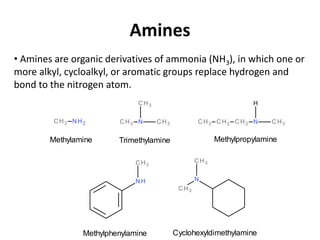
• Amines are organic derivatives of ammonia (NH3), in which one or
more alkyl, cycloalkyl, or aromatic groups replace hydrogen and
bond to the nitrogen atom.
Methylamine Trimethylamine Methylpropylamine
Methylphenylamine Cyclohexyldimethylamine
Classification of Amines
 Classified as primary, secondary and tertiary
[according to the number of groups attached to the
nitrogen atom].
1o amine 2o amine 3o amine
Nomenclature for amines
• Common and IUPAC systems are used extensively for naming
amines.
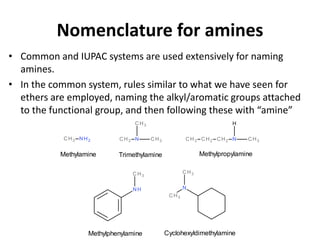
• In the common system, rules similar to what we have seen for
ethers are employed, naming the alkyl/aromatic groups attached
to the functional group, and then following these with “amine”
Methylamine Trimethylamine Methylpropylamine
Methylphenylamine Cyclohexyldimethylamine
Nomenclature for amines
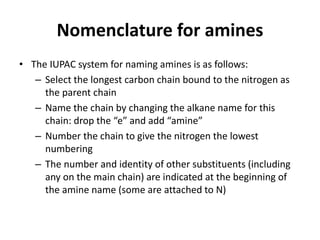
• The IUPAC system for naming amines is as follows:
– Select the longest carbon chain bound to the nitrogen as
the parent chain
– Name the chain by changing the alkane name for this
chain: drop the “e” and add “amine”
– Number the chain to give the nitrogen the lowest
numbering
– The number and identity of other substituents (including
any on the main chain) are indicated at the beginning of
the amine name (some are attached to N)
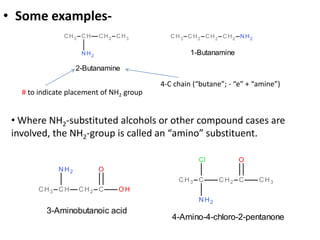
• Some examples-
2-Butanamine
1-Butanamine
# to indicate placement of NH2 group
4-C chain (“butane”; - “e” + “amine”)
3-Aminobutanoic acid
4-Amino-4-chloro-2-pentanone
• Where NH2-substituted alcohols or other compound cases are
involved, the NH2-group is called an “amino” substituent.
Functional group priority
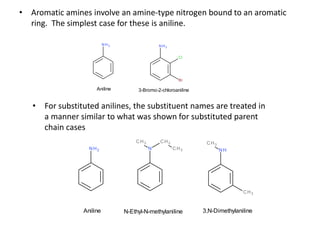
• Aromatic amines involve an amine-type nitrogen bound to an aromatic
ring. The simplest case for these is aniline.
Aniline 3-Bromo-2-chloroaniline
• For substituted anilines, the substituent names are treated in
a manner similar to what was shown for substituted parent
chain cases
Aniline 3,N-DimethylanilineN-Ethyl-N-methylaniline
Physical properties of amines
• Amines tend to be gases for low molecular weight cases (e.g.
up to (CH3)3N, trimethylamine) and many heavier ones are
liquids at room temperature.
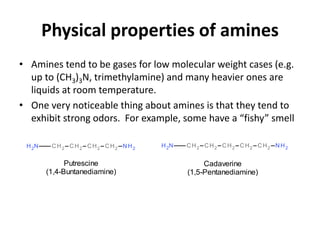
• One very noticeable thing about amines is that they tend to
exhibit strong odors. For example, some have a “fishy” smell
Cadaverine
(1,5-Pentanediamine)
Putrescine
(1,4-Buntanediamine)
Physical properties of amines
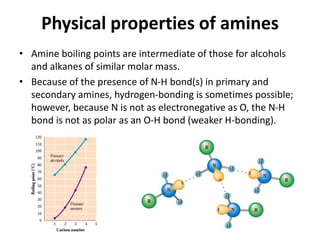
• Amine boiling points are intermediate of those for alcohols
and alkanes of similar molar mass.
• Because of the presence of N-H bond(s) in primary and
secondary amines, hydrogen-bonding is sometimes possible;
however, because N is not as electronegative as O, the N-H
bond is not as polar as an O-H bond (weaker H-bonding).
Physical properties of amines
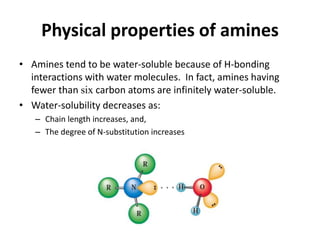
• Amines tend to be water-soluble because of H-bonding
interactions with water molecules. In fact, amines having
fewer than six carbon atoms are infinitely water-soluble.
• Water-solubility decreases as:
– Chain length increases, and,
– The degree of N-substitution increases
Chemical reaction of Amines
• Amines are similar to ammonia in their reactions.
• Like ammonia, amines are basic.
• Like ammonia, amines are nucleophilic and react with alkyl
halides, acid chlorides, and carbonyl compounds.
• The aromatic amines are highly reactive in electrophilic
aromatic substitution.
Amine gives this Chemical reactions:
1. As bases
2. Alkylation
3. Conversion into amides
4. Hofmann elimination from quaternary ammonium salts
5. Reactions with nitrous acid
6. Carbylamines Reaction
7. Oxidation of Amines
8. Substitution in Benzene ring of Aniline
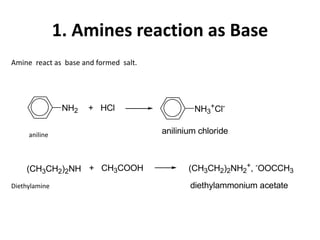
NH2 + HCl NH3
+
Cl-
(CH3CH2)2NH + CH3COOH (CH3CH2)2NH2
+
, -
OOCCH3
anilinium chloride
diethylammonium acetate
1. Amines reaction as Base
Amine react as base and formed salt.
aniline
Diethylamine
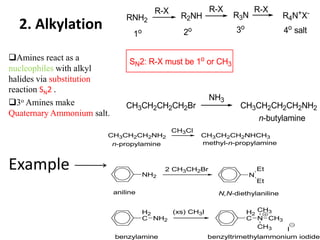
2. Alkylation
RNH2
R-X
R2NH
R-X
R3N
R-X
R4N+X-
1o 2o 3o
4o salt
SN2: R-X must be 1o or CH3
CH3CH2CH2CH2Br
NH3
CH3CH2CH2CH2NH2
n-butylamine
Amines react as a
nucleophiles with alkyl
halides via substitution
reaction SN2 .
3o Amines make
Quaternary Ammonium salt.
Example
CH3CH2CH2NH2
CH3Cl
CH3CH2CH2NHCH3
n-propylamine methyl-n-propylamine
NH2
2 CH3CH2Br
N
Et
Et
aniline N,N-diethylaniline
H2
C NH2
benzylamine
(xs) CH3I H2
C N
CH3
CH3
CH3 I
benzyltrimethylammonium iodide
R-NH2 + RCOCl  RCONHR + HCl
1o N-substituted. amide
R2NH + RCOCl  RCONR2 + HCl
2o N,N-disubstituted. amide
R3N + RCOCl  No reaction
[ cause No Substitution Hydrogen]
3o
3. Conversion into Amide
NH2 + (CH3CO)2O
H
N C CH3
O
N-phenylacetamide
C
O
Cl
(CH3CH2)2NH + C
O
N CH2CH3
CH2CH3
N.N-diethyl-m-toluamide
N CH3
CH3
+ CH3C
O
Cl
NR
H3C H3C
DEET
Example
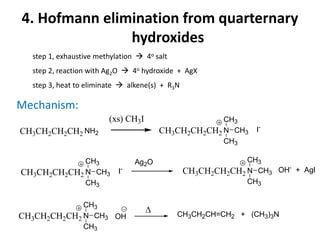
4. Hofmann elimination from quarternary
hydroxides
step 1, exhaustive methylation  4o salt
step 2, reaction with Ag2O  4o hydroxide + AgX
step 3, heat to eliminate  alkene(s) + R3N
Mechanism:
CH3CH2CH2CH2
(xs) CH3I
CH3CH2CH2CH2NH2 N
CH3
CH3
CH3 I-
CH3CH2CH2CH2 N
CH3
CH3
CH3 I-
Ag2O
CH3CH2CH2CH2 N
CH3
CH3
CH3 OH-
+ AgI
CH3CH2CH2CH2 N
CH3
CH3
CH3 OH
 CH3CH2CH=CH2 + (CH3)3N
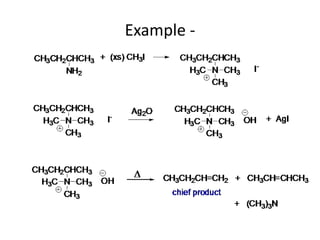
Example -
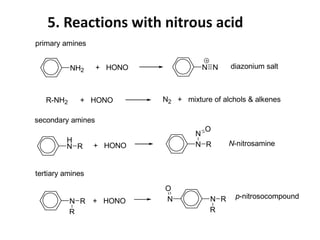
5. Reactions with nitrous acid
NH2 + HONO N N diazonium salt
R-NH2 + HONO N2 + mixture of alchols & alkenes
primary amines
secondary amines
H
N R + HONO N R
N
O
N-nitrosamine
tertiary amines
N R
R
+ HONO N R
R
N
O
p-nitrosocompound
6. Carbylamine reaction
• Primary amine reaction with CHCl3 and KOH under the 60 0-70 0 degree temperature.
Then isocyanide[Carbyl-amine] with unpleasent smell found.
• Aliphatic Amine-
• Aromatic Amine-
• Secondary and tertiary amines have no reaction.
7. Oxidation of Amines
Oxidation with KMnO4 : H
• CH3-CH2-NH2 + [O] H2SO4
KMnO4 CH3-CH=NH H+ CH3-C=O +NH3
ethylamine ethanal
Primary aliphatic amines oxidation by KMnO4 and produce ethanal.
Oxidation with H2O2 :
-NH2 + 3 H2O2 -NO2 + 4H2O
Aniline oxidation with hydrogen peroxide; produce nitro benzene and water.
8. Substitution in Benzene ring of Aniline
• In benzene ring , amine group increase the density of Electron at Ortho,
pera position. So the next group will attach to the benzene ring at the
Ortho, pera position.
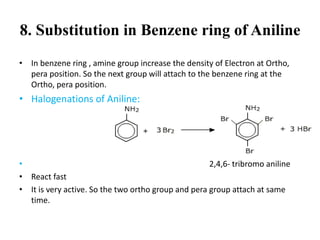
• Halogenations of Aniline:
• 2,4,6- tribromo aniline
• React fast
• It is very active. So the two ortho group and pera group attach at same
time.
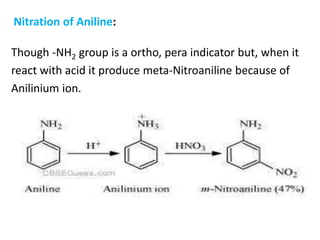
Nitration of Aniline:
Though -NH2 group is a ortho, pera indicator but, when it
react with acid it produce meta-Nitroaniline because of
Anilinium ion.
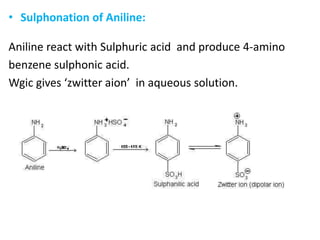
• Sulphonation of Aniline:
Aniline react with Sulphuric acid and produce 4-amino
benzene sulphonic acid.
Wgic gives ‘zwitter aion’ in aqueous solution.
Thank
you
Everyone.

Amines.

  • 1.
  • 2.
    Amines • Amines areorganic derivatives of ammonia (NH3), in which one or more alkyl, cycloalkyl, or aromatic groups replace hydrogen and bond to the nitrogen atom. Methylamine Trimethylamine Methylpropylamine Methylphenylamine Cyclohexyldimethylamine
  • 3.
    Classification of Amines Classified as primary, secondary and tertiary [according to the number of groups attached to the nitrogen atom]. 1o amine 2o amine 3o amine
  • 4.
    Nomenclature for amines •Common and IUPAC systems are used extensively for naming amines. • In the common system, rules similar to what we have seen for ethers are employed, naming the alkyl/aromatic groups attached to the functional group, and then following these with “amine” Methylamine Trimethylamine Methylpropylamine Methylphenylamine Cyclohexyldimethylamine
  • 5.
    Nomenclature for amines •The IUPAC system for naming amines is as follows: – Select the longest carbon chain bound to the nitrogen as the parent chain – Name the chain by changing the alkane name for this chain: drop the “e” and add “amine” – Number the chain to give the nitrogen the lowest numbering – The number and identity of other substituents (including any on the main chain) are indicated at the beginning of the amine name (some are attached to N)
  • 6.
    • Some examples- 2-Butanamine 1-Butanamine #to indicate placement of NH2 group 4-C chain (“butane”; - “e” + “amine”) 3-Aminobutanoic acid 4-Amino-4-chloro-2-pentanone • Where NH2-substituted alcohols or other compound cases are involved, the NH2-group is called an “amino” substituent.
  • 7.
  • 8.
    • Aromatic aminesinvolve an amine-type nitrogen bound to an aromatic ring. The simplest case for these is aniline. Aniline 3-Bromo-2-chloroaniline • For substituted anilines, the substituent names are treated in a manner similar to what was shown for substituted parent chain cases Aniline 3,N-DimethylanilineN-Ethyl-N-methylaniline
  • 9.
    Physical properties ofamines • Amines tend to be gases for low molecular weight cases (e.g. up to (CH3)3N, trimethylamine) and many heavier ones are liquids at room temperature. • One very noticeable thing about amines is that they tend to exhibit strong odors. For example, some have a “fishy” smell Cadaverine (1,5-Pentanediamine) Putrescine (1,4-Buntanediamine)
  • 10.
    Physical properties ofamines • Amine boiling points are intermediate of those for alcohols and alkanes of similar molar mass. • Because of the presence of N-H bond(s) in primary and secondary amines, hydrogen-bonding is sometimes possible; however, because N is not as electronegative as O, the N-H bond is not as polar as an O-H bond (weaker H-bonding).
  • 11.
    Physical properties ofamines • Amines tend to be water-soluble because of H-bonding interactions with water molecules. In fact, amines having fewer than six carbon atoms are infinitely water-soluble. • Water-solubility decreases as: – Chain length increases, and, – The degree of N-substitution increases
  • 12.
    Chemical reaction ofAmines • Amines are similar to ammonia in their reactions. • Like ammonia, amines are basic. • Like ammonia, amines are nucleophilic and react with alkyl halides, acid chlorides, and carbonyl compounds. • The aromatic amines are highly reactive in electrophilic aromatic substitution.
  • 13.
    Amine gives thisChemical reactions: 1. As bases 2. Alkylation 3. Conversion into amides 4. Hofmann elimination from quaternary ammonium salts 5. Reactions with nitrous acid 6. Carbylamines Reaction 7. Oxidation of Amines 8. Substitution in Benzene ring of Aniline
  • 14.
    NH2 + HClNH3 + Cl- (CH3CH2)2NH + CH3COOH (CH3CH2)2NH2 + , - OOCCH3 anilinium chloride diethylammonium acetate 1. Amines reaction as Base Amine react as base and formed salt. aniline Diethylamine
  • 15.
    2. Alkylation RNH2 R-X R2NH R-X R3N R-X R4N+X- 1o 2o3o 4o salt SN2: R-X must be 1o or CH3 CH3CH2CH2CH2Br NH3 CH3CH2CH2CH2NH2 n-butylamine Amines react as a nucleophiles with alkyl halides via substitution reaction SN2 . 3o Amines make Quaternary Ammonium salt. Example CH3CH2CH2NH2 CH3Cl CH3CH2CH2NHCH3 n-propylamine methyl-n-propylamine NH2 2 CH3CH2Br N Et Et aniline N,N-diethylaniline H2 C NH2 benzylamine (xs) CH3I H2 C N CH3 CH3 CH3 I benzyltrimethylammonium iodide
  • 16.
    R-NH2 + RCOCl RCONHR + HCl 1o N-substituted. amide R2NH + RCOCl  RCONR2 + HCl 2o N,N-disubstituted. amide R3N + RCOCl  No reaction [ cause No Substitution Hydrogen] 3o 3. Conversion into Amide NH2 + (CH3CO)2O H N C CH3 O N-phenylacetamide C O Cl (CH3CH2)2NH + C O N CH2CH3 CH2CH3 N.N-diethyl-m-toluamide N CH3 CH3 + CH3C O Cl NR H3C H3C DEET Example
  • 17.
    4. Hofmann eliminationfrom quarternary hydroxides step 1, exhaustive methylation  4o salt step 2, reaction with Ag2O  4o hydroxide + AgX step 3, heat to eliminate  alkene(s) + R3N Mechanism: CH3CH2CH2CH2 (xs) CH3I CH3CH2CH2CH2NH2 N CH3 CH3 CH3 I- CH3CH2CH2CH2 N CH3 CH3 CH3 I- Ag2O CH3CH2CH2CH2 N CH3 CH3 CH3 OH- + AgI CH3CH2CH2CH2 N CH3 CH3 CH3 OH  CH3CH2CH=CH2 + (CH3)3N
  • 18.
  • 19.
    5. Reactions withnitrous acid NH2 + HONO N N diazonium salt R-NH2 + HONO N2 + mixture of alchols & alkenes primary amines secondary amines H N R + HONO N R N O N-nitrosamine tertiary amines N R R + HONO N R R N O p-nitrosocompound
  • 20.
    6. Carbylamine reaction •Primary amine reaction with CHCl3 and KOH under the 60 0-70 0 degree temperature. Then isocyanide[Carbyl-amine] with unpleasent smell found. • Aliphatic Amine- • Aromatic Amine- • Secondary and tertiary amines have no reaction.
  • 21.
    7. Oxidation ofAmines Oxidation with KMnO4 : H • CH3-CH2-NH2 + [O] H2SO4 KMnO4 CH3-CH=NH H+ CH3-C=O +NH3 ethylamine ethanal Primary aliphatic amines oxidation by KMnO4 and produce ethanal. Oxidation with H2O2 : -NH2 + 3 H2O2 -NO2 + 4H2O Aniline oxidation with hydrogen peroxide; produce nitro benzene and water.
  • 22.
    8. Substitution inBenzene ring of Aniline • In benzene ring , amine group increase the density of Electron at Ortho, pera position. So the next group will attach to the benzene ring at the Ortho, pera position. • Halogenations of Aniline: • 2,4,6- tribromo aniline • React fast • It is very active. So the two ortho group and pera group attach at same time.
  • 23.
    Nitration of Aniline: Though-NH2 group is a ortho, pera indicator but, when it react with acid it produce meta-Nitroaniline because of Anilinium ion.
  • 24.
    • Sulphonation ofAniline: Aniline react with Sulphuric acid and produce 4-amino benzene sulphonic acid. Wgic gives ‘zwitter aion’ in aqueous solution.
  • 25.